icl Singapore

ICL Surgery in Singapore

Implantable Collamer Lens, or ICL surgery, is a form of vision correction in which a specially designed lens is implanted inside the eye to correct myopia and astigmatism.

Unlike LASIK, SMILE or PRK, ICL surgery does not require removal of corneal tissue. This makes it an important vision correction option for people with higher degrees of myopia, thinner corneas, dry eyes, or other factors that may make corneal laser surgery less suitable.

As a cataract and refractive surgeon, Dr Val Phua provides assessment for ICL and other vision correction procedures in Singapore. The aim of the assessment is not simply to determine whether ICL can be performed, but to identify which option is most appropriate for the individual eye, prescription and lifestyle.

What is ICL?

ICL stands for Implantable Collamer Lens.

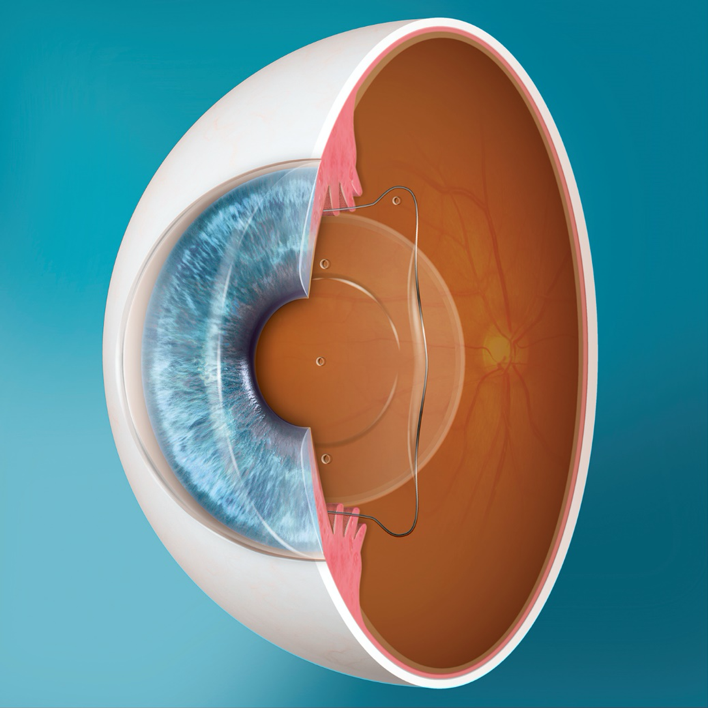
The lens is placed inside the eye, behind the iris and in front of the natural crystalline lens. Once positioned, it works together with the eye’s own optical system to focus light more accurately onto the retina.

The ICL is not visible to other people and generally cannot be felt once it is inside the eye.

Unlike a contact lens, it does not sit on the surface of the eye.

Unlike LASIK or SMILE, it does not reshape the cornea.

Who may be suitable for ICL?

ICL may be considered for adults with myopia, with or without astigmatism, who would like to reduce their dependence on glasses or contact lenses.

It can be particularly useful in people with:
● Moderate to high myopia
● Thin or borderline corneas
● Corneal characteristics that make laser vision correction less desirable
● Dry eye concerns
● Significant astigmatism
● A preference for a vision correction procedure that does not remove corneal tissue

Suitability cannot be determined from spectacle prescription alone.

A detailed assessment of the cornea, anterior chamber, pupil, retina, eye pressure and internal dimensions of the eye is important before deciding whether ICL is appropriate.

Why choose ICL instead of LASIK or SMILE?

There is no single vision correction procedure that is best for everyone.

LASIK, SMILE, PRK and ICL correct refractive error in different ways.

Laser procedures reshape the cornea. ICL instead places an additional optical lens inside the eye while leaving the central corneal tissue largely unchanged.

For some patients, particularly those with higher myopia or certain corneal characteristics, this can make ICL an attractive alternative.

Potential advantages include:
● No removal of central corneal tissue
● Ability to correct relatively high levels of myopia
● Treatment of astigmatism with Toric ICL
● Less direct impact on corneal nerves than some laser procedures
● The implanted lens can be removed or exchanged if medically necessary

However, ICL is an intraocular operation and therefore has a different risk profile from laser vision correction.

The choice between ICL, LASIK, SMILE and PRK should therefore be based on the anatomy of the eye rather than simply personal preference.

How Dr Val Phua assesses patients for ICL

A successful ICL outcome begins with careful patient selection and accurate pre-operative measurements.

During an ICL assessment, several factors may be considered.

Your prescription

The amount of myopia and astigmatism helps determine whether ICL is an appropriate option and which lens power may be required.

Anterior chamber anatomy

Measurements of the space inside the front of the eye help determine whether there is sufficient room for an ICL.

Retina

Patients with significant myopia have a higher lifetime risk of certain retinal conditions.

A retinal examination is therefore an important component of refractive surgery assessment, particularly in people with high myopia.

Corneal shape and thickness

Corneal tomography helps assess the structure and shape of the cornea.

Even though ICL does not reshape the cornea, understanding corneal anatomy remains important when comparing ICL with laser vision correction.

ICL sizing

Choosing the appropriate ICL size is an important part of surgery.

After implantation, the lens should sit an appropriate distance in front of the natural crystalline lens. This distance is commonly referred to as the vault.

Lifestyle and visual requirements

Occupation, sports, night driving, screen use and expectations from surgery may all influence the choice of refractive procedure.

The objective is not simply to determine whether an operation is technically possible, but to select the option that offers the most appropriate balance of visual outcome, safety and long-term considerations.

What is Toric ICL?

Patients who have both myopia and significant astigmatism may be suitable for a Toric ICL.

A Toric ICL corrects both spherical refractive error and astigmatism.

Because astigmatism correction depends on the orientation of the lens, accurate positioning of the Toric ICL is important.

Its rotational position is checked after surgery and during follow-up.

What happens during ICL surgery?

ICL surgery is usually performed as a short day procedure.

A small incision is created at the edge of the cornea. The folded ICL is inserted through this opening and positioned behind the iris.

The lens then unfolds into its intended position.

The incision is small and usually does not require sutures.

Patients are typically reviewed after surgery to assess vision, intraocular pressure, lens position and ICL vault.

ICL recovery

Vision often improves quickly following ICL surgery, although the speed of recovery varies between individuals.

During the early postoperative period, patients may experience:
● Mild blurring
● Light sensitivity
● Halos or glare
● Mild discomfort or foreign-body sensation
● Fluctuation in vision

Eye drops are prescribed after surgery, and follow-up visits are important to monitor healing, eye pressure and ICL position.

Most patients can return progressively to normal daily activities, although specific restrictions may apply during the early recovery period.

Is ICL safe?

ICL surgery has been performed internationally for many years and has a well-established role in modern refractive surgery.

However, like any intraocular procedure, it is not without risk.

Potential complications can include:
● Infection
● Raised intraocular pressure
● Inflammation
● Cataract formation
● An inappropriate ICL vault
● Rotation of a Toric ICL
● Need for repositioning, exchange or removal of the lens
● Rare sight-threatening complications

Careful pre-operative assessment, appropriate lens sizing, meticulous surgery and postoperative monitoring are therefore important parts of ICL treatment.

Can an ICL be removed?

One difference between ICL and corneal laser surgery is that the implanted lens can be surgically removed.

This does not mean that ICL surgery should be viewed as temporary or casually reversible. Any additional intraocular procedure carries its own risks.

However, the ability to remove or exchange the lens can be useful if there is a medical reason to do so.

What happens to the ICL when I develop cataracts?

ICL surgery does not prevent the natural lens of the eye from ageing.

Most people will eventually develop some degree of cataract as they grow older.

If cataract surgery becomes necessary in the future, the ICL can generally be removed as part of the surgical planning before the cataractous natural lens is replaced with an intraocular lens.

Having undergone ICL surgery therefore does not prevent future cataract treatment.

ICL versus LASIK, SMILE and PRK

The main refractive surgery options work in different ways.

LASIK reshapes the cornea beneath a thin corneal flap.

SMILE removes a small lenticule of corneal tissue through a small incision.

PRK and TransPRK reshape the surface of the cornea without creating a flap.

ICL places an additional lens inside the eye without using a laser to reshape the central cornea.

Each procedure has advantages and disadvantages.

For this reason, refractive surgery assessment is best approached as a comparison between suitable options rather than deciding on a particular procedure before the eyes have been examined.

Dr Val Phua and ICL surgery

Dr Val Phua is a Senior Consultant Ophthalmologist and cataract and refractive surgeon in Singapore.

His refractive surgery practice includes ICL, LASIK, SMILE Pro and PRK, allowing patients to be assessed across different forms of vision correction rather than being limited to a single procedure.

His approach to ICL emphasises detailed pre-operative evaluation, lens sizing, assessment of postoperative vault and appropriate follow-up.

Frequently asked questions about ICL

Is ICL painful?

ICL surgery is performed with anaesthetic eye drops. Patients may notice pressure, bright lights or mild discomfort during the procedure, but significant pain is uncommon.

Can ICL correct very high myopia?

ICL is particularly useful for moderate and high degrees of myopia where corneal laser treatment may be less suitable.

The degree that can be treated depends on the individual eye and available lens powers.

Does ICL cause dry eyes?

Because ICL does not require significant reshaping of the cornea, it generally has less direct effect on the corneal nerves than some corneal laser procedures.

However, patients can still experience dry-eye symptoms for other reasons.

Can ICL correct astigmatism?

Yes. Toric ICLs are designed to correct myopia together with astigmatism in suitable patients.

Will I still need glasses after ICL?

The aim is to reduce dependence on glasses or contact lenses, but no refractive procedure can guarantee complete spectacle independence.

Small residual prescriptions can occasionally remain.

How long does an ICL last?

The lens is designed to remain inside the eye long term unless there is a reason for it to be removed or exchanged.

Can I exercise after ICL surgery?

Light activities can usually be resumed relatively quickly, while swimming, strenuous exercise, contact sports and other activities may need to be avoided for a period after surgery.

Your surgeon will advise when specific activities can safely be resumed.

Learn more about ICL

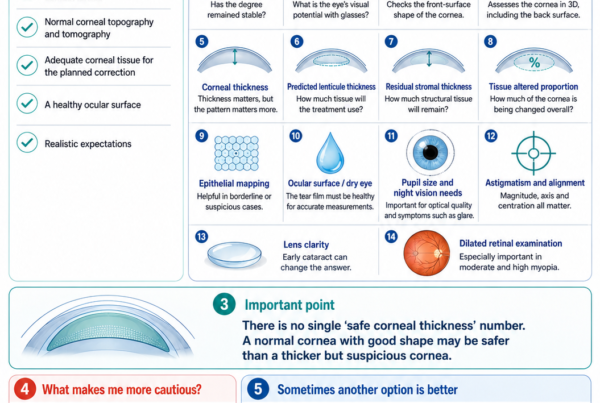
Who Is Suitable for SMILE Pro? The Measurements I Assess Before Recommending Treatment

Learn how suitability for SMILE Pro is assessed, including prescription stability, corneal tomography, thickness, residual stroma, dry eye and retinal health. Article Excerpt
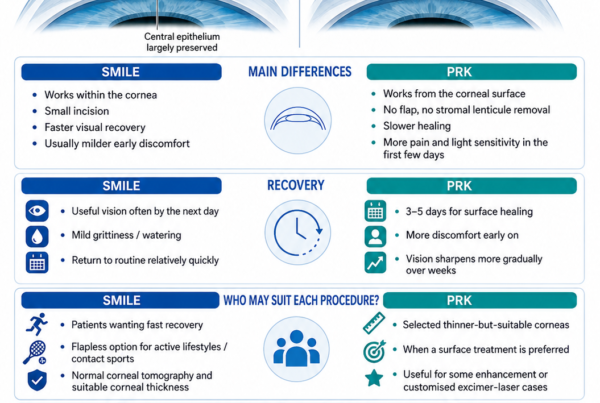
SMILE vs PRK: Recovery, Suitability and the Differences Between Two Flapless Techniques

Compare SMILE vs PRK for recovery, pain, dry eye, corneal strength, haze, suitability and visual results—and learn which flapless procedure may suit you.
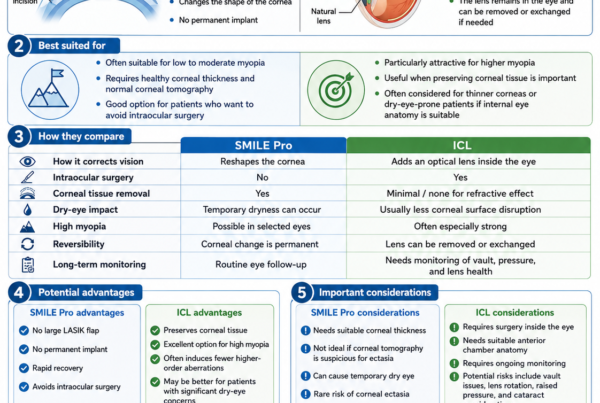
SMILE Pro vs ICL: How Corneal Laser Surgery Compares with an Implantable Lens

Compare SMILE Pro vs ICL for myopia, visual quality, dry eye, recovery and safety—and learn when corneal laser surgery or an implantable lens may be better.
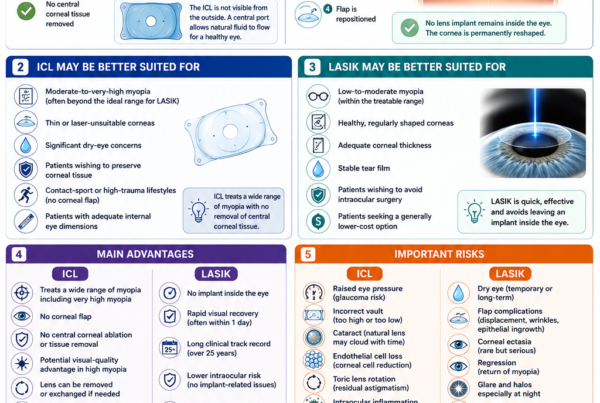
ICL vs LASIK: Which Vision Correction Surgery Is Better?

Compare ICL vs LASIK for myopia and astigmatism. Learn how they differ in suitability, visual quality, dry eye, risks, recovery and long-term care.
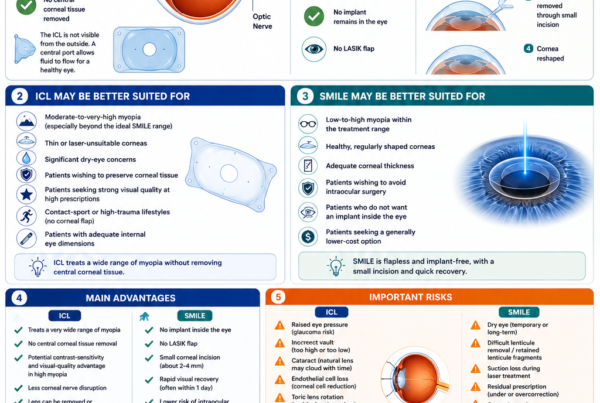
ICL vs SMILE: Which Vision Correction Surgery Is Better?

Compare ICL vs SMILE for myopia and astigmatism. Learn how they differ in suitability, visual quality, dry eye, risks, recovery and long-term care.
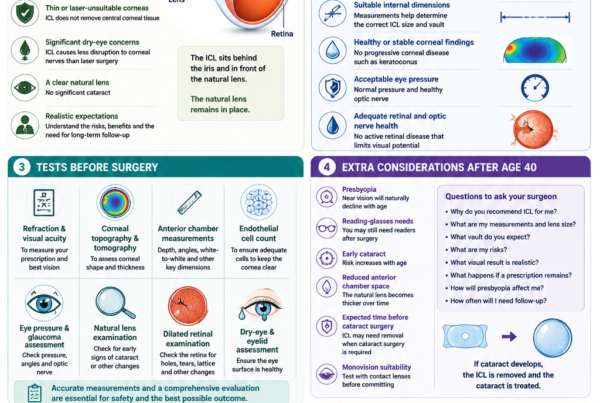
Who Is Suitable for ICL Surgery?

Find out who is suitable for ICL surgery, including the ideal prescription, age, corneal and internal eye requirements, and reasons someone may not qualify.
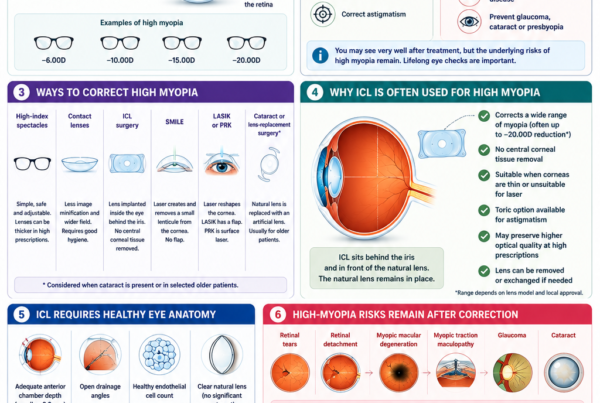
Can High Myopia Be Corrected? Understanding ICL and Other Treatment Options

High myopia can be corrected with glasses, contact lenses, ICL or laser surgery, but the elongated eye and retinal risks remain. Learn which option may be suitable.
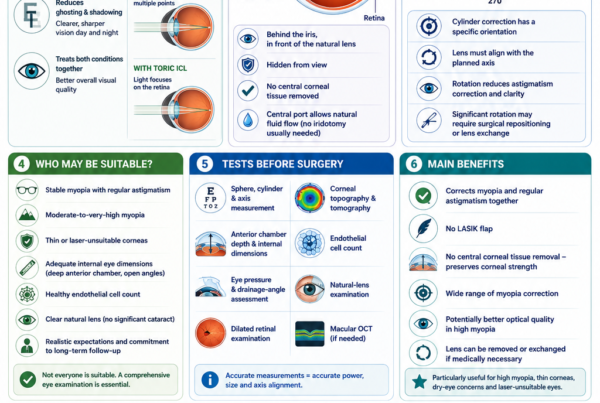
Toric ICL Explained: How It Corrects Myopia and Astigmatism

Toric ICL surgery corrects myopia and astigmatism with a lens implanted behind the iris. Learn how it works, who is suitable, rotation risks and recovery.
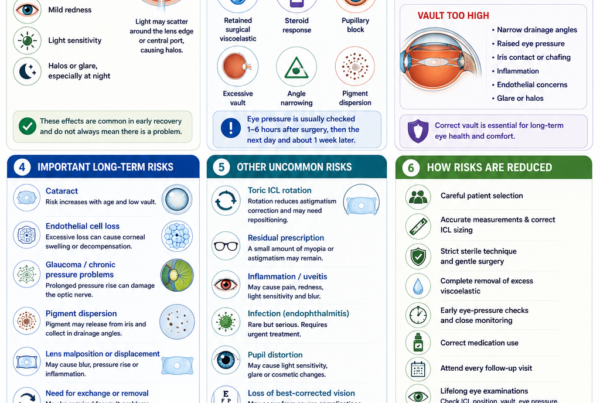
ICL Surgery Risks: Side Effects, Complications and Long-Term Safety

Learn about ICL surgery risks, including eye-pressure changes, cataract, incorrect vault, endothelial cell loss, halos, infection and additional surgery.
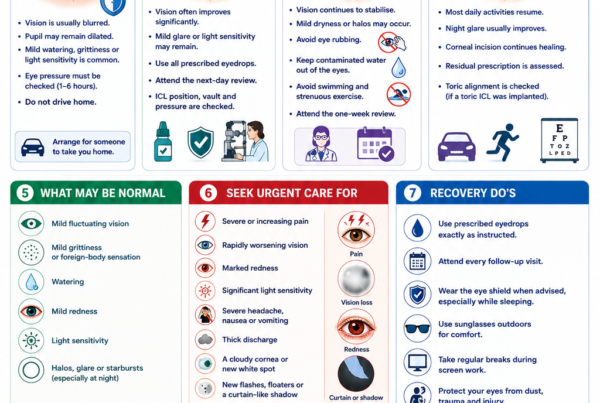
Recovery After ICL Surgery: A Day-by-Day Guide

Learn what to expect after ICL surgery, including the recovery timeline, eyedrops, driving, work, exercise, swimming and symptoms needing urgent care.
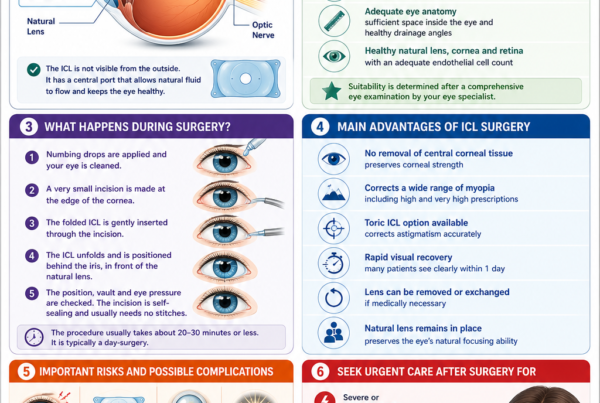
What Is ICL Surgery? Benefits, Risks, Recovery and Who Is Suitable

ICL surgery corrects myopia and astigmatism by implanting a lens inside the eye. Learn how it works, who is suitable, its benefits, risks and recovery.
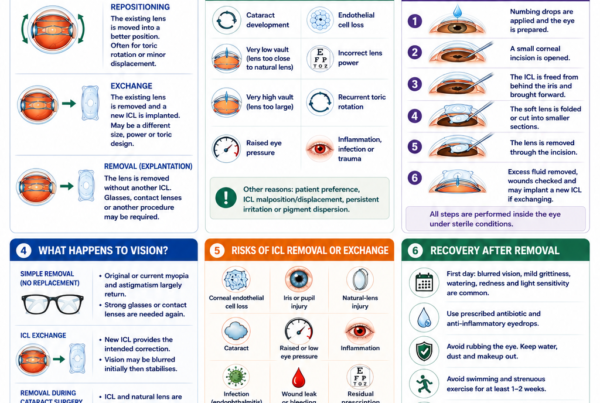
Can an ICL Be Removed? ICL Removal, Exchange and Reversibility Explained

An ICL can usually be removed, and uncomplicated removal largely restores the eye to its preoperative state. Learn about exchange, risks and recovery.
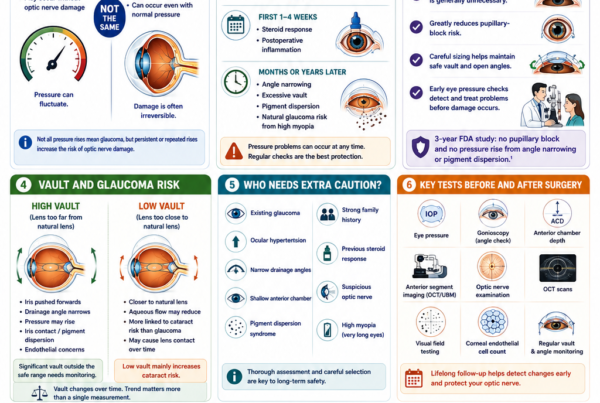
Does ICL Increase Glaucoma Risk? Eye Pressure, Warning Signs and Long-Term Monitoring

ICL does not commonly cause glaucoma, but eye pressure can rise after surgery. Learn about steroid response, high vault, angle narrowing and monitoring.
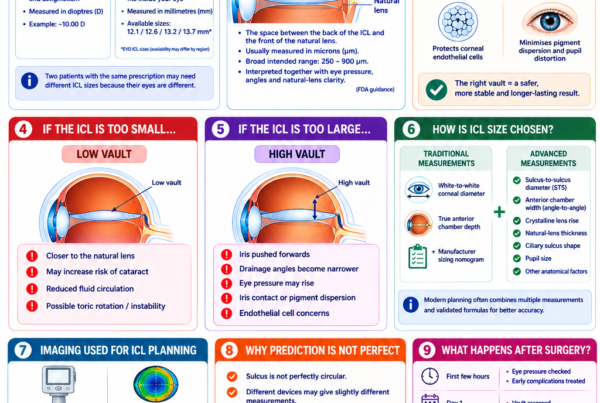
ICL Sizing Explained: How the Correct Lens Size and Vault Are Chosen

Learn how ICL size is chosen using white-to-white, anterior chamber depth, OCT and sulcus measurements, and why correct vault is important.
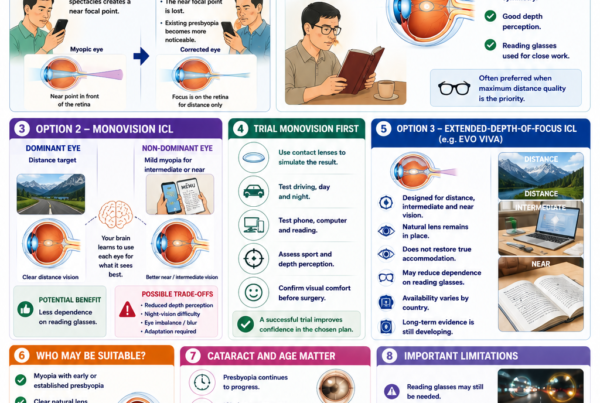
Can ICL Treat Presbyopia? Monovision, Extended-Depth-of-Focus Lenses and Reading Vision

Standard ICL does not cure presbyopia, but monovision or an extended-depth-of-focus ICL may reduce the need for reading glasses.


Considering vision correction?

Choosing between ICL, LASIK, SMILE and PRK depends on more than your spectacle prescription.

A comprehensive refractive assessment can determine which procedures are suitable for your eyes and help you understand the advantages, limitations and risks of each option.

eye doctor singapore

Enquiry