Author: Dr Val Phua
Estimated reading time: 22 minutes
SMILE and PRK are both forms of flapless laser vision correction.
Neither creates the large hinged corneal flap used in LASIK.
That similarity sometimes leads patients to assume that SMILE and PRK are essentially the same operation.
They are not.
They reshape the cornea in fundamentally different ways.
With SMILE:
- A femtosecond laser creates a thin lens-shaped piece of tissue called a lenticule within the corneal stroma.
- A small peripheral incision is created.
- The surgeon removes the lenticule through this opening.
- The corneal epithelium remains largely intact.
With PRK:
- The central corneal epithelium is removed.
- An excimer laser directly reshapes the anterior corneal stroma.
- A bandage contact lens is placed.
- The epithelium must regenerate over the following several days.
The difference explains many of the practical contrasts between the procedures.
SMILE generally offers:
- Less early discomfort
- Faster functional visual recovery
- No large epithelial wound
- No postoperative corneal-haze mechanism identical to PRK
PRK generally offers:
- A very superficial treatment
- No flap
- No deep lenticule-dissection plane
- Greater flexibility for customised excimer-laser treatments
- Potential advantages in selected thinner corneas
- A well-established role in surface enhancements and irregular corneal optical treatments
Modern studies show that both procedures can produce excellent final visual and refractive outcomes.
A 2026 meta-analysis comparing TransPRK with SMILE found no statistically significant difference in overall efficacy or safety, while predictability was broadly comparable. The authors concluded that procedure selection should be based more on patient characteristics, complication risk, available technology and surgeon experience than on the assumption that one technique is universally superior.
A direct randomised contralateral-eye trial comparing PRK and SMILE similarly found comparable:
- Safety
- Efficacy
- Contrast sensitivity
- Higher-order aberrations
at 18 months.
The important difference was early recovery: at one month, the PRK eyes reported worse vision and greater foreign-body sensation than the SMILE eyes.
The central message is:
SMILE and PRK can both provide excellent final vision. SMILE generally wins on comfort and speed of recovery, while PRK remains extremely valuable when a superficial, highly customisable corneal treatment is preferable.
The Quick Answer
What Is the Main Difference Between SMILE and PRK?
SMILE works inside the cornea.
PRK works from the surface of the cornea.
SMILE creates and removes an internal stromal lenticule through a small incision.
PRK removes the epithelium and uses an excimer laser directly on the anterior stromal surface.
Are Both Truly Flapless?
Yes.
Neither creates a LASIK flap.
However, “flapless” does not mean the operations affect the cornea in the same way.
SMILE creates:
- An internal lenticule
- An overlying corneal cap
- A small access incision
PRK creates:
- A large temporary epithelial defect
- A superficial stromal ablation
The healing biology is therefore very different.
Which Has Faster Recovery?
SMILE.
This is probably the most obvious difference for patients.
After SMILE, many patients have useful vision by the following day.
After PRK:
- The epithelium must regrow.
- Pain and light sensitivity are common for several days.
- A bandage contact lens is required.
- Vision improves more gradually over the following weeks.
Direct comparison studies show better early visual quality after SMILE, while the difference generally diminishes with time.
Which Is More Painful?
PRK.
SMILE generally causes relatively mild:
- Grittiness
- Watering
- Light sensitivity
- Irritation
during early recovery.
PRK commonly produces:
- Burning
- Stinging
- Significant tearing
- Foreign-body sensation
- Light sensitivity
particularly during the first 24 to 72 hours.
The pain improves as the epithelium closes.
Which Gives Better Final Vision?
For appropriately selected patients:
both can give excellent final vision.
A recent meta-analysis found no significant overall difference in efficacy between TransPRK and SMILE.
A 2025 study comparing low myopia treated with PRK or SMILE likewise found:
- Similar refractive outcomes
- Similar corrected visual acuity
- Similar overall corneal higher-order aberrations
at six months.
Which Is Better for Thin Corneas?
Sometimes PRK.
But this requires careful explanation.
PRK removes tissue from the anterior surface without creating:
- A LASIK flap
- A relatively deep SMILE cap plane
This can make it attractive when the available corneal tissue is limited.
However:
A thin or suspicious cornea is not automatically safe for PRK.
The surgeon must still assess:
- Corneal tomography
- Thickness distribution
- Posterior elevation
- Degree of refractive correction
- Ectasia risk
An eye with keratoconus or suspicious ectatic features may be unsuitable for both procedures.
Which Is Better for Contact Sports?
Both are attractive because neither leaves a LASIK flap.
For:
- Boxing
- Martial arts
- Rugby
- Military activity
- High-impact occupations
both SMILE and PRK remove the concern of late traumatic LASIK flap displacement.
SMILE has the practical advantage of faster recovery.
PRK has decades of use in environments where avoidance of a flap is important.
Which Causes Less Dry Eye?
Both can cause temporary dryness.
SMILE preserves the central epithelium and uses a relatively small incision, so it generally disrupts fewer superficial corneal nerves than larger-incision refractive procedures. Reviews also suggest less corneal denervation after SMILE than after PRK or LASIK, although the direct SMILE-versus-PRK dry-eye evidence is smaller than the extensive SMILE-versus-LASIK literature.
PRK initially removes:
- Epithelium
- Superficial nerve endings
so temporary changes in:
- Corneal sensitivity
- Tear-film regulation
- Dry-eye symptoms
may occur during healing.
Neither procedure should be used as a substitute for treating significant pre-existing dry-eye disease.
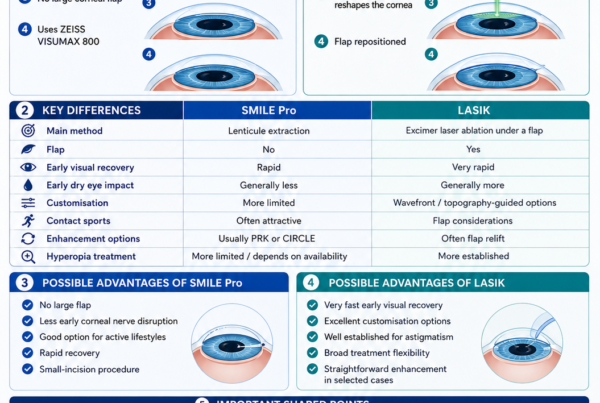
A Note About SMILE Pro
The fundamental comparison in this article applies to both traditional SMILE and newer SMILE Pro.
SMILE Pro uses the newer ZEISS VISUMAX 800 platform.
The principle remains:
- Create a lenticule within the cornea.
- Remove it through a small incision.
The newer platform improves the delivery of the treatment through:
- Faster lenticule creation
- Centration assistance
- Cyclotorsion compensation for astigmatism
Singapore National Eye Centre currently describes SMILE Pro as a small-incision, flapless treatment with lenticule creation in under approximately 10 seconds using the VISUMAX 800.
The comparison with PRK therefore remains biologically the same:
SMILE Pro = internal lenticule extraction.
PRK = surface excimer-laser ablation.
How SMILE Works
Step 1: Anaesthetic Drops
The eye is numbed using topical anaesthetic.
The patient remains awake.
Step 2: The Eye Is Docked to the Femtosecond Laser
The eye is aligned beneath the laser.
Gentle suction stabilises the cornea.
Step 3: The Lenticule Is Created
The femtosecond laser creates:
- A posterior lenticule surface
- An anterior lenticule surface
- A lenticule edge
- A small access incision
Step 4: The Surgeon Separates the Lenticule
Fine instruments are passed through the incision.
The surgeon separates the lenticule from the surrounding stromal tissue.
Step 5: The Lenticule Is Removed
The lenticule is extracted through the small incision.
This alters the curvature of the cornea.
For myopia, the central cornea becomes flatter.
Step 6: The Small Incision Heals
No stitches are normally required.
The central epithelium has not been removed, so there is no large epithelial defect requiring several days to close.
How PRK Works
Step 1: Anaesthetic Drops
The corneal surface is numbed.
Step 2: The Epithelium Is Removed
The central epithelium may be removed:
- Mechanically
- Using dilute alcohol
- With the excimer laser in TransPRK
Step 3: The Excimer Laser Reshapes the Cornea
The laser directly ablates the anterior corneal stroma.
For myopia, the central cornea is flattened.
Step 4: Mitomycin C May Be Used
In selected cases, mitomycin C is applied briefly to reduce the postoperative wound-healing response and risk of clinically significant haze.
A meta-analysis of 3,536 eyes found strong evidence that mitomycin C reduces both early and late corneal haze after PRK.
Step 5: A Bandage Contact Lens Is Placed
The contact lens:
- Protects the exposed cornea
- Reduces eyelid friction
- Improves comfort
- Supports epithelial healing
It is normally removed after the surgeon confirms that the surface has adequately healed.
What Is TransPRK?
TransPRK is a variation of PRK in which the excimer laser removes both:
- The epithelium
- The underlying stromal tissue
without separate mechanical epithelial removal.
It may be called:
- Transepithelial PRK
- TransPRK
- No-touch PRK
- All-laser surface ablation
A 2025 meta-analysis involving more than 10,000 eyes found no significant difference in overall visual efficacy or safety between TransPRK and conventional PRK, although modern TransPRK may offer workflow and early-recovery advantages depending on the platform.
TransPRK is still PRK biologically.
The surface epithelium is removed and must regenerate.
SMILE vs PRK: At a Glance
| Feature | SMILE / SMILE Pro | PRK / TransPRK |
|---|---|---|
| LASIK flap | No | No |
| Main mechanism | Lenticule extraction | Excimer ablation |
| Central epithelium removed | No | Yes |
| Large epithelial wound | No | Yes, temporary |
| Bandage contact lens | Usually no | Yes |
| Early pain | Usually mild | Greater |
| Visual recovery | Faster | Slower |
| Haze risk | No classic PRK haze response | Recognised risk |
| Mitomycin C | Not routine | Often used when indicated |
| Dry-eye symptoms | Possible | Possible |
| Customised excimer treatment | Limited | Strong advantage |
| Topography-guided treatment | Not in the same way | Available on suitable platforms |
| Contact sports | Attractive | Attractive |
| Enhancement strategy | Often PRK/CIRCLE | Repeat surface treatment may be possible |
| Hyperopia | Platform-dependent | Can be treated on appropriate excimer platforms |
| Ectasia | Rare but possible | Rare but possible |
Recovery: The Biggest Practical Difference
Immediately After SMILE
Patients commonly notice:
- Misty vision
- Mild watering
- Grittiness
- Light sensitivity
Vision is usually already substantially improved.
Immediately After PRK
Vision is also improved compared with unaided preoperative vision, but the eye is commonly:
- Watery
- Sensitive
- Painful
- Hazy
The bandage lens remains in place.
Day 1 After SMILE
Many patients have good functional vision.
Some can:
- Work
- Use screens
- Perform ordinary daily tasks
although vision may still be mildly hazy.
Day 1 After PRK
The first few days are primarily about surface healing.
Patients may experience:
- Significant tearing
- Burning
- Stinging
- Photophobia
- Blurred vision
- Difficulty keeping the eyes open
Days 2–3 After SMILE
Vision commonly continues to sharpen.
Discomfort is usually mild.
Days 2–3 After PRK
This may still be the most uncomfortable part of recovery.
The epithelium is migrating across the treatment zone.
Days 3–5 After PRK
The epithelium commonly closes sufficiently for consideration of bandage-lens removal.
The exact timing varies.
Once epithelial closure occurs:
- Pain usually improves rapidly.
- Light sensitivity reduces.
- Vision may remain blurred.
Week 1 After SMILE
Most patients have:
- Good functional vision
- Little discomfort
Possible remaining symptoms include:
- Dryness
- Mild glare
- Halos
- Slight fluctuation
Week 1 After PRK
Comfort is usually much better.
Vision may still be:
- Variable
- Hazy
- Less crisp
- Sensitive to dry eye
Weeks 2–4
The difference begins narrowing.
SMILE vision usually continues to refine.
PRK vision frequently improves substantially during this period.
A 2024 comparison of SMILE with high-frequency TransPRK found superior unaided acuity and objective optical quality with SMILE at one week and one month, but both achieved excellent visual outcomes by six months.
Three to Six Months
For uncomplicated eyes, final visual outcomes are generally much more similar than the early recovery experience suggests.
A direct 18-month randomised trial found PRK and SMILE comparable in:
- Visual acuity
- Efficacy
- Safety
- Contrast sensitivity
- Wavefront aberrations
despite the more difficult early PRK recovery.
Which Should I Choose if I Need to Return to Work Quickly?
SMILE usually has the advantage.
This may matter if you:
- Cannot take several days off
- Drive for work
- Have high screen demands
- Need predictable early functional vision
- Have an upcoming examination or professional commitment
PRK should not ideally be scheduled immediately before an important event where visual performance is critical.
Pain: SMILE vs PRK
Why PRK Hurts More
Corneal nerves are densely concentrated near the surface.
Removing the epithelium exposes and disturbs these superficial nerve endings.
Until the epithelium closes, this may produce substantial discomfort.
Why SMILE Is Usually More Comfortable
The central epithelial surface remains intact.
The access incision is small.
There is therefore no large exposed central wound.
Does PRK Pain Mean Something Is Wrong?
No.
Pain during the first few days can be part of normal healing.
However, seek prompt assessment for:
- Increasing pain after initial improvement
- Marked redness
- Significant discharge
- Falling vision
- A visible white corneal spot
These may indicate infection or another complication.
Dry Eye
SMILE and Corneal Nerves
SMILE preserves much of the anterior corneal surface.
The small incision transects fewer anterior nerve fibres than a large LASIK flap, and the technique has generally shown favourable early corneal-sensation recovery.
PRK and Corneal Nerves
PRK directly removes the epithelial and subepithelial nerve endings across the treatment zone.
These regenerate over time.
The result may be temporary:
- Reduced corneal sensitivity
- Tear-film instability
- Dryness
- Fluctuating vision
Which Is Better for Someone with Dry Eye?
SMILE may offer a recovery advantage in some patients.
However, significant pre-existing dry-eye disease should be treated before either procedure.
The decision may also depend on:
- Meibomian-gland health
- Allergy
- Contact-lens intolerance
- Screen use
- Corneal anatomy
Corneal Haze: A PRK-Specific Consideration
What Is Haze?
Corneal haze is increased light scattering within the healing anterior stroma.
It results from the corneal wound-healing response after surface ablation.
Symptoms may include:
- Foggy vision
- Glare
- Halos
- Reduced contrast
- Refractive regression
Does SMILE Cause Haze?
SMILE does not produce the same surface-ablation healing response.
Classic postoperative PRK haze is therefore not a characteristic SMILE complication.
Interface-related inflammation can occur after SMILE, but this is a different process.
How Common Is Significant PRK Haze Today?
Clinically important haze is much less common than during the early years of PRK because of:
- Improved laser profiles
- Better postoperative treatment
- More appropriate patient selection
- Mitomycin C
The evidence strongly supports mitomycin C for reducing haze in appropriate PRK treatments.
Who Has Greater Haze Risk?
Risk tends to increase with:
- Greater ablation depth
- Higher myopic correction
- Strong wound-healing response
- Significant UV exposure
- Certain treatment parameters
This is one reason very high myopic corrections are not automatically ideal for PRK.
Corneal Biomechanics: Which Is Stronger?
This is more complicated than marketing slogans suggest.
Because SMILE has no LASIK flap, it is often described as biomechanically strong.
That comparison is most intuitive when SMILE is compared with LASIK.
The comparison with PRK is different.
PRK Is Also Flapless
PRK does not create:
- A LASIK flap
- A deep corneal cap
It removes tissue from the anterior surface.
What Do Direct Studies Show?
A 2025 randomised comparison of PRK and SMILE in low-to-moderate myopia found:
- Comparable visual outcomes
- Comparable epithelial remodelling
- Comparable higher-order aberrations
but several measured biomechanical indices changed more after SMILE.
The authors concluded that PRK demonstrated greater biomechanical stability in their study population.
A separate matched one-year study likewise found a greater residual stromal-bed proportion after PRK and smaller changes in several biomechanical measurements.
Other experimental work has found no significant difference in measured elastic properties between PRK and SMILE.
The responsible conclusion is therefore:
There is no justification for claiming that SMILE is universally biomechanically superior to PRK.
The structural effect depends on:
- Treatment depth
- Cap depth
- Optical zone
- Prescription
- Corneal thickness
- Individual anatomy
Which Removes More Tissue?
This cannot be answered simply from the name of the operation.
The amount and distribution of tissue affected depend on:
- Prescription
- Optical zone
- Transition zone
- SMILE cap parameters
- Minimum lenticule thickness
- Excimer ablation profile
For a particular patient, the surgeon should calculate the actual expected tissue architecture rather than assuming one procedure is automatically more tissue-saving.
Thin Corneas
PRK is often considered when the cornea is too thin for LASIK because it avoids flap creation.
It may also be preferable to SMILE for certain low-to-moderate corrections when a more superficial structural approach is advantageous.
However:
Corneal thickness alone is never enough to establish safety.
A thin cornea with:
- Abnormal posterior elevation
- Inferior steepening
- Abnormal pachymetric progression
- Keratoconus features
may be unsuitable for all routine corneal refractive surgery.
Keratoconus and Ectasia
Can SMILE Cause Ectasia?
Yes, rarely.
Can PRK Cause Ectasia?
Yes, rarely.
A systematic review estimated reported ectasia rates in eyes without identifiable preoperative risk factors at approximately:
- 20 per 100,000 PRK eyes
- 11 per 100,000 SMILE eyes
However, these numbers were calculated from reported cases and estimated surgical volumes rather than a prospective registry, and SMILE had substantially less historical follow-up at the time.
These figures should therefore not be treated as exact individual probabilities.
The most important determinant is good preoperative screening.
Can PRK Be Done if LASIK or SMILE Is Unsafe Because of Keratoconus?
Not simply because it is surface surgery.
Untreated keratoconus is a corneal structural disorder.
Removing tissue from a biomechanically abnormal cornea may worsen instability.
Selected specialised procedures combining topography-guided treatment and cross-linking are a different clinical situation and should not be confused with routine refractive PRK.
Visual Quality
Is One Procedure Sharper?
Not universally.
Visual quality depends on:
- Residual prescription
- Astigmatism
- Treatment centration
- Tear film
- Optical zone
- Pupil size
- Higher-order aberrations
Higher-Order Aberrations
A 2025 comparison of low-myopia PRK and SMILE found no significant difference in overall postoperative corneal aberrations.
In moderate-to-high myopia, a 2024 study found:
- Better early optical quality after SMILE
- Less coma after TransPRK later in follow-up
- Less spherical aberration after SMILE at some later time points
demonstrating that each technique can have different optical strengths.
A separate 2025 study found TransPRK had lower total higher-order aberrations and better low-light contrast than SMILE at six months, although differences in optical-zone design may have contributed.
Therefore:
There is no credible basis for claiming that either SMILE or PRK universally produces better night vision.
Astigmatism
Both can correct myopic astigmatism.
PRK
Modern excimer-laser platforms may incorporate:
- Eye tracking
- Cyclotorsion compensation
- Wavefront optimisation
- Wavefront guidance
- Topography guidance
This can provide considerable flexibility.
SMILE
Astigmatism is incorporated into lenticule geometry.
First-generation SMILE showed some tendency towards astigmatic under-correction in pooled studies, particularly with higher cylinder.
Modern SMILE Pro addresses this through:
- OcuLign cyclotorsion compensation
- CentraLign-assisted positioning
so older SMILE astigmatism studies may underestimate current performance.
Customisation: An Important PRK Advantage
This is one of PRK’s major strengths.
Because PRK uses an excimer laser directly on the corneal surface, treatment can potentially be:
- Wavefront-optimised
- Wavefront-guided
- Topography-guided
depending on the laser platform.
When Might Topography-Guided PRK Be Useful?
Selected situations include:
- Irregular corneal optics
- Previous refractive-surgery problems
- Decentered ablations
- Selected enhancement cases
Topography-guided PRK has even been used to treat symptomatic irregularity following previous SMILE, although haze prevention becomes important.
SMILE does not currently provide the same point-by-point corneal-surface ablation flexibility.
High Myopia
Both procedures can treat substantial myopia in appropriately selected eyes.
However, increasing correction changes the risk-benefit calculation.
High Myopia and PRK
Larger excimer ablations may increase:
- Haze risk
- Regression
- Tissue removal
- Healing variability
Historical 10-year PRK studies found substantially greater regression and retreatment after treatment of myopia above -6.00 D than after lower corrections.
Those studies used older laser technology, so the exact numbers should not be applied directly to modern PRK.
The biological principle remains relevant.
High Myopia and SMILE
SMILE can treat high myopia in suitable corneas.
Long-term studies have demonstrated favourable results up to approximately -10.00 D, with a 10-year study finding 81% within ±0.50 D and 94% within ±1.00 D of target among the eyes reviewed.
However, higher SMILE correction requires a thicker lenticule.
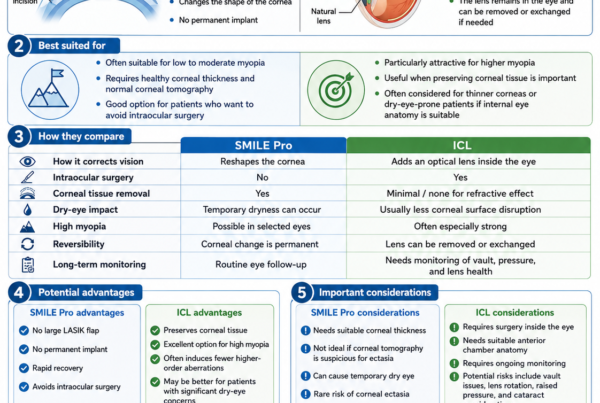
Should ICL Be Considered?
Yes.
As myopia increases, ICL deserves increasingly serious consideration because it:
- Preserves corneal stromal tissue
- Avoids large corneal curvature changes
- Can provide excellent optical quality in high myopia
The question should therefore not be:
“SMILE or PRK?”
when a third option may be anatomically more suitable.
Low Myopia
Both PRK and SMILE can perform extremely well for low myopia.
A 2025 direct comparison of eyes between approximately -1.00 and -2.00 D found both procedures safe and effective with comparable six-month visual quality.
For low myopia, procedure choice may depend more on:
- Recovery expectations
- Corneal thickness
- Customisation needs
- Cost
- Surgeon preference
than on final visual acuity.
Hyperopia
PRK can treat selected hyperopic prescriptions using appropriate excimer-laser platforms.
Traditional SMILE was primarily used for:
- Myopia
- Myopic astigmatism
The newer VISUMAX 800 platform now supports hyperopic lenticule extraction in some jurisdictions, but availability and regulatory approval vary.
PRK remains the more historically established surface-laser option for hyperopic treatment.
Contact and Combat Sports
Both procedures are flapless.
This removes the specific concern of traumatic LASIK flap displacement.
SMILE may be attractive when:
- Rapid return to daily function matters.
- Contact sports are part of the patient’s lifestyle.
PRK may be attractive when:
- Maximum flap avoidance is desired.
- A superficial treatment is anatomically preferable.
- Longer recovery is acceptable.
Neither operation eliminates the need for protective eyewear.
Military and High-Impact Occupations
PRK has historically been widely used in military and aviation refractive programmes because it creates no flap.
SMILE offers another flapless approach with:
- Less postoperative pain
- Faster functional recovery
Current occupational standards vary.
Patients should check the medical requirements of their military, aviation or professional authority before surgery.
Enhancement After SMILE
If meaningful residual refractive error remains after SMILE, enhancement options may include:
- PRK
- CIRCLE
- LASIK-type strategies in selected cases
PRK is therefore a common way to perform a surface enhancement after SMILE.
Enhancement After PRK
Repeat surface ablation may sometimes be possible after PRK.
Suitability depends on:
- Remaining corneal thickness
- Tomography
- Residual prescription
- Previous haze response
- Stability
Repeated corneal surgery should never be automatic simply because some small prescription remains.
Is Enhancement Easier After PRK?
Not necessarily.
The strategy depends on:
- What surgery was performed first
- Corneal anatomy
- Residual prescription
- Time since surgery
SMILE does not have a conventional LASIK flap available for straightforward relifting.
PRK does not have a flap either.
Both therefore require individualised retreatment planning.
Infection
Infection is rare after both procedures.
PRK
The early infection concern is particularly relevant while:
- The epithelium remains open
- A bandage contact lens is present
SMILE
The epithelial barrier remains largely intact, but infection can still occur within the small incision or interface.
Seek prompt assessment after either procedure for:
- Increasing pain
- Increasing redness
- Light sensitivity
- Discharge
- Falling vision
- A white corneal spot
Returning to Exercise
SMILE
Light exercise may resume relatively quickly once the surgeon is satisfied.
PRK
More caution is required during the first few days while:
- The surface is healing
- The bandage contact lens remains in place
Swimming
Avoid swimming after either procedure during early healing.
This includes:
- Pools
- Sea water
- Hot tubs
The risk is particularly important after PRK while the epithelial barrier remains incomplete.
Showering
You may usually shower carefully.
Avoid:
- Direct water spray into the eyes
- Shampoo
- Soap
- Rubbing
during early recovery.
Screens
Screens do not damage either laser correction.
After PRK, screen use may simply be uncomfortable during the first few days.
After SMILE, many people resume screen use quickly.
For both:
- Blink frequently.
- Use prescribed lubricants.
- Take breaks.
Driving
Do not decide based simply on the number of days after surgery.
Drive when:
- Visual acuity is adequate.
- Glare is acceptable.
- Vision feels stable.
- You are confident.
- The postoperative examination is satisfactory.
SMILE patients often reach this stage sooner than PRK patients.
Does Either Procedure Prevent Presbyopia?
No.
Presbyopia results from ageing of the natural crystalline lens.
A patient with excellent distance vision after SMILE or PRK may still need reading glasses later.
Does Either Procedure Prevent Cataract?
No.
Both affect the cornea.
Neither prevents the natural lens from ageing.
Does Either Procedure Affect Future Cataract Surgery?
Yes.
Both alter corneal curvature.
Future cataract-surgery calculations therefore need to account for previous corneal refractive surgery.
Tell your cataract surgeon whether you previously underwent:
- PRK
- TransPRK
- SMILE
- SMILE Pro
Retaining old refractive records may be useful.
Does Either Procedure Remove the Retinal Risks of High Myopia?
No.
This is extremely important.
A patient may have been:
-8.00 D before surgery
and see:
6/6 without glasses afterwards.
The eyeball may still remain elongated.
The patient still has increased lifetime risk of:
- Retinal tear
- Retinal detachment
- Myopic macular degeneration
- Myopic choroidal neovascularisation
Laser surgery corrects the optics.
It does not shorten the eye.
Long-Term Results
Both procedures have reassuring long-term data.
PRK
PRK has been performed for several decades.
Ten-year studies confirm durable safety, although higher corrections show greater long-term regression than lower corrections.
SMILE
SMILE now also has follow-up extending to ten years.
Long-term cohorts report:
- Good efficacy
- Good safety
- Relatively small average regression
over a decade.
SMILE Pro itself is newer.
The long-term biological evidence comes from established SMILE, while the newer platform improves the way the procedure is delivered.
Common Myths
“SMILE and PRK Are the Same Because Both Are Flapless”
False.
SMILE is an intrastromal lenticule-extraction procedure.
PRK is a surface-ablation procedure.
“Flapless Means No Corneal Wound”
False.
PRK intentionally creates a large temporary epithelial wound.
SMILE creates a small incision and internal stromal planes.
“SMILE Has No Recovery Time”
False.
Recovery is rapid, but vision still requires time to stabilise.
“PRK Takes Six Months Before You Can See”
False.
Useful vision generally returns far sooner.
Fine stabilisation may continue for months.
“PRK Is Old Technology”
False.
The original principle is older, but modern PRK may use:
- Advanced excimer profiles
- High-speed eye tracking
- TransPRK
- SmartPulse or similar surface optimisation
- Wavefront guidance
- Topography guidance
“SMILE Is Automatically Better Because It Is Newer”
False.
“SMILE Is Always Stronger Than PRK”
Not supported.
Modern direct biomechanical studies show that PRK may preserve several measured biomechanical parameters at least as well as—and sometimes better than—SMILE.
“PRK Is Always Better for Thin Corneas”
False.
Corneal tomography matters as much as thickness.
“SMILE Cannot Cause Ectasia”
False.
“PRK Cannot Cause Ectasia”
False.
Both require proper keratoconus screening.
“PRK Always Causes Haze”
False.
Clinically significant haze is uncommon with modern treatment and appropriate mitomycin C use.
“SMILE Causes No Dry Eye”
False.
“PRK Permanently Damages Corneal Nerves”
False.
Corneal nerves regenerate gradually after surgery.
“SMILE Always Gives Better Night Vision”
False.
Optical studies show advantages and disadvantages for each procedure depending on:
- Treatment profile
- Optical zone
- Prescription
- Pupil size
“PRK Is Better for Every Athlete”
Not necessarily.
SMILE is also flapless and offers much faster early recovery.
“Once the Surgery Is Done, My Myopia Cannot Return”
False.
Regression or natural refractive progression may occur.
“Laser Surgery Removes the Risks of High Myopia”
False.
Retinal risks remain.
Frequently Asked Questions
Which Is Safer: SMILE or PRK?
Both have excellent safety records in properly selected patients.
Their risks differ.
SMILE avoids:
- Large epithelial defects
- PRK-type haze
PRK avoids:
- Lenticule-dissection complications
- A deeper internal cap/lenticule architecture
Patient selection matters more than declaring one universally safer.
Which Gives Better 6/6 Vision?
Both commonly achieve excellent unaided vision.
Current comparative evidence does not demonstrate a meaningful universal difference in final efficacy.
Which Recovers Faster?
SMILE.
Which Hurts More?
PRK.
How Long Does PRK Hurt?
Discomfort is usually greatest during the first 24 to 72 hours and improves substantially as the epithelium closes.
How Long Does SMILE Hurt?
Most patients experience only mild discomfort during the first day.
Which Is Better for Dry Eye?
SMILE may offer an early nerve-preservation advantage.
Significant dry-eye disease should be treated before either operation.
Which Is Better for Night Vision?
Neither universally.
Optical-zone design, centration, pupil size and residual refractive error may matter more.
Which Is Better for High Astigmatism?
Modern excimer PRK offers excellent astigmatic flexibility.
Modern SMILE Pro has improved astigmatic alignment through cyclotorsion compensation.
The individual cylinder and axis should guide the decision.
Can PRK Correct a Prescription SMILE Cannot?
Depending on the laser platform, PRK may offer greater flexibility for:
- Hyperopia
- Customised treatments
- Certain irregular optical patterns
Which Is Better for -2.00 D?
Both may work extremely well.
Recovery preferences and anatomy may drive the decision.
Which Is Better for -5.00 D?
Both remain reasonable in many normal corneas.
Which Is Better for -9.00 D?
SMILE may be preferable to PRK in some suitable corneas because of:
- Faster recovery
- Lower haze concern
but ICL should also be considered because the correction is high.
Can I Have PRK After SMILE?
Yes in selected cases.
Surface ablation is a recognised enhancement strategy after SMILE.
Can I Have SMILE After PRK?
This is less routine and requires careful assessment of:
- Existing corneal thickness
- Prior ablation
- Tomography
- Residual refractive error
Another enhancement strategy may be preferable.
Can I Have Cataract Surgery Later?
Yes after either procedure.
Does PRK Affect Eye-Pressure Measurements?
Yes.
Does SMILE Affect Eye-Pressure Measurements?
Yes.
Both change corneal:
- Thickness
- Curvature
- Biomechanics
and may cause applanation-based eye-pressure readings to underestimate the true physiological pressure.
Can I Wear Contact Lenses Again?
Yes if needed after complete healing.
Previous corneal reshaping may affect the ideal lens design.
Which Is Better for Boxing?
Both avoid a LASIK flap.
SMILE may offer faster recovery.
PRK has a long history of use in high-impact populations.
Which Is Better for Military Service?
This depends on current military policy.
Check occupational standards before surgery.
Can I Swim Earlier After SMILE?
Usually yes compared with PRK, although swimming should still be avoided during the early postoperative period until the surgeon permits it.
Can I Work the Day After SMILE?
Some patients can.
Can I Work the Day After PRK?
It is generally unrealistic to plan on comfortable full-time work the following day.
Can PRK Vision Become Better Than SMILE Vision Eventually?
Both can achieve excellent final corrected and unaided acuity.
The difference is usually not best described as one becoming “better”.
Does TransPRK Recover as Fast as SMILE?
Usually not.
Modern TransPRK may improve early recovery compared with conventional PRK, but it still requires epithelial regeneration.
Warning Signs After SMILE
Contact the treating clinic promptly for:
- Increasing pain
- Increasing redness
- Significant light sensitivity
- Falling vision
- Discharge
- A white corneal spot
Warning Signs After PRK
The same warning signs apply.
Particular attention is warranted when symptoms:
improve and then become significantly worse.
This may indicate:
- Infection
- Epithelial breakdown
- Significant inflammation
Retinal Warning Signs After Either Procedure
Seek urgent retinal assessment for:
- New flashes
- A sudden shower of floaters
- A curtain or shadow
- Sudden peripheral-field loss
These are especially important if you were highly myopic before surgery.
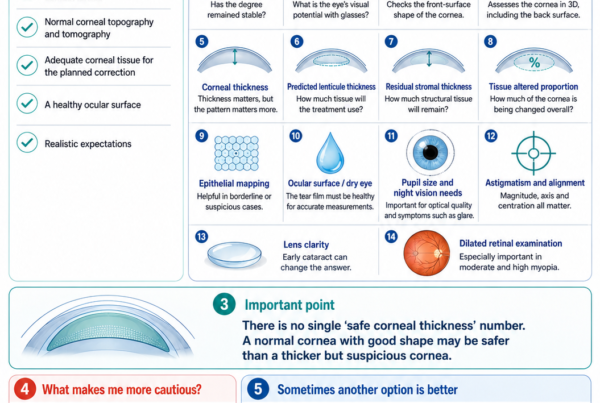
A SMILE vs PRK Decision Checklist
Your Prescription
- How much myopia do I have?
- How much astigmatism?
- Is the prescription stable?
- Is it sufficiently high that ICL should also be considered?
Your Cornea
- Is my tomography completely normal?
- How thick is the cornea?
- What is the posterior corneal elevation?
- Is there any ectasia concern?
- How much tissue would each procedure affect?
Your Ocular Surface
- Do I have dry eye?
- Do I have meibomian-gland dysfunction?
- Do I have allergy?
- Do I rub my eyes?
Your Recovery Needs
- How many days can I take off work?
- Do I need to drive quickly?
- Can I tolerate several uncomfortable days?
- Do I have an important event soon?
Your Lifestyle
- Do I participate in contact sports?
- Do I work in dust or water?
- Do I have military or aviation requirements?
- Is night vision particularly important?
Your Optical Needs
- Would I benefit from topography-guided treatment?
- Do I have significant corneal aberrations?
- Is a customised excimer treatment advantageous?
Questions to Ask the Surgeon
- Why do you recommend SMILE rather than PRK for me?
- Why PRK rather than SMILE?
- Is my cornea structurally normal?
- Which procedure leaves the better tissue profile in my particular cornea?
- What is my haze risk?
- Will mitomycin C be used with PRK?
- How long should I take off work?
- How quickly can I drive?
- How would you enhance the result if some prescription remains?
- Should I consider ICL instead?
Which Procedure Often Makes More Sense?
SMILE May Be Particularly Attractive When
- Rapid recovery is important
- Myopia is within an appropriate range
- Corneal tomography is normal
- Corneal thickness is suitable
- The patient wants a flapless procedure
- Contact sports are important
- Several uncomfortable postoperative days would be difficult
PRK May Be Particularly Attractive When
- A highly superficial treatment is advantageous
- The cornea is unsuitable for a deeper flap/cap approach but still otherwise safe for surface ablation
- Topography-guided treatment is needed
- Wavefront-guided treatment is desirable
- A previous refractive procedure requires surface enhancement
- The patient accepts a slower recovery
Neither May Be Best When
- Tomography is abnormal
- Keratoconus is present
- Severe uncontrolled dry eye is present
- Cataract is developing
- The prescription is unstable
- High myopia makes ICL a better anatomical choice
The Bottom Line
SMILE and PRK are both flapless refractive-surgery procedures, but they are very different operations.
SMILE:
- Creates an internal stromal lenticule
- Removes it through a small incision
- Preserves the central epithelium
- Usually causes mild early discomfort
- Provides rapid functional visual recovery
- Does not produce the classic surface-ablation haze response
- Can still cause dryness, residual prescription and rare ectasia
PRK:
- Removes the central epithelium
- Uses an excimer laser to reshape the anterior stroma
- Requires a bandage contact lens
- Causes more discomfort during the first several days
- Has slower early visual recovery
- Can produce corneal haze
- Allows sophisticated excimer-laser customisation
- May provide an advantageous tissue strategy in selected corneas
Modern comparative evidence shows that final visual outcomes are generally similar.
A 2026 meta-analysis found no significant overall difference in efficacy between TransPRK and SMILE.
A direct 18-month randomised trial likewise found comparable:
- Safety
- Efficacy
- Contrast sensitivity
- Higher-order aberrations
while SMILE provided a more comfortable and visually functional early recovery.
SMILE therefore has a clear practical advantage when the patient values:
- Faster recovery
- Less early pain
- No bandage contact lens
PRK retains important advantages when the surgeon wants:
- A superficial treatment
- Topography-guided correction
- Wavefront-guided treatment
- A surface enhancement strategy
The biomechanical comparison is more nuanced than commonly assumed.
Recent direct studies suggest that PRK may preserve several biomechanical parameters at least as well as SMILE, so the phrase “SMILE is stronger because it is flapless” should not be used when comparing SMILE with another flapless procedure such as PRK.
Both procedures can rarely be followed by ectasia, which is why careful corneal tomography remains essential.
PRK carries a unique haze risk, but modern mitomycin-C protocols substantially reduce that risk.
Both procedures have reassuring long-term evidence extending to approximately a decade or more.
The most important message is:
Choose SMILE when its small-incision approach and faster recovery best match the eye and lifestyle. Choose PRK when a superficial or highly customised excimer treatment offers a better anatomical or optical strategy. Being flapless is only the beginning of the comparison—the best procedure is the one that leaves the safest cornea while delivering the visual result the patient actually needs.
References
- Serfözö A, Abu Dail Y, Munteanu C, et al. The efficacy, safety and predictability in transepithelial photorefractive keratectomy versus LASIK/SMILE: a meta-analysis. Eur J Ophthalmol. 2026;36:837–855. PMID: 41734035.
- Damgaard IB, et al. Eighteen-month outcomes of a contralateral randomised prospective clinical trial comparing PRK and SMILE for myopia. PMID: 36892242.
- Joshi S, Bari A, Shakkarwal C, et al. Visual outcomes and corneal biomechanical properties after PRK and SMILE in low-to-moderate myopia. Indian J Ophthalmol. 2025;73:128–133. PMID: 39446853.
- Comparative analysis of myopia correction outcomes and aberration changes between PRK and SMILE. 2025. PMID: 40075391.
- Comparison of objective visual quality following SMILE and SmartPulse-assisted TransPRK for moderate-to-high myopia. J Refract Surg. 2024;40–e498. PMID: 39007811.
- Comparison of visual quality and optical zones after TransPRK, SMILE and FS-LASIK. BMC Ophthalmol. 2025. PMID: 41034774.
- Serfözö A, et al. Efficacy, safety and predictability of transepithelial versus conventional PRK: meta-analysis. J Cataract Refract Surg. 2025. PMID: 40929568.
- Liu J, Lu Y, Liu J, Wei C. Meta-analysis of efficacy, safety, stability and predictability of SMILE for myopia. 2024. PMID: 38329555.
- Spiru B, Torres-Netto EA, Kling S, et al. Biomechanical properties of human cornea after PRK versus SMILE in paired donor eyes. J Refract Surg. 2019;35:501–505. PMID: 31393988.
- Corneal biomechanics after SMILE, femtosecond LASIK and PRK: matched comparison. PMID: 36928130.
- Early elastic and viscoelastic corneal biomechanical changes after PRK and SMILE. PMID: 38954134.
- Guo H, et al. Corneal biomechanical properties after SMILE versus FLEX, LASIK, LASEK or PRK: systematic review and meta-analysis. PMID: 31370817.
- Chang YM, Liang CM, Weng TH, et al. Mitomycin C for prevention of corneal haze in PRK: meta-analysis and trial sequential analysis. Acta Ophthalmol. 2021;99:652–662. PMID: 33326173.
- Moshirfar M, et al. Ectasia after corneal refractive surgery: a systematic review. Ophthalmol Ther. 2021. PMID: 34417707.
- Blum M, et al. Ten-year results of small-incision lenticule extraction. J Refract Surg. 2019. PMID: 31610002.
- Xia F, Chen Z, Miao H, et al. Ten-year outcomes following SMILE for myopia up to -10 D. 2024. PMID: 37194118.
- Long-term outcomes of PRK, LASIK and SMILE. PMID: 34241701.
- Alió JL, et al. Ten-year follow-up of PRK for myopia below -6.00 D. PMID: 18154752.
- Alió JL, et al. Ten-year follow-up of PRK for myopia above -6.00 D. PMID: 18154753.
- Singapore National Eye Centre. SMILE Pro clinical information and VISUMAX 800 treatment description. Current August 2026 information.