Author: Dr Val Phua
Estimated reading time: 16 minutes
ICL and SMILE are two modern vision-correction procedures used to treat short-sightedness and astigmatism. Both can provide excellent unaided vision in appropriately selected patients, but they achieve this in very different ways.
ICL surgery places a corrective lens inside the eye without removing central corneal tissue.
SMILE uses a femtosecond laser to create and remove a small piece of corneal tissue, permanently changing the shape and focusing power of the cornea.
This difference influences:
- The range of prescriptions that can be treated
- Corneal suitability
- Dry-eye symptoms
- Visual quality
- Recovery
- Long-term follow-up
- Possible complications
- Whether the correction can later be removed
For patients with healthy, regularly shaped corneas and a prescription within the appropriate treatment range, SMILE can provide effective correction without placing an implant inside the eye.
ICL is often considered when myopia is high, the cornea is relatively thin or unsuitable for laser treatment, preserving corneal tissue is important, or the expected optical result from a large corneal correction may be less favourable.
Comparative studies and meta-analyses generally find both procedures effective, safe and predictable for moderate-to-high myopia. Some studies report better contrast sensitivity, fewer induced higher-order aberrations and better overall visual quality after ICL, particularly at higher prescriptions. However, ICL is an intraocular operation and introduces risks that do not occur with SMILE.
Neither procedure is universally better. The preferred option depends on the individual patient’s prescription, corneal anatomy, internal eye dimensions, eye-surface health, age, occupation, lifestyle and tolerance for the different types of surgical risk.
What Is ICL Surgery?
ICL stands for Implantable Collamer Lens.
During ICL surgery, a soft, foldable corrective lens is inserted through a small incision and positioned:
- Behind the iris
- In front of the eye’s natural crystalline lens
The natural lens is not removed.
The ICL adds the optical power needed to focus light more accurately on the retina. A spherical ICL corrects myopia, while a toric ICL corrects myopia together with astigmatism.
Modern EVO ICL models contain a small central port that allows aqueous fluid to circulate through the lens. This design generally avoids the need for the peripheral iridotomy that was commonly required before implantation of earlier ICL models.
What Is SMILE?
SMILE stands for Small Incision Lenticule Extraction.
It is a corneal laser procedure performed using a femtosecond laser.
During SMILE:
- The laser creates a thin, lens-shaped piece of tissue called a lenticule within the cornea.
- The laser creates a small opening at the edge of the cornea.
- The surgeon separates and removes the lenticule through this opening.
- Removing the tissue changes the corneal curvature and corrects the prescription.
SMILE does not create the large hinged corneal flap used in LASIK, and it does not require an excimer laser. However, it still permanently removes corneal stromal tissue.
ICL vs SMILE at a Glance
ICL
- A corrective lens is implanted inside the eye
- The lens sits behind the iris
- The natural lens remains in place
- No central corneal tissue is removed
- No corneal flap is created
- Can correct a wide range of myopia
- Toric ICL can correct astigmatism
- Requires adequate internal eye dimensions
- Requires endothelial cell assessment
- Introduces intraocular and implant-related risks
- Requires long-term monitoring
SMILE
- A laser creates a lenticule within the cornea
- The lenticule is removed through a small incision
- Corneal tissue is permanently removed
- No corneal flap is created
- No implant is left inside the eye
- Treats myopia and astigmatism within the available treatment range
- Requires adequate corneal thickness and normal tomography
- Introduces corneal and eye-surface risks
- Does not require implant or vault surveillance
What Is the Main Difference Between ICL and SMILE?
The central difference is where the correction occurs.
ICL Is an Additive Intraocular Procedure
The ICL adds a corrective optical lens inside the eye.
The central cornea is not reshaped, and the amount of myopia corrected does not determine how much corneal tissue must be removed.
SMILE Is a Subtractive Corneal Procedure
SMILE corrects vision by removing a calculated volume of corneal tissue.
The higher the prescription, the thicker the lenticule generally needs to be. This means that the amount of tissue removed increases as the required correction increases.
Which Procedure Can Correct Higher Myopia?
ICL generally has an advantage when the degree of myopia is high or very high.
SMILE has been used successfully for high myopia, and studies have reported good safety, efficacy and patient satisfaction even for corrections above −9.00 dioptres in appropriately selected corneas. However, high corrections require greater tissue removal and careful assessment of the remaining corneal structure.
ICL can correct a wide range of myopia without removing a correspondingly large volume of corneal tissue. This often makes ICL attractive when:
- The prescription is high
- The cornea is relatively thin
- The planned SMILE lenticule would remove substantial tissue
- Preserving corneal structure is a priority
- The expected optical quality after a large corneal correction is a concern
Studies directly comparing ICL and SMILE for high myopia generally find both procedures effective and predictable. Several meta-analyses have nevertheless reported better safety indices, contrast sensitivity or higher-order aberration profiles after ICL.
Is ICL Better Than SMILE for High Myopia?
ICL is frequently favoured for high myopia, but it is not automatically the correct choice for every highly myopic patient.
Potential advantages of ICL include:
- No removal of central corneal tissue
- Less dependence on corneal thickness
- Fewer surgically induced corneal aberrations
- Potentially better contrast sensitivity
- Potentially better night-time visual quality
- Lower concern about corneal ectasia caused by tissue removal
- A removable or exchangeable optical lens
A 2023 meta-analysis involving more than 1,000 eyes found broadly similar efficacy and predictability between ICL and SMILE but reported better safety and several visual-quality measurements in the ICL group. These results should be interpreted carefully because many included studies were observational rather than randomised, and treatment selection may have differed between groups.
A four-year comparative study found that both SMILE and central-port ICL provided safe and effective correction of high myopia. SMILE showed slightly better long-term refractive predictability in that particular cohort, while mild visual disturbances occurred after both procedures.
This illustrates an important point: study averages cannot determine the best procedure for an individual patient.
Which Is Better for Low or Moderate Myopia?
For patients with low-to-moderate myopia, healthy corneas and a stable tear film, SMILE may be preferred because it:
- Avoids intraocular surgery
- Does not leave an implant inside the eye
- Avoids implant sizing and vault concerns
- Does not expose the natural lens to an implanted device
- Usually requires less long-term implant-specific monitoring
- Is generally less expensive than ICL
ICL can still produce excellent results in lower and moderate myopia. It may be considered when:
- The cornea is too thin for the intended laser correction
- Corneal tomography is unsuitable for SMILE
- Significant dry-eye concerns are present
- Preserving corneal tissue is particularly important
- The patient understands and accepts the risks of intraocular surgery
- The internal eye anatomy is suitable
The fact that a low prescription can be corrected with ICL does not necessarily mean that placing an intraocular lens is the preferred risk–benefit choice.
Which Is Better if You Have Thin Corneas?
ICL is often preferred when the cornea is too thin for safe SMILE treatment.
SMILE removes a lenticule from within the corneal stroma. The surgeon must ensure that the remaining corneal tissue has an adequate structural reserve.
Assessment includes:
- Corneal thickness
- Corneal topography
- Corneal tomography
- The degree of myopia and astigmatism
- Planned cap thickness
- Planned lenticule thickness
- Residual stromal thickness
- Signs of keratoconus or corneal instability
- Age and prescription history
ICL does not remove central corneal tissue, but a thin cornea still requires investigation. Thin or abnormal corneas may indicate keratoconus or another corneal disorder.
ICL can correct the refractive error associated with a stable abnormal cornea, but it does not strengthen the cornea or treat progressive keratoconus.
Which Is Better for Dry Eyes?
ICL may have an advantage for patients with significant dry-eye risk because it causes less central corneal nerve disruption.
SMILE generally affects fewer corneal nerves than LASIK because it does not create a large corneal flap. Nevertheless, it still involves:
- A corneal incision
- Femtosecond laser treatment within the corneal stroma
- Lenticule dissection
- Temporary changes in corneal sensation
- Postoperative inflammation
- Tear-film disruption
Dryness, burning, grittiness and fluctuating vision can therefore occur after SMILE.
A 2024 comparative study found that objective dry-eye measurements recovered more quickly after ICL than after SMILE during the first postoperative month. However, both groups experienced temporary eye-surface changes, and the longer-term difference was less pronounced.
ICL can also cause temporary dry-eye symptoms because of:
- The small corneal incision
- Surgical antiseptics
- Frequent postoperative eyedrops
- Preservatives within medication
- Reduced blinking
- Pre-existing blepharitis or meibomian gland dysfunction
Neither procedure cures dry eye. Existing eye-surface disease should be identified and treated before surgery.
Which Produces Better Quality of Vision?
Both procedures can produce excellent unaided visual acuity. However, quality of vision includes more than the smallest letters that can be read on an eye chart.
It also includes:
- Contrast sensitivity
- Night vision
- Glare
- Halos
- Starbursts
- Ghost images
- Clarity in dim lighting
- Stability of vision
- Higher-order aberrations
- Light scatter
In moderate-to-high myopia, ICL may provide an optical advantage because it does not significantly alter the shape of the central cornea.
Several comparative studies have found:
- Better contrast sensitivity after ICL
- Fewer induced corneal higher-order aberrations
- Better modulation transfer measurements
- Lower coma and spherical aberration
- Better early postoperative objective visual quality
However, results vary according to the prescription, pupil size, measurement method, follow-up period and patient group.
A one-year study found that both SMILE and central-port ICL provided good safety, predictability and optical quality in high myopia, with relatively stable results in both groups.
Does ICL Provide Better Contrast Sensitivity Than SMILE?
Some studies suggest that it does, particularly at higher prescriptions.
Contrast sensitivity measures the ability to distinguish an object from its background when the difference between light and dark is subtle.
It is important for:
- Night driving
- Seeing in rain
- Recognising faces in dim light
- Detecting steps or edges
- Performing visually demanding tasks
A comparative study reported better visual outcomes and improved contrast sensitivity at several spatial frequencies after EVO ICL compared with SMILE. Meta-analyses have found similar trends, although the size and consistency of the advantage vary.
Excellent contrast sensitivity is possible after either procedure. The difference becomes more clinically relevant when the myopia is high and the SMILE correction requires a substantial corneal shape change.
Can Both Procedures Cause Glare and Halos?
Yes.
Glare and Halos After ICL
Possible causes include:
- The optical edge of the lens
- The central port
- A large pupil
- Residual refractive error
- Toric lens rotation
- Lens position
- Vault
- Early postoperative inflammation
- Neural adaptation
A 2021 meta-analysis found a higher reported risk of halos after ICL than after SMILE, despite generally favourable efficacy and visual-quality measurements with ICL.
Glare and Halos After SMILE
Possible causes include:
- Tear-film instability
- Residual myopia or astigmatism
- Induced spherical aberration or coma
- Decentration
- Interface haze
- Irregular lenticule removal
- A pupil extending beyond the effective optical treatment zone
Most early visual disturbances improve as healing occurs and the brain adapts. Persistent night-vision problems require assessment.
Which Has Faster Visual Recovery?
Both procedures can provide useful vision within the first day.
ICL Recovery
Many patients notice substantially clearer distance vision by the following day.
Early fluctuations may be caused by:
- Dilated pupils
- Mild inflammation
- Temporary corneal swelling
- Residual surgical medication
- Raised eye pressure
- Tear-film disturbance
- Adaptation to the implanted optics
Early postoperative pressure and lens-position checks are important.
SMILE Recovery
Many patients also see well by the following day. However, the visual recovery can sometimes be slightly less crisp during the first few hours or days because of:
- Interface swelling
- Mild corneal haze
- Tear-film disturbance
- Inflammation within the lenticule plane
- Temporary changes in corneal sensation
Vision generally improves progressively over the first days and weeks.
The speed at which vision becomes functional should not be confused with complete healing. Both procedures require medication, activity precautions and follow-up.
Which Procedure Is More Painful?
Both procedures are normally performed using anaesthetic eyedrops.
During ICL Surgery
Patients may notice:
- Bright lights
- Movement
- Mild pressure
- Water around the eye
- Temporary blurring
Sharp pain is not expected.
During SMILE
Patients may notice:
- Pressure from the suction device
- Temporary dimming or loss of the fixation light
- Movement during lenticule removal
- Water around the eye
After either procedure, mild grittiness, watering or light sensitivity may occur.
Severe or increasing pain is not normal and requires urgent review.
Which Procedure Has the Easier Recovery?
SMILE avoids entering the eye and generally requires less implant-specific monitoring.
ICL requires early assessment for:
- Eye-pressure elevation
- Inflammation
- ICL position
- Vault
- Pupil abnormalities
- Wound integrity
SMILE requires assessment for:
- Corneal healing
- Interface clarity
- Incomplete lenticule removal
- Infection
- Eye-surface recovery
- Residual refractive error
After either procedure, patients are generally advised to:
- Avoid rubbing the eyes
- Use prescribed eyedrops
- Keep soap and contaminated water away from the eyes initially
- Avoid swimming until permitted
- Avoid eye makeup during early healing
- Avoid strenuous exercise for the recommended period
- Attend all follow-up appointments
ICL vs SMILE for Contact Sports
Neither ICL nor SMILE creates a LASIK flap.
This may make both options attractive for people involved in:
- Martial arts
- Rugby
- Boxing
- Football
- Water polo
- Military or tactical work
- Occupations with a risk of facial impact
Advantage of SMILE
SMILE has no implant inside the eye. Once the corneal incision and tissue plane have healed, there is no intraocular lens that can rotate or be displaced.
Advantage of ICL
ICL avoids removal of corneal tissue and does not weaken the cornea through laser ablation.
However, a strong impact can still injure:
- The ICL
- The iris
- The natural lens
- The drainage angle
- The retina
SMILE also does not make the eye immune to trauma. Blunt injury can damage the cornea, retina, natural lens or other structures after any refractive procedure.
Protective eyewear remains important.
Which Procedure Is More Reversible?
ICL is more removable, but neither procedure should be described as completely reversible.
ICL
The lens can usually be surgically removed or exchanged if required.
Reasons may include:
- Incorrect vault
- Incorrect power
- Toric rotation
- Cataract
- Raised eye pressure
- Inflammation
- Patient intolerance
Removal requires another intraocular operation. The eye cannot be guaranteed to return precisely to its preoperative condition.
SMILE
SMILE is not reversible because corneal tissue has been permanently removed.
A residual prescription may sometimes be treated with:
- Glasses
- Contact lenses
- PRK
- Conversion of the SMILE cap into a LASIK-type flap
- Another corneal enhancement technique
- ICL in selected cases
The appropriate enhancement depends on the remaining corneal thickness, corneal shape, residual prescription and eye-surface health.
What Are the Main Risks of SMILE?
Dry Eye and Tear-Film Disturbance
SMILE may cause:
- Dryness
- Burning
- Grittiness
- Fluctuating vision
- Watering
- Eye fatigue
The risk is generally lower than after LASIK in many studies, but clinically significant dry eye can still occur.
Suction Loss
The eye must remain correctly positioned while the femtosecond laser creates the lenticule.
If suction is lost, treatment may need to be restarted, modified, postponed or converted to another procedure depending on the stage at which it occurs.
Difficult Lenticule Dissection
The surgeon must separate the front and back surfaces of the lenticule before removing it.
Potential difficulties include:
- Entering the wrong tissue plane
- Lenticule tears
- Retained lenticule fragments
- Cap tears
- Incision damage
- Incomplete lenticule removal
Many SMILE-specific complications are associated with lenticule identification and extraction and are influenced by surgical experience.
Interface Inflammation or Debris
Inflammation, cells or debris may accumulate in the space where the lenticule was removed.
This can cause:
- Blurred vision
- Light sensitivity
- Haze
- Irregular optical quality
Treatment may require additional medication or, rarely, surgical irrigation.
Residual Prescription
Under-correction, overcorrection or residual astigmatism can occur.
Possible management includes:
- Glasses
- Contact lenses
- Observation
- Surface laser enhancement
- Cap-to-flap conversion
- ICL implantation in selected patients
Enhancement after SMILE can be less straightforward than lifting an existing LASIK flap.
Regression
Some myopia may return over time because of:
- Corneal remodelling
- Ongoing myopia progression
- High initial correction
- Age-related changes
- Individual healing responses
Long-term SMILE studies have generally reported good refractive stability, although mild regression has been observed in some high-myopia cohorts.
Corneal Ectasia
Corneal ectasia is progressive weakening and bulging of the cornea.
It can cause:
- Increasing myopia
- Increasing astigmatism
- Ghosting
- Distorted vision
- Reduced corrected vision
SMILE does not create a flap, but it still removes stromal tissue. Ectasia has therefore been reported after SMILE, particularly in eyes with pre-existing risk factors or insufficient structural reserve.
Careful tomography and tissue planning reduce the risk but cannot eliminate it completely.
Infection
Infectious keratitis after SMILE is uncommon but potentially serious.
Warning symptoms include:
- Increasing pain
- Increasing redness
- Reduced vision
- Light sensitivity
- Discharge
- A white spot on the cornea
Urgent treatment is required.
Loss of Best-Corrected Vision
Rarely, infection, scarring, irregular astigmatism, ectasia or another complication may reduce vision even with spectacles.
What Are the Main Risks of ICL Surgery?
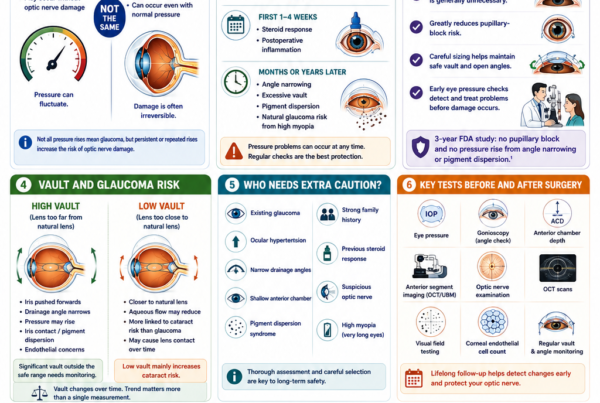
Raised Eye Pressure
Eye pressure may increase because of:
- Retained surgical viscoelastic
- Steroid response
- Inflammation
- Excessive vault
- Narrowing of the drainage angle
- Pupillary block
- Pigment dispersion
Pressure elevation may occur shortly after surgery or later and requires appropriate monitoring.
Incorrect Vault
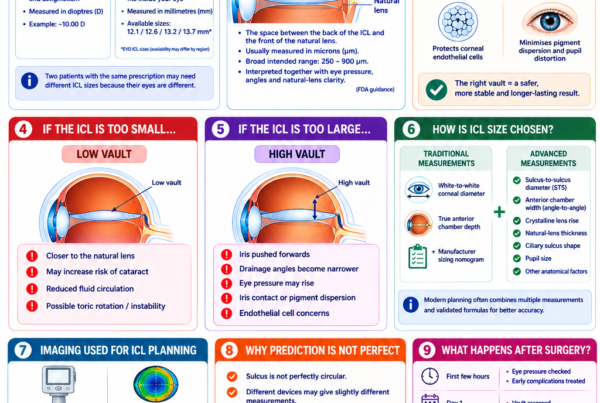
Vault is the space between the ICL and the natural lens.
A very low vault may increase the risk of proximity or contact with the natural lens.
A very high vault may:
- Narrow the drainage angle
- Increase eye pressure
- Cause iris contact
- Produce inflammation
- Contribute to optical symptoms
Inappropriate vault is a major reason for ICL exchange or removal in published series.
Cataract
The natural lens remains in the eye and can develop cataract with age.
Additional concern may arise when:
- Vault is very low
- The patient is older
- The anterior chamber is relatively shallow
- The natural lens is touched during surgery
- The ICL has been implanted for many years
Modern central-port ICL studies have reported low rates of ICL-associated anterior subcapsular cataract, but the risk cannot be eliminated.
Endothelial Cell Loss
The corneal endothelial cells keep the cornea clear.
Endothelial cell density naturally decreases with age and may also be affected by intraocular surgery. Excessive cell loss could eventually contribute to corneal swelling.
Long-term endothelial cell monitoring is therefore recommended after ICL implantation. Ten-year central-port ICL data have shown favourable endothelial outcomes in selected cohorts, but individual monitoring remains necessary.
Toric ICL Rotation
A toric ICL must remain aligned with the intended astigmatism axis.
Significant rotation may cause:
- Residual astigmatism
- Blurred vision
- Ghost images
- Reduced visual quality
Surgical repositioning or lens exchange may be required.
Inflammation
Mild inflammation is expected after intraocular surgery and is treated with prescribed anti-inflammatory drops.
Persistent or severe inflammation requires further assessment.
Infection Inside the Eye
Endophthalmitis is a rare but potentially sight-threatening infection within the eye.
Symptoms may include:
- Increasing pain
- Marked redness
- Rapidly worsening vision
- Severe light sensitivity
- Eyelid swelling
- Increasing discharge
This requires emergency treatment.
Need for Lens Exchange or Removal
An ICL may require exchange or removal because of:
- Incorrect vault
- Cataract
- Pressure elevation
- Incorrect refractive power
- Toric rotation
- Patient dissatisfaction
One retrospective series reported that 2% of implanted central-port ICLs required exchange or explantation over seven years. This was a study-specific result and should not be interpreted as a universal complication rate.
Which Procedure Has More Serious Risks?
The procedures have different categories of risk.
SMILE Risks Mainly Involve:
- The cornea
- The tear film
- Corneal sensation
- Lenticule dissection
- Corneal biomechanics
- Visual quality after corneal reshaping
ICL Risks Mainly Involve:
- Eye pressure
- Lens sizing and vault
- The natural crystalline lens
- Corneal endothelial cells
- Intraocular inflammation
- Intraocular infection
SMILE avoids the risks of placing an implant inside the eye.
ICL avoids the risks associated with permanently removing central corneal tissue.
The number of possible complications listed for each procedure does not, by itself, determine which is safer. The more relevant question is which risk profile is more favourable for the individual eye.
Which Procedure Is Safer?
Both can be safe when performed on appropriately selected patients.
SMILE Becomes Less Attractive When:
- The cornea is thin
- Tomography suggests keratoconus or ectasia risk
- A high correction would remove excessive tissue
- Dry-eye disease is severe or uncontrolled
- Corneal scarring or irregularity is present
- The prescription is outside the available treatment range
ICL Becomes Less Attractive When:
- The anterior chamber is too shallow
- The drainage angles are narrow
- The endothelial cell count is inadequate
- The natural lens is developing cataract
- Glaucoma or significant optic nerve damage is present
- Internal dimensions are unsuitable
- Long-term follow-up is unlikely
- The patient does not accept intraocular surgical risk
Meta-analyses have sometimes reported a higher safety index with ICL than SMILE for high myopia. However, these findings should not be interpreted as proof that ICL is safer for every patient because most comparative evidence is non-randomised and patient selection differs.
Is SMILE Safer Because It Does Not Enter the Eye?
SMILE avoids the risks unique to intraocular surgery, including:
- Endophthalmitis inside the eye
- ICL-related cataract
- Incorrect vault
- ICL-related pressure elevation
- Implant rotation
- Endothelial-cell concerns associated with an intraocular implant
However, SMILE introduces risks that ICL largely avoids, including:
- Permanent corneal tissue removal
- Corneal ectasia
- Lenticule dissection complications
- Corneal interface inflammation
- Corneal nerve disruption
- Corneal higher-order aberrations
The safest procedure is the one whose anatomy-specific risks are lowest for that particular patient.
Which Procedure Is More Accurate?
Both are generally predictable.
A 2023 meta-analysis found no major difference in overall efficacy or predictability between ICL and SMILE for myopic correction.
Accuracy depends on:
- Prescription stability
- Measurement quality
- Corneal shape
- The degree of myopia
- Astigmatism
- Surgeon planning
- Healing
- ICL power calculation
- ICL rotation
- Treatment centration
A four-year comparative study found slightly better long-term predictability after SMILE in its study population. Other studies have found equivalent refractive accuracy or small advantages with ICL.
No procedure can guarantee an exact zero prescription.
Which Is Better for Astigmatism?
Both can correct regular myopic astigmatism.
Toric ICL
A toric ICL contains astigmatic power within the implanted lens.
Its effectiveness depends on:
- Accurate preoperative measurement
- Correct lens power
- Accurate axis placement
- Rotational stability
SMILE
SMILE corrects astigmatism by varying the shape and orientation of the removed lenticule.
Its effectiveness depends on:
- Accurate refraction
- Fixation
- Treatment centration
- Cyclotorsion control
- Corneal healing
A 2026 comparative study of oblique astigmatism found both toric ICL and SMILE effective, with slightly greater axis precision and refractive predictability in the toric ICL group. This was a specific patient group and should not be generalised to every form of astigmatism.
Irregular astigmatism caused by keratoconus, scarring or corneal disease may not be fully corrected by either procedure.
Which Is More Stable Over Time?
Both procedures have demonstrated long-term stability.
SMILE Stability
Ten-year SMILE studies have reported generally stable vision and refraction, with mild average regression in some cohorts. Long-term high-myopia studies have also found good safety and predictability, although a minority of patients experience refractive change.
ICL Stability
The ICL lens power itself does not gradually wear out. However, the eye can continue to change because of:
- Natural myopia progression
- Vault changes
- Toric rotation
- Cataract
- Presbyopia
- Retinal or macular disease
Ten-year central-port ICL studies have shown favourable refractive and safety outcomes in selected patients.
Does Either Procedure Stop Myopia From Progressing?
No.
Both procedures correct the current refractive error. They do not:
- Shorten an elongated eye
- Stop future axial growth
- Prevent myopia-related retinal disease
- Prevent future prescription changes
Patients should generally wait until the prescription is reasonably stable before surgery.
Patients with high myopia remain at increased lifetime risk of:
- Retinal tears
- Retinal detachment
- Myopic macular degeneration
- Glaucoma
- Cataract
Excellent unaided vision after surgery does not remove these underlying structural risks.
Does Either Procedure Prevent Presbyopia?
No.
Presbyopia is the age-related loss of the natural lens’s ability to focus at near.
A patient who currently reads by removing their myopic spectacles may lose this unaided near vision when both eyes are corrected for clear distance vision.
Possible approaches include:
- Reading glasses
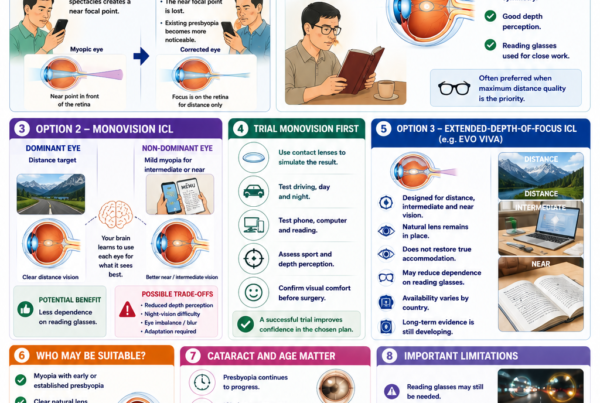
- Monovision
- Leaving a small amount of myopia in one eye
- Other presbyopia-management strategies
A contact lens monovision trial is often helpful before choosing a permanent monovision target.
Which Is Better After Age 40?
Age alone does not determine suitability, but additional issues become important after 40.
These include:
- Presbyopia
- Early cataract
- Natural-lens clarity
- Night-driving symptoms
- Current unaided near vision
- Expected future cataract surgery
- Endothelial cell count
- Retinal health
ICL may be less attractive when the natural lens already has cataract changes because the ICL may need to be removed when cataract surgery becomes necessary.
SMILE may correct distance vision successfully but will not prevent reading-glasses dependence.
For some older patients with cataract or significant presbyopia, cataract surgery or refractive lens exchange may be more appropriate than either ICL or SMILE.
What Happens if Cataract Develops Later?
After ICL
The ICL is usually removed, and the cloudy natural lens is replaced with a cataract intraocular lens.
After SMILE
Cataract surgery can be performed normally, but previous corneal refractive surgery changes the relationship between corneal curvature and optical power.
Modern formulas improve intraocular lens calculations after SMILE, but the calculation may be less straightforward than in an untreated cornea.
Patients should retain records of their preoperative refraction and SMILE treatment whenever possible.
Which Procedure Requires More Long-Term Follow-Up?
ICL generally requires more implant-specific long-term monitoring.
Follow-up may include:
- Vision and refraction
- Eye pressure
- ICL position
- Vault
- Drainage-angle assessment
- Endothelial cell count
- Natural-lens examination
- Retinal examination
SMILE patients still require routine eye examinations for:
- Dry eye
- Refractive change
- Corneal stability
- Ectasia
- Cataract
- Glaucoma
- Retinal disease
However, there is no implanted lens requiring vault, rotation or endothelial surveillance.
Which Procedure Costs More?
ICL is generally more expensive than SMILE because it involves:
- A customised implantable lens
- Detailed internal eye measurements
- An intraocular operation
- Operating-theatre resources
- Implant inventory
- More implant-specific follow-up
Toric ICLs may cost more than spherical lenses.
Fees vary according to:
- The surgeon and clinic
- The lens model
- Whether astigmatism correction is needed
- Whether one or both eyes are treated
- The investigations included
- Postoperative care
- Whether an enhancement is required
Cost should not be the primary deciding factor when the procedures have different anatomical requirements and risk profiles.
What Tests Are Needed Before Choosing?
A comprehensive refractive surgery assessment may include the following.
Refraction and Visual Acuity
To measure:
- Myopia
- Astigmatism
- Best-corrected vision
- Prescription stability
Corneal Topography and Tomography
Essential for SMILE and still important before ICL.
These scans assess:
- Corneal shape
- Corneal thickness
- Astigmatism
- Keratoconus risk
- Previous corneal disease
- Suitability for tissue removal
Corneal Biomechanical Assessment
Some patients may undergo additional testing to assess corneal deformation or biomechanical risk.
These measurements support, but do not replace, careful interpretation of tomography and clinical findings.
Tear-Film and Eyelid Assessment
To identify:
- Dry eye disease
- Blepharitis
- Meibomian gland dysfunction
- Allergy
- Contact lens-related inflammation
Anterior Chamber Measurements
Particularly important for ICL.
Measurements may include:
- Anterior chamber depth
- Drainage-angle anatomy
- White-to-white diameter
- Sulcus-to-sulcus dimensions
- Lens sizing parameters
Endothelial Cell Count
Required when considering ICL to ensure that the cornea has an adequate endothelial cell reserve.
Eye Pressure and Optic Nerve Assessment
To identify glaucoma or pressure-related risk.
Dilated Retinal Examination
Particularly important in moderate and high myopia to identify:
- Retinal holes
- Retinal tears
- Lattice degeneration
- Macular disease
- Other myopia-related abnormalities
Pupil Size
Large pupils may influence glare, halos and night-vision symptoms after either procedure.
Who May Be Better Suited to SMILE?
SMILE may be more suitable when the patient:
- Has low-to-high myopia within the available treatment range
- Has regular astigmatism
- Has adequate corneal thickness
- Has normal corneal tomography
- Has a stable prescription
- Wishes to avoid intraocular surgery
- Does not want an implant inside the eye
- Accepts permanent corneal tissue removal
- Has manageable dry-eye risk
- Prefers a generally lower-cost option
Who May Be Better Suited to ICL?
ICL may be more suitable when the patient:
- Has moderate, high or very high myopia
- Has myopia with astigmatism
- Has insufficient corneal tissue for SMILE
- Has corneal anatomy that makes laser treatment less desirable
- Wants to preserve central corneal tissue
- Has significant concern about postoperative dry eye
- Has adequate internal eye dimensions
- Has an adequate endothelial cell count
- Has a clear natural lens
- Accepts intraocular surgical risk
- Is willing to attend long-term reviews
Who May Be Unsuitable for Both?
Neither procedure may be appropriate when there is:
- An unstable prescription
- Active eye infection
- Active intraocular inflammation
- Severe untreated dry eye
- Progressive keratoconus
- Significant cataract
- Advanced glaucoma
- Retinal or optic nerve disease limiting visual potential
- Pregnancy or breastfeeding with unstable measurements
- A medical condition affecting healing
- Unrealistic expectations
- Inability to understand or accept the risks
Glasses and contact lenses remain valid alternatives. Choosing not to undergo elective surgery is also reasonable.
Can You Have SMILE After ICL?
SMILE is not normally the first enhancement choice after ICL because the residual prescription is often relatively small and a second lenticule may not be technically appropriate.
Depending on the circumstances, options for residual refractive error after ICL may include:
- Glasses
- Contact lenses
- ICL rotation
- ICL exchange
- PRK
- LASIK
- Observation
A separate corneal assessment is required before any laser enhancement.
Can You Have ICL After SMILE?
Yes, in selected patients.
ICL may be considered after SMILE when:
- A significant residual or recurrent prescription is present
- Further corneal tissue removal is undesirable
- The natural lens remains clear
- Internal eye anatomy is suitable
- Endothelial cell density is adequate
- The prescription falls within the available ICL range
Previous SMILE does not prevent ICL implantation, but the cause of the residual prescription must first be understood.
Progressive corneal ectasia should not be treated simply by implanting an ICL without addressing corneal stability.
What Questions Should You Ask Your Surgeon?
Useful questions include:
- Why do you recommend ICL or SMILE for my eyes?
- Is my corneal tomography completely normal?
- How much corneal tissue would SMILE remove?
- What residual stromal thickness would remain?
- What is my risk of corneal ectasia?
- What is my anterior chamber depth?
- Is my endothelial cell count adequate for ICL?
- What ICL size and vault do you expect?
- What is my risk of dry eye?
- Which procedure is more likely to provide good night vision?
- What result is realistic for my prescription?
- What happens if a prescription remains?
- What enhancement options would be available?
- How will presbyopia affect me?
- What follow-up is required?
- How would future cataract surgery be managed?
- What symptoms require urgent review?
When Should You Seek Urgent Care After Surgery?
After either procedure, seek urgent assessment for:
- Severe or increasing eye pain
- Rapidly worsening vision
- Marked redness
- Significant light sensitivity
- Increasing discharge
- Difficulty opening the eye
- Severe headache
- Nausea or vomiting with eye pain
- A white or grey spot on the cornea
- Trauma to the operated eye
- New flashes or floaters
- A curtain-like shadow across the vision
Do not wait for the next scheduled appointment if symptoms are rapidly worsening.
Frequently Asked Questions About ICL vs SMILE
Is ICL Better Than SMILE?
Not for everyone.
ICL may be preferable for high myopia, thin or laser-unsuitable corneas, significant dry-eye concerns or when preserving corneal tissue is important.
SMILE may be preferable for patients with suitable corneas who wish to avoid intraocular surgery and an implanted lens.
Is ICL Safer Than SMILE?
They have different risks.
ICL avoids corneal tissue removal and ectasia related to laser correction but introduces risks involving eye pressure, vault, cataract, endothelial cells and intraocular infection.
SMILE avoids intraocular and implant-related risks but introduces risks involving the cornea, lenticule extraction, dry eye and ectasia.
Does ICL Give Sharper Vision Than SMILE?
Both can provide excellent vision.
Some studies suggest that ICL provides better contrast sensitivity and fewer induced higher-order aberrations in high myopia. Individual outcomes vary.
Does ICL Cause Less Dry Eye?
ICL generally affects fewer central corneal nerves. Short-term objective dry-eye measurements may recover more quickly after ICL than after SMILE.
However, ICL does not cure pre-existing dry eye.
Is SMILE Recovery Faster?
Both can provide useful vision within one day.
SMILE avoids intraocular pressure and vault monitoring, while ICL may occasionally provide crisper early vision in high myopia. The recovery experience varies between individuals.
Is ICL Truly Reversible?
The lens can usually be removed or exchanged, but removal requires another intraocular operation.
It is more accurate to describe ICL as removable rather than completely reversible.
Can SMILE Cause Keratoconus?
SMILE does not normally cause inherited keratoconus, but postoperative corneal ectasia can occur in susceptible or inadequately screened eyes.
Careful tomography and tissue planning reduce this risk.
Can ICL Cause Cataract?
Yes.
Modern central-port lenses have reduced concern compared with older models, but cataract may still develop because of age, low vault, anatomy or surgical factors.
Which Is Better for Night Driving?
ICL may preserve contrast sensitivity and control higher-order aberrations better for high myopia.
However, ICL can produce halos, and both procedures can cause glare or night-vision symptoms.
The result depends on pupil size, prescription, treatment centration, residual refractive error, tear-film quality and neural adaptation.
Which Is Better for Athletes?
Both avoid a LASIK flap.
SMILE avoids an internal implant. ICL avoids corneal tissue removal.
The best choice depends on the prescription, corneal anatomy and type of sport.
Can I Choose Based Only on My Prescription?
No.
Two patients with the same prescription may require different procedures because of differences in:
- Corneal thickness
- Corneal shape
- Tear-film health
- Anterior chamber depth
- Endothelial cell count
- Pupil size
- Natural-lens clarity
- Retinal health
- Age
- Lifestyle
Will Either Procedure Last Forever?
The SMILE corneal reshaping and the ICL are intended to provide long-term correction.
However, the eye can continue to change because of:
- Myopia progression
- Presbyopia
- Cataract
- Corneal change
- Retinal disease
- Other age-related conditions
Future glasses or additional treatment may still be needed.
Key Takeaway
ICL and SMILE are both effective vision-correction procedures, but they correct myopia in fundamentally different ways.
SMILE uses a femtosecond laser to remove a small lenticule from within the cornea. It avoids a LASIK flap and does not leave an implant inside the eye. It is often well suited to patients with healthy, regularly shaped corneas and prescriptions within the appropriate treatment range.
ICL places a corrective lens behind the iris without removing central corneal tissue. It is often advantageous for patients with moderate-to-very-high myopia, thin or laser-unsuitable corneas, significant dry-eye concerns or situations in which preserving corneal tissue is important.
ICL may provide better contrast sensitivity and control of higher-order aberrations in high myopia, but it introduces intraocular risks involving eye pressure, vault, cataract, endothelial cells and infection.
SMILE avoids intraocular and implant-related risks but permanently removes corneal tissue and carries risks involving dry eye, difficult lenticule extraction, residual refractive error and corneal ectasia.
The better procedure is not the one with the newest technology or the longest list of advantages. It is the procedure whose benefits and risks are best matched to the individual patient’s prescription, anatomy and lifestyle.
References
- Cao K, et al. Implantable Collamer Lens Versus Small-Incision Lenticule Extraction for High Myopia: A Meta-analysis. 2021. PubMed.
- Li HY, Ye Z, Li ZH. Postoperative Efficacy, Safety, Predictability and Visual Quality of ICL Implantation Versus SMILE: A Meta-analysis. 2023. PubMed.
- Di Y, et al. A Meta-analysis of Visual Outcomes and Optical Quality After SMILE and ICL Implantation. 2023.
- Sinha R, et al. Visual Outcomes With Implantable Collamer Lens Versus SMILE in Moderate-to-High Myopia. 2025. PubMed.
- Niu L, et al. One-Year Visual Outcomes and Optical Quality of SMILE and ICL V4c for High Myopia. 2020. PubMed.
- Chen D, et al. Comparison of Visual Outcomes and Optical Quality After SMILE and ICL V4c Implantation. 2022. PubMed.
- Zhao W, et al. A Comprehensive Investigation of Contrast Sensitivity and Visual Quality After EVO ICL and SMILE. 2022. PubMed.
- Luo W, et al. Four-Year Visual Outcomes and Optical Quality of SMILE and EVO ICL for High Myopia. 2023. PubMed.
- Yao J, et al. Effects of SMILE and ICL Implantation on the Ocular Surface and Dry-Eye Parameters. 2024. PubMed.
- Blum M, et al. Ten-Year Results of Small-Incision Lenticule Extraction. 2019. PubMed.
- Lang M, et al. Five-Year Refractive and Vision-Related Outcomes After SMILE for High Myopia. 2021. PubMed.
- Damgaard IB, et al. Seven-Year Results of SMILE for High Myopia. 2021. PubMed.
- Zhao GH, et al. Ten-Year Evaluation of the Efficacy, Safety and Predictability of SMILE. 2024. PubMed.
- Reinstein DZ, et al. SMILE for the Treatment of Myopia Greater Than −9.00 Dioptres. 2022. PubMed.
- Krueger RR, et al. A Review of Small-Incision Lenticule Extraction Complications. 2018. PubMed.
- Asif MI, et al. Complications of Small-Incision Lenticule Extraction. 2020. PubMed.
- Moshirfar M, et al. Ectasia After Corneal Refractive Surgery: A Systematic Review. 2021. PubMed.
- Alfonso-Bartolozzi B, et al. Ten-Year Follow-up of Posterior Chamber Phakic Intraocular Lenses With Central-Port Design. 2024. PubMed.
- Parkhurst G, et al. Three-Year Results From the United States FDA Prospective Multicentre EVO ICL Study. 2025. PubMed.
- Alhamzah A, et al. Indications for Exchange or Explantation of Central-Port Implantable Collamer Lenses. 2021. PubMed.
- Gong D, et al. Causes and Management Strategies for Elevated Intraocular Pressure After ICL Implantation. 2024. PubMed.
- US Food and Drug Administration. EVO Implantable Collamer Lens Patient Information.
- US Food and Drug Administration. VisuMax SMILE Patient Information Booklet.