Author: Dr Val Phua
Estimated reading time: 20 minutes
Cataract surgery removes the eye’s cloudy natural lens and replaces it with a clear artificial intraocular lens, or IOL.
A standard intraocular lens can correct much of the eye’s short-sightedness or long-sightedness. However, if significant corneal astigmatism is left untreated, vision may remain blurred, distorted or dependent on glasses even after the cataract has been removed.
A toric intraocular lens is specifically designed to reduce regular corneal astigmatism during cataract surgery.
The strongest available evidence shows that toric monofocal IOLs generally provide:
- Better unaided distance vision
- Less residual postoperative astigmatism
- Greater distance-spectacle independence
than comparable non-toric monofocal lenses in appropriately selected patients. Toric IOLs also tend to provide more predictable astigmatic correction than corneal relaxing incisions, particularly when the amount of astigmatism is moderate or high.[1–3]
However, a toric lens cannot guarantee zero astigmatism or complete freedom from glasses.
The result depends on:
- Accurate corneal measurements
- A stable tear film
- Correct toric-lens power selection
- Consideration of the back surface of the cornea
- The effect of the surgical incision
- Precise alignment of the lens
- Rotational stability after surgery
- The health of the cornea, retina and optic nerve
- The optical design selected
- Normal biological variability
The Quick Answer
What Is a Toric Intraocular Lens?
A toric IOL is an artificial lens with different focusing powers in different meridians.
This allows it to correct:
- The eye’s overall spherical prescription
- Regular corneal astigmatism
at the same operation.
The toric component must be positioned at a calculated axis inside the eye. Unlike an ordinary spherical IOL, it cannot simply be inserted at any orientation.
Who Should Consider a Toric Lens?
A toric lens may be considered when:
- You have clinically significant regular corneal astigmatism.
- You want clearer unaided distance vision.
- You want to reduce dependence on distance glasses.
- Your corneal measurements are consistent.
- Your ocular surface is sufficiently stable.
- The capsular bag is expected to hold the lens securely.
- The selected toric power is appropriate for the predicted postoperative astigmatism.
There is no single astigmatism threshold that applies to every patient. The decision depends on the total predicted postoperative cylinder, the axis, the surgical incision, the chosen IOL design and the patient’s visual goals. Modern toric options can correct relatively low levels of regular astigmatism in selected eyes, while higher astigmatism generally produces a clearer potential benefit.[1,4]
Does a Toric Lens Also Provide Reading Vision?
Not necessarily.
“Toric” describes astigmatism correction. It does not describe the range of focus.
A toric lens may also be:
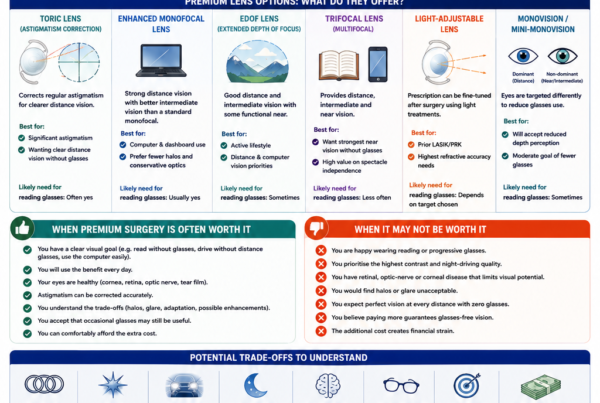
- Monofocal
- Enhanced monofocal
- Extended depth of focus
- Multifocal
- Trifocal
A toric monofocal lens targeted for distance usually still requires reading glasses.
A toric EDOF or trifocal lens may provide a wider range of unaided vision, but it also carries the benefits and compromises of that optical design.
What Is Astigmatism?
The Cornea Is Not Perfectly Symmetrical
In an eye without significant astigmatism, the cornea has relatively similar curvature in all directions.
With astigmatism, one meridian is steeper or more powerful than another.
A simple analogy is:
- A basketball has similar curvature in all directions.
- A rugby ball has different curvature along its two principal axes.
The human cornea is more complex than either shape, but the analogy helps explain why light may not come to one precise focus.
How Does Astigmatism Affect Vision?
Astigmatism may cause:
- Blurred vision
- Ghost images
- Shadowed letters
- Distorted lines
- Glare
- Halos
- Eye strain
- Difficulty seeing fine detail
- Poor night vision
- Reduced unaided vision after cataract surgery
The amount of visual disturbance depends on:
- The magnitude of astigmatism
- Its axis
- Whether it is regular or irregular
- Pupil size
- Lighting
- Other refractive errors
- Corneal and retinal health
Corneal and Lenticular Astigmatism Are Different
Before cataract surgery, the patient’s glasses prescription reflects the combined optical effect of:
- The front and back surfaces of the cornea
- The natural lens
- Other smaller internal optical factors
When the cataractous natural lens is removed, its contribution to astigmatism is also removed.
For this reason, toric-IOL planning is based mainly on the astigmatism expected to remain from the cornea after surgery—not simply on the cylinder written in the patient’s current spectacle prescription.[4,5]
What Does a Toric Lens Correct?
It Corrects Regular Corneal Astigmatism
Regular astigmatism has two principal meridians that are approximately perpendicular to one another.
This pattern is usually suitable for correction with:
- Spectacles
- Toric contact lenses
- Toric intraocular lenses
- Selected corneal incisional procedures
It Does Not Correct Every Corneal Irregularity
A toric IOL cannot fully neutralise highly irregular optics caused by:
- Keratoconus
- Corneal scarring
- Previous corneal infection
- Decentered laser treatment
- Radial keratotomy
- Significant higher-order aberrations
- Unstable corneal shape
- Severe ocular-surface disease
Some carefully selected eyes with stable mild keratoconus or other regularisable patterns may still benefit from a toric lens, but expectations and measurements require particular caution.
It Does Not Treat Retinal or Optic-Nerve Disease
A toric lens improves the optical focus reaching the retina.
It cannot restore vision lost from:
- Macular degeneration
- Epiretinal membrane
- Diabetic macular disease
- Advanced glaucoma
- Optic neuropathy
- Amblyopia
- Retinal scarring
Good unaided vision requires both clear optics and a healthy visual system.
Toric Does Not Mean Multifocal
A Toric Monofocal Lens
A toric monofocal lens provides:
- One principal focal distance
- Astigmatism correction
When targeted for distance, it often provides:
- Clear unaided distance vision
- Good contrast
- Relatively few halos
- Better night-vision tolerance than multifocal optics
Reading glasses are usually required.
A Toric Enhanced Monofocal Lens
An enhanced monofocal toric lens aims to provide:
- Strong distance vision
- Some additional intermediate function
- Astigmatism correction
- A broadly monofocal-like visual profile
Reading glasses are still commonly needed for small print.
A Toric EDOF Lens
A toric EDOF lens combines:
- Correction of regular astigmatism
- Excellent distance vision
- Strong intermediate vision
- Some functional near vision
Reading glasses may still be required for fine print or prolonged reading.
A Toric Trifocal Lens
A toric trifocal lens aims to provide:
- Distance vision
- Intermediate vision
- Near vision
- Astigmatism correction
This may offer the greatest chance of spectacle independence, but residual astigmatism is particularly important because even relatively small amounts can reduce the performance of presbyopia-correcting optics.[6]
How Common Is Astigmatism Before Cataract Surgery?
Corneal astigmatism is common among cataract patients.
Large datasets and reviews indicate that a substantial proportion of eyes have at least 0.5 dioptre of corneal astigmatism, and many have 1.0 dioptre or more. The exact percentage varies according to the population, measurement device and definition used.[4,7]
This matters because untreated astigmatism is an important reason why a patient may still need distance glasses after otherwise successful cataract surgery.
How Is Astigmatism Measured?
Keratometry
Keratometry measures the curvature and power of the cornea’s anterior surface.
It identifies:
- The flatter meridian
- The steeper meridian
- The magnitude of anterior corneal astigmatism
- Its orientation
Keratometry is an essential part of toric-IOL planning, but anterior measurements alone may not describe the entire corneal optical system.
Corneal Topography
Topography maps the curvature pattern across the corneal surface.
It can help detect:
- Regular astigmatism
- Irregular astigmatism
- Keratoconus
- Decentered previous laser treatment
- Contact-lens warpage
- Corneal-surface distortion
A toric lens should not be selected from one isolated number without considering whether the overall corneal pattern is regular and reproducible.
Corneal Tomography
Tomography evaluates the three-dimensional corneal structure and can provide information about:
- Anterior curvature
- Posterior curvature
- Corneal thickness
- Elevation
- Corneal shape
It is particularly useful when:
- Measurements disagree.
- Keratoconus is suspected.
- Previous LASIK or PRK was performed.
- Astigmatism is irregular or unusually high.
- A premium presbyopia-correcting toric lens is being considered.
Repeat Measurements
Measurements may need to be repeated when:
- The tear film is unstable.
- The patient recently wore contact lenses.
- Different devices disagree.
- Corneal staining is present.
- Astigmatism appears irregular.
- Previous results are inconsistent.
A toric calculation is only as reliable as the measurements used to generate it.
Why Does the Tear Film Matter?
The Tear Film Is the Eye’s First Optical Surface
Every corneal measurement is made through the tear film.
Dryness or tear-film instability can alter:
- Keratometry
- Astigmatism magnitude
- Astigmatism axis
- Corneal topography
- Toric-IOL selection
A study specifically examining artificial tears during toric-IOL assessment illustrates the importance of ocular-surface quality when obtaining preoperative measurements.[4]
Dry Eye Can Cause Inconsistent Scans
The same eye may produce different measurements on different days when:
- Blinking is incomplete.
- Meibomian-gland dysfunction is present.
- The corneal epithelium is irregular.
- Preservative-containing drops irritate the surface.
- Contact lenses have recently been removed.
Treat Before Finalising the Lens
Management may include:
- Preservative-free lubricants
- Warm compresses
- Eyelid hygiene
- Treatment of meibomian-gland dysfunction
- Anti-inflammatory dry-eye treatment
- Temporary cessation of contact-lens wear
- Repeating measurements after stabilisation
This is particularly important when the goal is reduced dependence on glasses.
Why Is the Posterior Cornea Important?
The Cornea Has Two Refracting Surfaces
Traditional keratometry estimates total corneal power mainly from the front surface.
However, the posterior surface of the cornea also contributes to total corneal astigmatism.
Ignoring this contribution can lead to:
- Overcorrection in some eyes
- Undercorrection in others
- A shift in the final astigmatic axis
- Residual postoperative cylinder
Studies have shown that posterior corneal astigmatism influences toric-IOL calculation accuracy.[5,8]
Modern Calculators Account for It
Contemporary toric calculators may use:
- A predicted posterior-corneal model
- Directly measured posterior corneal data
- Total keratometry
- Ray tracing
- A combination of biometric inputs
Comparative research suggests that modern formulas incorporating predicted or measured posterior corneal astigmatism generally outperform calculations based only on anterior keratometry.[4,8]
What Is Surgically Induced Astigmatism?
The Cataract Incision Can Change Corneal Shape
Creating the surgical incision may slightly alter corneal curvature.
This change is called surgically induced astigmatism, or SIA.
Its magnitude and direction depend on factors including:
- Incision size
- Incision location
- Corneal properties
- Surgical technique
- Wound healing
It Must Be Included in Planning
The toric calculation aims to predict the astigmatism remaining after:
- The cataract has been removed.
- The incision has changed the cornea.
- The toric IOL has been implanted at its intended axis.
Surgeons may use their own measured SIA values or modern formula assumptions when planning the lens.[4]
How Is the Toric Lens Power Chosen?
The Spherical Power and Cylinder Power Are Calculated
The surgeon must select:
- The overall IOL power for the desired refractive target
- The toric-cylinder power
- The axis at which the lens should be positioned
The calculation may consider:
- Eye length
- Corneal power
- Anterior-chamber depth
- Lens thickness
- Total corneal astigmatism
- Posterior corneal astigmatism
- Surgically induced astigmatism
- Incision location
- Expected IOL position
Toric Power Is Often Labelled at the IOL Plane
The cylinder value printed on an IOL package may not equal the amount corrected at the corneal plane.
The effective correction depends partly on:
- The spherical power of the IOL
- Its position inside the eye
- The manufacturer’s optical design
- The calculation method
Patients should not compare the number on the IOL box directly with the cylinder in their spectacle prescription.
How Is the Lens Axis Marked?
The Eye Can Rotate When You Lie Down
When a patient moves from sitting to lying flat, the eye may rotate slightly.
This is called cyclotorsion.
If the axis is marked only after the patient lies down, the planned position may be inaccurate.
Manual Marking
Manual marking may involve:
- Reference marks placed while sitting upright
- An intraoperative axis marker
- Alignment marks on the toric IOL
This approach can be effective when performed carefully.
Digital Image Guidance
Image-guided systems may:
- Register preoperative eye images
- Identify blood-vessel and iris landmarks
- Compensate for cyclotorsion
- Display the intended axis through the operating microscope
These systems can improve alignment precision, although good outcomes remain possible with careful manual marking.[4]
Intraoperative Aberrometry
Intraoperative aberrometry measures the eye’s refractive state during surgery and may help refine:
- IOL spherical power
- Toric power
- Toric axis
An American Academy of Ophthalmology assessment found that intraoperative aberrometry can be useful in selected circumstances, although modern preoperative formulas that account for posterior corneal astigmatism may perform similarly in many routine toric cases.[9]
What Happens During Surgery?
The Cataract Is Removed Normally
The main stages remain similar to ordinary cataract surgery:
- The eye is anaesthetised.
- Small corneal incisions are created.
- The front of the lens capsule is opened.
- The cataract is fragmented and removed.
- The capsular bag is cleaned.
- The toric IOL is inserted.
- The lens is rotated towards the intended axis.
- The final alignment is checked.
- The wounds are secured and assessed.
The Lens Is Aligned Near the End
The surgeon rotates the toric IOL so that its reference marks correspond with the calculated axis.
Precise final positioning is important because rotation away from the intended axis reduces the amount of astigmatism corrected.
Why Is Rotational Stability Important?
A Toric Lens Must Remain at Its Planned Axis
A spherical IOL has the same refractive power in every orientation.
A toric IOL does not.
If it rotates significantly:
- Astigmatic correction decreases.
- Residual cylinder increases.
- Vision may become blurred or distorted.
- The axis of residual astigmatism may change.
- Repositioning may be required.
Modern Lenses Are Generally Stable
A 2024 systematic review and meta-analysis involving 51 studies and 4,863 eyes found that modern toric lenses generally demonstrated strong rotational stability, with an average absolute rotation of approximately 2.4 degrees across the included lens models. Stability nevertheless varied between designs.[10]
Most Rotation Occurs Early
Rotation is generally most likely before the capsular bag contracts around the IOL.
Factors that may influence stability include:
- IOL material
- Haptic design
- Capsular-bag size
- Very long eyes
- Weak zonules
- Incomplete removal of viscoelastic
- Lens placement
- Capsular support
Not every rotation is clinically significant.
Who May Have a Higher Risk of Rotation?
Additional caution may be required in eyes with:
- High axial myopia
- A large capsular bag
- Weak or damaged zonules
- Pseudoexfoliation
- Previous trauma
- Connective-tissue disorders
- Previous vitrectomy
- Complicated surgery
- Significant capsular instability
A toric lens may still be possible in selected cases, but the surgeon must balance the benefit of astigmatism correction against the risk that the lens may not remain stable.
What Results Can You Expect?
Better Unaided Distance Vision
Systematic reviews and the 2024 AAO technology assessment found that toric monofocal IOLs generally provide better unaided distance visual acuity than non-toric monofocal lenses in eyes with pre-existing corneal astigmatism.[1,2]
Less Residual Astigmatism
Toric IOLs generally leave less postoperative refractive cylinder than:
- Non-toric monofocal lenses
- Non-toric lenses combined with corneal relaxing incisions
although the precision varies among studies, lens models and astigmatic ranges.[1–3]
Greater Distance-Spectacle Independence
Reducing corneal astigmatism increases the chance that distance vision will be clear without glasses.
However, spectacle independence also depends on:
- The spherical refractive result
- Ocular health
- The selected focal target
- Whether both eyes have been treated
- The type of IOL
A toric monofocal lens targeted for distance does not normally eliminate the need for reading glasses.
Can a Toric Lens Make You Completely Spectacle-Free?
Toric Monofocal
A toric monofocal lens can reduce dependence on distance spectacles.
It does not restore accommodation.
Most patients still need glasses for:
- Phone use
- Books
- Menus
- Small print
- Fine near work
Toric Monovision
Different targets can be selected:
- One eye for distance
- One eye for intermediate or near vision
This may reduce dependence on glasses across a wider range.
The trade-offs may include:
- Reduced fine depth perception
- Visual imbalance
- Less optimal low-light vision
- Difficulty adapting
Toric EDOF
A toric EDOF strategy may provide:
- Distance vision
- Computer vision
- Functional near vision
- Astigmatism correction
Reading glasses may still be useful for small print.
Toric Trifocal
A toric trifocal lens may provide the greatest chance of spectacle independence for:
- Distance
- Intermediate activities
- Near tasks
However, patients must accept the possibility of:
- Halos
- Glare
- Starbursts
- Reduced contrast in dim light
- Neuroadaptation
Accurate astigmatism correction is especially important for these lenses.[6]
Toric IOLs Versus Corneal Relaxing Incisions
What Are Relaxing Incisions?
Corneal relaxing incisions are placed in the steep corneal meridian to reduce astigmatism.
They may be created:
- Manually
- With a diamond blade
- With a femtosecond laser
They are often described as:
- Limbal relaxing incisions
- Peripheral corneal relaxing incisions
- Arcuate keratotomy
Advantages of Corneal Incisions
Potential advantages include:
- No toric lens is required.
- They may be useful for low levels of astigmatism.
- They may be combined with different IOL types.
- There is no risk of toric-IOL rotation.
Limitations
Potential disadvantages include:
- Variable healing response
- Less predictability
- Undercorrection
- Overcorrection
- Axis shift
- Regression
- Corneal discomfort
- Induced irregularity in uncommon cases
Which Is More Effective?
Cochrane evidence indicates that toric IOLs probably provide a higher chance of achieving low residual astigmatism than limbal relaxing incisions. The AAO review similarly concluded that toric lenses provide more effective correction, particularly for greater magnitudes of astigmatism.[1,3]
A 2025 meta-analysis comparing toric IOLs with femtosecond laser-assisted astigmatic keratotomy found less residual cylinder and better unaided distance vision with toric lenses overall.[11]
Toric IOLs Versus Glasses
Glasses Can Correct Residual Astigmatism
A non-toric IOL can be implanted and the remaining astigmatism corrected with spectacles.
This may be reasonable if:
- You are comfortable wearing glasses.
- The astigmatism is irregular.
- Measurements are inconsistent.
- Capsular stability is uncertain.
- The expected benefit of a toric lens is small.
- Cost is an important consideration.
A Toric IOL Reduces Dependence on External Correction
The main advantage is that astigmatism is corrected inside the eye.
This can improve unaided vision and reduce reliance on:
- Distance spectacles
- High-cylinder spectacle lenses
- Toric contact lenses
It does not guarantee that glasses will never be useful.
Toric IOLs Versus Toric Contact Lenses
Toric contact lenses sit on the corneal surface, while toric IOLs are implanted permanently inside the eye.
After cataract surgery, contact lenses may still be used if appropriate, but many patients choose a toric IOL to reduce the need for ongoing external correction.
A toric IOL does not:
- Become dry
- Need daily cleaning
- Fall out
- Move with blinking
However, it is an intraocular implant and requires accurate surgical planning and alignment.
When Might a Toric Lens Not Be Recommended?
Irregular or Unstable Astigmatism
A toric lens may be unsuitable when measurements show:
- Markedly irregular astigmatism
- Progressive keratoconus
- Contact-lens warpage
- Unstable corneal shape
- Severe epithelial irregularity
- Inconsistent axis readings
Poor Visual Potential
The benefit may be limited when vision is primarily reduced by:
- Advanced macular disease
- Advanced glaucoma
- Optic atrophy
- Dense amblyopia
- Severe corneal opacity
Inadequate Capsular Support
The lens may not remain aligned when there is:
- Severe zonular weakness
- Marked pseudoexfoliation
- Significant previous trauma
- Major capsular damage
- Need for an alternative IOL position
Measurements Cannot Be Trusted
Surgery may need to be delayed when:
- Dry eye is uncontrolled.
- Contact-lens effects have not resolved.
- Corneal scans disagree significantly.
- The cornea is actively changing.
- Previous records are incomplete after complex refractive surgery.
Toric Lenses After LASIK or PRK
Previous Laser Surgery Changes Corneal Relationships
LASIK and PRK alter the anterior corneal surface.
Traditional assumptions about the relationship between the front and back of the cornea may no longer apply accurately.
This can make both spherical and toric calculations more complex.
Detailed Corneal Assessment Is Needed
Planning may require:
- Topography
- Tomography
- Total keratometry
- Aberrometry
- Several modern formulas
- Previous laser records when available
- Assessment of higher-order aberrations
A Toric Lens May Still Be Suitable
A toric IOL may be effective when the residual corneal astigmatism is:
- Regular
- Stable
- Reproducible
- Accurately measured
It may be less suitable when the laser treatment has created significant irregularity or decentration.
Toric Lenses in Keratoconus
Keratoconus Requires Careful Selection
Keratoconus causes corneal thinning and irregular shape.
A toric lens does not correct the full irregular optical pattern.
Selected Stable Eyes May Benefit
A toric IOL may be considered when:
- Keratoconus is mild or moderate.
- The condition is stable.
- The central optical zone is reasonably regular.
- Measurements are repeatable.
- The patient obtains good vision with spectacles.
- Expectations are realistic.
Specialty Contact Lenses May Still Be Needed
Patients relying on rigid or scleral lenses before cataract surgery may still require them after surgery to correct irregular astigmatism.
Implanting a toric IOL may complicate future contact-lens over-refraction if the corneal pattern changes, so planning must be individualised.
What Can Cause Residual Astigmatism?
Measurement Error
Possible causes include:
- Dry eye
- Poor fixation
- Contact-lens warpage
- Inconsistent keratometry
- Incorrect axis measurement
- Unrecognised irregular astigmatism
Posterior Corneal Astigmatism
Failure to account adequately for the posterior cornea can result in prediction error.[5,8]
Surgically Induced Astigmatism
The actual corneal change caused by the incision may differ from the assumed value.
Incorrect Effective Lens Position
The amount of cylinder correction at the corneal plane depends partly on where the IOL ultimately sits inside the eye.
Toric-Lens Rotation
Rotation away from the intended axis reduces correction.
Corneal Change Over Time
Astigmatism may change gradually with:
- Age
- Eyelid anatomy
- Corneal disease
- Surgery
- Ocular-surface changes
An Incorrect Toric Power Was Selected
The available toric-cylinder powers are supplied in steps.
The surgeon may need to choose between:
- A small predicted undercorrection
- A possible overcorrection
- Leaving a low amount of residual astigmatism
More Than One Factor May Be Present
A large analysis using a toric-IOL back-calculator found that residual astigmatism may result from a combination of lens alignment, corneal measurement differences and other predictive errors rather than rotation alone.[12]
How Is Residual Astigmatism Assessed?
Refraction
A manifest refraction measures:
- The residual sphere
- The residual cylinder
- The residual cylinder axis
- How much vision improves with glasses
Lens-Axis Examination
The ophthalmologist may dilate the pupil and examine:
- The toric reference marks
- The current lens axis
- The intended lens axis
- Lens centration
- Capsular stability
Corneal Measurements
Repeat keratometry, topography or tomography may determine whether:
- The cornea changed
- The preoperative measurement was inaccurate
- The astigmatism is irregular
- Dry eye is affecting the result
Toric Back-Calculation
A toric back-calculator may estimate:
- Whether rotating the IOL would reduce the residual cylinder
- The ideal new axis
- The predicted remaining astigmatism after rotation
What Can Be Done if Astigmatism Remains?
Glasses
Glasses are the simplest and lowest-risk solution.
They may be suitable when:
- The residual error is small.
- Vision is excellent with correction.
- The patient does not mind spectacles.
- Further surgery is not justified.
Contact Lenses
A toric soft lens or rigid lens may be used in selected patients.
Rigid or scleral lenses may be particularly useful when the cornea is irregular.
Toric-IOL Repositioning
If the lens has rotated significantly and back-calculation predicts meaningful improvement, the IOL may be rotated to a new axis.
Repositioning is often easier before the capsule has become firmly fibrosed around the lens.
Corneal Laser Enhancement
LASIK or PRK may correct residual astigmatism when:
- The cornea is suitable.
- Refraction is stable.
- Ocular-surface disease is controlled.
- The amount of correction is appropriate.
Corneal Relaxing Incisions
Selected residual astigmatism may be treated using:
- Manual arcuate incisions
- Femtosecond laser-assisted arcuate keratotomy
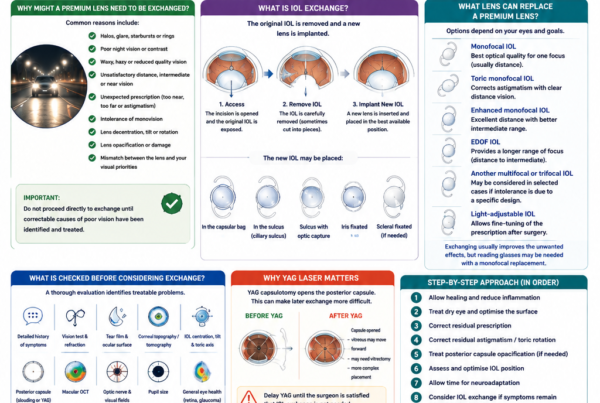
Lens Exchange
Lens exchange may be considered when:
- The toric power is substantially incorrect.
- The IOL is unsuitable.
- Rotation cannot provide adequate correction.
- Other methods are inappropriate.
Lens exchange carries additional intraocular risks and is not usually the first solution for a small residual prescription.
Can the Toric Lens Rotate Years Later?
Late rotation is uncommon after the lens has become stable within the capsular bag.
However, late changes may occur with:
- Progressive zonular weakness
- Pseudoexfoliation
- Trauma
- Capsular contraction
- IOL-bag complex instability
New blur or astigmatism years after surgery should therefore be assessed rather than assumed to be a glasses issue.
Does YAG Laser Affect the Toric Lens?
YAG Treats Capsule Clouding
Posterior capsule opacification can cause:
- Blur
- Glare
- Reduced contrast
- A decline in unaided vision
YAG laser capsulotomy creates an opening in the cloudy capsule behind the IOL.
Confirm the Cause Before YAG
Before performing YAG, the ophthalmologist should evaluate:
- Refraction
- Toric alignment
- Lens stability
- Corneal clarity
- Macular health
- The degree of capsule opacity
If toric-lens repositioning or exchange is being seriously considered, opening the posterior capsule may make later surgery more complex.
Do You Need Glasses After a Toric Lens?
For Distance
Many patients achieve good unaided distance vision, but glasses may still help when there is:
- Residual sphere
- Residual cylinder
- Dry eye
- Corneal irregularity
- Retinal disease
- A need for maximum night-driving clarity
For Reading
A toric monofocal lens targeted for distance does not provide normal accommodation.
Reading glasses are therefore usually required.
For Night Driving
A low-powered prescription may improve:
- Headlight clarity
- Contrast
- Road signs
- Residual astigmatism
- Visual comfort
Using glasses for selected situations does not mean the toric lens has failed.
Is a Toric Lens Worth the Additional Cost?
Potential Benefits
A toric IOL may provide value through:
- Better unaided distance vision
- Reduced dependence on distance glasses
- Correction built into the cataract operation
- More predictable correction than incisional procedures
- Improved performance of EDOF or trifocal optics
It May Be Less Valuable When:
- You are comfortable wearing glasses.
- The predicted residual astigmatism is minimal.
- The cornea is irregular.
- Measurements are unreliable.
- Visual potential is limited.
- Capsular stability is uncertain.
- The available toric power is not a good match.
The decision should be based on the predicted benefit for that individual eye—not simply on whether a premium option is available.
Frequently Asked Questions
Is a Toric Lens Better Than a Normal Lens?
A toric lens is generally better when clinically significant regular corneal astigmatism should be corrected.
A non-toric lens may be more appropriate when:
- Astigmatism is minimal.
- The cornea is irregular.
- Measurements are unstable.
- The patient is comfortable using glasses.
- The lens may not remain rotationally stable.
How Much Astigmatism Do I Need for a Toric Lens?
There is no universal cutoff.
The decision depends on:
- Total corneal astigmatism
- Posterior corneal astigmatism
- Surgical incision
- The available toric powers
- The IOL type
- The refractive target
- Your desire to reduce glasses
Will a Toric Lens Remove All My Astigmatism?
Not always.
The aim is to reduce astigmatism as accurately as reasonably possible.
A small residual amount may remain because of measurement limitations, healing, lens rotation or the available IOL power steps.
Can a Toric Lens Overcorrect Astigmatism?
Yes.
Overcorrection may occur if:
- The toric power is too strong.
- Posterior corneal astigmatism is not accounted for correctly.
- The surgical effect differs from the prediction.
- Measurements are inaccurate.
Modern calculators are designed to minimise this risk.
Does a Toric Lens Correct Near Vision?
Only when it is combined with an optical strategy designed to provide near vision.
A toric monofocal lens targeted for distance usually requires reading glasses.
Is a Toric Lens Also a Premium Lens?
It is commonly described as a premium IOL because it provides additional astigmatism correction.
However, “premium” does not mean it is automatically multifocal.
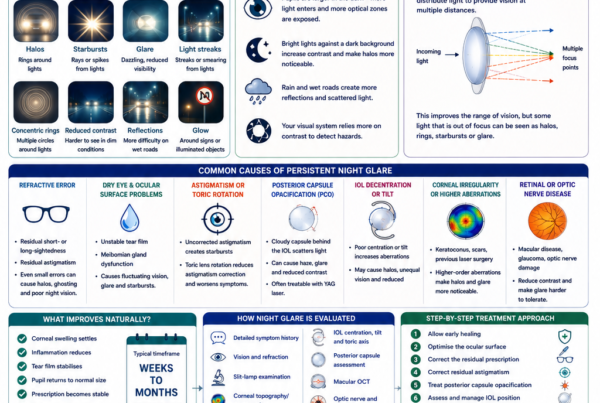
Does a Toric Lens Cause Halos?
The toric component itself is not generally the main cause of multifocal-style halos.
Halos may still occur because of:
- Residual astigmatism
- Dry eye
- Corneal swelling
- Posterior capsule opacification
- A multifocal or EDOF optical design
- Other ocular abnormalities
Is a Toric Lens Good for Night Driving?
A well-aligned toric monofocal lens can provide excellent distance and night-driving vision when the rest of the eye is healthy.
A toric trifocal or diffractive EDOF lens may produce additional halos related to its presbyopia-correcting optics.
Can a Toric Lens Move?
It can rotate, particularly during the early postoperative period.
Modern toric lenses are generally rotationally stable, but significant rotation occasionally requires repositioning.[10]
How Will I Know if It Has Rotated?
Possible symptoms include:
- Blurred distance vision
- Ghosting
- Increased astigmatism
- Vision that was initially clear and then worsened
An examination is required because the same symptoms can also result from dry eye, corneal swelling or other conditions.
Can the Lens Be Rotated Back?
Yes, when rotation is clinically significant and repositioning is predicted to improve the result.
Can I Have a Toric Lens After LASIK?
Possibly.
The corneal astigmatism must be sufficiently regular and the measurements reliable.
Can I Have a Toric Lens With Keratoconus?
Selected stable cases may be suitable, but a toric lens cannot correct the full irregular astigmatism of keratoconus.
Can I Have Toric Lenses in Both Eyes?
Yes.
Each eye is calculated independently because:
- Astigmatism may differ.
- The axis may differ.
- The spherical power may differ.
- One eye may require a toric lens while the other does not.
Can One Eye Have a Toric Lens and the Other a Non-Toric Lens?
Yes.
The decision is made for each eye according to its predicted postoperative astigmatism and visual plan.
Questions to Ask Your Ophthalmologist
About Your Astigmatism
- How much total corneal astigmatism do I have?
- Is it regular or irregular?
- Are my measurements consistent?
- Has the posterior cornea been considered?
- Is the astigmatism likely to remain after cataract removal?
- Is the amount high enough to justify a toric lens?
About the Lens
- Is the proposed lens monofocal, enhanced monofocal, EDOF or trifocal?
- What toric power will be used?
- What axis will it be aligned to?
- Is the selected model rotationally stable?
- Is a toric version available in my required spherical power?
- Will I still need reading glasses?
About the Procedure
- Will manual or digital alignment be used?
- Will intraoperative aberrometry be used?
- What is your expected surgically induced astigmatism?
- How will alignment be checked after surgery?
- What happens if the lens rotates?
About the Backup Plan
- What residual astigmatism is predicted?
- Would glasses correct it?
- Could the lens be repositioned?
- Is laser enhancement possible?
- Could relaxing incisions be used?
- When would lens exchange be considered?
A Toric-Lens Suitability Checklist
Factors Supporting a Toric Lens
- Regular corneal astigmatism
- Repeatable measurements
- Stable ocular surface
- Good visual potential
- Healthy or sufficiently functional retina and optic nerve
- Stable capsular support
- Desire to reduce distance-glasses dependence
- An available toric power that matches the calculation
- Realistic expectations
Factors Requiring Additional Caution
- Irregular astigmatism
- Keratoconus
- Corneal scarring
- Previous LASIK or PRK
- Severe dry eye
- Very high myopia
- Pseudoexfoliation
- Zonular weakness
- Previous trauma
- Previous vitrectomy
- Macular disease
- Advanced glaucoma
- Poor vision in the other eye
- Inconsistent scans
The Bottom Line
A toric intraocular lens is designed to correct regular corneal astigmatism during cataract surgery.
Compared with a non-toric monofocal lens, a well-selected and well-aligned toric lens generally provides:
- Better unaided distance vision
- Less residual astigmatism
- Greater distance-spectacle independence
- More predictable correction than corneal relaxing incisions
The result depends on:
- Accurate keratometry
- Corneal topography or tomography when indicated
- A stable tear film
- Consideration of posterior corneal astigmatism
- Correct toric power selection
- The effect of the surgical incision
- Precise axis alignment
- Rotational stability
- The health of the rest of the eye
Remember:
- Toric means astigmatism-correcting.
- It does not automatically mean multifocal.
- A toric monofocal lens usually still requires reading glasses.
- A toric EDOF or trifocal lens may provide a wider visual range.
- A small residual prescription may still remain.
- Irregular corneal astigmatism may not be fully corrected.
- Significant lens rotation can occasionally require repositioning.
The best toric lens is not simply the lens with the highest cylinder power.
It is the lens that most accurately matches your predicted postoperative corneal astigmatism, remains stable inside your eye and supports the overall visual strategy you have selected.
References
- Al-Mohtaseb Z, Steigleman WA, Pantanelli SM, Lin CC, Hatch KM, Rose-Nussbaumer JR, et al. Toric monofocal intraocular lenses for the correction of astigmatism during cataract surgery: a report by the American Academy of Ophthalmology. Ophthalmology. 2024;131(3):383–392. doi:10.1016/j.ophtha.2023.10.010. PMID: 38149945.
- Kessel L, Andresen J, Tendal B, Erngaard D, Flesner P, Hjortdal J. Toric intraocular lenses in the correction of astigmatism during cataract surgery: a systematic review and meta-analysis. Ophthalmology. 2016;123(2):275–286. doi:10.1016/j.ophtha.2015.10.002. PMID: 26601819.
- Lake JC, Victor G, Clare G, Porfírio GJM, Kernohan A, Evans JR. Toric intraocular lens versus limbal relaxing incisions for corneal astigmatism after phacoemulsification. Cochrane Database Syst Rev. 2019;12(12). doi:10.1002/14651858.CD012801.pub2. PMID: 31845757.
- Park RB, Kim MK, Wee WR. Astigmatism management in modern cataract surgery. J Clin Med. 2024;13(7):1944. doi:10.3390/jcm13071944.
- Klijn S, Reus NJ, Sicam VADP. Evaluation of keratometry with a novel colour-LED corneal topographer. Impact of the posterior cornea on toric-IOL calculation accuracy. Graefes Arch Clin Exp Ophthalmol. 2015;253(8):1243–1252. PMID: 25259550.
- Zhang L, et al. Effect of postoperative residual astigmatism on visual outcomes after trifocal intraocular lens implantation. Front Med. 2023;10:1202793. doi:10.3389/fmed.2023.1202793. PMID: 37497270.
- Khoramnia R, Auffarth GU, Łabuz G, Pettit G, Suryakumar R. Refractive outcomes after cataract surgery. Diagnostics. 2022;12(2):243. doi:10.3390/diagnostics12020243. PMID: 35204334.
- Reitblat O, Barnir M, Qassoom A, Levy A, Assia EI, Kleinmann G. Comparison of the Barrett Toric Calculator using measured and predicted posterior corneal astigmatism and the Kane and Abulafia-Koch calculators. J Cataract Refract Surg. 2023;49(7):704–710. doi:10.1097/j.jcrs.0000000000001178. PMID: 38000619.
- Pantanelli SM, et al. Intraoperative aberrometry versus preoperative biometry for intraocular lens power selection: a report by the American Academy of Ophthalmology. Ophthalmology. 2025. doi:10.1016/j.ophtha.2024.08.007. PMID: 39365199.
- Li ES, Vanderford EK, Xu Y, Kang PC. Rotational stability of toric intraocular lenses by lens model and haptic design: systematic review and single-arm meta-analysis. J Cataract Refract Surg. 2024;50(9):976–984. doi:10.1097/j.jcrs.0000000000001486. PMID: 38768060.
- Yen WT, et al. Femtosecond laser-assisted astigmatic keratotomy versus toric intraocular lens implantation for correcting astigmatism in cataract patients: a systematic review and meta-analysis. Eye. 2025. PMID: 38575199.
- Kramer BA, Berdahl JP, Hardten DR, Potvin R. Residual astigmatism after toric intraocular lens implantation: analysis of data from an online toric intraocular lens back-calculator. J Cataract Refract Surg. 2016;42(11):1595–1601. doi:10.1016/j.jcrs.2016.09.017. PMID: 27956286.