Author: Dr Val Phua
Estimated reading time: 20 minutes
Multifocal intraocular lenses are designed to reduce dependence on spectacles after cataract surgery by providing useful vision at more than one distance.
A standard monofocal lens usually has one principal focal point. When it is targeted for distance, patients commonly need glasses for reading and may need them for computer work.
A multifocal lens distributes incoming light across different focal ranges so that the eye can see distant, intermediate and near objects. Modern trifocal lenses are designed to provide all three ranges.
The central trade-off is straightforward:
- The main advantage is a greater chance of seeing at several distances without glasses.
- The main disadvantage is a greater possibility of halos, glare, starbursts or reduced visual quality in dim lighting.
Systematic reviews have found that multifocal lenses generally provide better unaided near vision and greater spectacle independence than monofocal lenses. However, glare and halos are reported more frequently, and whether the benefits outweigh the optical compromises differs between patients.
A multifocal lens is therefore not automatically a “better” lens. It is an alternative optical strategy for patients who place a high value on reducing their use of glasses and are willing to accept possible visual side effects.
The Quick Answer
What Are the Main Benefits?
Multifocal lenses may provide:
- Clear distance vision
- Better intermediate vision
- Better unaided reading vision
- Reduced dependence on spectacles
- Convenience for phone, computer and everyday activities
- A broad binocular range after both eyes are treated
Compared with monofocal lenses, the clearest evidence-supported advantages are improved unaided near vision and a greater likelihood of spectacle independence. Distance visual acuity is generally similar when the refractive result is accurate.
What Are the Main Disadvantages?
Possible disadvantages include:
- Halos around lights
- Glare
- Starbursts
- Light streaks
- Reduced contrast in dim conditions
- Less crisp night vision
- A period of neuroadaptation
- Greater sensitivity to dry eye
- Greater sensitivity to residual astigmatism or prescription
- A need for glasses in some situations
- Occasional need for additional treatment
Meta-analyses have found substantially more reported halos and moderately more glare with multifocal lenses than with monofocal lenses, although results vary among lens generations and study methods.
Who Is Most Likely to Be Happy With a Multifocal Lens?
The strongest candidates generally:
- Strongly value spectacle independence
- Have healthy corneas
- Have a stable tear film
- Have healthy maculae and optic nerves
- Have regular astigmatism that can be corrected
- Understand that halos may occur
- Accept that occasional glasses may still be useful
- Have realistic expectations
Careful patient selection and counselling are central to successful outcomes with multifocal IOLs.
What Is a Multifocal Intraocular Lens?
More Than One Focal Range
A multifocal IOL is an artificial lens that provides more than one optical power.
Depending on its design, it may offer:
- Distance and near focus
- Distance and intermediate focus
- Distance, intermediate and near focus
A modern lens designed for all three ranges is generally described as a trifocal IOL.
How Does It Work?
Most multifocal lenses use refractive zones, diffractive rings or a combination of optical principles to distribute incoming light towards different focal distances.
This means that light from more than one focal range reaches the retina simultaneously. The brain must select the most useful information for the object being viewed and suppress less relevant optical information.
This differs from natural accommodation, in which a young natural lens changes shape to focus at different distances. A multifocal IOL does not restore the eye to the optical state of a healthy 20-year-old lens.
Bifocal Versus Trifocal Lenses
A bifocal lens generally provides:
- Distance vision
- Near vision
A trifocal lens generally adds a dedicated intermediate focus for activities such as:
- Computer use
- Car-dashboard viewing
- Cooking
- Seeing objects across a desk
Modern comparative evidence suggests that trifocal lenses provide particularly strong unaided near vision while maintaining distance vision comparable with monofocal lenses.
Diffractive Versus Refractive Multifocal Lenses
Multifocal lenses may use:
- Diffractive rings
- Refractive zones
- Hybrid designs
- Pupil-dependent optics
- Pupil-independent optics
These designs do not perform identically. Newer diffractive technologies may provide better near vision and fewer unwanted visual phenomena than some older refractive or diffractive designs, but no multifocal platform eliminates every optical compromise.
Pros of Multifocal Lenses
Better Unaided Near Vision
Near vision is one of the strongest advantages of a multifocal lens.
Patients may be able to see:
- A phone
- Menus
- Books
- Labels
- Price tags
- Printed documents
- A watch
- Medicine instructions
without reaching for reading glasses.
Cochrane and other systematic reviews consistently find better unaided near vision with multifocal IOLs than with distance-targeted monofocal lenses.
Greater Spectacle Independence
Multifocal lenses increase the probability that a patient can complete routine activities without spectacles.
This may include:
- Driving
- Watching television
- Using a computer
- Looking at a phone
- Shopping
- Cooking
- Reading menus
- Social activities
In the 2019 systematic review, multifocal-lens recipients were substantially less likely to depend on spectacles than recipients of standard IOLs.
Good Distance Vision
Multifocal lenses are not designed to sacrifice ordinary distance acuity.
When:
- The IOL calculation is accurate
- Astigmatism is adequately corrected
- The ocular surface is stable
- The retina and optic nerve are healthy
- The lens is well centred
distance visual acuity can be excellent.
Large reviews generally find no clinically important difference in average unaided or corrected distance acuity between multifocal and monofocal lenses.
Useful Intermediate Vision
Modern trifocal lenses provide an intermediate range for:
- Desktop screens
- Laptops
- Car dashboards
- Cooking
- Supermarket shelves
- Musical instruments
- Household activities
Intermediate performance depends on the lens design and the distance at which the task is performed.
For example, a lens optimised around 60 centimetres may perform differently from a lens whose intermediate focus is closer to 80 centimetres.
Convenience During Daily Life
Reducing glasses dependence may make everyday activities easier.
Examples include:
- Reading a message immediately
- Seeing a restaurant menu
- Looking at the dashboard while driving
- Reading a price tag
- Exercising without spectacles
- Wearing non-prescription sunglasses
- Avoiding repeatedly putting glasses on and taking them off
The value of this convenience is highly personal. A patient who rarely minds using glasses may place less value on it than a patient who strongly dislikes spectacles.
A Broad Binocular Range
Multifocal performance generally works best when both eyes have compatible optical plans.
After both eyes are treated, binocular summation may improve:
- Distance clarity
- Intermediate performance
- Near vision
- Contrast
- Depth perception
- Overall visual confidence
The first operated eye may not fully demonstrate the intended bilateral result while the other eye still has a cataract or a substantially different prescription.
Reduced Need for Progressive Glasses
Patients who become functionally spectacle-independent may avoid some inconveniences of progressive spectacles, including:
- Distortion at the lens edges
- Head-position dependence
- Difficulty on stairs
- Glasses fogging
- Frame pressure
- Repeated prescription changes
Spectacles may still be kept for specialised tasks or maximum visual sharpness.
Cons of Multifocal Lenses
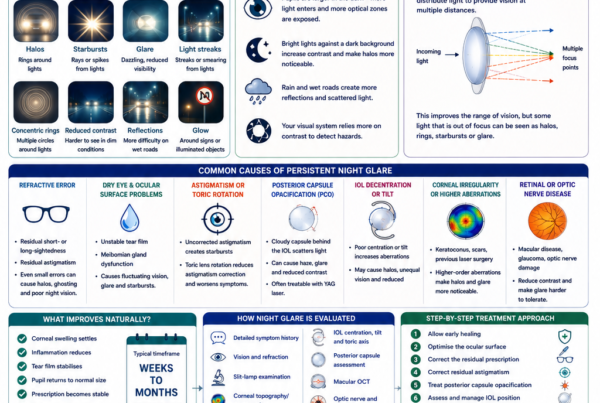
Halos Around Lights
Halos are commonly described as rings or circles around:
- Headlights
- Streetlights
- Traffic signals
- Illuminated signs
- Small LED lights
The Cochrane review found halos to be more prevalent with multifocal than monofocal IOLs, while the 2019 meta-analysis also found a markedly increased pooled risk.
Glare and Starbursts
Patients may notice:
- Dazzling from oncoming headlights
- Star-shaped rays around lights
- Light streaks
- Reflections from wet roads
- Difficulty in very dark environments
- Reduced visual comfort after bright-light exposure
These are often grouped under the term positive dysphotopsias.
Dysphotopsias are recognised causes of dissatisfaction after otherwise uncomplicated cataract surgery.
Reduced Contrast in Dim Lighting
Contrast sensitivity is the ability to detect an object that does not stand out strongly from its background.
It is important for seeing:
- A pedestrian in dark clothing
- Steps in dim light
- A grey kerb
- Lane markings in rain
- Low-contrast print
- Facial details in poor lighting
Because multifocal lenses distribute light among several focal ranges, the retinal image may feel less crisp under low-contrast conditions.
Research results vary: some studies demonstrate reduced contrast, whereas broader network analyses have not always found statistically significant binocular differences. Patients should therefore be counselled that the effect is possible and lens-specific rather than inevitable.
Night Driving May Be More Difficult
Many multifocal patients drive comfortably after adaptation.
Others remain troubled by:
- Headlight halos
- Starbursts
- Reflections in rain
- Reduced pedestrian detection
- Visual fatigue on long drives
- Less confidence on poorly lit roads
A 2025 review of night-driving outcomes identified photic phenomena, contrast and neuroadaptation as relevant considerations after presbyopia-correcting IOL implantation.
Patients who drive professionally or frequently at night should take this trade-off particularly seriously.
Glasses May Still Be Needed
A multifocal IOL reduces spectacle dependence but does not guarantee complete spectacle independence.
Glasses may remain helpful for:
- Very small print
- Reading in dim light
- Prolonged reading
- Detailed craftwork
- Computer screens at an unusual distance
- Night driving
- Correcting residual astigmatism
- Maximising distance clarity
The appropriate promise is a greater chance of reduced dependence—not a guarantee of never using glasses again.
Greater Sensitivity to Residual Prescription
Small refractive errors may be more noticeable with multifocal optics.
These include:
- Residual short-sightedness
- Residual long-sightedness
- Residual astigmatism
Even when eye-chart acuity remains fairly good, residual error may cause:
- Ghosting
- Blurred reading
- Halos
- Reduced contrast
- Waxy vision
- Visual fatigue
Studies of dissatisfied patients identify residual refractive error as one of the most frequent treatable causes of blurred or foggy vision after presbyopia-correcting IOL implantation.
Greater Sensitivity to Dry Eye
The tear film forms the first refracting surface of the eye.
Dry eye may cause:
- Fluctuating vision
- Ghosting
- Glare
- Halos
- Burning
- Grittiness
- Difficulty sustaining reading
In dissatisfied presbyopia-correcting-IOL patients, dry eye has been identified as one of the most common causes of visual complaints.
An unstable tear film can also reduce the accuracy of preoperative measurements, making ocular-surface treatment important before final lens calculations.
Neuroadaptation May Take Time
The brain needs time to adjust to receiving simultaneous optical information from several distances.
Patients may initially notice:
- Competing images
- Halos
- Light rings
- Reduced visual clarity
- Difficulty in dim light
- An unfamiliar visual sensation
Neuroadaptation may occur over weeks or months.
Comprehensive counselling about adaptation is recommended because not every patient adjusts at the same speed or to the same extent.
Not Every Patient Fully Adapts
A minority of patients continue to experience significant symptoms despite:
- Good visual acuity
- Accurate lens position
- A clear capsule
- Treatment of dry eye
- Correction of residual prescription
Some patients require further intervention, and a small number ultimately undergo lens exchange.
In referral-based studies, most causes of dissatisfaction could be identified and treated, but some patients remained dissatisfied despite multiple measures.
Additional Treatment May Be Required
Possible postoperative treatments include:
- Dry-eye treatment
- Spectacles
- Contact lenses
- Corneal laser enhancement
- Toric-IOL rotation
- YAG laser capsulotomy
- Treatment of retinal disease
- IOL exchange
This does not mean that additional treatment is common for every patient. It means that choosing a multifocal lens involves a higher expectation of refractive precision and occasionally a longer path to the final visual result.
Cost Is Usually Higher
Multifocal lenses commonly involve additional charges related to:
- The IOL technology
- Advanced preoperative measurements
- Astigmatism correction
- Additional counselling
- Potential enhancement planning
- Additional postoperative assessments
Higher cost does not mean the lens will be better for every eye.
A carefully selected monofocal lens may provide a more satisfactory result than an unsuitable multifocal lens.
A Quick Pros-and-Cons Summary
| Potential advantages | Potential disadvantages |
|---|---|
| Better unaided near vision | Halos around lights |
| Strong distance vision | Glare and starbursts |
| Useful computer vision | Possible reduction in low-light contrast |
| Greater spectacle independence | Night-driving difficulty in some patients |
| Convenience for daily activities | Glasses may still be required |
| Less reliance on progressive spectacles | Sensitive to residual prescription |
| Broad binocular range | Sensitive to dry eye |
| Good lifestyle flexibility | Requires neuroadaptation |
| Toric versions may correct astigmatism | Higher cost |
| High satisfaction in suitable candidates | Additional treatment may occasionally be needed |
Who Is a Good Candidate?
A Patient Strongly Motivated to Reduce Glasses Use
The patient should value freedom from spectacles enough to accept possible optical compromises.
The Cochrane review concluded that motivation to achieve spectacle independence is likely to be an important deciding factor when balancing improved near vision against glare and halos.
Healthy Corneas
The cornea should ideally be:
- Clear
- Regular
- Stable
- Free from significant scarring
- Free from meaningful irregular astigmatism
- Associated with acceptable higher-order aberrations
Corneal topography or tomography may be needed when the shape is uncertain.
A Stable Ocular Surface
Dry eye and meibomian-gland dysfunction should be identified and treated before final measurements when possible.
The goal is to improve:
- Measurement consistency
- Astigmatism planning
- Lens-power accuracy
- Postoperative visual quality
Healthy Maculae
Macular function is essential for reading and contrast.
Optical coherence tomography may identify subtle conditions such as:
- Epiretinal membrane
- Vitreomacular traction
- Early macular degeneration
- Diabetic macular abnormalities
A retina that looks broadly normal during routine examination may still have structural changes that affect multifocal performance.
Healthy Optic Nerves
The optic nerve should provide adequate:
- Contrast sensitivity
- Visual-field function
- Central visual potential
Significant optic-nerve damage may make multifocal light distribution less desirable.
Correctable Regular Astigmatism
Astigmatism should be minimised because residual cylinder may affect:
- Distance clarity
- Reading vision
- Contrast
- Halo perception
A toric multifocal or trifocal lens may be considered when clinically significant regular corneal astigmatism is present.
Realistic Expectations
A suitable patient understands that:
- Halos may occur.
- Adaptation may take time.
- Glasses may occasionally still be useful.
- No calculation is perfectly accurate.
- An enhancement may occasionally be needed.
- No IOL recreates youthful natural accommodation.
Who May Not Be an Ideal Candidate?
Significant Macular Disease
Caution is appropriate with:
- Age-related macular degeneration
- Epiretinal membrane
- Diabetic macular disease
- Macular oedema
- Vitreomacular traction
- Macular hole
- Previous macular surgery
These conditions can reduce contrast and fine-detail vision even when the cataract operation is technically successful.
Moderate or Advanced Glaucoma
Glaucoma may reduce:
- Contrast sensitivity
- Peripheral vision
- Low-light function
Premium-IOL reviews advise individualised selection according to disease severity, visual-field loss, ocular surface and future glaucoma-management needs.
A monofocal strategy is often more conservative when optic-nerve damage is significant.
Irregular Corneas
Multifocal optics may perform poorly in eyes with:
- Keratoconus
- Corneal scars
- Significant irregular astigmatism
- Decentered previous laser treatment
- Radial keratotomy
- Significant higher-order aberrations
A toric lens corrects regular astigmatism but does not fully correct irregular optical distortion.
Uncontrolled Dry Eye
A patient with significant untreated ocular-surface disease may experience:
- Variable measurements
- Refractive error
- Fluctuating vision
- Poor-quality near vision
- More glare and halos
The surface should be optimised before making a final lens decision.
Amblyopia or Poor Vision in One Eye
Multifocal strategies generally benefit from good binocular function.
When one eye has limited visual potential, the patient may not receive the full binocular advantage of bilateral multifocal implantation.
Unstable Eye Alignment
Patients with:
- Strabismus
- Suppression
- Previous double vision
- Unstable binocular fusion
require careful assessment.
Unrealistic Expectations
A multifocal lens is less suitable for a patient expecting:
- Perfect vision at every distance
- No glasses under any circumstances
- Zero halos
- Immediate adaptation
- Perfect night driving
- Guaranteed 6/6 vision
- No possibility of enhancement
How Does Astigmatism Affect Multifocal Performance?
Residual Astigmatism Reduces Image Quality
Astigmatism can cause:
- Ghosting
- Shadowed letters
- Blur
- Halos
- Reduced contrast
- Poor reading vision
Multifocal lenses generally require a highly accurate refractive result.
Toric Multifocal Lenses
A toric multifocal lens combines:
- Astigmatism correction
- Distance focus
- Intermediate or near focus, depending on design
Accurate calculation and rotational alignment are important.
Corneal Incisions or Laser Correction
Other possible methods of managing astigmatism include:
- Corneal relaxing incisions
- Femtosecond arcuate incisions
- Postoperative LASIK or PRK
- Spectacles
- Contact lenses
The method should be selected according to the magnitude and regularity of the astigmatism.
Multifocal Lenses After LASIK or PRK
Lens-Power Calculations Are More Complex
Previous laser vision correction alters corneal shape and may increase the risk that the postoperative prescription differs from the intended target.
Modern formulas have improved accuracy, but prediction remains less straightforward than in an untreated cornea.
Existing Corneal Aberrations Matter
Some post-LASIK eyes have:
- Regular, centred corneas
- Stable measurements
- Good optical quality
Others have:
- Decentered ablations
- Irregular astigmatism
- Dry eye
- Significant spherical aberration
- Existing night halos
A multifocal lens may add optical phenomena to an eye that already has reduced corneal image quality.
Previous LASIK Is Not an Automatic Exclusion
Selected post-LASIK patients may do well after careful evaluation using:
- Corneal topography
- Tomography
- Aberrometry
- Multiple IOL formulas
- Ocular-surface optimisation
- Macular OCT
- Detailed counselling about refractive uncertainty
What Happens After the First Eye?
The Result May Feel Unbalanced
After the first operation, the patient may have:
- A multifocal lens in one eye
- A cataract in the other
- Different colour perception
- Different prescriptions
- Different image quality
- Halos in one eye but not the other
This can make the initial result difficult to judge.
Bilateral Implantation Often Improves Function
After the second eye is treated, patients may experience better:
- Range of vision
- Binocular acuity
- Reading function
- Depth perception
- Contrast
- Adaptation
The second eye should still be planned carefully rather than automatically receiving the same lens if the first-eye result raises concerns.
What Is Neuroadaptation?
Learning to Ignore Competing Optical Information
The multifocal IOL provides retinal information from several focal ranges.
The brain gradually learns to:
- Select the useful focal image
- Suppress less relevant images
- Reduce awareness of halos
- Combine the two eyes
- Adjust to altered contrast
How Long Does It Take?
The time varies.
Some patients adapt within days or weeks. Others require several months.
Adaptation may improve as:
- Inflammation settles.
- The pupil normalises.
- Dry eye is treated.
- The prescription stabilises.
- Both eyes are operated on.
- The patient gains visual experience with the lens.
A recent clinical study found that some reported photic phenomena resolved spontaneously over longer follow-up, often between six and twelve months, although persistent intolerance can occur.
Do Not Blame Every Problem on Neuroadaptation
Persistent visual difficulty should be assessed for correctable causes such as:
- Residual prescription
- Dry eye
- Corneal irregularity
- Lens decentration
- Posterior capsule opacification
- Macular disease
- Pupil-related effects
Why Are Some Patients Dissatisfied?
Residual Refractive Error
This is a common cause of:
- Blurred distance vision
- Poor reading
- Ghosting
- Halos
- Visual fatigue
In one referral series, residual refractive error was the most frequently identified cause of complaints after presbyopia-correcting IOL implantation.
Dry Eye
Dry eye was also a major cause of dissatisfaction in referral populations and may respond to ocular-surface treatment.
Posterior Capsule Opacification
Clouding of the capsule behind the IOL may cause:
- Hazy vision
- Glare
- Reduced contrast
- Halos
- Poor near vision
YAG laser capsulotomy can often improve vision when true capsule opacification is the cause.
Lens Decentration or Tilt
Multifocal optics may be sensitive to lens position.
Decentration or tilt may affect:
- Visual clarity
- Halo patterns
- Contrast
- Reading performance
Large Pupil Size
A larger pupil may expose more peripheral optical zones and make night-time visual symptoms more noticeable in certain lens designs.
Macular or Optic-Nerve Disease
Subtle disease can limit visual performance even if the IOL and cornea appear clear.
How Should Dissatisfaction Be Investigated?
Refraction
A careful refraction determines whether spectacles improve:
- Distance vision
- Intermediate vision
- Near vision
- Glare or ghosting
Ocular-Surface Assessment
The examination should assess:
- Tear-film stability
- Corneal staining
- Meibomian-gland dysfunction
- Epithelial irregularity
- Dry-eye symptoms
Corneal Imaging
Topography or tomography can identify:
- Irregular astigmatism
- Keratoconus
- Decentered laser treatment
- Higher-order corneal abnormalities
IOL Position
The ophthalmologist should assess:
- Centration
- Tilt
- Capsular position
- Toric alignment when relevant
Posterior Capsule
The capsule should be examined for meaningful opacification.
Macular OCT
OCT can detect subtle retinal abnormalities that affect reading and image quality.
Optic-Nerve Assessment
Glaucoma or optic neuropathy may explain reduced contrast or field-related symptoms.
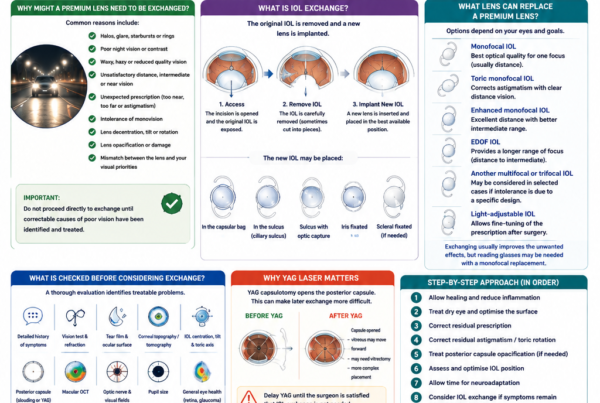
Why Should YAG Laser Sometimes Be Delayed?
YAG Capsulotomy Opens the Posterior Capsule
YAG laser treatment is effective when capsule clouding is genuinely responsible for reduced vision.
However, once the capsule is opened, a later IOL exchange may become more technically complex.
A study of dissatisfied multifocal-IOL patients specifically advised delaying YAG capsulotomy until the need for IOL exchange had been excluded.
Identify the Cause First
Before YAG treatment, the ophthalmologist should establish whether symptoms are mainly due to:
- Posterior capsule opacification
- Dry eye
- Residual prescription
- IOL decentration
- Retinal disease
- Intolerance of multifocal optics
Can a Multifocal Lens Be Exchanged?
Exchange Is Possible
A multifocal IOL may be exchanged for:
- A monofocal lens
- An enhanced monofocal lens
- An EDOF lens
- A different multifocal lens
Exchange Is Another Intraocular Operation
Potential risks include:
- Capsular damage
- Vitreous loss
- Corneal injury
- Retinal complications
- Infection
- Residual refractive error
- Need for an alternative IOL position
Lens exchange should not be regarded as a simple or risk-free reversal.
Most Complaints Do Not Automatically Require Exchange
Referral studies found that many dissatisfied patients could be managed with:
- Glasses
- Dry-eye treatment
- Refractive correction
- YAG laser when appropriate
- Other conservative interventions
Only a minority underwent IOL exchange in these series.
Alternatives to Multifocal Lenses
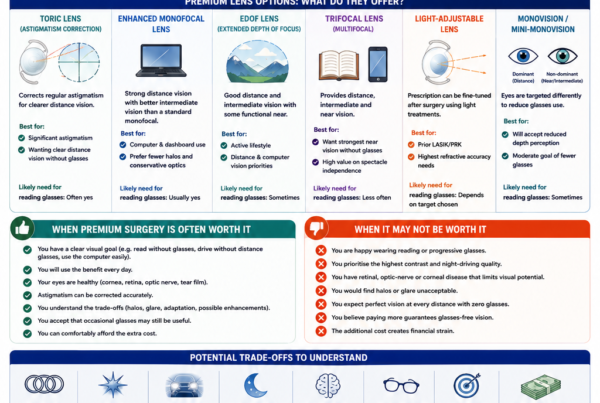
Distance-Targeted Monofocal Lenses
Advantages include:
- Crisp distance vision
- Good contrast
- Fewer halos
- Easier night driving
- Greater tolerance of ocular imperfections
Reading glasses are usually required.
Monofocal Monovision
One eye is targeted for distance and the other for intermediate or near vision.
Potential advantages:
- Reduced glasses dependence
- Fewer multifocal rings
- Monofocal optical quality within each eye
Potential disadvantages:
- Reduced depth perception
- Visual imbalance
- Difficulty adapting
- Less optimal dim-light vision
Enhanced Monofocal Lenses
Enhanced monofocal lenses may provide:
- Excellent distance vision
- Better intermediate vision than a standard monofocal
- Relatively monofocal-like optical quality
Reading glasses are commonly still needed for fine print.
EDOF Lenses
Extended-depth-of-focus lenses generally favour:
- Distance vision
- Computer vision
- Dashboard vision
- Functional near vision
They may provide less close-reading ability than trifocal lenses.
EDOF lenses can still cause halos, and the visual-disturbance profile varies by design.
Light-Adjustable Lenses
A light-adjustable lens can be fine-tuned after surgery and may be used to create:
- Distance vision in both eyes
- Monovision
- Mini-monovision
It does not automatically provide a multifocal range and requires a specialised postoperative treatment programme.
Frequently Asked Questions
Are Multifocal Lenses Worth It?
They may be worthwhile for a suitable patient who strongly values reducing spectacle dependence and accepts possible halos and glare.
They may not be worthwhile for a patient who prioritises maximum night-time visual quality or is comfortable using reading glasses.
Will I Be Completely Glasses-Free?
Possibly, but it cannot be guaranteed.
Many patients use few or no glasses for ordinary activities. Some still use spectacles for fine print, dim lighting or night driving.
Do Multifocal Lenses Give Good Distance Vision?
Yes, when the refractive result is accurate and the eye is otherwise healthy.
Average distance visual acuity is generally comparable with monofocal lenses.
Do Multifocal Lenses Cause Halos?
They can.
Halos are more common than with monofocal lenses, although their severity varies and many patients become less aware of them over time.
Do Halos Go Away?
They often improve with healing and neuroadaptation.
They may not disappear completely in every patient.
Are Multifocal Lenses Good for Night Driving?
Many patients drive comfortably, but some experience significant headlight halos, glare or reduced low-light contrast.
Frequent or professional night drivers should consider this carefully.
Is a Multifocal Lens Better Than an EDOF Lens?
Neither is universally better.
A multifocal or trifocal lens generally provides stronger near vision.
An EDOF lens generally prioritises distance and intermediate vision and may offer a more forgiving optical profile with selected designs.
Can I Have a Multifocal Lens if I Have Astigmatism?
Yes, when the astigmatism is regular and can be corrected.
A toric multifocal or trifocal lens may be required.
Can I Have a Multifocal Lens After LASIK?
Possibly, after detailed corneal assessment.
The calculations may be less predictable, and existing corneal aberrations may affect visual quality.
Can I Have a Multifocal Lens if I Have Glaucoma?
It depends on the severity and stability of the glaucoma.
Moderate or advanced glaucoma generally favours a more conservative monofocal strategy.
Can I Have a Multifocal Lens if I Have an Epiretinal Membrane?
A meaningful epiretinal membrane may reduce retinal image quality and make a multifocal lens less suitable.
Macular OCT is important.
Can Dry Eye Affect a Multifocal Lens?
Yes.
Dry eye may cause fluctuating vision, halos, glare and inaccurate preoperative measurements.
Can the Lens Be Removed?
Yes, but lens exchange is another intraocular operation and carries additional risks.
A Practical Decision Guide
Consider a Multifocal Lens if:
- Reducing glasses use is a major priority.
- You want distance, computer and reading vision.
- Your cornea is healthy and regular.
- Your tear film is stable.
- Your macula and optic nerve are healthy.
- Astigmatism can be corrected accurately.
- You accept the possibility of halos and glare.
- You have realistic expectations.
- You are prepared for neuroadaptation.
Consider a Monofocal, Enhanced Monofocal or EDOF Alternative if:
- Crisp optical quality is your overriding priority.
- You drive extensively at night.
- You do not mind using reading glasses.
- You have significant retinal or optic-nerve disease.
- Your cornea is irregular.
- Your dry eye remains unstable.
- You are highly intolerant of visual imperfection.
- You do not wish to accept multifocal photic phenomena.
Questions to Ask Your Ophthalmologist
About Your Eyes
- Is my cornea regular?
- Is my dry eye adequately controlled?
- How much astigmatism do I have?
- Is my macula normal on OCT?
- Is my optic nerve healthy?
- Do I have glaucoma?
- Does previous LASIK affect my suitability?
- Do both eyes have good visual potential?
About the Lens
- Is the proposed lens bifocal or trifocal?
- Is it diffractive, refractive or hybrid?
- What reading distance does it favour?
- How strong is its intermediate vision?
- Is a toric version needed?
- How common are halos with this lens model?
- What percentage of patients still use glasses?
- Will the same lens be used in both eyes?
About the Backup Plan
- What happens if the prescription is not exact?
- Can glasses correct it?
- Is laser enhancement possible?
- When should YAG laser be considered?
- What happens if I cannot adapt?
- Can the lens be exchanged?
- Are enhancements included in the surgical package?
The Bottom Line
Multifocal lenses can provide an excellent range of unaided vision and significantly reduce dependence on glasses after cataract surgery.
Their main advantages are:
- Better unaided near vision
- Useful intermediate vision
- Excellent distance acuity when accurately targeted
- Greater spectacle independence
- Convenience for everyday activities
Their main disadvantages are:
- Halos
- Glare
- Starbursts
- Possible reduction in low-light contrast
- Greater sensitivity to dry eye
- Greater sensitivity to residual prescription and astigmatism
- A need for neuroadaptation
- Occasional need for additional treatment
- Higher cost
Evidence consistently shows better near vision and greater spectacle independence compared with monofocal lenses. It also consistently shows more unwanted optical phenomena, particularly halos.
A multifocal lens is most likely to succeed when:
- The eye is healthy.
- The measurements are accurate.
- Astigmatism is corrected.
- The ocular surface is stable.
- The patient understands the trade-offs.
- The patient strongly values reduced glasses use.
The correct question is therefore not:
“Is a multifocal lens the best lens?”
It is:
“Does the wider range of unaided vision offered by a multifocal lens justify its possible optical side effects for my eyes, lifestyle and priorities?”
References
- de Silva SR, Evans JR, Kirthi V, Ziaei M, Leyland M. Multifocal versus monofocal intraocular lenses after cataract extraction. Cochrane Database Syst Rev. 2016;12(12). doi:10.1002/14651858.CD003169.pub4. PMID: 27943250.
- Khandelwal SS, Jun JJ, Mak S, Booth MS, Shekelle PG. Effectiveness of multifocal and monofocal intraocular lenses for cataract surgery and lens replacement: a systematic review and meta-analysis. Graefes Arch Clin Exp Ophthalmol. 2019;257(5):863–875. doi:10.1007/s00417-018-04218-6. PMID: 30627791.
- Cho JY, Won YK, Park J, Nam JH, Hong JY, Min S, et al. Visual outcomes and optical quality of accommodative, multifocal, extended depth-of-focus, and monofocal intraocular lenses in presbyopia-correcting cataract surgery: a systematic review and Bayesian network meta-analysis. JAMA Ophthalmol. 2022;140(11):1045–1053. doi:10.1001/jamaophthalmol.2022.3667. PMID: 36136323.
- Rampat R, Gatinel D. Multifocal and extended depth-of-focus intraocular lenses in 2020. Ophthalmology. 2021;128(11)–e185. doi:10.1016/j.ophtha.2020.09.026. PMID: 32980397.
- Woodward MA, Randleman JB, Stulting RD. Dissatisfaction after multifocal intraocular lens implantation. J Cataract Refract Surg. 2009;35(6):992–997. doi:10.1016/j.jcrs.2009.01.031. PMID: 19465282.
- de Vries NE, Webers CAB, Touwslager WRH, Bauer NJC, de Brabander J, Berendschot TTJM, Nuijts RMMA. Dissatisfaction after implantation of multifocal intraocular lenses. J Cataract Refract Surg. 2011;37(5):859–865. doi:10.1016/j.jcrs.2010.11.032. PMID: 21397457.
- Gibbons A, Ali TK, Waren DP, Donaldson KE. Causes and correction of dissatisfaction after implantation of presbyopia-correcting intraocular lenses. Clin Ophthalmol. 2016;10:1965–1970. doi:10.2147/OPTH.S114890. PMID: 27784985.
- Pusnik A, Petrovski G, Lumi X. Dysphotopsias or unwanted visual phenomena after cataract surgery. Life. 2023;13(1):53. doi:10.3390/life13010053. PMID: 36676002.
- Chiam PJT, Chan JH, Aggarwal RK, Kasaby S. ReSTOR intraocular lens implantation in cataract surgery: quality of vision. J Cataract Refract Surg. 2006;32(9):1459–1463. doi:10.1016/j.jcrs.2006.04.015. PMID: 16931257.
- Cochener B, Lafuma A, Khoshnood B, Courouve L, Berdeaux G. Comparison of outcomes with multifocal intraocular lenses: a meta-analysis. Clin Ophthalmol. 2011;5:45–56. doi:10.2147/OPTH.S14325. PMID: 21311656.
- Chen JL, Al-Mohtaseb ZN, Chen AJ. Criteria for premium intraocular lens patient selection. Curr Opin Ophthalmol. 2024;35(5):353–358. doi:10.1097/ICU.0000000000001067. PMID: 38920096.
- Puente-Bustillo S, et al. Visual performance during night driving after intraocular refractive surgery procedures. Expert Rev Med Devices. 2025;22(7):675–684. doi:10.1080/17434440.2025.2512038. PMID: 40418587.