Author: Dr Val Phua
Estimated reading time: 20 minutes
One of the most common questions patients ask before cataract surgery is:
“Will I still need glasses after the operation?”
Modern cataract surgery can often reduce dependence on spectacles substantially. Some patients become independent of glasses for most daily activities, while others still use glasses for reading, computer work, night driving or fine visual tasks.
However, cataract surgery cannot guarantee that every patient will be completely spectacle-free at all distances and under every lighting condition.
Your likelihood of achieving spectacle independence depends on:
- The type of intraocular lens implanted
- The focusing target selected for each eye
- Whether astigmatism is corrected
- The accuracy of the lens-power calculation
- The health of the cornea, retina and optic nerve
- The stability of the tear film
- Whether you have undergone previous LASIK or other eye surgery
- How well the two eyes work together
- Your tolerance of halos, glare or monovision
- What you personally mean by “spectacle-free”
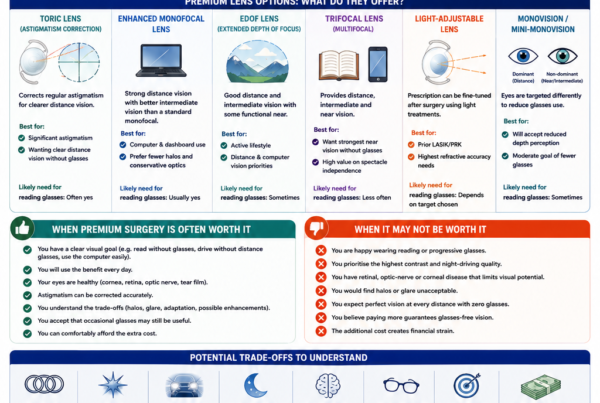
Modern presbyopia-correcting lenses can provide a wider range of unaided vision than conventional distance-targeted monofocal lenses. Trifocal lenses generally provide the strongest unaided near vision and greatest near spectacle independence, while EDOF and enhanced monofocal lenses tend to emphasise intermediate vision and visual quality. No lens performs perfectly at every distance for every patient.
The Quick Answer
Can Cataract Surgery Make You Spectacle-Free?
Yes, it is possible to become independent of glasses for most or even all routine activities after cataract surgery.
The strategies that may reduce spectacle dependence include:
- Multifocal or trifocal intraocular lenses
- Extended-depth-of-focus lenses
- Enhanced monofocal lenses
- Monovision or mini-monovision
- Toric lenses to correct astigmatism
- Light-adjustable lenses where available
- Carefully chosen different refractive targets for the two eyes
Nevertheless, even patients who achieve excellent results may occasionally prefer glasses for:
- Very small print
- Reading in dim light
- Prolonged computer use
- Night driving
- Fine craftwork
- Low-contrast tasks
- Maximising distance sharpness
- Correcting a small residual prescription
The realistic aim is usually reduced dependence on spectacles, rather than a promise that spectacles will never be useful again.
Which Lens Gives the Greatest Chance of Spectacle Independence?
Modern trifocal lenses generally provide the greatest chance of unaided vision across:
- Distance
- Intermediate range
- Near range
Comparative evidence indicates that trifocal IOLs provide particularly strong near acuity and near spectacle independence. Multifocal lenses as a broader group also achieve higher spectacle independence than standard monofocal lenses, although they are associated with more halos, glare and reduced contrast in some settings.
Can You Become Spectacle-Free With Monofocal Lenses?
Yes, but usually through monovision.
With monovision:
- One eye is targeted mainly for distance.
- The other eye is targeted for intermediate or near vision.
This can reduce spectacle dependence without using multifocal optical rings.
Systematic reviews suggest that pseudophakic monovision can provide high satisfaction and meaningful spectacle independence in appropriately selected patients. The trade-offs may include reduced fine depth perception, visual imbalance and less optimal vision at certain distances.
What Does “Spectacle-Free” Actually Mean?
Complete Spectacle Independence
Complete spectacle independence means not needing glasses for:
- Driving
- Watching television
- Computer work
- Phone use
- Reading
- Shopping
- Menus
- Hobbies
- Routine daily tasks
This is achievable in some patients, particularly with suitable trifocal lenses or carefully planned blended-vision strategies.
It cannot be guaranteed.
Functional Spectacle Independence
Functional spectacle independence means that you can perform most ordinary daily activities without glasses but may use them occasionally.
For example, you may be comfortable without spectacles for:
- Driving during the day
- Computer work
- Seeing your phone
- Shopping
- Cooking
- Social activities
but choose glasses for:
- Small print
- Prolonged reading
- Night driving
- Detailed work
This is a common and highly satisfactory result.
Distance Spectacle Independence
Some patients only want to see clearly in the distance without glasses.
Their priorities may include:
- Driving
- Watching television
- Seeing road signs
- Playing sport
- Recognising faces
- Walking outdoors
A distance-targeted monofocal or toric monofocal lens may be sufficient.
Reading glasses will generally still be required.
Near Spectacle Independence
Some naturally short-sighted patients value reading without glasses more than distance independence.
A monofocal lens can be deliberately targeted for near vision.
The patient may then read without glasses but require spectacles for:
- Driving
- Television
- Cinema
- Outdoor distance vision
This is not a poor surgical result when it was intentionally planned.
Why Do We Need Reading Glasses as We Age?
The Natural Lens Loses Accommodation
A young natural lens can change shape to focus from distance to near.
This focusing process is called accommodation.
With age, the natural lens becomes less flexible. This causes presbyopia, which may result in:
- Difficulty reading small print
- Holding a phone farther away
- Needing brighter light
- Eye strain during near work
- Dependence on reading glasses
A Standard Artificial Lens Does Not Accommodate Normally
During cataract surgery, the cloudy natural lens is removed and replaced with an artificial intraocular lens.
A conventional monofocal IOL does not change shape and refocus in the same way as a healthy young natural lens.
It provides one principal focal power.
To obtain a wider range of unaided vision, the surgeon must use:
- More than one optical focus
- An extended focal range
- Different targets between the eyes
- A combination of these methods
No current artificial lens reproduces the full natural accommodation of a healthy young eye.
Route 1: Monofocal Lenses Targeted for Distance
What Vision Can You Expect?
When both eyes receive monofocal lenses targeted for distance, many patients can see clearly without spectacles for:
- Driving
- Television
- Walking outdoors
- Recognising faces
- Sport
- General distance activities
The exact result depends on whether the final prescription is sufficiently close to the intended target.
Will You Need Reading Glasses?
Usually, yes.
Reading glasses are commonly required for:
- Phone use
- Books
- Menus
- Labels
- Newspapers
- Fine print
- Sewing
- Detailed near work
Some patients retain functional computer vision because of:
- Natural depth of focus
- Pupil size
- Mild residual short-sightedness
- Corneal optical characteristics
- Differences between the two eyes
However, this should not be promised.
Why Choose This Strategy?
Distance-targeted monofocal lenses generally offer:
- Crisp vision
- Good contrast
- Fewer halos
- Easier night driving
- Greater tolerance of mild ocular imperfections
- A relatively straightforward adaptation process
This may be the preferred strategy when image quality is more important than avoiding reading glasses.
Route 2: Monofocal Monovision
What Is Monovision?
Monovision deliberately creates different focusing targets in the two eyes.
Usually:
- The dominant eye is targeted for distance.
- The non-dominant eye is targeted for intermediate or near vision.
The brain combines the two images to provide a broader functional range.
What Is Full Monovision?
Full monovision usually involves a larger difference between the eyes.
The near eye is made sufficiently short-sighted to provide useful reading vision.
Potential benefits include:
- Better near vision without glasses
- Lower dependence on spectacles
- No multifocal optical rings
- Monofocal optical quality within each eye
Potential disadvantages include:
- Reduced fine stereopsis
- Visual imbalance
- Difficulty in dim light
- Blur in one eye at each extreme
- Difficulty adapting
What Is Mini-Monovision?
Mini-monovision uses a smaller difference between the two eyes.
For example:
- One eye is targeted close to distance.
- The other is targeted mildly towards intermediate or near vision.
This may provide:
- Good binocular distance vision
- Better computer vision
- Functional phone vision
- Less imbalance than full monovision
- Better preservation of depth perception
The near range is usually weaker than with full monovision or trifocal lenses.
Recent systematic-review evidence indicates that mini-monovision with monofocal, enhanced monofocal or EDOF lenses can produce high satisfaction and reduced spectacle dependence, although the amount of independence varies according to the lens and refractive targets used.
Who Is a Good Candidate?
Monovision may be suitable if you:
- Have previously tolerated contact-lens monovision
- Do not want multifocal optical phenomena
- Accept that some glasses may still be required
- Have healthy binocular vision
- Do not require maximum fine depth perception
- Understand that one eye will be intentionally less clear at distance
Who May Struggle With Monovision?
Additional caution is appropriate if you:
- Require very precise stereopsis
- Have strabismus or unstable ocular alignment
- Have amblyopia
- Have poor vision in one eye
- Drive extensively at night
- Are highly sensitive to imbalance
- Cannot tolerate blur in either eye
Can Monovision Be Tested Before Surgery?
A contact-lens simulation may help.
However, it is not a perfect test because:
- The cataract remains present.
- The contact lens may cause dryness.
- Contact-lens optics differ from IOL optics.
- The final surgical target may be different.
- The brain may need more time to adapt after surgery.
A successful trial is reassuring, but an unsuccessful trial does not always mean that every milder mini-monovision strategy will fail.
Route 3: Enhanced Monofocal Lenses
What Is an Enhanced Monofocal Lens?
An enhanced monofocal lens is designed to preserve strong distance vision while extending some useful focus towards intermediate range.
It may provide better unaided vision for:
- Computer screens
- Car dashboards
- Cooking
- Supermarket shelves
- Seeing across a desk
- Larger phone text
Meta-analyses have found that enhanced monofocal lenses improve intermediate vision compared with conventional monofocal lenses while maintaining similar distance performance.
Can It Make You Completely Spectacle-Free?
It may reduce glasses use, particularly for distance and intermediate tasks.
However, reading glasses are still commonly required for:
- Small print
- Books
- Dimly lit menus
- Prolonged phone use
- Detailed near work
Enhanced Monofocal With Mini-Monovision
Spectacle independence may be increased by targeting the non-dominant eye slightly towards near vision.
This can provide:
- Distance vision from the dominant eye
- Improved computer and phone vision from the non-dominant eye
- Fewer multifocal rings
- A relatively natural binocular blend
It remains a compromise. Fine near vision and low-light distance vision may still benefit from glasses.
Route 4: Extended-Depth-of-Focus Lenses
What Is an EDOF Lens?
An extended-depth-of-focus lens creates an elongated focal range.
It generally aims to provide:
- Excellent distance vision
- Strong intermediate vision
- Functional near vision
- A smoother transition between focal distances
EDOF lenses are particularly suited to activities such as:
- Driving
- Computer work
- Dashboard viewing
- Cooking
- Sport
- Shopping
- Social interaction
Will You Need Reading Glasses?
Possibly.
EDOF lenses often provide enough near vision for:
- Larger phone text
- Price labels
- Menus in good lighting
- Short messages
- A smartwatch
Reading glasses may still be needed for:
- Very small print
- Prolonged reading
- Detailed close work
- Poor lighting
- Low-contrast text
Can Mini-Monovision Improve EDOF Near Vision?
Yes.
The non-dominant eye may be targeted slightly towards near vision to extend the binocular range.
This can improve:
- Phone vision
- Menu reading
- Functional near vision
- Overall spectacle independence
The trade-off may be a small reduction in distance sharpness in the non-dominant eye.
Do EDOF Lenses Cause Halos?
They can.
The EDOF category includes several different technologies:
- Diffractive EDOF
- Non-diffractive EDOF
- Refractive EDOF
- Wavefront-shaping lenses
- Hybrid multifocal-EDOF lenses
The halo profile varies considerably among designs.
EDOF should not be interpreted as “halo-free.”
Route 5: Multifocal and Trifocal Lenses
How Do Multifocal Lenses Work?
Multifocal lenses distribute incoming light between more than one focal distance.
Modern trifocal lenses generally provide focal ranges for:
- Distance
- Intermediate vision
- Near vision
The brain learns to use the focal information most relevant to the object being viewed.
Why Do They Offer Greater Spectacle Independence?
A trifocal lens includes a stronger dedicated near focus than a conventional monofocal or most EDOF designs.
This improves the likelihood of seeing:
- A phone
- Books
- Menus
- Labels
- Printed documents
- Computer screens
- Road signs
without glasses.
Systematic reviews and comparative studies consistently show greater unaided near vision and spectacle independence with multifocal lenses than with distance-targeted monofocal lenses.
What Are the Trade-Offs?
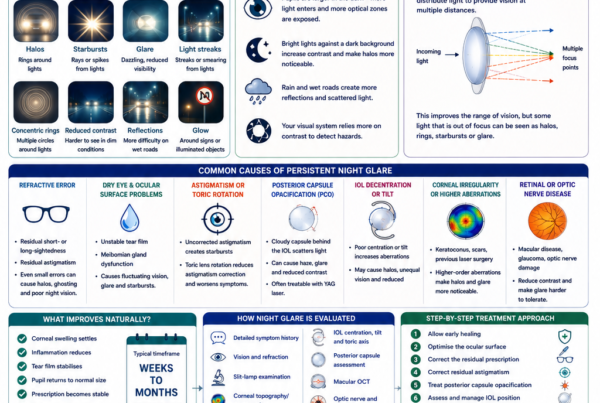
Multifocal optics may cause:
- Halos around headlights
- Starbursts
- Glare
- Light rings
- Reduced contrast
- Less crisp vision in dim light
- A period of neuroadaptation
Premium-IOL reviews have found that multifocal lenses increase spectacle independence but also increase dysphotopsias and may reduce contrast sensitivity, particularly under low-light or glare conditions.
Does Everyone Notice Halos?
Many patients notice halos initially.
They may become less prominent as:
- The pupil normalises.
- The eye heals.
- Dryness improves.
- The residual prescription is corrected.
- Both eyes have been treated.
- Neuroadaptation occurs.
Some patients remain aware of them long term.
Who Is Most Likely to Be Satisfied?
A suitable trifocal candidate generally has:
- A healthy cornea
- A stable tear film
- A healthy macula
- A healthy optic nerve
- Regular astigmatism that can be corrected
- Accurate measurements
- Realistic expectations
- A strong desire to reduce glasses use
- Acceptance of possible halos
Who May Be Less Suitable?
Caution is required in patients with:
- Significant macular disease
- Moderate or advanced glaucoma
- Optic-nerve disease
- Irregular astigmatism
- Keratoconus
- Corneal scarring
- Uncontrolled dry eye
- Significant previous laser-treatment irregularity
- Unrealistic expectations
- Intolerance of night-time optical symptoms
Route 6: Light-Adjustable Lenses
What Is a Light-Adjustable Lens?
A light-adjustable lens allows its refractive power to be modified after cataract surgery.
After healing:
- The patient undergoes a refraction.
- Controlled light treatments modify the lens power.
- The visual target can be refined.
- Final treatments lock the lens power.
How Can This Help Spectacle Independence?
The lens can be customised after surgery to provide:
- Distance vision in both eyes
- Monovision
- Mini-monovision
- A personalised balance between distance and near vision
This may be particularly useful when preoperative lens-power prediction is less certain.
Is It a Multifocal Lens?
Not necessarily.
A standard light-adjustable lens usually achieves spectacle independence through refractive targeting or monovision rather than multiple simultaneous focal points.
Reading glasses may still be required if both eyes are targeted for distance.
Who May Benefit?
It may be attractive for patients with:
- Previous LASIK or PRK
- High refractive expectations
- Uncertain lens-power calculations
- A desire to test monovision after surgery
- Willingness to attend repeated treatment visits
What Are the Limitations?
The process requires:
- Multiple postoperative appointments
- Compliance with protective eyewear
- Reliable fixation during treatments
- A longer refractive-treatment pathway
- Access to the specialised technology
It does not eliminate all sources of blurred vision, such as macular disease or corneal irregularity.
Astigmatism: A Major Barrier to Spectacle Independence
What Is Astigmatism?
Astigmatism occurs when the cornea has different curvatures in different directions.
It may cause:
- Blur
- Ghost images
- Shadowed letters
- Glare
- Halos
- Reduced reading clarity
- Poor night vision
Why Is Astigmatism Important?
Even a sophisticated presbyopia-correcting lens may perform poorly if meaningful astigmatism remains.
Multifocal and trifocal lenses are particularly sensitive to residual refractive error.
A prospective study of trifocal-IOL recipients found that postoperative residual astigmatism was associated with worse visual outcomes and visual quality.
How Can Astigmatism Be Corrected?
Options may include:
- Toric intraocular lenses
- Corneal relaxing incisions
- Femtosecond-laser arcuate incisions
- Postoperative laser vision correction
- Spectacles
- Contact lenses
What Is a Toric Lens?
A toric IOL contains different powers in different meridians to correct regular corneal astigmatism.
Toric correction can be combined with:
- Monofocal optics
- Enhanced monofocal optics
- EDOF optics
- Trifocal optics
“Toric” describes astigmatism correction; it does not describe the lens’s focusing range.
The Importance of Accurate Lens-Power Calculations
Cataract Surgery Is Also Refractive Surgery
Removing the cataract is only one part of the operation.
The surgeon must also choose an intraocular lens power intended to achieve the desired postoperative prescription.
Modern biometry and formulas have improved accuracy considerably. However, biological variability and measurement limitations mean that the final result cannot be guaranteed to be exactly zero prescription.
Why Might the Result Differ From the Target?
Possible reasons include:
- Normal biological variation
- Eye-length measurement uncertainty
- Corneal measurement errors
- Dry-eye-related instability
- Astigmatism
- Previous LASIK or PRK
- Unusual eye dimensions
- Lens-position differences
- Wound healing
- Toric lens rotation
- Corneal irregularity
What Is a Refractive Surprise?
A refractive surprise occurs when the final prescription differs meaningfully from the intended target.
For example, the patient may remain:
- Short-sighted
- Long-sighted
- Astigmatic
This may require glasses or an additional corrective procedure.
Residual refractive error remains an important cause of dissatisfaction after otherwise successful cataract surgery.
Why Dry Eye Matters
The Tear Film Is Part of the Eye’s Optical System
The first refracting surface of the eye is the tear film over the cornea.
An unstable tear film can cause:
- Fluctuating vision
- Ghosting
- Glare
- Halos
- Intermittent blur
- Poor reading comfort
Dry Eye Can Affect Preoperative Measurements
Corneal measurements may vary when the ocular surface is dry or irregular.
This can affect:
- IOL power calculations
- Astigmatism measurements
- Toric-lens planning
- Lens-selection accuracy
Patients seeking spectacle independence may require treatment of the ocular surface before final measurements.
Dry Eye Can Mimic Lens Failure
A patient may believe that the IOL is incorrect when the true problem is:
- Tear-film instability
- Meibomian-gland dysfunction
- Corneal staining
- Postoperative medication irritation
Dry eye should be assessed before considering laser enhancement or lens exchange.
The Health of the Retina and Optic Nerve
Clear Optics Cannot Overcome Retinal Disease
Cataract surgery clears the optical pathway, but the retina must still process the image.
Conditions that may limit spectacle-free vision include:
- Epiretinal membrane
- Age-related macular degeneration
- Diabetic macular disease
- Macular oedema
- Vitreomacular traction
- Previous retinal-vein occlusion
- Macular hole
- Previous retinal surgery
Macular OCT May Be Important
A routine retinal examination may appear relatively normal while OCT identifies subtle changes.
These changes can affect:
- Reading quality
- Contrast
- Fine detail
- Multifocal-lens suitability
- Final satisfaction
Glaucoma Can Reduce Contrast and Peripheral Vision
Patients with glaucoma may have good central letter acuity but reduced:
- Contrast sensitivity
- Peripheral vision
- Low-light performance
A monofocal or conservative enhanced monofocal strategy is often preferred when optic-nerve damage is significant.
Previous LASIK, PRK or SMILE
Previous Corneal Surgery Can Affect Predictability
Laser refractive surgery changes the corneal shape.
This can make IOL calculations more complex and increase the likelihood of residual prescription.
Corneal Quality Matters
Some post-LASIK patients have:
- Regular, well-centred corneas
- Excellent optical quality
- Stable measurements
Others have:
- Irregular astigmatism
- Decentered ablation
- Higher-order aberrations
- Dry eye
- Existing night halos
A multifocal lens may amplify pre-existing optical symptoms in a less-than-ideal cornea.
Can Post-LASIK Patients Still Become Spectacle-Free?
Yes, in carefully selected cases.
Strategies may include:
- Monofocal monovision
- EDOF mini-monovision
- A light-adjustable lens
- Selected trifocal lenses
- Toric correction
- Postoperative laser enhancement
The counselling should include a greater degree of refractive uncertainty.
Why Both Eyes Matter
Binocular Vision Is More Than Two Separate Eyes
Spectacle independence depends on how the eyes function together.
The brain combines information from both eyes to improve:
- Visual acuity
- Depth perception
- Contrast
- Range of vision
- Confidence
- Adaptation to premium optics
The First-Eye Result May Not Represent the Final Outcome
After first-eye surgery, you may have:
- A clear operated eye
- A cataract in the other eye
- A large prescription difference
- Unequal colour perception
- Unequal image sizes
- Different glare patterns
The final binocular result may improve after second-eye surgery.
The First Eye Can Inform the Second-Eye Plan
When surgeries are staged, the surgeon may review:
- The refractive result
- Near and intermediate function
- Halo tolerance
- Adaptation
- The required target for the second eye
This may allow refinement of the second-eye strategy.
Does Dominant Eye Selection Matter?
The Dominant Eye Is Often Targeted for Distance
In monovision strategies, the dominant eye is commonly selected for distance because this may feel more natural.
The non-dominant eye is targeted for:
- Intermediate
- Near
- A blended range
Crossed Monovision Can Also Work
Some patients naturally function better with the non-dominant eye targeted for distance.
Eye dominance is therefore a guide rather than an absolute law.
The final decision should consider:
- Previous spectacle habits
- Contact-lens experience
- Ocular health
- Which eye has better potential vision
- Lifestyle requirements
Which Activities May Still Need Glasses?
Night Driving
Glasses may sharpen vision or correct residual astigmatism during:
- Night driving
- Heavy rain
- Low-contrast conditions
- Long journeys
Even a patient who is functionally spectacle-free during the day may prefer glasses at night.
Prolonged Reading
Low-powered reading glasses may improve:
- Small print
- Reading endurance
- Comfort
- Low-contrast text
- Dim-light reading
Computer Work
Computer glasses may be useful if:
- The monitor distance does not match the IOL’s best intermediate range.
- The patient works for many hours.
- Dryness causes visual fluctuation.
- Fine detail is required.
Precision Tasks
Glasses may remain beneficial for:
- Sewing
- Jewellery work
- Microsoldering
- Fine art
- Detailed musical notation
- Technical inspection
- Very small print
Using glasses for specialised tasks does not mean that cataract surgery has failed.
What if You Still Need Glasses After Surgery?
Wait Until the Eye Has Stabilised
Vision may fluctuate during early healing because of:
- Corneal swelling
- Inflammation
- Dry eye
- Pupil changes
- Eye drops
- Neuroadaptation
Do not judge the final result too early.
Obtain a Proper Refraction
A refraction determines whether vision improves with:
- Spherical correction
- Astigmatism correction
- Reading addition
This helps distinguish an optical prescription problem from retinal, corneal or IOL-related causes.
Glasses May Be the Safest Solution
A small residual prescription may be easily corrected with:
- Distance glasses
- Reading glasses
- Computer glasses
- Progressive lenses
Further surgery is not always justified.
Can Residual Prescription Be Corrected?
Corneal Laser Enhancement
LASIK or PRK may be used in suitable patients to correct:
- Residual short-sightedness
- Residual long-sightedness
- Residual astigmatism
The cornea must be:
- Thick enough
- Regular
- Stable
- Free from significant disease
IOL Rotation
A toric lens that has rotated may sometimes be repositioned.
The decision depends on:
- The amount of rotation
- Residual astigmatism
- Time since surgery
- Capsular stability
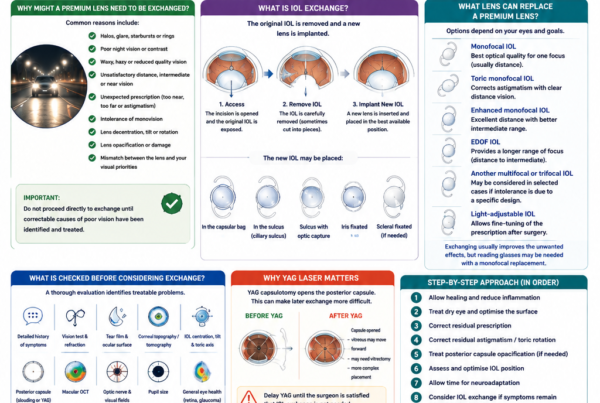
Lens Exchange
An incorrect or poorly tolerated IOL can sometimes be replaced.
However, lens exchange is another intraocular operation and carries risks such as:
- Capsular damage
- Vitreous loss
- Corneal injury
- Retinal complications
- Infection
- Residual prescription
Piggyback Lens
In selected cases, a supplementary IOL may be inserted to correct residual refractive error.
Light Adjustment
When a light-adjustable lens has been implanted and not yet locked, its power can be refined through the planned light-treatment process.
Refractive-enhancement reviews emphasise that the cause of reduced vision should be identified before performing another procedure.
Posterior Capsule Opacification
Can a Cataract Grow Back?
The cataract itself does not grow back.
However, the capsule behind the IOL may become cloudy. This is called posterior capsule opacification, or PCO.
How Does PCO Affect Spectacle Independence?
It may cause:
- Hazy vision
- Glare
- Reduced contrast
- Halos
- Poor reading vision
- A feeling that the cataract has returned
Changing glasses may not solve the problem.
How Is It Treated?
PCO can often be treated with YAG laser capsulotomy.
A small opening is created in the cloudy capsule to clear the visual axis.
Why Should YAG Sometimes Be Delayed?
When significant dissatisfaction may lead to an IOL exchange, YAG laser can make later lens exchange more technically complex.
The cause of poor vision should therefore be established before proceeding.
Spectacle Independence Versus Visual Quality
These Are Not the Same Goal
A patient may have excellent visual quality but use reading glasses.
Another may see across a wide range without glasses but notice:
- Halos
- Glare
- Reduced contrast
- Less crisp night vision
Neither result is automatically better.
The Most Important Question
Ask yourself:
“Would I rather use occasional glasses, or accept a greater chance of halos to reduce my use of glasses?”
Your answer helps guide lens selection.
Who Has the Best Chance of Becoming Spectacle-Free?
Favourable Factors
The likelihood is greatest when there is:
- Healthy corneal optics
- Stable tear film
- Regular astigmatism
- Accurate biometry
- Healthy macula
- Healthy optic nerve
- Good vision in both eyes
- Predictable IOL position
- Realistic expectations
- Willingness to accept the chosen trade-offs
Factors That Reduce the Probability
The chance may be lower with:
- Significant dry eye
- Irregular astigmatism
- Previous complex corneal surgery
- Macular disease
- Advanced glaucoma
- Amblyopia
- Poor vision in one eye
- Unstable ocular alignment
- Complicated cataract surgery
- Uncorrected astigmatism
- Unrealistic expectations
Questions to Ask Yourself Before Surgery
Which Distances Matter Most?
Consider whether you mainly want to see without glasses for:
- Driving
- Television
- Computer work
- Phone use
- Reading
- Sport
- Music
- Cooking
- Fine hobbies
How Often Do You Drive at Night?
Frequent night driving may favour:
- Monofocal lenses
- Enhanced monofocal lenses
- Selected EDOF lenses
- A more conservative monovision target
How Would You Feel About Halos?
Would you accept light rings around headlights in exchange for better reading vision?
Would you prefer occasional reading glasses in exchange for fewer halos?
Are You Comfortable With Monovision?
Have you previously used:
- One contact lens for distance
- One contact lens for near
- Blended-vision laser correction
Previous tolerance can be helpful.
What Does Spectacle-Free Mean to You?
Do you want:
- No glasses for distance?
- No glasses for computer work?
- No glasses for your phone?
- No glasses for small print?
- No glasses under any circumstances?
The more demanding the goal, the greater the need to accept optical compromises and refractive uncertainty.
Questions to Ask Your Ophthalmologist
About Your Eyes
- Is my cornea regular?
- Is my tear film stable?
- How much astigmatism do I have?
- Is my macula normal on OCT?
- Is my optic nerve healthy?
- Do I have glaucoma?
- Does previous LASIK affect the calculations?
- Is one eye weaker than the other?
- Is monovision suitable for me?
About the Lens Strategy
- Will both eyes be targeted for distance?
- Will monovision or mini-monovision be used?
- Is the proposed lens monofocal, enhanced monofocal, EDOF or trifocal?
- Do I need a toric lens?
- Which distances does the lens favour?
- How often will I probably need reading glasses?
- What halos should I expect?
- What is the expected adaptation period?
About the Backup Plan
- What happens if the final prescription is not exact?
- Would glasses correct it?
- Could laser enhancement be performed?
- Can a toric lens be rotated?
- Could the IOL be exchanged?
- When should YAG laser be considered?
- Are enhancements included in the treatment package?
Frequently Asked Questions
Can Cataract Surgery Guarantee That I Will Never Need Glasses?
No.
Modern surgery can substantially reduce dependence on spectacles, but no surgeon or IOL can guarantee perfect unaided vision at every distance and in every lighting condition.
Can I Become Spectacle-Free With a Standard Monofocal Lens?
Possibly through monovision.
If both eyes are targeted for distance, reading glasses will usually be required.
Which Lens Gives the Best Chance of No Glasses?
A suitable trifocal lens generally gives the strongest chance of broad distance, intermediate and near spectacle independence.
The trade-off is a greater possibility of halos, glare and reduced low-light contrast.
Is EDOF Enough to Avoid Glasses?
Many EDOF patients function without glasses for distance and intermediate activities.
Reading glasses may still be needed for small print and prolonged close work.
Can Enhanced Monofocal Lenses Make Me Spectacle-Free?
They may reduce glasses use, especially for intermediate tasks.
Complete near spectacle independence is less likely unless mini-monovision is added.
Is Monovision Better Than Multifocal Lenses?
Neither is universally better.
Monovision may produce fewer multifocal halos and can be less expensive, but may reduce depth perception or cause imbalance.
Multifocal lenses provide a wider binocular range but may cause more dysphotopsias.
Can a Toric Lens Help Me Become Spectacle-Free?
Yes, when regular corneal astigmatism is present.
Correcting astigmatism is essential to maximise unaided visual quality.
Can I Still Need Glasses With a Trifocal Lens?
Yes.
Glasses may still help with:
- Very small print
- Dim lighting
- Residual prescription
- Astigmatism
- Night driving
- Prolonged reading
Can I Become Spectacle-Free After LASIK?
Possibly, but lens-power calculations are less predictable.
Detailed corneal assessment and realistic counselling are essential.
Will Both Eyes Need Surgery?
Binocular spectacle independence usually works best when both eyes have been treated and planned as a pair.
A patient with one premium IOL and a significant cataract in the other eye may not experience the final intended range.
Can Glasses Correct Vision if I Do Not Adapt to a Multifocal Lens?
Glasses can correct residual refractive error but cannot always remove halos caused by the multifocal optical design.
Other causes such as dry eye, PCO or lens decentration should also be investigated.
Can My Lens Be Changed Later?
Yes, but lens exchange is another intraocular operation and carries additional risks.
It should not be regarded as a simple reversal.
Is Being Spectacle-Free Always Better?
No.
Some patients prefer:
- Maximum crispness
- Better contrast
- Easier night driving
- Fewer halos
and are happy to use reading glasses.
A Practical Decision Guide
Consider Distance-Targeted Monofocal Lenses if:
- You prioritise crisp distance quality.
- You drive frequently at night.
- You do not mind reading glasses.
- You have retinal, corneal or optic-nerve disease.
- You prefer the most conservative optical strategy.
Consider Monofocal Mini-Monovision if:
- You want fewer multifocal halos.
- You accept some difference between the eyes.
- Computer and functional near vision are important.
- You have tolerated monovision previously.
- You accept occasional glasses.
Consider Enhanced Monofocal Mini-Monovision if:
- Distance and intermediate vision are priorities.
- You want greater range than a conventional monofocal.
- You prefer relatively monofocal-like optical quality.
- You accept reading glasses for fine print.
Consider an EDOF Strategy if:
- Distance and computer vision are most important.
- You have an active lifestyle.
- You want a smooth functional range.
- You accept that reading glasses may occasionally be needed.
- You want a compromise between range and optical quality.
Consider a Trifocal Strategy if:
- Maximum spectacle independence is the main goal.
- Reading and phone use without glasses are important.
- Your cornea, macula and optic nerve are healthy.
- You accept possible halos and glare.
- You understand that adaptation may take time.
Consider a Light-Adjustable Strategy if:
- Postoperative refractive precision is especially important.
- You previously underwent LASIK or PRK.
- You want a customised monovision target.
- You can attend the required treatment visits.
- You can follow the protective-eyewear instructions.
A Spectacle-Independence Checklist
Before Surgery
Confirm that:
- Your ocular surface has been assessed.
- Astigmatism has been measured.
- Macular OCT has been considered.
- Your optic nerve is healthy enough for the selected lens.
- Previous corneal surgery has been discussed.
- Your preferred reading and computer distances are known.
- Night-driving requirements have been considered.
- You understand the possibility of halos.
- You understand that glasses may still occasionally help.
After Surgery
Give the eye time to:
- Heal
- Stabilise
- Recover from dryness
- Complete medication
- Adapt to the new optics
Attend follow-up so the ophthalmologist can assess:
- Refraction
- Corneal clarity
- Eye pressure
- IOL position
- Astigmatism
- Retina
- Posterior capsule
The Bottom Line
Cataract surgery can significantly reduce your dependence on spectacles.
Some patients become glasses-free for almost all daily activities. Others remain independent for distance and intermediate activities but use glasses for small print or specialised tasks.
Your options include:
- Distance monofocal: Excellent distance quality, but reading glasses are usually needed.
- Monofocal monovision: Broader range without multifocal optics, but may reduce depth perception or cause imbalance.
- Enhanced monofocal: Better intermediate vision than a standard monofocal, but reading glasses are often still required.
- EDOF: Strong distance and intermediate vision with functional near vision; readers may be needed for fine print.
- Trifocal: Greatest chance of distance, intermediate and near spectacle independence, but with a higher possibility of halos and glare.
- Toric correction: Important when regular astigmatism is present.
- Light-adjustable lens: Allows postoperative refractive refinement where available.
The best strategy is not necessarily the one that provides the widest theoretical range.
It is the one that provides the visual abilities you value while creating compromises you find acceptable.
A patient who drives frequently at night may prefer occasional reading glasses and monofocal optical quality.
A patient who strongly dislikes spectacles and has healthy eyes may prefer a trifocal lens despite the possibility of halos.
A patient focused on computers, sport and everyday intermediate tasks may prefer an EDOF or enhanced monofocal strategy.
The safest promise is not:
“You will never need glasses again.”
It is:
“We will select and plan the lens strategy that gives you the best realistic chance of reducing your dependence on glasses while preserving the visual quality that matters to you.”
References
- Li J, Sun B, Zhang Y, Hao Y, Wang Z, Liu C, Jiang S. Comparative efficacy and safety of all kinds of intraocular lenses in presbyopia-correcting cataract surgery: a systematic review and meta-analysis. BMC Ophthalmol. 2024;24(1):172. doi:10.1186/s12886-024-03446-1. PMID: 38627651.
- de Silva SR, Evans JR, Kirthi V, Ziaei M, Leyland M. Multifocal versus monofocal intraocular lenses after cataract extraction. Cochrane Database Syst Rev. 2016;12(12). doi:10.1002/14651858.CD003169.pub4. PMID: 27943250.
- Labiris G, Giarmoukakis A, Patsiamanidi M, Papadopoulos Z, Kozobolis VP. A systematic review of pseudophakic monovision for presbyopia correction. Int J Ophthalmol. 2017;10(6):992–1000. doi:10.18240/ijo.2017.06.24. PMID: 28730093.
- Wang SY, Stem MS, Oren G, Shtein R, Lichter PR. Patient-centered and visual quality outcomes of premium cataract surgery: a systematic review. Eur J Ophthalmol. 2017;27(4):387–401. doi:10.5301/ejo.5000978. PMID: 28574135.
- Wan KH, Au ACK, Kua WN, Ng ALK, Cheng GPM, Lam NM, Chan WSC. Enhanced monofocal versus conventional monofocal intraocular lens in cataract surgery: a meta-analysis. J Refract Surg. 2022;38(8):538–546. doi:10.3928/1081597X-20220707-01. PMID: 35947003.
- Levy I, et al. Outcomes of mini-monovision with monofocal, enhanced monofocal and extended-depth-of-focus intraocular lenses: a systematic review. Eye. 2025. PMID: 40061383.
- Khoramnia R, Auffarth G, Łabuz G, Pettit G, Suryakumar R. Refractive outcomes after cataract surgery. Diagnostics. 2022;12(2):243. doi:10.3390/diagnostics12020243. PMID: 35204334.
- Zhang L, et al. Effect of postoperative residual astigmatism on visual outcomes after trifocal intraocular lens implantation. Front Med. 2023;10:1202793. doi:10.3389/fmed.2023.1202793. PMID: 37497270.
- Moshirfar M, McCaughey MV, Santiago-Caban L, et al. Refractive enhancements for residual refractive error after cataract surgery. Curr Opin Ophthalmol. 2021;32(1):54–61. doi:10.1097/ICU.0000000000000717. PMID: 33122488.
- Pusnik A, Petrovski G, Lumi X. Dysphotopsias or unwanted visual phenomena after cataract surgery. Life. 2023;13(1):53. doi:10.3390/life13010053. PMID: 36676002.
- Cho JY, Won YK, Park J, et al. Visual outcomes and optical quality of accommodative, multifocal, extended depth-of-focus, and monofocal intraocular lenses in presbyopia-correcting cataract surgery: a systematic review and Bayesian network meta-analysis. JAMA Ophthalmol. 2022;140(11):1045–1053. doi:10.1001/jamaophthalmol.2022.3667. PMID: 36136323.
- Park ESY, et al. Visual outcomes, spectacle independence, and patient satisfaction of pseudophakic mini-monovision using an enhanced monofocal intraocular lens. Sci Rep. 2022;12:21752. PMID: 36522397.