Author: Dr Val Phua
Estimated reading time: 20 minutes
Yes. A premium intraocular lens can sometimes be removed and replaced with a different lens.
This procedure is called an intraocular lens exchange, or IOL exchange.
A multifocal, trifocal or extended-depth-of-focus lens may be exchanged when a patient remains significantly troubled by:
- Halos or glare
- Starbursts
- Poor night vision
- Waxy or hazy vision
- Unsatisfactory distance, intermediate or near vision
- An unexpected postoperative prescription
- Intolerance of monovision
- Lens decentration, tilt or rotation
- Lens opacification
- A mismatch between the lens and the patient’s visual priorities
However, IOL exchange should not be regarded as a simple reversal of cataract surgery.
The original lens may have become attached to the surrounding capsule. The capsule may have contracted or become cloudy, and a previous YAG laser capsulotomy may have opened the posterior capsule. These factors can make removal more technically demanding and may prevent the replacement lens from being positioned in exactly the same location.
Published case series show that multifocal and diffractive EDOF lenses can be successfully exchanged for monofocal lenses in carefully selected patients with persistent dysphotopsia, reduced visual quality or difficulty driving at night. Nevertheless, exchange is another intraocular operation and carries genuine surgical risks.
The most important principle is:
Do not proceed directly to lens exchange until potentially correctable causes of poor vision have been identified and treated.
The Quick Answer
Can a Multifocal, Trifocal or EDOF Lens Be Removed?
Yes.
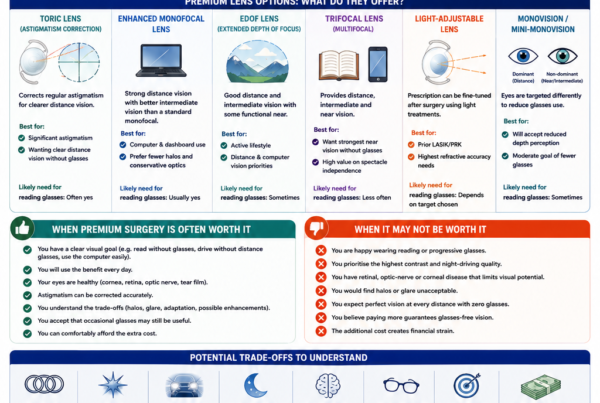
Premium lenses that may be exchanged include:
- Multifocal IOLs
- Trifocal IOLs
- Diffractive EDOF lenses
- Non-diffractive EDOF lenses
- Enhanced monofocal lenses
- Toric lenses
- Light-adjustable lenses
- Accommodating lenses
- Opacified or damaged premium lenses
The possibility and complexity of exchange depend on:
- Time since the original surgery
- Degree of capsular fibrosis
- Whether YAG laser has been performed
- Integrity of the capsule
- Strength of the zonules
- Current IOL position
- Previous retinal or glaucoma surgery
- Corneal and retinal health
- The replacement lens being considered
Is Lens Exchange Common?
Most patients receiving premium lenses do not require an exchange.
Exchange is generally reserved for a smaller group whose symptoms remain functionally significant despite:
- Adequate healing
- Treatment of dry eye
- Correction of residual prescription
- Astigmatism management
- Assessment of lens position
- A reasonable period for neuroadaptation
In a series of 64 eyes undergoing exchange of diffractive multifocal or EDOF lenses for monofocal lenses, the main indications included diffractive photic phenomena, poor visual quality and night-driving difficulty.
Does Exchange Guarantee That Every Symptom Will Disappear?
No.
Exchanging a multifocal or diffractive EDOF lens for a monofocal lens often reduces optical rings, halos and other lens-design-related symptoms.
However, symptoms may persist if they are also caused by:
- Dry eye
- Corneal irregularity
- Residual astigmatism
- Previous LASIK
- Retinal disease
- Glaucoma
- Pupil-related effects
- Ordinary pseudophakic dysphotopsia
- Neurological or binocular-vision factors
The replacement lens may also create a new visual compromise. For example, exchanging a trifocal lens for a monofocal lens usually improves optical simplicity but increases dependence on reading glasses.
What Is an Intraocular Lens Exchange?
The Original IOL Is Removed
During an IOL exchange, the surgeon removes the artificial lens previously implanted during cataract or refractive lens surgery.
A replacement lens is then implanted when adequate support is available.
The replacement IOL may be positioned:
- Inside the original capsular bag
- In the ciliary sulcus
- In the sulcus with optic capture
- Secured to the iris
- Secured to the sclera
- In the anterior chamber in selected cases
The capsular bag is generally the preferred position when it remains intact and suitable because it provides a stable and anatomically favourable location.
Exchange Is Different From Lens Repositioning
The lens may not need to be removed when the main problem is:
- Toric-lens rotation
- Mild decentration
- A correctable positioning issue
In these cases, the existing IOL may sometimes be:
- Rotated
- Repositioned
- Recentred
- Sutured or otherwise stabilised
Exchange Is Different From Laser Enhancement
LASIK or PRK changes the corneal focusing power.
It may correct:
- Residual short-sightedness
- Residual long-sightedness
- Residual astigmatism
It does not remove the intrinsic multifocal or diffractive optical pattern of the IOL.
A patient whose main complaint is halos caused by the lens design may still experience halos after the prescription has been corrected.
Exchange Is Different From YAG Laser Capsulotomy
YAG laser capsulotomy creates an opening in the cloudy posterior capsule behind the IOL.
It can improve vision when the true cause is posterior capsule opacification.
YAG laser does not:
- Remove the IOL
- Change a multifocal lens into a monofocal lens
- Correct dry eye
- Correct significant residual astigmatism
- Remove intrinsic diffractive rings
- Guarantee improvement in neuroadaptation failure
Why Might a Premium Lens Need to Be Exchanged?
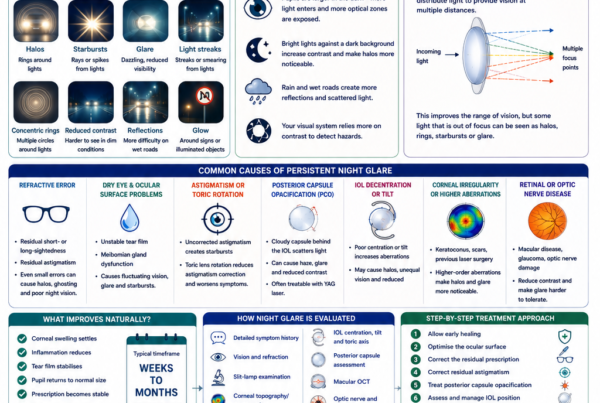
Persistent Halos, Glare or Starbursts
Multifocal and diffractive lenses manipulate light to provide vision at more than one distance.
This may produce:
- Concentric rings around lights
- Halos
- Starbursts
- Spider-web patterns
- Glare
- Light streaks
- Reduced night-driving confidence
Many patients adapt, but some remain significantly affected.
Diffractive visual phenomena were a leading reason for exchange in the 64-eye series of multifocal and EDOF lens removal.
Waxy or Hazy Vision
Some patients describe:
- Waxy vision
- A misty or filmy image
- Good eye-chart vision but poor real-world quality
- Reduced clarity in dim conditions
- A lack of crispness
- Difficulty distinguishing low-contrast objects
In a Japanese series of 50 explanted multifocal lenses, waxy vision was the most frequently reported complaint, followed by glare, halos and blurred vision at different distances.
Poor Night Vision
A patient may achieve excellent daytime acuity but struggle with:
- Oncoming headlights
- Wet-road reflections
- Dimly lit roads
- Pedestrians in dark clothing
- Lane markings
- Recovery after bright glare
The visual result may be unacceptable for someone who drives professionally or frequently at night.
Inadequate Near Vision
A patient may choose a premium lens expecting to read without glasses but still struggle with:
- Small print
- Menus
- Phone text
- Fine hobbies
- Dim-light reading
- A preferred reading distance
Possible causes include:
- The optical design’s near focal point
- Residual refractive error
- Astigmatism
- Dry eye
- Macular dysfunction
- Pupil characteristics
- Unrealistic expectations
Exchange is rarely the first treatment when the main problem can be corrected with reading glasses or refractive treatment.
Inadequate Distance Vision
Poor unaided distance vision may result from:
- Incorrect IOL power
- Residual astigmatism
- Toric rotation
- Dry eye
- Corneal irregularity
- Lens decentration
- Posterior capsule opacification
- Retinal disease
A careful refraction is essential before concluding that the lens design is the problem.
Intolerance of Monovision
One eye may have been targeted for distance and the other for intermediate or near vision.
Some patients cannot adapt and experience:
- Visual imbalance
- Poor depth perception
- Difficulty tracking moving objects
- Eye strain
- Reduced confidence
- Blur when both eyes are open
Possible solutions include:
- Glasses
- Contact-lens simulation
- Corneal laser enhancement
- Adjusting the refractive target
- IOL exchange in selected cases
Residual Refractive Error
The final prescription may differ from the intended target.
A patient may remain:
- Short-sighted
- Long-sighted
- Astigmatic
In a 35-eye study of multifocal-to-monofocal exchanges, refractive outcomes after exchange were generally predictable, but calculations still required careful adjustment because the effective lens position and replacement-lens design could differ from the original plan.
Toric-Lens Rotation
A toric premium lens must remain aligned with the intended astigmatic axis.
Rotation may cause:
- Residual cylinder
- Ghosting
- Starbursts
- Blurred vision
- Reduced multifocal performance
If the lens design is otherwise suitable, rotation or repositioning may be preferable to exchange.
IOL Decentration or Tilt
Premium optics generally perform best when the IOL is well centred.
Decentration or tilt may cause:
- Unequal halos
- Reduced contrast
- Ghosting
- Coma-like aberration
- Blurred near vision
- Different image quality between the eyes
The lens may sometimes be repositioned rather than replaced.
Lens Opacification
An IOL can occasionally become cloudy or calcified.
Opacification may cause:
- Progressive haze
- Reduced contrast
- Glare
- Colour change
- Loss of vision
An opacified premium lens may be exchanged for either a monofocal or another premium lens, depending on the remaining capsular support and the patient’s visual priorities. Late exchange has been reported many years after the original implantation.
Damage or Mechanical Complications
Exchange may be required for:
- Broken haptics
- Lens dislocation
- Lens subluxation
- Uveitis–glaucoma–hyphema syndrome
- Chafing against the iris
- Persistent inflammation
- Incorrect IOL orientation
- Inappropriate lens placement
These indications may require more urgent intervention than ordinary neuroadaptation concerns.
Does Every Unhappy Premium-Lens Patient Need an Exchange?
No
A significant proportion of complaints after premium-lens implantation have a treatable cause that does not require removal.
Common correctable factors include:
- Dry eye
- Meibomian-gland dysfunction
- Residual prescription
- Residual astigmatism
- Toric rotation
- Posterior capsule opacification
- Corneal oedema
- Inflammation
Earlier studies of dissatisfied multifocal-IOL patients found that many improved after treatment directed at the underlying cause, and only a minority ultimately required exchange.
The Cause of Dissatisfaction Must Be Defined
The ophthalmologist should determine whether the main problem is:
- Optical blur
- Intrinsic dysphotopsia
- Ocular-surface disease
- Retinal limitation
- Incorrect refractive target
- Monovision intolerance
- Lens-position abnormality
- Unrealistic expectations
- A combination of factors
Exchange is more likely to help when the symptoms are clearly linked to the IOL’s optical design or mechanical position.
What Should Be Checked Before Considering Exchange?
A Detailed Symptom History
Important questions include:
- What exactly do you see?
- Is the problem blur, halos, glare or distortion?
- Is one eye worse?
- Does blinking improve vision?
- Are symptoms mainly at night?
- Can glasses improve the vision?
- Have the symptoms improved since surgery?
- Were similar symptoms present before surgery?
- Can you drive safely?
- Has YAG laser already been performed?
- Are both eyes implanted with the same lens?
Unaided and Corrected Visual Acuity
Vision should be tested:
- Without glasses
- With a careful refraction
- At distance
- At intermediate range
- At near
A patient may believe that the multifocal lens has failed when a small refractive correction produces a major improvement.
Refraction
Refraction identifies:
- Residual sphere
- Residual cylinder
- The axis of astigmatism
- Whether spectacles improve clarity
- Whether refractive enhancement may be suitable
Tear-Film and Ocular-Surface Assessment
The examination should assess:
- Tear-film stability
- Corneal staining
- Meibomian-gland dysfunction
- Eyelid disease
- Epithelial irregularity
- Drop-related toxicity
Dry eye is a common and frequently treatable cause of poor visual quality after presbyopia-correcting lens implantation.
Corneal Topography or Tomography
Corneal imaging may identify:
- Irregular astigmatism
- Keratoconus
- Previous LASIK irregularity
- Decentered ablation
- Contact-lens warpage
- Higher-order aberrations
Exchanging the IOL may not resolve symptoms caused primarily by the cornea.
IOL Position
The surgeon should evaluate:
- Centration
- Tilt
- Capsular support
- Toric axis
- Haptic position
- Anterior capsule overlap
- Capsular contraction
- Zonular stability
Posterior Capsule
The capsule should be examined for:
- Posterior capsule opacification
- Previous YAG opening
- Capsular tears
- Fibrosis
- Phimosis
- Integrity of the remaining support
Macular OCT
OCT may identify:
- Epiretinal membrane
- Macular oedema
- Vitreomacular traction
- Macular degeneration
- Other subtle retinal disease
A premium lens cannot compensate for limited retinal image processing.
Optic-Nerve Assessment
Glaucoma or optic neuropathy may reduce:
- Contrast
- Low-light vision
- Visual fields
- Overall visual quality
Exchange may not correct symptoms primarily caused by optic-nerve disease.
What Alternatives Should Be Tried First?
Observation and Neuroadaptation
When:
- The operation is recent
- The eye is healthy
- The prescription is acceptable
- Symptoms are improving
- The patient can function safely
it may be reasonable to allow time for neuroadaptation.
There is no universally correct waiting period. The appropriate duration depends on symptom severity and whether progress is occurring.
Dry-Eye Treatment
Treatment may include:
- Preservative-free lubricants
- Warm compresses
- Eyelid hygiene
- Treatment of meibomian-gland dysfunction
- Anti-inflammatory dry-eye therapy
- Punctal treatment in selected cases
The ocular surface should be stabilised before judging the IOL’s final optical quality.
Glasses
Spectacles may correct:
- Residual short-sightedness
- Residual long-sightedness
- Astigmatism
- Night-driving blur
- Near-vision limitations
Some patients are comfortable using glasses for specific tasks rather than undergoing another operation.
Contact Lenses
A contact-lens trial can help determine whether symptoms improve when:
- Refractive error is corrected
- Monovision is reversed
- A different binocular target is simulated
Corneal Laser Enhancement
LASIK or PRK may treat a stable residual prescription when:
- The cornea is suitable
- The tear film is controlled
- The IOL is well centred
- The symptoms improve with refraction
- The main problem is not intrinsic multifocal dysphotopsia
Toric-Lens Rotation
A rotated toric lens may be repositioned if back-calculation predicts meaningful improvement.
Supplementary or Piggyback IOL
A supplementary lens may correct selected residual refractive errors without removing the original IOL.
This strategy is not suitable for every eye and does not remove intrinsic halos caused by multifocal optics.
YAG Laser Capsulotomy
YAG may be appropriate when posterior capsule opacification is clearly responsible for:
- Hazy vision
- Reduced contrast
- Increasing glare
- Deterioration after an initially good result
It should not be used as a diagnostic experiment when the need for lens exchange remains uncertain.
Why Does YAG Laser Matter Before Lens Exchange?
YAG Opens the Posterior Capsule
During cataract surgery, the IOL is usually placed inside the lens capsule.
The posterior capsule acts as a barrier between:
- The anterior segment
- The vitreous cavity
YAG capsulotomy creates a permanent opening in this membrane.
Exchange May Become More Complex
When the posterior capsule is open:
- Vitreous may come forward during surgery.
- An anterior vitrectomy may be required.
- The replacement lens may not be safely placed in the capsular bag.
- Sulcus placement or optic capture may be needed.
- Scleral or iris fixation may occasionally be required.
- The risk profile may increase.
Published guidance from multifocal-IOL dissatisfaction studies recommends delaying YAG capsulotomy until the surgeon is satisfied that IOL exchange will not be necessary.
Previous YAG Does Not Make Exchange Impossible
Late exchange after YAG capsulotomy has been reported successfully.
However, the surgery may be more technically challenging because of:
- The open capsule
- Capsular fibrosis
- Adhesions
- Greater risk of vitreous prolapse
- Reduced options for replacement-lens positioning
A small case series of late multifocal exchange found that surgery could still be completed successfully, although the authors emphasised the additional difficulty created by capsulotomy and fibrosis.
When Is the Best Time for Lens Exchange?
There Is No Universal Deadline
A premium IOL can sometimes be exchanged:
- Within weeks
- After several months
- Years after surgery
The correct timing depends on the reason for exchange.
Earlier Exchange May Be Technically Easier
During the early postoperative period:
- The capsule may be less fibrotic.
- The haptics may be easier to separate.
- The bag may be easier to preserve.
- The replacement lens may be more likely to remain in the original capsular bag.
However, exchanging too early may deprive the patient of a reasonable opportunity for:
- Healing
- Ocular-surface recovery
- Refractive stabilisation
- Neuroadaptation
Waiting Is Reasonable When Symptoms Are Improving
Observation may be appropriate if:
- The eye is healthy.
- Vision is functionally safe.
- Symptoms are gradually improving.
- Correctable causes are being treated.
- The patient understands the plan.
Waiting Is Less Appropriate When the Problem Is Mechanical
Earlier intervention may be advisable for:
- Significant IOL dislocation
- Unstable toric rotation
- Iris chafing
- Uveitis–glaucoma–hyphema syndrome
- Marked decentration
- Incorrect lens position
- Severe refractive error that cannot be tolerated
- A damaged IOL
Late Exchange Remains Possible
Exchange has been performed years after the original cataract operation, including in eyes with opacified multifocal IOLs.
Late surgery may require:
- Cutting the original IOL
- More extensive viscodissection
- Capsular-ring management
- Sulcus placement
- Optic capture
- Vitrectomy
- Alternative fixation
The feasibility must be judged individually.
How Is a Premium Lens Exchanged?
Anaesthesia
The procedure may be performed under:
- Topical anaesthesia
- Local anaesthesia
- Sedation
- Less commonly, general anaesthesia
The choice depends on:
- Surgical complexity
- Expected duration
- Patient cooperation
- Previous ocular surgery
- Surgeon preference
The Previous Incision Is Reopened or Enlarged
The surgeon may use:
- The original corneal incision
- A new incision
- An enlarged incision
The size required depends on:
- Lens material
- Whether the IOL can be folded
- Whether it will be cut
- The replacement lens
- Capsular support
Adhesions Are Separated
A viscoelastic material may be injected between:
- The IOL and anterior capsule
- The IOL and posterior capsule
- The haptics and capsular equator
This process is called viscodissection.
The aim is to free the lens while preserving:
- The capsule
- The zonules
- The corneal endothelium
- The iris
The Original Lens Is Removed
The IOL may be:
- Folded
- Cut into sections
- Cut through the optic
- Partially divided
- Removed through an enlarged incision
The method depends on the lens material and the degree of capsular adhesion.
Vitrectomy May Be Required
An anterior vitrectomy may be needed when:
- The posterior capsule is open.
- Vitreous comes forward.
- The capsule tears.
- The lens is displaced.
- Previous YAG has been performed.
The Replacement Lens Is Inserted
The new IOL may be positioned:
- In the capsular bag
- In the sulcus
- In the sulcus with optic capture
- With iris fixation
- With scleral fixation
- In the anterior chamber in selected eyes
The safest option depends on the remaining anatomy.
Which Lens Can Replace a Premium Lens?
Monofocal IOL
A monofocal lens is commonly selected when the aim is to reduce:
- Halos
- Diffractive rings
- Night glare
- Waxy vision
- Competing focal images
The main compromise is increased dependence on glasses for other distances.
A patient exchanging a trifocal lens for a distance monofocal should expect to need reading glasses.
Toric Monofocal IOL
A toric monofocal lens may be chosen when regular corneal astigmatism remains significant.
This can provide:
- Clearer distance vision
- Better optical simplicity
- Reduced distance-glasses dependence
- Fewer multifocal-style halos
The capsular support and expected rotational stability must be considered.
Enhanced Monofocal IOL
An enhanced monofocal may offer:
- Strong distance vision
- Some additional intermediate range
- A relatively monofocal-like optical profile
It generally does not provide the close-reading vision of a trifocal lens.
EDOF IOL
An EDOF replacement may preserve more intermediate range than a monofocal.
However:
- It may still cause glare or halos.
- Near vision may remain limited.
- Exchanging one premium lens for another does not guarantee symptom resolution.
A Different Multifocal or Trifocal Lens
Some patients are dissatisfied with one multifocal optical profile but still strongly value spectacle independence.
A 2024 study compared exchange to a monofocal lens with exchange to an alternative multifocal design. It supports the principle that another multifocal lens may be considered in selected neuroadaptation-failure cases, but careful counselling remains essential because optical symptoms can persist.
Light-Adjustable Lens
Where available and suitable, an adjustable lens may improve postoperative refractive customisation.
Its use depends on:
- Capsular support
- Device availability
- Pupil dilation
- Retinal health
- Ability to attend multiple treatments
- Compliance with protective eyewear
The Replacement May Not Be Placed in the Bag
If the capsule cannot safely support the new IOL, the surgeon may need to use a different lens model or fixation method.
This can affect:
- Lens selection
- Refractive calculation
- Astigmatism correction
- Future stability
- Expected visual range
How Is the Replacement Lens Power Calculated?
The Original Lens Information Is Important
The surgeon should know:
- Original lens model
- Original lens power
- Intended refractive target
- Preoperative biometry
- Current refraction
- Current IOL position
- Corneal measurements
The Current Refractive Result Helps
The difference between:
- The intended result
- The achieved result
can be used to guide the replacement-lens calculation.
The New Lens May Sit in a Different Position
A lens placed:
- In the bag
- In the sulcus
- With optic capture
- At the iris
- At the sclera
may require a different power calculation.
A replacement lens should not automatically have the same power as the removed IOL.
Refractive Accuracy Is Good but Not Perfect
In a large tertiary-centre series including 511 IOL exchanges for various indications, approximately 79% of eyes achieved a spherical equivalent within one dioptre of the intended target. This broad cohort included complex dislocations and secondary fixation procedures, so its results should not be interpreted as the exact risk profile of an uncomplicated early premium-lens exchange.
What Are the Risks of Premium-Lens Exchange?
Posterior Capsule Rupture
The capsule may tear while the original IOL is being separated or removed.
This may change the replacement-lens plan.
Zonular Damage
The fine fibres supporting the capsule may be stretched or broken.
This may cause:
- Capsular instability
- Lens decentration
- Need for a capsular-tension device
- Need for alternative fixation
Vitreous Loss
Vitreous may move forward if the posterior capsule is open or damaged.
An anterior vitrectomy may then be required.
Corneal Endothelial Damage
Manipulation inside the eye may injure endothelial cells.
Possible consequences include:
- Temporary corneal swelling
- Prolonged oedema
- Rare corneal decompensation
- Need for corneal transplantation in severe cases
Cystoid Macular Oedema
Macular swelling may cause:
- Blurred central vision
- Reduced contrast
- Distortion
- Delayed visual recovery
In the broad 511-eye exchange series, cystoid macular oedema was the most frequently recorded postoperative complication, occurring in 7.6% of eyes. That population contained many complex eyes and secondary-fixation procedures, so the percentage should not be applied directly to every premium-lens exchange.
Raised Eye Pressure
Eye pressure may rise because of:
- Retained viscoelastic
- Inflammation
- Steroid response
- Vitreous or pigment-related factors
Retinal Tear or Detachment
Any additional intraocular operation may carry a retinal risk, particularly in:
- Highly myopic eyes
- Eyes with previous retinal tears
- Eyes with previous vitrectomy
- Eyes with complicated capsular surgery
Infection
Endophthalmitis is rare but potentially sight-threatening.
Bleeding or Inflammation
Possible complications include:
- Hyphema
- Iris trauma
- Persistent inflammation
- Uveitis
- Pupil irregularity
Replacement-Lens Decentration or Dislocation
The new lens may be less stable if it cannot be placed in an intact capsular bag.
Different secondary-fixation methods have different complication profiles.
Residual Refractive Error
The final prescription may remain:
- Short-sighted
- Long-sighted
- Astigmatic
Glasses or further refractive treatment may still be required.
Need for Further Surgery
In the large tertiary-centre series, 21 eyes required another operative procedure after exchange and 14 eyes underwent a further IOL exchange. Again, this included many complex cases and does not represent the expected rate for every uncomplicated premium-IOL exchange.
What Results Can Be Expected?
Visual Quality Often Improves
Patients undergoing exchange because of intolerable multifocal or diffractive symptoms commonly report improvement in:
- Halos
- Glare
- Waxy vision
- Night-driving difficulty
- Overall visual quality
In the 64-eye diffractive-IOL exchange series, multifocal and EDOF lenses were replaced with monofocal lenses for persistent photic phenomena, poor visual quality or night-vision complaints, with favourable postoperative visual outcomes reported overall.
Reading Vision Usually Decreases After Monofocal Exchange
When a trifocal or multifocal lens is replaced with a distance monofocal lens, the patient should expect:
- Reading-glasses dependence
- Possible computer-glasses dependence
- Loss of some unaided intermediate and near vision
The improvement in optical quality must be weighed against this reduction in range.
Satisfaction Is Not Guaranteed
Persistent dissatisfaction may occur because:
- Symptoms were not caused solely by the IOL.
- Corneal or retinal limitations remain.
- Residual prescription remains.
- The patient dislikes the new focal target.
- Ordinary pseudophakic dysphotopsia persists.
- The replacement lens is not perfectly centred.
- Reading-glasses dependence is unacceptable.
Another Premium Lens May Preserve Range
Exchange to a different optical design may preserve more unaided near or intermediate function.
However, another premium lens may also retain:
- Halos
- Contrast trade-offs
- Neuroadaptation requirements
- Sensitivity to refractive error
The patient should understand why the new design is expected to perform differently from the first.
Should One Eye or Both Eyes Be Exchanged?
Symptoms May Be Dominated by One Eye
If one eye is clearly worse because of:
- Decentration
- Residual refractive error
- Greater halos
- Toric rotation
- Optical intolerance
the surgeon may consider treating that eye first.
The Dominant Eye May Be Prioritised for Distance Quality
A common strategy is to provide:
- Stronger distance optical quality in the dominant eye
- A broader range from the fellow eye
This may involve a monofocal, enhanced monofocal or mixed strategy.
Unilateral Exchange Can Create Optical Imbalance
After exchanging only one eye, the patient may have:
- A monofocal lens in one eye
- A multifocal or EDOF lens in the other
This may be successful in selected patients but can create:
- Different halo patterns
- Unequal image quality
- Different focal ranges
- Binocular imbalance
- More complex adaptation
Do Not Automatically Exchange the Second Eye
The result of the first exchange should be assessed before assuming that both eyes require the same procedure.
Premium-Lens Exchange After YAG Capsulotomy
Exchange Is Still Possible
A previous YAG capsulotomy does not automatically prevent IOL exchange.
However, the procedure is more likely to require:
- Anterior vitrectomy
- Sulcus placement
- Optic capture
- Alternative fixation
- More complex capsular management
The Size and Shape of the YAG Opening Matter
A small, centred opening may leave more capsular support than a large or irregular capsulotomy.
Surgical Planning Must Be Individualised
The surgeon should assess:
- Remaining anterior capsule
- Posterior capsule opening
- Zonular strength
- IOL adhesions
- Vitreous position
- Replacement-lens options
Late exchange after YAG has been reported successfully, but it is considered technically more demanding.
Premium-Lens Exchange After LASIK or PRK
Refractive Calculation Is More Challenging
Previous corneal laser surgery may reduce the predictability of:
- Original IOL calculations
- Replacement-lens calculations
- Corneal enhancement
Corneal Symptoms May Persist
If halos or glare are partly caused by:
- Decentered ablation
- Irregular astigmatism
- Higher-order aberrations
- Dry eye
exchanging the IOL may improve but not completely remove the symptoms.
A Monofocal Strategy May Be More Forgiving
A monofocal or selected enhanced monofocal replacement may provide:
- Better contrast
- Fewer competing images
- Greater tolerance of corneal imperfections
Exchange of a Toric Premium Lens
Determine Whether the Lens Merely Rotated
Before exchange, check:
- Current toric axis
- Intended axis
- Residual cylinder
- Corneal astigmatism
- Predicted result after rotation
Rotation may solve the problem without removing the lens.
The Replacement May Also Need to Be Toric
If significant regular astigmatism remains, replacing a toric premium lens with a non-toric monofocal may leave considerable distance blur.
A toric monofocal or toric enhanced monofocal may be preferable when stability permits.
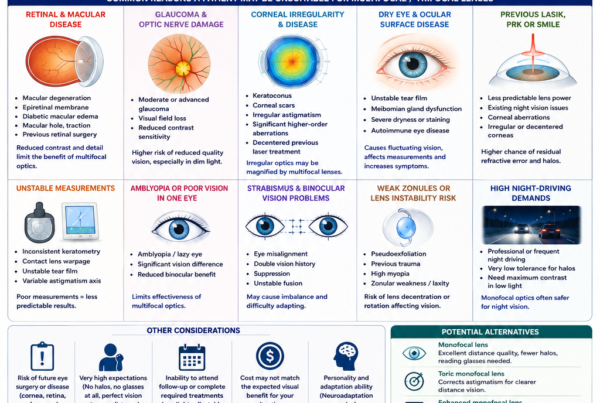
Exchange Because of Retinal or Glaucoma Disease
The Lens May Have Been Reasonable at the Time of Surgery
A patient may initially do well but later develop:
- Epiretinal membrane
- Macular degeneration
- Diabetic macular disease
- Glaucoma progression
- Optic-nerve disease
The resulting loss of contrast may make multifocal optics harder to tolerate.
Treat the Underlying Disease First
Exchange should not be performed until the contribution of the retinal or optic-nerve condition has been understood.
A monofocal lens cannot restore vision permanently lost from retinal or optic-nerve damage.
Recovery After Premium-Lens Exchange
The Recovery May Differ From the Original Cataract Surgery
Recovery depends on whether the exchange involved:
- Simple in-the-bag replacement
- Capsular dissection
- Anterior vitrectomy
- Sulcus placement
- Iris fixation
- Scleral fixation
- Corneal sutures
Temporary Symptoms May Include
- Blurred vision
- Redness
- Grittiness
- Light sensitivity
- Corneal swelling
- Floaters
- Pupil irregularity
- Visual fluctuation
Medication
Patients may require:
- Antibiotic drops
- Steroid drops
- Non-steroidal anti-inflammatory drops
- Eye-pressure medication
- Lubricating drops
Use medication exactly as prescribed.
Follow-Up
Follow-up may include assessment of:
- Corneal clarity
- Eye pressure
- Inflammation
- IOL position
- Retina
- Macular OCT
- Final refraction
Final Vision May Take Time
Vision may continue to improve as:
- Corneal swelling resolves.
- Inflammation settles.
- Sutures stabilise or are removed.
- The prescription becomes stable.
- The brain adapts to the replacement lens.
Warning Signs After IOL Exchange
Sudden or Significant Loss of Vision
Seek urgent assessment if vision:
- Suddenly worsens
- Becomes dark
- Develops a fixed shadow
- Is substantially worse than earlier
- Fails to improve as expected
Severe or Increasing Pain
Mild grittiness can occur.
Severe or worsening pain is not normal.
Increasing Redness or Discharge
Contact your ophthalmologist urgently for:
- Marked redness
- Thick discharge
- Eyelid swelling
- Increasing light sensitivity
- Pain associated with visual loss
New Flashes, Floaters or a Curtain
Seek urgent retinal assessment for:
- New flashes
- A sudden shower of floaters
- A dark curtain
- Missing peripheral vision
- A fixed shadow
Nausea, Vomiting and Eye Pain
These symptoms may indicate significantly raised eye pressure.
Frequently Asked Questions
Can a Multifocal Lens Be Changed to a Monofocal Lens?
Yes.
This is one of the more common exchange strategies for persistent multifocal dysphotopsia or poor visual quality.
The patient should expect greater dependence on reading glasses.
Can a Trifocal Lens Be Changed to an EDOF Lens?
Yes, in selected cases.
However, an EDOF lens may still cause halos and may not eliminate the underlying problem.
Can an EDOF Lens Be Changed to a Monofocal Lens?
Yes.
Diffractive and non-diffractive EDOF lenses can be exchanged when persistent symptoms justify the surgical risk.
Can a Monofocal Lens Be Exchanged for a Premium Lens?
Technically, yes.
However, exchanging a well-positioned monofocal lens solely to gain reading vision exposes the eye to additional intraocular risk.
Alternatives such as:
- Reading glasses
- Contact lenses
- Corneal laser monovision
- Supplementary lenses in selected cases
should be discussed first.
Can a Toric Lens Be Exchanged?
Yes.
However, repositioning may be sufficient when the main problem is rotation.
Can a Light-Adjustable Lens Be Exchanged?
Yes, if clinically required.
Before lock-in, refractive adjustment should usually be considered first when the issue is lens power rather than mechanical or optical intolerance.
Can a Premium Lens Be Exchanged Years Later?
Yes, but later exchange may be more difficult because of:
- Capsular fibrosis
- Adhesions
- Zonular weakness
- Previous YAG
- Reduced capsular support
Late exchange remains possible in selected cases.
Is Exchange Easier Within the First Few Weeks?
It is often technically easier before extensive capsular fibrosis develops.
However, the eye must also be allowed enough time to heal and demonstrate whether symptoms are improving.
How Long Should I Wait for Neuroadaptation?
There is no universal period.
Some surgeons allow several months when:
- The eye is healthy.
- Symptoms are improving.
- The patient can function safely.
- Correctable causes have been treated.
Severe, non-improving symptoms deserve earlier reassessment.
Should I Have YAG Laser Before Deciding on Exchange?
Only when genuine posterior capsule opacification is clearly the cause and exchange is no longer being seriously considered.
YAG can complicate later lens-exchange surgery.
Will Lens Exchange Remove All Halos?
It may substantially reduce halos caused by multifocal or diffractive optics.
It cannot guarantee removal of halos caused by:
- Dry eye
- Corneal irregularity
- Residual astigmatism
- Large pupils
- Previous LASIK
- Ordinary pseudophakic dysphotopsia
Will My Near Vision Be Worse After Monofocal Exchange?
Usually, yes, when the replacement lens is targeted for distance.
Reading glasses will generally be required.
Is Exchange as Safe as the Original Cataract Operation?
No operation is risk-free.
Exchange may be more complex than primary cataract surgery because the original IOL may be adherent to the capsule and the capsular support may be altered.
Does an Experienced Exchange Surgeon Matter?
Yes.
The surgeon must be prepared to manage:
- Capsular fibrosis
- Zonular weakness
- Vitreous prolapse
- Sulcus placement
- Optic capture
- Iris or scleral fixation
- Alternative lens calculations
The surgical plan should include backup IOLs and fixation strategies.
A Pre-Exchange Checklist
Confirm the Symptoms
- Which activities are affected?
- Is one eye worse?
- Are symptoms improving?
- Can glasses help?
- Is night driving unsafe?
- Is the problem blur, halos, distortion or imbalance?
Confirm That Correctable Causes Have Been Addressed
- Dry eye has been treated.
- A careful refraction has been performed.
- Residual astigmatism has been assessed.
- Toric alignment has been checked.
- Corneal imaging has been reviewed.
- Macular OCT has been performed when indicated.
- IOL position has been assessed.
- Capsule clouding has been evaluated.
- Adequate neuroadaptation time has been considered.
Understand the Replacement Plan
- Which IOL will replace the current lens?
- Where will the replacement lens be positioned?
- Will it correct astigmatism?
- What distances will be clear without glasses?
- Will reading glasses be needed?
- What is the backup plan if the capsule is damaged?
- Is vitrectomy likely?
- Has YAG already been performed?
Understand the Risks
- Capsule rupture
- Zonular damage
- Vitreous loss
- Corneal swelling
- Macular oedema
- Raised eye pressure
- Retinal tear or detachment
- Infection
- Residual prescription
- Need for further surgery
The Bottom Line
Premium intraocular lenses can be exchanged.
Exchange may be considered for persistent:
- Halos
- Glare
- Starbursts
- Waxy vision
- Poor night vision
- Unsatisfactory visual range
- Refractive error
- Monovision intolerance
- Lens decentration
- Toric rotation
- IOL opacification
- Mechanical complications
However, exchange should not be the first response to every postoperative visual complaint.
Before proceeding, the ophthalmologist should assess and treat:
- Dry eye
- Residual prescription
- Astigmatism
- Toric alignment
- Corneal irregularity
- Posterior capsule opacification
- IOL position
- Retinal disease
- Optic-nerve disease
YAG laser capsulotomy should generally be delayed when premium-lens exchange remains a realistic possibility because opening the posterior capsule can make later exchange more complex.
When an exchange is performed:
- A monofocal lens generally provides the most optically conservative replacement.
- A toric monofocal may be needed for astigmatism.
- An enhanced monofocal may preserve more intermediate vision.
- Another EDOF or multifocal lens may be considered in carefully selected cases.
- Reading-glasses dependence usually increases after exchange to a distance monofocal.
IOL exchange can substantially improve intolerable premium-lens symptoms in appropriately selected patients, but it remains another intraocular operation with real risks.
The correct question is not simply:
“Can the lens be exchanged?”
It is:
“Are my symptoms clearly caused by the lens, have reversible causes been addressed, and does the expected benefit of exchange justify the surgical risks and the visual compromises of the replacement lens?”
References
- Alsetri H, Pham D, Masket S, Fram NR, Naids S, Lee A. Diffractive optic intraocular lens exchange: indications and outcomes. J Cataract Refract Surg. 2022;48(6):673–678. doi:10.1097/j.jcrs.0000000000000815. PMID: 34508030.
- Kamiya K, Hayashi K, Shimizu K, Negishi K, Sato M, Bissen-Miyajima H; Survey Working Group of the Japanese Society of Cataract and Refractive Surgery. Multifocal intraocular lens explantation: a case series of 50 eyes. Am J Ophthalmol. 2014;158(2):215–220.e1. doi:10.1016/j.ajo.2014.04.010. PMID: 24792105.
- Woodward MA, Randleman JB, Stulting RD. Dissatisfaction after multifocal intraocular lens implantation. J Cataract Refract Surg. 2009;35(6):992–997. doi:10.1016/j.jcrs.2009.01.031. PMID: 19465282.
- Gibbons A, Ali TK, Waren DP, Donaldson KE. Causes and correction of dissatisfaction after implantation of presbyopia-correcting intraocular lenses. Clin Ophthalmol. 2016;10:1965–1970. doi:10.2147/OPTH.S114890. PMID: 27784985.
- Kim EJ, Sajjad A, Montes de Oca I, Koch DD, Wang L, Weikert MP, Al-Mohtaseb ZN. Refractive outcomes after multifocal intraocular lens exchange. J Cataract Refract Surg. 2017;43(6):761–766. doi:10.1016/j.jcrs.2017.03.034. PMID: 28732609.
- Patel V, Pakravan P, Lai J, Watane A, Mehra D, Eatz TA, Patel N, Yannuzzi NA, Sridhar J. Intraocular lens exchange: indications, comparative outcomes by technique, and complications. Clin Ophthalmol. 2023;17:941–951. doi:10.2147/OPTH.S399857. PMID: 36993987.
- Al-Shymali O, Cantó-Cerdán M, Alió del Barrio JL, McAlinden C, Yebana P, Alio JL. Managing dissatisfaction after multifocal intraocular lens implantation through lens exchange using monofocal or alternative multifocal IOLs. Acta Ophthalmol. 2024;102(7)–e1049. doi:10.1111/aos.16720. PMID: 38780148.
- Kuo YW, Hou YC. Late intraocular lens exchange in dissatisfied patients with multifocal intraocular lens implantation. Taiwan J Ophthalmol. 2022;12(1):109–112. PMID: 35399976.
- Stewart SA, McNeely RN, Chan WC, Moore JE. Visual and refractive outcomes following exchange of an opacified multifocal intraocular lens. Clin Ophthalmol. 2022;16:1929–1936. doi:10.2147/OPTH.S362930. PMID: 35706684.
- de Vries NE, Webers CAB, Touwslager WRH, Bauer NJC, de Brabander J, Berendschot TTJM, Nuijts RMMA. Dissatisfaction after implantation of multifocal intraocular lenses. J Cataract Refract Surg. 2011;37(5):859–865. doi:10.1016/j.jcrs.2010.11.032. PMID: 21397457.
- Pusnik A, Petrovski G, Lumi X. Dysphotopsias or unwanted visual phenomena after cataract surgery. Life (Basel). 2023;13(1):53. doi:10.3390/life13010053. PMID: 36676002.
- Al-Shymali O, Alió del Barrio JL, McAlinden C, Alió JL. Patients’ dissatisfaction with multifocal intraocular lenses managed by exchange with other multifocal lenses of different optical profiles. Eye Vis (Lond). 2022;9:7. doi:10.1186/s40662-022-00280-8.