Author: Dr Val Phua
Estimated reading time: 20 minutes
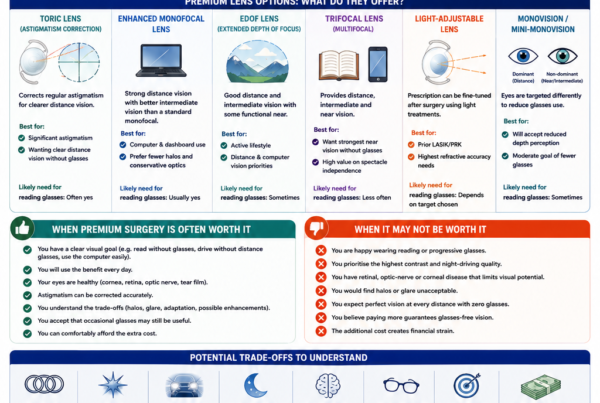
Premium intraocular lenses can reduce dependence on spectacles after cataract surgery. Depending on the lens design, they may provide clearer vision at distance, intermediate or near ranges, correct astigmatism or allow the refractive result to be adjusted after surgery.
However, not every premium lens is suitable for every patient.
This does not necessarily mean that cataract surgery is unsafe or that the patient cannot achieve excellent vision. It usually means that the potential optical disadvantages of a particular lens may outweigh its expected benefits.
For example, a patient may be unsuitable for a multifocal or trifocal lens but remain an excellent candidate for:
- A monofocal lens
- A toric monofocal lens
- An enhanced monofocal lens
- A carefully selected EDOF lens
- Monovision or mini-monovision
- A light-adjustable lens
- A specialised small-aperture lens
The goal is not to implant the most advanced or expensive lens available. The goal is to select the lens that provides the most useful vision with compromises the individual patient is likely to tolerate.
Modern reviews emphasise that premium-IOL selection should consider the cornea, tear film, macula, optic nerve, astigmatism, previous surgery, refractive predictability, lifestyle and expectations rather than applying one lens design to everyone.
The Quick Answer
Why Might Someone Be Unsuitable for a Premium Lens?
A patient may be less suitable for a presbyopia-correcting lens because of:
- Macular or retinal disease
- Moderate or advanced glaucoma
- Optic-nerve damage
- Corneal scarring or irregularity
- Keratoconus
- Significant higher-order aberrations
- Uncontrolled dry eye
- Unstable preoperative measurements
- Previous laser vision correction with poor corneal optical quality
- Irregular or poorly correctable astigmatism
- Amblyopia or poor vision in one eye
- Strabismus or unstable binocular vision
- Weak zonules or uncertain lens stability
- A high risk of future retinal, corneal or glaucoma surgery
- Heavy occupational night-driving demands
- Very low tolerance for halos or visual imperfection
- Unrealistic expectations
- Inability to complete required follow-up or postoperative treatment
These factors do not all create an absolute prohibition. Many are relative contraindications, meaning that suitability depends on severity, stability, the particular lens design and the patient’s priorities.
What Is the Main Concern?
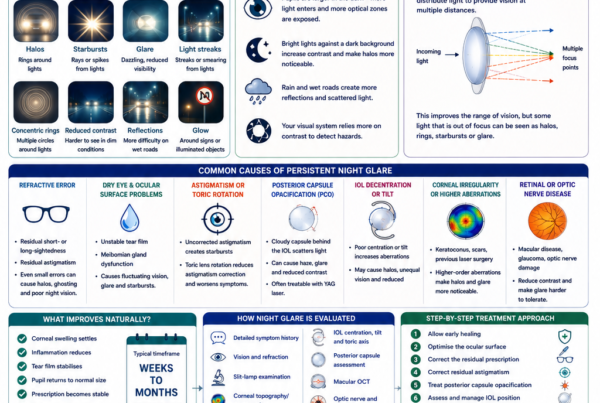
Multifocal and trifocal lenses distribute light between several focal ranges. This improves unaided near and intermediate vision but can also produce:
- Halos
- Glare
- Starbursts
- Reduced contrast
- Less crisp vision in dim light
- Greater sensitivity to dry eye
- Greater sensitivity to residual prescription
- Greater dependence on accurate lens centration
- A need for neuroadaptation
When the cornea, retina or optic nerve already reduces image quality, adding a light-distributing lens may compound the visual limitation.
Does “Unsuitable” Mean the Patient Cannot Have Any Premium Lens?
No.
The term premium lens covers several technologies.
A patient who is unsuitable for a trifocal lens may still benefit from:
- Toric correction for astigmatism
- An enhanced monofocal lens
- A non-diffractive EDOF lens
- A light-adjustable lens
- A small-aperture lens for selected irregular corneas
Toric lenses, in particular, correct astigmatism without automatically introducing multifocal optics. They may be appropriate in many patients who should avoid a multifocal or trifocal lens.
What Is a Premium Intraocular Lens?
Premium Is a Broad Term
“Premium lens” is not one exact medical category.
It commonly includes lenses with an additional function beyond a conventional spherical monofocal IOL, such as:
- Toric correction
- Enhanced intermediate vision
- Extended depth of focus
- Multifocal or trifocal focus
- Postoperative adjustability
- Small-aperture optics
These lenses solve different problems.
A toric lens corrects astigmatism. An EDOF lens extends the functional visual range. A trifocal lens aims to provide distance, intermediate and near vision. A light-adjustable lens allows postoperative refractive refinement.
Not All Premium Lenses Have the Same Suitability Criteria
A retinal condition that makes a strong multifocal lens unsuitable may not prevent implantation of a toric monofocal lens.
An irregular cornea that makes a diffractive trifocal lens undesirable may sometimes be managed with:
- A conventional monofocal lens
- A light-adjustable lens
- A small-aperture lens
- Postoperative spectacles or specialty contact lenses
The lens category must therefore be discussed precisely rather than simply labelling the patient “unsuitable for premium lenses.”
Unsuitable Does Not Necessarily Mean Unsafe
Safety and Optical Suitability Are Different
A lens may be surgically safe to implant but unlikely to provide a satisfying visual result.
For example, a multifocal lens may remain physically stable inside an eye with early retinal disease. The concern is that the patient may experience:
- Reduced contrast
- Disappointing reading vision
- Poor low-light quality
- Greater difficulty coping with halos
The issue is the quality and usefulness of the final vision rather than the mechanical safety of the implant alone.
The Potential Benefit Must Exceed the Optical Cost
Presbyopia-correcting lenses trade some optical simplicity for a wider focusing range.
This trade may be worthwhile in a patient with:
- Healthy eyes
- Stable measurements
- Strong motivation to reduce glasses
- Reasonable night-driving requirements
- Realistic expectations
The same trade may not be worthwhile when the eye already has reduced contrast or irregular optics.
Retinal and Macular Disease
Why Does the Macula Matter?
The macula is the central part of the retina responsible for:
- Reading
- Fine detail
- Recognising faces
- Colour discrimination
- High-quality central vision
A premium lens cannot compensate for reduced macular function.
Multifocal lenses are often approached cautiously in eyes with conditions such as:
- Age-related macular degeneration
- Epiretinal membrane
- Diabetic retinopathy
- Diabetic macular oedema
- Vitreomacular traction
- Macular hole
- Retinal-vein occlusion
- Previous macular surgery
The concern is that multifocal optics may reduce contrast while the retinal condition simultaneously limits the eye’s ability to process fine visual information.
Epiretinal Membrane
An epiretinal membrane can wrinkle or distort the macula.
Possible symptoms include:
- Distorted lines
- Unequal image sizes
- Reduced reading speed
- Blurred central vision
- Reduced contrast
A mild membrane may cause few symptoms, while a more significant membrane may substantially limit the benefit of a multifocal lens.
The decision depends on:
- OCT appearance
- Current vision
- Distortion symptoms
- Likelihood of progression
- Possibility of future retinal surgery
Age-Related Macular Degeneration
Early macular changes do not automatically make every premium lens impossible.
However, caution increases when there is:
- Drusen affecting central function
- Pigmentary change
- Geographic atrophy
- Previous macular bleeding
- Active or treated neovascular disease
- Reduced contrast or reading vision
A monofocal strategy is commonly the more conservative choice when macular function is meaningfully compromised.
Diabetic Retinal Disease
Diabetes may affect the retina before the patient notices major symptoms.
Potential concerns include:
- Diabetic macular oedema
- Retinal ischaemia
- Progressive retinopathy
- Future laser or injection treatment
- Fluctuating vision
A multifocal lens may make subtle loss of contrast more noticeable and may not perform well if macular function later deteriorates.
Previous Retinal Surgery
Eyes that have undergone vitrectomy, retinal-detachment repair or macular surgery require individual assessment.
Considerations include:
- Macular function
- Retinal stability
- Visual-field loss
- Zonular or capsular stability
- The likelihood of future retinal procedures
- Refractive predictability
The fact that the retina is anatomically attached does not necessarily mean that its visual function is normal.
Why Macular OCT Is Important
Some Retinal Abnormalities Are Subtle
A routine examination may show a retina that appears broadly healthy while OCT reveals:
- A small epiretinal membrane
- Vitreomacular traction
- Early macular degeneration
- Intraretinal fluid
- Abnormal foveal structure
These findings may alter the lens recommendation.
OCT Does Not Replace Clinical Judgement
A small OCT abnormality is not automatically an absolute contraindication.
The ophthalmologist should consider:
- The severity of the finding
- The patient’s visual symptoms
- Expected progression
- Contrast sensitivity
- The proposed IOL design
- The patient’s priorities
Glaucoma
Glaucoma Affects More Than Peripheral Vision
Glaucoma can reduce:
- Contrast sensitivity
- Visual-field function
- Low-light vision
- Speed of visual processing
- Confidence in complex environments
A patient may still read 6/6 letters while experiencing reduced visual quality.
A systematic review of premium IOLs in glaucoma emphasised that lens selection should account for the severity and location of field loss, glaucoma subtype, ocular-surface disease, previous or future glaucoma surgery and the reliability of ongoing glaucoma monitoring.
Glaucoma Suspects and Ocular Hypertension
A patient with:
- Raised eye pressure
- Normal optic nerves
- Normal visual fields
- Low risk of progression
may still be considered for a presbyopia-correcting lens.
The decision depends on the full clinical picture rather than the eye-pressure reading alone.
Mild Stable Glaucoma
Some patients with mild, well-controlled glaucoma and preserved contrast may be considered for selected:
- EDOF lenses
- Enhanced monofocal lenses
- Carefully chosen multifocal designs
However, counselling should address the possibility that glaucoma may progress over the lifetime of the lens.
Moderate or Advanced Glaucoma
A monofocal or toric monofocal strategy is generally more conservative when there is:
- Meaningful visual-field loss
- Reduced contrast sensitivity
- Progressive optic-nerve damage
- Central or paracentral defects
- Uncertain long-term stability
Multifocal optics cannot restore visual information lost through optic-nerve damage.
Future Glaucoma Surgery
Some glaucoma operations can change:
- Corneal astigmatism
- Effective lens position
- Ocular-surface quality
- Refractive stability
A patient likely to require future filtering or drainage surgery may be less suitable for a highly refractive-sensitive premium lens.
Other Optic-Nerve Conditions
Optic Neuropathy
Conditions affecting the optic nerve may reduce:
- Colour perception
- Contrast
- Central vision
- Visual fields
Examples include:
- Previous optic neuritis
- Ischaemic optic neuropathy
- Compressive optic neuropathy
- Hereditary optic neuropathy
- Optic atrophy
Even when the cataract is removed successfully, the optic nerve may prevent the premium lens from delivering the expected visual quality.
Corneal Irregularity
Premium Optics Require a Good Corneal Image
The cornea provides most of the eye’s focusing power.
A premium IOL works with the image delivered through the cornea. If the corneal image is irregular, a multifocal lens may add further complexity rather than correcting it.
Conditions of concern include:
- Keratoconus
- Pellucid marginal degeneration
- Corneal scarring
- Previous microbial keratitis
- Previous trauma
- Decentered LASIK or PRK
- Radial keratotomy
- Irregular astigmatism
- Significant higher-order aberrations
Higher-Order Aberrations
Higher-order aberrations are optical imperfections that cannot be fully corrected with ordinary sphere and cylinder spectacles.
They may cause:
- Ghosting
- Halos
- Starbursts
- Smearing
- Reduced night vision
- Reduced contrast
A 2025 study demonstrated that corneal higher-order aberrations influence multifocal-IOL performance, while also emphasising that one numerical cutoff should not be applied universally across all lens designs.
Keratoconus
A toric lens corrects regular astigmatism but cannot fully neutralise the irregular optical pattern of keratoconus.
Selected patients with mild, stable and relatively regular keratoconus may benefit from a toric monofocal lens.
A strong multifocal lens is often less suitable when the corneal image is already degraded.
Corneal Scars
The effect of a corneal scar depends on:
- Its location
- Density
- Depth
- Effect on topography
- Degree of induced irregular astigmatism
- Whether vision improves well with spectacles
A peripheral faint scar may have little effect. A central irregular scar may make multifocal optics disappointing.
Small-Aperture Alternatives
Small-aperture IOLs may have a specialised role in selected eyes with irregular corneal optics because they use a pinhole principle to reduce the effect of peripheral aberrated rays.
They are not suitable for everyone, but their availability illustrates why an eye may be unsuitable for a multifocal lens without being unsuitable for every advanced IOL technology.
Dry Eye and Ocular-Surface Disease
Why Does Dry Eye Matter So Much?
The tear film is the first refracting surface of the eye.
An unstable tear film can cause:
- Fluctuating vision
- Ghosting
- Glare
- Halos
- Burning
- Watering
- Difficulty reading
- Variable measurements
Dry eye can therefore affect both the planning and the performance of a premium lens.
Measurements May Be Inaccurate
Premium lenses require accurate assessment of:
- Corneal curvature
- Astigmatism
- IOL power
- Corneal higher-order aberrations
- Topographic regularity
If the tear film changes between measurements, the selected IOL power or toric axis may be less reliable.
Dry Eye Can Mimic Lens Intolerance
After surgery, the patient may blame the IOL for blur or halos when the primary problem is:
- Tear-film instability
- Meibomian-gland dysfunction
- Corneal staining
- Preservative toxicity
- Incomplete blinking
Referral studies of dissatisfied presbyopia-correcting-IOL patients identify dry eye and residual refractive error among the most common identifiable causes of poor vision.
Dry Eye Is Often Treatable
Dry eye does not always make the patient permanently unsuitable.
Treatment may include:
- Preservative-free lubricants
- Warm compresses
- Eyelid hygiene
- Treatment of meibomian-gland dysfunction
- Anti-inflammatory drops
- Punctal occlusion in selected cases
- Repeat measurements after stabilisation
The lens decision should be postponed until measurements are sufficiently repeatable.
Severe or Unstable Ocular-Surface Disease
A presbyopia-correcting lens may remain inappropriate when the surface cannot be stabilised because of:
- Severe aqueous-deficient dry eye
- Significant autoimmune disease
- Neurotrophic keratopathy
- Limbal stem-cell disease
- Severe exposure
- Persistent epithelial irregularity
Previous LASIK, PRK or SMILE
Previous Laser Surgery Is Not an Automatic Exclusion
Many post-laser patients can achieve satisfactory results with presbyopia-correcting IOLs when:
- The treatment was well centred.
- The cornea is regular.
- Higher-order aberrations are acceptable.
- The ocular surface is stable.
- Measurements are reliable.
- Expectations are realistic.
A systematic review found that presbyopia-correcting IOLs can provide useful outcomes after previous corneal laser surgery, but calculation difficulty and photic phenomena remain important considerations.
Why Is Planning More Difficult?
Corneal laser surgery alters the relationship between:
- Measured corneal curvature
- True corneal focusing power
- Estimated effective IOL position
This increases the risk of residual:
- Short-sightedness
- Long-sightedness
- Astigmatism
Presbyopia-correcting lenses are particularly sensitive to small residual refractive errors.
Existing Night-Vision Symptoms Matter
A patient who already experiences:
- Halos
- Starbursts
- Glare
- Ghost images
after LASIK may be less suitable for a diffractive multifocal lens.
The lens may add new optical phenomena to the existing corneal aberrations.
Alternative Strategies
Depending on the eye, alternatives may include:
- Monofocal IOLs
- Toric monofocal IOLs
- Selected EDOF lenses
- Light-adjustable lenses
- Monovision
- Small-aperture lenses
The final choice depends on corneal shape and visual priorities.
Astigmatism and Measurement Instability
Residual Astigmatism Reduces Premium-Lens Performance
Uncorrected astigmatism may cause:
- Blur
- Ghosting
- Halos
- Reduced reading vision
- Poor night vision
Presbyopia-correcting lenses generally require accurate management of even relatively low levels of astigmatism.
Regular Astigmatism Can Often Be Corrected
Regular corneal astigmatism may be treated with:
- Toric monofocal IOLs
- Toric enhanced monofocal IOLs
- Toric EDOF lenses
- Toric trifocal lenses
- Corneal relaxing incisions
- Postoperative laser correction
A patient with astigmatism is therefore not automatically unsuitable.
Irregular Astigmatism Is More Difficult
Irregular astigmatism may arise from:
- Keratoconus
- Scarring
- Dry eye
- Contact-lens warpage
- Previous corneal surgery
A toric IOL does not fully correct irregular astigmatism.
Contact-Lens Warpage
Long-term contact-lens wear can temporarily alter the corneal shape.
Measurements may need to be delayed until the cornea stabilises after stopping the lenses.
Amblyopia and Poor Vision in One Eye
Premium Lenses Work Best With Good Visual Potential
Amblyopia means that one eye did not develop normal vision during childhood.
If one eye has permanently reduced visual potential, bilateral multifocal performance may be limited.
Possible concerns include:
- Reduced binocular summation
- Limited depth perception
- Greater dependence on the better eye
- Less effective use of different focal images
Protecting the Better Eye May Be the Priority
When one eye provides most of the useful vision, some patients prefer the most optically conservative strategy for that eye.
This may favour:
- Monofocal vision
- Toric monofocal correction
- An enhanced monofocal lens
rather than a stronger light-distributing design.
Strabismus and Binocular-Vision Problems
The Two Eyes Must Work Together
Multifocal and blended-vision strategies rely partly on the brain’s ability to combine images from both eyes.
Additional caution is appropriate in patients with:
- Strabismus
- Intermittent eye deviation
- Previous double vision
- Suppression
- Poor stereopsis
- Previous prism use
- Previous strabismus surgery
Monovision May Destabilise Binocular Control
Deliberately creating different focal targets between the eyes may worsen:
- Eye strain
- Suppression
- Double vision
- Loss of depth perception
A preoperative monovision trial may help, although it cannot perfectly reproduce the postoperative result.
Zonular Weakness and Lens Stability
The Lens Must Remain Centred
Presbyopia-correcting optics generally perform best when the IOL is:
- Well centred
- Stable
- Minimally tilted
- Secure within the capsular bag
Multifocal-lens decentration or dislocation can increase aberrations and reduce contrast.
Conditions Associated With Zonular Weakness
These may include:
- Pseudoexfoliation
- Previous eye trauma
- High myopia
- Previous vitrectomy
- Connective-tissue disorders
- Lens subluxation
- Complicated cataract surgery
A monofocal lens or an alternative fixation strategy may be safer when stable centration cannot be assured.
Toric Rotation Is Also Relevant
A toric lens must remain aligned with its intended axis.
If capsular support is poor, the lens may rotate and lose astigmatic correction.
Future Eye Disease or Surgery
The IOL Is Permanent but the Eye Continues to Age
A lens selected today may remain in the eye for decades.
The ophthalmologist should consider the likelihood of future:
- Macular degeneration
- Glaucoma progression
- Retinal surgery
- Corneal decompensation
- Zonular instability
The future cannot be predicted perfectly, but known risk factors should influence the choice.
Fuchs Endothelial Dystrophy
Fuchs dystrophy may cause:
- Corneal swelling
- Morning blur
- Glare
- Reduced contrast
- Progressive endothelial failure
A presbyopia-correcting lens may be less suitable when corneal clarity is uncertain or future endothelial transplantation is likely.
A light-adjustable or monofocal strategy may sometimes be considered, but selection depends on disease severity and refractive predictability.
Likely Retinal Surgery
Future vitrectomy or macular surgery may alter:
- Visual quality
- Refraction
- Lens position
- Macular function
The patient should understand that the premium lens cannot protect against future retinal visual loss.
Pupil Size and Night-Vision Demands
Pupil Size Can Affect Optical Symptoms
Some multifocal designs interact with pupil size.
Large pupils in dim conditions may increase awareness of:
- Halos
- Glare
- Starbursts
- Peripheral optical aberrations
The significance varies according to the lens model and corneal optical quality.
Frequent Night Drivers
Patients who regularly drive at night may place greater importance on:
- Contrast sensitivity
- Headlight tolerance
- Wet-road visibility
- Pedestrian detection
- Rapid adaptation to darkness
A monofocal, toric monofocal or selected enhanced monofocal lens may be the more conservative choice.
Professional Visual Demands
Additional caution may be appropriate for:
- Pilots
- Professional drivers
- Military personnel
- Emergency-service workers
- Maritime workers
- Night-shift operators
- Workers using low-contrast displays
The widest range of unaided vision is not necessarily the most appropriate occupational result.
Lifestyle May Make a Premium Lens Less Suitable
Fine Visual Work
Some occupations and hobbies demand maximum optical precision.
Examples include:
- Microsurgery
- Jewellery work
- Fine technical inspection
- Photography
- Precision engineering
- Detailed artwork
- Prolonged low-contrast reading
A patient may prefer occasional glasses and stronger contrast rather than maximum spectacle independence.
Racket Sports and Depth Perception
A multifocal lens does not necessarily reduce stereopsis, but any strategy involving significant monovision may affect fine depth perception.
Patients involved in:
- Tennis
- Padel
- Badminton
- Ball sports
- Precision hand–eye tasks
should discuss how refractive targeting may affect dynamic depth judgement.
Expectations and Personality
Expectations Are Central to Satisfaction
Premium lenses do not guarantee:
- Perfect vision at every distance
- Zero glasses
- Zero halos
- Perfect night driving
- Immediate adaptation
- An exact zero prescription
- Vision identical to that of a young natural lens
A patient who considers any use of glasses a surgical failure may be a poor candidate unless expectations can be recalibrated.
A Detail-Oriented Patient Is Not Automatically Unsuitable
Many highly analytical or perfectionistic patients achieve excellent results.
The important questions are whether the patient:
- Understands the trade-offs
- Accepts biological variability
- Can tolerate a period of adaptation
- Is willing to use occasional glasses
- Understands that enhancement may sometimes be needed
Intolerance of Optical Phenomena
A patient who states that even mild halos would be unacceptable may be better suited to a monofocal strategy.
Multifocal lenses consistently provide greater near spectacle independence than monofocal lenses but also produce more halos and glare overall.
Neuroadaptation
What Is Neuroadaptation?
Presbyopia-correcting lenses provide the brain with optical information from an unfamiliar focusing system.
The brain gradually learns to:
- Select the useful focal image
- Suppress competing information
- Ignore some halos
- Combine the two eyes
- Adapt to changes in contrast
Not Everyone Adapts Equally
Most patients improve with time, but a minority remain troubled by:
- Halos
- Waxy vision
- Glare
- Reduced contrast
- Competing images
Neuroadaptation failure is recognised as one cause of persistent dissatisfaction after multifocal implantation.
Do Not Attribute Every Complaint to Adaptation
Persistent symptoms should be assessed for:
- Dry eye
- Residual prescription
- Astigmatism
- Lens decentration
- Posterior capsule opacification
- Corneal irregularity
- Retinal disease
Treatable causes should be corrected before concluding that the patient cannot adapt.
Inability to Complete Follow-Up
Some Premium Technologies Require Additional Visits
Light-adjustable lenses require:
- Repeated postoperative refractions
- Light-adjustment sessions
- Lock-in treatments
- Compliance with protective eyewear
A patient unable to attend these visits or follow the ultraviolet-protection instructions may be unsuitable for that technology.
Enhancements May Be Needed
Presbyopia-correcting patients may occasionally require:
- Glasses
- Dry-eye treatment
- Laser enhancement
- Toric-lens repositioning
- YAG laser
- Lens exchange
A patient who is unwilling or unable to consider additional treatment should understand the limitations before choosing a refractively demanding lens.
Why Residual Prescription Matters
No Calculation Is Perfect
Even with modern biometry, the final prescription may differ from the target because of:
- Measurement uncertainty
- Dry eye
- Previous refractive surgery
- Astigmatism
- Unusual eye dimensions
- Effective lens-position variation
- Healing differences
Multifocal and trifocal lenses are less forgiving of small residual errors than standard monofocal lenses.
A Correctable Problem Can Still Cause Dissatisfaction
Studies of dissatisfied presbyopia-correcting-IOL patients found residual refractive error to be a leading identifiable cause of blurred vision or poor visual quality.
The patient should be willing to consider:
- Spectacles
- Contact lenses
- Laser enhancement
- Other correction
if the postoperative result is not exactly on target.
When Age Is Not the Main Issue
Age Alone Does Not Determine Suitability
A healthy older patient with:
- Good macular function
- Healthy optic nerves
- Regular corneas
- Stable measurements
- Appropriate expectations
may be an excellent candidate.
A younger patient with irregular corneas, retinal disease or unrealistic expectations may be unsuitable.
Biological eye health and lifestyle are usually more important than chronological age alone.
Are Premium Lenses Unsuitable in Only One Eye?
Each Eye Is Assessed Separately
One eye may have:
- Macular disease
- Significant astigmatism
- Previous trauma
- Amblyopia
- Corneal irregularity
while the other eye is healthy.
The surgeon may recommend:
- Different lens types
- Different refractive targets
- A conservative bilateral strategy
- Avoidance of a mixed optical system
Mix-and-Match Strategies Require Planning
Using different IOL types can sometimes widen the binocular range.
However, it may also create:
- Different image qualities
- Different halo patterns
- Imbalance
- More complex adaptation
The strategy should be intentional and based on binocular visual goals.
When “Not Suitable Now” May Change
Treatable Problems Can Be Optimised
A patient may initially be unsuitable because of:
- Dry eye
- Contact-lens warpage
- Uncontrolled eyelid disease
- Active diabetic macular oedema
- Unstable glaucoma
- Incomplete corneal measurements
After treatment and stabilisation, the lens options may be reconsidered.
Some Conditions Remain Limiting
Other issues may permanently favour a conservative lens, such as:
- Advanced macular damage
- Advanced glaucoma
- Severe amblyopia
- Dense central corneal scarring
- Unstable zonules
- Severe binocular dysfunction
Better Alternatives for Patients Who Are Unsuitable
Monofocal Lens
A monofocal IOL may offer:
- Crisp vision at the selected distance
- Good contrast
- Fewer halos
- Greater tolerance of ocular disease
- A simpler adaptation process
Reading glasses are usually required when both eyes are targeted for distance.
Toric Monofocal Lens
A toric monofocal lens may provide:
- Astigmatism correction
- Strong distance vision
- Better unaided clarity
- Relatively low dysphotopsia risk
It can be an excellent premium option for a patient who should avoid multifocal optics. Toric IOLs produce better unaided distance vision and less residual astigmatism than comparable non-toric lenses in appropriately selected eyes.
Enhanced Monofocal Lens
An enhanced monofocal lens may offer:
- Excellent distance vision
- Improved intermediate function
- A more monofocal-like optical profile
- Fewer multifocal-style halos
Reading glasses may still be needed for small print.
EDOF Lens
A carefully selected EDOF lens may provide:
- Distance vision
- Computer vision
- Some functional near vision
- A smoother focal range
EDOF lenses still require healthy enough eyes and can still cause halos. They are not automatically appropriate for every patient rejected for a trifocal lens.
Monovision or Mini-Monovision
Monofocal or EDOF lenses can be targeted differently:
- One eye mainly for distance
- The other for intermediate or near
This reduces dependence on glasses without using strong multifocal optics.
Potential disadvantages include:
- Reduced stereopsis
- Visual imbalance
- Difficulty in dim lighting
- Adaptation problems
Light-Adjustable Lens
A light-adjustable lens may be useful when refractive predictability is the primary concern, particularly after previous laser surgery.
It does not correct retinal, optic-nerve or corneal image-quality limitations.
Spectacles Remain an Excellent Option
Glasses can provide:
- Precise correction
- Adjustable prescriptions
- Strong contrast
- Different solutions for different tasks
- No intraocular optical trade-off
Needing glasses after cataract surgery does not represent failure.
Questions to Ask Your Ophthalmologist
About the Retina and Optic Nerve
- Is my macula normal on OCT?
- Do I have an epiretinal membrane?
- Do I have macular degeneration?
- Is diabetic retinal disease present?
- Is my optic nerve healthy?
- Do I have glaucoma or visual-field loss?
About the Cornea
- Is my cornea regular?
- Do I have keratoconus or scarring?
- Are my higher-order aberrations acceptable?
- Is my tear film stable?
- Are the measurements repeatable?
- Does previous LASIK affect the recommendation?
About the Lens
- Which premium-lens category am I unsuitable for?
- Am I unsuitable for multifocal optics or for all premium features?
- Could I still have a toric lens?
- Would an enhanced monofocal or EDOF lens be appropriate?
- Is monovision an option?
- What glasses am I likely to need?
About the Trade-Offs
- How likely am I to experience halos?
- How may night driving be affected?
- What visual range can I realistically expect?
- What happens if the prescription is not exact?
- Could an enhancement be performed?
- What would make you recommend a monofocal lens instead?
Frequently Asked Questions
Does Retinal Disease Always Prevent a Premium Lens?
No.
The decision depends on:
- The retinal condition
- Its severity
- Stability
- Contrast sensitivity
- Visual potential
- The proposed lens design
A toric or enhanced monofocal lens may remain appropriate even when a strong multifocal lens is not.
Can I Have a Multifocal Lens With an Epiretinal Membrane?
A very mild membrane may not be an absolute contraindication, but a clinically significant membrane can reduce contrast and reading quality.
Macular OCT and careful counselling are essential.
Can I Have a Premium Lens With Glaucoma?
Possibly in mild, stable disease.
Moderate or advanced glaucoma generally favours monofocal optics because of concerns about contrast and visual-field loss.
Can I Have a Premium Lens With Dry Eye?
Possibly after the dry eye has been treated and measurements have stabilised.
Severe uncontrolled dry eye may make a presbyopia-correcting lens unsuitable.
Can I Have a Multifocal Lens After LASIK?
Some patients can.
The cornea should be regular and well centred, measurements should be reliable and the patient should understand the greater refractive uncertainty and possible photic symptoms.
Does Astigmatism Make Me Unsuitable?
Regular astigmatism can often be corrected with a toric lens.
Irregular astigmatism is more difficult and may favour a monofocal or specialised strategy.
Can I Have a Premium Lens if One Eye Is Weak?
It depends on why the eye is weak.
Amblyopia, retinal disease or optic-nerve damage may reduce the binocular benefit of presbyopia-correcting lenses.
Are Premium Lenses Unsuitable for Older Patients?
Not solely because of age.
Eye health, measurements, visual potential and expectations are more important.
Are Premium Lenses Unsuitable for Perfectionists?
Not automatically.
The patient must understand that no lens provides perfect vision at every distance with zero optical side effects.
Which Lens Has the Fewest Halos?
A conventional monofocal lens generally produces the fewest multifocal-style halos.
Enhanced monofocal and selected EDOF lenses may provide a wider range while maintaining a relatively low dysphotopsia profile.
Can I Still Become Spectacle-Free if I Am Unsuitable for Multifocal Lenses?
Possibly through:
- Monovision
- Mini-monovision
- Enhanced monofocal lenses
- EDOF lenses
- Light-adjustable lenses
- Toric correction
Complete spectacle independence cannot be guaranteed.
Can the Lens Be Changed if I Am Unhappy?
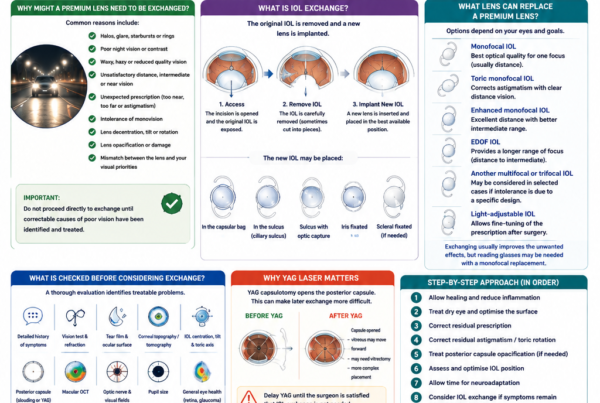
IOL exchange is possible, but it is another intraocular operation with additional risks.
Correctable causes such as dry eye, residual prescription and capsule clouding should be assessed first.
Only a minority of dissatisfied multifocal-IOL patients in referral studies required lens exchange, although persistent dissatisfaction can occur.
Why Should YAG Laser Sometimes Be Delayed?
YAG capsulotomy opens the capsule behind the IOL.
If lens exchange is being seriously considered, an open capsule may make exchange more technically difficult.
The cause of dissatisfaction should therefore be established before YAG treatment.
A Premium-Lens Suitability Checklist
Factors Supporting a Presbyopia-Correcting Lens
- Healthy maculae
- Healthy optic nerves
- Regular corneas
- Stable tear film
- Repeatable measurements
- Correctable regular astigmatism
- Good visual potential in both eyes
- Stable lens support
- Realistic expectations
- Strong desire to reduce glasses
- Acceptance of possible halos
- Ability to complete follow-up
Factors Requiring Additional Caution
- Early retinal disease
- Mild stable glaucoma
- Previous LASIK or PRK
- Mild corneal irregularity
- Treated dry eye
- High refractive error
- Large pupils
- Significant night-driving needs
- Previous vitrectomy
- Limited binocular vision
Factors That Often Favour a Monofocal Strategy
- Advanced macular disease
- Moderate or advanced glaucoma
- Significant optic neuropathy
- Severe irregular astigmatism
- Dense central corneal scarring
- Uncontrolled ocular-surface disease
- Severe amblyopia
- Unstable double vision
- Marked zonular weakness
- Inability to tolerate halos
- Expectations of guaranteed perfect vision
The Bottom Line
Some patients are unsuitable for premium presbyopia-correcting lenses because their eyes or visual requirements make the optical trade-offs more likely to outweigh the benefits.
The main reasons include:
- Retinal or macular disease
- Glaucoma or optic-nerve damage
- Corneal irregularity
- Higher-order aberrations
- Uncontrolled dry eye
- Unstable measurements
- Irregular astigmatism
- Poor binocular vision
- Weak lens support
- High night-driving demands
- Unrealistic expectations
- Inability to complete postoperative treatment
However, being unsuitable for a multifocal or trifocal lens does not necessarily mean being unsuitable for every premium option.
A patient may still benefit from:
- Toric correction
- An enhanced monofocal lens
- A selected EDOF lens
- Monovision
- A light-adjustable lens
- A specialised small-aperture lens
The correct question is therefore not simply:
“Am I suitable for a premium lens?”
It is:
“Which lens provides the best balance of visual range, optical quality, predictability and long-term safety for my particular eyes and lifestyle?”
A well-selected monofocal lens is better than an unsuitable multifocal lens.
The best lens is the one that works with the eye’s strengths, respects its limitations and creates compromises the patient genuinely understands and accepts.
References
- Chen JL, Al-Mohtaseb ZN, Chen AJ. Criteria for premium intraocular lens patient selection. Curr Opin Ophthalmol. 2024;35(5):353–358. doi:10.1097/ICU.0000000000001067. PMID: 38920096.
- Li J, Sun B, Zhang Y, et al. Comparative efficacy and safety of all kinds of intraocular lenses in presbyopia-correcting cataract surgery: a systematic review and meta-analysis. BMC Ophthalmol. 2024;24(1):172. doi:10.1186/s12886-024-03446-1. PMID: 38627651.
- Hong ASY, Ang BCH, Dorairaj E, Dorairaj S. Premium intraocular lenses in glaucoma—a systematic review. Bioengineering. 2023;10(9):993. doi:10.3390/bioengineering10090993. PMID: 37760095.
- Grzybowski A, Kanclerz P, Tuuminen R. Multifocal intraocular lenses and retinal diseases. Graefes Arch Clin Exp Ophthalmol. 2020;258(4):805–813. doi:10.1007/s00417-020-04603-0. PMID: 31955239.
- Fernández J, Burguera N, Rodríguez Calvo-de-Mora M, Rocha-de-Lossada C, Rodríguez-Vallejo M. Influence of corneal higher-order aberrations on visual performance with a multifocal intraocular lens. J Refract Surg. 2025;41(4)–e299. doi:10.3928/1081597X-20250213-01. PMID: 40197073.
- Moshirfar M, Ellis J, McCaughey MV, et al. Use of presbyopia-correcting intraocular lenses in patients with prior corneal refractive surgery. Curr Opin Ophthalmol. 2021;32(1):74–82. PMID: 33122489.
- Sun Y, Zhang T, Xu Y, et al. Presbyopia-correcting intraocular lenses implantation in eyes after corneal refractive laser surgery: a meta-analysis and systematic review. Front Med. 2022;9:834805. doi:10.3389/fmed.2022.834805.
- Alió JL, Plaza-Puche AB, Férnandez-Buenaga R, Pikkel J, Maldonado M. Multifocal intraocular lenses: an overview. Surv Ophthalmol. 2017;62(5):611–634. doi:10.1016/j.survophthal.2017.03.005. PMID: 28366683.
- Gibbons A, Ali TK, Waren DP, Donaldson KE. Causes and correction of dissatisfaction after implantation of presbyopia-correcting intraocular lenses. Clin Ophthalmol. 2016;10:1965–1970. doi:10.2147/OPTH.S114890. PMID: 27784985.
- Woodward MA, Randleman JB, Stulting RD. Dissatisfaction after multifocal intraocular lens implantation. J Cataract Refract Surg. 2009;35(6):992–997. doi:10.1016/j.jcrs.2009.01.031. PMID: 19465282.
- Khandelwal SS, Jun JJ, Mak S, Booth MS, Shekelle PG. Effectiveness of multifocal and monofocal intraocular lenses for cataract surgery and lens replacement: a systematic review and meta-analysis. Graefes Arch Clin Exp Ophthalmol. 2019;257(5):863–875. doi:10.1007/s00417-018-04218-6. PMID: 30627791.
- Al-Mohtaseb Z, Steigleman WA, Pantanelli SM, et al. Toric monofocal intraocular lenses for the correction of astigmatism during cataract surgery: a report by the American Academy of Ophthalmology. Ophthalmology. 2024;131(3):383–392. doi:10.1016/j.ophtha.2023.10.010. PMID: 38149945.
- Al-Shymali O, Alió del Barrio JL, Alió JL. Patients’ dissatisfaction with multifocal intraocular lenses: aetiology, evaluation and management. Eye Vis. 2022;9:7. doi:10.1186/s40662-022-00282-2.
- Stern B, et al. Presbyopia correction in lens replacement surgery: a review. Clin Ophthalmol. 2025.
- Rampat R, Gatinel D. Multifocal and extended depth-of-focus intraocular lenses in 2020. Ophthalmology. 2021;128(11)–e185. doi:10.1016/j.ophtha.2020.09.026. PMID: 32980397.