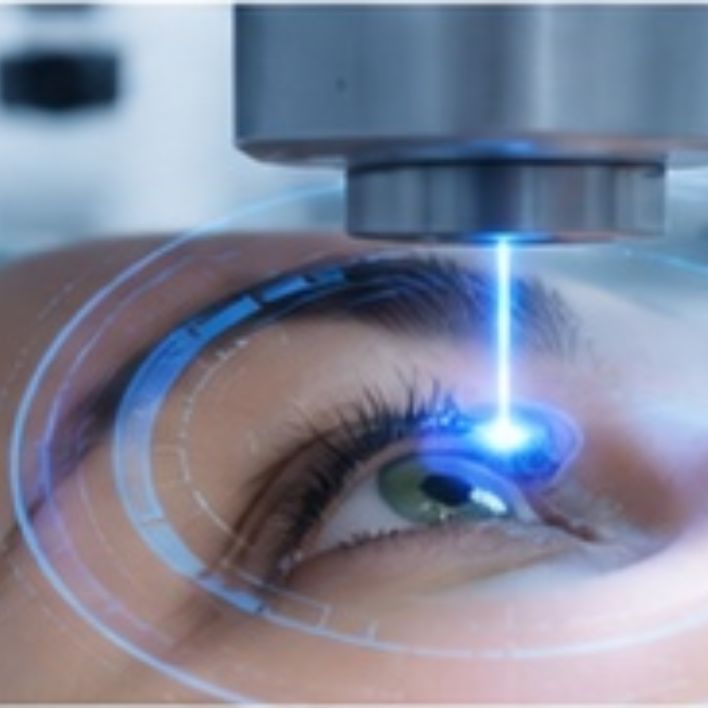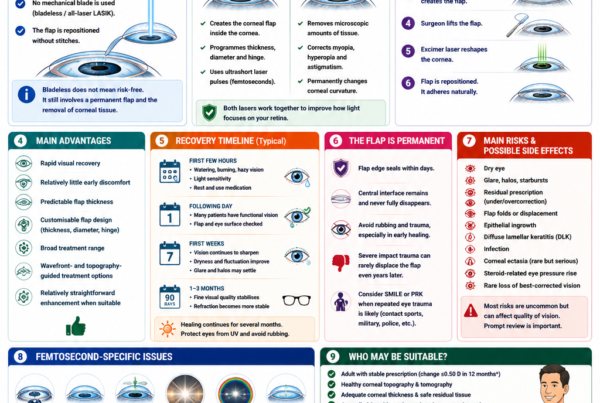
LASIK Surgery in Singapore

LASIK is one of the most established forms of laser vision correction and is used to correct myopia, astigmatism and, in selected cases, hyperopia.

The procedure reshapes the cornea so that light entering the eye can be focused more accurately onto the retina, reducing dependence on glasses or contact lenses.

Modern refractive surgery, however, offers several different options including LASIK, SMILE Pro, PRK and Implantable Collamer Lens (ICL) surgery.

The most suitable procedure depends on factors such as your prescription, corneal thickness and shape, dry-eye status, lifestyle, age and visual requirements.

As a cataract and refractive surgeon, Dr Val Phua assesses patients across the different refractive surgery options rather than approaching every patient as a LASIK candidate.

What is LASIK?

LASIK stands for Laser-Assisted In Situ Keratomileusis.

During LASIK, a thin flap is created in the cornea. This flap is lifted, and an excimer laser is used to reshape the underlying corneal tissue.
The flap is then repositioned.

By altering the curvature of the cornea, LASIK changes the way light is focused inside the eye.

The procedure is usually performed with topical anaesthetic eye drops and is typically completed within a short period of time.

What can LASIK correct?

LASIK may be used to correct:
● Myopia
● Astigmatism
● Hyperopia in selected patients
● Certain differences in prescription between the two eyes

The amount of refractive error that can safely be treated depends on the individual eye.

A higher prescription does not automatically mean that LASIK is unsuitable, but more corneal tissue generally needs to be reshaped.

For this reason, prescription must always be considered together with corneal thickness, shape and other anatomical factors.

How Dr Val Phua assesses patients for LASIK

The purpose of refractive assessment is not simply to confirm whether LASIK can technically be performed.

It is to determine which refractive procedure offers the most appropriate balance of vision, safety and long-term considerations for the individual eye.

Several factors are therefore considered.

Your prescription

The amount of myopia and astigmatism helps determine whether ICL is an appropriate option and which lens power may be required.

Corneal shape

Corneal tomography and topography are important parts of refractive surgery assessment.

These scans help identify irregular corneal patterns and conditions that may increase the risk of postoperative corneal weakening.

Pupil size and visual requirements

Night driving, occupation, screen use and other visual demands may influence refractive planning and counselling.

Corneal thickness

LASIK removes corneal tissue.

There must therefore be sufficient corneal thickness before surgery and an adequate amount of structurally intact cornea remaining afterwards.

Ocular surface and dry eye

Dry-eye symptoms may occur after LASIK, particularly during the early postoperative period.

Pre-existing dry eye, meibomian gland dysfunction and ocular surface inflammation should therefore be identified and managed before surgery where appropriate.

Age and accommodation

LASIK can correct distance refractive error, but it does not stop the normal ageing process of the eye.

Patients approaching their 40s and beyond should understand the implications of presbyopia, particularly the possibility of requiring reading glasses.

Retina and general eye health

A refractive surgery assessment should also consider the health of the rest of the eye.

Patients with significant myopia may benefit from careful retinal assessment because myopia itself is associated with an increased lifetime risk of retinal problems.

What happens during LASIK?

LASIK is typically performed in two main stages.

First, a femtosecond laser creates a thin corneal flap.

The flap is carefully lifted.

An excimer laser then reshapes the underlying corneal tissue according to the patient’s refractive correction.

The flap is subsequently repositioned.

It naturally adheres to the underlying corneal surface as healing begins.

No stitches are normally required.

Does LASIK hurt?

Anaesthetic eye drops are used before the procedure.

Patients may notice pressure, bright lights and temporary blurring during surgery, but significant pain during the procedure is uncommon.

After LASIK, the eyes may feel:
● Gritty
● Watery
● Irritated
● Sensitive to light
● Mildly uncomfortable

These symptoms are generally most noticeable during the first several hours after treatment.

How quickly does vision recover after LASIK?

One of the advantages of LASIK is relatively rapid visual recovery.

Many patients notice substantial improvement by the following day.

However, vision may fluctuate during the early healing period.

Some patients experience:
● Mild blur
● Variable clarity
● Halos
● Glare
● Light sensitivity
● Dryness

Visual quality generally becomes more stable with healing.

The precise recovery period varies between individuals.

What are the benefits of LASIK?

Potential advantages of LASIK include:
● Rapid visual recovery
● Minimal postoperative discomfort for most patients
● Long clinical track record
● Treatment of myopia and astigmatism
● No implanted intraocular lens
● Ability to customise treatment according to refractive measurements

However, these advantages must be considered alongside the structural effects of creating a corneal flap and removing corneal tissue.

What are the risks of LASIK?

LASIK has a long-established safety profile in appropriately selected patients, but no refractive procedure is risk-free.

Potential complications include:
● Dry-eye symptoms
● Glare and halos
● Fluctuating vision
● Under-correction or over-correction
● Residual astigmatism
● Need for enhancement
● Flap-related complications
● Infection or inflammation
● Corneal haze or scarring in unusual circumstances
● Corneal ectasia
● Reduced quality of vision despite good spectacle-chart acuity
● Rare sight-threatening complications

Careful patient selection and detailed pre-operative corneal assessment are therefore important.

What is corneal ectasia?

Corneal ectasia is an uncommon but important complication of corneal refractive surgery.

It occurs when the cornea progressively weakens and becomes more irregular in shape.

This may cause increasing myopia, astigmatism and distorted vision.

Modern screening attempts to identify patients whose corneal shape or biomechanical characteristics may make laser vision correction less suitable.

Patients with concerning corneal findings may be better suited to another refractive option, such as ICL, depending on the rest of the eye examination.

LASIK and dry eye

Dry-eye symptoms are common during the early period after LASIK.

This occurs partly because corneal nerves are temporarily affected during flap creation and laser treatment.

Symptoms can include:
● Dryness
● Grittiness
● Burning
● Fluctuating vision
● Eye fatigue

For most patients, these symptoms improve with healing.

Patients with significant pre-existing dry eye may require treatment before refractive surgery, or an alternative procedure may sometimes be considered.

LASIK vs SMILE

LASIK and SMILE both correct refractive error by reshaping the cornea, but they do so differently.

LASIK involves creation of a corneal flap followed by excimer laser reshaping.

SMILE removes a small piece of corneal tissue, known as a lenticule, through a small incision without creating a conventional LASIK flap.

Both procedures can provide excellent vision in appropriately selected patients.

The better option depends on factors including:
● Prescription
● Corneal anatomy
● Dry-eye tendency
● Lifestyle
● Astigmatism
● Visual requirements
● Surgeon assessment

Neither procedure is universally superior for every patient.

LASIK vs PRK

Both LASIK and PRK use an excimer laser to reshape the cornea.

The main difference is how the surface of the cornea is managed.

With LASIK, a flap is created.

With PRK, the surface epithelium is removed and the laser treatment is performed without creating a corneal flap.

PRK generally has:
● Slower visual recovery
● More discomfort during the first few days
● No LASIK flap
● Different biomechanical considerations

For certain corneas or occupations, PRK may be preferable.

LASIK vs ICL

LASIK and ICL correct vision in fundamentally different ways.

LASIK permanently reshapes the cornea.

ICL surgery places an additional lens inside the eye without removing central corneal tissue.

ICL may be particularly attractive for patients with:
● Higher myopia
● Thin or borderline corneas
● Certain corneal shapes
● Dry-eye concerns
● Prescriptions outside the preferred laser treatment range

However, ICL is an intraocular procedure and therefore carries a different set of surgical risks.

The decision should be based on the entire eye rather than prescription alone.

Is LASIK permanent?

The corneal reshaping performed during LASIK is permanent.

However, the eye itself continues to change throughout life.

Possible future changes include:
● Progression of myopia
● Development of presbyopia
● Cataract formation
● Other age-related eye changes

For this reason, LASIK should not be interpreted as a guarantee that glasses will never be required again.

Will I need reading glasses after LASIK?

LASIK does not prevent presbyopia.

Presbyopia is the gradual loss of the eye’s ability to focus at near, usually becoming noticeable from the early to mid-40s.

Someone who has excellent distance vision after LASIK may therefore still require reading glasses later in life.

Some patients may consider monovision, where one eye is targeted for distance and the other for nearer vision.

This requires careful discussion and is not suitable for everyone.

Can LASIK be repeated?

In some patients with residual or recurrent refractive error, an enhancement may be possible.

Whether further laser treatment is appropriate depends on:● Corneal thickness
● Corneal shape
● Amount of residual prescription
● Time since the original surgery
● Age
● Other eye conditions

An enhancement should only be considered after confirming that the prescription is stable and the cornea remains suitable.

How long does LASIK last?

The corneal changes created during LASIK do not simply wear off.

However, vision may change over time because the eye continues to age.

This can occur because of:
● Natural refractive changes
● Presbyopia
● Cataracts
● Changes in the crystalline lens

Long-term visual stability therefore depends partly on the patient’s age and underlying refractive error.

LASIK and cataract surgery later in life

Having undergone LASIK does not prevent future cataract surgery.

However, previous laser vision correction changes the corneal measurements used to calculate the power of the intraocular lens implanted during cataract surgery.

Modern cataract calculations can account for previous LASIK, but patients should inform their cataract surgeon about any previous refractive surgery.

If available, keeping previous LASIK treatment records may also be useful.

Frequently asked questions about LASIK

How long does LASIK take?

The laser treatment itself is brief, although additional time is required for preparation, positioning and checks.

LASIK is generally performed as a day procedure.

Can both eyes be treated together?

Yes. LASIK is commonly performed on both eyes during the same treatment session when appropriate.

When can I return to work?

Many patients can return to office-based work within a short period, although this depends on visual recovery, comfort and occupational requirements.

Can LASIK correct high myopia?

LASIK can treat a range of myopic prescriptions, but suitability depends on the amount of correction required and the amount of corneal tissue available.
For higher degrees of myopia, ICL may sometimes be preferable.

When can I exercise after LASIK?

Light exercise can usually be resumed relatively early.

Swimming, contact sports and activities where the eyes may be rubbed or struck generally require more caution during the early healing period.

Can I rub my eyes after LASIK?

Patients should avoid rubbing the eyes during the early postoperative period because the corneal flap is still healing.

Does LASIK cause halos?

Halos and glare may occur after LASIK, particularly during the early recovery period and in low-light conditions.

Is LASIK safe?

LASIK is generally safe in appropriately selected patients, but it remains a surgical procedure and carries potential risks.

Detailed pre-operative screening is essential.

Dr Val Phua and LASIK surgery

Dr Val Phua is a Senior Consultant Ophthalmologist and cataract and refractive surgeon in Singapore.

His refractive surgery practice includes LASIK, SMILE Pro, PRK and ICL, allowing patients to be assessed across multiple vision correction options.

His approach is based on detailed assessment of the prescription, cornea, ocular surface, internal eye anatomy, visual requirements and lifestyle before deciding which procedure is most appropriate.

The aim is not simply to determine whether LASIK can be performed, but whether LASIK is the right option for that particular eye.

LASIK Patient Guides

For more detailed information, explore these LASIK topics:

What Is Femto-LASIK? Procedure, Recovery, Benefits and Risks Explained

Learn how Femto-LASIK uses a femtosecond laser to create a corneal flap, how quickly vision recovers and its benefits, risks and suitability.
Who Is Suitable for LASIK? Eligibility, Eye Tests and Reasons You May Not Qualify

Learn who is suitable for LASIK, including age, prescription stability, corneal thickness, dry eye, health conditions and reasons you may not qualify.
LASIK Myths: Separating Fact From Fiction About Laser Eye Surgery

Separate LASIK facts from myths about blindness, pain, dry eye, permanence, glasses, corneal flaps, presbyopia, cataract and long-term safety.
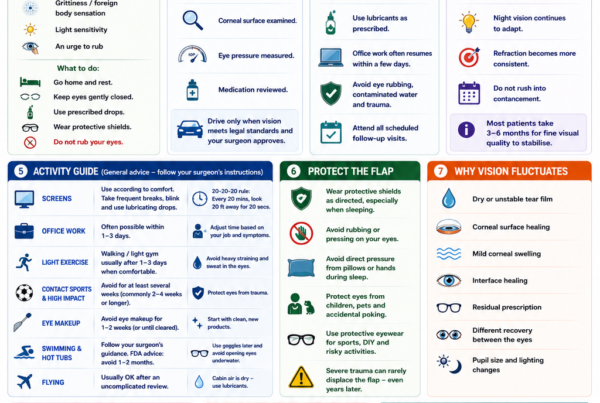
Recovery After LASIK: What to Expect From the First Day to Three Months

Learn what to expect after LASIK, including first-day vision, dry eye, recovery time, activity restrictions, flap care and symptoms requiring urgent review.
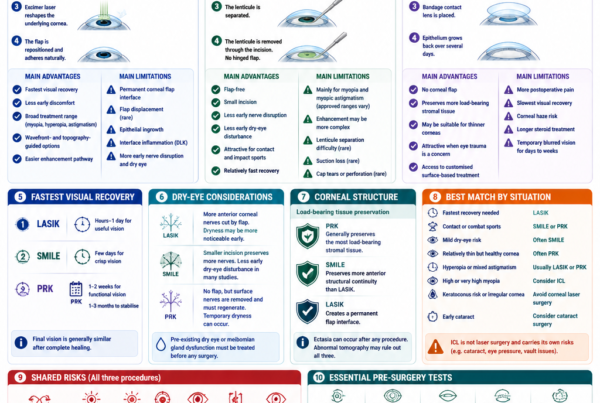
Which Laser Eye Surgery Is Best? LASIK, SMILE and PRK Compared

Compare LASIK, SMILE and PRK by recovery, dry eye, corneal strength, risks, prescription range and lifestyle to find the safest option for your eyes.
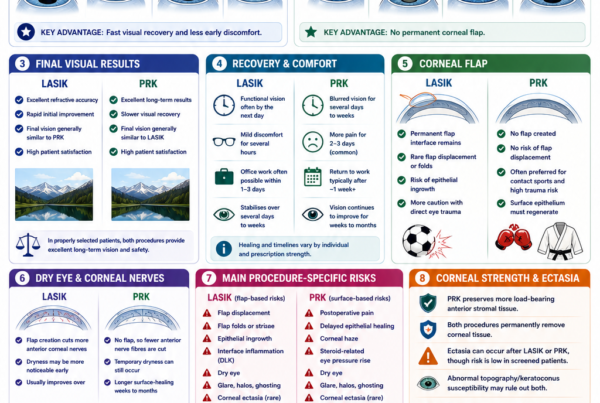
LASIK vs PRK: Which Laser Vision Correction Procedure Is Better?

Compare LASIK and PRK, including visual recovery, pain, dry eye, haze, flap risks, thin-cornea suitability and long-term results.
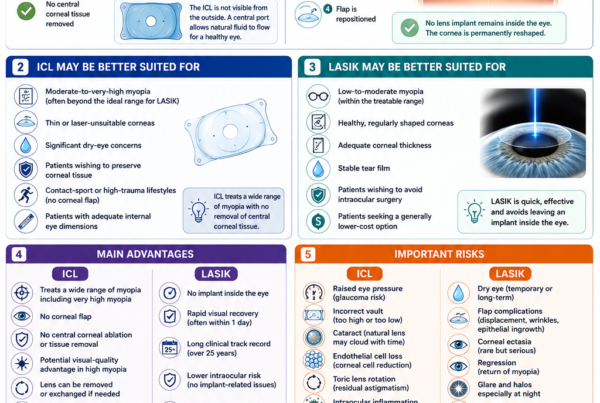
ICL vs LASIK: Which Vision Correction Surgery Is Better?

Compare ICL vs LASIK for myopia and astigmatism. Learn how they differ in suitability, visual quality, dry eye, risks, recovery and long-term care.
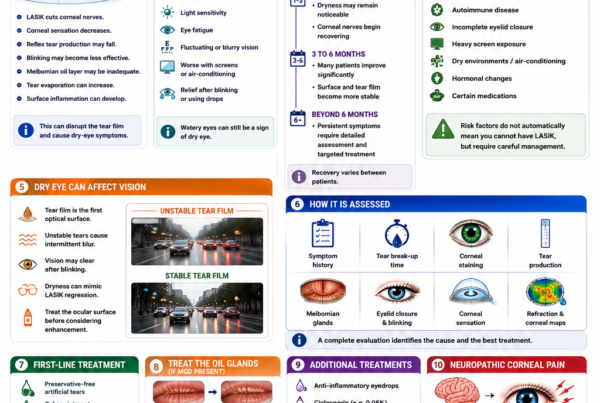
Dry Eyes After LASIK: Causes, Duration, Treatment and When to Worry

Learn why dry eyes occur after LASIK, how long symptoms last, who is at risk and how lubricants, eyelid treatment, punctal plugs and other therapies help.
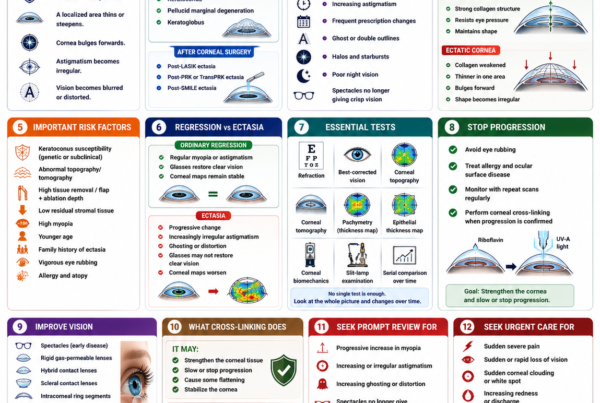
Corneal Ectasia Explained: Causes, Symptoms, Diagnosis and Treatment

Learn what corneal ectasia is, how it differs from keratoconus and LASIK regression, its warning signs and treatments including cross-linking and scleral lenses.
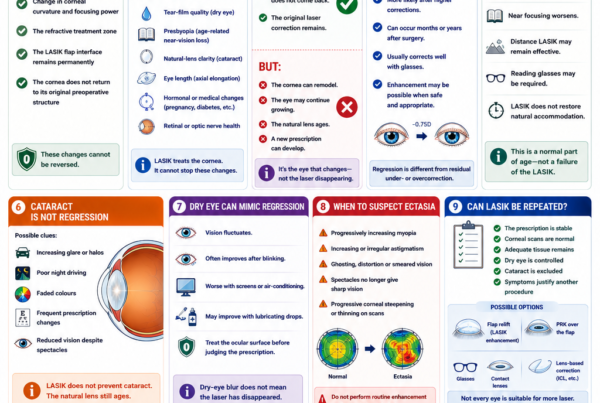
Is LASIK Permanent? How Long Results Last and Why Vision Can Still Change

LASIK permanently reshapes the cornea, but vision can still change from regression, presbyopia, cataract, dry eye or myopia progression.
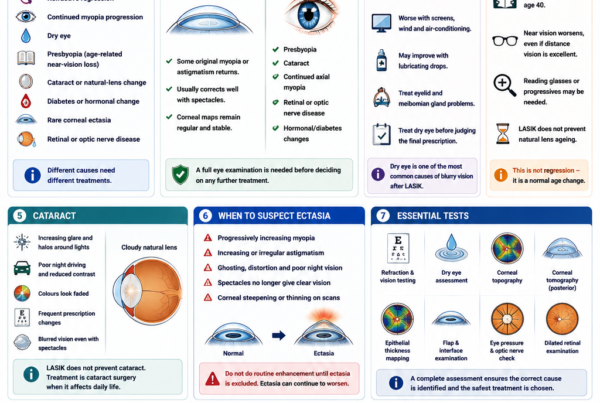
Can My Eyesight Worsen After LASIK? Regression, Ageing and When to Seek Review

Vision can change after LASIK because of regression, dry eye, presbyopia, cataract or rare corneal ectasia. Learn the causes and treatment options.
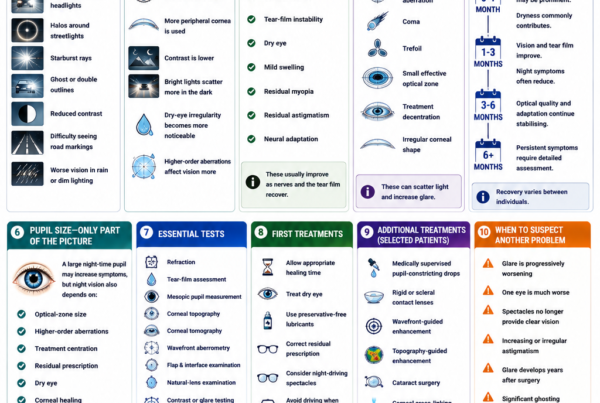
Night Glare After LASIK: Causes, Recovery, Treatment and When to Seek Review

Learn why glare, halos and starbursts occur after LASIK, how long night-vision symptoms last, warning signs and treatments that may improve them.


Considering LASIK or another form of vision correction?

LASIK is one of several ways to reduce dependence on glasses or contact lenses.

For some patients, LASIK may be the most appropriate option.

For others, SMILE, PRK or ICL may offer advantages based on corneal anatomy, prescription, dry-eye status or lifestyle.

A comprehensive refractive assessment can determine which procedures are suitable and allow the benefits, limitations and risks of each option to be considered before making a decision.

eye doctor singapore

Enquiry