Author: Dr Val Phua
Estimated reading time: 18 minutes
Night glare is a recognised visual symptom after LASIK.
Patients may notice:
- Bright lights appearing unusually intense
- A glowing haze around headlights
- Halos around streetlights
- Starburst patterns extending from light sources
- Ghost images or overlapping outlines
- Reduced contrast in dim conditions
- Difficulty seeing road markings at night
- Greater difficulty driving in rain
- Vision that seems clear during the day but less sharp after dark
These symptoms are often most noticeable during the first weeks or months after surgery and commonly improve as the cornea, tear film and visual system recover.
However, persistent or severe night glare should not automatically be dismissed as normal healing. It may be caused by:
- Dry-eye-related tear-film instability
- A small residual spectacle prescription
- Residual astigmatism
- A large pupil under dim lighting
- Higher-order optical aberrations
- A small or decentered effective optical treatment zone
- Irregular corneal healing
- Flap or interface complications
- Corneal ectasia
- Cataract or another eye condition unrelated to LASIK
The FDA-supported Patient-Reported Outcomes With LASIK studies found that some patients developed new visual symptoms after surgery. Among participants who had no halos before LASIK, up to 40% reported halos at three months. Nevertheless, more than 95% of participants were satisfied with their postoperative vision, and fewer than 1% had major difficulty performing usual activities because of any single visual symptom.
The balanced message is:
Temporary night glare is relatively common after LASIK and often improves. Persistent, progressive or functionally significant symptoms require assessment to identify the underlying optical or ocular cause.
What Is Night Glare?
Glare occurs when scattered light reduces visual clarity or comfort.
At night, the visual system must distinguish relatively dim objects while bright light sources such as headlights, traffic signals and streetlamps are present.
A patient with night glare may still achieve excellent high-contrast eye-chart vision in a bright examination room but struggle with:
- Oncoming headlights
- Wet-road reflections
- Dimly illuminated pedestrians
- Dark road signs
- Fine details outside the direct beam of the headlights
- Rapid adaptation between bright and dark areas
Standard visual acuity does not measure every aspect of night vision.
Night-time visual quality also depends on:
- Contrast sensitivity
- Light scatter
- Tear-film stability
- Pupil size
- Corneal optical quality
- Higher-order aberrations
- Retinal adaptation
- Neural processing
Are Glare, Halos and Starbursts the Same?
They are related but describe different visual experiences.
Glare
Glare is excessive brightness or scattered light that reduces visual comfort or visibility.
Patients may describe:
- Headlights appearing too bright
- A washed-out area around a light
- Difficulty seeing objects close to bright lights
- Reduced contrast while driving
Halos
Halos are rings or glowing circles surrounding a light source.
They may appear around:
- Streetlamps
- Car headlights
- Traffic signals
- Decorative lights
- White text on a dark screen
Starbursts
Starbursts are rays or spikes extending outwards from a point of light.
They can make a headlight appear larger and more distracting than it actually is.
Ghosting
Ghosting is a faint second image, shadow or duplicate outline.
It may arise from:
- Residual astigmatism
- Tear-film irregularity
- Corneal coma
- Decentered treatment
- Irregular corneal shape
Reduced Contrast Sensitivity
A patient may see black letters on a white chart but struggle to identify low-contrast objects in dim conditions.
This can affect:
- Night driving
- Walking in dark environments
- Recognising faces in poor lighting
- Seeing road hazards in rain or mist
These symptoms can occur together, but identifying the dominant complaint helps guide investigation.
Why Is Night Glare More Noticeable After Dark?
Several changes occur in dim lighting.
The Pupil Becomes Larger
The pupil dilates to allow more light into the eye.
A larger pupil exposes a wider area of the cornea. Light may then pass through:
- The central treatment zone
- The peripheral transition zone
- Untreated or differently curved peripheral cornea
- Areas affected by optical irregularity
This can increase the effect of spherical aberration, coma and other higher-order aberrations.
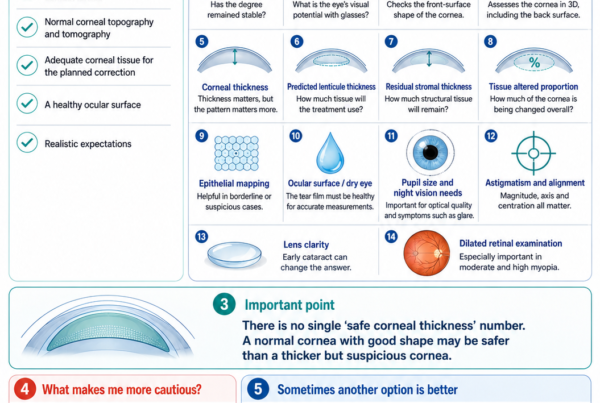
FDA guidance advises that pupils should be measured in dim lighting because large pupils may increase the risk of glare, halos, starbursts and ghost images after LASIK.
However, pupil size is not the only determinant of symptoms. Some studies found an association between larger pupils and early night-vision complaints, while other studies found that pupil size alone did not predict persistent symptoms after modern customised treatment.
Contrast Is Lower
The visual system has less light available to distinguish objects from their background.
Small optical imperfections that are not noticeable during the day become more obvious.
Bright Lights Produce Greater Relative Scatter
A headlight against a dark background creates a much stronger contrast than the same light during daylight.
Even modest corneal or tear-film scatter may therefore appear more disturbing.
Tear-Film Irregularity Becomes More Important
A dry or unstable tear film creates an irregular optical surface.
At night, this can enlarge glare patterns, increase starbursts and reduce contrast.
Why Can LASIK Cause Night Glare?
LASIK permanently changes the curvature of the cornea.
Even when the intended spectacle prescription is corrected accurately, the procedure may temporarily or permanently alter subtler aspects of optical quality.
Early Corneal Healing
During the early postoperative period, the cornea may have:
- Mild swelling
- Surface irregularity
- Tear-film instability
- Interface healing
- Inflammatory changes
- Temporary differences between the two eyes
These factors can scatter light and reduce contrast.
Symptoms often improve as healing progresses.
Dry Eye and Tear-Film Instability
Dry eye is one of the commonest causes of fluctuating vision after LASIK.
The tear film forms the first optical surface of the eye. When it breaks up:
- The corneal surface becomes optically irregular
- Light scatters
- Halos and starbursts may enlarge
- Vision may fluctuate between blinks
- Night driving may become more difficult
A useful clue is that the glare or blur:
- Improves immediately after blinking
- Improves after lubricating drops
- Worsens during screen use
- Worsens under air-conditioning
- Becomes more noticeable later in the day
Dry-eye-related glare does not necessarily mean that the laser correction is inaccurate.
Residual Myopia
Even a small amount of residual short-sightedness can become more noticeable at night.
Patients may have:
- Good daytime functional vision
- Slightly blurred distant signs after dark
- More glare around headlights
- A tendency to squint
- Improvement with a weak spectacle correction
Night-time pupils are larger, and the eye may also undergo a small physiological shift towards myopia in dim conditions.
Residual Astigmatism
Residual astigmatism can produce:
- Starbursts
- Directional streaks
- Ghost images
- Shadowed letters
- Headlights that appear stretched vertically or horizontally
A small cylinder correction may substantially improve night driving even when daytime unaided visual acuity is good.
Higher-Order Aberrations
Ordinary spectacle prescriptions correct lower-order aberrations:
- Myopia
- Hyperopia
- Regular astigmatism
Higher-order aberrations are more complex optical imperfections that cannot be corrected completely with ordinary spherical and cylindrical spectacle lenses.
Important examples include:
- Spherical aberration
- Coma
- Trefoil
Studies have shown that night-vision disturbances after LASIK correlate with increased corneal higher-order aberrations, particularly spherical aberration and coma.
Spherical Aberration
Spherical aberration occurs when peripheral and central light rays focus at different positions.
It may cause:
- Halos
- Glare
- Reduced contrast
- A general softening of night vision
Myopic LASIK can increase positive spherical aberration because the central cornea is flattened more than the peripheral cornea.
Coma
Coma can cause a point of light to appear comet-shaped or smeared in one direction.
Possible causes include:
- Treatment decentration
- Irregular corneal shape
- Unequal healing
- Pre-existing corneal asymmetry
Trefoil
Trefoil may produce a three-pointed or irregular star-like distortion around lights.
The amount and pattern of higher-order aberration depend on the original cornea, degree of correction, pupil size, treatment profile and healing response.
Optical-Zone Size
The optical zone is the central area planned to provide the intended refractive correction.
A transition zone blends the treated area into the surrounding cornea.
When the effective optical zone is relatively small compared with the pupil in dim lighting, light may pass through different corneal curvatures.
This may increase:
- Halos
- Glare
- Starbursts
- Spherical aberration
- Reduced night-time contrast
Earlier studies identified smaller ablation diameters and higher attempted corrections as risk factors for night-vision complaints.
A larger optical zone may improve night-time optical quality but requires more corneal tissue removal. Treatment planning must therefore balance visual quality against structural safety.
Treatment Decentration
Ideally, the refractive treatment is centred appropriately over the patient’s visual axis or chosen centration reference.
A decentered treatment may induce:
- Coma
- Ghost images
- Asymmetric glare
- Reduced contrast
- Monocular double vision
Modern laser systems may use:
- Eye tracking
- Iris registration
- Cyclotorsion compensation
- Pupil tracking
- Corneal vertex or visual-axis-based planning
These technologies reduce but do not eliminate the possibility of optical decentration.
Higher Original Prescription
Patients with higher myopia generally require:
- Deeper tissue removal
- A greater change in corneal curvature
- A broader transition between central and peripheral cornea
- More significant induced spherical aberration
Higher attempted correction has repeatedly been associated with greater night-vision complaints in older LASIK studies.
Modern aspheric and customised profiles aim to reduce these effects, but high correction remains an important planning consideration.
Flap or Interface Problems
Night glare may occasionally be associated with:
- Flap folds or striae
- Interface inflammation
- Epithelial ingrowth
- Interface debris
- Irregular flap alignment
- Interface fluid caused by high eye pressure
These conditions may also produce:
- Reduced visual acuity
- Ghosting
- Fluctuation
- Light sensitivity
- A difference between the eyes
Slit-lamp examination is required to identify these problems.
Corneal Ectasia
Corneal ectasia is uncommon but important.
It involves progressive weakening and bulging of the cornea after refractive surgery.
Possible symptoms include:
- Increasing myopia
- Progressive or irregular astigmatism
- Ghosting
- Increasing glare
- Distorted lights
- Reduced best-corrected vision
- Spectacles no longer providing crisp vision
Night glare caused by progressive ectasia should not be treated with routine further LASIK.
Corneal topography and tomography are required when there is progressive refractive or optical change.
Cataract or Natural-Lens Changes
Night glare developing several years after LASIK may not be caused by the cornea.
Cataract may cause:
- Headlight glare
- Halos
- Reduced contrast
- Faded colours
- Frequent prescription changes
- Poor night driving
- Reduced vision despite spectacles
LASIK does not prevent cataract.
A patient with previously good night vision who develops increasing glare later in life should have the natural lens examined before assuming that the LASIK effect has deteriorated.
Retinal or Optic Nerve Disease
Retinal and optic nerve disease generally do not produce classic corneal halos, but they can reduce contrast and night-time visual function.
Possible conditions include:
- Glaucoma
- Myopic macular degeneration
- Diabetic retinopathy
- Retinal degeneration
- Optic nerve disease
A complete assessment may therefore be required when symptoms are not explained by the cornea or refraction.
How Common Is Night Glare After LASIK?
Reported frequency varies because studies differ in:
- Surgical era
- Laser platform
- Treatment profile
- Degree of myopia
- Symptom questionnaire
- Follow-up duration
- Definition of clinically significant glare
In the FDA PROWL studies, up to 46% of patients who reported no visual symptoms before LASIK reported at least one visual symptom at three months. Halos were the most frequently reported new symptom. Most symptoms did not cause major functional limitation, and overall satisfaction remained high.
An earlier study reported that night-vision complaints decreased from 25.6% at one month to 4.7% at twelve months, illustrating that many early symptoms improve with healing and adaptation.
Figures from older LASIK technology should not be applied directly to all modern treatments, but they demonstrate the importance of recovery time.
How Long Does Night Glare Last?
There is no universal timeline.
The First Few Days
Glare may be related to:
- Tear-film instability
- Mild swelling
- Surface irritation
- Postoperative medication
- Early interface healing
Night driving may be uncomfortable or unsafe.
The First Month
Halos, glare and starbursts may remain noticeable.
Symptoms often fluctuate according to:
- Dryness
- Fatigue
- Lighting
- Pupil size
- Screen exposure
- The difference between the two eyes
One to Three Months
Many patients notice progressive improvement as:
- Dryness settles
- Corneal swelling resolves
- The interface becomes clearer
- Refraction stabilises
- The visual system adapts
Three to Six Months
Fine optical quality and neural adaptation may continue improving.
FDA information commonly advises that visual symptoms may take approximately three to six months to stabilise.
Beyond Six Months
Persistent symptoms deserve further evaluation, especially when they:
- Interfere with driving
- Remain severe
- Are worsening
- Affect one eye much more than the other
- Do not improve with blinking or spectacles
- Are accompanied by ghosting or reduced corrected vision
Some patients continue to improve beyond six months, but waiting alone is not appropriate when a treatable cause is present.
Does the Brain Adapt to Night Glare?
Neural adaptation may reduce awareness of visual disturbances over time.
The brain can learn to:
- Suppress minor ghost images
- Interpret altered light patterns
- rely more heavily on the clearer eye
- Function more effectively with a new optical system
However, neural adaptation cannot correct:
- Significant residual myopia
- Irregular astigmatism
- Severe dry eye
- Decentered ablation
- Cataract
- Progressive ectasia
Patients should not be told simply to “get used to it” without an appropriate examination.
Does Pupil Size Cause Night Glare?
Pupil size can contribute but should not be treated as the sole explanation.
A large pupil exposes a broader corneal area and may increase the contribution of peripheral optical aberrations.
Early studies found more glare, haze and halos among patients with larger mesopic pupils during the first postoperative months.
Other studies found that pupil size alone was not a strong predictor of persistent symptoms after wavefront-guided LASIK.
The practical interpretation is:
- Pupil size matters
- Optical-zone size also matters
- Higher-order aberrations matter
- Treatment centration matters
- Dry eye and residual prescription matter
- Pupil size alone cannot reliably predict every patient’s experience
Are Modern LASIK Treatments Better for Night Vision?
Modern treatments may improve night-time optical quality compared with older conventional ablation patterns.
Available treatment strategies include:
Wavefront-Optimised LASIK
This aims to reduce induction of spherical aberration by placing additional treatment towards the peripheral optical zone.
Wavefront-Guided LASIK
This uses measurements of the eye’s optical aberrations to create an individualised treatment profile.
Topography-Guided LASIK
This uses detailed corneal surface measurements to address refractive error and selected corneal optical irregularities.
Ray-Tracing-Guided Treatment
This combines multiple optical and anatomical measurements to model how light travels through the individual eye.
Clinical studies and meta-analyses generally report excellent outcomes with modern customised treatments, with some evidence that topography-guided or wavefront-guided approaches reduce selected higher-order aberrations or improve subjective night vision compared with older conventional profiles.
No platform can guarantee freedom from night glare.
Treatment quality still depends on:
- Accurate refraction
- Stable tear film
- Appropriate centration
- Corneal shape
- Pupil characteristics
- Astigmatic alignment
- Individual healing
Is Night Vision Better After Wavefront-Guided LASIK?
Wavefront-guided LASIK is designed to account for measured optical aberrations as well as the ordinary spectacle prescription.
Studies have reported:
- Less induction of some higher-order aberrations
- Good contrast sensitivity
- Better simulated night-driving performance than conventional LASIK in selected comparisons
- Reduced night-vision symptoms in some patient groups
A controlled study comparing simulated night driving found better postoperative performance with wavefront-guided than conventional LASIK.
However, wavefront-guided treatment is not automatically superior for every patient.
Its usefulness depends on:
- Measurement quality
- Pupil size during aberrometry
- Tear-film stability
- Whether the aberration originates mainly from the cornea or internal eye
- Treatment range
- Corneal tissue requirements
Is Topography-Guided LASIK Better for Night Vision?
Topography-guided treatment may be useful when corneal surface shape contributes to optical irregularity.
Studies have reported:
- Less induced coma or spherical aberration in selected groups
- Improved subjective night clarity
- Good refractive predictability
- High patient satisfaction
A 2023 contralateral-eye study reported better night clarity and quality-of-vision scores after topography-guided treatment than wavefront-optimised treatment in the studied patients.
These findings do not mean that every patient should receive topography-guided LASIK.
The best profile depends on the patient’s:
- Corneal regularity
- Ocular aberrations
- Astigmatism
- Treatment history
- Pupil behaviour
- Available tissue
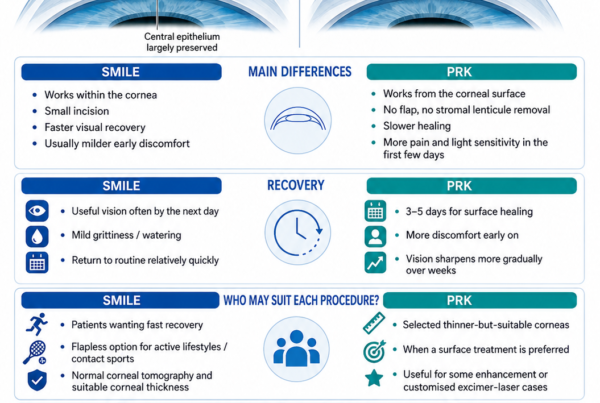
Does SMILE Cause Less Night Glare Than LASIK?
SMILE and LASIK generally provide similar final visual acuity and refractive accuracy in suitable myopic patients.
Their induced aberration patterns may differ:
- LASIK may induce more spherical aberration in some comparisons
- SMILE may induce more vertical coma or trefoil in some comparisons
- Overall higher-order aberration differences are not consistently clinically significant
A meta-analysis found both wavefront-guided LASIK and SMILE safe and effective, without a significant overall difference in induced total higher-order aberrations.
A 2024 comparison found no significant difference in reported glare, halos, rings or starbursts between topography-guided LASIK and SMILE at three months.
Neither procedure guarantees better night vision for every patient.
Is PRK Better for Night Glare?
PRK avoids a flap interface but still changes the corneal shape and can induce higher-order aberrations.
It may also cause:
- Early corneal haze
- Surface irregularity
- Slower optical recovery
- Dry eye
- Glare and halos
After complete healing, LASIK, PRK and SMILE generally provide comparable patient-reported functional outcomes in appropriately selected patients.
Procedure selection should be based on corneal safety and individual anatomy rather than a general promise of superior night vision.
How Is Night Glare After LASIK Assessed?
A proper assessment should identify whether the symptom arises from:
- Tear film
- Refraction
- Corneal shape
- Higher-order aberrations
- Pupil behaviour
- LASIK flap
- Natural lens
- Retina or optic nerve
Symptom History
Important questions include:
- When did the glare begin?
- Is it improving, stable or worsening?
- Is one eye worse?
- Does blinking improve it?
- Do lubricants help?
- Is there ghosting?
- Is the glare circular or directional?
- Does it occur only while driving?
- Was night glare present before surgery?
- Did symptoms develop years later?
- Is vision also blurred during the day?
Patients may be asked to describe or draw the pattern they see around lights.
Unaided and Best-Corrected Visual Acuity
The doctor checks:
- Daytime unaided vision
- Best-corrected vision
- Vision in each eye separately
- Whether ordinary spectacles improve the symptom
Good high-contrast acuity does not rule out significant night-vision difficulty.
Refraction
A careful refraction looks for:
- Residual myopia
- Residual hyperopia
- Residual astigmatism
- Unequal correction between the eyes
- Refractive regression
A night-driving spectacle correction may help even when the daytime prescription is small.
Tear-Film and Eyelid Assessment
The examination may include:
- Tear break-up time
- Corneal staining
- Meibomian gland assessment
- Eyelid margins
- Blink completeness
- Tear production
- Corneal sensation
The ocular surface should be stabilised before interpreting subtle refraction or wavefront measurements.
Mesopic or Scotopic Pupil Measurement
The pupil is measured under dim or dark conditions.
A bright-room pupil measurement does not reflect night-driving conditions.
Corneal Topography and Tomography
These scans assess:
- Treatment-zone centration
- Corneal regularity
- Residual astigmatism
- Optical-zone dimensions
- Corneal steepening or thinning
- Evidence of ectasia
Wavefront Aberrometry
Wavefront testing measures optical imperfections across the pupil.
It may identify:
- Spherical aberration
- Coma
- Trefoil
- Total higher-order aberration
Results must be interpreted carefully because tear-film instability can produce unreliable measurements.
Slit-Lamp Examination
The doctor examines:
- Flap position
- Flap striae
- Interface inflammation
- Epithelial ingrowth
- Corneal scarring
- Natural-lens clarity
- Ocular surface
Contrast-Sensitivity or Glare Testing
Selected clinics may measure:
- Low-contrast visual acuity
- Contrast sensitivity
- Vision under glare conditions
- Mesopic visual performance
These tests may better reflect the patient’s real-world difficulty than a standard bright-room visual acuity chart.
Dilated Eye Examination
A dilated examination may be needed to assess:
- Cataract
- Retina
- Macula
- Optic nerve
- Other causes of reduced visual quality
How Is Night Glare Treated?
Treatment depends on the cause.
Allow Time for Healing
When surgery was recent and examination findings are reassuring, observation may be appropriate.
Improvement may occur as:
- The tear film stabilises
- Corneal swelling resolves
- The interface clears
- Refraction settles
- Neural adaptation develops
Observation should include scheduled review rather than indefinite waiting.
Treat Dry Eye
Dry-eye treatment may include:
- Preservative-free artificial tears
- Lipid-containing lubricants
- Gel or ointment at night
- Warm compresses
- Eyelid hygiene
- Treatment of meibomian gland dysfunction
- Anti-inflammatory dry-eye medication
- Punctal plugs in selected patients
- Environmental and screen adjustments
The tear film should be stabilised before concluding that the corneal laser result requires enhancement.
Night-Driving Spectacles
A weak spectacle prescription may improve:
- Residual myopia
- Residual astigmatism
- Contrast
- Road-sign clarity
- Headlight glare
Anti-reflective spectacle coating may reduce reflections from the spectacle surfaces, although it does not remove corneal higher-order aberrations.
Using glasses for night driving does not mean the entire LASIK procedure has failed.
Temporary Pupil-Constricting Medication
Selected patients whose symptoms worsen primarily when the pupil dilates may benefit from a prescribed drop that reduces night-time pupil size.
Small clinical studies found that brimonidine reduced scotopic pupil size, halo size and night-vision difficulty in selected post-LASIK patients.
This use may be off-label depending on the medication and jurisdiction.
Potential limitations include:
- Redness
- Allergy
- Dryness
- Fatigue
- Reduced effect with repeated use
- Rebound changes
- Systemic side effects in susceptible patients
Pupil-constricting medication should only be used under medical supervision.
It does not correct:
- Residual astigmatism
- Decentered treatment
- Cataract
- Corneal ectasia
Contact Lenses
Specialised rigid or scleral contact lenses can create a smoother optical surface.
They may help when glare results from:
- Irregular corneal shape
- Significant higher-order aberrations
- Ectasia
- Decentered ablation
- Corneal scarring
A study of reverse-geometry rigid lenses in symptomatic post-refractive-surgery eyes found significant reductions in higher-order aberrations with lens wear.
Contact lenses require specialist fitting and careful hygiene.
Laser Enhancement for Residual Prescription
An enhancement may be considered when:
- The prescription is stable
- Symptoms correlate with the residual refractive error
- Dry eye is controlled
- Corneal tomography is normal
- Adequate corneal tissue remains
- Cataract is excluded
- Expected benefit outweighs additional risk
Options may include:
- Flap relift
- PRK over the LASIK flap
- Another customised corneal treatment
An enhancement should not be performed merely because glare is present.
Further laser treatment can worsen symptoms if the true cause is:
- Dry eye
- Ectasia
- Cataract
- Neuropathic symptoms
- Retinal disease
Wavefront- or Topography-Guided Retreatment
Selected patients with significant corneal higher-order aberrations or decentration may benefit from a customised retreatment.
Published series have reported improvement in subjective night-vision symptoms and reduction of corneal spherical aberration after corneal wavefront-guided retreatment.
However, retreatment is complex.
Potential risks include:
- Further tissue removal
- Dry eye
- Flap complications
- Epithelial ingrowth
- Corneal haze after surface treatment
- New aberrations
- Corneal ectasia
The treatment should only be performed when measurements are reliable and the optical problem is clearly defined.
Cataract Surgery
When night glare is caused mainly by cataract, additional corneal laser treatment is unlikely to solve the problem.
Cataract surgery may improve:
- Glare
- Contrast
- Colour quality
- Night-driving vision
- Refractive error
Previous LASIK must be considered when calculating the intraocular-lens power.
Corneal Cross-Linking
Progressive corneal ectasia requires structural assessment.
Corneal cross-linking may be recommended to reduce the risk of further progression.
It is intended primarily to stabilise the cornea rather than remove every halo or eliminate the need for optical correction.
Additional rehabilitation may require:
- Spectacles
- Rigid lenses
- Scleral lenses
- Ring segments
- Selected topography-guided treatment
Can Night Glare Be Prevented?
Not every symptom can be prevented, but risk can be reduced.
Stabilise the Tear Film Before Surgery
Dry eye can affect:
- Refraction
- Corneal maps
- Wavefront measurements
- Astigmatism
- Treatment centration
Preoperative treatment may include:
- Lubricants
- Eyelid hygiene
- Meibomian gland treatment
- Allergy control
- Anti-inflammatory therapy
- Temporary discontinuation of contact lenses
Measure the Pupil Under Dim Conditions
Pupil assessment should reflect the environment in which symptoms are likely to occur.
Select an Appropriate Optical Zone
The treatment plan should balance:
- Pupil size
- Degree of correction
- Corneal thickness
- Structural safety
- Night-vision requirements
A larger optical zone is not automatically better if it requires unsafe tissue removal.
Correct Astigmatism Accurately
Planning may incorporate:
- Iris registration
- Cyclotorsion compensation
- Accurate axis alignment
- Repeatable refraction
- Corneal topography
Select the Correct Procedure
For some patients, the safest option may be:
- LASIK
- SMILE
- PRK or TransPRK
- ICL
- Spectacles or contact lenses
- No surgery
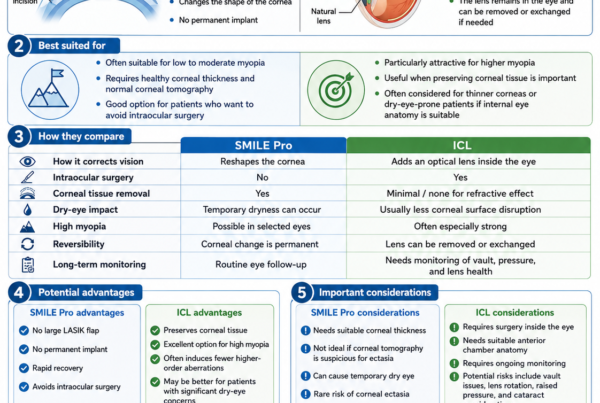
Patients with very high myopia may be better suited to ICL when laser treatment would require excessive corneal tissue removal or an undesirably small optical zone.
Use Realistic Counselling
Patients should understand that:
- Night glare can occur
- Early symptoms commonly improve
- Perfect night vision cannot be guaranteed
- Glasses may still help for night driving
- Severe persistent symptoms are uncommon but possible
- Existing night-vision problems may not disappear after surgery
Who Is More Likely to Experience Night Glare?
Possible risk factors include:
- High myopic correction
- Significant astigmatism
- Large dim-light pupils
- Small effective optical zone
- Residual refractive error
- Decentered treatment
- Increased higher-order aberrations
- Dry-eye disease
- Previous refractive surgery
- Irregular corneal shape
- Existing night-vision complaints
- Early cataract
Risk factors do not guarantee that symptoms will occur, and the absence of obvious risk factors does not guarantee perfect night vision.
Is Night Glare Dangerous?
Glare itself does not necessarily mean that the eye is structurally damaged.
However, it can become a safety issue when it affects driving.
Patients should avoid night driving when they cannot reliably see:
- Road markings
- Pedestrians
- Cyclists
- Vehicles close to headlights
- Traffic signs
- Changes in road surface
Driving should only resume when vision is legally adequate and the patient feels safe.
When Should You Arrange a Review?
Arrange an examination when:
- Night glare is not gradually improving
- Symptoms interfere with driving
- One eye is substantially worse
- Ghosting is present
- Spectacle vision is less clear than before
- Glare develops several years after surgery
- Lubricants do not help
- The prescription appears to be changing
- Symptoms are increasing rather than stabilising
When Is Urgent Assessment Needed?
Seek urgent review for:
- Sudden or rapidly worsening vision
- Severe eye pain
- Increasing redness
- Marked light sensitivity
- Significant discharge
- A white or grey corneal spot
- Eye trauma
- Sudden distortion
- New flashes or many floaters
- A curtain-like shadow
- Sudden loss of peripheral vision
These symptoms may indicate infection, inflammation, retinal disease, flap complications or another urgent condition rather than routine night glare.
Frequently Asked Questions About Night Glare After LASIK
Is Night Glare Normal After LASIK?
Some glare, halos or starbursts are relatively common during early recovery.
They should generally become less noticeable over time.
How Long Does Night Glare Last?
Many patients improve during the first three to six months.
The duration depends on dryness, prescription, pupil size, treatment profile and individual healing.
Can Glare Improve After Six Months?
Yes.
Some patients continue to improve through tear-film recovery and neural adaptation.
Persistent significant symptoms should nevertheless be evaluated.
Is Night Glare Permanent?
Persistent symptoms can occur, but not all long-lasting glare is permanent or untreatable.
Possible treatable causes include:
- Dry eye
- Residual myopia
- Astigmatism
- Cataract
- Corneal irregularity
Why Is My Daytime Vision Clear but Night Vision Poor?
In dim lighting:
- The pupil enlarges
- Contrast decreases
- Peripheral optical aberrations become more important
- Tear-film instability becomes more noticeable
Why Do Headlights Look Bigger?
Light scatter and higher-order aberrations can spread the apparent image of a bright light beyond its true boundaries.
Why Do Lights Have Spikes?
Starburst spikes may be caused by:
- Astigmatism
- Tear-film irregularity
- Corneal trefoil or coma
- Pupil-related exposure of peripheral cornea
Why Is One Eye Worse?
The two eyes may differ in:
- Residual prescription
- Dryness
- Pupil size
- Treatment centration
- Corneal healing
- Higher-order aberrations
A significant asymmetry should be examined.
Does Blinking Improve Glare?
When blinking briefly improves vision or reduces glare, tear-film instability is likely contributing.
Can Dry Eye Cause Halos?
Yes.
An irregular tear film can scatter light and enlarge halos or starbursts.
Will Artificial Tears Cure Night Glare?
They may help when dryness is a major cause.
They will not correct significant residual astigmatism, decentration, cataract or ectasia.
Can Glasses Help?
Yes.
A weak night-driving prescription may improve residual myopia or astigmatism and reduce glare.
Do Anti-Glare Glasses Help?
Anti-reflective coating can reduce reflections from spectacle lenses.
It does not remove corneal higher-order aberrations but may improve comfort when a spectacle prescription is useful.
Can Pupil-Constricting Drops Help?
They may temporarily reduce symptoms in selected patients whose glare increases with pupil dilation.
They require medical supervision and are not appropriate for everyone.
Can LASIK Be Repeated to Correct Glare?
Sometimes, but only when a measurable and treatable optical abnormality has been identified.
Enhancement may worsen the situation if performed without a clear cause.
Can Wavefront-Guided Treatment Correct Night Glare?
It may help selected patients with significant measurable higher-order aberrations and adequate corneal tissue.
It cannot guarantee complete symptom elimination.
Can Topography-Guided Treatment Correct a Decentered Ablation?
Selected decentered or irregular treatments may be improved using topography- or corneal-wavefront-guided surface treatment.
The treatment requires specialised planning and adequate structural safety.
Can Contact Lenses Help?
Rigid or scleral contact lenses may improve optical quality when the cornea is irregular.
Is Glare a Sign of Corneal Ectasia?
Glare alone is not specific for ectasia.
Concern increases when glare is accompanied by:
- Progressive myopia
- Increasing astigmatism
- Ghosting
- Reduced best-corrected vision
- Abnormal corneal tomography
Can Cataract Cause Glare After LASIK?
Yes.
Cataract is a common cause of increasing night glare years after an initially successful LASIK procedure.
Does LASIK Cause Cataract?
LASIK does not normally cause ordinary age-related cataract.
The natural lens continues to age after surgery.
Is SMILE Better for Night Vision?
Not universally.
SMILE and LASIK generally provide comparable final visual outcomes, although they may induce different patterns of optical aberration.
Is PRK Better for Night Vision?
Not universally.
PRK avoids a flap but still changes corneal optics and may cause glare during its longer healing period.
Can I Drive at Night With Glare?
Only when vision is legally adequate and you can identify road hazards safely.
Patients who feel unsafe should avoid night driving until reviewed.
Does Night Glare Mean LASIK Failed?
No.
Temporary glare can occur despite an accurate refractive result.
The clinical significance depends on severity, duration and cause.
Key Takeaway
Night glare after LASIK may appear as:
- Excessive brightness
- Halos
- Starbursts
- Ghost images
- Reduced contrast
- Difficulty driving after dark
Common early causes include:
- Corneal healing
- Tear-film instability
- Dry eye
- Mild residual prescription
- Temporary interface changes
- Neural adaptation
Other possible causes include:
- Residual astigmatism
- Higher-order aberrations
- A large dim-light pupil
- A relatively small effective optical zone
- Treatment decentration
- Flap or interface irregularity
- Cataract
- Rare corneal ectasia
Many patients improve during the first three to six months.
Persistent symptoms should be assessed using:
- Refraction
- Tear-film examination
- Mesopic pupil measurement
- Corneal topography
- Corneal tomography
- Wavefront aberrometry
- Flap and interface examination
- Natural-lens assessment
- Retinal and optic nerve examination when indicated
Treatment may include:
- Time and observation
- Dry-eye therapy
- Night-driving spectacles
- Temporary medically supervised pupil-constricting drops
- Rigid or scleral contact lenses
- A carefully selected customised enhancement
- Cataract surgery
- Corneal cross-linking when ectasia is present
Another laser treatment should not be recommended until the cause of the glare has been identified and the ocular surface, refraction and corneal scans are stable.
The aim is not simply to achieve clear letters on a bright eye chart. It is to provide safe, functional vision across the lighting conditions that matter in everyday life.
References
- US Food and Drug Administration. LASIK Quality of Life Collaboration Project. Patient-reported visual symptoms and satisfaction after LASIK.
- US Food and Drug Administration. When Is LASIK Not for Me? Guidance regarding pupils, glare, halos, starbursts and night vision.
- US Food and Drug Administration. LASIK Patient Information Booklet. Visual risks including glare, halos and difficulty driving at night.
- Villa C, Gutiérrez R, Jiménez JR, González-Méijome JM. Night Vision Disturbances After Successful LASIK Surgery. 2007. PMID: 17314153.
- Pop M, Payette Y. Risk Factors for Night Vision Complaints After LASIK for Myopia. 2004. PMID: 14711706.
- Schallhorn SC, Kaupp SE, Tanzer DJ, Tidwell J, Laurent J, Bourque LB. Pupil Size and Quality of Vision After LASIK. 2003. PMID: 12917181.
- Chan A, Manche EE. Effect of Preoperative Pupil Size on Quality of Vision After Wavefront-Guided LASIK. 2011. PMID: 21093922.
- Hammond SD Jr. Quality of Vision and Patient Satisfaction After LASIK. 2004. PMID: 15232473.
- Schallhorn SC, et al. Comparison of Night Driving Performance After Wavefront-Guided and Conventional LASIK. 2009. PMID: 19344822.
- Mai ELC, et al. Higher-Order Aberrations of Topography-Guided LASIK Versus Wavefront-Optimised LASIK. 2023. PMID: 36983581.
- Moin KA, et al. Three-Month Comprehensive Outcomes of Topography-Guided LASIK and SMILE. 2024. PMID: 38951314.
- Alió JL, et al. Corneal Wavefront-Guided Retreatment for Significant Night-Vision Symptoms After LASIK. 2008. PMID: 17981258.
- Alió JL, et al. Corneal Wavefront-Guided LASIK Retreatment for Decentration and Night-Vision Symptoms. 2007. PMID: 17985795.
- Lee JH, et al. Efficacy of Brimonidine Tartrate in Reducing Halo Size and Night-Vision Symptoms After LASIK. 2008. PMID: 18499002.
- Edwards JD, et al. Effect of Brimonidine Tartrate on Night-Vision Difficulty and Contrast Testing After Refractive Surgery. 2008. PMID: 18721716.
- Tan G, et al. Reverse-Geometry Rigid Gas-Permeable Contact Lenses for Higher-Order Aberrations After Refractive Surgery. 2010. PMID: 20021249.
- Ryan DS, et al. A Comparative Analysis of LASIK, SMILE and PRK: Patient-Reported Outcomes and Quality of Vision. 2025. PMID: 39641610.