Author: Dr Val Phua
Estimated reading time: 20 minutes
One of the most common questions patients ask after cataract surgery is: “When can I drive again?”
There is no single answer that applies to every patient. Some people recover clear, comfortable vision within a few days, while others need more time because of corneal swelling, dry eyes, glare, a difference between the two eyes or another eye condition.
Being able to read letters on an eye chart is also not the only requirement for safe driving. Driving depends on several visual abilities working together, including:
- Clear central vision
- Peripheral awareness
- Contrast sensitivity
- Depth perception
- The ability to judge speed and distance
- Adaptation to changes in lighting
- Resistance to glare
- Coordination between the two eyes
- The ability to respond quickly to unexpected hazards
Cataract surgery often improves driving performance by improving clarity, contrast sensitivity and glare tolerance. Research has shown that improvements in contrast sensitivity after bilateral cataract surgery are strongly associated with better driving performance.
However, vision may be temporarily unstable during the early recovery period. You should return to driving only when your vision is sufficiently clear and comfortable, you meet the applicable legal requirements and your ophthalmologist has not advised you to avoid driving.
The Most Important Rule
Do Not Drive on the Day of Cataract Surgery
You should not drive yourself home after cataract surgery.
Even if the operation was uncomplicated and your eye feels comfortable, driving on the same day is unsafe because your vision may be affected by:
- Pupil-dilating eye drops
- Anaesthetic medication
- Sedation
- An eye pad or shield
- Temporary corneal swelling
- Watering
- Light sensitivity
- Blurred vision
- Reduced depth perception
- A large difference between your two eyes
Arrange for someone to take you home after the operation.
Sedation May Affect You Even When You Feel Alert
Medication used to help you relax may impair:
- Reaction time
- Judgement
- Balance
- Coordination
- Concentration
- Decision-making
You may not feel noticeably drowsy, but your driving ability can still be affected.
Follow the instructions from your anaesthetist or surgical centre regarding driving, alcohol, operating machinery and making important decisions after sedation.
Arrange Transport in Advance
Before the operation, arrange for a responsible adult to:
- Take you home
- Help you collect medication
- Listen to the discharge instructions
- Assist you with your first doses of eye drops
- Remain contactable during the first evening
Do not assume that you can decide whether to drive after seeing how you feel immediately following surgery.
Is There a Fixed Number of Days Before You Can Drive?
There Is No Universal Waiting Period
Some patients may be ready to drive within several days after uncomplicated cataract surgery. Others may need one or two weeks, or occasionally longer.
The appropriate timing depends on:
- How quickly the operated eye heals
- Vision in the other eye
- Whether one or both eyes have been operated on
- Your intended refractive target
- The type of intraocular lens
- Whether you have residual spectacle power
- Whether glare or halos are present
- Whether your depth perception is reliable
- Whether you have glaucoma, retinal disease or corneal disease
- Whether the operation was complicated
- Your ophthalmologist’s advice
- The type of driving you perform
The calendar alone cannot determine whether you are ready.
Passing a Vision Check Is Necessary but May Not Be Sufficient
A standard visual-acuity chart measures your ability to identify high-contrast letters under controlled lighting.
Real-world driving also requires you to detect:
- A pedestrian wearing dark clothing
- A cyclist at dusk
- Lane markings in rain
- A vehicle emerging from a side road
- A low-contrast object
- A hazard beside the road
- Movement in the peripheral visual field
- Objects in the presence of headlight glare
Contrast sensitivity and glare can affect driving performance even when standard visual acuity appears reasonably good.
What Must Be True Before You Drive Again?
Your Vision Should Be Clear Enough for the Road
You should be able to see road signs, vehicles, pedestrians and lane markings clearly at the distances required for safe driving.
Vision should not be:
- Severely blurred
- Misty
- Intermittently obscured
- Distorted
- Doubled
- Significantly different from moment to moment
Mild fluctuation from dry eyes may occur during recovery, but you should not drive if it substantially affects clarity or concentration.
You Must Meet the Applicable Legal Vision Requirements
Driving-licence requirements differ between countries and may also differ according to:
- Licence class
- Private versus commercial driving
- Age
- Medical conditions
- Whether spectacles are required
- Whether one eye has limited vision
- Visual-field status
Meeting a minimum legal standard does not automatically mean that you are personally safe to drive in every situation.
Your ophthalmologist may recommend waiting longer if glare, imbalance or another clinical concern remains.
Both Eyes Should Work Together Comfortably
Driving is performed using both eyes together.
Before returning to the road, you should be comfortable with:
- Depth perception
- Judging distance
- Seeing steps and kerbs
- Estimating the speed of approaching vehicles
- Moving your gaze between the dashboard and road
- Checking mirrors
- Turning your head to check blind spots
A large prescription difference between the operated and unoperated eyes can make these tasks difficult.
You Should Not Have Double Vision
Do not drive if you see two images of:
- Road signs
- Traffic lights
- Cars
- Pedestrians
- Lane markings
Double vision may be caused by a temporary imbalance between the eyes, an eye-alignment problem or residual anaesthetic effects.
Persistent or new double vision should be assessed before you resume driving.
Glare Should Be Manageable
You should not drive if bright light causes:
- Severe dazzling
- Prolonged visual recovery after headlights
- Difficulty detecting pedestrians
- Loss of lane markings
- Large halos obscuring nearby objects
- An inability to tolerate oncoming traffic
Glare can be particularly important at night, in rain, inside tunnels and when driving towards low sunlight.
You Must Be Able to React Normally
Do not drive if you are:
- Drowsy
- Dizzy
- Nauseated
- Taking sedating medication
- Experiencing significant eye pain
- Distracted by visual symptoms
- Unable to turn your head comfortably
- Unsteady when walking
Safe driving requires more than good eyesight.
A Practical Driving-Readiness Checklist
Before Driving, Ask Yourself:
- Has my ophthalmologist told me that recovery is progressing normally?
- Can I see clearly with both eyes open?
- Can I read road signs at a safe distance?
- Can I judge steps, kerbs and the distance between objects?
- Is my vision stable rather than repeatedly becoming blurred?
- Am I free from double vision?
- Can I tolerate normal daylight without disabling glare?
- Can I turn my head and check mirrors comfortably?
- Am I no longer affected by sedation?
- Do I meet the legal visual requirements?
- Are my current glasses suitable?
- Do I feel confident rather than uncertain?
If you are unsure about several of these points, you are probably not ready to drive.
Do Not Rely Only on Confidence
Some patients feel confident before their visual function has fully recovered. Others remain anxious despite having safe vision.
Confidence is important, but it should be combined with:
- Clinical examination
- Objective vision testing
- Legal eligibility
- Practical functional vision
- An understanding of your own limitations
Do Not Test Your Vision in Heavy Traffic
Your first attempt at driving should not occur:
- During rush hour
- At night
- In heavy rain
- On an unfamiliar expressway
- In a crowded city centre
- During poor visibility
- With distracting passengers
- When you are tired
What Happens at the Postoperative Review?
Your Ophthalmologist Will Check the Eye
At the first follow-up, your ophthalmologist may assess:
- Unaided vision
- Vision with correction
- Eye pressure
- Corneal clarity
- The surgical incision
- Inflammation
- Intraocular lens position
- The pupil
- The retina or macula when indicated
Your doctor may also ask whether you have:
- Glare
- Halos
- Double vision
- Fluctuating vision
- Pain
- Increasing redness
- New floaters or flashes
- Difficulty judging distances
Why an Early Review Matters
You may feel that your vision is good while still having:
- Elevated eye pressure
- Corneal swelling
- Inflammation
- An unsuitable spectacle prescription
- Imbalance between the eyes
The postoperative examination helps determine whether the eye is recovering predictably and whether driving is reasonable.
Do Not Skip the Appointment Because You Can See Well
A clear visual impression does not guarantee that every aspect of recovery is normal.
Continue all prescribed medication and attend the scheduled review even if your vision seems excellent.
Why Vision Can Be Unstable During the First Few Days
The Pupil May Still Be Dilated
Pupil-dilating drops can cause:
- Light sensitivity
- Glare
- Difficulty focusing
- Blurred near vision
- Reduced ability to adapt between bright and dark environments
The effect may last for several hours and occasionally longer in some patients.
The Cornea May Be Swollen
Mild corneal swelling can produce:
- Hazy vision
- Halos
- Glare
- Reduced contrast
- Vision that is worse in the morning
Swelling is more likely after surgery for a very dense cataract or in patients with reduced corneal endothelial function.
The Tear Film May Be Unstable
Cataract surgery and postoperative eye drops can temporarily aggravate dry-eye symptoms.
This may cause vision that:
- Clears after blinking
- Becomes blurred during prolonged concentration
- Fluctuates while driving
- Worsens in air conditioning
- Becomes uncomfortable with prolonged screen use
Driving requires sustained visual attention, so seemingly mild dryness can become more noticeable on the road.
Eye Drops Can Temporarily Blur Vision
Some postoperative drops leave a temporary film over the ocular surface.
Do not begin driving immediately after instilling a drop if your vision is blurred. Wait until clarity has returned.
Inflammation May Affect Visual Quality
Some inflammation is expected after surgery.
Although it may not prevent you from reading large letters, it can affect:
- Contrast
- Glare tolerance
- Focusing comfort
- Visual stability
Continue your prescribed anti-inflammatory medication.
One Eye Operated On: Why Driving May Feel Uncomfortable
The Two Eyes May Have Different Prescriptions
After first-eye surgery, the operated eye may be close to the intended target while the other eye still has its old prescription and cataract.
This difference is called anisometropia.
It may cause:
- Headache
- Dizziness
- Poor depth perception
- Unequal image sizes
- Difficulty wearing old glasses
- A feeling that the road is tilted
- Trouble judging stairs
- Visual fatigue
Old Glasses May No Longer Be Suitable
The spectacle lens in front of the operated eye may now be far too strong or otherwise inappropriate.
Wearing the old glasses can sometimes make vision worse than not wearing them.
Possible temporary solutions include:
- Removing the lens in front of the operated eye
- Wearing glasses only for selected tasks
- Using a temporary prescription
- Using a contact lens in the unoperated eye
- Waiting for second-eye surgery
These options should be discussed with your ophthalmologist or optometrist.
Do not drive while experimenting with an unfamiliar visual arrangement.
The Other Eye May Still Have Significant Cataract
Even if the operated eye is clear, the unoperated eye may continue to contribute:
- Glare
- Reduced contrast
- Blur
- Colour imbalance
- Poor night vision
Keeping both eyes open may not fully overcome these symptoms.
Depth Perception May Be Temporarily Reduced
Stereopsis, or fine three-dimensional depth perception, depends on the brain receiving sufficiently clear and compatible images from both eyes.
This is important for:
- Judging gaps in traffic
- Parking
- Reversing
- Entering a roundabout
- Estimating the distance of approaching vehicles
- Changing lanes
If depth perception feels unreliable, wait before driving.
Does Second-Eye Surgery Affect Driving Ability?
Bilateral Vision Often Provides Better Driving Function
After both eyes have recovered, patients may experience improvements in:
- Contrast sensitivity
- Binocular visual acuity
- Depth perception
- Glare tolerance
- Peripheral awareness
- Driving confidence
Research has found that driving performance can improve after bilateral cataract extraction, with changes in contrast sensitivity being an important predictor of better performance.
Do Not Assume You Must Wait for Both Eyes
Some patients can drive safely after first-eye surgery if:
- The operated eye has recovered well
- The other eye provides useful vision
- The two eyes work together comfortably
- Legal requirements are met
- Glare and depth perception are acceptable
Others may not be comfortable until after second-eye surgery.
The decision should be individualised.
Do Not Drive Immediately After the Second Operation
The same restrictions apply after second-eye surgery.
Even if you were driving comfortably after the first operation, you should not drive home following the second procedure.
Allow the newly operated eye to recover and undergo the recommended review.
Daytime Driving Versus Night Driving
Daytime Driving Is Usually Easier
Daylight generally provides:
- Better contrast
- Smaller pupils
- More visible lane markings
- Easier visual adaptation
- Less dependence on artificial lighting
- Fewer headlight-related symptoms
When your ophthalmologist agrees that you may resume driving, it is often sensible to start during daylight.
Night Driving Places Greater Demands on Vision
Night driving requires the visual system to function under:
- Low contrast
- Reduced illumination
- Larger pupil size
- Oncoming headlight glare
- Reflections from wet roads
- Rapid changes between bright and dark areas
Even moderate visual impairment can reduce pedestrian detection and driving performance in the presence of glare.
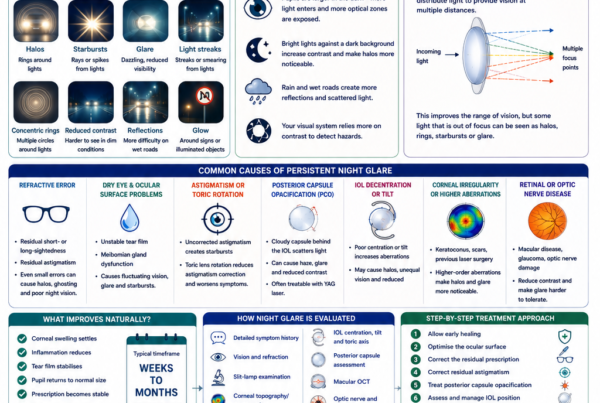
Halos and Starbursts
After cataract surgery, some patients notice:
- Halos around lights
- Starbursts
- Light streaks
- Arcs
- Glare
- Reflections
These symptoms are known as positive dysphotopsias.
They may be more noticeable:
- At night
- Around LED headlights
- With larger pupils
- In rain
- With residual spectacle power
- With dry eyes
- With certain intraocular lens designs
Dysphotopsias are recognised unwanted visual phenomena after cataract surgery and may cause dissatisfaction despite otherwise good visual acuity.
Wait Longer Before Night Driving if Necessary
You may be ready for short daytime journeys before you are ready to drive at night.
Do not force yourself to resume night driving if:
- Headlights are dazzling
- Halos overlap nearby vehicles
- You cannot see pedestrians reliably
- Lane markings disappear in rain
- Your eyes take too long to recover after bright lights
- You feel tense or unsafe
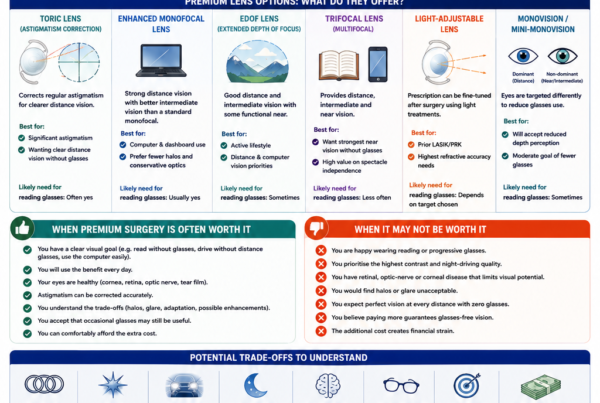
How Does the Type of Intraocular Lens Affect Driving?
Monofocal Intraocular Lenses
A monofocal lens generally provides one main focal range.
If it is targeted for distance, distance driving vision may be good without glasses once the eye has healed.
However, residual short-sightedness, long-sightedness or astigmatism may still require correction.
Monofocal Lens Targeted for Near Vision
If the operated eye has deliberately been targeted for near vision, distance vision in that eye will remain blurred without correction.
You may need distance spectacles for driving even when the surgical outcome is exactly as planned.
Monovision
With monovision:
- One eye is targeted primarily for distance
- The other eye is targeted for intermediate or near vision
Some patients adapt quickly. Others initially notice:
- Reduced depth perception
- Visual imbalance
- Difficulty in dim light
- Problems judging distance
- Eye strain
Do not drive until you are confident that you can use both eyes together safely.
Multifocal and Trifocal Lenses
Multifocal lenses are designed to provide more than one focal distance, but may produce:
- Halos
- Glare
- Starbursts
- Reduced contrast in dim light
- Difficulty around headlights
These effects often improve with healing and neuroadaptation, but the adaptation period varies.
Extended-Depth-of-Focus Lenses
Extended-depth-of-focus lenses aim to provide a continuous range of vision, particularly at distance and intermediate ranges.
Some patients may still experience halos or glare, although the pattern and intensity can differ from multifocal lenses.
Toric Lenses
A toric lens is designed to reduce corneal astigmatism.
If significant astigmatism remains or the lens rotates away from its intended axis, driving vision may be blurred or distorted.
Report persistent blur rather than assuming that it will always resolve spontaneously.
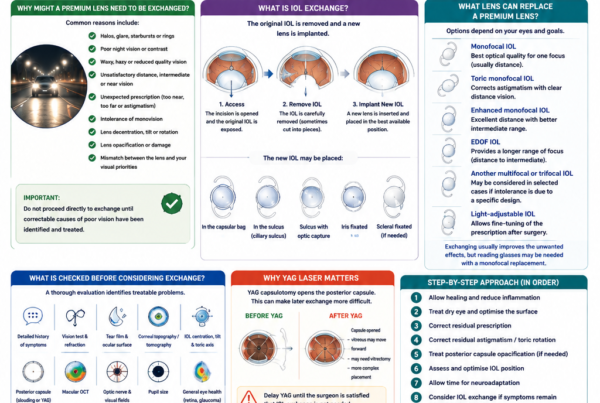
Do You Need New Glasses Before Driving?
Some Patients Need Temporary Distance Glasses
Even when the operation is successful, there may be residual:
- Short-sightedness
- Long-sightedness
- Astigmatism
- Difference between the two eyes
A temporary pair of distance glasses may improve driving safety before the final prescription is issued.
The Final Prescription May Take Time to Stabilise
The eye’s prescription often becomes relatively stable during the first weeks after uncomplicated surgery, but not every eye stabilises at the same rate.
Research suggests that refraction may be relatively stable by one week in many uncomplicated cases, although a proportion of patients still have unstable astigmatic measurements at that stage.
Do Not Wait for Final Glasses if a Safe Temporary Solution Is Available
You may not necessarily need to wait four to six weeks before driving if:
- The eye is healing normally
- A reliable temporary correction is available
- You meet the visual requirements
- Your ophthalmologist approves
Conversely, you should not drive with avoidable blur while waiting for the final prescription.
Sunglasses Are Not a Substitute for Clear Vision
Sunglasses may improve comfort in bright daylight, but they do not correct:
- Blur
- Astigmatism
- Double vision
- Poor depth perception
Very dark lenses may also reduce visibility in shaded areas, tunnels or poor weather.
How Should You Resume Driving?
Begin With a Short Daytime Journey
When your ophthalmologist has confirmed that you may drive, consider beginning with:
- A familiar route
- Good daylight
- Dry weather
- Light traffic
- A short distance
- A calm passenger
Avoid making your first drive a long or essential journey.
Check Your Vision Before Moving the Car
Before starting:
- Read signs at different distances.
- Check the rear-view and side mirrors.
- Look over each shoulder.
- Confirm that you see one clear image.
- Check whether dashboard instruments are visible.
- Notice whether bright reflections cause disabling glare.
If something feels wrong, do not proceed.
Practise in a Safe Environment
A quiet, familiar area may help you assess:
- Steering confidence
- Distance judgement
- Braking
- Mirror use
- Parking
- Lane positioning
However, a short drive in a quiet area cannot prove that you are safe in complex traffic.
Increase Driving Gradually
Progress from:
- Short daytime journeys
- Familiar local roads
- Moderate traffic
- Longer journeys
- Expressways
- Dusk
- Night driving
- Rain or other difficult conditions
You do not need to complete every stage on a fixed timetable.
Stop if You Feel Unsafe
Pull over safely if you experience:
- Sudden blur
- Double vision
- Dizziness
- Significant glare
- Eye pain
- A dark shadow
- New flashes or floaters
- Difficulty judging lanes
- Loss of confidence
Do not continue simply because you are close to your destination.
Driving in Rain, Tunnels and Low Sunlight
Rain Reduces Contrast
Wet roads can:
- Reflect headlights
- Obscure lane markings
- Create glare
- Reduce visibility through the windscreen
Wait until your vision is stable before driving in heavy rain.
Tunnels Require Rapid Light Adaptation
Entering and leaving a tunnel requires the eyes to adapt rapidly between bright and dark environments.
Delay tunnel driving if you notice:
- Slow adaptation
- Dazzling
- Temporary loss of visibility
- Difficulty seeing vehicles in shadow
Low Sunlight Can Be Disabling
Morning and evening sunlight may shine directly into the eyes.
Use:
- A clean windscreen
- The vehicle sun visor
- Suitable sunglasses
- An alternative route or time when necessary
Do not drive if low sunlight overwhelms your vision.
Can You Drive With One Eye?
Monocular Driving Requires Careful Assessment
Some people with useful vision in only one eye are legally permitted to drive, depending on local requirements and the condition of the remaining eye.
However, a new loss of vision in one eye can temporarily affect:
- Depth perception
- Peripheral awareness
- Judgement of distance
- Confidence
- Head movements used to compensate for field loss
Adaptation takes time.
Long-Term Adaptation Is Different From a Sudden Change
A person who has driven safely with one functioning eye for years is different from a patient who has suddenly developed a major difference between the eyes after surgery.
Seek individual medical advice.
Visual-Field Problems Matter
Good central acuity does not compensate for substantial loss of peripheral vision.
Patients with glaucoma, retinal disease, stroke-related visual-field loss or optic-nerve disease may need formal visual-field assessment.
Professional and Commercial Drivers
Occupational Driving May Require a Higher Standard
Professional drivers may spend many hours on the road or drive:
- Heavy vehicles
- Buses
- Taxis
- Private-hire cars
- Emergency vehicles
- Construction machinery
- Forklifts
- Vehicles carrying passengers
Your employer, licensing authority or occupational physician may impose additional requirements.
Consider the Real Demands of Your Job
Professional driving may involve:
- Night shifts
- Long periods of concentration
- Poor weather
- Repeated glare
- Reversing large vehicles
- Tight parking
- Passenger responsibility
- Frequent transitions between indoor and outdoor lighting
A patient who can manage a short daytime personal journey may not yet be ready for full occupational driving.
Obtain Documentation When Required
Your ophthalmologist may need to provide:
- A visual-acuity measurement
- A medical memorandum
- A visual-field assessment
- Confirmation of stability
- Advice regarding spectacles
- A recommended return-to-work date
Do not resume professional driving solely based on your own impression.
Older Drivers and Additional Safety Considerations
Vision Is Only One Part of Driving Fitness
Older drivers should also consider:
- Reaction time
- Neck movement
- Hearing
- Cognitive function
- Medication effects
- Balance
- Neurological disease
- Cardiovascular symptoms
Cataract surgery may improve vision, but it does not correct unrelated factors affecting driving.
Cataract Surgery Can Improve Driving Outcomes
Research consistently shows that cataracts can impair driving and that cataract surgery can improve driving-related outcomes.
Potential benefits include:
- Better visual clarity
- Improved contrast sensitivity
- Reduced glare
- Greater driving confidence
- Fewer driving-related difficulties
Do Not Overestimate Improvement
Even after successful surgery, age-related changes may remain in:
- Contrast sensitivity
- Dark adaptation
- Peripheral awareness
- Reaction speed
- Recovery after glare
Drive according to your actual ability rather than assuming that cataract removal restores every aspect of youthful vision.
Warning Signs That Mean You Must Not Drive
Sudden Reduction in Vision
Do not drive if vision becomes significantly worse, especially if it had previously improved.
Possible causes include:
- Corneal swelling
- Raised eye pressure
- Macular swelling
- Retinal problems
- Inflammation
- Infection
Seek prompt ophthalmic assessment.
Increasing Eye Pain
Mild grittiness is common after surgery.
Severe or progressively worsening pain is not normal and may be associated with:
- Raised eye pressure
- Significant inflammation
- Infection
- Corneal injury
Do not drive yourself to the clinic. Arrange transport.
Increasing Redness or Discharge
Increasing redness, thick discharge or marked eyelid swelling requires medical review.
New Flashes or Floaters
Do not drive if you develop:
- New flashes of light
- A sudden shower of floaters
- A dark curtain
- A missing area of peripheral vision
These symptoms may indicate a retinal tear or retinal detachment.
A Dark Shadow or Curtain
A dark curtain, fixed shadow or loss of part of the visual field requires urgent examination.
Do not assume that it is an ordinary lens-related optical effect.
Persistent Double Vision
Do not drive until double vision has been assessed and adequately managed.
Severe Halos or Glare
Do not drive, particularly at night, if halos or glare obscure other road users or road markings.
Frequently Asked Questions
Can I Drive the Day After Cataract Surgery?
Some patients have clear vision the following day, but this does not automatically mean that they should drive.
You should first consider:
- The postoperative examination
- Visual acuity
- Glare
- Depth perception
- Vision in the other eye
- Current glasses
- Sedation instructions
- Your surgeon’s advice
Can I Drive Two Days After Cataract Surgery?
Possibly, after uncomplicated surgery, but not solely because two days have passed.
You must have adequate, stable and comfortable vision and meet the applicable legal requirements.
Do I Have to Wait One Week?
Not every patient needs to wait exactly one week.
Some may be ready earlier, while others should wait longer.
Follow your individual assessment rather than a fixed online timetable.
Must My Ophthalmologist Formally Clear Me?
Requirements vary according to local law, licence type, medical history and occupation.
Even when formal written clearance is not legally required, your postoperative review provides important information about whether the eye is recovering normally.
Can I Drive Before My Final Glasses Are Ready?
Yes, provided you already have sufficiently clear vision with an appropriate temporary correction and meet all safety and legal requirements.
Do not drive with avoidable blur while waiting for the final prescription.
Can I Use My Old Glasses?
Possibly, but the operated eye’s prescription may have changed substantially.
Stop using the old glasses if they cause:
- Blur
- Distortion
- Dizziness
- Headache
- Poor depth perception
Ask your ophthalmologist or optometrist about temporary correction.
Can I Drive With an Eye Shield?
An eye shield blocks or restricts vision and may interfere with peripheral awareness.
Do not drive while an eye pad or shield is covering the operated eye.
Can I Drive With One Eye Closed?
No.
Closing one eye to overcome blur or double vision is not an appropriate way to make yourself safe for driving immediately after surgery.
It reduces binocular vision and depth perception and indicates that the two eyes are not working together comfortably.
Can I Drive at Night as Soon as I Can Drive in Daylight?
Not necessarily.
Night driving demands better low-contrast vision and glare tolerance. You may need additional time before driving safely after dark.
Why Are Headlights Still Bothersome?
Possible reasons include:
- Early healing
- Dryness
- Residual astigmatism
- Corneal swelling
- A large pupil
- Dysphotopsia
- Multifocal or extended-depth-of-focus optics
- Posterior capsule opacification later in recovery
Persistent symptoms should be assessed.
Will Cataract Surgery Make Me a Safer Driver?
For many patients, surgery improves clarity, contrast sensitivity and glare tolerance.
However, safe driving also depends on:
- The condition of both eyes
- Peripheral visual fields
- General health
- Cognitive function
- Reaction time
- Driving behaviour
Should Someone Accompany Me on My First Drive?
A calm, trusted passenger may be helpful, provided the passenger does not create distraction.
Choose a short, familiar route in good conditions.
Can I Drive to My Postoperative Appointment?
Do not assume that you can.
Your pupil may be dilated again during the examination, which can cause temporary blur and light sensitivity.
Arrange alternative transport unless the clinic has confirmed that dilation will not be required and you are already safe to drive.
A Sensible Step-by-Step Return to Driving
Step 1: Complete the Immediate Recovery Period
Do not drive on the day of surgery or while affected by sedation, an eye pad, marked blur or pupil dilation.
Step 2: Attend Your Postoperative Examination
Confirm that:
- The eye is healing normally
- Vision is adequate
- Eye pressure is acceptable
- There is no significant complication
Step 3: Resolve Any Spectacle Problem
Determine whether you need:
- Temporary distance glasses
- Adjustment of your old glasses
- Removal of one spectacle lens
- Correction of residual astigmatism
Step 4: Assess Binocular Function
Make sure both eyes work together without:
- Double vision
- Dizziness
- Severe imbalance
- Unreliable depth perception
Step 5: Start in Easy Conditions
Choose:
- Daylight
- Dry weather
- A familiar road
- Light traffic
- A short journey
Step 6: Delay Difficult Conditions
Wait longer before attempting:
- Night driving
- Heavy rain
- Rush-hour traffic
- Long journeys
- Unfamiliar roads
- Tunnels
- Professional driving
Step 7: Stop and Seek Advice if Symptoms Develop
Do not continue driving through:
- Pain
- Worsening blur
- Double vision
- Flashes
- Floaters
- A dark shadow
- Severe glare
- Loss of visual confidence
The Bottom Line
You should not drive on the day of cataract surgery.
After that, there is no universal number of days that applies to everyone. Many patients can return to daytime driving within several days after uncomplicated surgery, but others require more time.
You are ready to drive only when:
- Your postoperative recovery is progressing normally.
- Your vision is clear and stable.
- You meet the applicable legal vision requirements.
- Both eyes work together comfortably.
- You have no double vision.
- Glare and halos do not prevent you from seeing hazards.
- Your depth perception is reliable.
- Your glasses, when required, are suitable.
- You are no longer affected by sedation.
- You feel confident in ordinary road conditions.
- Your ophthalmologist has not advised you to avoid driving.
Begin with a short daytime journey in familiar surroundings.
Night driving, heavy rain, long journeys and occupational driving may need to be resumed later.
When uncertain, wait and seek advice. Returning to driving a few days later is safer than returning before your vision is ready.
References
- Wood JM, Carberry TP. Bilateral cataract surgery and driving performance. British Journal of Ophthalmology. 2006;90(10):1277–1280. PMID: 16825273.
- Subzwari S, Desapriya E, Scime G, Babul S, Jivani K, Pike I. Effectiveness of cataract surgery in reducing driving-related difficulties: a systematic review and meta-analysis. Injury Prevention. 2008;14(5):324–328. PMID: 18836050.
- Agramunt S, Meuleners LB, Fraser ML, Morlet N, Chow KC, Ng JQ. Bilateral cataract, crash risk, driving performance and self-regulation practices among older drivers. Journal of Cataract and Refractive Surgery. 2016;42(5):788–794. PMID: 27255257.
- Nguyen H, Di Tanna GL, Coxon K, et al. Associations between vision impairment and vision-related interventions on crash risk and driving cessation: systematic review and meta-analysis. BMJ Open. 2023;13. PMID: 37567751.
- Wood JM, Black AA, Mallon K, Thomas R, Owsley C. Effects of age-related visual decline on driving performance. PMID: 22427575.
- Black AA, Wood JM, Colorado LH, Collins MJ. The impact of uncorrected astigmatism on night driving performance. Ophthalmic and Physiological Optics. 2019. PMID: 31378990.
- Charlesworth E, Alderson AJ, de Juan V, Elliott DB. When is refraction stable following routine cataract surgery? A systematic review and meta-analysis. Ophthalmic and Physiological Optics. 2020;40(5):531–539. PMID: 32696501.
- Pusnik A, Petrovski G, Lumi X. Dysphotopsias or unwanted visual phenomena after cataract surgery. Life. 2023;13(1):53. PMID: 36676002.
- Parede TRR, Torricelli AAM, Mukai A, Vieira Netto M, Bechara SJ. Quality of vision in refractive and cataract surgery, indirect measurers: review article. Arquivos Brasileiros de Oftalmologia. 2013. PMID: 24510091.
- Puente-Bustillo S, et al. Visual performance during night driving after intraocular lens implantation: a systematic review. 2025. PMID: 40418587.
- Meuleners LB, Hendrie D, Lee AH, Ng JQ, Morlet N. Impact of first-eye cataract surgery on motor vehicle crash risk. PMID: 22171634.
- Mönestam EI. Twenty-year follow-up of cataract surgery in car drivers. 2023. PMID: 37662648.
- McGwin G Jr, Scilley K, Brown J, Owsley C. Impact of cataract surgery on self-reported visual difficulties. Journal of Cataract and Refractive Surgery. 2003. PMID: 12781280.