Author: Dr Val Phua
Estimated reading time: 16 minutes
TransPRK—short for transepithelial photorefractive keratectomy—is a form of laser vision correction used to treat refractive errors such as myopia and astigmatism.
It is a modern variation of conventional PRK.
During TransPRK, an excimer laser removes:
- The thin surface epithelial layer of the cornea
- The precise amount of underlying corneal tissue required to correct the prescription
Modern single-step TransPRK performs both parts as one programmed laser treatment.
No LASIK flap is created, and the surgeon does not usually need to scrape the central epithelium manually or loosen it with alcohol. This is why TransPRK is sometimes marketed as:
- No-touch laser surgery
- Touch-free laser eye surgery
- Single-step PRK
- All-laser surface ablation
However, “no-touch” does not mean that nothing touches the eye.
Anaesthetic drops, antiseptic preparation, an eyelid speculum, medication and a bandage contact lens are still used. The term refers mainly to the laser-based removal of the central corneal epithelium rather than mechanical or alcohol-assisted epithelial removal.
TransPRK can provide excellent visual and refractive outcomes in properly selected patients. Its main advantages are that it avoids a permanent corneal flap and may preserve more load-bearing corneal tissue than LASIK.
Its main disadvantages are:
- More postoperative discomfort than LASIK
- Slower visual recovery
- A temporary open epithelial wound
- A risk of corneal haze
- A longer period of steroid-eyedrop treatment
- Possible regression or residual prescription
- The need for careful ultraviolet protection and follow-up
TransPRK is not universally better than conventional PRK, LASIK or SMILE. The most appropriate procedure depends on the patient’s prescription, corneal structure, eye-surface health, lifestyle and desired recovery time.
What Does “Transepithelial” Mean?
The corneal epithelium is the thin outer layer of cells covering the cornea.
It acts as a protective barrier against:
- Infection
- Foreign material
- Tear-film disturbance
- Injury to the underlying corneal tissue
In conventional PRK, the surgeon first removes the epithelium using a separate technique. The excimer laser then reshapes the exposed corneal stroma.
In TransPRK, the excimer laser removes the epithelium before continuing into the refractive treatment.
“Transepithelial” therefore means that the laser treatment passes through the epithelial layer to reach the underlying tissue being reshaped.
Is TransPRK the Same as PRK?
TransPRK is a type of PRK.
Both procedures:
- Remove the corneal epithelium
- Use an excimer laser to reshape the cornea
- Do not create a LASIK flap
- Require the epithelium to grow back
- Use a bandage contact lens during early healing
- Have a slower recovery than LASIK
- Carry a risk of postoperative haze
The primary difference is how the epithelium is removed.
Conventional PRK
The epithelium may be removed using:
- A blunt surgical instrument
- A rotating brush
- Dilute alcohol
- Another mechanical technique
TransPRK
The excimer laser removes the epithelium according to a programmed profile.
Modern single-step systems then continue directly into the refractive stromal treatment.
Comparative studies generally find that conventional PRK and TransPRK have similarly good final safety, efficacy and refractive accuracy. Some studies report less pain or faster healing with TransPRK, while others find little difference or even slower epithelial healing. The result appears to depend partly on the laser platform, epithelial profile, treatment technique and postoperative protocol.
What Is Single-Step TransPRK?
Earlier transepithelial procedures were commonly performed in two separate stages:
- A phototherapeutic keratectomy programme removed the epithelium.
- A refractive programme reshaped the underlying cornea.
Modern single-step TransPRK integrates both parts into one treatment plan.
The laser calculates a combined ablation that includes:
- The expected epithelial thickness
- The refractive correction
- The intended optical zone
- A transition zone between treated and untreated cornea
This shortens the procedural workflow and reduces the need to stop and realign between epithelial removal and refractive correction. Reviews and clinical studies have found modern single-step techniques to be safe and effective for appropriately selected myopic eyes.
What Is Reverse Single-Step TransPRK?
Some systems use a reverse single-step sequence.
Rather than completing all epithelial removal before beginning the refractive correction, the system may apply portions of the epithelial and stromal ablation in a planned sequence intended to:
- Reduce stromal dehydration
- Maintain a smoother treatment surface
- Shorten treatment time
- Improve the uniformity of ablation
These details vary between laser platforms.
Terms such as SmartSurface, StreamLight and other branded names refer to specific manufacturer implementations of transepithelial surface ablation. They should not be assumed to produce identical outcomes because the epithelial profiles, laser frequencies, treatment algorithms and smoothing technologies differ.
How Does TransPRK Correct Vision?
The cornea provides much of the eye’s focusing power.
TransPRK permanently changes its curvature so that light focuses more accurately on the retina.
Myopia
In myopia, light focuses in front of the retina.
The laser removes more tissue centrally, flattening the cornea and reducing its focusing power.
Astigmatism
In astigmatism, the cornea has different curvatures along different directions.
The laser removes different amounts of tissue across different meridians to produce a more balanced optical shape.
Hyperopia
Hyperopic treatment makes the central cornea relatively steeper by removing tissue in a ring-shaped peripheral pattern.
TransPRK has been used for hyperopia, but the clinical evidence is less extensive than for myopia, and availability depends on the laser platform and local regulatory approval.
How Is TransPRK Performed?
A typical procedure includes the following steps.
Preoperative Checks
Before treatment, the surgical team confirms:
- Patient identity
- Eye to be treated
- Prescription
- Corneal maps
- Treatment profile
- Laser calibration
The corneal surface is cleaned, and anaesthetic eyedrops are applied.
Eyelid Speculum
A small instrument keeps the eyelids open.
Patients do not need to worry about blinking during the laser treatment.
Fixation
The patient looks towards a fixation light.
Modern excimer-laser systems may use eye tracking to compensate for small eye movements.
Laser Epithelial Removal
The excimer laser removes the central epithelial layer according to a programmed thickness profile.
Stromal Reshaping
The laser continues into the refractive correction, removing microscopic amounts of corneal stromal tissue.
The treatment itself may take seconds, although the complete theatre process takes longer.
Mitomycin C When Appropriate
Mitomycin C may be applied briefly to the treated surface when the surgeon considers the risk of corneal haze significant.
The concentration and exposure time are individualised.
Rinsing and Medication
The corneal surface is rinsed, and prescribed medication is applied.
Bandage Contact Lens
A soft bandage contact lens is placed over the cornea.
It:
- Protects the healing surface
- Reduces friction from blinking
- Improves comfort
- Supports epithelial regrowth
The lens is usually removed after the epithelium has healed adequately.
Does TransPRK Require a Blade?
No surgical blade is used to create a LASIK-style flap.
The excimer laser performs the epithelial and refractive ablation.
However, calling it “bladeless” does not by itself demonstrate superiority. LASIK, SMILE and modern PRK techniques also commonly avoid mechanical blades, depending on the method used.
The important differences are:
- Whether a flap is created
- How much corneal tissue is affected
- How the surface heals
- Which procedure best matches the individual eye
Is TransPRK Really “No Touch”?
TransPRK can reasonably be described as no-touch epithelial removal because an instrument does not generally scrape or brush the central corneal surface.
However, the eye still requires:
- Anaesthetic drops
- Antiseptic preparation
- An eyelid speculum
- Irrigation
- Medication
- A bandage contact lens
- Postoperative examinations
“No-touch” should therefore be understood as a description of the laser technique rather than a promise of zero contact, zero pain or zero surgical risk.
Does TransPRK Hurt During Surgery?
The procedure is performed using anaesthetic eyedrops, so sharp pain should not normally occur during laser treatment.
Patients may notice:
- Bright or flashing lights
- A mild pressure sensation
- The smell produced when laser energy interacts with corneal tissue
- Temporary blur
- Water around the eye
The laser treatment itself is generally brief.
Is TransPRK Painful After Surgery?
TransPRK is usually more uncomfortable than LASIK because the epithelial surface has been removed.
Until it grows back, patients may experience:
- Burning
- Stinging
- Watering
- Significant light sensitivity
- Grittiness
- Eyelid swelling
- Difficulty keeping the eyes open
- A foreign-body sensation
- Blurred vision
Discomfort is usually greatest during the first two to three days and improves as the epithelium heals.
Some comparative studies report less postoperative pain after TransPRK than after conventional PRK, while others report no meaningful advantage or greater pain with TransPRK. The evidence does not support promising that TransPRK is pain-free.
What Is the Recovery Timeline?
Recovery differs between patients and laser platforms.
The First 24 Hours
Common symptoms include:
- Blurred vision
- Watering
- Burning
- Light sensitivity
- Grittiness
- Difficulty keeping the eyes open
Patients should rest and follow their prescribed medication schedule carefully.
Days Two to Four
The epithelial cells grow across the treated surface.
Symptoms may fluctuate. The two eyes may heal at different rates.
The bandage contact lens usually remains in place.
Days Four to Seven
Once the epithelium has closed sufficiently, the bandage contact lens may be removed.
Vision is often still blurred or hazy.
Contact lenses should only be removed by the clinical team unless the surgeon has given specific instructions.
Weeks One to Four
Vision gradually improves.
Patients may continue to notice:
- Fluctuation
- Dryness
- Glare
- Halos
- Haze
- Reduced contrast
- Different vision between the eyes
Office-based work may be possible after several days to one week, depending on visual demands and comfort.
One to Three Months
Vision generally becomes clearer and more stable.
Patients with higher corrections, significant dryness or haze may take longer.
Three to Six Months
Fine visual quality and refraction may continue to stabilise.
Steroid drops may be continued for a longer period than after LASIK, depending on the correction and healing response.
How Quickly Does the Epithelium Heal?
Epithelial closure commonly takes several days.
TransPRK has sometimes been promoted as producing faster epithelial healing than conventional PRK because laser removal may create a more regular wound edge.
However, clinical findings are mixed.
A meta-analysis found broadly similar final outcomes and suggested possible early recovery advantages for TransPRK. In contrast, a randomised contralateral-eye study found no significant difference in overall epithelial-closure time and calculated faster epithelial healing rates with conventional techniques.
The healing rate depends on:
- Initial epithelial defect size
- Patient age
- Dry-eye status
- Eyelid health
- Laser platform
- Epithelial-removal profile
- Medication
- Bandage contact lens
- Individual biological healing
Why Can Epithelial Thickness Affect TransPRK Accuracy?
A single-step TransPRK treatment generally assumes a programmed epithelial-thickness profile.
However, the epithelium is not equally thick in every patient or across every part of the cornea.
Actual epithelial thickness may vary because of:
- Individual anatomy
- Dry eye
- Contact lens warpage
- Keratoconus
- Corneal irregularity
- Previous surgery
- Epithelial compensation over an uneven stromal surface
If the actual epithelium is thinner than assumed, the laser may reach the stroma earlier than predicted.
If it is thicker, part of the intended stromal treatment may initially be used to remove the remaining epithelium.
Modern algorithms, epithelial modelling and nomogram adjustments aim to reduce this source of error, but it cannot be eliminated completely. This is one reason accurate preoperative mapping and appropriate patient selection remain important.
Does TransPRK Give Good Visual Results?
Yes, in appropriately selected patients.
Studies generally report:
- High rates of good unaided distance vision
- Good refractive predictability
- Preservation of best-corrected vision
- Effective myopia and astigmatism correction
- High overall safety
A 2022 meta-analysis involving 1,711 eyes found broadly similar efficacy, predictability and safety between transepithelial and conventional PRK. A 2025 randomised trial likewise found both procedures safe and effective.
Recent clinical series using newer, high-frequency excimer-laser platforms have also reported favourable outcomes for moderate and high myopia, although results from one platform or centre should not automatically be applied to every TransPRK system.
Is TransPRK Better Than Conventional PRK?
Not universally.
Potential advantages of TransPRK include:
- Laser rather than manual epithelial removal
- No alcohol exposure during epithelial removal
- A more standardised epithelial-ablation profile
- Shorter procedural workflow on some platforms
- Potentially less pain or faster early recovery in some studies
- Less instrument contact with the central cornea
Potential disadvantages include:
- Dependence on an assumed epithelial profile
- Platform-specific accuracy
- Possible removal of unintended stromal tissue if the epithelium is thinner than assumed
- No consistent proof of less pain or faster healing
- The same fundamental surface-ablation recovery and haze risks as PRK
The final visual outcomes are generally similar. The surgeon’s experience with the platform and the suitability of the eye may matter more than the method of epithelial removal.
TransPRK vs LASIK
TransPRK
- No corneal flap
- Slower visual recovery
- More postoperative discomfort
- A risk of corneal haze
- More load-bearing stromal tissue generally preserved
- Attractive when long-term flap trauma is a concern
LASIK
- Creates a permanent corneal flap
- Faster visual recovery
- Less early pain
- Lower surface-haze risk
- A more straightforward early enhancement pathway
- Greater disruption of anterior corneal nerves
A comparative study found that TransPRK and femtosecond LASIK both produced good safety and efficacy for high myopia, but a single study cannot establish that TransPRK is preferable for all highly myopic eyes.
Another comparative study found equivalent one-year refractive outcomes between TransPRK and femtosecond LASIK, while LASIK retained its advantage in early recovery.
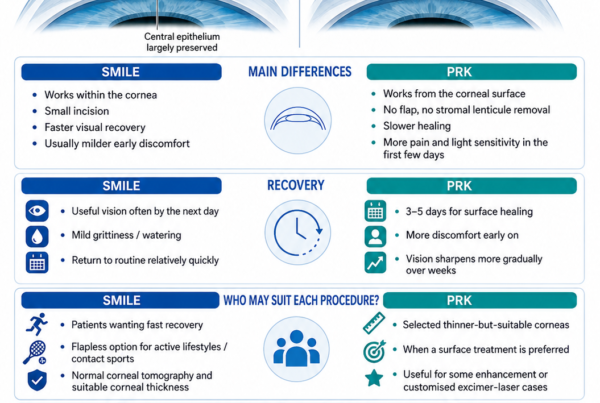
TransPRK vs SMILE
TransPRK
- Uses an excimer laser
- Removes the surface epithelium
- No flap or corneal cap
- Can potentially use topography- or wavefront-guided excimer profiles
- Slower and more uncomfortable recovery
- Haze risk
SMILE
- Uses a femtosecond laser
- Creates and removes an internal corneal lenticule
- Uses a small surface incision
- Preserves the central epithelium
- Faster and generally more comfortable recovery
- No PRK-type surface haze
- Has lenticule- and interface-specific risks
A network and meta-analysis found that TransPRK, SMILE and femtosecond LASIK all produced excellent efficacy, predictability and safety for myopia, without one procedure showing universal superiority across every outcome.
Comparative studies suggest that differences in early optical quality and higher-order aberrations depend on the laser platforms and measurements used. These findings should not be interpreted as proving that one procedure always provides better subjective vision.
Is TransPRK Better for Dry Eyes?
TransPRK does not create a LASIK flap, so it avoids broad flap-related transection of the anterior corneal nerve network.
Corneal sensation may recover relatively early compared with LASIK in some studies.
However, TransPRK still removes:
- The surface epithelium
- Superficial nerve endings
- Corneal stromal tissue
Temporary dryness, burning and fluctuating vision are therefore common during recovery.
Severe dry-eye disease may make TransPRK unsuitable, just as it may rule out LASIK or SMILE. The eye surface should be treated and stable before measurements and surgery.
Is TransPRK Better for Thin Corneas?
TransPRK may be considered when a LASIK flap would leave insufficient load-bearing stromal tissue.
Because TransPRK does not create a flap, more of the remaining stroma contributes to corneal strength.
However, a thin cornea is not automatically suitable for TransPRK.
The surgeon must still assess:
- Corneal topography and tomography
- Total corneal thickness
- Planned ablation depth
- Optical-zone size
- Residual stromal tissue
- Epithelial thickness
- Corneal biomechanical risk
- Degree of prescription
A thin or structurally abnormal cornea may be unsuitable for every corneal laser procedure.
Can TransPRK Cause Corneal Ectasia?
Yes.
Corneal ectasia is progressive weakening and bulging of the cornea after refractive surgery.
It can cause:
- Increasing myopia
- Irregular astigmatism
- Ghosting
- Reduced best-corrected vision
- Need for rigid or scleral lenses
- Need for corneal cross-linking
- Rarely, corneal transplantation
Reported ectasia appears less common after PRK than after LASIK, but it has occurred after PRK and TransPRK. Differences in reported rates are influenced by patient selection, procedure volumes, follow-up and underreporting.
TransPRK should not be performed in patients with:
- Keratoconus
- Forme-fruste keratoconus
- Progressive corneal thinning
- Suspicious tomography
- Inadequate residual tissue
- Another corneal ectatic disorder
Avoiding a flap reduces one structural concern but does not make an unstable cornea safe for tissue removal.
Is TransPRK Suitable for Contact Sports?
TransPRK may be attractive for patients involved in:
- Martial arts
- Boxing
- Rugby
- Football
- Water polo
- Military training
- Police or tactical work
- Occupations involving facial trauma
Because no LASIK flap is created, there is no long-term risk of traumatic flap displacement.
However, the eye remains vulnerable to ordinary traumatic injuries, including:
- Corneal abrasion
- Infection
- Traumatic inflammation
- Cataract
- Retinal tears
- Retinal detachment
Protective eyewear remains important.
What Is Corneal Haze?
Corneal haze is an abnormal healing response in the treated stroma.
It may be visible during slit-lamp examination without causing symptoms, or it may lead to:
- Hazy vision
- Glare
- Halos
- Reduced contrast
- Refractive regression
- Reduced best-corrected vision
The risk is influenced by:
- Depth of laser treatment
- High myopic correction
- Ultraviolet exposure
- Healing response
- Steroid compliance
- Mitomycin C use
- Previous corneal surgery
- Genetic and biological factors
Modern laser profiles, mitomycin C and postoperative steroid protocols have substantially reduced clinically significant haze, but they have not eliminated it.
What Is Mitomycin C?
Mitomycin C is an anti-proliferative medication that may be applied briefly to the treated corneal surface.
It reduces the activity of cells involved in scar and haze formation.
It is more likely to be considered when:
- The refractive correction is high
- The ablation is relatively deep
- Previous corneal surgery has been performed
- The surgeon considers the patient at increased haze risk
Mitomycin C should not be viewed as a guarantee against haze.
Its concentration and application time must be carefully controlled because it can also affect keratocytes and corneal endothelial cells. Systematic reviews support its effectiveness in reducing PRK-associated haze when used appropriately.
How Can Patients Reduce Haze Risk?
Patients should:
- Use prescribed steroid drops correctly
- Attend all follow-up visits
- Avoid unprotected ultraviolet exposure
- Wear good-quality sunglasses outdoors
- Avoid stopping medication independently
- Report worsening vision promptly
- Avoid eye rubbing
- Maintain good ocular-surface lubrication
Steroid drops may need to be tapered over weeks or months.
Because steroids can raise eye pressure in susceptible patients, pressure must be monitored during treatment.
Can Steroid Drops Cause Glaucoma?
Steroid eyedrops can raise intraocular pressure in steroid responders.
This risk may be especially relevant after surface ablation because steroid treatment is often longer than after uncomplicated LASIK.
Raised pressure may initially cause no symptoms.
Follow-up examinations may therefore include:
- Eye-pressure measurement
- Corneal examination
- Assessment for haze
- Review of the steroid schedule
Patients should not stop steroids without medical advice because inadequate anti-inflammatory treatment may increase haze risk.
Can Infection Occur After TransPRK?
Yes, although serious infection is uncommon.
During the first several days:
- The epithelial barrier is incomplete
- A bandage contact lens is present
- The corneal surface is healing
These factors create a temporary opportunity for infection.
Warning symptoms include:
- Increasing pain after initial improvement
- Increasing redness
- Rapidly worsening vision
- Thick discharge
- Marked light sensitivity
- A white or grey corneal spot
Urgent assessment is required.
What Are the Other Risks of TransPRK?
Potential risks include:
- Under-correction
- Overcorrection
- Residual astigmatism
- Refractive regression
- Delayed epithelial healing
- Recurrent epithelial defects
- Corneal haze
- Infection
- Steroid-induced pressure elevation
- Dry eye
- Glare
- Halos
- Starbursts
- Ghosting
- Reduced contrast sensitivity
- Corneal ectasia
- Need for enhancement
- Rare loss of best-corrected vision
- Rare persistent corneal or neuropathic pain
TransPRK is surface-based and flap-free, but it is not risk-free.
Is TransPRK Permanent?
Yes.
The excimer laser permanently removes corneal tissue.
The removed tissue does not grow back.
The epithelium regenerates, but the underlying stromal shape remains altered.
Vision may nevertheless change later because of:
- Continuing myopia progression
- Corneal remodelling
- Presbyopia
- Cataract
- Pregnancy
- Hormonal changes
- Diabetes-related refractive changes
- Other eye disease
A permanent corneal correction does not guarantee that the eye’s prescription will remain unchanged for life.
Does TransPRK Prevent Presbyopia?
No.
Presbyopia is caused by age-related loss of flexibility in the natural crystalline lens.
TransPRK reshapes the cornea but does not restore natural accommodation.
Patients corrected fully for distance will generally need reading glasses as presbyopia develops.
A monovision strategy may be considered:
- One eye is corrected mainly for distance
- The other retains mild myopia for nearer tasks
A contact lens trial is advisable before permanent monovision treatment whenever practical.
Can TransPRK Treat High Myopia?
It can treat significant myopia when the cornea has sufficient healthy tissue.
However, higher corrections require deeper ablation and may increase:
- Haze risk
- Regression
- Night-vision symptoms
- Optical aberrations
- Ectasia concern
- Limits on future enhancement
Clinical series have reported favourable outcomes in moderate-to-high myopia using modern TransPRK platforms, but this does not mean that every highly myopic eye should undergo surface ablation.
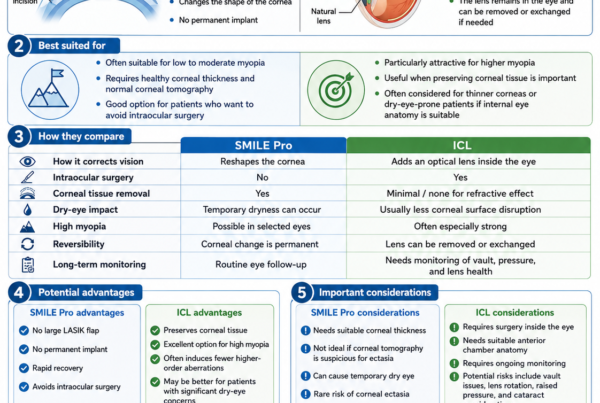
An Implantable Collamer Lens may be preferable when laser treatment would remove excessive corneal tissue.
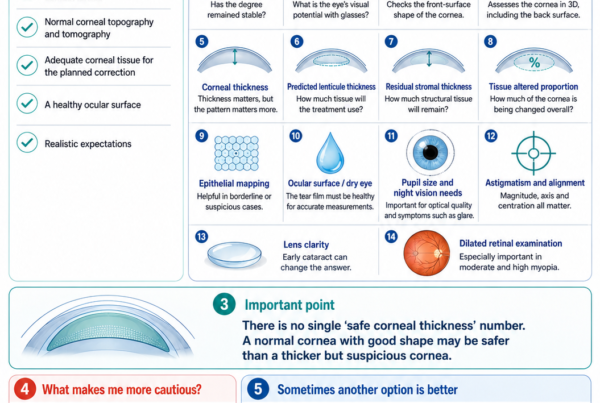
Who May Be Suitable for TransPRK?
A typical candidate has:
- An adult, stable prescription
- Myopia with or without regular astigmatism within the platform’s treatment range
- Healthy corneal topography and tomography
- Adequate corneal tissue
- No evidence of keratoconus
- A controlled and stable ocular surface
- No active eye infection or inflammation
- No significant cataract
- Realistic expectations
- Willingness to accept slower recovery
- Ability to attend follow-up and use medication correctly
TransPRK may be particularly considered when:
- Avoiding a LASIK flap is important
- Contact or combat sports are relevant
- The cornea is too thin for LASIK but remains suitable for surface ablation
- A customised excimer-laser treatment is desirable
- Previous anatomy makes flap creation less appropriate
Who May Not Be Suitable?
TransPRK may be unsuitable when there is:
- Keratoconus or another corneal ectatic disorder
- Suspicious or progressive corneal tomography
- Insufficient corneal tissue
- An unstable prescription
- Severe uncontrolled dry eye
- Active infection or inflammation
- Significant corneal scarring
- Poor epithelial healing
- Active autoimmune disease
- Poorly controlled diabetes
- Pregnancy or breastfeeding
- Significant cataract
- Vision-limiting retinal or optic nerve disease
- Unrealistic expectations
Patients with recurrent corneal erosion or epithelial basement membrane dystrophy require individual assessment. Surface ablation may occasionally be incorporated into treatment for selected epithelial disorders, but routine refractive TransPRK is not automatically appropriate.
What Tests Are Required Before TransPRK?
Refraction and Visual Acuity
The surgeon measures:
- Myopia or hyperopia
- Astigmatism
- Best-corrected vision
- Prescription stability
Cycloplegic Refraction
Dilating drops may be used to relax accommodation and confirm the true prescription.
Corneal Topography
This assesses:
- Front corneal curvature
- Astigmatism
- Asymmetry
- Contact lens warpage
- Keratoconus patterns
Corneal Tomography
Tomography evaluates:
- Front and back corneal elevation
- Thickness distribution
- Pachymetric progression
- The position of the thinnest point
- Ectasia risk
Corneal Thickness and Tissue Calculations
The surgeon estimates:
- Epithelial ablation
- Stromal ablation depth
- Optical-zone requirements
- Remaining corneal tissue
- Structural safety margin
Epithelial Thickness Mapping
This may identify:
- Unusual epithelial thickness
- Early keratoconus compensation
- Contact lens-related distortion
- Corneal irregularity
It may be particularly relevant because TransPRK treatment relies on an assumed epithelial profile.
Dry-Eye and Eyelid Assessment
The assessment may include:
- Tear-film stability
- Corneal staining
- Meibomian glands
- Blepharitis
- Allergy
- Eyelid closure
Pupil Measurement
Pupil size assists with counselling about:
- Glare
- Halos
- Night vision
- Optical-zone planning
Eye Pressure and Optic Nerve
Baseline pressure is important, particularly because postoperative steroid drops may raise pressure.
Natural-Lens Examination
The surgeon checks for cataract or natural-lens-related prescription changes.
Dilated Retinal Examination
This is particularly important in moderate and high myopia.
TransPRK corrects the cornea but does not remove the retinal risks associated with an elongated myopic eye.
Why Must Contact Lenses Be Stopped Before Testing?
Contact lenses can temporarily alter:
- Corneal curvature
- Epithelial thickness
- Astigmatism
- Refraction
- Tear-film quality
- Corneal topography
The required contact lens-free period depends on:
- Soft or rigid lenses
- Toric lenses
- Overnight wear
- Duration of use
- Evidence of corneal warpage
Measurements should be repeated if the cornea has not stabilised.
What Happens if Some Prescription Remains?
A residual prescription may be managed with:
- Observation
- Spectacles
- Contact lenses
- A surface-laser enhancement
- Another refractive procedure in selected eyes
Enhancement is only considered after:
- The refraction has stabilised
- The epithelium has remodelled
- Corneal maps remain safe
- Adequate tissue remains
- Dry eye is controlled
A second TransPRK or PRK treatment requires another period of epithelial healing and carries additional haze and tissue-removal concerns.
Does TransPRK Have Long-Term Evidence?
Conventional PRK has decades of long-term evidence.
Modern single-step TransPRK has a shorter clinical history, but studies extending to one, two and several years generally report favourable visual and refractive outcomes.
Because different TransPRK platforms use different epithelial profiles and algorithms, results should be interpreted according to the specific technology used rather than treating every transepithelial procedure as identical.
Long-term stability also depends on:
- Age
- Initial prescription
- Corneal healing
- Continuing eye growth
- Natural-lens changes
- Development of cataract
Frequently Asked Questions About TransPRK
Is TransPRK the Same as PRK?
TransPRK is a form of PRK in which the excimer laser removes the epithelium.
Conventional PRK uses a separate manual, brush or alcohol-assisted epithelial-removal step.
Is TransPRK Truly Touch-Free?
The central epithelium is usually removed without mechanical scraping.
However, drops, an eyelid speculum, medication and a bandage contact lens still contact the eye.
Is TransPRK Pain-Free?
No.
The procedure itself is performed under topical anaesthesia, but burning, watering and light sensitivity commonly occur during the first few postoperative days.
Is TransPRK Better Than PRK?
The final results are generally similar.
Some studies suggest better early comfort or faster healing with TransPRK, while others find no clear advantage.
Is TransPRK Better Than LASIK?
TransPRK avoids a permanent flap and preserves more load-bearing stromal tissue.
LASIK provides faster recovery, less early pain and generally easier enhancement.
Neither is universally better.
Is TransPRK Better Than SMILE?
TransPRK allows surface-based excimer-laser customisation and avoids an internal lenticule interface.
SMILE provides faster, more comfortable recovery and preserves the central epithelium.
The best option depends on the eye and visual priorities.
Can TransPRK Treat Astigmatism?
Yes, it can treat regular astigmatism within the laser platform’s approved and clinically suitable range.
Can TransPRK Treat Hyperopia?
Some platforms can perform hyperopic TransPRK, but the evidence and availability are less extensive than for myopic correction.
Is TransPRK Suitable for Thin Corneas?
It may be suitable when LASIK would leave insufficient tissue.
A thin or structurally abnormal cornea may be unsuitable for every corneal laser procedure.
Does TransPRK Cause Dry Eye?
Temporary dryness and fluctuating vision can occur.
It avoids a LASIK flap but still removes the epithelium and superficial nerves.
Does TransPRK Cause Haze?
Corneal haze is a recognised surface-ablation risk.
Modern laser profiles, mitomycin C, steroids and ultraviolet protection reduce the risk.
How Long Does TransPRK Recovery Take?
The epithelium usually closes over several days.
Functional vision often improves over one to two weeks, while fine visual quality may continue stabilising for one to three months or longer.
When Can I Return to Work?
Many patients return to office work after approximately several days to one week.
The timing depends on comfort, visual recovery and job demands.
When Can I Drive?
Driving should resume only when vision meets legal requirements and the surgeon has confirmed that it is safe.
Why Is a Bandage Contact Lens Needed?
It protects the exposed corneal surface, supports epithelial healing and reduces discomfort.
Can I Remove the Bandage Lens Myself?
It should generally be removed by the treating clinical team unless the surgeon has given specific instructions.
Is TransPRK Safer for Contact Sports?
It avoids a permanent LASIK flap and may therefore be preferred when long-term eye-trauma risk is significant.
Is TransPRK Permanent?
Yes.
The epithelium regrows, but the stromal tissue removed to correct the prescription does not.
Can TransPRK Be Reversed?
No.
The laser-removed stromal tissue cannot be restored.
Can I Still Need Glasses?
Yes.
Glasses may still be needed for:
- A residual prescription
- Night driving
- Reading after presbyopia develops
- Future prescription changes
Can TransPRK Cause Blindness?
Severe permanent visual loss is rare but possible.
Potential causes include:
- Infection
- Severe haze or scarring
- Corneal ectasia
- Irregular healing
- Other uncommon complications
Does TransPRK Prevent Cataract?
No.
The natural crystalline lens remains and continues to age.
Do I Still Need Eye Examinations?
Yes.
Regular examinations remain important for:
- Corneal health
- Eye pressure
- Glaucoma
- Cataract
- Retinal health
- Myopia-related complications
Key Takeaway
TransPRK is a form of PRK in which an excimer laser removes the corneal epithelium and reshapes the underlying cornea.
Modern single-step TransPRK combines both stages into one programmed treatment.
Its potential advantages include:
- No LASIK flap
- No manual central epithelial scraping
- No alcohol-assisted epithelial removal
- Preservation of more load-bearing stromal tissue than LASIK
- Suitability for some relatively thinner corneas
- Advantages when contact-sport or occupational trauma is a concern
- Access to excimer-laser treatment profiles
Its limitations include:
- More postoperative discomfort than LASIK
- Slower visual recovery
- A temporary open epithelial wound
- Corneal haze risk
- Longer steroid treatment
- Possible steroid-related pressure elevation
- Regression or residual prescription
- The need for careful ultraviolet protection
“Touch-free” does not mean painless, risk-free or contact-free.
Final outcomes are generally similar to conventional PRK, and the evidence does not establish that TransPRK is universally superior.
TransPRK may be a good option when:
- The prescription is stable
- The cornea is structurally healthy
- Adequate tissue remains
- The eye surface is controlled
- Avoiding a flap is important
- The patient accepts the recovery period
It should not be used to justify laser treatment in a structurally abnormal cornea.
The safest option may instead be LASIK, SMILE, conventional PRK, an Implantable Collamer Lens, spectacles, contact lenses—or no surgery.
References
- Way C, et al. Transepithelial Photorefractive Keratectomy—Review. 2024.
- Alasbali T, et al. Transepithelial Photorefractive Keratectomy Compared to Conventional Photorefractive Keratectomy: A Meta-analysis. 2022. PMID: 36051276.
- Ang RET, et al. Transepithelial Versus Conventional PRK: A Randomized Controlled Trial. 2025. PMID: 40445504.
- Hashemi H, et al. Comparison of Transepithelial and Conventional Photorefractive Keratectomy: A Randomized Contralateral-Eye Trial. 2022. PMID: 35148689.
- Gaeckle HC, et al. Early Clinical Outcomes and Comparison Between Transepithelial and Conventional PRK. 2021. PMID: 33863311.
- Chang JY, et al. Comparison of Clinical Outcomes of LASIK, TransPRK and SMILE. 2022. PMID: 34861667.
- Cui G, et al. Efficacy, Predictability and Safety of SMILE, Femtosecond LASIK and TransPRK for Myopia: A Network Meta-analysis. 2023. PMID: 36743675.
- Ho T, et al. Clinical Outcomes of Transepithelial Photorefractive Keratectomy Using a High-Frequency Excimer Laser. 2024. PMID: 38892769.
- Yilmaz BS, et al. Comparison of Long-Term Visual and Refractive Results of Mechanical and Transepithelial PRK. 2022. PMID: 35692276.
- Adib-Moghaddam S, et al. Efficacy and Safety of Transepithelial Photorefractive Keratectomy. 2018. PMID: 30172569.
- Adib-Moghaddam S, et al. Single-Step Transepithelial Photorefractive Keratectomy for Myopia and Astigmatism. 2016. PMID: 27956283.
- Luger MHA, et al. Myopia Correction With Transepithelial PRK Versus Femtosecond LASIK. 2016. PMID: 27956284.
- Zhang J, et al. Clinical Outcomes of TransPRK Versus Femtosecond LASIK for High Myopia. 2020. PMID: 32560634.
- Aslanides IM, et al. Comparison of Single-Step Reverse Transepithelial Surface Ablation and Alcohol-Assisted PRK. 2012. PMID: 22815640.
- Alhawsawi A, et al. Outcomes of Single-Step Transepithelial PRK Compared With Alcohol-Assisted PRK. 2023. PMID: 37123747.
- Gunn DJ, et al. StreamLight Single-Step Transepithelial Photorefractive Keratectomy Outcomes. 2024. PMID: 39575318.
- Moshirfar M, et al. Ectasia After Corneal Refractive Surgery: A Systematic Review. 2021. PMID: 34417707.
- Somani SN, Moshirfar M, Patel BC. Photorefractive Keratectomy. Updated 2025. PMID: 31751077.