Author: Dr Val Phua
Estimated reading time: 13–15 minutes
Can Childhood Myopia Really Be Slowed?
Yes.
Childhood myopia cannot usually be reversed, but several evidence-based treatments can slow the rate at which the spectacle prescription increases and the eyeball elongates.
The main myopia-control options are:
- Specialised myopia-control spectacle lenses
- Dual-focus or multifocal soft contact lenses
- Orthokeratology lenses
- Low-concentration atropine eye drops
- Selected combinations of these treatments
Outdoor time and healthier near-work habits remain important, but once myopia is already progressing, lifestyle changes alone may not provide enough control.
No treatment completely stops progression in every child. The aim is to reduce the amount of myopia the child accumulates before eye growth eventually slows.
The International Myopia Institute’s 2025 review concluded that multiple optical and pharmacological treatments can significantly reduce refractive progression and axial elongation. The best treatment is the one that combines good evidence, safety, suitability and consistent use for the individual child.
What Does “Myopia Control” Mean?
Ordinary glasses correct blurred distance vision by refocusing light onto the retina.
Myopia-control treatment does more than correct vision. It aims to slow the excessive front-to-back growth of the eye, known as axial elongation.
A child’s myopia may progress because:
- The eyeball continues to grow longer.
- Distant images become increasingly focused in front of the retina.
- A stronger negative prescription is required.
- The stretched retina and supporting tissues face greater lifetime risk.
Myopia control does not normally shorten an eye that has already elongated. Its purpose is to reduce further growth.
Why Is Slowing Myopia Important?
The concern is not simply that the child may require thicker glasses.
Increasing levels of myopia are associated with greater lifetime risks of:
- Retinal tears and retinal detachment
- Myopic macular degeneration
- Glaucoma
- Cataract
- Abnormal blood vessels beneath the retina
- Permanent visual impairment
Risk increases progressively with the amount of myopia and axial elongation. Even reducing the final prescription by one or two dioptres may have meaningful long-term value.
Can Treatment Guarantee That My Child Will Not Develop High Myopia?
No.
Treatment reduces risk but does not eliminate it.
The eventual prescription depends on:
- Age at myopia onset
- Current prescription
- Axial length
- Natural rate of eye growth
- Family history
- Ethnicity and population background
- Outdoor exposure
- Near-work behaviour
- Treatment adherence
- Individual biological response
A young child who begins treatment at –1.00 D may still progress, but may finish childhood substantially less myopic than the child would have been without treatment.
Why Is Early Treatment Important?
Myopia commonly progresses fastest in younger children.
A child who becomes myopic at age six has many more years of potential eye growth than a teenager whose myopia begins at age fifteen.
Earlier onset is therefore one of the strongest predictors of eventual high myopia.
Treatment should not be delayed until the prescription becomes severe. By then, much of the structural eye growth has already occurred.
The greatest benefit may come from slowing each year of progression across the child’s remaining period of growth.
Which Children Should Be Considered for Myopia Control?
Myopia-control treatment may be discussed when:
- Myopia has developed during childhood
- The prescription is increasing
- Axial length is increasing faster than expected
- Myopia began at a young age
- One or both parents are myopic
- The child is likely to develop high myopia
- Progression continues despite lifestyle changes
- The child already has moderate or high myopia
- There is a significant difference between the two eyes
- The child has a strong family history of retinal complications from myopia
Treatment does not necessarily require waiting for progression of –1.00 D in a year.
A young child with recent-onset myopia and strong risk factors may warrant early intervention even before a full year of observation has passed.
How Is Progression Measured?
Myopia should ideally be monitored using both:
- Cycloplegic refraction
- Axial-length measurement
Cycloplegic Refraction
Children have powerful focusing muscles.
Cycloplegic eye drops temporarily relax these muscles, allowing a more accurate measurement of the true prescription.
Without cycloplegia, a child may appear more myopic than they really are.
Axial Length
Axial length measures the front-to-back length of the eye.
It provides direct information about structural eye growth.
This is useful because:
- Prescription measurements can fluctuate.
- Atropine may affect focusing and pupil size.
- Orthokeratology temporarily changes the corneal shape.
- Axial elongation is the main process linked to future myopia-related complications.
The 2025 International Myopia Institute instrumentation report supports axial length as an important part of monitoring where the equipment is available.
What Is Considered Rapid Progression?
There is no single threshold suitable for every age and population.
Features that raise concern include:
- A prescription increase of approximately –0.50 D or more in one year
- Axial elongation that is faster than expected for age
- Continued progression despite treatment
- Rapid change in a child younger than ten
- Progression towards high myopia
- Increasing asymmetry between the eyes
Axial growth must be interpreted using age, ethnicity, baseline eye length and treatment history. Younger children normally have more physiological eye growth than older teenagers.
The important question is not simply whether the eye grew, but whether it grew faster than would be expected in a successfully controlled child.
Is There One Best Myopia-Control Treatment?
No single treatment is best for every child.
The choice depends on:
- Age
- Prescription and astigmatism
- Axial length
- Rate of progression
- Corneal shape and health
- Dry eye or allergy
- Ability to handle contact lenses
- Sports and lifestyle
- Sensitivity to light
- Near-vision demands
- Cost
- Availability
- Family preference
- Likelihood of consistent use
A highly effective treatment used inconsistently may perform worse than a slightly less intensive option the child wears every day.
How Effective Are the Different Treatments?
Clinical trials report treatment effect in different ways:
- Percentage reduction in prescription progression
- Percentage reduction in axial elongation
- Absolute dioptre difference
- Absolute millimetre difference
- One-year, two-year or longer outcomes
Percentages from separate studies should not be compared as though they came from one head-to-head trial.
Results differ because studies involve different:
- Ages
- Prescriptions
- Ethnic groups
- Control groups
- Treatment durations
- Definitions of progression
- Wearing times
It is more useful to ask whether a treatment has good evidence, whether the child can use it safely and whether that particular child is responding.
Lifestyle Measures: The Foundation of Every Treatment Plan
Lifestyle measures should accompany whichever clinical treatment is selected.
Outdoor Time
Children should aim for approximately two hours outdoors each day when practical.
Outdoor exposure is most clearly associated with reducing the risk of myopia onset. It remains advisable after myopia begins, although outdoor time alone may have a smaller effect on established progression than active treatment.
Near-Work Habits
Encourage children to:
- Avoid holding books or devices extremely close
- Maintain approximately 30–40 cm reading distance
- Break up prolonged near work
- Look into the distance every 20–30 minutes
- Prefer a larger screen for longer tasks
- Avoid extended handheld-device use
- Use appropriate lighting
- Keep devices out of bed
Clear Vision Correction
The child should receive appropriate visual correction.
Deliberately undercorrecting myopia has not been shown to provide reliable control and may leave the child with unnecessary blur.
Myopia-Control Spectacle Lenses
Specialised spectacle lenses are often the simplest starting option.
They provide clear central vision while incorporating additional optical zones intended to deliver a myopia-control signal to the peripheral retina.
Designs include:
- Defocus incorporated multiple-segment lenses
- Highly aspherical lenslet designs
- Other peripheral-defocus or contrast-modifying designs
The optical structures may appear as small lenslets or segments surrounding a clear central zone.
How Do Myopia-Control Spectacles Work?
The central portion provides clear distance correction.
The surrounding treatment zones create a pattern of myopic defocus or altered retinal contrast.
The precise mechanism is still being investigated, but the intended effect is to reduce the retinal signal encouraging excessive axial growth.
How Effective Are Myopia-Control Spectacles?
Randomised clinical trials have shown that DIMS and highly aspherical lenslet designs can reduce both prescription progression and axial elongation compared with ordinary single-vision glasses.
DIMS lenses demonstrated continued benefit through three-year follow-up. Highly aspherical lenslet spectacles have demonstrated sustained efficacy through five years in children who wore them consistently.
Different spectacle technologies should not automatically be considered equivalent. Their designs, clinical evidence and required wearing patterns differ.
Advantages of Myopia-Control Spectacles
- Non-invasive
- No eye drops
- No contact-lens infection risk
- Easy for younger children
- Correct myopia and astigmatism
- Suitable for children who cannot handle contact lenses
- Relatively simple to stop or change
- Minimal systemic side effects
Limitations of Myopia-Control Spectacles
- Must be worn consistently
- Effectiveness depends partly on wearing time
- May not suit children who constantly remove their glasses
- Peripheral blur or visual awareness may occur initially
- Frames must fit well and remain centred
- Lenses may be thicker or more expensive than standard lenses
- Scratched or poorly positioned lenses may reduce visual performance
- Progression can still occur
How Long Should They Be Worn Each Day?
They are generally intended for full-time or near-full-time wear.
Longer wearing time has been associated with better outcomes in some highly aspherical lenslet studies.
The spectacles should be worn during:
- School
- Homework
- Outdoor activity
- Sports when practical
- Most waking activities
They should not be treated as reading glasses that are worn only for schoolwork.
Will Children Adapt to the Lenslets?
Most children adapt quickly.
Some may initially notice:
- Peripheral blur
- Halos
- A swim-like sensation
- Awareness of the treatment zones
- Mild difficulty on stairs
Frame fitting is important because the central clear area should align appropriately with the pupils.
Persistent symptoms require reassessment of:
- Frame position
- Prescription
- Lens centration
- Whether the child is looking through the correct zone
Are Ordinary Progressive Lenses or Bifocals the Same?
No.
Traditional bifocals and progressive-addition lenses were designed primarily to provide different focusing powers for distance and near.
Some older studies found modest myopia-control effects in selected children, but modern myopia-control spectacle designs use different optical principles and generally have stronger supporting evidence.
Soft Myopia-Control Contact Lenses
Specialised soft contact lenses use multiple optical zones to:
- Correct distance vision
- Provide simultaneous myopic defocus
- Reduce the stimulus for axial elongation
They are worn during the day and removed before sleep.
Designs include:
- Dual-focus lenses
- Centre-distance multifocal lenses
- Extended-depth-of-focus designs
Not every multifocal contact lens has the same evidence or regulatory status for childhood myopia control.
How Effective Are Dual-Focus Soft Contact Lenses?
The three-year randomised MiSight trial reported approximately 59% less refractive progression and 52% less axial elongation than a single-vision daily disposable contact lens in children aged eight to twelve at treatment initiation.
Longer follow-up found that the treatment benefit continued and that children could use the lenses safely when appropriately selected, trained and monitored.
These figures apply to that particular clinical trial and lens design. They should not be assumed for every multifocal soft lens.
Advantages of Soft Myopia-Control Lenses
- Clear vision without spectacles during wear
- Useful for sport and active children
- Daily disposable options reduce cleaning requirements
- No overnight lens wear
- Proven myopia-control effect for specific designs
- Reversible
- May improve confidence and quality of life
Limitations and Risks
- Requires safe insertion and removal
- Requires consistent daily wear
- Cannot be worn during sleep
- Swimming and showering in lenses should be avoided
- May cause dryness or discomfort
- May not correct higher astigmatism adequately
- Carries a risk of corneal infection
- Requires regular corneal examinations
- Some children are not ready for lens responsibility
Are Contact Lenses Safe for Children?
Contact lenses can be used safely by appropriately selected children when:
- Hands are washed and dried before handling
- The child never sleeps in daytime lenses
- Water exposure is avoided
- Daily disposables are discarded after use
- Lenses are never shared
- Redness or pain is reported immediately
- Follow-up appointments are attended
The child’s maturity matters more than age alone.
A responsible eight-year-old with parental support may manage lenses better than an older child who ignores hygiene instructions.
What Symptoms Require Immediate Lens Removal?
Remove the lenses and seek prompt assessment for:
- Eye pain
- Redness
- Light sensitivity
- Discharge
- Blurred vision
- A white corneal spot
- Difficulty opening the eye
A painful red eye in a contact-lens wearer should be considered a potential corneal infection until examined.
Orthokeratology
Orthokeratology, or ortho-k, uses specially designed rigid gas-permeable lenses worn during sleep.
The lenses temporarily reshape the front surface of the cornea.
They are removed in the morning, allowing many children to see clearly during the day without glasses or daytime contact lenses.
The corneal change is temporary. Regular overnight wear is required to maintain the visual effect.
How Does Orthokeratology Control Myopia?
Ortho-k flattens the central cornea while creating a surrounding zone of altered corneal power.
This corrects central myopia and produces peripheral myopic defocus, which is thought to reduce the signal for axial elongation.
The treatment changes corneal shape but does not permanently flatten or shorten the eyeball.
Axial length must therefore still be monitored.
Advantages of Orthokeratology
- Clear daytime vision without glasses
- Useful for swimming and sport once the morning lenses are removed
- Effective myopia-control option
- Reversible corneal effect
- Can be helpful for children who dislike daytime spectacles
- May correct moderate myopia and some astigmatism
- Parents can supervise insertion and removal at home
Limitations of Orthokeratology
- Requires overnight contact-lens wear
- Requires meticulous cleaning and disinfection
- More fitting visits are usually needed
- Initial lens awareness is common
- Vision may fluctuate during the early fitting period
- The treatment effect wears off if lenses are stopped
- High myopia or significant astigmatism may be harder to correct fully
- Lost or damaged lenses can disrupt vision
- Cost is generally higher than ordinary spectacles
- Corneal infection is a potentially serious risk
Is Sleeping in Ortho-K Lenses Safe?
Overnight contact-lens wear carries more infection risk than spectacles.
Ortho-k should therefore be prescribed only with:
- Detailed corneal mapping
- Proper lens fitting
- Strict hygiene
- No tap-water exposure
- Regular lens replacement
- Scheduled corneal examinations
- Immediate review of pain or redness
The lenses should never be rinsed with tap water or worn during an active eye infection.
Children who repeatedly disregard hygiene instructions may be better suited to spectacle lenses or atropine.
Who May Be a Good Candidate for Ortho-K?
Ortho-k may suit a child who:
- Is active in sport
- Strongly prefers daytime spectacle freedom
- Has a suitable prescription
- Has a healthy and regular cornea
- Has reliable parental support
- Can attend frequent reviews
- Can follow strict hygiene rules
- Does not have uncontrolled allergy or dry eye
Who May Not Be Suitable?
Ortho-k may be less suitable when there is:
- Active allergic conjunctivitis
- Significant dry eye
- Recurrent corneal erosion
- Corneal scarring
- Keratoconus or suspicious corneal topography
- Poor hygiene
- Inability to attend follow-up
- Frequent eye rubbing
- Severe lens anxiety
- A history of serious contact-lens infection
Low-Concentration Atropine Eye Drops
Atropine is a medication that affects receptors within the eye.
At full strength, it dilates the pupil and temporarily reduces focusing ability.
For myopia control, lower concentrations are commonly used to reduce axial elongation while limiting light sensitivity and near blur.
Concentrations used in clinical practice may include:
- 0.01%
- 0.025%
- 0.05%
- Other individually selected concentrations
The concentration, formulation and regulatory status vary between countries and clinics.
How Does Atropine Slow Myopia?
The exact mechanism is not fully understood.
Its effect does not appear to depend solely on paralysing the focusing muscle.
Atropine is thought to act through receptors in the retina, choroid and sclera, altering biochemical signals involved in eye growth.
LAMP biometric analysis found that its treatment effect was primarily associated with reduced axial elongation rather than significant changes in corneal or lens power.
Which Atropine Concentration Works Best?
Higher concentrations generally provide greater myopia control but also produce more:
- Pupil dilation
- Light sensitivity
- Near focusing difficulty
- Possible need for photochromic or reading lenses
The LAMP trial found a concentration-dependent response among 0.01%, 0.025% and 0.05% atropine, with 0.05% providing the strongest overall control over two and three years in the studied population.
However, no concentration is universally best.
The choice may depend on:
- Age
- Baseline progression
- Iris colour
- Sensitivity to light
- Near-work demands
- Initial treatment response
- Tolerance
- Availability
- Whether another myopia-control treatment is also used
Is 0.01% Atropine Still Useful?
It may be useful for selected children, particularly when minimising side effects is a priority.
However, several modern trials have found that 0.01% has a weaker effect on axial elongation than 0.025% or 0.05%.
Families should not assume that the lowest concentration is automatically the most appropriate.
A child progressing rapidly on 0.01% may require:
- A higher concentration
- An optical myopia-control treatment
- Combination therapy
- Review of adherence and measurement accuracy
How Is Atropine Used?
It is commonly prescribed as one drop in each treated eye at night.
The exact schedule may differ.
Children usually continue wearing:
- Glasses
- Myopia-control spectacles
- Daytime contact lenses
- Ortho-k lenses
Atropine slows progression but does not provide clear distance correction by itself.
Advantages of Atropine
- Simple once-daily use
- No contact-lens handling
- Suitable for younger children
- Can be combined with spectacles
- Does not depend on lens centration or wearing time
- Different concentrations allow dose adjustment
- Useful when contact lenses are unsuitable
Possible Side Effects
- Enlarged pupils
- Increased light sensitivity
- Near blur
- Difficulty reading very small print
- Headache
- Eye irritation
- Allergy or eyelid dermatitis
- Temporary stinging
- Rare systemic anticholinergic effects
Higher concentrations tend to produce greater pupil enlargement and focusing reduction.
Can Atropine Cause Fever, Dry Mouth or a Fast Heartbeat?
Systemic side effects are uncommon with low-concentration ophthalmic atropine but are possible.
Seek medical advice if a child develops unusual:
- Facial flushing
- Fever
- Dry mouth
- Confusion
- Palpitations
- Difficulty urinating
- Marked behavioural change
Pressure over the inner corner of the closed eyelid for approximately one minute after instillation may reduce drainage into the nose and systemic absorption.
Can Atropine Cause Permanent Pupil Enlargement?
The pupil effect is generally reversible after treatment is stopped.
The time required to return to baseline depends on:
- Concentration
- Duration of use
- Individual response
- Iris pigmentation
Does Atropine Make Children Dependent on the Drops?
No.
The eye does not become addicted to atropine.
However, the underlying tendency for myopia progression may still be present when treatment is stopped. Progression after discontinuation is therefore not necessarily drug dependence.
What Is Atropine Rebound?
Rebound refers to faster progression after treatment is stopped than would otherwise have occurred.
Rebound is more of a concern with higher-dose atropine and in younger children, although the degree varies.
The LAMP studies found that continued treatment was more effective than stopping and that younger age was associated with greater progression after discontinuation. Five-year data indicated that many children required treatment to be restarted.
The 2026 eight-year LAMP report found that tapering atropine before stopping produced less subsequent progression than abrupt cessation in the studied group.
Stopping treatment should therefore be planned rather than based only on the child reaching an arbitrary age.
How Long Is Atropine Continued?
Treatment may continue for several years.
The decision to reduce or stop depends on:
- Current age
- Recent prescription change
- Recent axial growth
- Pubertal development
- Baseline myopia
- Previous rebound
- Treatment tolerance
- Family preference
Many children continue progressing into the teenage years, and some progress into early adulthood.
Can Atropine Prevent Myopia Before It Begins?
Research has explored low-concentration atropine in pre-myopic children.
Some trials suggest that 0.05% atropine can delay myopia onset in selected high-risk children. However, preventive treatment requires careful assessment of:
- Cycloplegic prescription
- Age
- Parental myopia
- Axial length
- Rate of refractive change
- Outdoor exposure
Atropine should not be prescribed to every non-myopic child simply because a parent wears glasses.
Combination Therapy
Some children continue progressing despite good use of one treatment.
Combination therapy may be considered when:
- Myopia began very early
- Axial elongation remains rapid
- The prescription is approaching high myopia
- The response to monotherapy is inadequate
- The child is using the initial treatment correctly
- Measurement confirms genuine progression
Possible combinations include:
- Ortho-k plus low-concentration atropine
- Myopia-control spectacles plus atropine
- Soft myopia-control contact lenses plus atropine
Does Ortho-K Plus Atropine Work Better?
The most established combination evidence currently involves orthokeratology with low-dose atropine.
A 2025 living network meta-analysis found that ortho-k combined with low-dose atropine probably reduces axial elongation more than ortho-k alone.
The additional benefit is often most noticeable during the earlier treatment period.
Combination treatment may also produce more:
- Light sensitivity
- Near blur
- Cost
- Complexity
- Follow-up requirements
It should not be started automatically in every child.
Does Atropine Add More Benefit to Myopia-Control Spectacles?
Evidence is developing.
Some studies have found additional benefit when atropine is combined with DIMS or other specialised spectacle designs, while others have found limited added effect depending on age, concentration and spectacle design.
A 2025 randomised trial examined DIMS spectacles with atropine, and newer studies are evaluating combinations with highly aspherical lenslets. The results suggest potential benefit in selected children but do not establish that every child needs two treatments from the beginning.
Should Treatment Be Changed When Progression Continues?
Not immediately after one unexpected measurement.
First assess:
- Was cycloplegic refraction used?
- Was the same axial-length instrument used?
- Is the child wearing the treatment consistently?
- Are spectacles correctly fitted?
- Are contact lenses centred properly?
- Is atropine being instilled every night?
- Was treatment interrupted?
- Has the child recently had a growth spurt?
- Is there significant dry eye or allergy?
- Is the apparent change within measurement variability?
If genuine progression is confirmed, options include:
- Improving adherence
- Increasing atropine concentration
- Changing optical treatment
- Adding a second treatment
- Reviewing every three months
- Investigating unusually rapid or atypical progression
Repeated Low-Level Red-Light Therapy
Repeated low-level red-light therapy uses a tabletop device that delivers brief exposures of red light, usually more than once daily.
Several trials have reported substantial reductions in refractive progression and axial elongation.
However, important questions remain regarding:
- Long-term retinal safety
- Differences between devices
- Light intensity and dose
- Reported axial shortening
- Rebound after stopping
- Whether safety limits are appropriate
- Generalisability outside the populations studied
Reports of retinal injury and concerns that some devices may exceed recommended exposure limits mean this treatment should not be viewed as equivalent to well-established spectacles, atropine or contact-lens options.
At present, it is best considered an emerging treatment requiring careful specialist assessment, device-specific safety information and long-term monitoring rather than routine unsupervised home use.
What About Ordinary Single-Vision Glasses?
Single-vision glasses provide clear vision but generally do not offer substantial myopia control.
They may still be appropriate when:
- Myopia is stable
- Specialised treatment is unavailable
- The child cannot tolerate another option
- The prescription is temporary
- A more complete assessment is pending
For a young child with progressive myopia, repeatedly prescribing stronger single-vision lenses without discussing myopia control may miss an opportunity to reduce future severity.
What About Bifocals and Progressive Glasses?
Traditional bifocals and progressive lenses may provide modest benefit in some children, particularly those with certain focusing or eye-alignment patterns.
However, their average effect is generally less than that of modern lenslet-based myopia-control spectacles.
They should not automatically be considered interchangeable.
Can Ordinary Multifocal Contact Lenses Be Used?
Some centre-distance multifocal soft lenses have demonstrated myopia-control effects even when not originally designed specifically for this purpose.
Effectiveness depends on:
- Optical design
- Add power
- Lens centration
- Pupil size
- Wearing time
- Child’s prescription
- Adherence
A standard multifocal lens prescribed for adult presbyopia should not automatically be assumed to provide the same control as a clinically studied paediatric design.
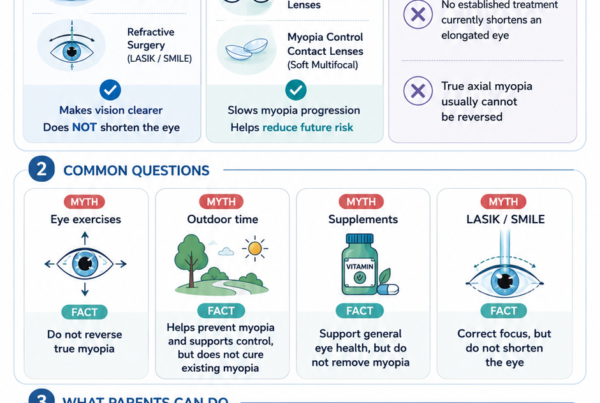
Can Myopia Be Reversed?
No current treatment reliably shortens the eye back to its original length or permanently removes established childhood axial myopia.
Orthokeratology temporarily changes the cornea and may make the daytime prescription appear lower, but the underlying axial length remains.
Atropine and optical treatments slow further growth rather than erasing previous elongation.
LASIK in adulthood can reduce spectacle dependence but does not remove the retinal and glaucoma risks associated with having a long myopic eye.
How Is the Best Option Chosen?
Younger Child Who Cannot Handle Contact Lenses
Possible options include:
- Myopia-control spectacles
- Atropine
- A combination if progression remains rapid
Active Child Who Strongly Dislikes Glasses
Possible options include:
- Daily disposable myopia-control contact lenses
- Orthokeratology
- Atropine as an additional treatment if necessary
Child with Allergy or Frequent Eye Rubbing
Spectacles and atropine may be safer initial choices while allergy is controlled.
Contact lenses should be used cautiously.
Child with Poor Hygiene
Avoid treatment that depends on meticulous contact-lens cleaning.
Myopia-control spectacles or atropine may be more appropriate.
Child with High Astigmatism
Options depend on the amount and type of astigmatism.
Possible choices include:
- Specialised spectacle lenses
- Toric or customised soft contact lenses where available
- Orthokeratology with an appropriate design
- Atropine combined with full optical correction
Child Progressing Rapidly on One Treatment
Possible strategies include:
- Confirming adherence
- Checking axial length and cycloplegic refraction
- Increasing treatment intensity
- Switching optical design
- Adding atropine
- Combining atropine with ortho-k or spectacles
How Quickly Should Treatment Work?
Myopia control is judged over months rather than days.
Atropine may change pupil size quickly, and ortho-k may improve daytime vision within several nights, but slowing axial growth must be assessed over a longer period.
A reasonable early review may assess:
- Vision
- Comfort
- Adherence
- Side effects
- Lens fit
- Corneal health
Treatment effectiveness is usually judged using serial refraction and axial length over approximately six to twelve months, with earlier assessment when progression is very rapid.
How Often Should the Child Be Reviewed?
Many children receiving active myopia control are reviewed every three to six months.
The exact interval depends on:
- Age
- Progression rate
- Treatment
- Contact-lens wear
- Corneal findings
- Atropine concentration
- Adherence
- Previous response
Follow-up may include:
- Visual acuity
- Cycloplegic or non-cycloplegic refraction as appropriate
- Axial length
- Corneal topography
- Contact-lens fit
- Eye pressure
- Pupil size
- Near focusing
- Ocular-surface examination
- Retinal examination when indicated
Should Treatment Continue After the Prescription Appears Stable?
Usually, treatment should not be stopped after only one stable visit.
Stability may be temporary.
The decision should consider:
- At least several recent measurements
- Axial-length trend
- Child’s age
- Pubertal stage
- Previous progression
- Treatment interruption history
- Seasonal variation
- Risk of rebound
Treatment is often continued until progression has remained low during the later teenage years, then reduced or stopped gradually depending on the therapy.
What Happens When Spectacle or Contact-Lens Treatment Is Stopped?
The child loses the optical treatment effect.
Ordinary correction is still needed for clear distance vision.
Current evidence does not show significant rebound beyond expected progression after stopping myopia-control spectacles or dual-focus soft contact lenses.
Orthokeratology’s corneal reshaping effect reverses when lens wear stops, so the original myopic prescription reappears over time.
Can Treatments Be Used in Teenagers?
Yes.
Teenagers may continue progressing and can still benefit from treatment.
The expected absolute benefit may be smaller than in a younger child because natural progression generally slows with age, but treatment can remain worthwhile when:
- Axial length is still increasing
- The prescription continues changing
- High myopia is developing
- Progression resumed after stopping treatment
Treatment should be based on current progression rather than age alone.
Can Treatments Be Used in Very Young Children?
Yes, when clinically justified.
Younger children may benefit greatly because they have more years of potential progression.
Treatment selection must consider:
- Ability to cooperate
- Safety
- Parental supervision
- Baseline prescription
- Cause of the myopia
- Whether the myopia is unusually high or associated with another condition
Very early or severe myopia may require additional investigation for:
- Retinal disease
- Lens abnormalities
- Corneal disease
- Connective-tissue disorders
- Prematurity
- Genetic syndromes
Does Every Child Respond?
No.
Some children show:
- Excellent control
- Moderate control
- Minimal response
- Progression despite combination therapy
A child who continues progressing is not necessarily a treatment failure.
The child may still have progressed more rapidly without therapy.
Because an untreated control eye is not available in ordinary practice, treatment response must be estimated using age, expected growth, prior progression and population reference data.
What Is a “Responder” or “Non-Responder”?
These labels should be used cautiously.
Eye-growth measurements vary, and treatment effects differ between years.
One six-month period of faster growth does not always prove that a treatment has failed.
Before changing treatment, the clinician should confirm:
- Reliable measurements
- Adequate wearing time
- Correct product use
- No prolonged interruption
- A consistent trend across more than one visit
What Can Parents Do to Improve Treatment Success?
- Make treatment part of the child’s routine.
- Ensure spectacles are worn consistently.
- Supervise atropine administration.
- Monitor contact-lens hygiene.
- Replace lenses and cases on schedule.
- Keep all lenses away from tap water.
- Attend every follow-up.
- Continue outdoor activity.
- Encourage sensible viewing distance.
- Avoid blaming the child for progression.
- Report side effects early.
- Keep previous prescriptions and measurement records.
Warning Signs Requiring Prompt Assessment
Seek prompt eye care for:
- Pain or redness in a contact-lens wearer
- Light sensitivity
- Discharge
- Sudden visual loss
- A white corneal spot
- Persistent headache or severe near blur after atropine
- Unusual systemic symptoms after drops
- Flashes, new floaters or a curtain in the vision
- Rapid prescription change in one eye
- New double vision
- Myopia that progresses unusually rapidly despite treatment
Frequently Asked Questions
Which option is most effective?
There is no universally most effective option.
Treatment rankings vary with the study, age group and outcome measured.
Atropine at higher low concentrations, modern spectacle designs, dual-focus soft contact lenses and ortho-k all have good evidence.
The best option is the safest effective treatment the child will use consistently.
Are myopia-control spectacles the safest choice?
They avoid medication and contact-lens infection risk, making them an attractive first treatment for many children.
They still need proper fitting, full-time wear and monitoring.
Is atropine stronger than myopia-control glasses?
It depends on the atropine concentration, spectacle design and individual response.
Results from separate trials cannot be compared directly.
Some children respond well to one option and less well to another.
Can my child use glasses and atropine together?
Yes.
Atropine does not correct distance blur, so glasses are still required.
The glasses may be ordinary correction or a specialised myopia-control design.
Can my child use ortho-k and atropine together?
Yes, in selected children.
Combination treatment may provide greater control than ortho-k alone, particularly when progression remains rapid.
Can my child switch treatments?
Yes.
Treatment may be changed because of:
- Inadequate control
- Side effects
- Cost
- Lifestyle changes
- Hygiene problems
- Contact-lens intolerance
- Availability
- Child preference
Switching should be planned so that the child does not experience a prolonged untreated period.
Can treatment be used in only one eye?
Sometimes.
Unequal prescriptions, amblyopia or unilateral progression may require different correction between the two eyes.
However, atropine is frequently used in both eyes when both are at risk.
Does my child need axial-length measurement?
It is highly useful but may not be available everywhere.
Treatment can still be managed using careful cycloplegic refraction and clinical assessment, but axial length provides valuable additional information about structural eye growth.
Is axial shortening a realistic treatment goal?
Small apparent reductions may occur with atropine, red-light therapy or measurement variation.
The usual goal of established myopia-control treatment is to slow elongation rather than produce sustained shortening.
Unexpected large changes should be confirmed before being interpreted as biological reversal.
Will atropine affect schoolwork?
Low concentrations usually have limited near-vision effects, but some children notice blur, particularly with higher concentrations.
Reading addition lenses or photochromic spectacles may help selected children.
Can atropine be used with contact lenses?
Yes.
It may be combined with daytime soft lenses or nighttime ortho-k, depending on the treatment plan.
The timing of drop instillation should follow the clinician’s instructions.
Is ortho-k permanent?
No.
Its corneal reshaping effect is temporary and gradually reverses after treatment stops.
Will my child be unable to wear contact lenses as an adult?
No.
Properly supervised childhood contact-lens use does not normally prevent future lens wear.
Corneal scarring from a severe infection could affect future options, which is why hygiene is essential.
Can my child swim in myopia-control contact lenses?
Daily soft lenses should generally be removed before swimming.
Ortho-k lenses are removed during the day, allowing children to swim without lenses once their daytime vision is adequate.
Prescription swimming goggles remain an alternative.
Are myopia-control treatments expensive?
They generally cost more than standard single-vision spectacles.
Costs may include:
- Specialised lenses
- Contact-lens supplies
- Atropine compounding
- Axial-length measurements
- Corneal topography
- More frequent reviews
- Replacement of lost or damaged products
Treatment value should be considered over several years rather than only as an initial purchase.
Can treatment stop once the prescription does not change for six months?
Not necessarily.
Six months may be too short to establish long-term stability, particularly in a young child.
Axial length may continue increasing despite a small prescription change.
Will two treatments always work better than one?
No.
Combination treatment may add cost and side effects without providing a meaningful additional effect in every child.
It is most useful when risk is high or response to one well-used treatment remains inadequate.
A Practical Comparison of the Main Options
| Treatment | Main advantages | Main limitations |
|---|---|---|
| Myopia-control spectacles | Non-invasive, simple, suitable for young children | Must be worn consistently; frame fit matters |
| Dual-focus soft contact lenses | Clear spectacle-free vision during wear; daily disposable options | Requires handling and carries infection risk |
| Orthokeratology | Clear daytime vision without glasses; effective optical control | Overnight lens wear, intensive hygiene and fitting |
| Low-concentration atropine | Simple nightly treatment; suitable for young children | Does not correct blur; may cause light sensitivity or near blur |
| Combination therapy | May help children progressing rapidly on one treatment | More cost, complexity and side effects |
| Red-light therapy | Promising efficacy in several studies | Long-term safety, device variation and rebound remain concerns |
A Step-by-Step Myopia-Control Plan
Step 1: Confirm the Prescription
- Measure visual acuity.
- Perform cycloplegic refraction when appropriate.
- Confirm that blur is caused by myopia rather than another eye condition.
Step 2: Assess Risk
Consider:
- Age
- Parental myopia
- Baseline prescription
- Axial length
- Previous progression
- Outdoor time
- Near-work habits
Step 3: Discuss Treatment Options
Compare:
- Effectiveness
- Safety
- Lifestyle fit
- Side effects
- Cost
- Child and parent preference
Step 4: Establish Baseline Measurements
Record:
- Prescription
- Axial length
- Corneal shape when contact lenses are planned
- Ocular-surface health
- Pupil and focusing function when atropine is planned
Step 5: Review Adherence and Tolerance
Check:
- Wearing time
- Drop administration
- Contact-lens hygiene
- Frame fit
- Visual comfort
- Side effects
Step 6: Measure Response
Use repeat:
- Refraction
- Axial length
- Corneal assessment
- Contact-lens evaluation
Step 7: Intensify Treatment When Necessary
Options include:
- Improving adherence
- Changing lens design
- Increasing atropine concentration
- Adding a second treatment
- Shortening the follow-up interval
The Bottom Line
Childhood myopia can usually be slowed, although it cannot currently be cured or completely stopped in every child.
The main evidence-based options are:
- Specialised myopia-control spectacles
- Dual-focus or multifocal soft contact lenses
- Orthokeratology
- Low-concentration atropine
- Combination therapy for selected children
Lifestyle remains important:
- Aim for approximately two hours outdoors daily.
- Avoid extremely close viewing.
- Break up prolonged near work.
- Prevent recreational screens from replacing outdoor activity.
- Provide clear, appropriate vision correction.
No single treatment is best for every child.
The choice should reflect:
- Age
- Prescription
- Axial growth
- Rate of progression
- Corneal health
- Lifestyle
- Safety
- Adherence
- Family preference
Treatment must be monitored rather than prescribed and forgotten.
The goal is not simply to keep the glasses thinner this year. It is to reduce excessive eye growth, lower the child’s final level of myopia and protect their vision over an entire lifetime.
References
- Bullimore MA, et al. IMI—Interventions for Controlling Myopia Onset and Progression 2025. Investigative Ophthalmology & Visual Science. 2025.
- Lawrenson JG, et al. Interventions for Myopia Control in Children: A Living Systematic Review and Network Meta-Analysis. Cochrane Database of Systematic Reviews. 2025.
- Yam JC, et al. Low-Concentration Atropine for Myopia Progression Study: One-Year Randomised, Double-Masked, Placebo-Controlled Trial. Ophthalmology. 2019.
- Yam JC, et al. Two-Year Clinical Trial of Low-Concentration Atropine for Myopia Progression. Ophthalmology. 2020.
- Yam JC, et al. Three-Year Clinical Trial of Low-Concentration Atropine: Continued Treatment Versus Washout. Ophthalmology. 2022.
- Zhang XJ, et al. Five-Year Clinical Trial of Low-Concentration Atropine for Myopia Progression. Ophthalmology. 2024.
- Zhang Y, et al. Eight-Year Results of the LAMP Randomised Clinical Trial: Tapering Versus Stopping Atropine. JAMA Ophthalmology. 2026.
- Lam CSY, et al. Defocus Incorporated Multiple Segments Spectacle Lenses for Slowing Myopia Progression: Randomised Clinical Trial and Three-Year Follow-Up. British Journal of Ophthalmology. 2020–2022.
- Bao J, et al. Spectacle Lenses With Aspherical Lenslets for Myopia Control: A Randomised Clinical Trial. JAMA Ophthalmology. 2022.
- Li X, et al. Five-Year Myopia-Control Efficacy of Spectacle Lenses With Highly Aspherical Lenslets. 2025.
- Chamberlain P, et al. A Three-Year Randomised Clinical Trial of MiSight Dual-Focus Soft Contact Lenses for Myopia Control. Optometry and Vision Science.
- Walline JJ, et al. Interventions to Slow Progression of Myopia in Children. Cochrane Database of Systematic Reviews. 2020.
- Bullimore MA, Brennan NA. Efficacy in Myopia Control—The Impact of Rebound. Ophthalmic and Physiological Optics. 2025.
- Ashby R, et al. IMI—The Role of Light in Refractive Development and Myopia. Investigative Ophthalmology & Visual Science. 2025.