Author: Dr Val Phua
Estimated reading time: 24 minutes
A children’s eye examination assesses much more than whether a child can read letters from a chart.
Depending on the child’s age and reason for examination, it may assess:
- Visual behaviour
- Vision in each eye separately
- Spectacle prescription
- Eye alignment
- Eye movements
- Focusing ability
- Depth perception
- Colour vision
- Pupil responses
- The health of the front and back of the eye
- Visual development
- Risk of amblyopia
- Signs of neurological or systemic disease
Children do not need to know the alphabet, speak fluently or reliably describe their symptoms before their eyes can be examined.
Infants and young children can be assessed using:
- Fixation behaviour
- Preferential-looking tests
- Matching pictures or symbols
- Objective retinoscopy
- Photoscreening
- Cover testing
- Pupil and red-reflex examination
- Dilated examination of the retina and optic nerve
Early eye assessment matters because vision develops during childhood.
When one eye provides a consistently poorer image than the other, the developing brain may learn to rely on the better eye and suppress the weaker one.
This can cause amblyopia, sometimes called lazy eye.
Amblyopia may result from:
- An unequal spectacle prescription
- Strabismus
- A high prescription in both eyes
- Cataract
- Drooping eyelid
- Corneal opacity
- Another condition obstructing vision
A child with amblyopia may appear to see normally because the better eye compensates.
The child may not complain, and parents may not notice anything unusual.
Preschool screening and early treatment can improve the visual outcome of amblyopia, although screening programmes differ in their methods, ages and effectiveness. A passed screening test also does not guarantee that every eye condition has been excluded.
Children’s eye examinations are also increasingly important because myopia is becoming more common, particularly in East and Southeast Asian populations.
A child who becomes myopic at a younger age has more years during which the eye may continue elongating.
Regular examination can help identify:
- The onset of myopia
- Rapid prescription change
- Increasing axial length
- The need for myopia-control treatment
- Retinal or other complications in highly myopic eyes
The central message for parents is:
A child does not need to complain of blurred vision before an eye problem can be present. Age-appropriate screening, attention to warning signs and timely comprehensive examination provide the best opportunity to protect visual development.
The Quick Answer
When Should a Child’s Eyes Be Checked?
Eye and vision assessment begins in infancy.
A practical age-based approach includes:
- Newborn examination, including inspection and red-reflex assessment
- Age-appropriate eye screening during infancy and early childhood
- Formal monocular vision screening during the preschool years when the child can cooperate
- Continued screening during the school years
- Comprehensive examination whenever symptoms, risk factors or abnormal screening results are present
The exact schedule varies between healthcare systems.
A child should not wait for the next routine screening when there is:
- A visible eye turn
- A white pupil
- Abnormal eye movements
- Reduced vision
- Persistent headaches associated with visual tasks
- A significant family history
- Prematurity
- Developmental delay
- Eye injury
- Rapidly increasing myopia
- Another concerning symptom
What Is the Difference Between Screening and an Eye Examination?
A vision screening is a short test intended to identify children who may need further assessment.
It may include:
- Visual-acuity testing
- Photoscreening
- Autorefraction
- Eye-alignment observation
- Red-reflex testing
A comprehensive eye examination evaluates the child in greater detail.
It may include:
- Vision in each eye
- Eye alignment and movement
- Cycloplegic refraction
- Slit-lamp examination
- Dilated retinal examination
- Additional imaging or tests when required
Screening does not provide a definitive spectacle prescription or exclude every eye condition.
Can a Baby Have an Eye Examination?
Yes.
A baby can be assessed by observing:
- Whether the baby fixes on a face or light
- Whether each eye follows a target
- Whether one eye objects more strongly to being covered
- Eye alignment
- Eye movements
- Pupil responses
- Red reflexes
- External eye structure
- Refraction
- The retina and optic nerves
Does My Child Need to Read Letters?
No.
Alternative tests include:
- Pictures
- Shapes
- Matching symbols
- Directional E symbols
- Preferential-looking cards
- Objective measurements
Will Dilating Drops Be Needed?
Often, but not at every visit.
Dilating and cycloplegic drops may be needed to:
- Relax focusing
- Measure the true prescription
- Detect hidden hyperopia
- Examine the lens
- Examine the retina and optic nerve
- Investigate reduced vision
- Assess strabismus or amblyopia
Is the Examination Painful?
Most parts of the examination are painless.
Children may dislike:
- Bright lights
- Having one eye covered
- Eye drops that sting briefly
- Keeping still
- Waiting for the drops to work
A calm explanation and age-appropriate testing usually allow useful information to be obtained without forcing the child through every test at the first attempt.
Why Children’s Vision Requires Special Attention
Vision Develops After Birth
A newborn does not have fully mature adult vision.
During childhood, the visual system develops through repeated use of clear and balanced images from both eyes.
The brain learns to:
- Recognise detail
- Coordinate the two eyes
- Judge depth
- Maintain stable alignment
- Process visual information efficiently
When the image from one eye is persistently blurred, blocked or misaligned, normal visual development may be interrupted.
What Is the Sensitive Period?
The sensitive period is the stage of childhood during which visual development is particularly responsive to visual experience.
Treatment is usually easier and more successful when amblyopia is recognised earlier.
However, this does not mean treatment becomes useless after a particular birthday.
Randomised trials show that older children may still improve with appropriate amblyopia treatment, although the response becomes less predictable and complete recovery may be less likely.
Children May Not Recognise That Their Vision Is Abnormal
A child may assume that everyone sees in the same way.
A child with blurred vision may:
- Sit closer to the television
- Hold books near the face
- Avoid reading
- Lose interest quickly
- Copy incorrectly from the board
- Rub the eyes
- Squint
- Turn or tilt the head
- Close one eye
- Become tired during near work
These behaviours are not specific to an eye condition.
Some children with significant eye disease show none of them.
One Good Eye Can Hide a Problem
When one eye sees well, the child may function normally during:
- Play
- Reading
- Sports
- School
- Navigation
This is why each eye should be tested separately whenever the child is able to cooperate.
Screening Versus Comprehensive Eye Examination
What Is Vision Screening?
Vision screening is designed to identify children who may have:
- Reduced vision
- Amblyopia risk factors
- Refractive error
- Strabismus
- Another ocular abnormality
Screening is valuable because it can reach many children efficiently.
It is not intended to provide a complete diagnosis.
Letter or Symbol Screening
Older preschool children may be asked to identify or match:
- Letters
- Pictures
- HOTV symbols
- Lea symbols
- Directional E shapes
Each eye should be tested separately.
Crowded symbols are often more sensitive to amblyopia than isolated symbols because children with amblyopia may identify a single symbol more easily than one surrounded by others.
Instrument-Based Screening
Photoscreeners and handheld autorefractors estimate refractive or optical risk factors.
They are particularly useful in:
- Toddlers
- Preverbal children
- Children who cannot complete a letter chart
- Children with developmental or communication differences
Most photoscreeners are designed to identify amblyopia risk factors, not to measure visual acuity directly.
They may detect possible:
- Myopia
- Hyperopia
- Astigmatism
- Anisometropia
- Strabismus
- Media opacity
- Abnormal pupil reflex
A meta-analysis of photoscreening in children younger than three found a pooled positive predictive value of approximately 56%, with substantial variation among studies and referral criteria. This means that some referred children will have a normal full examination, while some eye problems may also be missed.
A community study comparing photoscreening with visual-acuity testing found that neither method detected every child requiring ophthalmic intervention. The methods provided partly complementary information.
What Does Passing a Screening Mean?
Passing means that the child did not meet the screening programme’s referral criteria on that occasion.
It does not guarantee the absence of:
- Mild refractive error
- Hyperopia hidden by focusing
- Intermittent strabismus
- Convergence problems
- Early retinal or optic-nerve disease
- Colour-vision deficiency
- Peripheral retinal disease
- A condition developing after the screen
- An abnormality outside the device’s detection criteria
What Does Failing a Screening Mean?
Failing does not necessarily mean that the child has permanent poor vision.
It means that a comprehensive assessment is needed.
Possible outcomes include:
- Glasses
- Observation
- Treatment for amblyopia
- Treatment for strabismus
- Further investigations
- A normal examination after a false-positive screen
Parents should attend the recommended follow-up even when the child appears to see normally.
Screening has limited benefit when children who fail do not receive confirmatory examination, spectacles or continued care. A school-based randomised study highlighted that screening alone was insufficient without follow-up and provision of the recommended correction.
Age-by-Age Eye Assessment
Newborn Period
A newborn examination commonly includes:
- Inspection of the eyes and eyelids
- Assessment of pupil shape
- Red-reflex testing
- Observation of eye size and symmetry
- Review of pregnancy, birth and family history
What Is the Red Reflex?
The red reflex is the reddish-orange reflection produced when light enters the pupil and reflects from the retina.
The reflex should generally appear:
- Present in both eyes
- Similar in colour and brightness
- Free of a white, dark or irregular obstruction
An abnormal reflex may be caused by:
- Congenital cataract
- Corneal opacity
- Retinal abnormality
- Vitreous opacity
- Retinoblastoma
- Significant refractive asymmetry
- Technical factors
A systematic review found that universal newborn red-reflex screening may increase early referral and surgery for congenital cataract.
However, red-reflex screening has limited sensitivity.
A normal screening result does not exclude every significant eye condition.
Premature Infants
Some premature infants require specialised retinal screening for retinopathy of prematurity.
The timing and eligibility are based on factors such as:
- Gestational age
- Birth weight
- Neonatal course
- Local screening protocol
Parents should follow the neonatal team’s screening schedule closely because the child may appear visually normal while retinal disease is developing.
Infancy
During infancy, parents and clinicians may observe whether the baby:
- Looks towards faces
- Fixes and follows objects
- Uses both eyes similarly
- Has stable eye alignment
- Reaches for objects appropriately
- Responds to light
- Shows abnormal shaking or wandering eye movements
A young infant’s eye control may be immature.
Persistent, constant, marked or recurrent misalignment should not simply be assumed to be normal.
Toddler Years
Toddlers can often complete:
- Picture matching
- Preferential-looking tests
- Photoscreening
- Objective refraction
- Cover testing
- Stereo tests
- Dilated examination
Important concerns during this stage include:
- Strabismus
- Unequal refractive error
- High hyperopia
- Astigmatism
- Congenital or developmental eye disease
- Delayed visual behaviour
Preschool Years
The preschool period is important for detecting amblyopia before visual development becomes less adaptable.
A child who can cooperate should ideally have vision measured separately in each eye.
Research from population screening programmes suggests that earlier detection and treatment can improve amblyopic-eye outcomes. An intensive screening trial before age three was associated with a lower prevalence of amblyopia and better vision in treated eyes at age seven and a half than screening only at 37 months.
Primary-School Years
Common issues include:
- Myopia
- Astigmatism
- Uncorrected hyperopia
- Reduced vision in one eye
- Eye strain
- Headaches during near work
- Binocular-vision symptoms
- Colour-vision deficiency
- Progression of previously diagnosed conditions
Children with myopia should generally be reviewed more regularly than children with stable, normal findings because the prescription and axial length may continue changing.
Teenagers
Examinations may focus on:
- Myopia progression
- Contact-lens use
- Sports eye protection
- Screen and study habits
- Headaches or visual fatigue
- Driving vision
- Colour-vision implications for selected occupations
- Retinal health in high myopia
- Long-term management of childhood amblyopia or strabismus
Which Children Need a Comprehensive Examination?
A comprehensive examination is particularly appropriate when the child:
- Fails or cannot complete a screening test
- Has a visible eye turn
- Has unequal red reflexes
- Shows a white pupil
- Has abnormal eye movements
- Has persistent tearing or light sensitivity
- Has reduced vision
- Has an unusual head posture
- Closes one eye
- Has significant headaches associated with visual tasks
- Has rapidly increasing myopia
- Has difficulty seeing the board
- Has experienced eye trauma
- Uses medication that may affect the eyes
- Has a relevant systemic or neurological condition
Family History
Earlier assessment may be appropriate when there is a family history of:
- Childhood strabismus
- Amblyopia
- High refractive error
- Keratoconus
- Childhood cataract
- Congenital glaucoma
- Retinal dystrophy
- Retinoblastoma
- Significant inherited eye disease
A parent wearing glasses does not necessarily mean that a young child has an eye problem.
It may increase the likelihood of certain refractive errors, particularly myopia.
Prematurity
Premature children have increased rates of:
- Refractive error
- Strabismus
- Amblyopia
- Neurological visual impairment
- Retinal complications
- Reduced visual function
This remains relevant even when retinopathy-of-prematurity treatment was not required.
Developmental or Neurological Conditions
Children with the following may benefit from a lower threshold for comprehensive assessment:
- Developmental delay
- Cerebral palsy
- Down syndrome
- Autism spectrum disorder
- Hearing impairment
- Seizure disorder
- Hydrocephalus
- Brain injury
- Genetic syndromes
- Craniofacial abnormalities
The examination may need to be adapted, but meaningful information can usually still be obtained.
What Happens During a Children’s Eye Examination?
Medical and Visual History
The ophthalmologist or eye-care professional may ask about:
- Pregnancy and birth
- Prematurity
- Development
- General health
- Medication
- Family eye history
- Previous screening
- Previous spectacles
- Eye alignment
- School performance
- Headaches
- Reading behaviour
- Eye rubbing
- Outdoor time
- Screen and near-work habits
- Previous eye injury
- Parental observations
Parents should bring:
- Current glasses
- Previous prescriptions
- Previous eye reports
- School screening results
- A list of medication
- Photographs or videos showing an intermittent eye turn
Visual Behaviour in Infants
The examiner may observe:
- Fixation on a face or target
- Following movement
- Visual attention
- Reaching behaviour
- Response when either eye is covered
- Preference for one eye
- Response to light
Preferential-Looking Tests
Babies tend to look towards a patterned target rather than a blank target when they can see the pattern.
Cards with progressively finer stripes may estimate visual resolution.
This is not identical to adult letter-chart acuity, but it provides useful age-appropriate information.
Picture and Matching Tests
A young child may be shown several symbols and asked to:
- Name them
- Point to a matching card
- Match a symbol held in the lap
- Indicate the direction of a letter E
The child does not need to speak to perform a matching test.
Testing Each Eye Separately
One eye is covered while the other is tested.
Some children dislike occlusion because:
- They are unfamiliar with it.
- The patch feels uncomfortable.
- The uncovered eye sees less well.
Strong objection to covering one particular eye may suggest that the other eye has poorer vision, although this observation is not diagnostic by itself.
Crowded Visual Acuity
Crowded acuity presents a letter or symbol surrounded by other contours.
This can reveal amblyopia more effectively than a single isolated target.
Refraction
Refraction measures whether the child has:
- Myopia
- Hyperopia
- Astigmatism
- Anisometropia
Methods may include:
- Retinoscopy
- Autorefraction
- Photoscreening
- Subjective responses in older children
What Is Retinoscopy?
Retinoscopy is an objective technique.
The examiner shines a light into the eye and observes the movement of the reflected light while holding different lenses in front of the eye.
The child does not need to decide which lens is clearer.
Why Children Often Need Cycloplegic Refraction
Children can focus strongly.
This focusing ability, called accommodation, may:
- Hide hyperopia
- Make the child appear more myopic
- Cause inconsistent measurements
- Affect eye alignment
- Produce an inaccurate prescription
Cycloplegic drops temporarily relax accommodation.
A 2025 systematic review and meta-analysis found that non-cycloplegic autorefractors and photoscreeners systematically underestimated hyperopia compared with cycloplegic reference measurements. The bias was greatest in younger and hyperopic children.
Population studies have also shown that non-cycloplegic autorefraction can overestimate myopia and miss clinically important hyperopia.
Cycloplegic Eye Drops
Cycloplegic drops may cause:
- Brief stinging
- Dilated pupils
- Light sensitivity
- Blurred near vision
- Difficulty reading for several hours
- Temporary redness
Effects may persist into the evening and occasionally the following day, depending on:
- The medication
- Dose
- Iris colour
- Age
- Individual response
Most reactions are mild and temporary.
A prospective study of 646 children receiving cyclopentolate found that reported reactions were generally mild, with redness, drowsiness and facial flushing among the more frequent observations.
Rare systemic reactions can occur.
Parents should seek medical advice for concerning symptoms such as:
- Marked confusion
- Severe agitation
- Hallucinations
- Difficulty walking
- Persistent fever
- Breathing difficulty
- Facial swelling
- Unresponsiveness
Pressing gently over the inner corner of the closed eyelids after drops may reduce drainage into the nose and systemic absorption.
Eye Alignment
The examiner observes whether the eyes point in the same direction.
Tests may include:
- Corneal light reflex
- Cover test
- Alternate cover test
- Prism measurement
- Assessment at distance and near
- Testing in different directions of gaze
Cover Test
During a cover test, one eye is covered while the examiner watches the other eye.
Movement may reveal:
- Esotropia
- Exotropia
- Vertical strabismus
- A latent tendency for the eyes to drift
Eye Movements
The child follows a target while the examiner assesses:
- Range of movement
- Coordination
- Abnormal limitation
- Nystagmus
- Overaction or underaction of eye muscles
- Abnormal head posture
Depth Perception
Stereoacuity tests assess how the two eyes work together to judge depth.
The child may wear special glasses and identify:
- Raised shapes
- Animals
- Circles
- Hidden pictures
Reduced stereoacuity may occur with:
- Strabismus
- Amblyopia
- Unequal refractive error
- Poor cooperation
Improved optical correction and amblyopia treatment may improve stereoacuity in some children.
Pupil Examination
The pupils are checked for:
- Size
- Shape
- Symmetry
- Response to light
- A relative afferent pupillary defect
An abnormal pupil response may suggest:
- Optic-nerve disease
- Retinal disease
- Eye trauma
- Neurological disease
- Medication effect
Colour-Vision Testing
Colour-vision testing may be performed in cooperative children, especially when:
- There is a family history
- The child confuses colours
- School or career counselling is relevant
- Optic-nerve or retinal disease is suspected
Congenital red-green colour-vision deficiency is usually lifelong.
It does not mean that the child sees only in black and white.
Colour plates are screening tools and do not assess every aspect of occupational colour discrimination.
Slit-Lamp Examination
A slit lamp provides a magnified examination of structures including:
- Eyelids
- Conjunctiva
- Cornea
- Anterior chamber
- Iris
- Lens
A handheld instrument may be used for younger children.
Dilated Retinal Examination
After pupil dilation, the ophthalmologist may examine:
- Lens
- Vitreous
- Retina
- Macula
- Optic nerve
- Retinal blood vessels
- Peripheral retina
This may identify abnormalities that cannot be detected with a vision chart alone.
Eye-Pressure Measurement
Eye pressure is not required in every routine screening visit.
It may be measured when there is:
- Suspected glaucoma
- Enlarged cornea
- Light sensitivity and tearing
- Eye injury
- Steroid use
- Uveitis
- Family history
- Optic-nerve concern
- Previous eye surgery
Methods may include:
- Non-contact measurement
- Rebound tonometry
- Applanation tonometry
- Examination under anaesthesia in selected infants
Additional Tests
Depending on the findings, the child may require:
- OCT
- Corneal topography
- Axial-length measurement
- Fundus photography
- Visual-field testing
- Electroretinography
- Visual-evoked potentials
- Ultrasound
- Blood tests
- Genetic testing
- MRI or other neurological imaging
Common Conditions Detected During Children’s Eye Examinations
Myopia
Myopia causes distant objects to appear blurred.
A child may:
- Move closer to the board
- Squint
- Sit close to the television
- Fail to recognise distant faces
- Hold objects closer
- Avoid ball sports
- Report blurred distance vision
Myopia commonly develops during the primary-school years but may begin earlier.
Earlier onset often provides a longer period for progression.
An eye examination may assess:
- Cycloplegic prescription
- Visual acuity
- Eye alignment
- Axial length
- Corneal shape
- Retinal health
- Progression since the previous visit
Hyperopia
Hyperopia is sometimes described as long-sightedness.
Many young children have a degree of hyperopia and can compensate by focusing.
Higher hyperopia may contribute to:
- Blurred vision
- Eye strain
- Accommodative esotropia
- Amblyopia
- Difficulty sustaining near focus
A child with significant hyperopia may still pass a simple distance vision test because accommodation temporarily clears the chart.
This is one reason cycloplegic assessment may be needed.
Astigmatism
Astigmatism occurs when the eye has different focusing power in different meridians.
It may cause:
- Blurred vision
- Distortion
- Squinting
- Head tilt
- Eye strain
- Amblyopia when significant and uncorrected
Astigmatism may be caused by the cornea, natural lens or both.
Anisometropia
Anisometropia means that the two eyes have different prescriptions.
The brain may favour the eye with the clearer image.
The child may have:
- No visible eye turn
- No complaint
- Apparently normal daily function
- Amblyopia in one eye
Anisometropia is an important reason to test the eyes separately.
Amblyopia
Amblyopia is reduced vision caused by abnormal visual development rather than an eye that is simply “weak”.
Common causes include:
- Anisometropia
- Strabismus
- High refractive error in both eyes
- Cataract
- Ptosis
- Corneal opacity
Treatment addresses both:
- The cause of the blurred or blocked image
- The brain’s preference for the better eye
Glasses as Amblyopia Treatment
The first treatment is often accurate spectacle correction.
Vision may continue improving for weeks or months after glasses are started.
A recent multicentre randomised trial confirmed that optical treatment is an important component of amblyopia care, although the optimal timing of additional patching depends on the individual child and treatment strategy.
Patching
Patching covers the better-seeing eye so that the brain uses the amblyopic eye.
The prescribed duration depends on:
- Age
- Severity
- Cause
- Response
- Previous treatment
- Risk to the better eye
More patching is not automatically better.
Parents should follow the prescribed schedule.
Atropine Penalisation
Atropine drops may be used in the better eye to blur near focus and encourage use of the amblyopic eye.
Randomised trials in children with moderate amblyopia found that atropine and patching produced similar average improvements, although their practical advantages and side effects differ.
Strabismus
Strabismus means that the eyes are not consistently aligned.
Types include:
- Esotropia
- Exotropia
- Hypertropia
- Hypotropia
- Intermittent strabismus
- Constant strabismus
Possible effects include:
- Amblyopia
- Reduced depth perception
- Double vision in older children
- Abnormal head posture
- Psychosocial concerns
Treatment may include:
- Glasses
- Amblyopia treatment
- Prisms
- Observation
- Eye exercises for selected conditions
- Botulinum toxin
- Surgery
Pseudostrabismus
Some babies appear cross-eyed because of:
- A broad nasal bridge
- Prominent skin folds
- Facial asymmetry
This is called pseudostrabismus.
A photograph cannot reliably determine whether the child has true strabismus.
A child who appears to have an eye turn should be examined, particularly when the appearance is:
- Constant
- Increasing
- Unequal
- Associated with abnormal vision
- Not limited to photographs taken from one angle
Convergence Insufficiency
Convergence insufficiency is difficulty keeping the eyes comfortably aligned during near work.
Symptoms may include:
- Eye strain
- Words moving or doubling
- Headaches
- Losing the place
- Closing one eye
- Difficulty sustaining reading
These symptoms overlap with:
- Dry eye
- Attention difficulties
- Uncorrected refractive error
- Migraine
- Learning disorders
Diagnosis requires appropriate binocular-vision testing.
Colour-Vision Deficiency
Congenital colour-vision deficiency commonly affects red-green discrimination.
Children may:
- Use incorrect colours
- Struggle with colour-coded schoolwork
- Confuse certain shades
- Have no other visual symptoms
It usually does not affect visual acuity.
Teachers can help by avoiding instructions based solely on colour.
Ptosis
Ptosis is drooping of the upper eyelid.
It may require early assessment when the eyelid:
- Covers the pupil
- Causes an abnormal head posture
- Produces significant astigmatism
- Is associated with unequal pupils or eye movement
- Changes suddenly
Congenital Cataract
A congenital or early childhood cataract may interfere with visual development.
Possible signs include:
- White pupil
- Abnormal red reflex
- Strabismus
- Nystagmus
- Poor visual behaviour
Visually significant cataract requires prompt specialist management.
Childhood Glaucoma
Possible signs include:
- Enlarged eye
- Cloudy cornea
- Tearing
- Marked light sensitivity
- Eyelid squeezing
- Eye redness
- Progressive myopia in selected cases
Congenital glaucoma is uncommon but can cause irreversible damage without treatment.
Retinal and Optic-Nerve Conditions
A child may have reduced vision because of:
- Retinal dystrophy
- Optic-nerve hypoplasia
- Retinal scar
- Retinal detachment
- Inherited retinal disease
- Previous prematurity
- Neurological visual impairment
These conditions may not be detectable by refraction alone.
White Pupil or Leukocoria
A white or unusually pale pupil seen directly or in a photograph requires urgent assessment.
Possible causes include:
- Retinoblastoma
- Cataract
- Coats disease
- Retinal detachment
- Persistent fetal vasculature
- Retinal infection or inflammation
Parents often detect leukocoria or strabismus before healthcare professionals.
A child reported to have a recurrent white pupil should be referred promptly even when the reflex appears normal during a brief clinic examination.
Myopia, Outdoor Time and Near Work
Why Is Outdoor Time Important?
Increased outdoor time is associated with a lower risk of developing myopia.
Randomised-trial meta-analysis supports outdoor interventions as a practical strategy for reducing myopia onset in children and adolescents. The effect on progression after myopia is already established appears less consistent and generally smaller.
A practical goal is to build substantial outdoor activity into most days while considering:
- Sun protection
- Heat
- Hydration
- Safe play
- The child’s health
Outdoor light exposure appears to be more important than whether the child is performing vigorous exercise.
Does Screen Time Cause Myopia?
Screen use is frequently associated with:
- Near work
- Less outdoor time
- Shorter viewing distance
- Longer periods without breaks
- Reduced blinking
A 2025 dose-response meta-analysis found an association between greater digital-screen time and myopia, but observational associations do not prove that screens are the only or direct cause.
A balanced interpretation is:
- Screens are not inherently poisonous to the eyes.
- Prolonged close work may contribute to myopia risk.
- Reduced outdoor time is an important associated factor.
- Viewing distance and breaks matter.
- Genetics also influence risk.
Practical Near-Work Habits
Parents can encourage children to:
- Avoid holding books or screens extremely close
- Take regular distance-vision breaks
- Change posture and task periodically
- Use adequate lighting
- Blink normally
- Avoid unnecessary prolonged recreational screen sessions
- Spend regular time outdoors
The evidence does not support one exact break interval as a guaranteed method of preventing myopia.
The principle is to avoid uninterrupted, very close near work.
Does Reading Damage the Eyes?
Reading does not physically wear out the eyes.
Prolonged close reading may cause:
- Temporary blur
- Eye strain
- Dryness
- Headache
- Loss of concentration
Near work is associated with myopia risk at a population level, but children should not be discouraged from reading.
The aim is balanced habits rather than avoidance of education. A 2026 meta-analysis found a modest association between greater near-work exposure and childhood myopia, with substantial variation among studies.
Glasses for Children
Will Wearing Glasses Make the Eyes Weaker?
No.
Correct glasses do not make the eyes dependent or lazy.
A child may notice blur more after removing glasses because the child has experienced clearer vision and recognises the difference.
Must Glasses Be Worn All the Time?
This depends on:
- Prescription
- Age
- Amblyopia risk
- Eye alignment
- Visual demands
- Treatment goal
Some children need full-time wear.
Others may use glasses mainly for:
- Distance
- School
- Near work
- Particular activities
Parents should follow the prescribed plan rather than decide based only on whether the child appears to cope without glasses.
What if the Child Refuses Glasses?
Possible strategies include:
- Choosing a comfortable frame
- Ensuring the bridge and temples fit
- Using an elastic strap when appropriate
- Starting during an enjoyable activity
- Praising rather than punishing
- Asking teachers to support wear
- Checking whether the prescription or frame is uncomfortable
- Reviewing the child if refusal persists
A child with high hyperopia or astigmatism may need time to adapt.
Can a Prescription Be Too Strong?
An inaccurate prescription may cause blur or discomfort.
However, a cycloplegic result does not mean that the full measured prescription must always be placed directly into the glasses.
Prescribing considers:
- Age
- Visual acuity
- Symptoms
- Eye alignment
- Amblyopia risk
- Adaptation
- Previous spectacles
- The purpose of correction
Do Children Need Blue-Light Glasses?
Ordinary digital-device use does not require special blue-light-blocking glasses to protect the retina.
A child who has difficulty with screens should first be assessed for:
- Uncorrected refractive error
- Dry eye
- Excessive near work
- Poor ergonomics
- Binocular-vision problems
- Migraine
- Sleep disruption from late-night device use
Contact Lenses in Children
Contact lenses may be considered for:
- High refractive error
- Large prescription difference between the eyes
- Aphakia
- Myopia control
- Sports
- Cosmetic or practical reasons
Suitability depends on:
- Child maturity
- Parent support
- Hygiene
- Ability to follow instructions
- Ocular-surface health
- Willingness to attend reviews
Age alone does not determine readiness.
Contact-Lens Safety
Children should:
- Wash and dry their hands
- Avoid tap water on lenses
- Never swim or shower in lenses unless specifically managed with appropriate precautions
- Avoid sleeping in lenses unless medically prescribed
- Replace lenses and cases as directed
- Stop lens wear if the eye becomes painful or red
- Attend follow-up examinations
A painful red eye in a contact-lens wearer requires prompt assessment because microbial keratitis can progress rapidly.
Eye Examinations and School Performance
Can Poor Vision Affect Learning?
Clear vision supports:
- Reading the board
- Reading print
- Hand-eye coordination
- Visual attention
- Copying
- Participation in sports
- Classroom confidence
Correcting significant refractive error removes an avoidable barrier to learning.
However, not every learning difficulty is caused by an eye problem.
Does an Eye Examination Diagnose Dyslexia?
No.
Dyslexia is a language-based learning disorder.
An eye examination may identify coexisting problems such as:
- Refractive error
- Strabismus
- Amblyopia
- Convergence difficulty
Treating an eye condition may improve visual comfort but does not cure dyslexia.
Children with persistent reading difficulties may need assessment involving:
- Teachers
- Educational psychologists
- Speech and language professionals
- Paediatricians
- Other learning specialists
Do Coloured Overlays Cure Reading Disorders?
Some children report subjective comfort with coloured overlays.
They do not correct:
- Refractive error
- Amblyopia
- Strabismus
- The underlying language-processing features of dyslexia
They should not delay evidence-based educational assessment.
Headaches in Children
Headaches may be related to:
- Uncorrected refractive error
- Prolonged near work
- Poor posture
- Dry eye
- Migraine
- Sinus disease
- Stress
- Sleep problems
- Neurological disease
Headache alone does not prove that glasses are required.
Urgent medical review is warranted when headaches are associated with:
- Vomiting
- Neurological weakness
- Altered consciousness
- Double vision
- New eye movement abnormality
- Optic-disc swelling
- Sudden severe onset
- Progressive worsening
Preparing a Child for the Examination
Explain the Visit Simply
Parents can say:
- The doctor will look at how the eyes work.
- There are no wrong answers.
- Some lights will be bright.
- Eye drops may sting briefly.
- The child can ask for a pause.
Avoid telling the child that nothing uncomfortable will happen because the drops may sting.
Avoid Practising Too Intensively
It can be helpful to practise:
- Matching pictures
- Covering one eye
- Naming symbols
Do not coach the child to memorise a vision chart.
Bring Comfort Items
For younger children, consider bringing:
- A favourite toy
- Snacks when permitted
- A comfort object
- A tablet or book for the waiting period after drops
- Sunglasses or a hat for the journey home
Choose the Timing Carefully
Whenever possible, avoid appointments when the child is:
- Overly tired
- Hungry
- Unwell
- Rushing between activities
Do Not Punish Poor Cooperation
A first visit may establish trust and obtain the most important information without completing every possible test.
Objective techniques can often provide useful results even when the child is shy or non-verbal.
Children with Autism or Communication Differences
Helpful adjustments may include:
- A visual schedule
- A quiet waiting area
- Reduced sensory stimulation
- Familiarisation with equipment
- Testing in short stages
- Allowing the child to hold safe instruments
- Using preferred targets
- Parent-assisted communication
- More than one visit
Parents should tell the clinic about:
- Sensory triggers
- Communication style
- Preferred rewards
- Previous healthcare experiences
- Behaviours indicating distress
When Examination Under Anaesthesia May Be Needed
Examination under anaesthesia may be considered when essential information cannot safely be obtained while the child is awake.
Possible reasons include:
- Suspected congenital glaucoma
- Retinoblastoma
- Significant eye trauma
- Retinal disease
- Very young age
- Severe developmental or behavioural limitations
- Need for detailed measurements or treatment
Anaesthesia is not used simply because a child cannot read letters.
How Often Should Children Be Reviewed?
There is no single interval appropriate for every child.
Review frequency depends on:
- Age
- Screening results
- Prescription
- Amblyopia
- Strabismus
- Myopia progression
- Family history
- Prematurity
- Systemic conditions
- Treatment
- Symptoms
Children with Normal Findings
Children with normal findings and no risk factors may continue with age-appropriate community, school or primary-care screening.
A full review should occur earlier when new concerns develop.
Children Wearing Glasses
Review may be required every:
- Several months in younger children
- Six to twelve months in many school-aged children
- More frequently when the prescription is changing or amblyopia is being treated
The exact interval is individualised.
Children with Myopia
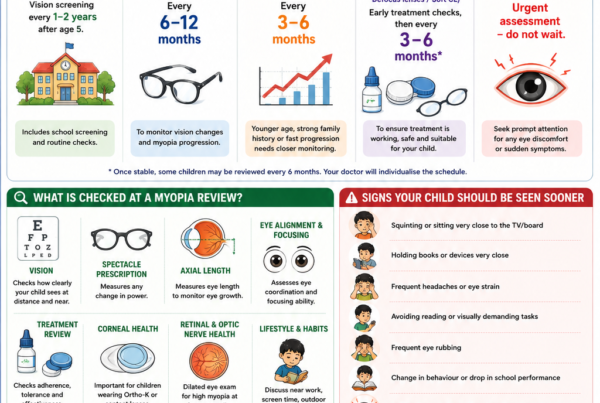
Myopic children may require review approximately every six months or according to the chosen treatment protocol.
The visit may assess:
- Visual acuity
- Refraction
- Axial length
- Treatment adherence
- Side effects
- Progression
- Retinal health when indicated
Children with Amblyopia
Reviews are commonly more frequent because treatment must be adjusted according to:
- Visual improvement
- Glasses wear
- Patching or atropine adherence
- Vision in the better eye
- Eye alignment
- Age
Children with Strabismus
Follow-up depends on:
- Type of strabismus
- Frequency
- Control
- Amblyopia
- Glasses
- Symptoms
- Surgical planning
- Risk of deterioration
Urgent Warning Signs
White Pupil
A white pupil in person or repeatedly in photographs requires urgent assessment.
Do not assume that it is only a camera-flash effect when:
- It appears repeatedly
- It affects one eye
- It occurs from several angles
- It is associated with strabismus
- The child has poor vision
Sudden Eye Turn or Double Vision
Sudden-onset strabismus or double vision requires prompt examination, particularly when accompanied by:
- Headache
- Vomiting
- Drooping eyelid
- Unequal pupils
- Weakness
- Poor coordination
- Behavioural change
Eye Pain and Redness
Urgent assessment is appropriate for:
- Severe pain
- Light sensitivity
- Reduced vision
- Corneal cloudiness
- Contact-lens-related redness
- Eye injury
- Chemical exposure
- Persistent discharge
- Eyelid swelling with fever or reduced eye movement
New Flashes, Floaters or a Curtain
These are less common in young children but require urgent assessment when reported, particularly after:
- Eye trauma
- High myopia
- Previous retinal surgery
- Inherited retinal disease
Sudden Loss of Vision
Sudden or rapidly worsening vision is an emergency even when the eye looks normal.
Abnormal Eye Movements
New nystagmus, inability to move an eye normally or an unusual head posture requires assessment.
Common Myths
“My Child Would Tell Me if Their Vision Was Blurred”
False.
Children may not recognise abnormal vision, particularly when the problem has always been present.
“My Child Sees Tiny Objects, So Both Eyes Must Be Normal”
False.
One good eye may compensate for a poorly seeing eye.
“School Screening Replaces an Eye Examination”
False.
Screening identifies risk but does not exclude every eye condition.
“A Child Must Know Letters Before the Eyes Can Be Tested”
False.
Objective and matching techniques can be used.
“Babies Cannot Wear Glasses”
False.
Infants can wear glasses when clinically necessary.
“Glasses Make Children’s Eyes Weaker”
False.
Correct optical treatment supports visual development.
“Amblyopia Means the Eye Muscle Is Weak”
False.
Amblyopia is primarily a developmental problem involving how the brain processes the image from an eye.
“The Eye Will Grow Out of a Squint”
Not reliably.
Some intermittent appearances may be harmless, but true strabismus requires assessment.
“Patching Straightens the Eyes”
Not necessarily.
Patching treats amblyopia.
It does not directly correct the mechanical alignment of most strabismus.
“Children with Good School Results Cannot Have Eye Problems”
False.
Some children compensate extremely well.
“Screen Time Permanently Damages the Retina”
Ordinary screen use has not been shown to burn or permanently damage a healthy retina.
Excessive screen use may contribute to near-work load, reduced outdoor time, dryness, fatigue and sleep disruption.
“Sitting Close to the Television Causes Myopia”
Sitting close may be a sign that a child is already myopic.
Near-work habits may also contribute to myopia risk, but one behaviour does not establish the cause.
“Colour-Vision Deficiency Means the Child Sees in Black and White”
Usually false.
Most congenital deficiencies affect discrimination between selected colours.
“Dyslexia Is Caused by the Eyes”
False.
Eye conditions may coexist with dyslexia but do not explain its core language-processing difficulty.
“Dilating Drops Are Unnecessary if the Autorefractor Gives a Number”
False.
Accommodation can make non-cycloplegic measurements misleading, particularly in younger or hyperopic children.
Frequently Asked Questions
At What Age Can My Child’s Eyes Be Tested?
At any age.
The test method is adapted to the child.
Should Every Child See an Ophthalmologist?
Every child should have age-appropriate vision and eye screening.
A comprehensive specialist examination is particularly important when there are:
- Symptoms
- Risk factors
- An abnormal screen
- Poor cooperation with screening
- A family history
- A known eye condition
Policies on universal comprehensive examinations vary.
My Child Passed School Screening. Why Are They Still Struggling?
The child may have:
- A mild prescription not detected by screening
- Hyperopia hidden by accommodation
- Binocular-vision symptoms
- Dry eye
- Migraine
- A learning or attention difficulty
- A non-visual cause
A screening result should be interpreted according to the child’s continuing symptoms.
My Child Failed Photoscreening but Seems to See Well. Should We Attend?
Yes.
Amblyopia risk factors often cause no obvious symptoms.
The screening result requires confirmation rather than assumption.
Why Are Eye Drops Necessary?
They help reveal the true prescription and allow examination of internal eye structures.
Can My Child Return to School After Dilation?
Usually yes, but the child may experience:
- Blurred near vision
- Light sensitivity
- Difficulty reading small print
A child with an important examination or visually demanding task may find another day more convenient.
Can My Child Use Screens After Dilation?
Yes.
The screen may feel uncomfortable or blurred at near.
Reducing brightness and increasing text size may help.
Can My Child Play Sports After Dilation?
Ordinary activities are generally safe when vision is adequate.
Bright sunlight, reduced near focus or blurred vision may temporarily affect comfort and coordination.
How Long Will the Pupils Stay Large?
This varies with:
- The drops used
- Iris colour
- Age
- Dose
- Individual response
The effect commonly lasts several hours and occasionally into the next day.
Why Is My Child More Long-Sighted After the Drops?
The drops have relaxed focusing and revealed hyperopia that was previously being hidden.
The eyes have not suddenly worsened.
Will the Glasses Prescription Be the Same as the Cycloplegic Measurement?
Not always.
The final prescription considers the complete examination and treatment goal.
Can Glasses Correct a Squint?
Some forms of esotropia are partly or fully caused by focusing effort from hyperopia.
Correcting the hyperopia may reduce or control the eye turn.
Other forms of strabismus are not corrected fully by glasses.
Can a Child Grow Out of Hyperopia?
The refractive state often changes as the eye grows.
Whether glasses remain necessary depends on:
- Amount of hyperopia
- Eye alignment
- Amblyopia
- Visual acuity
- Symptoms
- Age
Glasses should not be stopped without review.
Can a Child Grow Out of Astigmatism?
Astigmatism may increase, decrease or remain stable.
Significant astigmatism during early childhood may cause amblyopia and should not simply be ignored while waiting for it to disappear.
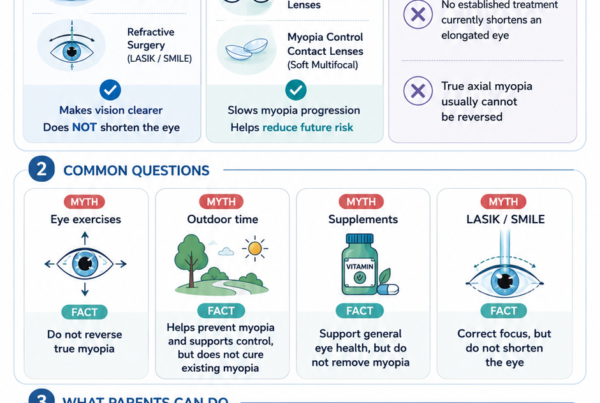
Can Myopia Reverse Naturally?
Established structural myopia generally does not reverse naturally.
The aim of myopia management is to correct vision and slow further progression.
Should My Child Wear Glasses During Sports?
This depends on the prescription and sport.
Options include:
- Securely fitted glasses
- Sports frames
- Polycarbonate lenses
- Contact lenses in suitable children
- Protective goggles
Children with useful vision in only one eye should receive specific advice on protective eyewear.
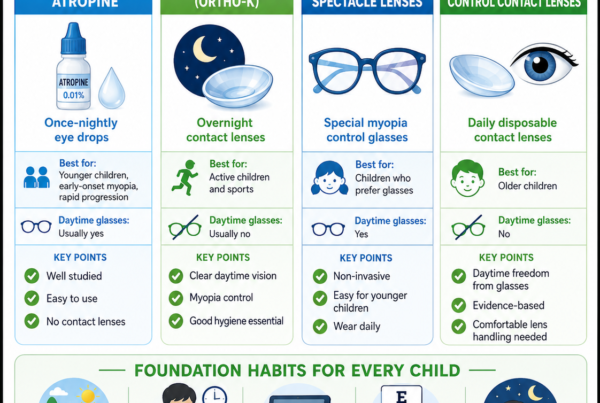
Can My Child Wear Contact Lenses for Myopia Control?
Possibly.
Options may include:
- Dual-focus soft contact lenses
- Orthokeratology
- Other regionally available designs
The child and family must be able to follow strict hygiene and review requirements.
Is Eye Rubbing Harmful?
Occasional gentle touching is unlikely to cause disease.
Frequent vigorous rubbing should be discouraged, particularly in children with:
- Allergy
- Keratoconus risk
- Corneal disease
Treating itch and allergy is more effective than repeatedly telling the child not to rub without addressing the cause.
Can My Child Have Laser Eye Surgery?
Corneal refractive surgery is generally not performed while the eyes and prescription are still developing.
Children with particular medical indications are managed individually, but ordinary childhood myopia is treated with glasses, contact lenses and myopia-control strategies rather than elective LASIK.
Why Does My Child Tilt Their Head?
Possible causes include:
- Strabismus
- Nystagmus
- Unequal vision
- Astigmatism
- Ptosis
- Neck or musculoskeletal conditions
- Habit
A persistent head posture should be assessed.
Why Does My Child Close One Eye in Bright Sunlight?
This can occur with intermittent exotropia but may also reflect:
- Glare
- Light sensitivity
- Habit
- Unequal vision
- Ocular-surface discomfort
Why Does One Eye Look White in Photographs?
Occasional photographic asymmetry may result from:
- Flash angle
- Eye position
- Camera processing
A repeated white reflex in one eye requires urgent assessment.
Can Children Have Glaucoma?
Yes.
Childhood glaucoma is uncommon but can occur at birth or develop later.
Can Eye Problems Cause Delayed Development?
Severe visual impairment may affect:
- Mobility
- Hand-eye coordination
- Communication
- Social interaction
- Learning
Children with suspected visual impairment may need multidisciplinary developmental support.
A Parent’s Eye-Examination Checklist
Before the Visit
- Bring the child’s current glasses.
- Bring previous eye reports.
- Bring the school-screening result.
- Record when symptoms began.
- Take videos of intermittent eye turns.
- Note relevant family history.
- List all medication.
- Tell the clinic about developmental or sensory needs.
- Bring sunglasses for possible dilation.
Observations to Report
- Sitting close to the television
- Holding books very near
- Squinting
- Closing one eye
- Head tilt
- Eye turn
- Eye shaking
- White pupil
- Frequent blinking
- Eye rubbing
- Tearing
- Light sensitivity
- Headaches
- Reading fatigue
- Losing place
- Difficulty seeing the board
- Clumsiness or poor depth judgement
Medical History to Report
- Prematurity
- Difficult birth
- Developmental delay
- Neurological disease
- Genetic condition
- Diabetes
- Steroid treatment
- Previous eye injury
- Previous eye surgery
- Family eye disease
Questions to Ask the Ophthalmologist
- Is vision normal in each eye?
- Is there any difference between the eyes?
- Does my child have amblyopia?
- Are the eyes properly aligned?
- Is cycloplegic refraction required?
- Does my child need glasses?
- Must the glasses be worn full time?
- Is the prescription likely to change?
- Is my child becoming myopic?
- Should axial length be monitored?
- Is myopia-control treatment appropriate?
- Is patching or atropine needed?
- How frequently should we return?
- What symptoms require urgent review?
- Are school or sports adjustments needed?
The Bottom Line
A children’s eye examination evaluates visual development as well as the physical health of the eyes.
Children can be examined before they can:
- Read
- Speak reliably
- Name pictures
- Describe blur
- Complete an adult eye test
Age-appropriate testing may include:
- Fixation and following
- Preferential-looking tests
- Matching symbols
- Visual acuity in each eye
- Refraction
- Cycloplegia
- Eye-alignment testing
- Eye-movement assessment
- Depth perception
- Colour vision
- Pupil testing
- Dilated examination
Screening is valuable but does not replace comprehensive examination when:
- The child fails the screen
- The child cannot be screened reliably
- Symptoms persist
- Risk factors are present
- Parents or teachers remain concerned
Important conditions include:
- Myopia
- Hyperopia
- Astigmatism
- Anisometropia
- Amblyopia
- Strabismus
- Congenital cataract
- Childhood glaucoma
- Retinal and optic-nerve disease
Cycloplegic refraction is particularly important in young children because active focusing can hide hyperopia and create misleading non-cycloplegic measurements.
Parents should seek urgent assessment for:
- A white pupil
- Sudden eye turn
- Sudden double vision
- Severe eye pain
- Eye trauma
- Rapid loss of vision
- New abnormal eye movements
- Neurological symptoms
Outdoor time, sensible near-work habits and regular review are important in the modern management of childhood myopia.
The most important message is:
Children often do not know that their vision is abnormal, and one good eye can hide substantial loss in the other. Timely screening, a low threshold for comprehensive examination and adherence to treatment provide the best opportunity for both eyes to develop useful vision.
References
- Saxena R, Sharma P, Gopal S, et al. National consensus statement regarding pediatric eye examination, refraction and amblyopia management. Indian J Ophthalmol. 2020. PMID: 31957721.
- Gupta S, et al. Universal newborn eye screening: a systematic review of the literature and review of international guidelines. 2022. PMID: 36269293.
- Subhi Y, et al. Diagnostic test accuracy of the red reflex test for ocular pathology in infants: a meta-analysis. JAMA Ophthalmol. 2021. PMID: 33180103.
- Roque A, Fernandes Nunes A, Nascimento H, Martinez-Perez C. Instrument-based, non-cycloplegic versus cycloplegic refraction in paediatric and young-adult populations: systematic review and meta-analysis. Adv Ophthalmol Pract Res. 2025. PMID: 41647053.
- Wallace DK, Repka MX, Lee KA, et al. Accuracy of autorefraction in children: a report by the American Academy of Ophthalmology. Ophthalmology. 2020. PMID: 32317177.
- Fotedar R, Rochtchina E, Morgan I, et al. Necessity of cycloplegia for assessing refractive error in 12-year-old children: a population-based study. Am J Ophthalmol. 2007. PMID: 17659966.
- Alves MR, et al. Photoscreening for amblyopia risk factors in young children: a systematic review with meta-analysis. 2022. PMID: 35522228.
- Kapoor V, Shah SP, Beckman T, Gole G. Community-based vision screening in preschool children: performance of the Spot Vision Screener and optotype testing. Ophthalmic Epidemiol. 2022;29(4):417–425. PMID: 34423736.
- Williams C, Northstone K, Harrad RA, Sparrow JM, Harvey I. Amblyopia treatment outcomes after screening before or at age three years: follow-up from a randomised trial. BMJ. 2002. PMID: 12089090.
- Williams C, Northstone K, Harrad RA, et al. Amblyopia treatment outcomes after preschool screening versus school-entry screening. Br J Ophthalmol. 2003. PMID: 12881342.
- Newman DK, East MM. Preschool vision screening: outcomes of children referred to the hospital eye service. Br J Ophthalmol. 1996. PMID: 9059274.
- Pediatric Eye Disease Investigator Group. A randomised trial of atropine versus patching for moderate amblyopia in children. Arch Ophthalmol. 2002. PMID: 11879129.
- Scheiman MM, Hertle RW, Kraker RT, et al. Patching versus atropine for amblyopia in children aged seven to twelve years. Arch Ophthalmol. 2008. PMID: 19064841.
- Pediatric Eye Disease Investigator Group. A randomised trial of daily versus weekend atropine for moderate amblyopia. Ophthalmology. 2004. PMID: 15522375.
- EuPatch Trial Group. Extended optical treatment versus early patching in children with amblyopia: a multicentre randomised trial. Lancet. 2024. PMID: 38704172.
- Richardson SR, Wright CM, Hrisos S, et al. Stereoacuity in unilateral visual impairment detected at preschool screening: outcomes from a randomised controlled trial. Invest Ophthalmol Vis Sci. 2005. PMID: 15623768.
- Mei Z, Zhang Y, Jiang W, et al. Efficacy of outdoor interventions for myopia in children and adolescents: systematic review and meta-analysis of randomised controlled trials. 2024. PMID: 39193200.
- Li D, Min S, Li X. Is spending more time outdoors able to prevent and control myopia in children and adolescents? A meta-analysis. Ophthalmic Res. 2024. PMID: 38710180.
- Ha A, Lee YJ, Lee M, et al. Digital screen time and myopia: a systematic review and dose-response meta-analysis. JAMA Netw Open. 2025. PMID: 39982728.
- Song et al. Near-work activity duration and myopia in children: an updated systematic review and meta-analysis. 2026. PMID: 41930098.
- Imai T, Hasebe S, Furuse T, et al. Adverse reactions to 1% cyclopentolate eye drops in children. Ophthalmic Physiol Opt. 2021;41(2):424–430. PMID: 33300632.
- Hernández-Rodríguez P, et al. Ocular cyclopentolate: a review of its benefits and risks. Clin Ophthalmol. 2022. PMID: 36411874.
- Butros LJ, Abramson DH, Dunkel IJ. Delayed diagnosis of retinoblastoma: degree, cause and potential consequences. Pediatrics. 2002. PMID: 11875173.
- Jonas DE, Amick HR, Wallace IF, et al. Screening for visual impairment in children aged one to five years: evidence update. PMID: 21282269.
- O’Hara MA. Instrument-based paediatric vision screening. Curr Opin Ophthalmol. 2016;27(5):398–401. PMID: 27228420.
- Imai T, et al. Incidence of side effects of topical atropine and cyclopentolate for cycloplegia in Japanese children: a multicentre study. 2018. PMID: 30046935.
- Taksande A, et al. Red-reflex examination in neonates: evaluation of three years of screening. 2016. PMID: 27822637.
- Wang J, et al. Refractive-error centile curves for Asian and Western children and adolescents: an individual-level meta-analysis. 2025. PMID: 41363895.
- Ding H, et al. Physical activity, sedentary behaviour, sleep and myopia in children and adolescents: systematic review and dose-response meta-analysis. BMC Public Health. 2025. PMID: 40170130.
- Pearce et al. Continued care and provision of glasses are necessary to improve visual and academic outcomes in children: a cluster-randomised school vision-screening trial. 2024. PMID: 38691337.