Author: Dr Val Phua
Estimated reading time: 12–14 minutes
Why Are More Children Becoming Short-Sighted?
Childhood myopia, or short-sightedness, is increasing in many parts of the world.
A large global analysis estimated that myopia affected approximately 36% of children and adolescents in 2023. If current trends continue, close to 40%—more than 740 million young people—may be affected by 2050.
The increase has been particularly noticeable in urbanised regions of East and Southeast Asia, including Singapore.
Singapore’s Ministry of Health reported that myopia prevalence among Primary 1 children had decreased and stabilised at 26% in 2023 following years of national screening and prevention efforts. Despite this improvement, childhood myopia remains common. In selected secondary schools, 7% of students had high myopia in 2023.
The rise cannot be explained by genetics alone. Human genes have not changed enough within a few generations to account for such a rapid increase.
The most likely explanation is an interaction between:
- Genetic susceptibility
- Reduced time outdoors
- More intensive and prolonged near work
- Increased educational demands
- Greater use of digital devices
- Urban indoor lifestyles
- Earlier onset of myopia
Phones and tablets are therefore part of the story, but they are not the only cause.
What Is Myopia?
Myopia is a focusing condition in which distant objects appear blurred while nearby objects remain clearer.
It usually develops because the eyeball grows too long from front to back. This is known as axial myopia.
When the eye becomes too long, light from distant objects is focused in front of the retina rather than directly on it.
The retina is the light-sensitive tissue lining the back of the eye. For clear distance vision, incoming light must be focused precisely onto its surface.
Myopia may also arise partly from excessive corneal or lens focusing power, but axial elongation is the main process in most childhood myopia.
How Does a Child’s Eye Normally Grow?
Most babies are born mildly long-sighted because their eyes are relatively short.
During early childhood, the eye grows in a carefully regulated process called emmetropisation. The eye attempts to match its length with the focusing power of the cornea and natural lens.
Ideally, a child retains a small amount of age-appropriate long-sightedness, sometimes called hyperopic reserve.
This reserve acts as a buffer while the eye continues growing.
A young child who has already lost most of this long-sighted reserve may be described as pre-myopic, even if the child can still pass an ordinary vision test.
The International Myopia Institute considers cycloplegic refractive error—the prescription measured after relaxing the eye’s focusing muscles—the strongest single clinical predictor of future myopia onset.
What Happens When Myopia Develops?
In a child developing myopia:
- The eye grows longer than required.
- Distant images become focused in front of the retina.
- Distance vision becomes blurred.
- Glasses or contact lenses are needed to refocus light onto the retina.
- Continued axial elongation causes the prescription to become increasingly negative.
The prescription may progress from:
- –0.50 dioptres
- To –1.00 dioptre
- To –2.00 dioptres
- And sometimes into high myopia
Each additional dioptre generally reflects further structural elongation of the eye.
Why Does the Length of the Eye Matter?
Myopia is more than an inconvenience corrected by glasses.
As the eye elongates, the retina, choroid and sclera are stretched over a larger surface.
Higher levels of myopia are associated with increased lifetime risks of:
- Retinal tears and detachment
- Myopic macular degeneration
- Glaucoma
- Earlier cataract
- Abnormal blood-vessel growth beneath the retina
- Permanent central visual loss
These complications usually occur later in life, but the degree of risk is influenced by how much the eye elongated during childhood.
The goal of myopia management is therefore not merely to reduce spectacle dependence. It is to limit excessive eye growth and reduce the child’s future ocular risk.
Why Is Childhood Myopia Increasing So Rapidly?
There is no single universal cause.
The modern increase appears to arise from several environmental pressures acting on children whose eyes are genetically susceptible.
The most important established factors are:
- Too little outdoor time
- Intensive near work
- Close working distances
- Long periods of uninterrupted reading or screen use
- Early and prolonged educational exposure
- Parental myopia
- Early loss of hyperopic reserve
How Important Is Genetics?
Genetics plays an important role.
A child is more likely to develop myopia when:
- One parent is myopic
- Both parents are myopic
- The parents have high myopia
- Myopia began early in other family members
A meta-analysis found a significant association between parental myopia and the child’s risk of becoming myopic.
However, genes alone do not determine the outcome.
A child with two myopic parents may remain non-myopic with favourable environmental exposure, while a child with no myopic parents can still develop myopia.
Genetics may be thought of as establishing susceptibility. The visual environment influences whether and when that susceptibility becomes expressed.
Why Can Genetics Not Explain the Whole Epidemic?
Population genetics changes slowly.
The prevalence of childhood myopia has risen within only a few decades—far too quickly to be explained by a major change in the human gene pool.
This means that environmental factors have become increasingly important.
The same genetically susceptible child may have a different outcome depending on:
- Time spent outdoors
- Educational intensity
- Near-work habits
- Screen use
- Age at which sustained close work begins
- Urban or rural environment
The epidemic is best understood as a gene–environment interaction rather than a purely inherited disease.
Why Does Time Outdoors Protect Against Myopia?
Time outdoors is the most consistently supported modifiable factor for delaying myopia onset.
Observational studies, school programmes and randomised clinical trials have repeatedly found that children who spend more time outdoors are less likely to become myopic.
The International Myopia Institute continues to recommend that children spend at least two hours outdoors each day when practical.
Outdoor time appears to be particularly helpful before a child becomes myopic.
Once established myopia is already progressing, outdoor activity remains healthy and advisable, but it may not provide enough control by itself.
How Much Difference Can Additional Outdoor Time Make?
In a randomised school trial, adding 40 minutes of outdoor activity to each school day reduced the incidence of myopia over three years.
Myopia developed in approximately:
- 30.4% of children receiving the additional outdoor period
- 39.5% of children following the usual school routine
This represented an absolute reduction of approximately nine percentage points.
Other school-based trials using additional outdoor periods have also reported reduced myopia onset or slower refractive change.
Outdoor time is attractive as a public-health strategy because it is inexpensive and also benefits:
- Physical fitness
- Sleep
- Mood
- Social development
- General health
Why Is Outdoor Light Different from Indoor Light?
Even on an overcast day, outdoor light intensity is generally much greater than typical indoor lighting.
Outdoor environments may provide:
- Much brighter light
- A broader light spectrum
- More distant viewing
- Greater visual variation
- Less continuous close focusing
- Different peripheral visual signals
Animal studies suggest that bright light may increase retinal dopamine activity. Dopamine appears to act as one of the signals that regulates eye growth and may help restrain excessive axial elongation.
Human studies support the protective association between outdoor exposure and myopia onset, although the exact contribution of brightness, spectrum, distance viewing and other outdoor features is still being studied.
Does Outdoor Time Have to Be in Bright Sunshine?
No.
Outdoor activity can still be beneficial when it is:
- Cloudy
- Shaded
- Early in the morning
- Later in the afternoon
- Conducted beneath a sheltered outdoor area
Directly staring at the sun is dangerous and provides no additional benefit.
Children should continue using appropriate sun protection, including:
- Hats
- Shade
- Sunscreen
- UV-protective sunglasses when needed
The International Myopia Institute states that hats and sunglasses do not negate the benefit of normal outdoor exposure.
Is Physical Exercise the Protective Factor?
Exercise is beneficial for general health, but the myopia-protective effect appears to be more closely related to being outdoors than to exercise itself.
A child sitting, drawing or reading outside may still receive some of the environmental benefit of outdoor light.
Conversely, exercising indoors does not provide the same light exposure.
The ideal approach combines:
- Outdoor exposure
- Physical activity
- Distance viewing
- A break from prolonged near work
How Does Near Work Contribute to Myopia?
Near work includes:
- Reading
- Writing
- Homework
- Drawing
- Studying
- Tablet use
- Smartphone use
- Handheld gaming
- Detailed craftwork
Near work requires the eyes to focus and converge at a close distance.
The evidence does not suggest that ordinary reading is harmful by itself. The concern is the pattern and intensity of near work.
Risk appears greater when a child:
- Holds material very close
- Reads continuously without breaks
- Spends many hours on near tasks
- Begins intensive academic work at a young age
- Performs near work instead of spending time outdoors
The International Myopia Institute notes associations between myopia and reading distances shorter than approximately 20 cm or continuous reading periods longer than about 45 minutes. These are associations rather than absolute safety thresholds.
Does Reading Cause Myopia?
Reading does not automatically cause myopia.
Many children read extensively without becoming highly myopic, while some children develop myopia despite relatively modest reading.
The important factors may include:
- How closely the child reads
- How long the child reads continuously
- Total daily near-work exposure
- Whether reading replaces outdoor activity
- The child’s genetic susceptibility
- The child’s remaining hyperopic reserve
Reading should not be discouraged. It provides major educational and developmental benefits.
The goal is to create healthier visual habits rather than to prevent children from learning.
Why Is Education Associated with Myopia?
Myopia prevalence is consistently higher in populations with:
- Earlier formal education
- Longer school hours
- Intensive homework
- Competitive examinations
- Extensive tuition
- High educational attainment
- Less time outdoors
Recent analyses have found that school grade may be more strongly associated with refractive error than chronological age, reinforcing the role of educational exposure.
Education itself is valuable and should not be viewed as harmful.
The problem is an educational lifestyle dominated by prolonged indoor near work without adequate visual breaks or outdoor time.
A balanced educational environment should include:
- Reading
- Creative learning
- Outdoor activity
- Physical education
- Distance viewing
- Adequate sleep
- Regular breaks
Are Phones and Tablets Causing the Myopia Epidemic?
Digital-device use is associated with childhood myopia, but the relationship is more complicated than “screens damage the eyes.”
A 2025 systematic review and dose-response meta-analysis found that each additional hour of daily digital-screen exposure was associated with approximately 21% higher odds of myopia.
However, most included studies were observational. This means the association may partly reflect:
- More close near work
- Shorter viewing distances
- Less outdoor time
- Longer educational exposure
- Socioeconomic and behavioural differences
The International Myopia Institute notes that childhood myopia was already increasing in East Asia before smartphones and tablets became widespread. Digital screens may contribute, but reducing screen time alone is unlikely to reverse the epidemic without increasing outdoor exposure and improving overall near-work habits.
Is a Phone Worse Than a Television?
A phone is usually held much closer than a television.
Close handheld devices may therefore produce:
- Greater accommodative demand
- Greater convergence
- More intense near-task exposure
- Smaller text
- Longer continuous fixation
- Fewer spontaneous visual breaks
Television is normally viewed from several metres away and is less likely to act as intensive near work.
This does not make unlimited television desirable. It means that the visual demands of different screens are not identical.
A larger screen positioned farther away is generally preferable to a small device held close to the face.
Is Screen Brightness the Main Problem?
Probably not.
The principal concerns are more likely to be:
- Viewing distance
- Duration
- Lack of breaks
- Displacement of outdoor time
- Late-night use
- Overall near-work intensity
Lowering a phone’s brightness does not transform prolonged close viewing into a protective activity.
The effect of modern artificial-light spectra on human eye growth remains under investigation, but current evidence does not support blue-light filters as an established method of preventing childhood myopia.
Does Blue Light Cause Childhood Myopia?
There is no convincing evidence that the blue light emitted by ordinary screens directly causes childhood myopia.
Blue-light filters may:
- Change screen colour
- Reduce glare for some users
- Improve subjective comfort in selected situations
They have not been shown reliably to prevent axial elongation.
The most useful interventions remain:
- More outdoor time
- Better viewing distance
- Regular breaks
- Early detection
- Evidence-based myopia control when needed
Did COVID-19 Lockdowns Increase Childhood Myopia?
The COVID-19 period provided an unplanned example of what can happen when children spend much more time indoors.
During lockdowns, many children had:
- Less outdoor exposure
- More screen-based schooling
- More recreational device use
- Fewer sports and outdoor activities
- Less variation in viewing distance
Several studies reported increased myopia incidence or faster myopic shifts, particularly among younger children, during home confinement. The International Myopia Institute considers these observations additional evidence for the importance of outdoor exposure.
The pandemic did not create myopia from nothing, but it intensified several established environmental risk factors simultaneously.
Does Poor Lighting Cause Myopia?
Reading in dim light may cause:
- Eye strain
- Reduced contrast
- Tiredness
- Headaches
- A tendency to move closer to the page
The evidence that dim lighting by itself directly causes permanent myopia is weaker.
Good task lighting remains sensible because it promotes comfort and may help children maintain a reasonable working distance.
However, simply buying a brighter desk lamp is unlikely to compensate for:
- Very little outdoor time
- Several hours of uninterrupted close work
- Holding books or devices extremely close
Does Bad Reading Posture Cause Myopia?
Posture does not directly alter the eye’s prescription.
However, poor posture may cause a child to:
- Lean very close to the page
- Read at less than 20–30 cm
- Maintain an intense near focus
- Develop neck and shoulder discomfort
- Work continuously without changing distance
Parents should encourage a comfortable upright position and a sensible reading distance rather than repeatedly scolding the child about posture.
A child who constantly moves closer may already be myopic and should have an eye examination.
Does Lack of Sleep Cause Myopia?
Research has examined:
- Short sleep duration
- Late bedtimes
- Irregular sleep
- Circadian-rhythm disruption
- Late-night screen use
Some studies have found associations with myopia, while others have not.
The International Myopia Institute considers the evidence inconsistent at present.
Adequate sleep remains important for general health and may reduce late-night near work, but it should not currently be presented as a proven standalone treatment for myopia.
Do Diet or Vitamin Deficiencies Cause Myopia?
No particular food, vitamin or supplement has been proven to prevent ordinary childhood axial myopia.
A balanced diet supports:
- General growth
- Retinal health
- Healthy body weight
- Normal development
However, carrots, blueberries, fish oil and lutein do not stop an elongating eyeball.
Parents should be cautious about supplements advertised as “curing” short-sightedness.
Can Eye Exercises Prevent Myopia?
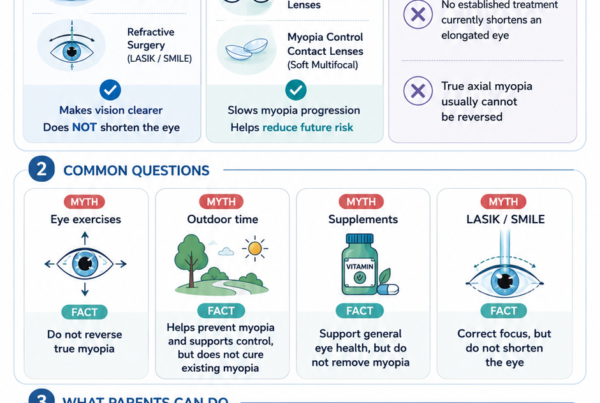
No eye exercise has been proven to shorten an elongated eye or reliably prevent childhood myopia.
Activities such as:
- Palming
- Eye rolling
- Focusing back and forth
- Massaging around the eyes
- Removing glasses to “train” the eyes
do not reverse axial elongation.
Looking into the distance during breaks may relax near focusing and improve comfort, but it should not be described as a cure.
Does Wearing Glasses Make Myopia Worse?
No.
Correctly prescribed glasses do not weaken the eyes or make a child dependent on them.
Myopia generally progresses because the eye is continuing to grow, not because the child wears glasses.
Without glasses, the child may:
- Squint
- Sit nearer the board
- Struggle in class
- Experience headaches
- Avoid sport
- Have reduced confidence
Undercorrecting myopia—deliberately giving weaker glasses—has not been shown to provide reliable protection and may allow persistent blur.
Children should generally receive clear, appropriate correction unless their eye-care professional has a specific reason to prescribe otherwise.
Why Does Myopia Often Begin During the Primary-School Years?
The primary-school years coincide with:
- Continued eye growth
- Increasing educational demands
- More reading and homework
- Greater use of digital devices
- Reduced unstructured outdoor play
- Increasing independence in device use
A child may begin school with only a small hyperopic reserve. Further axial growth can then shift the refraction into myopia.
This is why screening before obvious blur develops can be useful, particularly in children with strong risk factors.
Why Is Earlier Onset More Concerning?
A child who becomes myopic at age six has many more years of potential eye growth than a teenager who becomes myopic at age fifteen.
Earlier onset is one of the strongest predictors of eventual high myopia.
In one longitudinal cohort, children developing myopia at age seven or eight had a greater than 50% risk of developing high myopia later, although the exact risk differs between populations and individuals.
Delaying onset can therefore provide substantial long-term benefit.
The International Myopia Institute estimates that delaying myopia onset by one year may provide a benefit comparable to several years of current myopia-control treatment.
Which Children Are at Higher Risk?
A child may have a higher risk when one or more of the following are present:
- One or both parents are myopic
- A parent has high myopia
- A sibling developed myopia early
- The child has little age-appropriate hyperopia
- Axial length is increasing rapidly
- The child spends little time outdoors
- Near work is prolonged or very close
- The child lives in a highly urbanised environment
- Myopia has already begun at a young age
- The spectacle prescription is changing quickly
Risk is cumulative.
A child with two myopic parents, minimal outdoor time and little remaining hyperopic reserve deserves closer monitoring than a child with none of these factors.
Does Ethnicity Affect Myopia Risk?
Myopia prevalence differs between ethnic and geographical populations.
Higher rates have been reported among children of East Asian ancestry, particularly in urbanised and highly educated settings.
However, ethnicity is not destiny.
Environmental differences can substantially alter risk, even among children with similar ancestry.
This again supports the idea that genetic susceptibility interacts with educational and visual environments.
Is Urban Living a Risk Factor?
Myopia is generally more common in urban than rural populations.
Possible explanations include:
- More time indoors
- Less open space
- Longer school and tuition hours
- Greater digital-device use
- More intensive education
- Less distance viewing
- Reduced daylight exposure
Urbanisation does not cause myopia through one single pathway. It changes the child’s entire visual environment.
What Can Parents Do to Reduce the Risk?
Aim for at Least Two Hours Outdoors Daily
This is the most evidence-supported lifestyle recommendation for delaying myopia onset.
The two hours can be divided into:
- Morning play
- School recess
- Walking to or from school
- Outdoor sport
- Playground time
- Family walks
- Outdoor meals
- Weekend activities
Consistency is more important than an occasional long outdoor session.
Break Up Prolonged Near Work
Children should avoid performing a close task continuously for long periods.
A practical routine is to pause every 20–30 minutes and look across the room, out of a window or into the distance.
The familiar 20-20-20 rule—looking approximately 20 feet away for 20 seconds every 20 minutes—is useful as a reminder, although it was developed mainly for visual comfort rather than proven myopia prevention.
The broader principle is:
- Avoid long uninterrupted near work.
- Change visual distance frequently.
- Blink normally.
- Move around during breaks.
Maintain a Sensible Working Distance
Encourage children to keep:
- Books approximately 30–40 cm away
- Tablets at a comfortable forearm distance
- Computer screens farther away than handheld devices
- Phones away from the nose and face
Avoid repeatedly reading or gaming at extremely close distances.
A larger screen placed farther away is usually preferable for longer tasks.
Prevent Recreational Screen Time from Replacing Outdoor Time
The goal is not simply to count every minute of screen exposure.
Parents should consider what the screen is replacing.
An hour on a tablet may be less concerning when the child has already spent several hours outdoors than when it replaces the child’s only opportunity for outdoor play.
Useful household habits include:
- Screen-free outdoor periods
- No devices during meals
- Avoiding prolonged handheld gaming
- Keeping devices out of bed
- Scheduling breaks during homework
- Using larger screens for longer educational tasks
Encourage Good Lighting and Comfortable Posture
Provide:
- Adequate room lighting
- A well-lit desk
- A suitable chair and table height
- A working position that does not force the child close to the page
Good ergonomics supports comfort and healthy viewing distance, even though lighting and posture alone cannot prevent myopia.
Ensure Adequate Sleep
Regular sleep reduces late-night screen and near-work exposure and supports general childhood health.
Devices should ideally be kept away from the sleeping area when they interfere with bedtime.
Arrange Regular Vision Screening
Children may not realise that their distance vision is blurred.
They may assume everyone sees the same way.
Screening is especially important when:
- Parents are myopic
- The child squints
- The child sits close to the television
- School performance changes
- The child moves close to books or screens
- Headaches occur during schoolwork
- The teacher reports difficulty seeing the board
- A previous examination identified low hyperopic reserve
Singapore’s National Myopia Prevention Programme screens children from Kindergarten 1 through Primary 4 and includes parent education and community partnerships.
What Are the Early Signs of Childhood Myopia?
Possible signs include:
- Squinting at distant objects
- Difficulty reading the classroom board
- Sitting near the television
- Moving closer during sport or play
- Holding devices near the face
- Copying notes incorrectly
- Headaches after school
- Eye rubbing
- Reduced interest in outdoor ball games
- Difficulty recognising people from a distance
Some children have no obvious symptoms and are detected only through screening.
How Is Childhood Myopia Diagnosed?
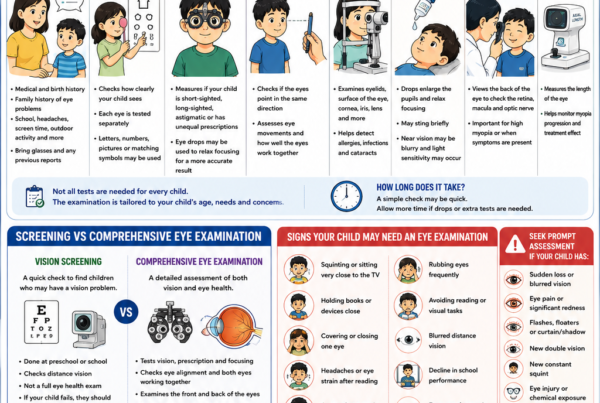
A complete assessment may include:
- Distance and near visual acuity
- Refraction
- Cycloplegic refraction
- Eye alignment
- Focusing assessment
- Corneal examination
- Retinal examination
- Axial-length measurement when available
Why Is Cycloplegic Refraction Important?
Children have powerful focusing muscles.
During an ordinary refraction, they may focus involuntarily and appear more myopic than they really are.
Cycloplegic eye drops temporarily relax the focusing muscle.
This allows a more accurate measurement of:
- True myopia
- Remaining hyperopic reserve
- Unequal prescriptions
- Hidden long-sightedness
- Risk of future myopia
The drops temporarily enlarge the pupils and blur near vision.
What Is Axial-Length Measurement?
Axial length is the front-to-back length of the eye.
Measuring axial length can help determine:
- Whether the eye is growing faster than expected
- Whether myopia control is working
- Whether progression reflects true structural elongation
- The child’s changing long-term risk
Prescription change remains important, but axial length gives direct information about eye growth.
What Is Pre-Myopia?
Pre-myopia describes a child who is not yet conventionally myopic but has insufficient long-sighted reserve for age and other risk factors suggesting a high probability of developing myopia.
The International Myopia Institute defines pre-myopia as a cycloplegic prescription greater than –0.50 D but no more than +0.75 D, together with additional risk factors that justify preventive attention.
Not every child within this range will become myopic.
Risk assessment should also consider:
- Age
- Parental myopia
- Axial length
- Rate of change
- Outdoor exposure
- Near-work behaviour
- Ethnicity and population norms
Can Myopia Be Prevented Completely?
Not always.
Lifestyle changes can reduce risk and delay onset, but they cannot override every genetic and developmental influence.
A child who follows excellent visual habits may still become myopic.
Prevention should therefore be understood as:
- Reducing probability
- Delaying onset
- Identifying risk earlier
- Minimising eventual severity
Parents should not blame themselves or the child when myopia develops.
What Should Be Done Once a Child Is Already Myopic?
Once myopia is established, ordinary single-vision glasses correct the blur but do not usually slow axial elongation sufficiently.
Children with progressive myopia may benefit from active myopia-control treatment.
Evidence-based options include:
- Special myopia-control spectacle lenses
- Dual-focus or multifocal soft contact lenses
- Orthokeratology
- Low-dose atropine eye drops
- Selected combinations of treatments
The International Myopia Institute’s 2025 review found substantial evidence from randomised trials supporting several optical and pharmacological treatments for slowing axial elongation.
Treatment should be individualised according to:
- Age
- Prescription
- Axial length
- Rate of progression
- Corneal health
- Lifestyle
- Ability to use contact lenses safely
- Side-effect tolerance
- Cost and availability
- Family preference
Is Outdoor Time Still Important During Myopia-Control Treatment?
Yes.
Myopia-control lenses or atropine should not replace healthy visual habits.
Children receiving treatment should still be encouraged to:
- Spend time outdoors
- Avoid excessively close reading
- Take regular breaks
- Limit prolonged handheld-device use
- Attend scheduled follow-up
Lifestyle and clinical treatment work together.
How Often Should a Myopic Child Be Reviewed?
The interval depends on age, treatment and progression.
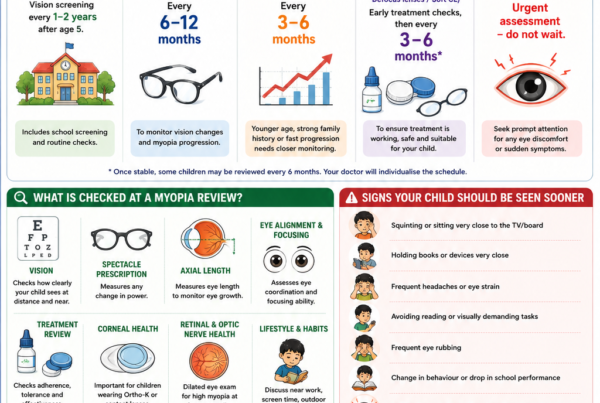
A child receiving active myopia control is commonly reviewed every three to six months, although individual schedules vary.
Monitoring may include:
- Visual acuity
- Refraction
- Axial length
- Corneal health
- Pupil and focusing effects
- Contact-lens fit
- Adherence
- Treatment side effects
Waiting several years between examinations may allow substantial progression to occur unnoticed.
Frequently Asked Questions
Is childhood myopia caused mainly by phones?
No.
Phones may contribute through close viewing, prolonged near work and displacement of outdoor activity. However, myopia was increasing before smartphones became common.
Reduced outdoor time and intensive near-focused lifestyles are broader and more established explanations.
Can taking away all screens prevent myopia?
Not necessarily.
A child may perform equally intensive near work using books, worksheets or drawing.
Reducing unnecessary screen time is helpful, but it should be combined with more outdoor exposure, sensible working distance and regular breaks.
Is reading bad for children’s eyes?
No.
Reading is educationally valuable.
Risk appears related to very close, intensive and uninterrupted near work rather than reading itself.
Should my child stop tuition?
This is a family and educational decision rather than a purely medical one.
Consider the total visual schedule. A child attending tuition may need additional outdoor time and breaks rather than simply replacing schoolwork with more indoor activity.
Does the child need direct sunlight?
No.
The child should be outdoors but does not need to stand in direct midday sun.
Shaded outdoor environments still provide far greater illumination than most indoor spaces.
Can sunglasses prevent the outdoor benefit?
No.
Normal hats and UV-protective sunglasses do not appear to eliminate the protective association of outdoor time.
Can my child read outside?
Yes.
Outdoor reading still provides brighter light, although the child should maintain a sensible distance and take breaks.
Outdoor play involving distance viewing provides a broader change from close work.
Does swimming count as outdoor time?
Outdoor swimming does.
Indoor swimming does not provide the same natural-light exposure, although it remains beneficial exercise.
Will full-power glasses make the eyes worsen faster?
No.
Appropriate full correction does not cause the eyeball to elongate.
Should glasses be removed for reading?
This depends on the prescription, age and treatment plan.
Children should not routinely remove or alter their glasses without advice from their eye-care professional.
Can ordinary spectacle lenses control myopia?
Single-vision lenses correct blur but generally do not provide substantial myopia control.
Specialised myopia-control designs use different optical principles intended to reduce the stimulus for axial elongation.
Does atropine cure myopia?
No.
Atropine may slow progression while it is being used. It does not shorten the eye or permanently remove the existing prescription.
Will myopia stop when the child reaches puberty?
Not necessarily.
Progression often slows during the teenage years, but many teenagers and some young adults continue to progress.
Can LASIK be performed in childhood?
No.
The prescription and eye are still changing. LASIK does not prevent axial elongation or eliminate the long-term retinal risks of high myopia.
Refractive surgery is generally considered only after adulthood and refractive stability.
Is high myopia inevitable when both parents are myopic?
No.
Risk is increased, but early detection, outdoor exposure and active myopia management may reduce the eventual severity.
A Practical Daily Eye-Health Plan for Children
Outdoors
- Aim for approximately two hours daily.
- Use recess, walking, play and sport.
- Choose outdoor family activities on weekends.
- Use ordinary sun protection.
During Homework and Reading
- Maintain approximately 30–40 cm viewing distance.
- Avoid lying with the book or device very close to the face.
- Pause every 20–30 minutes.
- Look into the distance and move around.
- Use adequate lighting.
Digital Devices
- Prefer larger screens for prolonged tasks.
- Position screens farther away.
- Avoid extended handheld-device use.
- Do not let recreational screens replace outdoor time.
- Avoid devices in bed.
Eye Examinations
- Attend school screening.
- Arrange assessment when symptoms occur.
- Consider earlier examination with a strong family history.
- Monitor progressing myopia regularly.
- Discuss myopia-control options rather than simply updating ordinary glasses repeatedly.
Common Myths About Childhood Myopia
“My child became myopic because I allowed too much reading.”
Reading is only one part of a complex interaction involving genetics, outdoor time, educational exposure and near-work behaviour.
“Wearing glasses made the eyes lazy.”
Glasses provide clear focus. They do not make the eyeball weak or lazy.
“Carrots can reverse short-sightedness.”
Carrots support normal nutrition but cannot shorten an elongated eye.
“Eye exercises can remove the prescription.”
Exercises do not reverse axial myopia.
“Blue-light glasses prevent myopia.”
Current evidence does not establish blue-light filters as a method of preventing axial elongation.
“My child sees well with glasses, so the myopia is no longer a concern.”
Glasses correct vision but do not remove the structural and long-term risks associated with progressive axial elongation.
The Bottom Line
Childhood myopia is increasing because modern childhood has become increasingly:
- Indoor
- Urban
- Educationally intensive
- Screen-based
- Focused on prolonged near tasks
Genetics influences which children are most susceptible, but environmental factors help determine whether myopia develops, when it begins and how far it progresses.
The strongest evidence supports:
- At least two hours of outdoor time daily
- Avoiding extremely close viewing
- Breaking up prolonged near work
- Preventing recreational screen use from replacing outdoor activity
- Early vision screening
- Monitoring children with parental myopia or low hyperopic reserve
- Starting evidence-based myopia control when progression is identified
Phones are not the sole cause. Books are not inherently harmful. Glasses do not weaken the eyes.
The central problem is an imbalance between intensive indoor near work and insufficient outdoor visual exposure acting on a growing, susceptible eye.
The earlier myopia begins, the longer the eye has to elongate. Delaying onset and slowing progression can meaningfully reduce a child’s eventual prescription and lifetime risk of myopia-related eye disease.
References
- Liang J, et al. Global Prevalence, Trend and Projection of Myopia in Children and Adolescents from 1990 to 2050: A Comprehensive Systematic Review and Meta-Analysis. British Journal of Ophthalmology. 2025.
- International Myopia Institute. IMI 2025 Digest. Investigative Ophthalmology & Visual Science. 2025.
- Ashby R, et al. IMI—The Role of Light in Refractive Development and Myopia: Evidence from Animal and Human Studies. Investigative Ophthalmology & Visual Science. 2025.
- Bullimore MA, et al. IMI—Interventions for Controlling Myopia Onset and Progression 2025. Investigative Ophthalmology & Visual Science. 2025.
- Ministry of Health Singapore. Effectiveness of the National Myopia Prevention Programme’s Strategies for Primary School Students. 2024.
- Ha A, et al. Digital Screen Time and Myopia: A Systematic Review and Dose-Response Meta-Analysis. JAMA Network Open. 2025.
- He M, et al. Effect of Time Spent Outdoors at School on the Development of Myopia Among Children in China: A Randomised Clinical Trial. JAMA. 2015.
- Kido A, et al. Interventions to Increase Time Spent Outdoors for Preventing the Incidence and Progression of Myopia in Children. Cochrane Database of Systematic Reviews. 2024.
- Yu M, et al. Global Risk-Factor Analysis of Myopia Onset in Children. 2023.
- Chua SYL, et al. Age of Onset of Myopia Predicts Risk of High Myopia in Later Childhood. Ophthalmic and Physiological Optics. 2016.
- Hu Y, et al. Association of Age at Myopia Onset With Risk of High Myopia in Adulthood. JAMA Ophthalmology. 2020.
- Zhang X, et al. Association Between Parental Myopia and the Risk of Myopia in a Child. 2015.