Author: Dr Val Phua
Estimated reading time: 20 minutes
Many patients plan cataract surgery around a holiday, business trip, family event or long-distance flight.
The reassuring news is that travel is usually possible relatively soon after uncomplicated cataract surgery. Routine commercial air travel does not normally damage the new intraocular lens, reopen a properly sealed cataract incision or interfere with the result of an otherwise uncomplicated operation. The American Academy of Ophthalmology states that there is generally no air-travel restriction after cataract surgery in an otherwise healthy eye.
However, being medically able to fly is not the same as being ready for a comfortable and well-supported trip.
Before travelling, you should also consider:
- Whether your first postoperative examination has been completed
- Whether the eye is healing normally
- Whether your vision is clear enough to move around safely
- Whether the two eyes work together comfortably
- Whether you can use your eye drops correctly
- Whether you can access urgent eye care at your destination
- Whether the trip will interfere with follow-up appointments
- Whether you had cataract surgery alone or a combined retinal procedure
- Whether an intraocular gas bubble is present
- Whether you will need to lift heavy luggage
- Whether you plan to swim or participate in strenuous activities
The safest approach is to discuss significant travel plans with your ophthalmologist before surgery, particularly when the trip involves international flights, remote destinations, cruises or limited access to medical care.
The Quick Answer
Can You Fly After Uncomplicated Cataract Surgery?
From the standpoint of cabin pressure, flying is generally safe after uncomplicated cataract surgery.
Routine cataract surgery replaces the cloudy natural lens with an artificial intraocular lens. It does not normally leave an expansile gas bubble inside the eye, and ordinary changes in commercial aircraft cabin pressure do not affect a properly positioned intraocular lens.
Nevertheless, it is usually sensible to wait until:
- The immediate effects of sedation have resolved.
- The pupil is no longer significantly dilated.
- Your first postoperative review has confirmed normal healing.
- You can administer your eye drops correctly.
- You have no significant pain, redness or worsening vision.
- Your ophthalmologist has not identified a reason to delay travel.
For many patients, this means remaining close to the surgical centre until at least the first planned postoperative assessment.
Can You Travel by Car or Train?
You may usually travel as a passenger once you feel well enough.
However:
- Do not drive on the day of surgery.
- Do not drive until your vision is clear, stable and legally adequate.
- Wear your seatbelt.
- Avoid rubbing the eye.
- Take breaks during long journeys.
- Keep your eye drops accessible.
- Ask for help with heavy luggage.
The National Eye Institute advises that patients cannot drive themselves home after cataract surgery and may need to avoid activities such as bending and heavy lifting during early recovery.
When Should You Delay Travel?
Delay travel and seek medical advice if you have:
- Increasing eye pain
- Worsening vision
- Increasing redness
- Thick discharge
- Significant eyelid swelling
- New flashes or floaters
- A dark curtain or shadow
- Persistent nausea or vomiting
- Significant corneal swelling
- Raised eye pressure
- A surgical complication
- A retinal gas bubble
You should also reconsider travel when the itinerary would cause you to miss an important postoperative examination.
A Practical Travel Timeline
This timeline applies generally to uncomplicated cataract surgery. Your ophthalmologist may recommend a different schedule.
On the Day of Surgery
Do not begin a significant journey immediately after the procedure unless it is the necessary trip home from the surgical centre.
You should not:
- Drive
- Travel alone when sedation has been used
- Operate machinery
- Lift heavy luggage
- Navigate a busy airport without assistance
- Rush to catch a flight
- Make important travel decisions while sedated
- Remove the shield contrary to instructions
Your vision may be temporarily affected by:
- Pupil-dilating drops
- Sedation
- An eye pad or shield
- Corneal swelling
- Watering
- Light sensitivity
- A difference between the two eyes
Arrange for a responsible adult to accompany you home.
During the First 24 to 48 Hours
It is preferable to remain somewhere with easy access to your surgeon or surgical centre.
During this period:
- Use your eye drops exactly as prescribed.
- Attend the first postoperative review.
- Rest and move around gently.
- Avoid heavy lifting and straining.
- Do not drive until your vision is safe.
- Observe for pain, redness or worsening vision.
The National Eye Institute notes that the eye may initially feel itchy, uncomfortable or light-sensitive and that follow-up examinations are required to confirm that healing is progressing correctly.
During the First Week
Short local trips may be reasonable if:
- The postoperative review is satisfactory.
- Vision is sufficiently clear.
- You can manage your medication.
- You are not experiencing concerning symptoms.
- You remain within reach of suitable medical care.
An international or remote trip during the first week deserves more caution because early postoperative problems may require prompt examination.
A long trip may also be unnecessarily uncomfortable if the eye is dry, watery, light-sensitive or visually imbalanced.
After Approximately One to Two Weeks
Many patients with uncomplicated surgery feel more comfortable undertaking:
- Domestic flights
- Short international flights
- Road trips
- Train travel
- Hotel stays
- Routine business travel
By this stage, the immediate postoperative irritation and visual fluctuation have often improved, although complete healing takes longer and medication may still be required. The National Eye Institute notes that full healing may take several weeks and that scheduled checkups remain important throughout recovery.
After Approximately Four Weeks
Many patients can travel with fewer practical restrictions after four weeks if recovery has been uncomplicated.
However, based on the postoperative protocol used in this guide:
- Do not swim until at least four weeks have passed.
- Resume swimming only after your ophthalmologist confirms normal healing.
- Continue to avoid direct eye trauma.
- Ask before returning to diving or high-risk water sports.
- Continue medication for as long as prescribed.
After Approximately Six to Eight Weeks
The eye is usually substantially healed following uncomplicated cataract surgery.
The National Eye Institute states that most patients are completely healed by approximately eight weeks, although recovery differs between individuals.
Patients who experienced complications or underwent combined eye surgery may require longer restrictions.
Flying After Cataract Surgery
Does Cabin Pressure Affect the Intraocular Lens?
A standard intraocular lens is a solid artificial lens.
It does not expand when cabin pressure falls and does not behave like a gas bubble.
Commercial flying is therefore generally safe from a cabin-pressure perspective following uncomplicated cataract surgery.
Can Flying Reopen the Cataract Incision?
Commercial aircraft cabin pressure does not ordinarily reopen a properly constructed and sealed cataract incision.
The more relevant concerns are practical:
- Whether the wound has been examined
- Whether vision is safe
- Whether inflammation is controlled
- Whether medication is available
- Whether emergency care can be accessed
- Whether you will miss follow-up
Can You Fly the Day After Surgery?
It may be physically possible after uncomplicated surgery, but it is often not the ideal plan.
Before flying, it is preferable to confirm that:
- The first postoperative examination is satisfactory.
- Eye pressure is acceptable.
- The cornea is sufficiently clear.
- The wound is secure.
- The intraocular lens is positioned normally.
- There is no excessive inflammation.
- You understand the medication schedule.
- Your surgeon agrees with the travel plan.
A first postoperative review can detect problems that may not yet cause dramatic symptoms.
What About Long-Haul Flights?
A long-haul flight is not necessarily more dangerous to the cataract incision than a short flight.
However, a long flight creates additional practical challenges:
- Prolonged exposure to dry cabin air
- Difficulty using eye drops in a confined space
- Fatigue
- Reduced blinking during screen use
- Limited access to ophthalmic assessment
- Handling luggage
- Navigating large airports
- Sleep disruption
- Crossing multiple time zones
For these reasons, many patients prefer to wait until the eye is comfortable and the first postoperative review has been completed.
The Critical Exception: Intraocular Gas
Never Fly With a Retinal Gas Bubble
The most important travel warning after eye surgery concerns an intraocular gas bubble.
Gas may be placed inside the eye during:
- Vitrectomy
- Retinal-detachment repair
- Macular-hole surgery
- Pneumatic retinopexy
- Certain other retinal procedures
As aircraft cabin pressure decreases during ascent, an intraocular gas bubble can expand. This may cause a rapid and dangerous rise in eye pressure, severe pain, loss of retinal or optic-nerve perfusion and permanent loss of vision. Experimental and clinical studies have documented significant pressure changes with even relatively small gas volumes.
Routine Cataract Surgery Usually Does Not Involve Gas
Cataract surgery alone does not normally require an intraocular gas bubble.
The warning becomes relevant when cataract surgery was:
- Combined with retinal surgery
- Followed by a retinal procedure
- Complicated by a condition requiring gas
- Performed in an eye that recently underwent vitrectomy
Do Not Guess Whether the Bubble Is Gone
Never assume that the gas bubble has disappeared because it looks small.
Air travel can still cause significant pressure changes with residual intraocular gas. Studies and case reports demonstrate that altitude changes may produce marked increases in intraocular pressure even when only a relatively small bubble remains.
You may fly only when your retinal surgeon has explicitly confirmed that:
- The bubble has completely resolved.
- Air travel is safe.
- High-altitude travel is permitted.
Mountains and High-Altitude Roads Also Matter
The same concern applies to significant ascent by:
- Car
- Coach
- Train
- Cable car
- Mountain railway
- Helicopter
Altitude-associated changes in intraocular pressure have been documented in gas-filled eyes during relatively modest elevation changes.
Scuba Diving Is Also Prohibited With Intraocular Gas
Do not scuba dive while an intraocular gas bubble remains.
Diving should resume only after:
- The bubble has fully resolved.
- Your retinal surgeon has approved it.
- The eye has healed.
- Vision is adequate for underwater safety.
Travelling to High-Altitude Destinations
High Altitude After Cataract Surgery Alone
In an eye that underwent uncomplicated cataract surgery without intraocular gas, ordinary altitude changes do not generally affect the intraocular lens or surgical result.
You may still need to consider:
- Dry air
- Bright ultraviolet exposure
- Wind
- Physical exertion
- Access to medical care
- Heavy luggage
- Hiking before your vision and balance are stable
High Altitude After Retinal Surgery
Do not travel to high altitude if retinal gas remains.
Your retinal surgeon should determine when:
- Mountain travel is safe.
- Flying is permitted.
- Cable-car travel is acceptable.
- Scuba diving may resume.
Dry Eyes During Air Travel
Aircraft Cabins Can Aggravate Dryness
Aircraft cabins generally have low relative humidity.
Experimental studies have shown increased tear evaporation under low-humidity conditions similar to those experienced during commercial air travel. One laboratory study found that tear evaporation increased substantially when subjects were exposed to 20% to 25% relative humidity compared with more humid conditions.
Cataract surgery can also temporarily disturb tear-film stability. A 2025 systematic review found evidence of reduced tear-film breakup time and other dry-eye changes during the weeks following cataract surgery, with symptoms or signs potentially persisting for up to three months in some patients.
Symptoms May Include
- Grittiness
- Burning
- Watering
- Redness
- A foreign-body sensation
- Intermittent blurred vision
- Light sensitivity
- Eye fatigue
How to Reduce Dryness During a Flight
- Use preservative-free lubricating drops if advised.
- Keep prescribed drops in your hand luggage.
- Direct the overhead air vent away from your face.
- Blink consciously during screen use.
- Take regular breaks from reading or watching videos.
- Avoid rubbing the eye.
- Stay adequately hydrated.
- Wear glasses rather than contact lenses during early recovery.
- Use sunglasses if bright cabin or airport lighting is uncomfortable.
Do not use an unfamiliar redness-relief drop or another person’s medication.
Avoid Applying Drops With Unclean Hands
Before using eye drops:
- Wash your hands when possible.
- Use hand sanitiser only if no washing facility is available and allow it to dry completely.
- Avoid touching the bottle tip.
- Do not let the tip contact your eyelashes or eyelids.
- Replace the cap immediately.
Planning Your Eye Drops While Travelling
Keep Medication in Your Hand Luggage
Do not place your entire medication supply in checked baggage.
Checked luggage may be:
- Delayed
- Lost
- Exposed to extreme temperatures
- Inaccessible during the flight
Carry enough medication for:
- The whole journey
- Unexpected delays
- Several additional days when practical
Keep the Original Label
Retain the original packaging or prescription label whenever possible.
This helps you:
- Identify each medication
- Follow the correct schedule
- Explain the medication at security checks
- Obtain a replacement if necessary
- Avoid confusing similar bottles
Protect Drops From Heat
Do not leave eye drops:
- In a hot parked car
- On a sunny windowsill
- In direct sunlight
- Beside a heater
- In excessively hot luggage storage
Follow the storage instructions printed on the medication.
Some drops require specific temperature control. Ask the clinic or pharmacist when uncertain.
Plan for Time-Zone Changes
For short trips, continuing drops according to your home schedule may be simplest.
For major time-zone changes:
- Write down the dosing interval.
- Ask the clinic how to adjust the timing.
- Set alarms.
- Avoid doubling a dose unless instructed.
- Do not stop medication early because the schedule is inconvenient.
The interval between doses is generally more important than matching a particular clock time.
Bring a Written Medication List
Your list should include:
- Medication name
- Which eye receives it
- Number of drops
- Frequency
- Start date
- Tapering schedule
- Known medication allergies
- Your clinic’s contact details
Follow-Up Appointments and Travel
Do Not Miss an Important Review
Postoperative examinations may identify:
- Raised eye pressure
- Excessive inflammation
- Corneal swelling
- Wound problems
- Intraocular lens-position issues
- Retinal problems
- Macular swelling
- Infection
The National Eye Institute recommends attending all scheduled checkups and seeking prompt care for new visual or ocular symptoms.
Plan Travel Around the Follow-Up Schedule
Before booking, ask:
- When is my first review?
- Will my pupil be dilated?
- When is the next review?
- Do I have a higher risk of macular swelling?
- Will I still be tapering steroid drops?
- When will my second eye be operated on?
- Will I need a refraction or new glasses?
Do Not Assume a Local General Practitioner Can Replace an Eye Examination
A general practitioner can assess your general health and help arrange urgent care, but postoperative eye complications may require:
- Slit-lamp examination
- Eye-pressure measurement
- Dilated retinal examination
- Optical coherence tomography
- Ultrasound
- Urgent ophthalmic treatment
Identify an ophthalmology clinic or hospital at the destination when travelling remotely.
Travelling Between First- and Second-Eye Surgery
The Eyes May Have Different Prescriptions
After first-eye surgery, the operated eye may be close to the intended target while the other eye retains its cataract and previous prescription.
This difference can cause:
- Dizziness
- Headache
- Poor depth perception
- Unequal image sizes
- Difficulty using old glasses
- Trouble judging stairs
- Visual fatigue
- Reduced confidence in unfamiliar surroundings
Airports and Stations May Be More Difficult
Large transport terminals involve:
- Escalators
- Moving walkways
- Stairs
- Crowds
- Bright signs
- Rapid changes in lighting
- Heavy bags
- Unfamiliar routes
Ask for assistance if your depth perception is unreliable.
Old Glasses May No Longer Be Suitable
Your existing glasses may make the visual imbalance worse.
Temporary options may include:
- Removing the spectacle lens in front of the operated eye
- Using temporary distance glasses
- Wearing reading glasses only when required
- Using a contact lens in the unoperated eye
- Waiting until after second-eye surgery for major travel
These options should be discussed with your ophthalmologist or optometrist.
Avoid Contact Lenses in the Operated Eye
Do not insert a contact lens into the operated eye unless your ophthalmologist specifically approves it.
A contact lens may:
- Irritate the ocular surface
- Introduce microorganisms
- Interfere with eye drops
- Mask symptoms
- Increase dryness during flying
Travel After Second-Eye Surgery
The Second Eye Requires Its Own Recovery Period
Even if you recovered quickly after the first operation, the second eye has a new surgical incision and its own postoperative course.
Restart the relevant restrictions after second-eye surgery.
Do not assume that you can:
- Drive immediately
- Fly before review without discussion
- Lift luggage
- Swim
- Resume strenuous exercise
simply because the first eye is already healed.
Binocular Vision May Improve
Once both eyes have recovered, many patients experience improved:
- Depth perception
- Contrast sensitivity
- Balance
- Colour perception
- Visual confidence
- Ability to navigate unfamiliar surroundings
However, a period of adaptation may still be required, particularly after monovision or presbyopia-correcting intraocular lenses.
Multifocal, Trifocal and Extended-Depth-of-Focus Lenses
Night Travel May Initially Be More Difficult
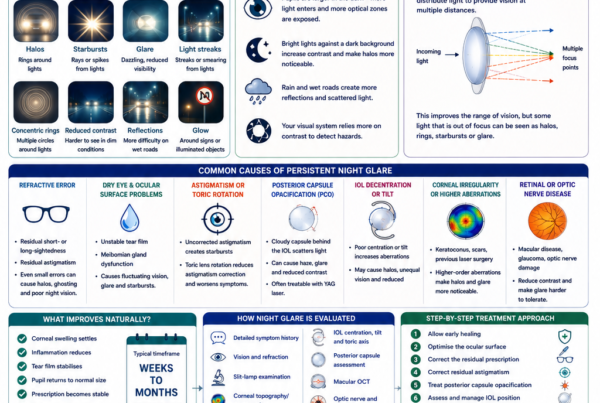
Some patients with presbyopia-correcting intraocular lenses experience:
- Halos
- Glare
- Starbursts
- Light streaks
- Reduced contrast in dim conditions
These symptoms may be more noticeable:
- In dark aircraft cabins
- At night
- While driving
- Around airport lighting
- In rain
- In unfamiliar surroundings
Consider delaying night driving and allowing more time for visual adaptation.
Bring Backup Glasses
Even when the aim is spectacle independence, bring:
- Reading glasses
- Distance glasses if prescribed
- Sunglasses
- A spare pair of spectacles
This is particularly helpful for:
- Small print
- Immigration forms
- Digital screens
- Low-light situations
- Unexpected residual prescription
Road Trips After Cataract Surgery
Travelling as a Passenger
You may usually travel as a passenger when:
- You feel well.
- Sedation has worn off.
- The seatbelt does not interfere with the eye.
- You can administer medication.
- The journey does not prevent follow-up.
Do Not Drive Until Your Vision Is Safe
You should not drive merely because a certain number of days has passed.
Before driving, you should have:
- Clear and stable vision
- Satisfactory depth perception
- No double vision
- Manageable glare
- Suitable glasses when required
- Adequate visual fields
- Legal eligibility
- No sedating medication effects
Take Breaks During Long Journeys
Regular breaks allow you to:
- Use your eye drops
- Rest your eyes
- Walk around
- Rehydrate
- Check for visual fluctuation
- Avoid prolonged fatigue
Avoid Heavy Vehicle Loading
Ask someone else to:
- Lift suitcases
- Load the boot
- Carry large boxes
- Move mobility equipment
- Handle heavy child seats
Early postoperative instructions commonly include avoiding heavy lifting and straining.
Train and Coach Travel
Train Travel Is Usually Suitable
Ordinary train travel does not create the same cabin-pressure concern as flying.
However, take care with:
- Platform gaps
- Moving trains
- Escalators
- Crowds
- Luggage racks
- Sudden braking
- Poor depth perception
High-Altitude Railways Are Different When Gas Is Present
Do not take a train or cable car to significantly higher altitude while an intraocular gas bubble remains.
Altitude, rather than the vehicle itself, is the concern.
Cruises After Cataract Surgery
Cruises Create Access-to-Care Challenges
A cruise may be less suitable during the early postoperative period because:
- Specialist ophthalmology care may not be available onboard.
- Port access may be delayed.
- Emergency evacuation may be difficult.
- Medication replacement may be challenging.
- The itinerary may interfere with follow-up.
- Sea movement may increase fall risk.
- Pools and hot tubs may tempt early water exposure.
Consider Waiting Until Recovery Is Stable
Before booking a cruise soon after surgery, confirm:
- The first reviews are complete.
- The eye is healing normally.
- You have sufficient medication.
- Your travel insurance covers recent surgery.
- The ship has appropriate medical support.
- You know where ophthalmic care is available at ports.
- You will not swim before four weeks.
Beach and Resort Holidays
You May Visit Without Swimming
A beach or resort holiday may be possible before you are permitted to swim.
Take these precautions:
- Wear sunglasses.
- Protect the eye from wind and sand.
- Keep sunscreen out of the eye.
- Avoid rubbing.
- Do not allow waves or pool water to splash your face.
- Avoid lifting heavy beach equipment.
- Use drops with clean hands.
Swimming Remains Restricted for Four Weeks
Do not enter:
- Swimming pools
- The sea
- Lakes
- Rivers
- Hot tubs
- Water parks
during the first four weeks after cataract surgery.
After four weeks, swimming should resume only if the eye has healed normally and your ophthalmologist has approved it.
Business Travel and Returning to Work
Desk-Based Travel May Resume Earlier
A patient attending meetings or working at a computer may travel sooner than someone whose work involves:
- Heavy lifting
- Construction sites
- Dust
- Outdoor exposure
- Night driving
- Machinery
- Aviation
- Diving
- Physical labour
Screen Use Is Safe but May Increase Dryness
Using a laptop or phone does not move the intraocular lens or reopen the incision.
However, concentrated screen use reduces blinking and may worsen:
- Dryness
- Eye fatigue
- Intermittent blur
- Light sensitivity
Take breaks and use prescribed lubricants.
Occupational Requirements May Differ
Pilots, commercial drivers, seafarers and workers operating heavy machinery may require:
- Formal visual clearance
- Occupational-health assessment
- Specific waiting periods
- Documentation from the ophthalmologist
- Stable refraction
- Adequate binocular vision
Travel After Complicated Cataract Surgery
You May Need to Delay the Trip
A longer delay may be required after:
- Posterior capsule rupture
- Vitreous loss
- Retained lens material
- A larger corneal incision
- Corneal sutures
- Significant corneal swelling
- Weak zonules
- Intraocular lens malposition
- Raised eye pressure
- Persistent inflammation
- Suspected infection
Remain Close to Ophthalmic Care
Complex cases may require:
- More frequent reviews
- Additional medication
- Eye-pressure monitoring
- Retinal examination
- Further surgery
- Urgent intervention if vision changes
Do not undertake remote or inflexible travel without specific clearance.
Travel After Combined Eye Surgery
Cataract and Retinal Surgery
Follow the retinal-surgery restrictions rather than a routine cataract-surgery timeline.
You may need to:
- Maintain a specific head position
- Avoid flying
- Avoid mountains
- Avoid scuba diving
- Limit exercise
- Attend frequent reviews
If intraocular gas is present, do not fly or ascend to high altitude until your retinal surgeon confirms that the gas has completely resolved.
Cataract and Glaucoma Surgery
Glaucoma-filtering procedures require more cautious travel planning because:
- Eye pressure may fluctuate.
- The conjunctival wound or filtering bleb must heal.
- Frequent postoperative adjustment may be necessary.
- Infection precautions may be stricter.
- Medication may change repeatedly.
Cataract and Corneal Surgery
Combined corneal procedures may require:
- Longer activity restrictions
- Positioning
- Additional medication
- More frequent reviews
- Delayed swimming
- Avoidance of eye rubbing and trauma
Travel Insurance and Documentation
Tell the Insurer About Recent Surgery
Travel-insurance terms vary.
Confirm whether the policy covers:
- Recent cataract surgery
- Postoperative complications
- Treatment overseas
- Trip cancellation
- Medical evacuation
- Pre-existing eye conditions
- Retinal surgery
- Glaucoma or diabetes
Do not assume that a standard policy automatically covers a recently operated eye.
Carry Relevant Documents
Bring:
- A medication list
- A copy of the surgical summary when available
- Your intraocular lens information
- Allergy information
- Your surgeon’s contact details
- Insurance details
- A list of medical conditions
- Details of any retinal gas bubble
Carry a Gas-Bubble Warning Card
Patients with intraocular gas should carry clear documentation stating:
- That gas is present inside the eye
- That flying and high-altitude travel are prohibited
- That nitrous-oxide anaesthesia must be avoided
- The type of gas when known
- The retinal surgeon’s contact details
Warning Signs While Travelling
Sudden or Worsening Loss of Vision
Seek urgent ophthalmic care if your vision:
- Suddenly becomes blurred
- Worsens after initially improving
- Becomes dark or shadowed
- Develops a missing area
- Is substantially worse than earlier in the day
Severe or Increasing Eye Pain
Mild grittiness may occur after surgery.
Severe or progressively increasing pain is not normal.
Do not wait until you return home.
Increasing Redness
Seek assessment when redness is:
- Increasing
- Associated with pain
- Accompanied by discharge
- Associated with worsening vision
- Combined with eyelid swelling
New Flashes, Floaters or a Curtain
Report urgently:
- New flashes of light
- A sudden shower of floaters
- A dark curtain
- A fixed shadow
- Loss of peripheral vision
These symptoms may indicate a retinal tear or retinal detachment. The National Eye Institute recommends immediate contact with an eye doctor for vision loss, severe pain, marked redness, flashes or a sudden increase in floaters after cataract surgery.
Nausea, Vomiting and Headache With Eye Pain
These symptoms may be associated with significantly raised eye pressure and require urgent assessment.
Do Not Fly Home Merely to See Your Own Surgeon
When symptoms suggest a serious complication, obtain care at the nearest appropriate ophthalmic facility.
Delaying assessment until the end of a flight or holiday may jeopardise vision.
Frequently Asked Questions
Can I Fly the Day After Cataract Surgery?
Commercial cabin pressure is generally not harmful after uncomplicated cataract surgery.
However, flying the next day may not be ideal if:
- You have not completed your postoperative examination.
- Your vision is blurred.
- The eye is painful or red.
- You have difficulty using the drops.
- The surgery was complicated.
- You are travelling somewhere without eye care.
Discuss the plan with your ophthalmologist.
Can I Fly Two or Three Days After Surgery?
Many patients may fly after the first satisfactory postoperative review if the operation was uncomplicated and the surgeon has no concerns.
Consider the length of the trip, destination and access to care.
Do I Need to Wait One Week Before Flying?
There is no universal one-week restriction after routine uncomplicated cataract surgery.
Waiting several days may nevertheless make the journey more comfortable and allow early complications to be excluded.
Can I Take a Long-Haul Flight?
Yes, after uncomplicated surgery when the eye is stable and your ophthalmologist agrees.
Prepare for dry cabin conditions, medication timing and reduced access to eye care.
Can Cabin Pressure Move My Intraocular Lens?
No. A standard intraocular lens does not expand with cabin-pressure changes.
The major pressure-related danger concerns an intraocular gas bubble after retinal surgery.
Can I Fly With a Gas Bubble if It Is Very Small?
No.
Do not fly until your retinal surgeon confirms that the bubble has completely resolved. Even small residual gas volumes can produce substantial eye-pressure changes during ascent.
Can I Travel to the Mountains?
After uncomplicated cataract surgery without gas, altitude does not generally affect the intraocular lens.
Do not travel to high altitude if intraocular gas remains.
Can I Travel by Car as a Passenger?
Yes, once you feel well enough.
Wear a seatbelt, avoid rubbing the eye and ask for help with luggage.
Can I Drive During My Holiday?
Drive only when:
- Vision is clear and stable.
- Both eyes work together comfortably.
- You have no double vision.
- Glare is manageable.
- You meet the relevant legal requirements.
- Your ophthalmologist has not advised against driving.
Can I Go on a Cruise?
A cruise may be possible after uncomplicated recovery, but consider limited access to specialist eye care and the possibility of missing follow-up.
Avoid swimming for the first four weeks.
Can I Travel Between First- and Second-Eye Surgery?
Yes, but the difference between the eyes may cause dizziness, visual imbalance or poor depth perception.
Try your temporary visual correction before travelling.
Should I Take My Eye Drops on the Plane?
Yes.
Keep them in your hand luggage, in their original packaging, with a written dosing schedule.
Can I Use My Drops During the Flight?
Yes.
Wash or sanitise your hands, allow sanitiser to dry completely and avoid touching the bottle tip to the eye or eyelashes.
Can I Wear Contact Lenses on the Flight?
Avoid a contact lens in the operated eye unless your ophthalmologist has approved it.
Glasses are usually more comfortable during early recovery because aircraft cabins can aggravate dryness.
Can I Swim During My Holiday?
Do not swim until at least four weeks after surgery.
After four weeks, swim only after your ophthalmologist confirms normal healing.
Can I Wear Sunglasses on the Plane?
Yes.
Sunglasses may help with light sensitivity, although they do not treat blur, dryness or an unsuitable prescription.
Can Airport Security Scanners Affect the Intraocular Lens?
No. A standard intraocular lens is not damaged or displaced by ordinary airport security screening.
What if I Lose My Eye Drops?
Contact your surgical clinic, local ophthalmologist or pharmacist promptly.
Do not stop postoperative medication for several days while waiting to return home.
A Pre-Travel Checklist
Before Booking
Confirm:
- The surgery date
- The first postoperative-review date
- The next follow-up date
- Whether the operation is expected to be routine
- Whether combined retinal surgery is planned
- Whether you will have enough recovery time
- Whether specialist eye care is available at the destination
Before Departure
Check that:
- Your ophthalmologist is satisfied with healing.
- There is no significant pain or redness.
- Vision is stable.
- You have sufficient medication.
- You understand the tapering schedule.
- Your drops are in your hand luggage.
- You have your clinic’s contact details.
- Travel insurance covers recent surgery.
- You have arranged help with heavy luggage.
- You know where to seek urgent eye care.
- No intraocular gas bubble is present.
During the Journey
- Use drops as prescribed.
- Keep the air vent away from your face.
- Blink regularly.
- Avoid rubbing the eye.
- Ask for help with overhead luggage.
- Wear sunglasses if light-sensitive.
- Take breaks during long road or rail journeys.
- Stop travelling and seek care if symptoms worsen.
At the Destination
- Continue medication.
- Keep appointments when scheduled.
- Protect the eye from dust, smoke, wind and sand.
- Do not swim before four weeks.
- Avoid direct eye trauma.
- Seek urgent care for warning symptoms.
The Bottom Line
Travel is usually possible relatively soon after uncomplicated cataract surgery.
From a cabin-pressure perspective, commercial flying generally does not harm a standard intraocular lens or an uncomplicated cataract incision. However, it is sensible to travel only after the initial postoperative examination has confirmed that the eye is healing normally.
A practical approach is:
- Day of surgery: Travel home with an accompanying adult; do not drive.
- First 24 to 48 hours: Remain near the surgical centre and complete the first review.
- First week: Consider only straightforward travel when the eye is stable and medical care is accessible.
- After one to two weeks: Many patients can undertake routine domestic or international travel more comfortably.
- After four weeks: Swimming may resume only after normal healing and medical approval.
- By six to eight weeks: Most uncomplicated eyes are substantially or completely healed.
The most important exception is retinal surgery involving intraocular gas.
Never fly, travel to high altitude or scuba dive while an intraocular gas bubble remains.
Before travelling:
- Confirm that the eye is healing normally.
- Attend essential postoperative reviews.
- Carry enough medication.
- Keep eye drops in your hand luggage.
- Ask for assistance with heavy bags.
- Plan for dry cabin air.
- Know where to obtain urgent eye care.
- Do not ignore pain, redness or worsening vision.
Your ophthalmologist’s individual advice should always take priority over a generic travel timetable.
References
- Shoss BL, Tsai LM. Postoperative care in cataract surgery. Curr Opin Ophthalmol. 2013;24(1):66–73. doi:10.1097/ICU.0b013e32835b0716. PMID: 23197268.
- National Eye Institute. Cataract surgery. National Institutes of Health. Updated December 5, 2024. Accessed July 20, 2026.
- American Academy of Ophthalmology. When can you fly after cataract surgery? Updated June 1, 2026. Accessed July 20, 2026.
- American Academy of Ophthalmology. Flying after eye surgery or with an eye condition. Updated July 6, 2026. Accessed July 20, 2026.
- Noble J, Kanchanaranya N, Devenyi RG, Lam WC. Evaluating the safety of air travel for patients with scleral buckles and small volumes of intraocular gas. Br J Ophthalmol. 2014;98(9):1226–1229. doi:10.1136/bjophthalmol-2014-304923. PMID: 24782473.
- Foulsham W, et al. Altitude-associated intraocular pressure changes in a gas-filled eye. Retin Cases Brief Rep. 2021;15(5):543–546. doi:10.1097/ICB.0000000000000852.
- Dieckert JP, O’Connor PS, Schacklett DE, Tredici TJ, Lambert HM, Fanton JW, Martin DA. Air travel and intraocular gas. Ophthalmology. 1986;93(5):642–645. doi:10.1016/S0161-6420(86)33691-1. PMID: 3725322.
- Mills MD, Devenyi RG, Lam WC, Berger AR, Beijer CD, Lam SR. An assessment of intraocular pressure rise in patients with gas-filled eyes during simulated air flight. Ophthalmology. 2001;108(1):40–44. PMID: 11150262.
- Uchiyama E, Aronowicz JD, Butovich I, McCulley JP. Increased evaporative rates in laboratory testing conditions simulating airplane cabin relative humidity: an important factor for dry eye syndrome. Eye Contact Lens. 2007;33(4):174–176. doi:10.1097/01.icl.0000252881.04636.5e. PMID: 17630623.
- Ta H, McCann P, Xiao M, et al. Dry eye post-cataract surgery: a systematic review and meta-analysis. BMC Ophthalmol. 2025;25:18. doi:10.1186/s12886-024-03841-8. PMID: 39806338.
- Garg P, Roy A, Sharma S. Endophthalmitis after cataract surgery: epidemiology, risk factors, and evidence on protection. Curr Opin Ophthalmol. 2017;28(1):67–72. doi:10.1097/ICU.0000000000000326. PMID: 27661662.
- Han JV, Patel DV, Squirrell D, McGhee CNJ. Cystoid macular oedema following cataract surgery: a review. Clin Exp Ophthalmol. 2019;47(3):346–356. doi:10.1111/ceo.13513. PMID: 30953417.