Author: Dr Val Phua
Estimated reading time: 20 minutes
Premium cataract surgery can provide more than removal of the cloudy natural lens.
Depending on the technology selected, it may also:
- Correct corneal astigmatism
- Improve intermediate vision
- Reduce dependence on reading glasses
- Provide distance, intermediate and near vision
- Allow the postoperative prescription to be adjusted
- Create a customised monovision or blended-vision result
However, premium cataract surgery is not automatically better for every patient.
A premium lens may provide excellent value when it solves a visual problem that matters greatly to the patient. For example, a toric lens may substantially improve unaided distance vision in someone with significant astigmatism, while a trifocal lens may be valuable to someone who strongly wishes to reduce dependence on reading glasses.
The same technology may be poor value when:
- The patient is comfortable wearing glasses.
- The additional visual range is not important.
- The eye is unsuitable for the optical design.
- Night-driving quality is a greater priority than reading without glasses.
- Expectations exceed what any artificial lens can provide.
- The patient is unwilling to accept halos, adaptation or occasional spectacle use.
- The additional cost creates significant financial strain.
There is no single premium lens that is best for everyone. Modern evidence instead supports matching the lens category to the patient’s ocular health, astigmatism, visual priorities and tolerance for optical compromises.
The Quick Answer
Is Premium Cataract Surgery Worth Paying For?
It can be worthwhile when:
- The additional lens feature addresses a genuine visual need.
- Your eyes are healthy enough to benefit.
- Your measurements are accurate and stable.
- You understand the advantages and disadvantages.
- Reduced dependence on glasses has substantial personal value.
- You can comfortably afford the additional cost.
- You accept that the result cannot be guaranteed.
It may not be worthwhile when:
- You are happy to wear reading or progressive glasses.
- You prioritise the most conservative optical quality.
- You have retinal, optic-nerve or corneal disease that limits the expected benefit.
- You drive extensively at night and would find halos unacceptable.
- You expect perfect vision at every distance.
- You believe that paying more guarantees freedom from glasses.
- The financial cost outweighs the likely practical benefit.
Does Premium Mean Better Vision?
Not necessarily.
Premium lenses provide an additional optical function. That function may include astigmatism correction, an extended focusing range, several focal distances or postoperative adjustment.
A standard monofocal lens may still provide the clearest and most comfortable vision for a patient who prioritises:
- Distance clarity
- Contrast
- Night driving
- Fewer halos
- Optical simplicity
A premium lens is better only when its additional feature is useful and appropriate for that particular patient.
Which Premium Feature Is Most Consistently Valuable?
For patients with clinically significant regular corneal astigmatism, toric correction can be particularly valuable.
The American Academy of Ophthalmology’s evidence review found that toric monofocal lenses generally provide better unaided distance vision, less residual astigmatism and greater distance-spectacle independence than comparable non-toric monofocal lenses in suitable eyes.
Which Lens Provides the Greatest Chance of Avoiding Glasses?
Modern trifocal lenses generally provide the strongest combined distance, intermediate and near vision and the greatest chance of near spectacle independence.
The trade-off is a greater possibility of:
- Halos
- Glare
- Starbursts
- Reduced low-light contrast
- A period of neuroadaptation
Systematic reviews consistently show better unaided near vision and greater spectacle independence with multifocal lenses than with standard monofocal lenses, but also more unwanted visual phenomena in many studies.
What Is Premium Cataract Surgery?
Premium Is Not One Specific Operation
The cataract-removal technique is often similar whether a standard or premium IOL is implanted.
The term “premium cataract surgery” commonly refers to additional planning, technology or lens functions such as:
- Toric astigmatism correction
- Enhanced monofocal optics
- Extended-depth-of-focus optics
- Multifocal or trifocal optics
- Light-adjustable lenses
- Advanced monovision planning
- Additional corneal imaging
- Astigmatism-management procedures
- Postoperative refractive enhancement programmes
Premium lenses are commonly associated with additional patient-paid costs, although coverage and payment arrangements vary between countries, insurers and surgical centres.
The Additional Cost Is Not Only for the Lens
Depending on the surgical package, the additional fee may include:
- Detailed lifestyle counselling
- Corneal topography or tomography
- Advanced biometry
- Total-corneal-astigmatism assessment
- Digital toric alignment
- Additional postoperative refractions
- Enhancement planning
- Light-adjustment treatments
- Extended follow-up
Patients should ask exactly what the quoted fee includes rather than assuming every premium package provides the same services.
Premium Does Not Mean Risk-Free
Premium lenses share the general risks of cataract surgery, including:
- Infection
- Inflammation
- Corneal swelling
- Raised eye pressure
- Macular oedema
- Retinal complications
- Residual refractive error
- Lens malposition
- Need for further treatment
Premium optics may also introduce additional visual considerations such as halos, contrast changes and neuroadaptation.
What Are You Actually Paying For?
Astigmatism Correction
A toric lens is designed to reduce regular corneal astigmatism.
This may improve:
- Unaided distance vision
- Clarity of road signs
- Night-time sharpness
- Dependence on distance glasses
- Performance of an EDOF or trifocal optical design
Toric correction does not automatically provide reading vision. A toric lens may be monofocal, enhanced monofocal, EDOF or trifocal.
A Wider Range of Vision
Presbyopia-correcting lenses may provide useful vision at more than one distance.
Depending on the lens, this may include:
- Distance vision
- Computer or dashboard vision
- Phone vision
- Reading vision
The wider the intended unaided range, the greater the likelihood that some optical compromise will be introduced.
Reduced Dependence on Spectacles
Some patients place substantial value on being able to:
- Read a message immediately
- See a menu without searching for glasses
- Exercise without spectacles
- Use a computer without changing glasses
- Wear ordinary sunglasses
- Avoid progressive spectacles
For these patients, reduced spectacle dependence may improve convenience and quality of life.
For a patient who enjoys wearing glasses and has no objection to reading spectacles, the same benefit may have little practical value.
Greater Refractive Precision
A light-adjustable lens allows the refractive result to be refined after implantation using controlled light treatments.
This may be particularly attractive when:
- Previous LASIK or PRK makes calculations less predictable.
- The patient has high refractive expectations.
- A customised monovision target is desired.
- The patient wants to assess the visual target after surgery.
Light-adjustable lenses require a structured postoperative programme, multiple visits and compliance with protective-eyewear instructions until treatment is completed.
When Is a Toric Lens Worth It?
Significant Regular Astigmatism Is Present
A standard non-toric IOL can correct spherical power but does not directly neutralise clinically significant corneal astigmatism.
Leaving astigmatism untreated may result in:
- Blurred unaided distance vision
- Ghosting
- Shadowed letters
- Starbursts
- Dependence on distance spectacles
A toric lens may therefore offer a clear and measurable benefit.
You Value Distance Vision Without Glasses
The value is often greatest for patients who want to see without distance spectacles for:
- Driving
- Television
- Sport
- Outdoor activities
- Recognising faces
- General mobility
Astigmatism Correction May Be More Valuable Than Multifocality
A patient with significant astigmatism may obtain better functional vision from a well-selected toric monofocal lens than from a non-toric multifocal lens that leaves meaningful cylinder uncorrected.
Correcting the eye accurately is often more important than selecting the widest theoretical range.
When Might It Be Less Worthwhile?
A toric lens may provide less value when:
- The predicted residual astigmatism is very low.
- The corneal astigmatism is irregular.
- Measurements are inconsistent.
- Capsular stability is uncertain.
- The patient is comfortable wearing glasses.
- Retinal or optic-nerve disease severely limits visual potential.
When Is an Enhanced Monofocal Lens Worth It?
You Want Better Intermediate Vision With Conservative Optics
Enhanced monofocal lenses aim to maintain strong distance vision while extending functional vision towards intermediate range.
They may help with:
- Computer work
- Car dashboards
- Cooking
- Supermarket shelves
- Seeing across a desk
- Larger phone text
Systematic reviews find better intermediate vision than with conventional monofocal lenses while distance performance remains broadly similar.
You Prefer Fewer Multifocal-Style Halos
An enhanced monofocal may be attractive when you want:
- More intermediate range than a standard monofocal
- A relatively monofocal-like image
- Less dependence on computer glasses
- Lower willingness to accept strong multifocal optical phenomena
Reading Glasses Are Still Likely
Enhanced monofocal lenses generally do not provide the strong close-reading vision of a trifocal lens.
They may be poor value for someone whose main goal is reading small print without glasses.
Mini-Monovision May Increase the Benefit
The non-dominant eye can sometimes be targeted slightly towards intermediate or near vision.
This may broaden the unaided range while preserving more monofocal-like optics.
Possible compromises include:
- Mild distance blur in one eye
- Reduced fine stereopsis
- Some dependence on reading glasses
- Difficulty adapting in selected patients
When Is an EDOF Lens Worth It?
Distance and Intermediate Vision Are Your Main Priorities
An EDOF lens may be valuable for patients who spend much of the day:
- Driving
- Using a desktop or laptop
- Looking at a dashboard
- Cooking
- Exercising
- Shopping
- Working across a desk
- Attending meetings
EDOF lenses generally provide strong distance and intermediate performance, with some functional near vision. Comparative evidence shows that EDOF and enhanced monofocal categories improve intermediate function, while trifocal lenses generally provide stronger close-reading vision.
You Accept Occasional Reading Glasses
The ideal EDOF patient understands that glasses may still help with:
- Small print
- Dimly lit menus
- Prolonged reading
- Detailed near work
- Very close phone viewing
You Want a Middle Ground
EDOF may be considered a compromise between:
- The optical simplicity of a monofocal lens
- The stronger close-reading range of a trifocal lens
However, EDOF is a broad category. Diffractive, non-diffractive and hybrid designs do not have identical visual ranges or halo profiles.
EDOF Does Not Mean Halo-Free
Some EDOF lenses can produce:
- Halos
- Glare
- Starbursts
- Reduced contrast
- Neuroadaptation symptoms
The proposed lens should be evaluated according to its specific optical design rather than its marketing category alone.
When Is a Multifocal or Trifocal Lens Worth It?
Avoiding Reading Glasses Is a Major Priority
A trifocal lens may offer high value when the patient strongly wants unaided:
- Phone vision
- Menu reading
- Book reading
- Computer vision
- Distance vision
- General daily independence from spectacles
Network meta-analyses generally rank trifocal lenses strongly for unaided near vision and near spectacle independence.
Your Eyes Are Healthy
The strongest candidates generally have:
- Clear and regular corneas
- Stable tear films
- Healthy maculae
- Healthy optic nerves
- Correctable regular astigmatism
- Reliable measurements
- Good visual potential in both eyes
You Accept the Optical Trade-Off
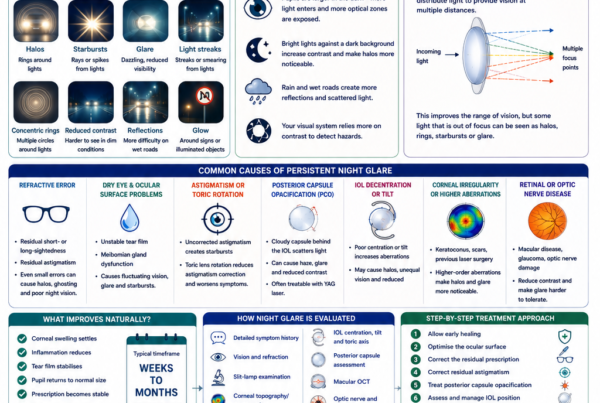
Multifocal and trifocal lenses may cause:
- Halos around headlights
- Glare
- Starbursts
- Rings around point lights
- Reduced low-light contrast
- An adaptation period
The decision depends on whether reducing spectacle dependence is more valuable to you than avoiding these optical effects.
The Cochrane review concluded that motivation to achieve spectacle independence is likely to be a major deciding factor when balancing improved near vision against glare and halos.
Night Driving Must Be Considered
Many trifocal patients drive comfortably after adaptation.
However, night driving remains difficult for some multifocal-IOL recipients, especially while neuroadaptation is incomplete. Patients who drive professionally or frequently at night should give this issue particular weight.
When Is a Light-Adjustable Lens Worth It?
Refractive Accuracy Is the Main Priority
The principal value of a light-adjustable lens is the ability to refine the prescription after the eye has healed.
This may be useful when:
- Previous laser surgery makes prediction more difficult.
- The patient wants a precise distance result.
- Astigmatism requires fine adjustment.
- Monovision needs to be tested and refined.
- The patient has unusually high refractive expectations.
Postoperative adjustment can correct defocus and astigmatism, but it requires a dedicated treatment workflow and does not correct visual limitations caused by retinal, optic-nerve or irregular-corneal disease.
You Can Complete the Treatment Programme
The lens is less suitable when the patient cannot:
- Attend repeated adjustment visits
- Dilate adequately
- Fixate during treatment
- Follow ultraviolet-protection instructions
- Delay final spectacle prescription until lock-in is complete
It Does Not Automatically Provide Multifocal Vision
A standard adjustable lens may achieve broad functional vision through:
- Distance targeting
- Monovision
- Mini-monovision
- Adjustable blended vision
It does not necessarily provide simultaneous distance, intermediate and near focal points like a trifocal lens.
When Is Premium Cataract Surgery Most Likely to Be Worthwhile?
You Have a Clear, Specific Visual Goal
Examples include:
- “I want to drive without distance glasses.”
- “I want to work at a computer without changing spectacles.”
- “I want to read my phone without glasses.”
- “I have significant astigmatism and want it corrected.”
- “I previously had LASIK and value postoperative fine-tuning.”
A specific goal allows the lens to be selected according to the function that matters.
Your Ocular Health Supports the Lens
Premium optics depend on the performance of the entire visual system.
The cornea, tear film, macula and optic nerve must all provide a sufficiently good image.
Patient-selection reviews emphasise that careful assessment of these structures is central to premium-IOL satisfaction.
The Benefit Will Be Used Frequently
The value may be higher when the visual function is used every day.
For example:
- A computer user may value intermediate vision for many hours daily.
- An avid reader may value near independence.
- A sports player may value distance vision without spectacles.
- A patient with high astigmatism may notice toric correction in almost every activity.
You Understand the Limitations
A suitable patient understands that:
- Glasses may still occasionally help.
- The final prescription may not be exactly zero.
- Halos may occur.
- Adaptation may take time.
- Dry eye can affect visual quality.
- An enhancement may occasionally be needed.
- No artificial lens restores natural youthful accommodation.
You Can Afford It Without Regret
Premium cataract surgery is elective enhancement of the refractive outcome.
The additional expenditure should not create significant financial anxiety.
A patient who feels pressured into paying for a premium lens is less likely to view minor compromises favourably.
When May It Not Be Worthwhile?
You Are Comfortable Wearing Glasses
A standard monofocal result combined with appropriate spectacles can provide:
- Excellent visual quality
- Precise correction
- Strong contrast
- Flexibility if the prescription changes
- Minimal concern about multifocal optical phenomena
Patients who do not mind reading glasses may gain little practical benefit from paying for a trifocal lens.
Night Vision Is Your Overriding Priority
A patient who frequently drives at night may prefer:
- A toric monofocal lens
- A conventional monofocal lens
- An enhanced monofocal lens
- A carefully selected EDOF strategy
rather than maximum unaided near vision.
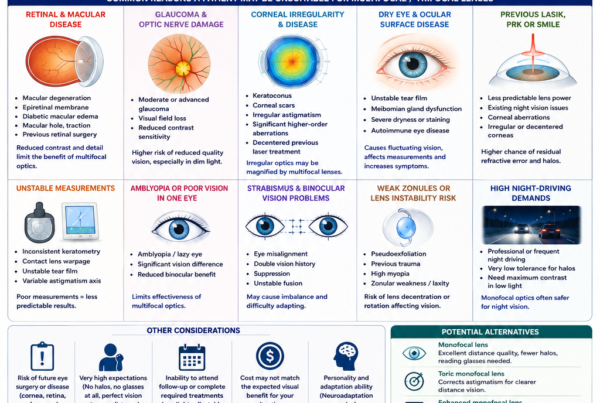
Your Eye Has Limited Visual Potential
Conditions that may reduce the benefit include:
- Significant macular degeneration
- Epiretinal membrane
- Diabetic macular disease
- Moderate or advanced glaucoma
- Optic neuropathy
- Corneal scarring
- Irregular astigmatism
- Severe amblyopia
A premium lens cannot restore visual information that the retina or optic nerve cannot process.
Your Measurements Are Unstable
Premium lenses require accurate measurements.
Planning should be delayed when:
- Dry eye is uncontrolled.
- Contact-lens warpage remains.
- Corneal scans disagree.
- Astigmatism is unstable.
- The cornea is changing.
- Fixation is unreliable.
Your Expectations Are Unrealistic
Premium surgery is unlikely to feel worthwhile when the patient expects:
- Perfect vision at every distance
- No glasses under any circumstances
- Zero halos
- Perfect night driving
- Immediate adaptation
- Guaranteed 6/6 vision
- No possibility of additional treatment
Why Standard Monofocal Surgery Is Not a Second-Class Option
It Provides Excellent Cataract Treatment
A standard monofocal lens can provide:
- Clear vision at the selected focal distance
- Good contrast
- Fewer multifocal-style halos
- Predictable optical performance
- Greater tolerance of ocular imperfections
- A straightforward adaptation process
Glasses Can Complete the Visual System
Reading, computer or progressive glasses may provide:
- Precise near correction
- Adjustable working distances
- Strong image quality
- Flexibility as visual needs change
A Standard Lens May Be the Best Lens
For some patients, the most sophisticated decision is to choose a simple optical design.
A well-selected monofocal lens may be better than an unsuitable premium lens.
How Eye Health Affects Value
Dry Eye
Dry eye can reduce:
- Measurement accuracy
- Distance clarity
- Reading comfort
- Contrast
- Premium-lens performance
An unstable ocular surface may make an expensive lens feel disappointing.
Dry eye should be treated before final measurements whenever possible.
Corneal Irregularity
Keratoconus, corneal scars, irregular astigmatism and decentered previous laser treatment may reduce image quality.
A multifocal lens may add further optical complexity.
Selected patients may be better served by:
- Monofocal optics
- Toric correction when the astigmatism is sufficiently regular
- A small-aperture strategy
- Specialty contact lenses
- Spectacles
Macular Disease
The macula is responsible for fine central vision and reading.
A premium near-focus lens cannot overcome:
- Epiretinal membrane distortion
- Macular degeneration
- Diabetic macular oedema
- Macular scarring
Glaucoma
Glaucoma may reduce contrast and visual-field function before high-contrast central acuity becomes poor.
A monofocal or conservative enhanced monofocal strategy is generally preferred when optic-nerve damage is significant.
Previous LASIK or PRK
Previous corneal laser surgery increases refractive uncertainty.
Premium surgery may still be worthwhile in carefully selected patients, but additional assessment may include:
- Corneal topography
- Tomography
- Higher-order-aberration analysis
- Several IOL formulas
- Light-adjustable technology
- Detailed counselling about residual prescription
Does Premium Surgery Guarantee Spectacle Independence?
No
Even after a technically successful premium-lens procedure, glasses may help with:
- Very small print
- Dim lighting
- Prolonged reading
- Night driving
- Fine hobbies
- Residual astigmatism
- Maximising distance sharpness
- A specific computer distance
Spectacle Independence Has Different Meanings
It may mean:
- No distance glasses
- No computer glasses
- No reading glasses
- No glasses for most daily activities
- No glasses under any circumstances
These are very different goals.
The lens should be selected according to the distances that matter most.
What Can Reduce the Value After Surgery?
Residual Prescription
Even modern calculations cannot guarantee an exact zero prescription.
Residual:
- Short-sightedness
- Long-sightedness
- Astigmatism
may reduce unaided performance.
Dry Eye
Postoperative tear-film instability may cause:
- Fluctuating blur
- Ghosting
- Glare
- Poor reading quality
- Dissatisfaction
Posterior Capsule Opacification
The capsule behind the IOL may later become cloudy.
This may cause:
- Haze
- Glare
- Reduced contrast
- A feeling that the cataract has returned
It can often be treated with YAG laser capsulotomy.
Lens Decentration or Rotation
Premium and toric lenses generally perform best when accurately positioned.
Significant decentration, tilt or toric rotation may require further treatment.
Neuroadaptation Difficulty
The brain may require weeks or months to adapt to multifocal or some EDOF optics.
A minority of patients remain troubled despite otherwise successful surgery.
What Additional Treatments Might Be Needed?
Depending on the cause, further treatment may include:
- Lubricating drops
- Dry-eye therapy
- Spectacles
- Contact lenses
- Corneal laser enhancement
- Toric-IOL rotation
- YAG laser capsulotomy
- IOL repositioning
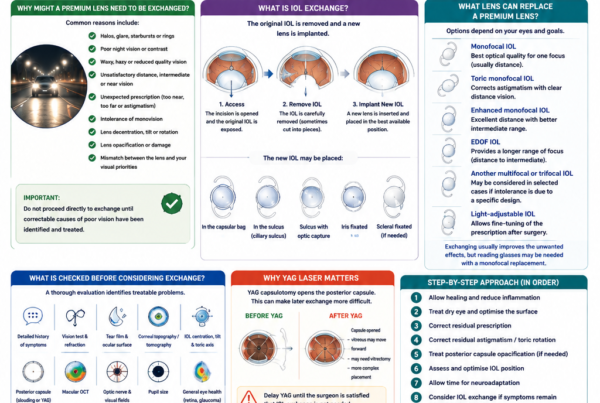
- IOL exchange
The possibility of further treatment should be discussed before surgery, especially for patients with very high refractive expectations.
Is Paying More a Guarantee of a Better Result?
No
The result depends on:
- Eye health
- Measurement quality
- Appropriate lens selection
- Surgical technique
- Lens positioning
- Healing
- Refractive accuracy
- Patient adaptation
- Expectations
A higher-cost lens cannot overcome:
- Macular damage
- Advanced glaucoma
- Severe corneal irregularity
- Unstable dry eye
- Unrealistic goals
The Value Comes From Matching, Not Pricing
The most valuable lens is the one whose function matches the patient’s needs.
Examples include:
- Toric monofocal for significant astigmatism and night-driving quality
- Enhanced monofocal for distance and computer work
- EDOF for distance-to-intermediate range
- Trifocal for maximum near spectacle independence
- Light-adjustable lens for postoperative refractive refinement
Practical Patient Scenarios
The Frequent Night Driver
Priorities:
- Crisp distance vision
- Headlight tolerance
- Contrast
- Wet-road visibility
Often worth considering:
- Toric monofocal
- Enhanced monofocal
- Selected EDOF
A strong multifocal lens may be less attractive if halos would be unacceptable.
The Avid Reader
Priorities:
- Phone use
- Books
- Menus
- Small print
- Minimal reading-glasses dependence
A trifocal lens may offer significant value if:
- The eyes are healthy.
- Astigmatism is corrected.
- The patient accepts halos and adaptation.
The Computer-Based Professional
Priorities:
- Laptop or desktop range
- Presentations
- Seeing across a meeting table
- Distance vision
Possible options include:
- Enhanced monofocal
- EDOF
- Trifocal
- Mini-monovision
The best option depends on whether strong close-reading vision is also required.
The Patient With Significant Astigmatism
Correcting the astigmatism may be more important than selecting a presbyopia-correcting lens.
A toric version of the otherwise appropriate lens may provide the greatest practical benefit.
The Patient Who Does Not Mind Glasses
A monofocal lens may provide excellent visual quality at lower cost.
Premium multifocality may offer little additional subjective value.
The Post-LASIK Patient
The patient may value:
- Postoperative fine-tuning
- Refractive precision
- Conservative optical quality
A light-adjustable, monofocal, selected EDOF or carefully planned monovision strategy may be considered after detailed corneal evaluation.
The Patient With Macular or Advanced Optic-Nerve Disease
A monofocal or toric monofocal lens is often the more appropriate choice.
Paying for multifocal range may not provide the expected benefit and may reduce already limited contrast.
Questions to Ask Before Paying for Premium Surgery
About the Visual Goal
- Which activities should I be able to perform without glasses?
- Which activities will probably still require glasses?
- What distance does this lens favour?
- Is my main goal distance, computer or reading vision?
- Would monovision provide a suitable alternative?
About the Lens
- Is the lens monofocal, enhanced monofocal, EDOF or trifocal?
- Is a toric version required?
- Is the EDOF design diffractive or non-diffractive?
- What halos are associated with this model?
- How strong is its near vision?
- Does it require neuroadaptation?
About Your Eyes
- Is my tear film stable?
- Is my cornea regular?
- How much astigmatism do I have?
- Is my macula normal on OCT?
- Is my optic nerve healthy?
- Does previous LASIK affect predictability?
- Are both eyes expected to have good visual potential?
About the Cost
- What exactly is included?
- Are advanced measurements included?
- Is toric correction included?
- Are postoperative enhancements included?
- Are additional refractions included?
- What treatments would involve further fees?
- What happens if I still need glasses?
About the Backup Plan
- What happens if the prescription is not exact?
- Can glasses correct it?
- Is laser enhancement possible?
- Can a toric lens be rotated?
- When would YAG laser be considered?
- Can the IOL be exchanged?
- What risks would exchange involve?
Frequently Asked Questions
Is Premium Cataract Surgery Better Than Standard Surgery?
Not universally.
Premium surgery provides additional refractive functions. Standard monofocal surgery may provide better value and optical quality for patients who are comfortable using glasses.
Is a Toric Lens Worth It?
It is often worthwhile when clinically significant regular corneal astigmatism is present and the patient wishes to reduce distance-glasses dependence.
Is a Multifocal Lens Worth It?
It may be worthwhile for a suitable patient who strongly values reading and computer vision without glasses and accepts possible halos, glare and neuroadaptation.
Is an EDOF Lens Worth It?
It may be worthwhile when distance and computer vision are priorities and the patient accepts that reading glasses may still be needed for fine print.
Is an Enhanced Monofocal Worth It?
It may be worthwhile when the patient wants more intermediate function than a standard monofocal but prefers a relatively conservative optical profile.
Is a Light-Adjustable Lens Worth It?
It may be worthwhile when postoperative refractive customisation is particularly valuable and the patient can complete the adjustment and lock-in process.
Will Premium Surgery Make Me Completely Glasses-Free?
Possibly, but it cannot be guaranteed.
The likelihood depends on:
- Lens design
- Astigmatism
- Refractive accuracy
- Ocular health
- Lighting
- Task distance
- Individual adaptation
Do Premium Lenses Last Longer?
Standard and premium IOLs are both intended to remain in the eye permanently.
The premium fee relates to additional optical function, not necessarily greater physical longevity.
Is the Most Expensive Lens the Best Lens?
No.
A lens may be technologically advanced but unsuitable for your eye or lifestyle.
Will Paying More Give Me Sharper Vision?
Not necessarily.
A monofocal lens may provide the sharpest and most straightforward image at its selected focal distance.
Premium lenses generally aim to broaden the unaided range rather than simply make one distance sharper.
Are Halos a Sign That the Lens Has Failed?
No.
Halos can be an expected effect of multifocal or diffractive optics.
They should be investigated when severe, worsening or associated with poor functional vision.
Can a Premium Lens Be Exchanged?
Yes, in selected cases.
However, IOL exchange is another intraocular operation with additional risks and should not be regarded as an easy reversal.
A Premium-Surgery Value Checklist
Premium Surgery May Be Worthwhile When:
- You have a clear visual goal.
- The proposed lens directly addresses that goal.
- Your ocular health is suitable.
- Measurements are stable.
- Astigmatism will be corrected.
- You strongly value reduced spectacle dependence.
- You understand possible halos and adaptation.
- You accept that occasional glasses may still help.
- You can afford the additional cost comfortably.
- You understand the backup plan.
Standard Surgery May Offer Better Value When:
- You are comfortable wearing glasses.
- Optical quality is more important than spectacle independence.
- You drive extensively at night.
- Your retina or optic nerve limits visual potential.
- Your cornea is irregular.
- Dry eye remains unstable.
- You have unrealistic expectations.
- The extra cost would create financial strain.
- You are unwilling to accept further treatment if required.
The Bottom Line
Premium cataract surgery can be worth it—but only when the added technology provides a benefit that matters to the individual patient.
The practical value of each option is different:
- Toric lens: Often valuable for correcting regular corneal astigmatism and improving unaided distance vision.
- Enhanced monofocal: Valuable for patients wanting strong distance vision with some additional intermediate range.
- EDOF lens: Valuable when distance and computer vision are the main priorities.
- Trifocal lens: Valuable when maximum spectacle independence and strong reading vision are the main goals.
- Light-adjustable lens: Valuable when postoperative refractive fine-tuning is especially important.
- Standard monofocal: Often the best value when optical quality, night vision and simplicity matter more than avoiding reading glasses.
Premium surgery is less likely to be worthwhile when:
- The eye cannot fully benefit from the technology.
- The patient does not mind glasses.
- Halos would be unacceptable.
- Expectations are unrealistic.
- The additional expense outweighs the likely convenience.
The key question is not:
“Is premium cataract surgery better?”
It is:
“Does this particular premium feature provide enough useful benefit for my eyes and lifestyle to justify its cost and compromises?”
For the right patient, a premium lens can provide substantial long-term convenience and visual freedom.
For another patient, a carefully selected monofocal or toric monofocal lens may deliver better quality, greater satisfaction and better overall value.
References
- Chen JL, Al-Mohtaseb ZN, Chen AJ. Criteria for premium intraocular lens patient selection. Curr Opin Ophthalmol. 2024;35(5):353–358. doi:10.1097/ICU.0000000000001067. PMID: 38920096.
- Li J, Sun B, Zhang Y, et al. Comparative efficacy and safety of all kinds of intraocular lenses in presbyopia-correcting cataract surgery: a systematic review and meta-analysis. BMC Ophthalmol. 2024;24(1):172. doi:10.1186/s12886-024-03446-1. PMID: 38627651.
- de Silva SR, Evans JR, Kirthi V, Ziaei M, Leyland M. Multifocal versus monofocal intraocular lenses after cataract extraction. Cochrane Database Syst Rev. 2016;12(12). doi:10.1002/14651858.CD003169.pub4. PMID: 27943250.
- Khandelwal SS, Jun JJ, Mak S, Booth MS, Shekelle PG. Effectiveness of multifocal and monofocal intraocular lenses for cataract surgery and lens replacement: a systematic review and meta-analysis. Graefes Arch Clin Exp Ophthalmol. 2019;257(5):863–875. doi:10.1007/s00417-018-04218-6. PMID: 30627791.
- Cho JY, Won YK, Park J, et al. Visual outcomes and optical quality of accommodative, multifocal, extended depth-of-focus, and monofocal intraocular lenses in presbyopia-correcting cataract surgery: a systematic review and Bayesian network meta-analysis. JAMA Ophthalmol. 2022;140(11):1045–1053. doi:10.1001/jamaophthalmol.2022.3667. PMID: 36136323.
- Al-Mohtaseb Z, Steigleman WA, Pantanelli SM, et al. Toric monofocal intraocular lenses for the correction of astigmatism during cataract surgery: a report by the American Academy of Ophthalmology. Ophthalmology. 2024;131(3):383–392. doi:10.1016/j.ophtha.2023.10.010. PMID: 38149945.
- Fernández J, et al. Visual and patient-reported outcomes of enhanced versus monofocal intraocular lenses in cataract surgery: a systematic review and meta-analysis. Eye. 2025;39(5):883–898. doi:10.1038/s41433-025-03625-4. PMID: 39893265.
- Wan KH, Au ACK, Kua WN, et al. Enhanced monofocal versus conventional monofocal intraocular lens in cataract surgery: a meta-analysis. J Refract Surg. 2022;38(8):538–546. doi:10.3928/1081597X-20220707-01. PMID: 35947003.
- Jun JH, Lieu A, Afshari NA. Light adjustable intraocular lenses in cataract surgery: considerations. Curr Opin Ophthalmol. 2024;35(1):44–49. doi:10.1097/ICU.0000000000001015. PMID: 37916944.
- Wang SY, Stem MS, Oren G, Shtein R, Lichter PR. Patient-centered and visual quality outcomes of premium cataract surgery: a systematic review. Eur J Ophthalmol. 2017;27(4):387–401. doi:10.5301/ejo.5000978. PMID: 28574135.
- Puente-Bustillo S, Holgueras A, López-Miguel A, Maldonado MJ. Visual performance during night driving after intraocular refractive surgery procedures. Expert Rev Med Devices. 2025;22(7):675–684. doi:10.1080/17434440.2025.2512038. PMID: 40418587.
- Goldberg DG, Goldberg MH, Shah R, Meagher JN, Ailani H. Pseudophakic mini-monovision: high patient satisfaction, reduced spectacle dependence, and low cost. BMC Ophthalmol. 2018;18(1):293. doi:10.1186/s12886-018-0963-3. PMID: 30413145.