Author: Dr Val Phua
Estimated reading time: 20 minutes
Choosing an intraocular lens is one of the most important decisions you will make before cataract surgery.
During the operation, the cloudy natural lens is removed and replaced with a clear artificial intraocular lens, or IOL. The new lens is intended to remain inside the eye permanently.
All modern intraocular lenses aim to restore clear vision. However, different lens designs distribute and focus light differently.
The main choice is often between:
- A monofocal lens, which is designed to provide one principal focal distance
- A multifocal lens, which is designed to provide useful vision across more than one distance
Neither lens is automatically “better” for everyone.
A monofocal lens generally provides dependable visual quality with fewer optical side effects, but most patients still require glasses for some distances.
A multifocal lens can reduce dependence on glasses for distance, intermediate and near activities, but this wider range of vision may come with halos, glare, reduced contrast or a period of visual adaptation.
Clinical trials and systematic reviews generally find similar distance visual acuity with monofocal and multifocal lenses. Multifocal lenses provide better unaided near vision and greater spectacle independence, but they also produce more unwanted visual phenomena in many studies. The importance of that trade-off varies considerably between patients.
The best lens depends on:
- Your visual priorities
- Your occupation
- Your hobbies
- How much you value freedom from glasses
- Your tolerance for halos and glare
- Whether you regularly drive at night
- The health of your cornea, retina and optic nerve
- The amount of astigmatism present
- Previous laser vision correction
- Your expectations
- Your willingness to accept compromises
The Quick Comparison
| Feature | Monofocal lens | Multifocal lens |
|---|---|---|
| Main optical aim | One principal focal distance | More than one focal distance |
| Distance vision | Usually excellent when targeted for distance | Usually excellent when accurately targeted |
| Intermediate vision | May require glasses, depending on target and lens design | Usually better without glasses |
| Near vision | Reading glasses commonly required when targeted for distance | Better unaided reading vision |
| Spectacle independence | Lower | Higher |
| Halos and glare | Generally less | More common |
| Contrast quality | Generally more forgiving | May be reduced, especially in dim light |
| Night driving | Usually easier to tolerate | May be affected by halos or starbursts |
| Sensitivity to small prescription errors | Lower | Higher |
| Adaptation period | Usually short | May require neuroadaptation |
| Suitability with other eye disease | Often suitable for a wider range of eyes | Requires more careful selection |
| Cost | Usually lower | Usually higher |
| Guaranteed freedom from glasses | No | No |
What Is an Intraocular Lens?
The Natural Lens Before Cataract Surgery
The natural lens sits behind the iris and pupil.
When you are young, it changes shape to focus from distant objects to nearby objects. This focusing process is called accommodation.
With age:
- The lens becomes less flexible.
- Near focusing becomes more difficult.
- Reading glasses become necessary.
- The lens may become cloudy and form a cataract.
What Happens During Cataract Surgery?
During cataract surgery:
- A small incision is created in the cornea.
- The cloudy natural lens is broken into small pieces.
- The lens material is removed.
- A clear artificial lens is inserted.
- The artificial lens usually unfolds within the natural lens capsule.
The intraocular lens does not normally need to be removed or replaced later.
An Artificial Lens Does Not Fully Reproduce a Young Natural Lens
A standard artificial lens does not change shape and refocus in the same way as a healthy young natural lens.
Different IOL technologies attempt to provide a broader range of vision using:
- Different focal zones
- Diffractive rings
- Refractive zones
- Extended-focus optical profiles
- Controlled amounts of spherical aberration
- Different focusing targets between the two eyes
Every approach involves benefits and compromises.
What Is a Monofocal Lens?
One Principal Focal Point
A monofocal intraocular lens has one principal focal power.
It is commonly targeted to provide clear vision at:
- Distance
- Intermediate distance
- Near
- A deliberately chosen point between these ranges
Most patients choose distance vision as the main target.
If both eyes are targeted accurately for distance, the patient will usually require glasses for reading and may require glasses for computer work.
Monofocal Does Not Mean Poor Vision
A monofocal lens is not an inferior or outdated lens.
It remains the standard reference lens against which other lens designs are compared.
Monofocal lenses are widely used because they generally provide:
- Clear distance vision
- Good contrast
- Predictable optical performance
- Fewer halos and starbursts
- Greater tolerance of minor ocular imperfections
- A relatively straightforward adaptation process
Distance-Targeted Monofocal Lenses
When the lens is targeted for distance, patients may be able to perform activities such as:
- Walking outdoors
- Watching television
- Recognising faces
- Driving
- Seeing road signs
- Playing many sports
without distance glasses, provided the refractive result is sufficiently accurate.
Glasses may still be required for:
- Reading
- Phone use
- Fine print
- Sewing
- Computer work
- Detailed near tasks
Near-Targeted Monofocal Lenses
A monofocal lens can instead be targeted for near vision.
This may be appropriate for a patient who:
- Has been short-sighted for many years
- Enjoys reading without glasses
- Is comfortable wearing distance spectacles
- Does not want multifocal optics
- Understands that unaided distance vision will remain blurred
A near target is not a surgical error when it has been deliberately selected.
Intermediate-Targeted Monofocal Lenses
Some patients choose a moderate degree of short-sightedness to favour:
- Computer work
- Cooking
- Looking at a car dashboard
- Seeing objects across a desk
- Household activities
Glasses may still be needed for clear distance and small print.
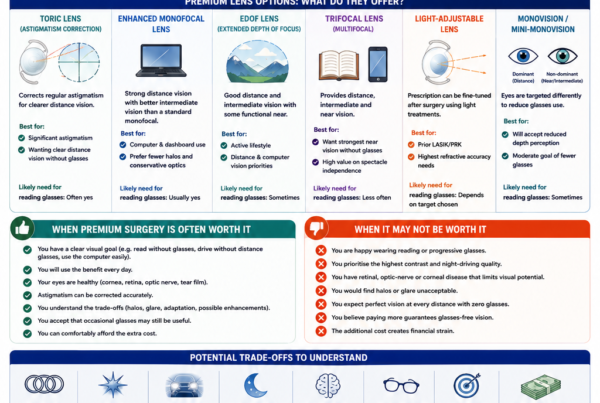
What Is a Multifocal Lens?
More Than One Focal Distance
A multifocal intraocular lens is designed to provide useful vision at more than one distance.
Depending on the design, it may provide:
- Distance and near vision
- Distance, intermediate and near vision
- A wider continuous functional range
Many lenses described as multifocal are more specifically classified as:
- Bifocal
- Trifocal
- Diffractive multifocal
- Refractive multifocal
- Hybrid optical designs
Extended-depth-of-focus lenses are related presbyopia-correcting lenses but are technically a separate category.
How Does a Multifocal Lens Work?
Most true multifocal lenses divide or distribute incoming light between different focal points.
For example:
- Some light is directed towards distance focus.
- Some light is directed towards intermediate focus.
- Some light is directed towards near focus.
This allows the brain to receive information from more than one focal range.
The brain must learn to select and use the most relevant image while suppressing less useful optical information.
What Is Neuroadaptation?
Neuroadaptation refers to the brain’s adjustment to the new optical system.
During this period, patients may gradually become less aware of:
- Halos
- Light rings
- Starbursts
- Slightly waxy vision
- Competing images
- Differences in contrast
Adaptation may occur over weeks or months.
However, neuroadaptation is not guaranteed. A minority of patients remain troubled by optical symptoms despite an otherwise technically successful operation.
What Is the Main Difference Between the Two Lenses?
Monofocal Lenses Prioritise Optical Simplicity
A monofocal lens directs most available light towards one main focus.
This tends to provide:
- Crisp vision at the chosen distance
- Good contrast
- Fewer competing images
- Less dependence on neuroadaptation
- Fewer night-time optical phenomena
The compromise is a narrower unaided focusing range.
Multifocal Lenses Prioritise Range of Vision
A multifocal lens attempts to provide useful vision across several distances.
This can reduce dependence on spectacles.
The compromise is that dividing light between different focal points may create:
- Halos
- Glare
- Starbursts
- Reduced contrast
- Less crisp vision in dim light
- Greater sensitivity to dry eye or residual prescription
Which Lens Gives Better Distance Vision?
Both Can Provide Excellent Distance Acuity
When surgery is uncomplicated and the refractive target is achieved, both monofocal and multifocal lenses can provide excellent distance visual acuity.
Systematic-review evidence has generally found no clinically important difference in unaided distance acuity between the two categories.
Visual Acuity Is Not the Same as Visual Quality
Two patients may both read the 6/6 line on an eye chart but experience different visual quality.
One may describe vision as:
- Crisp
- Sharp
- High contrast
- Comfortable at night
Another may read the same letters but notice:
- Halos
- Glare
- Slightly hazy vision
- Reduced clarity in dim light
The eye chart does not measure every aspect of real-world vision.
Which Lens Gives Better Intermediate Vision?
What Is Intermediate Vision?
Intermediate vision is commonly used for:
- Computer screens
- Tablets
- Cooking
- Supermarket shelves
- Car dashboards
- Musical instruments
- Seeing across a desk
- Household tasks
Standard Monofocal Lenses
A standard distance-targeted monofocal lens may provide some functional intermediate vision, but this varies according to:
- Pupil size
- Corneal shape
- Residual prescription
- Lens design
- Lighting
- Individual depth of focus
Some patients can use a computer without glasses. Others require intermediate spectacles.
Multifocal and Trifocal Lenses
Trifocal and some multifocal lenses are specifically designed to improve intermediate vision as well as near and distance vision.
Network meta-analyses generally show that presbyopia-correcting lenses provide better unaided intermediate and near vision than standard monofocal lenses, while distance acuity remains broadly comparable.
Which Lens Gives Better Near Vision?
Multifocal Lenses Usually Provide Better Unaided Near Vision
This is the clearest advantage of multifocal lenses.
Patients are more likely to read:
- A phone
- Menus
- Labels
- Messages
- Newspapers
- Books
- Price tags
without glasses.
Systematic reviews consistently report better unaided near vision with multifocal lenses than with distance-targeted monofocal lenses.
Near Vision Is Not Identical in Every Multifocal Lens
Near performance depends on:
- The optical design
- The near addition
- The intended reading distance
- Lighting
- Pupil size
- Residual refractive error
- Astigmatism
- Ocular-surface quality
- Whether both eyes have been treated
One multifocal lens may favour a closer reading distance, while another may provide stronger intermediate vision.
Small Print May Still Require Glasses
Even with a multifocal lens, glasses may still help with:
- Very small print
- Prolonged reading
- Dim lighting
- Detailed handiwork
- Low-contrast text
- Fatigued or dry eyes
A multifocal lens reduces glasses dependence. It does not guarantee perfect vision at every distance in every condition.
Which Lens Provides Greater Freedom From Glasses?
Multifocal Lenses Have the Advantage
Patients receiving multifocal lenses are more likely to achieve partial or complete spectacle independence than patients receiving standard monofocal lenses.
Spectacle Independence Is Not Guaranteed
A multifocal patient may still require glasses because of:
- Residual short-sightedness or long-sightedness
- Residual astigmatism
- Dry eye
- An inaccurate lens-power result
- An unsuitable reading distance
- Dim lighting
- Very fine visual tasks
- Other eye disease
Monofocal Patients May Not Need Glasses for Everything
A distance-targeted monofocal patient may have functional intermediate vision.
A patient using monovision may achieve a wider range without glasses.
A patient who was deliberately targeted for near vision may read comfortably without spectacles but need glasses for distance.
The amount of glasses use depends on the targeting strategy as well as the lens category.
Which Lens Has Better Contrast Sensitivity?
What Is Contrast Sensitivity?
Contrast sensitivity is the ability to detect an object that does not stand out strongly from its background.
Examples include:
- A grey kerb on a cloudy day
- A pedestrian wearing dark clothing at night
- A low-contrast face
- Lane markings in rain
- Stairs in dim lighting
- Text printed in pale ink
Monofocal Lenses Are Generally More Forgiving
Because a monofocal lens concentrates light mainly at one focal point, it tends to provide more straightforward optical quality.
Some studies show better contrast sensitivity with monofocal lenses, especially in dim conditions.
However, results vary between lens designs and studies. A large 2022 network meta-analysis did not find statistically significant differences in contrast sensitivity, glare or halos across every pooled comparison, while earlier systematic reviews found more glare and halos with multifocal lenses. This apparent difference reflects variation in lens generations, study methods and outcome measurement.
Contrast Matters More to Some Patients
A small reduction in contrast may be unimportant to one patient but troublesome to another.
It may matter more if you:
- Drive frequently at night
- Work in low lighting
- Fly aircraft
- Operate machinery
- Have glaucoma
- Have retinal disease
- Have reduced corneal clarity
- Require high-quality vision for your occupation
Which Lens Causes More Halos and Glare?
Multifocal Lenses Cause More Optical Phenomena Overall
Halos, glare and starbursts are generally more common after multifocal lens implantation than after monofocal implantation.
The 2016 Cochrane review found that glare and halos were more prevalent and troublesome with multifocal lenses. A later systematic review similarly found increased pooled risks of glare and halos, although the severity and frequency vary considerably among lens designs and individuals.
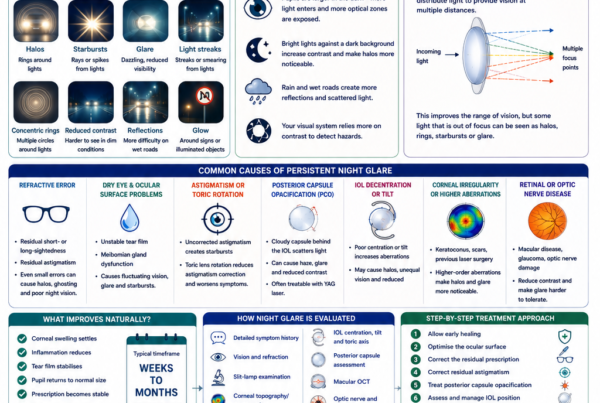
What Do Halos Look Like?
Patients may describe:
- Rings around headlights
- Circles around streetlights
- Star-shaped rays
- Light streaks
- A glow around illuminated signs
- Multiple rings around small light sources
These symptoms are usually most noticeable:
- At night
- With oncoming traffic
- In rain
- In dark restaurants
- Around LED lights
- When the pupil is larger
Do Halos Improve?
They often become less noticeable as:
- The eye heals.
- The pupil returns to normal.
- Dryness improves.
- Residual prescription is corrected.
- The brain adapts.
However, they do not disappear completely in every patient.
Monofocal Lenses Can Also Cause Halos
Halos are not exclusive to multifocal lenses.
They may also result from:
- Residual astigmatism
- Dry eye
- Corneal swelling
- Posterior capsule opacification
- Large pupils
- Corneal irregularity
- Lens decentration
- Other optical aberrations
The risk is simply generally lower with a monofocal optical design.
Which Lens Is Better for Night Driving?
Monofocal Lenses Are Usually the More Conservative Choice
Patients who place a high priority on night-driving quality often favour monofocal lenses because they generally produce:
- Fewer halos
- Less glare
- Better tolerance of low-contrast conditions
- Less dependence on neuroadaptation
Multifocal Lenses May Still Be Suitable for Many Drivers
Many multifocal patients drive safely and comfortably after adaptation.
However, some remain troubled by:
- Headlight halos
- Starbursts
- Reflections from wet roads
- Reduced contrast
- Slower recovery after bright lights
A patient who drives long distances at night should regard this trade-off seriously.
Professional Drivers Need Extra Caution
Professional drivers may have greater visual demands because they:
- Drive for prolonged periods
- Work in rain or darkness
- Carry passengers
- Operate large vehicles
- Encounter frequent glare
- Have occupational visual requirements
For some professional drivers, optical quality may be more important than maximum spectacle independence.
Which Lens Is Better for Reading and Computer Work?
Frequent Reading
A multifocal or trifocal lens may offer greater freedom from reading glasses.
However, comfortable prolonged reading also depends on:
- Tear-film quality
- Lighting
- Print contrast
- Reading distance
- Residual prescription
- Retinal function
Computer Use
A trifocal, extended-depth-of-focus or enhanced monofocal strategy may be particularly useful for intermediate work.
A standard distance-targeted monofocal patient may require computer glasses.
Precision Near Work
Patients performing highly detailed near tasks may still benefit from spectacles even with a multifocal lens.
Examples include:
- Fine jewellery work
- Microsoldering
- Detailed sewing
- Miniature painting
- Prolonged proofreading
- Very small musical notation
Glasses do not represent lens failure. They can improve comfort and precision for demanding tasks.
How Does Astigmatism Affect the Choice?
Astigmatism Can Blur Vision With Either Lens
Corneal astigmatism means the cornea has different curvatures in different meridians.
Uncorrected astigmatism may cause:
- Blur
- Ghosting
- Shadowed letters
- Glare
- Reduced contrast
- Poor near vision
Multifocal Lenses Are Less Tolerant of Residual Astigmatism
A small residual refractive error that is mildly noticeable with a monofocal lens may be much more troublesome with a multifocal lens.
Presbyopia-correcting lenses require a highly accurate optical result to perform well.
Toric Versions May Be Available
Toric intraocular lenses are designed to correct corneal astigmatism.
Depending on the available lens range, a patient may receive:
- A monofocal toric lens
- A multifocal toric lens
- A trifocal toric lens
- An extended-depth-of-focus toric lens
The eye must be measured carefully, and the lens must remain aligned with the intended axis.
Who Is a Good Candidate for a Monofocal Lens?
Patients Prioritising Visual Quality
A monofocal lens may be particularly suitable if you prioritise:
- Crisp vision
- Contrast
- Night driving
- Predictability
- Fewer halos
- A simpler adaptation process
Patients Comfortable With Glasses
A monofocal lens is often an excellent choice when you do not mind using:
- Reading glasses
- Computer glasses
- Progressive spectacles
- Distance glasses when needed
Patients With Other Eye Conditions
Monofocal lenses are often more forgiving in eyes with:
- Retinal disease
- Macular disease
- Glaucoma
- Optic-nerve disease
- Corneal irregularity
- Significant dry eye
- Previous corneal surgery
- Amblyopia
These conditions do not automatically prohibit every presbyopia-correcting lens, but they may reduce the quality of the image reaching the retina and make multifocal optical compromises less acceptable.
Who Is a Good Candidate for a Multifocal Lens?
Patients Strongly Motivated to Reduce Glasses Use
A suitable multifocal candidate usually places substantial value on unaided:
- Distance vision
- Computer vision
- Phone vision
- Reading vision
The motivation to reduce spectacle dependence is an important factor when weighing the additional risk of halos and glare.
Patients With Healthy Eyes
The best candidates generally have:
- A healthy cornea
- A stable tear film
- A healthy macula
- A healthy optic nerve
- Minimal irregular astigmatism
- Realistic expectations
- Accurate preoperative measurements
Patients Willing to Accept Optical Compromises
A multifocal patient should understand that:
- Halos may occur.
- Vision may be less crisp in dim light.
- Adaptation may take time.
- Glasses may still occasionally be required.
- A further enhancement may sometimes be necessary.
- No lens restores the eye to exactly how it functioned at age 20.
Who May Not Be an Ideal Multifocal Candidate?
Patients Who Cannot Tolerate Visual Imperfection
Multifocal lenses may be less suitable for patients who expect:
- Perfect vision at every distance
- Zero halos
- Zero glasses under all circumstances
- Immediate adaptation
- Identical vision to a young natural lens
- Guaranteed night-driving comfort
Significant Corneal Irregularity
The optical result may be compromised by:
- Keratoconus
- Corneal scarring
- Irregular astigmatism
- Unstable previous laser correction
- Significant higher-order aberrations
Significant Retinal or Optic-Nerve Disease
Careful consideration is required in patients with:
- Age-related macular degeneration
- Diabetic macular disease
- Epiretinal membrane
- Macular hole
- Retinal-vein occlusion
- Advanced glaucoma
- Optic neuropathy
These conditions may already reduce contrast or visual quality.
Adding a light-distributing lens may not provide the desired result.
Significant Dry Eye
Dry eye can cause:
- Fluctuating measurements
- Inaccurate lens calculations
- Blur
- Glare
- Ghosting
- Poor-quality vision
Studies of dissatisfied presbyopia-correcting IOL patients identify residual refractive error and dry eye among the most frequent correctable causes of blurred or foggy vision.
The ocular surface should be assessed and treated before final lens measurements whenever possible.
What About Previous LASIK or Other Laser Vision Correction?
Lens Calculations May Be Less Predictable
Previous LASIK, PRK or SMILE can alter the relationship between the measured corneal curvature and the true focusing power of the eye.
Modern calculation methods have improved outcomes, but the risk of residual prescription may still be higher.
Corneal Optical Quality Matters
Some post-laser patients have:
- Excellent regular corneas
- Minimal higher-order aberrations
- Stable measurements
Others have:
- Decentered treatment
- Irregular astigmatism
- Significant spherical aberration
- Dry eye
- Night-vision symptoms
A multifocal lens may magnify existing optical complaints in a less-than-ideal cornea.
Previous LASIK Is Not an Automatic Exclusion
Some carefully selected post-LASIK patients do well with presbyopia-correcting lenses.
The decision may require:
- Corneal topography
- Tomography
- Aberrometry
- Ocular-surface assessment
- Macular OCT
- Detailed counselling regarding refractive uncertainty
How Do Glaucoma and Retinal Conditions Affect the Decision?
Glaucoma
Early, stable glaucoma with good contrast and visual fields may not automatically exclude every presbyopia-correcting option.
However, caution increases when there is:
- Moderate or advanced field loss
- Reduced contrast sensitivity
- Progressive optic-nerve damage
- Uncertain long-term prognosis
- Need for future glaucoma surgery
A monofocal lens is often the more conservative choice when optic-nerve function is compromised.
Retinal Disease
Macular function is critical for multifocal performance.
Subtle conditions may be detected only with optical coherence tomography.
These include:
- Early epiretinal membrane
- Vitreomacular traction
- Macular degeneration
- Diabetic macular changes
- Previous macular oedema
A normal-looking retina on routine examination does not always guarantee normal macular structure.
How Important Are Personality and Expectations?
Expectations Strongly Influence Satisfaction
A technically excellent result may still disappoint a patient whose expectations were unrealistic.
The ideal conversation is not simply:
“Do you want glasses or no glasses?”
It should include:
- Which distances matter most?
- How often do you drive at night?
- How would you feel about halos?
- Would occasional reading glasses bother you?
- Is optical crispness more important than glasses independence?
- Are you willing to undergo a possible enhancement?
- How do you respond to visual changes and adaptation?
Perfectionism Is Not Automatically a Contraindication
A detail-oriented patient may do well when:
- The eye is healthy.
- Measurements are accurate.
- Expectations are realistic.
- The patient understands the trade-offs.
- The selected lens matches the patient’s priorities.
Problems arise when the expected result is physically impossible.
Monofocal Monovision as an Alternative
What Is Monovision?
Monovision uses different targets in the two eyes:
- One eye is targeted mainly for distance.
- The other is targeted for intermediate or near vision.
The brain combines the information to provide a broader functional range.
Advantages of Monovision
Monovision may provide:
- Reduced dependence on glasses
- Fewer multifocal rings or halos
- Monofocal optical quality in each eye
- Lower cost than some premium-lens options
- A useful intermediate range
Limitations of Monovision
Possible disadvantages include:
- Reduced fine depth perception
- Visual imbalance
- Blur in one eye at each extreme
- Reduced performance in dim lighting
- Need for glasses for demanding distance or near tasks
- Difficulty adapting in some patients
A Contact-Lens Trial Can Help
A trial of monovision with contact lenses may help determine tolerance before surgery.
However, the simulation is not perfect because:
- A cataract remains present.
- Contact-lens optics differ from IOL optics.
- Dry eye may affect the trial.
- The intended surgical target may differ.
What Are Enhanced Monofocal Lenses?
A Wider Range Than Standard Monofocal Lenses
Enhanced monofocal lenses are designed to extend functional intermediate vision while maintaining an optical profile closer to a monofocal lens.
They may offer:
- Good distance vision
- Improved intermediate vision
- Fewer halos than traditional multifocal designs
- Better visual quality than some light-splitting alternatives
Near Glasses Are Still Commonly Needed
Enhanced monofocal lenses should not be described as full multifocal lenses.
They may help with:
- Computer screens
- Car dashboards
- Cooking
- Household activities
but often do not provide strong unaided reading vision for small print.
What Are Extended-Depth-of-Focus Lenses?
An Elongated Focal Range
Extended-depth-of-focus, or EDOF, lenses aim to create an extended rather than multiple sharply separated focal range.
They generally prioritise:
- Distance
- Intermediate vision
- Some functional near vision
A Middle-Ground Option
EDOF lenses may be considered a compromise between:
- The optical simplicity of a monofocal lens
- The broad near range of a multifocal or trifocal lens
Compared with standard monofocal lenses, EDOF lenses generally improve intermediate vision and may improve near vision, although halos can still occur.
Reading Glasses May Still Be Required
Patients should not assume that an EDOF lens will provide the same close-reading performance as a strong multifocal or trifocal lens.
Should the Same Lens Be Used in Both Eyes?
Bilateral Matching
Using the same lens design in both eyes can provide:
- Similar optical images
- Balanced focusing ranges
- More predictable binocular summation
- Easier neuroadaptation
Multifocal lenses are commonly implanted bilaterally because using the lens in only one eye may limit binocular performance.
Mix-and-Match Strategies
In selected patients, surgeons may combine:
- Different multifocal additions
- An EDOF lens with a multifocal lens
- An enhanced monofocal with monovision
- Different refractive targets
The aim may be to improve the total visual range.
However, mixing lens types can create:
- Different visual qualities between the eyes
- Imbalance
- More complex adaptation
- Less predictable subjective results
Such strategies should be individualised.
What Happens if Only One Eye Has a Multifocal Lens?
Binocular Vision May Feel Unequal
A patient may temporarily have:
- A multifocal lens in one eye
- A cataract or monofocal lens in the other eye
This can produce:
- Different image clarity
- Different colour perception
- Unequal halos
- Visual imbalance
- Difficulty assessing the final outcome
The performance of a bilateral lens strategy should not always be judged solely from the first operated eye.
Do Not Ignore Significant Symptoms
Although adaptation can take time, persistent or severe symptoms should be assessed for:
- Residual refractive error
- Dry eye
- Corneal irregularity
- Lens decentration
- Posterior capsule opacification
- Macular disease
- Excessive pupil-related symptoms
Can Either Lens Correct Astigmatism?
Toric Monofocal Lenses
A toric monofocal lens may provide:
- Clear distance vision
- Better contrast
- Reduced dependence on distance glasses
- Fewer optical phenomena than a multifocal design
Reading glasses are generally required if both eyes are targeted for distance.
Toric Multifocal Lenses
A toric multifocal lens can correct astigmatism while also providing more than one focal distance.
Precise calculation and alignment are important because multifocal performance is sensitive to residual cylinder.
Other Astigmatism Treatments
Astigmatism may also be managed with:
- Corneal relaxing incisions
- Femtosecond-laser arcuate incisions
- Postoperative laser vision correction
- Spectacles
- Contact lenses
Not every method is appropriate for every degree or pattern of astigmatism.
What if the Lens-Power Result Is Not Exact?
No Calculation Is Perfect
Even with modern imaging and formulas, the final prescription may differ from the intended target.
Possible reasons include:
- Normal biological variation
- Measurement uncertainty
- Dry eye
- Previous laser surgery
- Unusual eye length
- Corneal irregularity
- Lens-position differences
- Astigmatism
Multifocal Lenses Are Less Forgiving
Small amounts of:
- Short-sightedness
- Long-sightedness
- Astigmatism
may affect a multifocal patient more than a monofocal patient.
Possible Solutions
Depending on the situation, management may include:
- Glasses
- Contact lenses
- Dry-eye treatment
- Corneal laser enhancement
- Astigmatic correction
- Lens rotation
- Piggyback lens
- Lens exchange
Not every patient requires further surgery.
Why Are Some Patients Unhappy With Multifocal Lenses?
Blurred or Waxy Vision
Possible causes include:
- Residual refractive error
- Dry eye
- Posterior capsule opacification
- Irregular astigmatism
- Lens decentration
- Macular disease
- Optical intolerance
- Failed neuroadaptation
Studies of referred dissatisfied patients show that many complaints have an identifiable and potentially treatable cause.
Halos and Photic Phenomena
Some patients achieve excellent eye-chart vision but remain bothered by:
- Halos
- Starbursts
- Glare
- Arcs
- Light streaks
These may improve with time, treatment of ocular-surface disease or correction of refractive error.
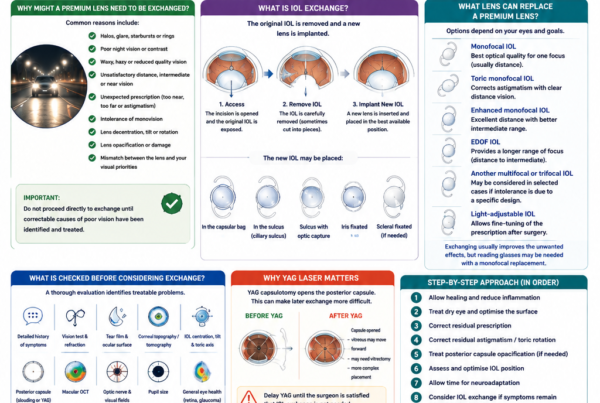
Not Every Problem Is Caused by the Lens Design
Before assuming that the multifocal lens must be removed, the ophthalmologist should assess:
- Refraction
- Corneal topography
- Tear film
- Lens position
- Posterior capsule
- Macula
- Optic nerve
- Pupil
- Binocular function
Can a Multifocal Lens Be Exchanged?
Lens Exchange Is Possible but Not Simple
A multifocal lens can sometimes be replaced with:
- A monofocal lens
- An EDOF lens
- A different multifocal design
However, lens exchange is another intraocular operation and carries risks.
These may include:
- Capsular damage
- Vitreous loss
- Corneal injury
- Retinal complications
- Infection
- Need for a differently positioned lens
- Residual refractive error
Earlier Exchange May Be Technically Easier
Over time, the lens capsule contracts and adheres to the IOL.
Exchange can become more difficult after:
- Capsular fibrosis
- Posterior capsule opacification
- YAG laser capsulotomy
For this reason, YAG capsulotomy should generally be deferred when lens exchange remains a serious possibility.
Exchange Does Not Guarantee Complete Satisfaction
Replacing a multifocal lens may reduce halos or improve contrast, but:
- Near vision may worsen.
- Reading glasses may become necessary.
- Previous retinal or corneal limitations may remain.
- Surgical complications may occur.
Lens exchange should be considered only after careful assessment and counselling.
What Are the Risks Common to Both Lens Types?
Surgical Risks
Both lenses are implanted during cataract surgery and share risks including:
- Infection
- Inflammation
- Bleeding
- Corneal swelling
- Raised eye pressure
- Posterior capsule rupture
- Retinal tear or detachment
- Macular swelling
- Lens malposition
- Residual refractive error
- Need for further surgery
The choice of optical design does not remove the general risks of cataract surgery.
Posterior Capsule Opacification
The capsule behind the lens may become cloudy months or years after surgery.
This may cause:
- Blurred vision
- Glare
- Reduced contrast
- Halos
It can often be treated with YAG laser capsulotomy.
Does a Multifocal Lens Cost More?
Multifocal Lenses Usually Involve Additional Charges
Costs may include:
- The premium lens
- Additional preoperative measurements
- Astigmatism management
- Laser-assisted steps
- Postoperative enhancements
- Additional follow-up
The exact amount depends on:
- Country
- Clinic
- Lens type
- Insurance
- Surgical package
- Whether toric correction is required
Higher Cost Does Not Mean Better Vision for Everyone
The higher price reflects the lens technology and associated services.
It does not mean that the lens is automatically more suitable or that the patient will have better visual quality than with a monofocal lens.
A well-selected monofocal result may be preferable to a poorly selected multifocal result.
Questions to Ask Before Choosing a Lens
Questions About Your Lifestyle
Ask yourself:
- How important is reading without glasses?
- How much computer work do I do?
- Do I drive frequently at night?
- Do I work in dim lighting?
- Do I play sports requiring precise contrast?
- Would occasional glasses bother me?
- Would halos bother me more than reading glasses?
- Which distance is most important to me?
Questions About Your Eyes
Ask your ophthalmologist:
- Is my retina healthy?
- Is my optic nerve healthy?
- Do I have an epiretinal membrane?
- Do I have glaucoma?
- Is my cornea regular?
- Is my dry eye adequately controlled?
- How much astigmatism do I have?
- Does previous LASIK affect my options?
- Is my lens-power calculation predictable?
- Am I suitable for a toric lens?
Questions About the Expected Result
- What distance will each eye be targeted for?
- What activities should I expect to perform without glasses?
- For which activities will I probably still need glasses?
- What halos or glare might I notice?
- How long might adaptation take?
- What happens if the prescription is not exact?
- Is enhancement included?
- What happens if I cannot adapt to the lens?
Frequently Asked Questions
Is a Multifocal Lens Better Than a Monofocal Lens?
Not universally.
A multifocal lens is better at reducing glasses dependence and usually provides better unaided near vision.
A monofocal lens is generally more conservative for contrast, night vision and optical simplicity.
Which Lens Gives the Sharpest Vision?
At its intended focal distance, a monofocal lens often provides the crispest and most straightforward optical quality.
A multifocal lens can also provide excellent visual acuity, but some patients describe the image as slightly less crisp, particularly in dim light.
Will I Need Glasses With a Monofocal Lens?
Usually yes, particularly for reading if both eyes are targeted for distance.
You may also require glasses for:
- Computer work
- Astigmatism
- Fine distance tasks
- Night driving
Will I Need Glasses With a Multifocal Lens?
Possibly.
Multifocal lenses reduce the frequency with which glasses are required, but do not guarantee complete spectacle independence.
Can Multifocal Lenses Cause Permanent Halos?
Halos often improve with healing and neuroadaptation.
Some patients continue to notice them long term, particularly at night.
Can Monofocal Lenses Cause Halos?
Yes, but generally less often.
Dry eye, residual astigmatism, corneal swelling and capsule clouding can cause halos with any lens.
Is a Multifocal Lens Suitable if I Drive at Night?
Possibly, but frequent night drivers should carefully consider the increased possibility of halos, glare and reduced low-light contrast.
A monofocal lens may be the more conservative choice.
Can I Have a Multifocal Lens in One Eye and a Monofocal Lens in the Other?
This can be done in selected cases, but it may create different visual qualities between the eyes.
The strategy should be planned rather than adopted accidentally.
Is a Multifocal Lens Suitable if I Have Glaucoma?
It depends on the severity and stability of the glaucoma.
Patients with significant field loss or reduced contrast are often better served by a monofocal strategy.
Is a Multifocal Lens Suitable if I Have an Epiretinal Membrane?
A significant epiretinal membrane may reduce retinal image quality and make a multifocal lens less suitable.
Macular OCT is important before deciding.
Can I Have Multifocal Lenses After LASIK?
Some post-LASIK patients are suitable, but careful corneal assessment and counselling about refractive uncertainty are required.
Can a Monofocal Lens Provide Near Vision?
Yes, if it is targeted for near vision or used in a monovision strategy.
The trade-off is reduced unaided distance vision in the near-targeted eye.
Can a Multifocal Lens Be Removed?
Yes, but lens exchange is another intraocular operation with additional risks.
It should not be regarded as a simple reversal.
Which Lens Is Safer?
Both lens categories are implanted through the same type of cataract operation and share the major surgical risks.
A monofocal lens may be more tolerant of optical imperfections, but it is not inherently free of surgical complications.
Which Lens Lasts Longer?
Both are designed to remain in the eye permanently.
A cataract does not grow back on either lens.
The capsule behind the lens may later become cloudy and require YAG laser treatment.
A Practical Decision Guide
Consider a Monofocal Lens if:
- You prioritise crisp vision and contrast.
- You drive frequently at night.
- You do not mind using reading glasses.
- You have retinal, optic-nerve or corneal disease.
- You want the most optically conservative option.
- You prefer fewer halos and less neuroadaptation.
- You are comfortable with monovision or spectacles.
Consider a Multifocal Lens if:
- Reducing glasses use is a major priority.
- You want unaided distance, intermediate and near vision.
- Your cornea, macula and optic nerve are healthy.
- Your ocular surface is stable.
- You accept the possibility of halos and glare.
- You understand that spectacles may still occasionally be required.
- You are willing to undergo a period of neuroadaptation.
Consider an Enhanced Monofocal or EDOF Lens if:
- Intermediate vision is important.
- You want a broader range than a standard monofocal lens.
- You prefer fewer optical phenomena than a strong multifocal design.
- You accept that reading glasses may still be necessary.
The Bottom Line
Both monofocal and multifocal lenses can provide excellent results after cataract surgery.
A monofocal lens generally offers:
- Clear vision at one main distance
- Good contrast
- Fewer halos and starbursts
- Better tolerance of minor optical imperfections
- A simpler adaptation process
The main compromise is greater dependence on glasses for other distances.
A multifocal lens generally offers:
- Better unaided near vision
- Better unaided intermediate vision
- A greater chance of spectacle independence
- A broader functional range
The main compromises are:
- More halos and glare
- Possible reduction in low-light contrast
- Greater sensitivity to dry eye and residual prescription
- A need for neuroadaptation
- A small possibility of persistent dissatisfaction
The decision is not simply between a “basic” lens and a “better” lens.
It is a choice between different visual priorities.
The most appropriate lens is the one that best matches:
- The health of your eyes
- Your daily activities
- Your attitude towards glasses
- Your tolerance for optical side effects
- Your expectations
A carefully selected monofocal lens is often better than an unsuitable multifocal lens. Conversely, a well-selected multifocal lens can provide excellent visual freedom for a motivated patient with healthy eyes and realistic expectations.
References
- de Silva SR, Evans JR, Kirthi V, Ziaei M, Leyland M. Multifocal versus monofocal intraocular lenses after cataract extraction. Cochrane Database Syst Rev. 2016;12(12). doi:10.1002/14651858.CD003169.pub4. PMID: 27943250.
- Khandelwal SS, Jun JJ, Mak S, Booth MS, Shekelle PG. Effectiveness of multifocal and monofocal intraocular lenses for cataract surgery and lens replacement: a systematic review and meta-analysis. Graefes Arch Clin Exp Ophthalmol. 2019;257(5):863–875. doi:10.1007/s00417-018-04218-6. PMID: 30627791.
- Cho JY, Won YK, Park J, et al. Visual outcomes and optical quality of accommodative, multifocal, extended depth-of-focus, and monofocal intraocular lenses in presbyopia-correcting cataract surgery: a systematic review and Bayesian network meta-analysis. JAMA Ophthalmol. 2022;140(11):1045–1053. doi:10.1001/jamaophthalmol.2022.3667. PMID: 36136323.
- Woodward MA, Randleman JB, Stulting RD. Dissatisfaction after multifocal intraocular lens implantation. J Cataract Refract Surg. 2009;35(6):992–997. doi:10.1016/j.jcrs.2009.01.031. PMID: 19465282.
- de Vries NE, Webers CAB, Touwslager WRH, et al. Dissatisfaction after implantation of multifocal intraocular lenses. J Cataract Refract Surg. 2011;37(5):859–865. doi:10.1016/j.jcrs.2010.11.032. PMID: 21397457.
- Gibbons A, Ali TK, Waren DP, Donaldson KE. Causes and correction of dissatisfaction after implantation of presbyopia-correcting intraocular lenses. Clin Ophthalmol. 2016;10:1965–1970. doi:10.2147/OPTH.S114890. PMID: 27784985.
- Pedrotti E, Carones F, Aiello F, et al. Comparative analysis of visual outcomes with four different monofocal and multifocal intraocular lenses. J Refract Surg. 2018;34(4):234–241.
- Pedrotti E, Bruni E, Bonacci E, Badalamenti R, Mastropasqua R, Marchini G. Extended depth of focus versus monofocal IOLs: objective and subjective visual outcomes. J Refract Surg. 2020;36(4):214–222. PMID: 32267951.
- Pusnik A, Petrovski G, Lumi X. Dysphotopsias or unwanted visual phenomena after cataract surgery. Life. 2023;13(1):53. doi:10.3390/life13010053. PMID: 36676002.
- Cochener B, Lafuma A, Khoshnood B, Courouve L, Berdeaux G. Comparison of outcomes with multifocal intraocular lenses: a meta-analysis. Clin Ophthalmol. 2011;5:45–56. PMID: 21311656.