Author: Dr Val Phua
Estimated reading time: 18 minutes
Cataracts usually develop gradually.
The early changes may be so subtle that patients assume they simply need:
- Stronger spectacles
- Brighter lighting
- More rest
- A larger phone font
- Less night driving
A cataract is clouding or increasing optical irregularity within the eye’s natural crystalline lens. The lens sits behind the iris and helps focus light onto the retina. As the lens becomes cloudy, yellowed or irregular, it scatters and blocks light instead of focusing it cleanly.
Cataracts can affect more than the number of letters a patient reads on a bright eye chart. They may also reduce:
- Contrast sensitivity
- Colour perception
- Glare tolerance
- Night vision
- Depth perception
- Real-world driving and mobility
Some patients retain relatively good high-contrast visual acuity while experiencing substantial difficulty with headlights, low lighting or everyday visual tasks.
The following are 15 possible signs that cataracts may be affecting your vision.
Having one of these symptoms does not prove that you have a cataract. Dry eye, uncorrected spectacle power, corneal disease, glaucoma, retinal disease and neurological conditions may produce similar complaints.
A complete eye examination is therefore required to determine the cause.
Sign 1: Your Vision Is Gradually Becoming Blurry, Cloudy or Hazy
The most familiar cataract symptom is a gradual, painless reduction in visual clarity.
Patients may describe their vision as:
- Misty
- Foggy
- Smoky
- Cloudy
- Softly focused
- Similar to looking through a dirty window
- Less crisp than before
The blur usually develops slowly over months or years. One eye may be more affected than the other.
A cataract scatters and absorbs light as it passes through the natural lens. This prevents a sharply focused image from reaching the retina.
Early cataract blur may initially improve with a change in spectacle prescription. As the lens becomes more cloudy or irregular, glasses may no longer restore the previous quality of vision.
Cataract Blur Is Usually Painless
Ordinary age-related cataracts do not normally cause:
- Severe pain
- Marked redness
- Significant discharge
- Sudden complete loss of vision
A sudden painful or red eye should not be assumed to be caused by a routine cataract.
Possible urgent causes include:
- Acute glaucoma
- Corneal infection
- Uveitis
- Retinal disease
- Eye trauma
Sign 2: You Cannot See as Well in Dim Lighting
Cataracts commonly make vision worse in dim environments.
You may notice difficulty:
- Walking through a dark restaurant
- Finding your seat in a cinema
- Seeing steps in a dim stairwell
- Reading a menu in subdued lighting
- Recognising faces in poor light
- Moving from a bright outdoor area into a darker room
- Seeing objects at dusk
The cataract reduces light transmission and contrast. When the surrounding illumination is already low, the retina receives an even poorer-quality image. Cataracts may therefore affect low-light function before they produce major loss on a bright high-contrast chart.
Dark Adaptation May Feel Slower
Some patients feel that their eyes take longer to adjust when moving between:
- Sunlight and an indoor room
- A brightly lit road and a dark car park
- A well-lit corridor and a dark bedroom
This symptom is not specific to cataract. Retinal disease, vitamin deficiency and other eye conditions can also impair dark adaptation.
Sign 3: You Need Brighter Light to Read or Work
An early cataract may make ordinary lighting feel inadequate.
You may find yourself:
- Turning on extra lamps
- Moving closer to a window
- Increasing your phone or computer brightness
- Using a torch to read menus
- Choosing stronger reading lamps
- Avoiding small print in dim conditions
The natural lens transmits less useful light as it becomes cloudy or increasingly yellow. Brighter illumination temporarily improves the contrast between the print and its background, but it does not remove the cataract.
Needing stronger light can also result from:
- Presbyopia
- Macular disease
- Uncorrected spectacle power
- Poor contrast sensitivity
- Dry eye
- Normal ageing of the visual system
The eye examination must identify which factor is responsible.
Sign 4: Headlights or Sunlight Produce Increasing Glare
Glare is one of the most functionally important cataract symptoms.
You may notice:
- Oncoming headlights appearing excessively bright
- Sunlight feeling uncomfortable
- Reflections from wet roads obscuring other objects
- Bright shop signs creating a surrounding haze
- Difficulty seeing beside a bright light source
- Reduced confidence driving towards the sun
- Greater visual difficulty in rain
A cataract scatters light inside the eye. Instead of forming one concentrated image, light spreads across the retina and reduces visibility of nearby lower-contrast objects.
A patient can have significant glare disability despite retaining good visual acuity under ordinary clinic lighting. Glare and contrast testing may therefore reveal impairment that is not obvious from a standard eye chart.
Glare Can Be Worse With Certain Cataract Types
Cortical and posterior subcapsular cataracts may cause substantial glare because their opacities interrupt light passing through the pupil.
The severity depends on:
- Cataract location
- Cataract density
- Pupil size
- Lighting
- Whether one or both eyes are affected
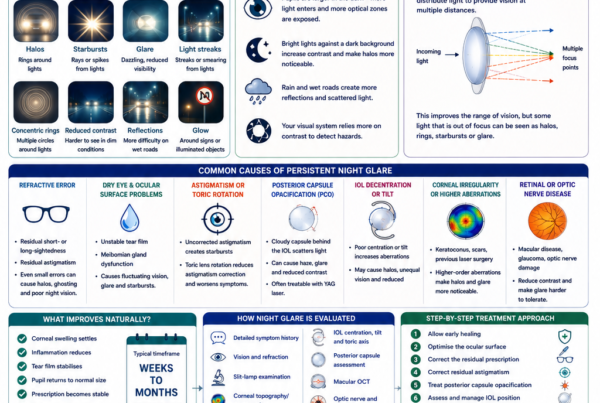
Sign 5: You See Halos or Starbursts Around Lights
Cataracts may cause lights to develop:
- Glowing rings
- Hazy borders
- Star-shaped rays
- Streaks
- Diffuse light scatter
- Multiple overlapping points
These effects may be especially noticeable around:
- Car headlights
- Streetlights
- Traffic signals
- Decorative lights
- Bright text on a dark screen
- The moon
Halos and starbursts occur when the cloudy or irregular lens sends incoming light in several directions instead of focusing it cleanly. They are recognised symptoms of cataract, particularly under night-time or high-glare conditions.
However, halos can also occur because of:
- Dry eye
- Astigmatism
- Corneal irregularity
- Glaucoma
- Previous laser vision correction
- Multifocal intraocular lenses
- Large pupils
Sudden coloured halos accompanied by severe eye pain, headache, nausea or redness may indicate acute angle-closure glaucoma and require urgent care.
Sign 6: Colours Look Faded, Dull or Yellow
A cataract can alter colour perception.
Patients may notice that:
- Whites appear cream or yellow
- Blues look less vivid
- Colours seem washed out
- Clothing colours are harder to distinguish
- Photographs appear dull
- Television images seem less vibrant
- One eye perceives colours differently from the other
Nuclear cataracts commonly cause the central natural lens to become progressively yellow or brown. The ageing lens absorbs and filters shorter wavelengths of visible light, altering colour balance and reducing colour discrimination.
Because the change occurs gradually, many patients do not realise how much colour perception has altered until:
- They compare the two eyes separately
- One eye undergoes cataract surgery
- They view a white surface through the operated and unoperated eye
After surgery, patients may describe whites and blues as unexpectedly bright or cool because they are now looking through a clear artificial lens.
Sign 7: Objects Look Washed Out or Lack Contrast
Contrast sensitivity is the ability to distinguish an object from a background with a similar brightness.
A patient with reduced contrast may struggle to see:
- A grey car on a rainy road
- A step with little colour difference from the floor
- A pedestrian wearing dark clothing at night
- Facial expressions in poor light
- Pale print on white paper
- A ball against a cloudy sky
- Food on a similarly coloured plate
Cataracts can reduce contrast sensitivity even when the patient reads relatively small black letters on a bright white eye chart.
This is why patients sometimes say:
“The eye-chart result seems acceptable, but my vision still does not feel good.”
Contrast sensitivity is particularly important for:
- Night driving
- Mobility
- Sports
- Facial recognition
- Low-light tasks
- Detecting hazards
Research has shown that contrast sensitivity and low-contrast vision may predict night-time hazard detection more effectively than ordinary high-contrast acuity alone.
Sign 8: Night Driving Is Becoming Difficult or Unsafe
Difficulty driving at night is one of the most common reasons patients seek cataract assessment.
You may notice:
- Headlights becoming overwhelming
- Lane markings disappearing in rain
- Difficulty seeing pedestrians
- Delayed recognition of road signs
- Reduced confidence judging distances
- Trouble driving on unlit roads
- Avoiding night driving altogether
- Needing another person to drive after dark
Cataracts reduce contrast and increase disability glare. These effects are amplified at night when the visual system must detect dim objects close to bright light sources.
Studies of patients undergoing cataract surgery have demonstrated improvements in:
- Road-sign recognition
- Hazard detection
- Overall driving performance
- Contrast sensitivity
The improvement in contrast sensitivity was strongly related to improved driving performance.
A patient should not continue driving at night merely because they can still read the licensing-standard eye chart in bright conditions.
Driving requires adequate:
- Contrast
- Glare tolerance
- Reaction time
- Binocular vision
- Visual field
- Confidence and safety
Sign 9: Your Spectacle Prescription Keeps Changing
A cataract can change the focusing power of the natural lens.
You may notice that:
- New spectacles help only briefly
- The prescription changes at repeated visits
- One eye becomes more short-sighted
- Astigmatism changes
- The two eyes become increasingly different
- Distance and reading prescriptions require frequent adjustment
Frequent refractive change is a recognised feature of cataract, particularly as the lens becomes denser or more optically irregular.
A single prescription change does not necessarily mean that a cataract is present.
Other causes include:
- Unstable blood glucose
- Dry eye
- Contact lens warpage
- Keratoconus
- Medication
- Normal refractive change
Repeated changes over a relatively short period should prompt examination of the natural lens and the rest of the eye.
Sign 10: You Are Becoming More Short-Sighted
A nuclear cataract may make the eye progressively more myopic.
Patients may notice:
- Distance signs becoming blurry
- Needing stronger short-sighted spectacles
- Removing glasses to read
- Near vision temporarily seeming better
- A previous reading-glasses requirement decreasing temporarily
This is sometimes called second sight.
The apparent improvement in reading does not mean the cataract is improving. The increasingly dense lens has changed its focusing power, shifting the eye towards myopia.
Second sight is usually temporary.
As the cataract progresses:
- Distance vision deteriorates
- Glare increases
- Contrast falls
- Near vision may eventually deteriorate as well
A new myopic shift in an older patient should prompt assessment for nuclear cataract, although diabetes and other lens-related conditions can also change refraction.
Sign 11: You See Double, Triple or Ghosted Images With One Eye
A cataract can cause monocular diplopia or polyopia.
This means that double or multiple images remain when the unaffected eye is covered.
You may notice:
- A second shadow beside a letter
- Several images of the moon
- Duplicate subtitles
- A ghost image around a person’s face
- Several points of light from one headlight
An irregular cataract can divide incoming light into several optical paths, creating multiple retinal images. Monocular diplopia, polyopia and ghosting are recognised manifestations of cataract.
Monocular double vision may also result from:
- Dry eye
- Corneal irregularity
- Uncorrected astigmatism
- Keratoconus
- A displaced natural or artificial lens
Binocular Double Vision Is Different
Binocular double vision disappears when either eye is covered.
It may be caused by:
- Eye-muscle imbalance
- Cranial nerve palsy
- Thyroid eye disease
- Neurological disease
- Decompensated strabismus
Sudden binocular double vision requires prompt medical assessment.
Sign 12: One Eye Is Becoming Noticeably Worse Than the Other
Cataracts often develop in both eyes, but they do not necessarily progress at the same rate.
You may notice:
- One eye producing dimmer vision
- Different colour perception between the eyes
- One eye seeing more glare
- Difficulty combining the two images
- Reduced depth perception
- Eye strain when using both eyes
- The stronger eye taking over
Cataracts do not spread from one eye to the other. Unequal development occurs because each natural lens ages or responds to risk factors differently.
One eye may develop cataract earlier because of:
- Previous trauma
- Inflammation
- Steroid treatment
- Previous retinal surgery
- Previous glaucoma surgery
- Natural biological variation
A simple home comparison can sometimes reveal asymmetry:
- Cover one eye.
- Look at a familiar distant object.
- Compare clarity, brightness and colour.
- Repeat with the other eye.
This is not a substitute for an eye examination, but it may reveal a difference that binocular vision had been masking.
Sign 13: Reading, Watching Television or Recognising Faces Is Becoming Harder
Cataracts may interfere with everyday detail recognition.
Patients may have difficulty:
- Reading newspaper print
- Reading medication labels
- Following subtitles
- Seeing facial expressions
- Recognising a person across the street
- Seeing fine details on television
- Sewing or doing handicrafts
- Preparing food safely
- Using a computer
Mixed cataract patterns have been associated with difficulty recognising people and performing common near and distance tasks.
The problem may arise from a combination of:
- Reduced visual acuity
- Reduced contrast
- Glare
- Colour changes
- Unequal vision between the eyes
Patients sometimes compensate without realising it by:
- Increasing font size
- Sitting closer to the television
- Using magnification
- Asking others to read labels
- Avoiding detailed activities
These compensations may hide the degree of visual decline.
Sign 14: Stairs, Sports or Everyday Mobility Feel Less Secure
Cataract-related loss of contrast, depth perception and low-light vision may make mobility more difficult.
Possible warning signs include:
- Missing steps or kerbs
- Hesitating on stairs
- Tripping in dim areas
- Difficulty judging the height of a step
- Misjudging the speed or distance of a ball
- Losing sight of a tennis or golf ball
- Reduced confidence walking outdoors at night
- Bumping into low-contrast objects
- Increasing dependence on another person
Visual impairment is only one of many possible causes of falls, but cataract has been associated with increased risks of falls and fractures in older adults. Cataract surgery has also been associated with reduced fall-related injuries in several observational studies.
A fall should never automatically be blamed on cataract.
Other contributors include:
- Muscle weakness
- Balance disorders
- Medication
- Neurological disease
- Low blood pressure
- Poor footwear
- Environmental hazards
However, declining visual contrast and depth perception should be addressed as part of a comprehensive fall-risk assessment.
Sign 15: Updated Glasses No Longer Restore Clear, Comfortable Vision
Early cataract-related refractive change may improve with new spectacles.
As the cataract progresses, patients may find that:
- The best spectacle correction still looks hazy
- Glare remains despite clearer eye-chart letters
- Night driving remains difficult
- Colours remain dull
- Ghosting persists
- Vision is technically measurable but functionally inadequate
- New spectacles become ineffective quickly
Glasses can correct ordinary myopia, hyperopia and regular astigmatism.
They cannot remove:
- Light scatter within the cloudy lens
- Reduced lens transparency
- Cataract-related colour filtering
- Irregular internal optical distortion
When the cataract causes meaningful functional difficulty that cannot be managed adequately with spectacles or lighting, cataract surgery may be considered. Surgery is the only established treatment that removes the cloudy natural lens.
Can You Have Cataracts Without Noticing Any Symptoms?
Yes.
Early cataracts may be found during a routine eye examination before the patient becomes aware of them.
This is especially likely when:
- The cataract is mild
- Only the peripheral lens is affected
- The other eye sees well
- The patient has gradually adapted
- Daily visual demands are limited
- The lighting environment is consistently bright
The presence of a cataract does not automatically mean that surgery is required.
Many early cataracts can be monitored until they begin affecting:
- Safety
- Independence
- Work
- Driving
- Reading
- Quality of life
- Examination or treatment of another eye disease
Why Can Someone Have Good Eye-Chart Vision but Still Need Cataract Surgery?
A standard eye chart typically measures high-contrast visual acuity under bright, controlled conditions.
It does not fully measure:
- Disability glare
- Contrast sensitivity
- Night vision
- Colour perception
- Visual performance in rain
- Real-world hazard detection
- The effect of bright lights near dim objects
Research has shown that cataracts can cause significant real-world impairment even when high-contrast visual acuity remains relatively good. Contrast and glare measurements may improve substantially after surgery independently of changes in standard acuity.
The decision about cataract surgery should therefore consider:
- Symptoms
- Functional needs
- Examination findings
- Other eye disease
- Patient goals
- Surgical risks
It should not depend solely on one line of the eye chart.
Which Cataract Types Cause Which Symptoms?
The location of the cataract influences the symptom pattern.
Nuclear Sclerotic Cataract
This affects the central nucleus of the lens.
Common features include:
- Gradual distance blur
- Increasing myopia
- Temporary second sight
- Yellowing or browning of colour perception
- Reduced contrast
- Slow progression
Cortical Cataract
This affects the outer lens cortex and often forms spoke-like or wedge-shaped opacities.
Common features include:
- Glare
- Halos
- Variable vision
- Light scatter
- Difficulty in bright lighting
- Symptoms that vary with pupil size
Posterior Subcapsular Cataract
This develops near the back-central surface of the lens, close to the visual axis.
Common features include:
- Glare
- Reading difficulty
- Reduced vision in bright light
- Halos
- Disproportionately severe symptoms from a relatively small opacity
- More rapid progression in some patients
Mixed cataracts containing more than one pattern are common.
What Else Can Cause Similar Symptoms?
Cataract symptoms are not unique to cataract.
Dry Eye
Dry eye may cause:
- Fluctuating blur
- Glare
- Burning
- Watering
- Vision that clears after blinking
Uncorrected Spectacle Power
Myopia, hyperopia and astigmatism may cause blur and night-driving difficulty but generally improve consistently with the correct prescription.
Corneal Disease
Keratoconus, corneal scarring or irregular astigmatism may cause:
- Ghosting
- Halos
- Multiple images
- Distortion
Glaucoma
Glaucoma usually affects the peripheral visual field before central visual acuity.
It may have no symptoms until advanced.
Macular Disease
Macular degeneration, epiretinal membrane and macular oedema may cause:
- Central distortion
- Difficulty reading
- Reduced detail
- Missing areas of vision
Retinal Detachment
Retinal tears or detachment may cause:
- Flashes
- A sudden increase in floaters
- A curtain-like shadow
- Sudden peripheral visual-field loss
These are not routine cataract symptoms and require urgent assessment.
How Are Cataracts Diagnosed?
A cataract assessment may include the following.
Visual Acuity
Vision is measured:
- Without correction
- With current spectacles
- After refraction
- In each eye separately
Refraction
This determines whether changing the spectacle prescription improves vision.
Frequent changes, myopic shift or irregular measurements may provide clues about lens change.
Slit-Lamp Examination
The ophthalmologist examines:
- The natural lens
- Cataract type
- Cataract density
- Cornea
- Anterior chamber
- Iris
- Pupil
- Signs of trauma or inflammation
Glare and Contrast Assessment
These may be useful when a patient has:
- Good bright-room acuity
- Significant night-driving difficulty
- Headlight glare
- Low-contrast complaints
Glare and contrast testing can provide additional evidence of functional visual impairment.
Eye-Pressure Measurement
This helps identify glaucoma or another pressure-related condition.
Dilated Retinal Examination
The retina, macula and optic nerve are examined to identify other causes of visual loss.
OCT
OCT may be used to detect:
- Epiretinal membrane
- Macular degeneration
- Macular oedema
- Vitreomacular traction
- Glaucomatous nerve damage
These findings help estimate the visual potential after cataract surgery.
When Should Cataract Surgery Be Considered?
Cataract surgery is generally considered when cataract-related visual impairment affects activities important to the patient.
Examples include difficulty with:
- Driving
- Night driving
- Reading
- Work
- Computer use
- Sports
- Cooking
- Walking safely
- Recognising faces
- Managing medication
- Maintaining independence
Surgery may also be considered when the cataract prevents adequate examination or treatment of the retina.
There is no single visual-acuity number at which every patient must undergo surgery.
A patient with 6/6 acuity but severe glare may have a stronger functional indication than a patient with poorer measured acuity who remains comfortable and independent.
Does a Cataract Need to Become “Ripe”?
No.
Modern cataract surgery is not based on waiting until the lens becomes completely white or vision becomes severely impaired.
The timing is guided by:
- Symptoms
- Functional difficulty
- Safety
- Other eye conditions
- Cataract density
- Surgical complexity
- Patient preference
Waiting is often safe when symptoms are mild. However, a very dense or mature cataract may require more surgical energy and make examination of the retina more difficult.
The aim is neither to rush into surgery nor to wait until the patient has lost unnecessary function.
Can Cataracts Be Treated Without Surgery?
Early symptoms may sometimes be managed temporarily with:
- Updated spectacles
- Better lighting
- Magnification
- Anti-glare sunglasses
- Avoiding unsafe night driving
- Increasing text size
- Treating accompanying dry eye
These measures do not remove the cataract.
There are currently no established eyedrops, supplements, exercises or diets that reliably restore transparency to an age-related cataract. Surgery remains the only proven method of removing the cloudy natural lens.
What Happens During Cataract Surgery?
During modern cataract surgery:
- Small corneal incisions are made.
- An opening is created in the front lens capsule.
- The cloudy natural lens is divided and removed.
- The remaining capsular bag is cleaned.
- A clear artificial intraocular lens is inserted.
- The incision usually seals without stitches.
The operation replaces the cloudy lens with an artificial lens selected according to the patient’s eye measurements and visual goals.
When Are Cataract Symptoms Urgent?
Ordinary age-related cataracts usually cause gradual, painless visual change.
Seek urgent assessment for:
- Sudden loss of vision
- Rapidly worsening vision
- Severe eye pain
- Marked redness
- Significant discharge
- Sudden new double vision
- New flashes of light
- A sudden shower of floaters
- A curtain or shadow in the visual field
- Sudden distortion
- Eye trauma
- Headache, nausea and coloured halos
These symptoms may indicate:
- Retinal tear or detachment
- Acute glaucoma
- Corneal infection
- Uveitis
- Vascular occlusion
- Neurological disease
- Another urgent condition
They should not be attributed to a slowly developing cataract without examination.
Frequently Asked Questions
What Is Usually the First Sign of Cataract?
Gradual, painless blurring or clouding of vision is common.
Some patients first notice glare, faded colours or difficulty driving at night.
Can Cataracts Begin With Glare Rather Than Blur?
Yes.
Glare and reduced contrast may become troublesome before standard eye-chart acuity deteriorates significantly.
Can Cataracts Affect Only Night Vision?
Early cataracts may be much more noticeable at night because contrast is lower and bright headlights produce internal light scatter.
Daytime acuity may remain relatively good.
Can Cataracts Make Bright Light Worse?
Yes.
Some cataracts increase glare in sunlight, around headlights or in brightly illuminated areas.
Why Do I Need More Light to Read?
The cataract blocks and scatters light, reducing the contrast of print.
Brighter illumination temporarily improves visibility.
Why Do Colours Look Yellow?
The ageing or cataractous lens may become increasingly yellow or brown, filtering certain wavelengths of visible light.
Can Cataracts Cause Colour Blindness?
Cataracts do not usually cause inherited colour blindness.
They can reduce colour discrimination and make colours appear faded, yellowed or less vibrant.
Can Cataracts Cause Double Vision?
Yes.
An irregular cataract may cause monocular double or multiple images that remain when the other eye is covered.
Can Cataracts Cause Headaches?
Cataracts do not directly cause most headaches.
Visual strain from blur or changing prescription may contribute to discomfort, but persistent or severe headaches require separate assessment.
Can Cataracts Cause Eye Pain?
Ordinary age-related cataracts are usually painless.
Pain, redness or sudden light sensitivity suggests another condition or a cataract-related complication.
Can Cataracts Cause Floaters?
No.
Ordinary floaters arise from the vitreous gel rather than the natural lens.
New floaters require retinal assessment, particularly when accompanied by flashes.
Can Cataracts Cause Flashes of Light?
No.
Flashes commonly arise from vitreous traction on the retina and may indicate a retinal tear.
Can Cataracts Cause a Curtain-Like Shadow?
No.
A curtain or shadow suggests possible retinal detachment and requires urgent examination.
Can Cataracts Cause Myopia?
Nuclear cataracts may produce a myopic shift, making distance vision more blurred while unaided near vision temporarily improves.
Is Better Reading Vision a Good Sign?
Not necessarily.
A temporary improvement in unaided near vision in an older patient may represent cataract-related second sight.
Why Does My Spectacle Power Keep Changing?
The cataract may be altering the natural lens’s focusing power.
Diabetes, dry eye and other conditions can also cause variable refraction.
Can One Eye Have a Cataract Before the Other?
Yes.
The two eyes commonly progress at different rates.
Do Cataracts Spread Between Eyes?
No.
Each natural lens develops its own cataract independently.
Can You See a Cataract in the Mirror?
Most early cataracts cannot be seen without specialised examination.
A very advanced cataract may eventually make the pupil appear white or grey, but patients should not wait for this stage before seeking assessment.
Is Cataract the Same as a Film Over the Eye?
No.
A cataract is clouding inside the natural lens behind the iris.
Can Cataracts Be Washed Away or Scraped Off?
No.
The cloudy lens is inside the eye.
Do Cataract Drops Work?
There are currently no established eyedrops that reliably reverse ordinary age-related cataracts.
Can New Glasses Treat Cataracts?
New glasses may temporarily improve the refractive component of early cataract.
They cannot remove lens opacity or internal light scatter.
How Do I Know When It Is Time for Surgery?
Surgery may be considered when symptoms affect safety, independence or activities that matter to you and other causes of reduced vision have been assessed.
Does the Cataract Need to Be Ripe?
No.
Modern timing is based on function and eye health rather than waiting for extreme cataract maturity.
Key Takeaway
The 15 possible signs of cataract are:
- Gradual, painless blurred or hazy vision
- Difficulty seeing in dim lighting
- Needing brighter light to read or work
- Increasing glare from headlights or sunlight
- Halos or starbursts around lights
- Faded, dull or yellowed colours
- Reduced contrast or washed-out vision
- Increasing difficulty driving at night
- Frequent changes in spectacle prescription
- Increasing myopia or temporary “second sight”
- Double, multiple or ghosted images from one eye
- One eye becoming worse than the other
- Difficulty reading, watching television or recognising faces
- Reduced confidence with stairs, sports or mobility
- Glasses no longer restoring clear, comfortable vision
Cataracts may affect real-world visual function before a bright-room eye chart shows major deterioration.
The decision about surgery should consider:
- Glare
- Contrast
- Night vision
- Driving
- Reading
- Work
- Sports
- Mobility
- Independence
- Other eye conditions
A cataract does not need to become “ripe.”
Surgery is the only established treatment that removes the cloudy natural lens, but it should be performed when the expected functional benefit justifies the risks.
Sudden vision loss, severe pain, marked redness, flashes, many new floaters or a curtain-like shadow are not typical signs of an ordinary cataract and require urgent assessment.
References
- National Eye Institute. Cataracts. Updated November 2025.
- National Eye Institute. Cataracts and the Eye.
- National Eye Institute. Types of Cataract. Updated August 2025.
- National Eye Institute. Cataract Surgery. Updated December 2024.
- Singapore National Eye Centre and SingHealth. Cataract Surgery: Symptoms, Diagnosis and Treatment.
- National University Hospital. Cataract: Symptoms, Causes and Treatment. Updated July 2025.
- Delbarre M, Froussart-Maille F. Signs, Symptoms and Clinical Forms of Cataract in Adults. 2020. PMID: 32586638.
- Brown NA, Hill AR. The Morphology of Cataract and Visual Performance. 1993. PMID: 8325426.
- Samarawickrama C, et al. Nuclear Cataract and Myopic Shift in Refraction. 2007. PMID: 17765431.
- Elliott DB, et al. Effect of a Cataract Simulation on Clinical and Real-World Vision. 1996. PMID: 8942376.
- Superstein R, et al. Glare Disability and Contrast Sensitivity Before and After Cataract Surgery. 1997. PMID: 9113577.
- Rubin GS, et al. Comparison of Acuity, Contrast Sensitivity and Disability Glare Before and After Cataract Surgery. 1993. PMID: 8424725.
- Wood JM, et al. Bilateral Cataract Surgery and Driving Performance. 2006. PMID: 16825273.
- Jones PR, et al. Contrast Sensitivity and Night Driving in Older People. 2022. PMID: 35966995.
- Ni W, et al. Impact of Cataract Surgery on Vision-Related Life Performances. 2015. PMID: 26272444.
- Tsang JY, et al. Risk of Falls and Fractures in Individuals With Cataract. 2024. PMID: 38153708.
- Alghamdi MA. Impact of Cataract on Colour Vision and Contrast Sensitivity. 2026. PMID: 41988617.