Author: Dr Val Phua
Estimated reading time: 13–15 minutes
What Is Blurred Vision?
Blurred vision means that objects do not appear as clear, sharp or well defined as usual.
A person may describe the problem as:
- Out of focus
- Hazy
- Misty
- Cloudy
- Smudged
- Like looking through dirty glass
- Unable to see fine details
- Needing to squint to make objects clearer
Blurred vision is a symptom rather than a diagnosis.
It may result from something common and easily corrected, such as:
- Short-sightedness
- Long-sightedness
- Astigmatism
- Presbyopia
- Dry eye
- An outdated spectacle prescription
It can also be caused by conditions requiring urgent treatment, including:
- Corneal infection
- Acute angle closure
- Retinal detachment
- Retinal vascular occlusion
- Optic-nerve ischaemia
- Giant cell arteritis
- Stroke
The most common symptom of a refractive error is blurred vision, but blur can arise from almost any structure involved in sight—from the tear film at the front of the eye to the visual areas of the brain.
Is Blurred Vision the Same as Vision Loss?
Not always.
Blurred vision may still allow the person to see the object, but with reduced sharpness.
Vision loss may involve:
- A missing area
- A dark shadow
- A curtain over the vision
- Loss of central vision
- Loss of side vision
- Complete inability to see
- Severe reduction to shapes, movement or light only
Patients sometimes describe a missing visual field as “blur,” especially when they have not tested each eye separately.
Sudden inability to see from one or both eyes is a medical emergency.
Is Blur the Same as Distorted Vision?
No.
Blurred vision means details look unfocused.
Distorted vision means that objects appear to have the wrong shape.
Examples include:
- Straight lines appearing wavy
- Doorframes looking bent
- Words appearing stretched
- Faces looking uneven
- Objects appearing larger in one eye
- Objects appearing smaller in one eye
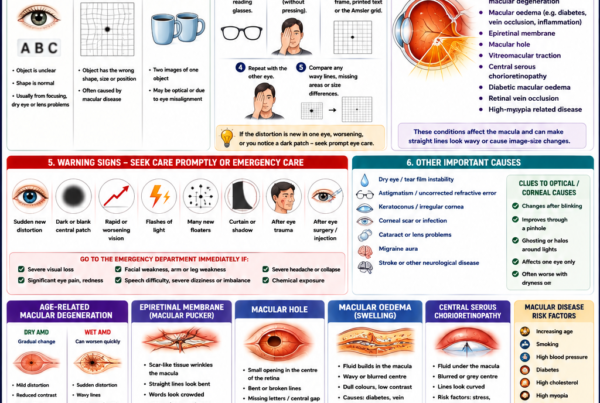
Distortion often suggests a problem affecting the macula, such as:
- Macular oedema
- Wet age-related macular degeneration
- Epiretinal membrane
- Macular hole
Macular oedema can cause blurred or wavy central vision, altered object size and faded colours.
Is Blur the Same as Double Vision?
No.
Double vision means seeing two images of one object.
It may be:
- Monocular: remains when the other eye is covered
- Binocular: disappears when either eye is covered
Monocular double vision can occur with:
- Dry eye
- Astigmatism
- Cataract
- Corneal irregularity
- Lens displacement
Binocular double vision may result from:
- An eye-muscle imbalance
- Cranial nerve palsy
- Thyroid eye disease
- Stroke
- Neurological disease
New double vision should be assessed even when it comes and goes.
What Details Help Determine the Cause?
The word “blurred” alone does not reveal the diagnosis.
The most important questions include:
- Did it begin suddenly or gradually?
- Is one eye affected or both?
- Is it constant or intermittent?
- Is distance, near or all vision affected?
- Is the eye painful?
- Is the eye red?
- Are there flashes or new floaters?
- Is there a shadow or curtain?
- Do straight lines look wavy?
- Is there headache, weakness or difficulty speaking?
- Does blinking temporarily clear the vision?
- Is the patient wearing contact lenses?
- Has there been injury, surgery or a new medication?
These features help distinguish a spectacle problem from a corneal, retinal, optic-nerve or neurological emergency.
Sudden Versus Gradual Blurred Vision
Sudden Blurred Vision
Blur developing over seconds, minutes or hours is more concerning.
Possible causes include:
- Retinal artery or vein occlusion
- Retinal tear or detachment
- Vitreous haemorrhage
- Acute angle closure
- Corneal infection
- Optic neuritis
- Ischaemic optic neuropathy
- Migraine aura
- Transient ischaemic attack
- Stroke
Sudden blur does not always mean that the cause is permanent, but it should not be ignored while waiting to see whether it improves.
Gradual Blurred Vision
Blur developing over weeks, months or years is more commonly associated with:
- Refractive error
- Presbyopia
- Cataract
- Dry eye
- Diabetic retinopathy
- Macular degeneration
- Epiretinal membrane
- Progressive corneal disease
- Chronic glaucoma
- Medication effects
Gradual does not automatically mean harmless. Progressive retinal, optic-nerve and corneal disease can cause permanent visual loss without pain.
One Eye Versus Both Eyes
Blur in One Eye
Possible causes include:
- A refractive difference between the eyes
- Dry eye affecting one eye more
- Corneal abrasion or infection
- Cataract
- Retinal detachment
- Retinal vascular occlusion
- Macular degeneration
- Macular oedema
- Optic neuritis
- Ischaemic optic neuropathy
- Amblyopia in a child
One-eye blur may be missed because the better eye compensates.
Blur in Both Eyes
Possible causes include:
- Refractive error
- Presbyopia
- Dry eye
- Cataracts in both eyes
- Blood-sugar fluctuation
- Medication effects
- Migraine aura
- Neurological disease
- Bilateral retinal or optic-nerve conditions
Sudden blur in both eyes with weakness, speech difficulty, confusion or imbalance may represent a neurological emergency. Stroke organisations include sudden blurred vision or loss of sight among potential stroke symptoms.
Why Should You Cover One Eye at a Time?
The visual fields of the two eyes overlap.
A strong eye may conceal substantial visual reduction in the other.
When blur develops, note what happens when:
- The right eye is covered.
- The left eye is covered.
- Both eyes are open.
This information can help the clinician but should not be used to delay urgent assessment.
Warning Signs Requiring Emergency Care
Seek immediate medical or ophthalmic care for blurred vision accompanied by:
- Sudden severe loss of sight
- Severe eye pain
- A painful red eye
- Halos with headache, nausea or vomiting
- A dark curtain or shadow
- A sudden shower of floaters
- Flashes of light with new blur
- Weakness or numbness on one side
- Facial drooping
- Difficulty speaking
- Sudden confusion
- Severe imbalance
- A new severe headache
- Significant eye trauma
- Chemical exposure
- A white spot on the cornea
- Sudden vision symptoms with temple or jaw pain in a person over 50
Do not drive yourself when vision is significantly impaired.
Retinal Detachment Warning Symptoms
Retinal detachment is an emergency.
Symptoms may include:
- A sudden increase in floaters
- Flashes of light
- A shadow entering from the side
- A curtain across the field of vision
- Sudden peripheral or central blur
Treatment is time-sensitive because a larger detachment increases the risk of permanent vision loss.
Stroke Warning Symptoms
Blurred vision may be a stroke symptom when it develops suddenly with:
- Facial weakness
- Arm or leg weakness
- Numbness
- Difficulty speaking
- Confusion
- Severe dizziness
- Unsteadiness
- Loss of part of the visual field
- A sudden severe headache
Emergency assessment is needed even if the symptoms improve, because a transient ischaemic attack may precede a completed stroke.
Giant Cell Arteritis Warning Symptoms
Giant cell arteritis is an inflammatory blood-vessel condition affecting people over 50.
It can interrupt blood supply to the optic nerve and cause irreversible visual loss.
Warning symptoms include:
- New severe headache
- Scalp tenderness
- Temple pain
- Jaw pain while chewing
- Tongue pain while eating
- Unexplained weight loss
- Fever or marked fatigue
- Temporary visual obscurations
- Double vision
- Sudden blurred or lost vision
Treatment may need to begin before all test results are available because the second eye can become affected rapidly.
Painful Versus Painless Blur
Painful Blurred Vision
Possible causes include:
- Corneal abrasion
- Corneal infection
- Contact-lens-related keratitis
- Uveitis
- Acute angle closure
- Scleritis
- Eye trauma
- Postoperative infection
- Optic neuritis
Painful blur is more concerning when associated with:
- Redness
- Light sensitivity
- Watering
- Discharge
- Contact-lens use
- Reduced vision
NICE identifies reduced visual acuity, moderate-to-severe pain, headache and photophobia as red flags in a red eye.
Painless Blurred Vision
Possible causes include:
- Refractive error
- Cataract
- Retinal detachment
- Retinal vascular occlusion
- Macular degeneration
- Diabetic macular oedema
- Vitreous haemorrhage
- Ischaemic optic neuropathy
- Stroke
- Chronic glaucoma
The absence of pain does not mean that the cause is safe.
Common Causes of Blurred Vision
Refractive Error
Refractive errors occur when light is not focused sharply onto the retina.
They include:
- Myopia
- Hyperopia
- Astigmatism
- Presbyopia
Myopia
Myopia makes distant objects appear blurred while near objects remain clearer.
Hyperopia
Hyperopia commonly affects near vision but may cause blur at all distances when the degree is significant or focusing ability is reduced.
Astigmatism
Astigmatism can make both near and distant objects look blurred, stretched or distorted.
Presbyopia
Presbyopia is the age-related reduction in near focusing ability.
Symptoms often begin with:
- Holding reading material farther away
- Needing brighter light
- Delayed focusing from distance to near
- Eye strain during reading
- Near blur that worsens when tired
Refractive errors are common and usually correctable with spectacles, contact lenses or selected surgical procedures.
Dry Eye
Dry eye occurs when the eyes do not produce enough tears or the tears do not remain stable over the eye.
Symptoms may include:
- Intermittent blur
- Burning
- Grittiness
- Redness
- Watering
- Heavy eyelids
- Contact-lens discomfort
- Eye fatigue
Blur from an unstable tear film often:
- Fluctuates
- Worsens with screen use
- Worsens in air conditioning
- Temporarily improves after blinking
- Improves after appropriate lubrication
Blink-related improvement suggests tear-film instability but does not prove that dry eye is the only problem.
Dry eye is a recognised cause of blurred vision, burning and scratchiness.
Screen-Related Blur
Long periods of screen use reduce blinking.
This may worsen:
- Tear evaporation
- Dry eye
- Eye fatigue
- Temporary focusing spasm
- Difficulty changing focus from near to distance
Screen use does not usually cause sudden permanent visual loss.
Persistent blur despite blinking, lubrication and rest requires an eye examination.
Contact-Lens-Related Blur
Contact lenses may cause blur because of:
- A dirty or deposited lens
- Lens movement
- An incorrect prescription
- Dryness
- Torn or damaged lenses
- Corneal swelling
- Wearing lenses too long
- Sleeping in lenses
- Contact-lens infection
Remove the lens and seek urgent assessment when blur is accompanied by:
- Pain
- Redness
- Light sensitivity
- Discharge
- A white corneal spot
- Difficulty opening the eye
Contact-lens-related keratitis is a potentially serious cause of corneal scarring and visual loss.
Cataract
A cataract is clouding of the eye’s natural lens.
Cataracts usually cause gradual, painless symptoms including:
- Blurred or hazy vision
- Glare
- Halos
- Poor night vision
- Faded colours
- Increasing spectacle changes
- Difficulty driving at night
- Double vision from one eye
Cataract blur may feel like looking through a foggy or dirty window.
Surgery is considered when the cataract interferes meaningfully with daily activities or examination of the retina and optic nerve.
Corneal Abrasion or Foreign Body
A scratch or foreign object on the cornea may cause:
- Sudden blur
- Sharp pain
- Watering
- Light sensitivity
- A foreign-body sensation
- Difficulty opening the eye
A central abrasion may reduce vision more than a peripheral abrasion.
Metal, glass, plant matter, chemical injury and high-velocity trauma require prompt assessment.
Corneal Infection
Corneal infection may develop after:
- Contact-lens wear
- Sleeping in lenses
- Exposure to contaminated water
- Trauma
- Eye-surface disease
- Previous corneal surgery
Symptoms commonly include:
- Pain
- Redness
- Blurred vision
- Light sensitivity
- Watering or discharge
- A visible white or grey spot
This requires urgent treatment.
Steroid eye drops should not be self-started for a painful red eye because they may worsen certain infections.
Corneal Swelling
The cornea must remain clear and appropriately dehydrated.
Swelling may cause:
- Hazy vision
- Halos
- Glare
- Morning blur
- A foggy appearance
- Pain from surface blisters in advanced cases
Possible causes include:
- Fuchs endothelial dystrophy
- Very high eye pressure
- Previous eye surgery
- Contact-lens overwear
- Corneal inflammation
- Endothelial-cell loss
Keratoconus and Irregular Cornea
Keratoconus causes progressive corneal thinning and irregular steepening.
Possible symptoms include:
- Increasing astigmatism
- Frequent spectacle changes
- Ghost images
- Halos
- Blur not fully corrected by glasses
- Distortion
- Difficulty with night vision
Corneal topography or tomography is needed to diagnose the condition.
Uveitis
Uveitis is inflammation inside the eye.
Symptoms may include:
- Blurred vision
- Eye pain
- Redness
- Light sensitivity
- Floaters
Some forms are painless, particularly inflammation affecting the middle or back of the eye.
Treatment depends on whether the uveitis is infectious, autoimmune or associated with another condition.
Acute Angle-Closure Glaucoma
Acute angle closure occurs when the eye’s drainage angle becomes blocked suddenly and eye pressure rises rapidly.
Symptoms may include:
- Severe eye or brow pain
- Redness
- Sudden misty vision
- Halos around lights
- Headache
- Nausea
- Vomiting
- A cloudy cornea
This is an emergency because prolonged high pressure can permanently damage the optic nerve.
Does Chronic Glaucoma Cause Blur?
Most chronic open-angle glaucoma does not cause general blurred vision in its early stages.
Central visual acuity may remain clear while peripheral visual-field damage develops silently.
Blur in a glaucoma patient may instead be caused by:
- Cataract
- Dry eye from glaucoma medication
- An incorrect spectacle prescription
- Corneal disease
- Advanced central glaucomatous damage
- A complication of surgery
A patient should not assume that every visual change is simply “the glaucoma.”
Retinal and Macular Causes
Age-Related Macular Degeneration
Age-related macular degeneration affects the macula, which provides detailed central vision.
Later disease may cause:
- A blurred central area
- Wavy or crooked lines
- Missing central patches
- Reduced colour brightness
- Difficulty reading
- Difficulty recognising faces
New distortion or a rapidly developing central blur may indicate wet AMD and requires prompt assessment.
Macular Oedema
Macular oedema is swelling caused by fluid leaking into the macula.
Possible causes include:
- Diabetic retinopathy
- Retinal vein occlusion
- Uveitis
- Cataract-surgery inflammation
- Other retinal vascular conditions
Symptoms include:
- Central blur
- Wavy lines
- Reduced contrast
- Faded colours
- Objects appearing different sizes between the eyes
OCT is commonly used to confirm and monitor macular swelling.
Epiretinal Membrane
An epiretinal membrane is a layer of scar-like tissue on the macular surface.
It may cause:
- Gradual central blur
- Distortion
- Bent lines
- Different image sizes between the eyes
- Difficulty reading small print
Mild membranes may require monitoring only.
Surgery may be considered when distortion significantly affects daily function.
Macular Hole
A macular hole is an opening within the central retina.
Symptoms may include:
- Central blur
- Wavy vision
- A small central missing patch
- Difficulty reading
- Reduced vision in one eye
OCT confirms the diagnosis and helps guide treatment.
Diabetic Retinopathy
Diabetes can affect vision through:
- Fluctuating blood sugar
- Cataract
- Diabetic retinopathy
- Diabetic macular oedema
- Vitreous haemorrhage
- Tractional retinal detachment
- Neovascular glaucoma
Early diabetic retinopathy often causes no symptoms.
Blur may develop when retinal blood vessels leak fluid into the macula or bleed into the eye.
Can Blood-Sugar Changes Cause Temporary Blur?
Yes.
Rapid changes in blood glucose can temporarily alter the water content and focusing power of the natural lens.
The spectacle prescription may therefore fluctuate while glucose is unstable.
Patients should avoid repeatedly changing spectacles during major glucose shifts without discussing timing with the eye doctor.
Persistent blur still requires retinal and lens assessment because diabetes can cause several independent eye conditions.
Retinal Vein Occlusion
A retinal vein occlusion occurs when a vein draining blood from the retina becomes blocked.
It may cause:
- Sudden painless blur
- Partial visual loss
- Severe visual loss
- Macular oedema
- Retinal bleeding
- New floaters
Central retinal vein occlusion commonly presents with blurred vision or sudden visual loss and requires a dilated retinal examination and imaging.
Retinal Artery Occlusion
A retinal artery occlusion interrupts blood flow into the retina.
It commonly causes:
- Sudden
- Painless
- Marked visual loss in one eye
Patients may describe:
- A curtain
- A blackout
- Severe blur
- Loss of part or all of the visual field
It requires emergency ocular and systemic vascular assessment because it may be associated with stroke risk.
Vitreous Haemorrhage
Bleeding into the vitreous gel may cause:
- Sudden blur
- Haze
- Cobwebs
- Dark spots
- Red or brown shadows
- Severe visual loss
Possible causes include:
- Diabetic retinopathy
- Retinal tear
- Retinal vein occlusion
- Trauma
- Abnormal retinal blood vessels
The retina must be assessed to exclude an associated tear or detachment.
Optic-Nerve Causes
Optic Neuritis
Optic neuritis is inflammation of the optic nerve.
It may cause:
- Blur in one eye
- Reduced colour intensity
- A central blind spot
- Pain with eye movement
- Reduced contrast
- Visual loss developing over hours or days
It may be associated with demyelinating or inflammatory disease.
Atypical age, severe disc swelling, absence of recovery or unusual systemic features may require additional investigation.
Ischaemic Optic Neuropathy
Ischaemic optic neuropathy occurs when blood supply to the optic nerve becomes insufficient.
It may cause:
- Sudden painless blur
- Loss of the upper or lower visual field
- Reduced colour vision
- A swollen optic nerve
- A relative afferent pupillary defect
In patients over 50, giant cell arteritis must be considered urgently when systemic warning symptoms are present.
Papilloedema and Raised Intracranial Pressure
Raised pressure around the brain can cause swelling of both optic nerves.
Symptoms may include:
- Headache
- Brief episodes of visual dimming
- Double vision
- Blind spots
- Pulsatile tinnitus
- Peripheral visual loss
Idiopathic intracranial hypertension is one possible cause, but brain tumours, blood clots and other conditions must sometimes be excluded.
Neurological Causes
Migraine Aura
Migraine aura may cause temporary visual symptoms such as:
- Zigzag lines
- Shimmering lights
- A spreading blind spot
- Distortion
- Temporary blur
- Coloured patterns
A typical aura often:
- Develops gradually
- Expands over several minutes
- Affects corresponding areas of both eyes
- Resolves within approximately an hour
A first episode, an atypical episode or symptoms with weakness, speech difficulty or persistent visual loss require medical assessment rather than being assumed to be migraine.
Stroke or Transient Ischaemic Attack
Stroke-related visual symptoms may include:
- Sudden blur
- Double vision
- Loss of one side of the visual field
- Loss of sight in one or both eyes
- Difficulty coordinating eye movements
Associated neurological symptoms increase concern, but isolated visual loss can also represent a vascular event.
Emergency assessment is required even when vision returns.
Medication-Related Blur
Blurred vision may be caused by:
- Pupil-dilating medication
- Anticholinergic drugs
- Sedatives
- Antihistamines that worsen dry eye
- Steroids causing cataract or pressure elevation
- Drugs affecting accommodation
- Toxic retinal or optic-nerve effects
- Changes in blood sugar from medication
Patients should not stop an important systemic medication independently.
The clinician needs to know:
- Drug name
- Dose
- Start date
- Timing of symptoms
- Whether one or both eyes are affected
Blurred Vision After Eye Drops
Temporary blur may occur after:
- Lubricating gels
- Ointments
- Dilating drops
- Glaucoma drops
- Antibiotic ointment
- Postoperative medication
Short-lived blur immediately after a thick preparation is expected.
Persistent or worsening blur—particularly with pain or redness—requires assessment.
Blurred Vision After Pupil Dilation
Dilating drops may cause:
- Near blur
- Light sensitivity
- Glare
- Difficulty focusing
The effect commonly lasts several hours and occasionally longer depending on:
- Drop used
- Iris colour
- Age
- Individual response
Patients should avoid driving when vision remains affected.
Blurred Vision After Eye Surgery
Temporary blur is common after:
- Cataract surgery
- LASIK or PRK
- Retinal procedures
- Glaucoma surgery
- Intravitreal injections
Possible reasons include:
- Corneal swelling
- Inflammation
- Surface dryness
- Dilating drops
- Healing
- Refractive change
Urgent postoperative assessment is needed for:
- Increasing pain
- Marked redness
- Discharge
- Worsening rather than improving vision
- New flashes or floaters
- A curtain or shadow
- Nausea with eye pain
After cataract surgery, most people ultimately see better, but initial blur can occur while the eye recovers.
Blurred Vision in Children
Common causes include:
- Myopia
- Hyperopia
- Astigmatism
- Amblyopia
- Strabismus
- Focusing problems
- Keratoconus
- Childhood cataract
- Retinal or optic-nerve disease
Children may not say that vision is blurred.
Possible clues include:
- Squinting
- Sitting close to screens
- Holding books very near
- Covering one eye
- Closing one eye in bright light
- Head tilting
- Declining school performance
- Frequent headaches
- Losing place while reading
- One eye drifting
A child with sudden blur, pain, trauma, a white pupil, abnormal eye movements or a new squint requires prompt assessment.
Why Can Blur Come and Go?
Intermittent blur may be caused by:
- Dry eye
- Tear-film instability
- Focusing fatigue
- Blood-sugar changes
- Migraine aura
- Intermittent angle closure
- Contact-lens movement
- Variable corneal swelling
- Transient vascular insufficiency
Intermittent symptoms can still be serious.
Temporary loss of vision in one eye may represent amaurosis fugax or giant cell arteritis and requires urgent vascular assessment.
Why Is Vision Blurry on Waking?
Possible causes include:
- Dry eye
- Overnight corneal swelling
- Fuchs endothelial dystrophy
- Eyelid exposure during sleep
- Mucus or tear-film debris
- Contact-lens overwear
- Recurrent corneal erosion
Blur that is consistently worst in the morning and clears over several hours may suggest corneal endothelial dysfunction, but an examination is needed.
Why Is Vision Blurry at Night?
Possible causes include:
- Cataract
- Uncorrected myopia or astigmatism
- Dry eye
- Large pupils exposing peripheral optical aberrations
- Corneal irregularity
- Multifocal lens effects
- Reduced retinal or optic-nerve function
Night blur with glare does not automatically mean cataract.
Why Is Vision Blurry After Reading or Screen Use?
Possible causes include:
- Dry eye
- Presbyopia
- Uncorrected hyperopia
- Convergence insufficiency
- Accommodative fatigue
- An unsuitable spectacle prescription
Convergence insufficiency can cause near blur, double vision, headache, sore eyes and difficulty concentrating.
Can Dehydration Cause Blurred Vision?
Dehydration may worsen:
- Dry eye
- Tear-film instability
- Fatigue
- Dizziness
However, persistent or significant blurred vision should not be attributed to dehydration without an eye examination.
Can High Blood Pressure Cause Blur?
Severely elevated blood pressure can affect:
- The retina
- Optic nerve
- Brain
- Retinal blood vessels
Blur associated with:
- Severe headache
- Chest pain
- Breathlessness
- Weakness
- Confusion
- Very high blood pressure
requires urgent medical assessment.
Can Low Blood Pressure Cause Blur?
Low blood pressure may cause:
- Temporary dimming
- Light-headedness
- Blur when standing
- Fainting
Repeated episodes may reflect:
- Dehydration
- Medication effects
- Heart-rhythm problems
- Blood loss
- Autonomic dysfunction
The symptoms may be systemic rather than caused by an eye disorder.
How Is Blurred Vision Assessed?
History
The clinician asks about:
- Onset
- Duration
- One or both eyes
- Pain
- Redness
- Flashes or floaters
- Distortion
- Headache
- Neurological symptoms
- Contact-lens use
- Diabetes
- Trauma
- Surgery
- Medication
- Family history
Visual-Acuity Testing
Each eye is tested separately.
Distance and near vision may be assessed.
A marked difference between the eyes may be clinically important even when the better eye allows normal binocular function.
Pinhole Testing
Looking through a small pinhole reduces unfocused peripheral light rays.
Vision that improves substantially through a pinhole often suggests a refractive component.
Failure to improve may suggest:
- Cataract
- Corneal opacity
- Retinal disease
- Optic-nerve disease
- Severe irregular astigmatism
Pinhole testing is a clue, not a complete diagnosis.
Refraction
Refraction determines whether spectacles or contact lenses can sharpen the image.
The clinician assesses:
- Myopia
- Hyperopia
- Astigmatism
- Presbyopia
- Changes from the previous prescription
Pupil Examination
The pupils are assessed for:
- Size
- Shape
- Light response
- Asymmetry
- Relative afferent pupillary defect
An abnormal pupil response may indicate significant retinal or optic-nerve dysfunction.
Eye-Pressure Measurement
Pressure testing helps identify:
- Acute angle closure
- Ocular hypertension
- Glaucoma
- Uveitis-related pressure changes
- Postoperative pressure problems
A normal pressure does not exclude retinal, optic-nerve or neurological disease.
Slit-Lamp Examination
The slit lamp examines:
- Eyelids
- Tear film
- Conjunctiva
- Cornea
- Anterior chamber
- Iris
- Lens
It may identify:
- Dry eye
- Abrasion
- Infection
- Inflammation
- Cataract
- Contact-lens complications
Dilated Retinal Examination
Dilating drops allow assessment of:
- Vitreous
- Retina
- Macula
- Blood vessels
- Optic nerve
- Peripheral retinal tears
- Retinal detachment
Dilation is particularly important when blur is associated with:
- Flashes
- Floaters
- Diabetes
- Retinal vascular risk
- Central distortion
- Unexplained one-eye visual loss
Optical Coherence Tomography
OCT provides cross-sectional images of:
- Macula
- Retinal layers
- Optic nerve
- Retinal nerve-fibre layer
It helps diagnose:
- Macular oedema
- Epiretinal membrane
- Macular hole
- AMD
- Glaucoma
- Optic-nerve disease
Retinal Photography and Angiography
Retinal photographs document:
- Bleeding
- Diabetic changes
- Vascular occlusion
- Optic-disc abnormalities
- Progression over time
Fluorescein or OCT angiography may assess:
- Leakage
- Blocked blood vessels
- Abnormal new vessels
- Macular circulation
Visual-Field Testing
Visual-field testing is useful when the patient reports:
- A missing area
- Peripheral loss
- A curtain
- Neurological symptoms
- Optic-nerve disease
- Glaucoma
Corneal Topography or Tomography
These tests map corneal shape and may identify:
- Keratoconus
- Irregular astigmatism
- Post-LASIK irregularity
- Corneal warpage
- Contact-lens-related changes
Blood Tests and Medical Imaging
Selected patients may require:
- Blood glucose
- HbA1c
- Inflammatory markers
- Full blood count
- Vascular investigations
- CT
- MRI
- Carotid imaging
- Cardiac assessment
The tests depend on the suspected cause.
Can Blurred Vision Be Diagnosed Online?
No.
A description of blur cannot reveal whether the problem arises from:
- Tear film
- Cornea
- Lens
- Retina
- Optic nerve
- Brain
Photographs of the external eye may also appear normal in serious painless retinal or optic-nerve disease.
Online information can help determine urgency but cannot replace examination.
What Can You Safely Check at Home?
Note:
- When the blur began
- Which eye is affected
- Whether it is constant
- Whether blinking clears it
- Whether straight lines look wavy
- Whether there are flashes or floaters
- Whether any visual field is missing
- Whether pain or redness is present
- Whether neurological symptoms are present
Do not repeatedly press the eye or use another person’s prescription drops.
What Is an Amsler Grid?
An Amsler grid is a square pattern of straight lines with a central dot.
It may help patients with macular disease notice:
- Wavy lines
- Missing squares
- Distortion
- A central blur
Each eye is tested separately while wearing the appropriate near correction.
A normal Amsler grid does not exclude every retinal or optic-nerve condition.
New distortion requires prompt assessment.
Can Artificial Tears Be Tried?
Preservative-free lubricants may be reasonable for mild fluctuating blur associated with:
- Burning
- Grittiness
- Prolonged screen use
- Temporary improvement after blinking
Do not rely on artificial tears when there is:
- Sudden visual loss
- Significant pain
- Marked redness
- Light sensitivity
- Contact-lens-related symptoms
- Flashes or floaters
- A shadow or curtain
- Neurological symptoms
Should You Update Your Glasses Immediately?
A new refraction may help when blur is gradual and the eye examination is otherwise healthy.
Delay changing glasses when the prescription may be unstable because of:
- Rapid blood-sugar changes
- Pregnancy-related changes
- Recent eye surgery
- Active dry eye
- Contact-lens-induced corneal warpage
- Acute corneal disease
- Certain medications
The underlying condition should first be stabilised.
Can Blurred Vision Be Treated?
Treatment depends entirely on the cause.
Possible treatments include:
- Spectacles
- Contact lenses
- Lubricating eye drops
- Dry-eye treatment
- Antibiotic or antiviral medication
- Anti-inflammatory treatment
- Cataract surgery
- Retinal injections
- Retinal laser
- Vitrectomy
- Retinal-detachment surgery
- Glaucoma medication or surgery
- Systemic vascular treatment
- Neurological treatment
The same symptom may therefore require anything from a new pair of glasses to emergency surgery.
Frequently Asked Questions
Is blurred vision always serious?
No.
Refractive error and dry eye are common causes.
Sudden, painful, one-sided or neurologically associated blur can be serious.
Can tiredness cause blurred vision?
Fatigue may worsen dry eye, focusing problems and visual awareness.
Persistent blur should not be attributed to tiredness without assessment.
Can lack of sleep cause blur?
Poor sleep can worsen:
- Dry eye
- Eye strain
- Migraine
- Focusing fatigue
It does not adequately explain sudden severe visual loss.
Can anxiety cause blurred vision?
Anxiety may affect:
- Focusing
- Breathing
- Tear film
- Migraine susceptibility
- Visual awareness
A new visual symptom still requires appropriate assessment.
Why does blinking clear my vision?
Blinking temporarily restores the tear film.
This often suggests ocular-surface instability, but corneal and lens conditions may coexist.
Why does squinting improve blur?
Squinting creates a pinhole effect and reduces unfocused light.
This often indicates refractive error but is not diagnostic.
Why is my vision blurry despite new glasses?
Possible reasons include:
- Incorrect or unstable prescription
- Dry eye
- Cataract
- Corneal irregularity
- Macular disease
- Optic-nerve disease
- Poor lens centration
- Adaptation to a new multifocal design
Why is one eye blurry with glasses but clear with contact lenses?
A contact lens may correct:
- High refractive error
- Irregular corneal optics
- Large differences between the eyes
more effectively than spectacles in selected patients.
Why is vision blurry after removing contact lenses?
Possible causes include:
- Corneal dryness
- Corneal warpage
- Swelling
- Overwear
- Infection
- An uncorrected spectacle prescription
Can cataract blur come and go?
Cataract blur is generally progressive, but symptoms may vary with:
- Lighting
- Pupil size
- Glare
- Tear-film quality
- Blood sugar
Can glaucoma cause general foggy vision?
Chronic glaucoma usually affects the visual field rather than producing early general blur.
Acute angle closure can cause severe misty vision with pain and redness.
Can retinal detachment be painless?
Yes.
Retinal tears and detachments are usually painless.
Does a retinal detachment always cause flashes and floaters?
No.
Some patients notice mainly a shadow, curtain or blurred area.
Can a stroke affect only vision?
Yes.
A vascular event may present with isolated visual loss or a visual-field defect.
Can migraine affect vision without headache?
Yes.
Visual aura can occur without a subsequent headache.
A first or atypical episode should be assessed.
Can high blood sugar blur vision without retinopathy?
Yes.
Rapid glucose changes can alter the focusing power of the natural lens.
Does blurred vision mean the spectacle power has increased?
Not necessarily.
Many eye and neurological diseases produce blur that spectacles cannot correct.
Can eye drops cause blur?
Yes.
Thick lubricants, ointments and pupil-dilating drops commonly cause temporary blur.
Can glaucoma drops blur vision?
They may cause temporary surface blur or worsen dry eye.
Persistent reduction still requires examination.
Is blurry vision after cataract surgery normal?
Some blur is expected during initial healing.
Worsening vision, pain, marked redness or discharge is not normal and requires urgent assessment.
Can posterior capsule opacification cause blur?
Yes.
Months or years after cataract surgery, clouding behind the artificial lens may cause:
- Gradual blur
- Glare
- Reduced contrast
- Poor night vision
It is commonly treated with YAG laser capsulotomy after other causes are excluded.
Why is my vision worse in dim lighting?
Possible causes include:
- Cataract
- Uncorrected refractive error
- Retinal disease
- Optic-nerve disease
- Large-pupil optical aberrations
Can vitamins cure blurred vision?
Not unless the blur is caused by a specific nutritional deficiency or a condition for which supplements have proven benefit.
Supplements do not correct refractive error, cataract or retinal detachment.
Should I stop driving?
Do not drive when vision is blurred enough to affect:
- Road signs
- Pedestrian detection
- Lane position
- Night-time glare
- Depth judgement
Arrange alternative transport for urgent assessment.
A Practical Urgency Guide
Seek Emergency Care Now
- Sudden severe vision loss
- Painful red eye with blur
- Blur with weakness or speech difficulty
- Curtain or shadow
- Sudden flashes and many new floaters
- Eye trauma or chemical injury
- Severe headache, jaw pain and visual symptoms in someone over 50
- Marked postoperative pain or worsening vision
Arrange Same-Day or Prompt Assessment
- Sudden painless blur in one eye
- New central distortion
- Contact-lens-related redness and blur
- New light sensitivity
- New floaters with reduced vision
- Rapid deterioration over hours or days
- Unexplained visual-field loss
Arrange a Routine Eye Examination
- Gradual distance or near blur
- Difficulty reading after age 40
- Blur improved by blinking
- Slowly increasing glare
- Outdated spectacle prescription
- Mild stable symptoms without red flags
A routine category becomes urgent when symptoms change suddenly or warning signs develop.
A Practical Clinical Approach
Step 1: Establish the Timing
- Seconds to minutes
- Hours to days
- Weeks to months
- Intermittent or constant
Step 2: Identify the Eye
- Right
- Left
- Both
- Test separately
Step 3: Clarify the Visual Experience
- Blur
- Distortion
- Double vision
- Dark area
- Flashing lights
- Floaters
- Curtain
- Reduced colour
Step 4: Look for Red Flags
- Pain
- Redness
- Photophobia
- Neurological symptoms
- Trauma
- Contact-lens use
- Recent surgery
- Giant cell arteritis symptoms
Step 5: Examine the Entire Visual System
- Refraction
- Cornea
- Lens
- Retina
- Optic nerve
- Eye pressure
- Visual field
- Neurological function
Step 6: Treat the Cause
Do not treat the word “blurred” without establishing where the visual system is failing.
Common Myths About Blurred Vision
“Blur always means I need stronger glasses.”
False.
Retinal, corneal, optic-nerve and neurological conditions may not improve with spectacles.
“A painless eye cannot have an emergency.”
False.
Retinal detachment, vascular occlusion and ischaemic optic neuropathy are often painless.
“If the blur improves, it cannot have been serious.”
False.
Transient visual loss may precede stroke or permanent optic-nerve damage.
“Clear vision in the other eye means I can wait.”
False.
The better eye may be masking serious one-eye disease.
“Floaters are always harmless.”
False.
New floaters with flashes, blur or a shadow may indicate a retinal tear or detachment.
“Migraine is the cause of every temporary visual disturbance.”
False.
Vascular and retinal causes must be considered, especially with a first or atypical episode.
“Eye drops from a previous problem are safe to reuse.”
False.
Steroid or antibiotic drops may be inappropriate, contaminated or harmful for the new condition.
“Blurred vision after surgery is always normal.”
False.
Mild early blur can be expected, but pain, redness and worsening vision require urgent review.
The Bottom Line
Blurred vision is a symptom, not a diagnosis.
Common causes include:
- Refractive error
- Presbyopia
- Dry eye
- Contact-lens problems
- Cataract
Potentially sight-threatening causes include:
- Corneal infection
- Acute angle closure
- Retinal detachment
- Retinal vascular occlusion
- Macular disease
- Optic neuritis
- Ischaemic optic neuropathy
- Giant cell arteritis
- Stroke
The most useful questions are:
- Did the blur begin suddenly?
- Is one eye affected or both?
- Is there pain or redness?
- Are there flashes, floaters or a curtain?
- Are straight lines distorted?
- Are neurological symptoms present?
- Is the patient over 50 with new headache or jaw pain?
Seek emergency care for:
- Sudden severe visual loss
- Painful red-eye blur
- A curtain or shadow
- Flashes with many new floaters
- Vision loss with stroke symptoms
- Visual symptoms suggestive of giant cell arteritis
Do not assume that blurred vision is merely a spectacle problem. Sudden, painful or unexplained blur should be assessed promptly because several important causes are time-sensitive and potentially reversible only when treated early.
References
- National Eye Institute. Refractive Errors. Updated December 2025.
- National Eye Institute. Dry Eye. Updated August 2025.
- National Eye Institute. Cataracts. Updated November 2025.
- National Eye Institute. Retinal Detachment. Updated November 2025.
- National Eye Institute. Age-Related Macular Degeneration.
- National Eye Institute. Macular Edema. Updated August 2025.
- National Eye Institute. Diabetic Retinopathy. Updated September 2025.
- National Eye Institute. Central Retinal Vein Occlusion. Updated November 2024.
- National Eye Institute. Corneal Conditions. Updated August 2025.
- National Eye Institute. Idiopathic Intracranial Hypertension. Updated November 2024.
- National Institute for Health and Care Excellence. Red Eye: Red-Flag Symptoms and Referral.
- NHS. Vision Loss.
- NHS. Temporal Arteritis.
- Stroke Association. Stroke Signs and Symptoms.
- Moorfields Eye Hospital. What Causes Blurred Vision?