Author: Dr Val Phua
Estimated reading time: 12 minutes
Watery eyes are common and are often caused by temporary irritation from wind, smoke, dust or bright light. However, persistent or recurrent tearing may indicate dry eye disease, allergies, infection, an eyelid problem or obstruction of the tear drainage system.
The medical term for excessive or persistent tearing is epiphora.
Watery eyes can occur for two main reasons:
- The eyes are producing too many tears, usually because the eye surface is irritated.
- The tears are not draining properly, causing them to accumulate and spill over the eyelids.
This distinction is important because the treatment for excessive tear production is different from the treatment for a blocked tear duct.
Although watery eyes are not usually serious, seek prompt assessment if tearing is accompanied by eye pain, significant redness, light sensitivity, reduced vision, trauma or contact lens-related discomfort.
How Do Tears Normally Work?
Tears are produced continuously to keep the surface of the eye smooth, comfortable and protected.
Each time you blink, the eyelids spread a thin layer of tears, known as the tear film, across the cornea. The tear film helps to:
- Lubricate the eye surface
- Wash away dust and debris
- Protect the eye from infection
- Support clear and stable vision
- Supply nutrients to the cornea
Tears are produced by the lacrimal glands and smaller glands around the eyes and eyelids. After spreading across the eye, they enter tiny openings called the puncta at the inner corners of the upper and lower eyelids.
From there, the tears travel through:
- The canaliculi
- The lacrimal sac
- The nasolacrimal duct
- The inside of the nose
This explains why the nose may run when a person cries.
What Is the Difference Between Watery Eyes and Crying?
Crying is a normal emotional or reflex response in which the lacrimal glands produce a large volume of tears.
Watery eyes usually refer to tears that occur unexpectedly or persistently. They may:
- Pool along the lower eyelid
- Blur the vision
- Run down the cheeks
- Require frequent wiping
- Make the skin around the eyes sore
- Occur without an obvious emotional trigger
Persistent tearing may affect one eye or both eyes. It may occur intermittently in certain environments or remain present throughout the day.
Why Can Dry Eyes Cause Watery Eyes?
Although it may appear contradictory, dry eye disease is one of the most common causes of excessive tearing.
When the tear film is unstable or the eye surface becomes dry, the corneal nerves detect irritation. The lacrimal glands then produce a sudden rush of watery reflex tears.
These reflex tears may spill over the eyelids, but they do not necessarily correct the underlying problem because they may lack the proper balance of oil, water and mucus needed to form a stable tear film.
It is therefore possible to have eyes that are simultaneously:
- Dry
- Irritated
- Gritty
- Burning
- Excessively watery
Dry eye develops when the eyes do not make enough tears, when the tears evaporate too quickly or when the tear composition is inadequate.
What Causes Watery Eyes?
Dry Eye Disease
Dry eye disease can trigger reflex tearing, particularly when the eye surface is exposed to:
- Air-conditioning
- Fans
- Wind
- Smoke or haze
- Prolonged screen use
- Contact lens wear
- Lack of sleep
- Dry environments
Other symptoms may include:
- Burning or stinging
- A gritty or sandy sensation
- Eye fatigue
- Intermittently blurred vision
- Redness
- Sensitivity to light
- Mucus around the eyes
- Symptoms that worsen later in the day
During screen use, people tend to blink less frequently and may not complete each blink fully. This can increase tear evaporation and worsen dry eye symptoms.
Dry eye-related watering may be particularly noticeable outdoors in the wind or in strongly air-conditioned environments.
Meibomian Gland Dysfunction
The meibomian glands within the eyelids produce the oily outer layer of the tear film. This oil slows evaporation and helps the tears remain on the eye surface.
When these glands become blocked or inflamed, the tear film evaporates too quickly. The exposed eye surface then becomes irritated and produces reflex tears.
Possible symptoms include:
- Watery eyes
- Burning
- Grittiness
- Fluctuating vision
- Eyelid discomfort
- Foamy tears
- Symptoms that worsen with screen use
Meibomian gland dysfunction commonly occurs together with blepharitis and dry eye disease.
Blepharitis
Blepharitis is inflammation of the eyelid margins. Oil, crusts and flakes may accumulate around the eyelashes and disrupt the tear film.
Symptoms may include:
- Watery or teary eyes
- Itchy eyelids
- Burning or stinging
- Crusting around the eyelashes
- Red or swollen eyelid margins
- Grittiness
- Dry eye symptoms
- Intermittent blurring
Blepharitis is usually chronic or recurrent. Regular eyelid hygiene and management of associated meibomian gland dysfunction are often required.
Allergic Conjunctivitis
Allergic conjunctivitis develops when the eyes react to an allergen.
Common triggers include:
- House dust mites
- Dust
- Animal dander
- Mould
- Pollen
- Cosmetics
- Skincare products
Allergic conjunctivitis commonly causes:
- Watery eyes
- Intense itching
- Redness
- Puffy eyelids
- Stringy mucus
- Sneezing
- A runny or blocked nose
Both eyes are usually affected. The symptoms may recur after exposure to a particular environment, animal, product or season.
Unlike viral and bacterial conjunctivitis, allergic conjunctivitis is not contagious.
Viral Conjunctivitis
Viral conjunctivitis can cause excessive watering together with:
- Redness
- A gritty sensation
- Mild burning or itching
- Swollen eyelids
- Watery discharge
- Light sensitivity in more severe cases
It commonly begins in one eye and may spread to the other. Some patients also have a sore throat, cough, runny nose or recent viral illness.
Viral conjunctivitis can be highly contagious and may spread through contaminated hands, towels, pillowcases, cosmetics and frequently touched surfaces.
Bacterial Conjunctivitis
Bacterial conjunctivitis may cause watering, but the discharge is usually thicker than the discharge seen in viral conjunctivitis.
Possible symptoms include:
- Yellow, white or green discharge
- Sticky eyelids
- Eyelids matted together on waking
- Redness
- Irritation
- Eyelid swelling
Antibiotic eyedrops are useful only when a bacterial infection is diagnosed or strongly suspected. They do not treat allergic or viral conjunctivitis.
Environmental Irritation
It is normal for the eyes to water in response to temporary irritation.
Common triggers include:
- Cold air
- Wind
- Smoke
- Haze
- Strong fragrances
- Cooking fumes
- Onions
- Dust
- Chlorine
- Bright light
- Air pollution
The eyes produce additional tears to dilute and wash away the irritant. Symptoms should usually improve once the exposure ends.
Foreign Body in the Eye
An eyelash, piece of grit or other small particle can become trapped on the eye surface or underneath the upper eyelid.
This may cause:
- Sudden watering
- A foreign-body sensation
- Pain or discomfort
- Redness
- Blinking
- Difficulty keeping the eye open
- Sensitivity to light
Rubbing the eye may push the object across the cornea and cause a scratch.
If the sensation persists after gentle irrigation, seek an eye examination. A foreign body lodged beneath the upper eyelid may not be visible without turning the eyelid over.
Corneal Abrasion
A corneal abrasion is a scratch on the clear front surface of the eye.
It may occur because of:
- A fingernail
- Paper or a tree branch
- Grit or dust
- Contact lens insertion or removal
- Vigorous eye rubbing
- Trauma
Symptoms commonly include:
- Sudden pain
- Profuse tearing
- A foreign-body sensation
- Redness
- Light sensitivity
- Difficulty opening the eye
A painful and watery eye after trauma should be examined to exclude a retained foreign body, corneal infection or deeper injury.
Contact Lens Problems
Contact lens-related dryness or irritation can cause watery eyes.
Possible causes include:
- Wearing lenses for too long
- Sleeping in lenses
- A damaged or poorly fitting lens
- Lens deposits
- Solution sensitivity
- Exposure to water while wearing lenses
- Giant papillary conjunctivitis
- Corneal infection
Remove your contact lenses if the eye becomes persistently watery, red, painful or blurred.
Seek urgent eye care if contact lens-related watering is accompanied by:
- Eye pain
- Significant redness
- Light sensitivity
- Reduced vision
- Discharge
- A white spot on the cornea
These symptoms may indicate microbial keratitis, which can progress rapidly and threaten vision.
Blocked Tear Duct
A blocked or narrowed tear drainage pathway prevents tears from flowing normally into the nose.
The tears may then:
- Pool along the lower eyelid
- Spill down the cheek
- Cause intermittent blurred vision
- Produce mucus or discharge
- Irritate the surrounding skin
A blocked tear duct commonly causes persistent watering in one eye, although both sides may be affected.
Symptoms may worsen:
- Outdoors in cold or windy weather
- During a cold or sinus infection
- When tear production increases
- After eye irritation
In adults, tear duct obstruction may develop because of age-related narrowing, previous infection, inflammation, trauma, sinus or nasal disease, or previous surgery. Less commonly, a mass can obstruct the drainage pathway.
Tear Duct Infection
When tears remain trapped in an obstructed tear sac, infection may develop. This is known as dacryocystitis.
Symptoms can include:
- Pain near the inner corner of the eye
- Redness and swelling between the eye and nose
- Tenderness
- Discharge
- Fever
- Recurrent conjunctivitis
A painful, red or tender swelling at the inner corner of the eye requires prompt medical assessment.
Narrow or Malpositioned Puncta
The puncta are the small tear drainage openings at the inner corners of the eyelids.
Tears may not drain properly when the puncta are:
- Too narrow
- Scarred
- Blocked
- Turned away from the surface of the eye
- Poorly positioned because of eyelid laxity
Some patients have normal tear production but persistent watering because the drainage openings are no longer positioned within the tear lake.
Ectropion
Ectropion occurs when the lower eyelid becomes loose and turns outwards, away from the eye.
The punctum may no longer sit against the eye surface, preventing tears from entering the drainage system. The exposed eye surface may also become dry and irritated, producing additional reflex tears.
Symptoms may include:
- A visibly drooping lower eyelid
- Watering
- Redness
- Grittiness
- Eyelid soreness
- Mucus or discharge
- Difficulty closing the eye fully
Ectropion becomes more common as the tissues supporting the eyelid weaken with age. It can also occur after facial nerve weakness, trauma, burns, scarring or previous surgery.
Entropion and Inward-Growing Eyelashes
Entropion occurs when the eyelid turns inwards. The eyelashes and eyelid skin then rub against the cornea and conjunctiva.
This repeated irritation can cause:
- Watering
- Redness
- Pain
- A gritty sensation
- Light sensitivity
- Corneal scratches
- Blurred vision
Individual eyelashes may also grow inwards even when the eyelid position is otherwise normal. This is called trichiasis.
Persistent eyelash contact with the cornea should be treated because it can cause corneal damage.
Facial Nerve Weakness
Conditions such as Bell’s palsy can weaken the muscles responsible for blinking and eyelid closure.
If the eye does not close completely:
- The cornea becomes exposed
- The tears evaporate rapidly
- The eye becomes dry and irritated
- Reflex watering develops
- The eyelid pump may not drain tears effectively
An eye that cannot close fully requires protection with lubricants and, in some cases, eyelid taping or other treatment to prevent corneal injury.
Eyelid Lumps or Swelling
A stye, chalazion, cyst, tumour or significant eyelid swelling can interfere with:
- Normal blinking
- Tear distribution
- Eyelid closure
- Tear drainage
Watering associated with a persistent eyelid lump, loss of eyelashes, bleeding or distortion of the eyelid should be assessed.
Eyedrops and Medications
Some eyedrops can irritate the eye surface or eyelid skin and trigger reflex tearing.
The cause may be:
- The active medication
- A preservative
- Frequent application
- Allergy to an ingredient
- Contact between the bottle tip and the eye
Certain systemic medications and medical treatments may also contribute to watery or dry eyes. Do not stop prescribed medication without consulting the prescribing doctor.
What Does the Pattern of Watering Suggest?
Both Eyes Water in Wind or Air-Conditioning
Dry eye disease or tear-film instability is a common possibility. The wind or moving air increases tear evaporation, causing reflex tearing.
Both Eyes Are Itchy, Red and Watery
This pattern is more suggestive of allergic conjunctivitis, particularly if there is sneezing or nasal irritation.
One Eye Waters Continuously
Persistent one-sided watering may suggest:
- A blocked tear duct
- A narrow punctum
- Eyelid malposition
- An inward-growing eyelash
- A retained foreign body
- Local irritation or infection
A continuously watering eye should be assessed if the symptom does not resolve.
One Eye Suddenly Becomes Painful and Watery
Possible causes include:
- A corneal abrasion
- A foreign body
- Corneal infection
- Acute inflammation
- Trauma
Sudden pain and watering require prompt assessment, particularly when accompanied by light sensitivity or blurred vision.
Watering Occurs Mainly While Reading or Using Screens
Dry eye disease may be contributing. Concentration reduces blink frequency and can cause the tear film to break up more rapidly.
Watering Occurs While Eating
Rarely, some people develop tearing while eating after facial nerve injury or facial paralysis. This is sometimes called crocodile tears syndrome and results from abnormal nerve regrowth.
Tears Run Down the Cheek Without Much Eye Irritation
This pattern may suggest impaired tear drainage rather than excessive tear production, especially when one eye is consistently affected.
Watering Is Associated With Sticky Discharge
Possible causes include:
- Conjunctivitis
- Blepharitis
- A blocked tear duct
- Tear sac infection
The colour and consistency of the discharge, together with the degree of redness and pain, help guide the diagnosis.
Watery Eyes in Babies and Children
Congenital Blocked Tear Duct
A common cause of persistent watery or sticky eyes in babies is delayed opening of the nasolacrimal duct.
The child may have:
- Persistent watering from one or both eyes
- Tears running down the cheek
- Sticky discharge
- Crusting after sleep
- Irritated skin around the eye
The white part of the eye is often relatively quiet unless a secondary infection develops.
Congenital tear duct obstruction is common and usually improves as the drainage system matures. Most affected infants improve without surgery during the first year of life.
A doctor may recommend:
- Cleaning away discharge
- Protecting irritated skin
- Tear-sac massage
- Observation
Parents should be shown the correct massage technique rather than pressing randomly on the eye.
Seek prompt assessment if the baby develops:
- Significant eye redness
- Eyelid swelling
- Fever
- Pain or distress
- A tender red lump near the inner corner of the eye
- Light sensitivity
- A cloudy or enlarged cornea
A tender swelling at the inner corner may indicate dacryocystitis and requires urgent treatment.
Childhood Allergies
Children with allergic conjunctivitis may have:
- Watery eyes
- Frequent eye rubbing
- Redness
- Itching
- Stringy mucus
- Sneezing or nasal congestion
- Puffy eyelids
Persistent eye rubbing should not be dismissed as a habit. Controlling the underlying allergy helps reduce discomfort and the risk associated with vigorous, repeated rubbing.
Other Causes in Children
Less common causes include:
- Foreign bodies
- Corneal scratches
- Eyelid abnormalities
- Congenital glaucoma
- Inflammation within the eye
- Other structural eye conditions
A child with watering together with marked light sensitivity, an enlarged or cloudy cornea, pain, poor vision or unusual eye appearance requires prompt ophthalmic assessment.
How Are Watery Eyes Diagnosed?
An eye doctor will first determine whether the problem is caused by excessive tear production, impaired drainage or a combination of both.
The assessment may include questions about:
- When the watering began
- Whether one or both eyes are affected
- Whether the symptom is constant or intermittent
- Pain, itching, redness or discharge
- Dry eye symptoms
- Contact lens use
- Previous trauma or surgery
- Nasal and sinus symptoms
- Eyedrops and medications
- Facial nerve weakness
- Previous tear duct infections
The eye examination may include:
Visual Acuity Testing
Vision is checked to determine whether the watering is associated with reduced or fluctuating vision.
Slit-Lamp Examination
A microscope is used to examine:
- The tear film
- Cornea
- Conjunctiva
- Eyelid margins
- Eyelashes
- Tear drainage openings
- Eyelid position
Fluorescein Examination
Fluorescein dye may be used to identify:
- Dry areas
- Corneal abrasions
- Corneal ulcers
- Tear-film instability
- Contact lens-related damage
Eyelid Examination
The doctor assesses whether the eyelids:
- Sit correctly against the eye
- Close fully
- Blink effectively
- Turn inwards or outwards
- Position the puncta correctly
Dye Disappearance Testing
A small amount of dye is placed in the eye. Delayed clearance may indicate impaired tear drainage.
Tear-Duct Irrigation
Saline may be gently flushed through the tear drainage pathway to determine whether it is open, narrowed or completely obstructed.
Nasal Examination or Imaging
Selected patients may require examination of the nose or sinuses, imaging or further investigation, particularly when the obstruction is unusual, recurrent or associated with bleeding, a mass or previous trauma.
How Are Watery Eyes Treated?
Treatment depends on the underlying cause. Treating the symptom alone may not provide lasting relief.
Treatment for Dry Eye Disease
Management may include:
- Preservative-free artificial tears
- Lubricating gels or ointments
- Warm compresses
- Eyelid hygiene
- Treatment of meibomian gland dysfunction
- Reducing direct exposure to fans and air-conditioning
- Regular screen breaks
- Conscious complete blinking
- Prescription anti-inflammatory treatment in selected cases
Paradoxically, improving lubrication can reduce excessive watering by making the eye surface less irritated.
Treatment for Allergic Conjunctivitis
Management may include:
- Avoiding recognised allergens
- Cool compresses
- Preservative-free artificial tears
- Antihistamine eyedrops
- Dual-action antihistamine and mast-cell-stabilising drops
- Treatment of associated nasal allergy
- Prescription anti-inflammatory medication for severe disease
Antihistamine eyedrops such as ketotifen or olopatadine may relieve allergic itching, redness and watering.
Treatment for Blepharitis
Treatment may involve:
- Warm compresses
- Gentle eyelid massage
- Cleaning the eyelid margins
- Artificial tears
- Treatment for associated rosacea or skin disease
- Prescribed antibiotic or anti-inflammatory medication when indicated
Blepharitis often requires consistent long-term management rather than a single brief course of treatment.
Treatment for Conjunctivitis
Treatment depends on the cause.
Viral Conjunctivitis
Supportive treatment may include:
- Cool compresses
- Artificial tears
- Careful hygiene
- Avoiding contact lenses
- Avoiding shared towels and cosmetics
Antibiotics do not treat viral conjunctivitis.
Bacterial Conjunctivitis
Antibiotic eyedrops may be prescribed when bacterial infection is likely.
Allergic Conjunctivitis
Anti-allergy treatment is more appropriate than antibiotics.
Removal of a Foreign Body or Inward-Growing Eyelash
A foreign body or misdirected eyelash may need to be removed.
Do not attempt to remove an embedded foreign body with tweezers or another sharp object. High-velocity injuries involving drilling, grinding or hammering require urgent assessment because a fragment may have penetrated the eye.
Treatment for Eyelid Malposition
Mild eyelid malposition may temporarily be managed with:
- Lubricating eyedrops
- Ointment
- Eyelid taping
- Protection of the exposed cornea
Surgery may be recommended when entropion or ectropion causes significant watering, irritation or corneal risk.
Treatment for Narrow Puncta
A narrowed punctum may sometimes be enlarged with a minor procedure. In selected cases, a small punctal procedure or temporary stent may be required.
Treatment for a Blocked Tear Duct
The treatment depends on the location and severity of the obstruction.
Options may include:
- Observation in mild cases
- Treatment of associated inflammation or infection
- Punctal dilation
- Probing
- Tear-duct irrigation
- Silicone tube insertion
- Surgery
A common operation for adult nasolacrimal duct obstruction is dacryocystorhinostomy, or DCR.
During DCR, a new drainage pathway is created between the lacrimal sac and the inside of the nose, allowing tears to bypass the obstructed nasolacrimal duct. The operation may be performed through a small skin incision or from inside the nose.
Treatment for Tear-Sac Infection
Dacryocystitis may require:
- Antibiotics
- Pain relief
- Drainage if an abscess develops
- Definitive tear-duct surgery after the acute infection settles
Do not repeatedly squeeze a painful swollen tear sac.
What Can You Do at Home?
Mild, short-lived watering without pain or visual changes may improve with simple measures.
Avoid Rubbing or Repeated Wiping
Repeated rubbing may worsen irritation and stretch the lower eyelid.
When tears spill over, dab them gently with a clean tissue rather than pulling downwards across the eyelid.
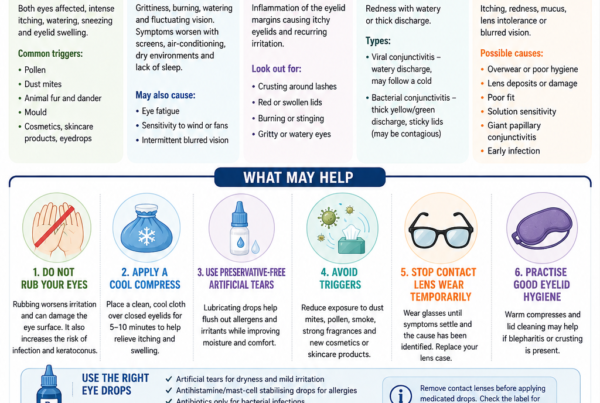
Use Preservative-Free Artificial Tears
Lubricating drops may reduce reflex watering caused by dry eye or environmental irritation.
Protect the Eyes From Wind and Irritants
Wraparound glasses or sunglasses can reduce exposure to:
- Wind
- Dust
- Haze
- Air-conditioning
- Bright light
Take Regular Screen Breaks
Follow the 20-20-20 approach:
- Every 20 minutes
- Look approximately 20 feet away
- For at least 20 seconds
Make a conscious effort to blink fully during prolonged screen use.
Apply the Appropriate Compress
Use a:
- Cool compress for allergy-related itching and swelling
- Warm compress for blepharitis or meibomian gland dysfunction
Stop Contact Lens Wear
Remove the lenses if the eyes are persistently watery, red or uncomfortable. Wear glasses until the cause has been identified and the symptoms have resolved.
When Should You See an Eye Doctor?
Arrange an eye examination when:
- Watering persists or repeatedly returns
- Tears regularly run down the cheek
- Only one eye is continuously affected
- The symptom interferes with reading, driving or work
- There is recurrent discharge or crusting
- The eyelid appears turned inwards or outwards
- The eye does not close fully
- Contact lenses have become uncomfortable
- The skin around the eye is becoming sore
- There is a recurrent lump or swelling near the inner corner
- A baby has persistent sticky or watery eyes
- Home treatment has not helped
- The cause is uncertain
Persistent one-sided watering should not simply be attributed to dry eye without assessing the tear drainage system and eyelid position.
When Are Watery Eyes an Emergency?
Seek urgent eye care if watering is accompanied by:
- Moderate or severe eye pain
- Marked redness
- Sensitivity to light
- Blurred or reduced vision
- A white or grey spot on the cornea
- Difficulty opening the eye
- Chemical exposure
- High-velocity trauma
- A suspected embedded foreign body
- A distorted pupil
- Sudden facial weakness
- Significant swelling around the eye
- Fever with swelling near the inner corner of the eye
- A red or painful eye in a contact lens wearer
Pain, visual change and light sensitivity are not typical of uncomplicated dry eye or a simple blocked tear duct. They may indicate corneal infection, uveitis, injury or another potentially sight-threatening condition.
If a chemical enters the eye, rinse immediately with plenty of clean running water. Do not delay irrigation while trying to identify the substance.
Can Watery Eyes Be Prevented?
Not every cause is preventable, but the risk of irritation-related watering may be reduced by:
- Treating dry eye disease
- Managing blepharitis consistently
- Avoiding known allergens
- Taking regular screen breaks
- Blinking fully
- Avoiding smoke and direct airflow
- Wearing protective eyewear during dusty or hazardous work
- Using contact lenses correctly
- Keeping contact lenses away from water
- Removing eye makeup before sleep
- Replacing expired cosmetics
- Avoiding habitual eye rubbing
- Seeking early treatment for eyelid or tear-duct problems
Frequently Asked Questions About Watery Eyes
Why Do My Eyes Water When They Are Dry?
Dryness irritates the eye surface and triggers reflex tear production. These reflex tears are often too watery and unstable to provide lasting lubrication.
Why Do My Eyes Water When I Go Outside?
Wind, bright light, cold air, dust and pollution can irritate the eye surface and stimulate tear production.
Dry eye disease often makes this reflex response more pronounced.
Why Does Only One Eye Keep Watering?
Persistent one-sided watering may be caused by:
- Tear-duct obstruction
- Narrowing of the punctum
- Eyelid malposition
- A foreign body
- An inward-growing eyelash
- Infection or local inflammation
It should be examined if it persists.
Why Do My Eyes Water When I Read?
Reading reduces blink frequency. This allows the tear film to evaporate and break up, causing dryness and reflex tearing.
Why Do My Eyes Water in Air-Conditioning?
Moving, cool air accelerates tear evaporation. An unstable tear film then triggers reflex watering.
Can Allergies Cause Watery Eyes Without Itching?
Yes. Itching is characteristic of eye allergy, but some patients mainly notice watering, redness or eyelid swelling.
Can a Blocked Tear Duct Clear on Its Own?
Congenital tear-duct obstruction in babies frequently improves as the drainage system matures.
A persistent acquired obstruction in an adult is less likely to resolve spontaneously and may require a procedure or surgery, depending on its severity and location.
Can Antibiotic Eyedrops Stop Watery Eyes?
Only when the watering is caused by a bacterial infection. Antibiotics do not treat dry eye disease, allergy, viral conjunctivitis or tear-duct obstruction.
Can Artificial Tears Make Watering Better?
Yes. Artificial tears may reduce reflex watering when the underlying cause is dry eye or eye-surface irritation.
Why Does My Vision Blur When My Eyes Water?
Excess tears can form an uneven layer across the cornea, temporarily altering the way light enters the eye.
Vision should usually clear after blinking or wiping away the tears. Persistent blurred vision requires assessment.
Can Watery Eyes Affect Driving?
Severe tearing may blur vision, cause glare and require frequent wiping, particularly outdoors or at night. An assessment is advisable when watering interferes with safe driving.
Is Tear-Duct Surgery Painful?
DCR is generally performed under local or general anaesthesia, depending on the individual and surgical approach. Postoperative discomfort, swelling and bruising are usually temporary. Your surgeon will explain the expected recovery and possible risks.
Key Takeaway
Watery eyes develop when the eyes produce more tears than usual or when the normal tear drainage system is unable to remove them effectively.
Common causes include:
- Dry eye disease
- Allergic or infective conjunctivitis
- Blepharitis
- Environmental irritation
- Foreign bodies
- Eyelid malposition
- Blocked tear ducts
The appropriate treatment depends on the underlying cause. Lubricating drops may help dry eye-related reflex tearing, while persistent drainage obstruction may require a tear-duct procedure or surgery.
Seek urgent eye care if watering is accompanied by pain, light sensitivity, reduced vision, significant redness, trauma, a corneal white spot or contact lens-related symptoms.
References
- National Eye Institute. How Tears Work. Updated August 2025.
- American Academy of Ophthalmology. Tearing.
- American Academy of Ophthalmology. The Tearing Patient: Diagnosis and Management.
- National Eye Institute. Dry Eye. Updated August 2025.
- American Academy of Ophthalmology. What Is Dry Eye? Symptoms, Causes and Treatment. Updated December 2025.
- HealthHub Singapore. Dry Eye.
- National Eye Institute. Blepharitis.
- HealthHub Singapore. Allergic Conjunctivitis. Reviewed December 2024.
- American Academy of Ophthalmology. Eye Allergies: Why Are My Eyes Itchy? Updated December 2025.
- National Eye Institute. Pink Eye. Updated August 2024.
- National Eye Institute. Treatment for Pink Eye.
- Moorfields Eye Hospital. Epiphora: Watering Eye.
- Moorfields Eye Hospital. Epiphora: Diagnosis and Treatment.
- NHS. Watering Eyes.
- American Academy of Ophthalmology. What Is a Blocked Tear Duct?
- American Academy of Ophthalmology. Blocked Tear Duct Symptoms.
- American Academy of Ophthalmology. Blocked Tear Duct Causes.
- American Academy of Ophthalmology. Blocked Tear Duct Treatment.
- Moorfields Eye Hospital. Dacryocystorhinostomy.
- NHS. Ectropion. Reviewed July 2025.
- National Eye Institute. Pink Eye in Newborns. Updated December 2024.
- Cambridge University Hospitals. Children With Sticky and Watery Eyes Due to Failure of Tear Drainage.
- HealthHub Singapore. Antihistamine Eye Drops.
- HealthHub Singapore. Olopatadine Eye Drops.
- National Eye Institute. Corneal Conditions. Updated August 2025.