PRK & TransPRK in Singapore

Surface laser vision correction without creating a corneal flap

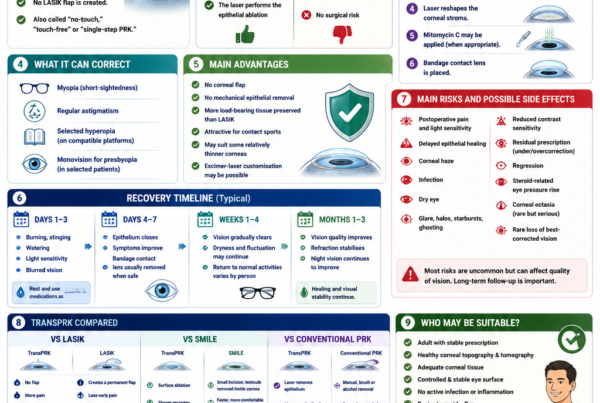
PRK (photorefractive keratectomy) is a form of laser vision correction that reshapes the cornea to correct short-sightedness, astigmatism and, in selected cases, long-sightedness.

Unlike LASIK, PRK does not require the creation of a corneal flap. Instead, treatment is performed directly on the surface of the cornea.

For some patients, particularly those with thinner corneas, certain corneal shapes or lifestyles where avoiding a flap may be desirable, PRK or TransPRK can remain an excellent option for vision correction.

What is PRK?

PRK uses an excimer laser to precisely reshape the cornea so that light entering the eye can focus more accurately on the retina.

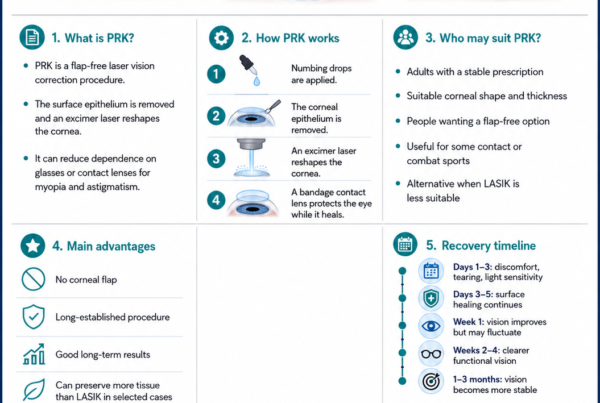
During conventional PRK, the thin surface layer of the cornea — the epithelium — is first removed. The excimer laser then reshapes the underlying corneal tissue according to the patient’s prescription.

The epithelium naturally regenerates over the following few days.

Because no corneal flap is created, PRK is sometimes described as surface laser vision correction.

What is TransPRK?

TransPRK is a variation of PRK in which both removal of the corneal epithelium and reshaping of the cornea are performed using the laser.

This is sometimes referred to as a “no-touch” surface laser procedure, although patients still require the same careful pre-operative assessment and post-operative recovery associated with surface laser treatment.

PRK and TransPRK share the same fundamental principle: the cornea is reshaped without creating a LASIK flap.

Who may be suitable for PRK?

PRK may be considered in patients who would like laser vision correction but for whom creating a LASIK flap may not be the preferred option.

Examples may include patients with:
● Relatively thin corneas
● Certain corneal shapes or tomography findings
● Mild to moderate short-sightedness and astigmatism
● Occupations or activities involving a higher risk of direct eye trauma
● Concerns about having a permanent LASIK flap
● Specific ocular-surface or anatomical considerations

However, having a thin cornea does not automatically mean PRK is safe, and having a thick cornea does not automatically make someone suitable for LASIK.

The entire corneal shape, thickness profile, prescription and predicted amount of tissue removal must be considered together.

Why might I recommend PRK instead of LASIK?

One of the main differences between PRK and LASIK is how the laser reaches the tissue that needs to be reshaped.

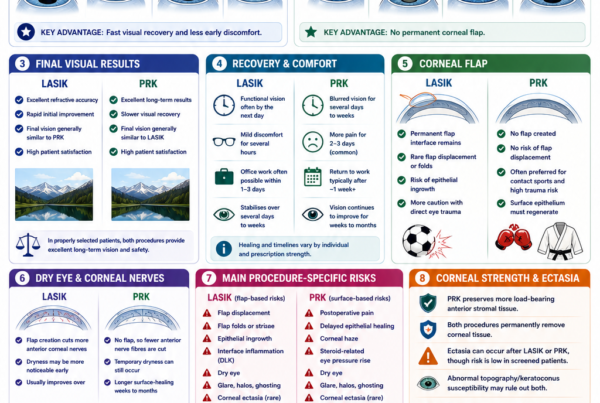
With LASIK, a thin corneal flap is created and lifted before laser treatment.

With PRK, there is no flap.

This preserves more of the anterior corneal structure and avoids complications that are specifically related to the presence of a LASIK flap.

For selected patients, that can make PRK an attractive option.

The trade-off is that recovery is slower.

PRK may offer:

● No corneal flap
● Less corneal tissue disruption than some flap-based treatments
● Suitability for selected thinner corneas
● No long-term risk of traumatic displacement of a LASIK flap
● Excellent visual outcomes in appropriately selected patients

But compared with LASIK or SMILE:

● The first few days are generally more uncomfortable
● Vision takes longer to clear
● Visual fluctuations may continue for several weeks
● Eye drops are required for longer
● Corneal haze is a potential complication, particularly with larger corrections

For this reason, I do not consider PRK automatically “better” or “worse” than LASIK or SMILE.

The question is which procedure best suits the individual eye.

PRK vs LASIK vs SMILE vs ICL

There is no single refractive procedure that is ideal for everyone.

When I assess someone for vision correction, I consider several possible options rather than starting with the assumption that one procedure should be performed.

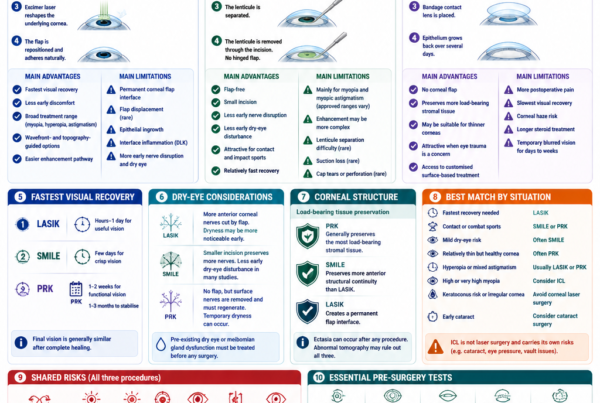
PRK / TransPRK LASIK SMILE Pro ICL
Corneal flap No Yes No No
Corneal tissue removed Yes Yes Yes No
Early recovery Slower Fast Fast Fast
Higher prescriptions Limited by corneal tissue Limited by corneal tissue Limited by corneal tissue Often particularly suitable
Thin/borderline corneas Sometimes considered May be unsuitable Depends on anatomy May be considered
Implant inside eye No No No Yes

This table is only a general comparison.

Actual suitability depends on your prescription, corneal measurements, age, eye health and individual circumstances.

How I decide whether PRK is appropriate

My approach is not simply to ask:

“Can this prescription be treated with PRK?”

I also consider:

Corneal tomography

Modern corneal imaging allows us to assess not only corneal thickness but also the shape of the front and back surfaces of the cornea.

This helps identify eyes that may have subtle features making laser vision correction less appropriate.

Corneal thickness

The amount of tissue remaining after treatment matters.

Higher prescriptions generally require greater corneal reshaping.

Prescription

PRK can treat myopia and astigmatism effectively, but the amount of correction needs to be considered in relation to the patient’s corneal anatomy.

For very high myopia, I may instead discuss ICL surgery.

Ocular surface

Dry eye, blepharitis and meibomian gland dysfunction should ideally be addressed before refractive surgery.

Lifestyle

Contact sports, occupations with potential facial trauma and the patient’s tolerance for a slower recovery may influence the choice between PRK and other procedures.

Age and long-term visual goals

Refractive surgery corrects the prescription present at the time of surgery.

It does not prevent normal age-related changes such as presbyopia or cataract formation.

What happens during PRK?

The procedure itself is generally relatively quick.

1. Anaesthetic eye drops

Numbing drops are applied to the eye.

2. Removal of the epithelium

The thin surface layer of the cornea is removed.

With TransPRK, this step is performed using the laser.

3. Excimer laser treatment

The laser reshapes the cornea according to the planned correction.

The laser treatment itself usually lasts only seconds.

4. Bandage contact lens

A soft contact lens is placed over the cornea to protect the healing surface.

This is usually removed once the epithelium has healed sufficiently.

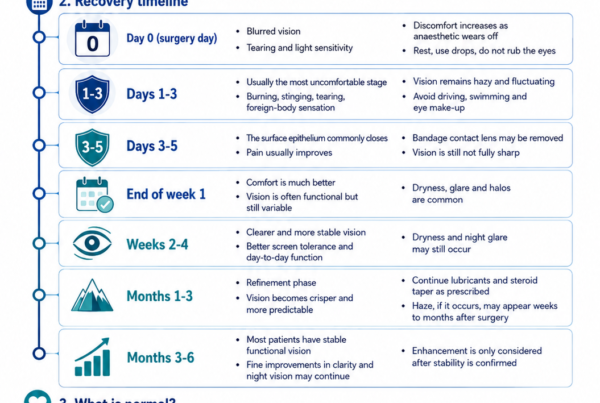
What is recovery like after PRK?

Recovery after PRK is different from LASIK and SMILE.

Patients should expect this before choosing the procedure.

First few days

The eyes may feel:
● Gritty
● Watery
● Light-sensitive
● Sore or uncomfortable

Vision is usually blurred during this period.

A bandage contact lens protects the cornea while the surface epithelium heals.

First week

Discomfort usually improves significantly as the epithelium heals.

Vision gradually becomes more functional, although it may still fluctuate.

Following weeks

Vision typically becomes progressively clearer.

Some patients experience fluctuations, particularly when reading or using screens.

Following months

Fine visual quality continues to stabilise.

Steroid eye drops may be prescribed for a period after surgery depending on the degree of treatment and individual healing response.

Is PRK painful?

PRK is performed using anaesthetic eye drops, so patients should not normally feel pain during the laser treatment itself.

However, unlike LASIK and SMILE, the corneal epithelium has to regrow afterwards.

This means that discomfort during the first few days is expected.

Patients may experience burning, watering, foreign-body sensation and sensitivity to light until the corneal surface heals.

Medication, lubricating drops and a bandage contact lens are used to make this period more comfortable.

What are the risks of PRK?

PRK has been performed for many years and can provide excellent visual outcomes in appropriately selected patients.

However, as with all surgery, complications can occur.

Potential risks include:
● Infection
● Delayed epithelial healing
● Corneal haze
● Dry eye symptoms
● Glare or halos
● Under-correction or over-correction
● Residual astigmatism
● Regression of correction
● Need for enhancement
● Rare corneal weakening or ectasia

Careful patient selection and appropriate follow-up help reduce these risks.

Patients should understand both the potential benefits and limitations of treatment before proceeding.

PRK for thin corneas

One common reason patients are referred for PRK is because they have been told that their corneas are too thin for LASIK.

PRK can preserve more corneal tissue than LASIK because a flap is not created.

However, PRK is not automatically safe simply because it does not involve a flap.

If there are features suggesting an inherently abnormal or unstable cornea, performing PRK may still be inappropriate.

This is why corneal tomography is an important part of refractive surgery assessment.

In some patients with thin or borderline corneas, a non-corneal procedure such as ICL may instead be preferable.

PRK and contact sports

Because PRK does not create a permanent corneal flap, it may be considered for patients involved in occupations or activities where direct trauma to the eye is more likely.

Examples may include:
● Martial arts
● Boxing
● Contact sports
● Military or tactical occupations

However, suitability still depends on the individual’s corneal measurements and prescription.

PRK or ICL for High Myopia?

For mild or moderate myopia, PRK may provide excellent correction.

As the degree of myopia increases, however, a greater amount of corneal tissue must be removed to achieve the desired correction.

For patients with high myopia, I may therefore discuss an Implantable Collamer Lens (ICL).

ICL corrects the prescription by placing a lens inside the eye rather than removing corneal tissue.

My approach to refractive surgery

I view PRK as one component of a wider range of refractive surgery options.

The objective of an assessment is not simply to determine whether laser surgery can be performed.

It is to determine whether surgery is appropriate, and if so, which technique provides the most appropriate balance between:
● Visual outcome
● Corneal safety
● Prescription
● Recovery
● Lifestyle
● Long-term considerations

Depending on the eye, I may therefore recommend PRK, TransPRK, LASIK, SMILE Pro, ICL — or occasionally no refractive surgery at all.

Frequently asked questions

How long does PRK take?

The laser treatment itself usually takes only a short time, although additional time is required for preparation and treatment of both eyes.

How quickly can I return to work?

This varies between patients. Because vision is blurred and the eyes may be uncomfortable during the first few days, patients usually require more time away from work than after LASIK or SMILE.

When can I drive after PRK?

Driving should only resume once vision has recovered adequately and the patient meets the appropriate visual requirements.

Is PRK permanent?

The corneal reshaping produced by PRK is permanent. However, the eye can continue to change naturally with age, and refractive changes can occur over time.

Can my degree return?

Some regression is possible, particularly after larger corrections. An enhancement may occasionally be considered if clinically appropriate.

Does PRK cause dry eye?

Temporary dry-eye symptoms can occur after PRK. Pre-existing ocular-surface problems should ideally be treated before surgery.

Can both eyes be treated together?

In most suitable patients, both eyes can be treated during the same session.

Learn more about PRK

Explore my detailed patient guides:


What Is PRK? A Complete Guide to Photorefractive Keratectomy

Learn how PRK laser eye surgery works, how it differs from LASIK and SMILE, who is suitable, recovery time, risks, pain and expected results.

LASIK vs PRK: Which Laser Vision Correction Procedure Is Better?

Compare LASIK and PRK, including visual recovery, pain, dry eye, haze, flap risks, thin-cornea suitability and long-term results.

Which Laser Eye Surgery Is Best? LASIK, SMILE and PRK Compared

Compare LASIK, SMILE and PRK by recovery, dry eye, corneal strength, risks, prescription range and lifestyle to find the safest option for your eyes.

What Is TransPRK? Procedure, Recovery, Benefits and Risks Explained

Learn how TransPRK works, what “no-touch” laser surgery means, recovery time, pain, haze risk and how it compares with PRK, LASIK and SMILE.

PRK Recovery: Day by Day — What to Expect During the First Few Days, Weeks and Months

PRK recovery explained day by day. Learn what to expect after surgery, including pain, blurred vision, bandage lens removal and recovery over weeks and months.

Considering PRK or laser vision correction?

The first step is a comprehensive refractive surgery assessment.

Measurements typically include your prescription, corneal thickness, corneal tomography and assessment of the ocular surface and overall eye health.

These findings can then be used to determine whether PRK, TransPRK, LASIK, SMILE Pro or ICL is most appropriate for your eyes.

eye doctor singapore

Enquiry