
SMILE Pro in Singapore

Small-incision laser vision correction without creating a corneal flap

SMILE Pro is a form of laser vision correction used to treat short-sightedness and astigmatism.

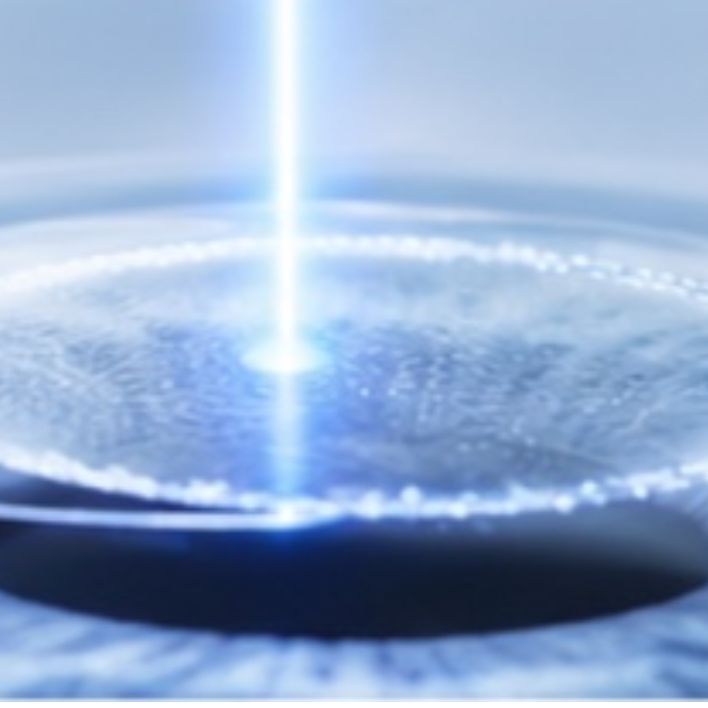
Unlike LASIK, SMILE does not require the creation of a large corneal flap. Instead, a femtosecond laser creates a thin layer of tissue — known as a lenticule — within the cornea. This lenticule is then removed through a small incision, changing the shape of the cornea and correcting the patient’s prescription.

For suitable patients, SMILE Pro offers fast visual recovery, a small-incision approach and freedom from a permanent LASIK flap.
What is SMILE?

SMILE stands for Small Incision Lenticule Extraction.

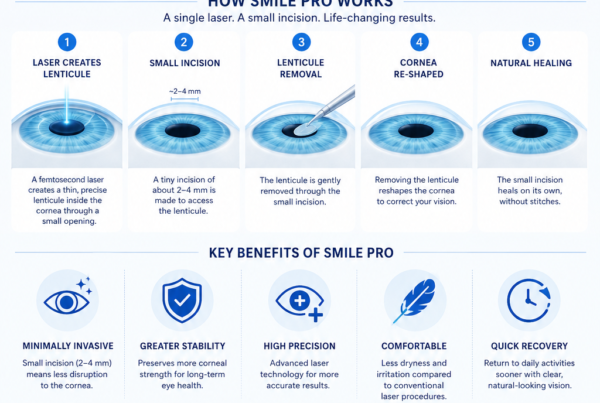
During treatment, a femtosecond laser creates a precisely shaped lenticule within the cornea.

A small opening is then created at the edge of the cornea.

The lenticule is gently removed through this incision.

Once it has been removed, the shape of the cornea changes, allowing light to focus more accurately on the retina.

Unlike LASIK, there is no large corneal flap and no excimer laser treatment.

What is SMILE Pro?

SMILE Pro is the newer generation of SMILE treatment performed using the ZEISS VISUMAX 800 femtosecond laser platform.

The fundamental concept remains the same as conventional SMILE: a lenticule is created within the cornea and removed through a small incision.

The newer platform allows the laser portion of treatment to be completed more rapidly and incorporates updated centration and treatment-planning features.

From the patient’s perspective, the procedure remains a small-incision, flapless form of corneal laser vision correction.

How is SMILE different from LASIK?

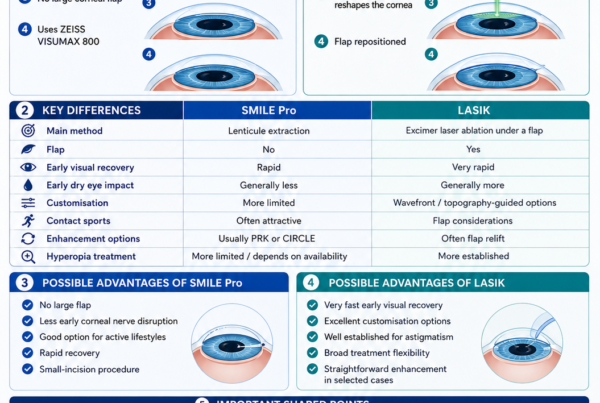
Both SMILE and LASIK reshape the cornea to correct refractive error.

The main difference is how the corneal tissue is accessed.

LASIK

A thin corneal flap is created and lifted.

An excimer laser then reshapes the underlying cornea before the flap is repositioned.

SMILE Pro

No large flap is created.

Instead, the laser creates a lenticule within the cornea, which is removed through a small incision.

This means SMILE avoids complications that are specifically related to having a permanent LASIK flap.

However, that does not mean SMILE is automatically the better choice for every patient.

What are the potential advantages of SMILE Pro?

For appropriately selected patients, SMILE Pro may offer several advantages.

Fast visual recovery

Many patients achieve functional vision relatively quickly after surgery.

Fine visual quality may continue to improve over the following days and weeks.

Less disruption of the anterior corneal surface

Because the incision is smaller than a LASIK flap, fewer superficial corneal nerves may be disturbed.

Some patients may therefore experience fewer early dry-eye symptoms compared with LASIK, although dry eye can still occur after SMILE.

Treatment of myopia and astigmatism

SMILE Pro can treat a broad range of short-sightedness and astigmatism in suitable eyes.

Who may be suitable for SMILE Pro?

SMILE Pro may be considered for adults with stable short-sightedness and astigmatism who have suitable corneal anatomy.

Assessment generally includes:
● Stable refractive error
● Adequate corneal thickness
● Normal corneal shape and tomography
● Healthy ocular surface
● Appropriate degree of myopia and astigmatism
● No significant underlying eye disease
● Realistic expectations regarding the outcome of surgery

Suitability cannot be determined simply from your spectacle prescription.

The cornea must be assessed carefully before any form of laser vision correction is recommended.

Who may not be suitable for SMILE Pro?

SMILE may not be appropriate in every eye.

Examples include patients with:
● Abnormal or suspicious corneal tomography
● Keratoconus or corneal ectasia
● Insufficient corneal thickness for the planned correction
● Significant dry eye or active ocular-surface disease
● Unstable refractive error
● Certain corneal scars
● Some very high prescriptions
● Other significant ocular disease

In these situations, another procedure — such as PRK or ICL — may sometimes be more appropriate.

Occasionally, the safest recommendation is not to undergo refractive surgery at all.

How I decide whether SMILE Pro is appropriate

I do not start a refractive consultation by assuming that SMILE should be performed simply because it is newer technology.

The more important question is:

Which procedure is most appropriate for this particular eye?

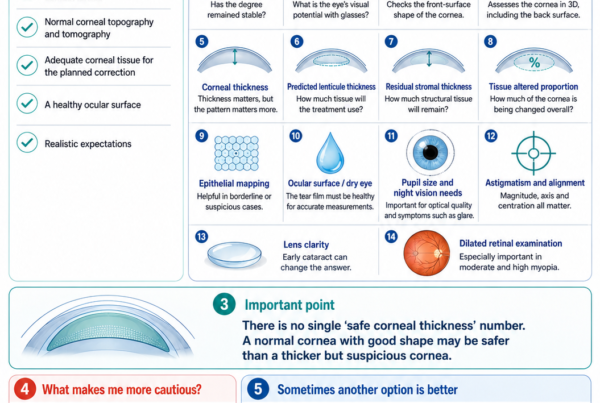
Several factors influence that decision.

Corneal tomography

The shape of both the front and back surfaces of the cornea needs to be assessed.

Subtle abnormalities may indicate that corneal laser surgery is not advisable.

Corneal thickness

The amount and distribution of corneal tissue remaining after treatment matters.

This becomes increasingly important as the degree of myopia increases.

Prescription

SMILE works particularly well for many patients with myopia and astigmatism.

However, very high prescriptions may require removal of a larger amount of corneal tissue.

In these situations, I may discuss ICL instead.

Ocular surface

Dry eye, meibomian gland dysfunction and blepharitis should be addressed before surgery.

Lifestyle

Contact sports, occupational requirements and the importance of avoiding a corneal flap may influence the choice between SMILE, LASIK and other procedures.

Visual requirements

Occupation, night driving, screen use and expectations regarding vision all form part of the discussion.

What happens during SMILE Pro?

The procedure itself is relatively quick.

1. Anaesthetic eye drops

Numbing drops are placed into the eye.

No injection around the eye is normally required.

2. Positioning under the laser

The patient looks towards a fixation light while the eye is gently positioned beneath the femtosecond laser.

3. Creation of the lenticule

The laser creates a thin, precisely shaped lenticule within the cornea together with a small access incision.

4. Lenticule removal

The lenticule is separated and removed through the small incision.

5. Corneal reshaping

Once the lenticule has been removed, the corneal shape changes and the refractive error is corrected.

There are no external stitches.

Is SMILE Pro painful?

The procedure is performed using anaesthetic eye drops.

Patients may feel pressure or awareness of the eye being touched, but significant pain during the procedure would not normally be expected.
Afterwards, the eyes may feel:
● Gritty
● Watery
● Slightly irritated
● Sensitive to light

These symptoms generally improve relatively quickly.

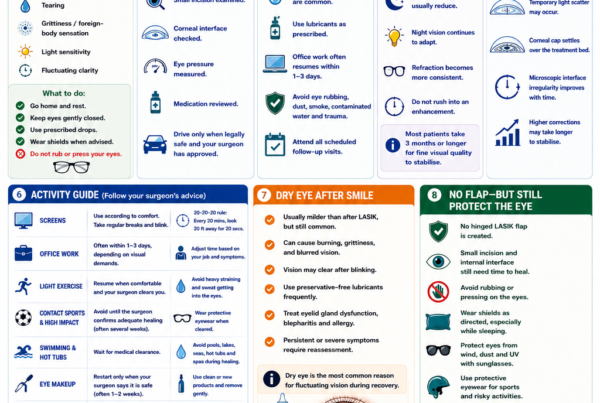
How quickly does vision recover after SMILE Pro?

Visual recovery is usually significantly faster than after PRK.

First day

Vision is commonly hazy immediately after treatment but often improves considerably over the first several hours.

First few days

Many patients are able to perform routine activities within a few days.

Vision may still fluctuate, particularly with prolonged screen use.

First few weeks

Fine visual quality continues to improve.

Some patients notice temporary glare, halos or fluctuations at night during the early healing period.

Following months

The cornea and ocular surface continue to stabilise.

SMILE Pro and dry eye

Dry-eye symptoms can occur after any form of corneal refractive surgery.

Because SMILE uses a relatively small incision rather than creating a large LASIK flap, there may be less disruption to some of the superficial corneal nerves.

For some patients, this may translate into fewer or shorter-lasting early dry-eye symptoms compared with LASIK.

However, SMILE does not eliminate the risk of dry eye.

Pre-existing dry eye, meibomian gland dysfunction and prolonged screen use should be identified and managed before surgery.

SMILE Pro vs LASIK vs PRK vs ICL

There is no single procedure that is best for every patient.

SMILE Pro LASIK PRK / TransPRK ICL
Corneal flap No Yes No No
Corneal tissue removed Yes Yes Yes No
Incision Small Larger flap Surface treatment Small intraocular incision
Early recovery Fast Fast Slower Fast
High myopia Depends on cornea Depends on cornea More limited Often particularly suitable
Implant inside eye No No No Yes
Flap-related trauma risk No Present No No

SMILE Pro or LASIK?

For many suitable patients, both SMILE and LASIK can provide excellent visual outcomes.

I may favour SMILE when:
● Avoiding a LASIK flap is desirable
● The patient participates in contact sports
● There are concerns regarding early dry-eye symptoms
● The prescription and corneal anatomy are well suited to lenticule extraction

I may favour LASIK when certain treatment characteristics or enhancement considerations make it the more appropriate procedure.

The decision should be based on the patient’s individual measurements rather than simply choosing the newest technique.

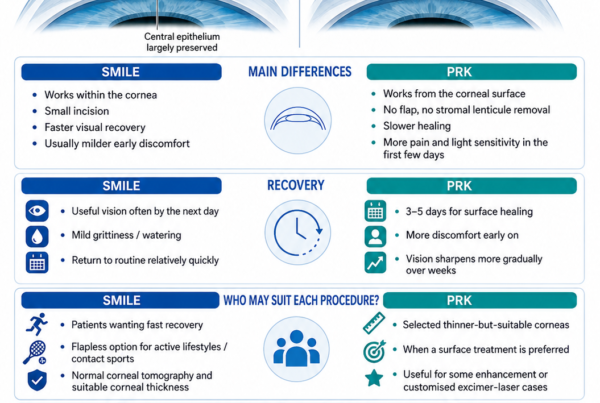
SMILE Pro or PRK?

Both procedures avoid creating a LASIK flap.

However, their recovery is very different.

SMILE generally offers significantly faster early visual recovery and less discomfort.

PRK remains useful in selected patients, particularly where a surface treatment may be preferred based on corneal anatomy or other considerations.

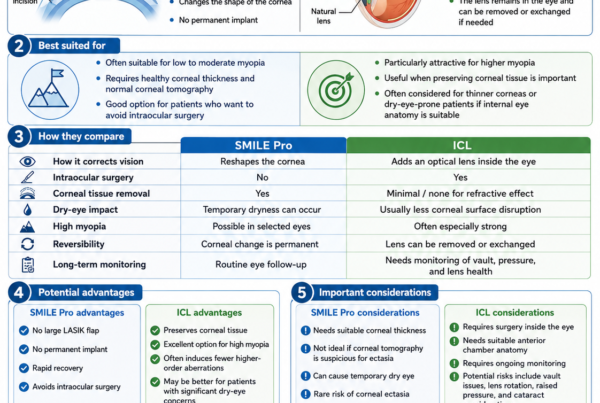
SMILE Pro or ICL?

This becomes particularly relevant for patients with moderate to high myopia.

SMILE reshapes the cornea by removing corneal tissue.

ICL corrects the prescription by placing a lens inside the eye and does not remove corneal tissue.

For patients with higher degrees of myopia, thin or borderline corneas, or particular corneal measurements, I may therefore discuss ICL instead of further increasing the amount of laser treatment.

Conversely, suitable patients who prefer not to have an implant placed inside the eye may favour SMILE.

Can SMILE Pro treat high myopia?

SMILE can correct relatively high levels of short-sightedness in suitable patients.

However, the question is not simply whether the laser is technically capable of treating the prescription.

The higher the correction, the more corneal tissue must be altered.

I therefore consider:
● Overall corneal thickness
● Corneal tomography
● Treatment depth
● Predicted remaining corneal tissue
● Age
● Prescription stability
● Alternative options such as ICL

For some highly myopic patients, ICL may provide a more appropriate way of correcting the prescription without removing corneal tissue.

SMILE Pro for contact sports and active lifestyles

Because SMILE does not create a large permanent corneal flap, it can be attractive for patients involved in activities where the eye may potentially be struck.

Examples include:
● Martial arts
● Rugby
● Football
● Basketball
● Racquet sports
● Military and tactical occupations

This does not mean there is no recovery period after surgery.

Patients should still avoid eye rubbing, swimming and significant eye trauma during the early healing phase.

What are the risks of SMILE Pro?

SMILE has a good safety profile in appropriately selected patients, but no surgical procedure is completely without risk.

Potential complications include:
● Dry-eye symptoms
● Glare or halos
● Fluctuating vision
● Under-correction or over-correction
● Residual astigmatism
● Regression
● Infection
● Inflammation
● Difficulty separating or removing the lenticule
● Small lenticule remnants
● Interface-related problems
● Need for further refractive correction
● Rare corneal weakening or ectasia

Careful pre-operative assessment and appropriate post-operative follow-up are therefore important.

What if there is still some degree after SMILE?

A small residual prescription can occasionally remain after any refractive procedure.

Whether further treatment should be considered depends on:
● The amount of residual refractive error
● Whether it is stable
● Corneal thickness
● Corneal shape
● The patient’s symptoms and visual requirements

Enhancement after SMILE is possible, but the strategy may differ from enhancement after LASIK.

This is another reason why long-term refractive planning should be considered before the initial procedure.

My approach to refractive surgery

I regard SMILE Pro as one of several excellent refractive-surgery options rather than the default procedure for every patient.

My aim during assessment is to determine whether the eye is suitable for refractive surgery and, if so, which procedure provides the most appropriate balance between:
● Visual outcome
● Corneal safety
● Prescription
● Recovery
● Dry-eye considerations
● Lifestyle
● Long-term eye health

Depending on the individual eye, I may therefore recommend SMILE Pro, LASIK, PRK / TransPRK, ICL — or occasionally no surgery.

Frequently asked questions

How long does SMILE Pro take?

The laser portion of the procedure is brief. Additional time is required for preparation, positioning and removal of the lenticule.

Can both eyes be treated on the same day?

In most suitable patients, both eyes can be treated during the same session.

When can I return to work?

Many patients return to routine work within a few days, although visual recovery varies and prolonged screen use may initially cause some fatigue or dryness.

Can my myopia return?

Some refractive change or regression can occur over time, particularly in patients whose prescription was not completely stable before treatment.

When can I drive?

Driving should resume only once vision has recovered adequately and the appropriate visual requirements are met.

Can I exercise after SMILE?

Light activity can usually resume relatively quickly, but swimming, contact sports and activities where the eye may be struck should be avoided during the initial recovery period.

Is SMILE permanent?

The change in corneal shape is permanent. However, the eye can continue to change naturally over time.

Does SMILE prevent presbyopia?

No.

SMILE corrects the distance prescription present at the time of surgery but does not stop the normal age-related loss of near focusing ability.

Learn more about SMILE Pro

Explore my detailed patient guides:

What Is SMILE Pro? A Complete Guide to Flapless Laser Vision Correction

Learn how SMILE Pro flapless laser eye surgery works, how it differs from LASIK and SMILE, who is suitable, recovery time, risks and expected results.

SMILE Pro vs LASIK: What Is the Difference?

Compare SMILE Pro vs LASIK for myopia, astigmatism, recovery, dry eye, safety and visual results—and learn which procedure may suit your eyes better.

SMILE Pro vs ICL: How Corneal Laser Surgery Compares with an Implantable Lens

Compare SMILE Pro vs ICL for myopia, visual quality, dry eye, recovery and safety—and learn when corneal laser surgery or an implantable lens may be better.

SMILE vs PRK: Recovery, Suitability and the Differences Between Two Flapless Techniques

Compare SMILE vs PRK for recovery, pain, dry eye, corneal strength, haze, suitability and visual results—and learn which flapless procedure may suit you.

Who Is Suitable for SMILE Pro? The Measurements I Assess Before Recommending Treatment

Learn how suitability for SMILE Pro is assessed, including prescription stability, corneal tomography, thickness, residual stroma, dry eye and retinal health. Article Excerpt

Recovery After SMILE: What to Expect From the First Day to Three Months

Learn what to expect after SMILE eye surgery, including first-day vision, dry eye, recovery time, activity restrictions, halos and urgent warning signs.

Considering SMILE Pro?

The first step is a comprehensive refractive surgery assessment.

This usually includes evaluation of:
● Your spectacle prescription
● Corneal thickness
● Corneal tomography
● Ocular surface
● Pupil and visual requirements
● Overall eye health

These measurements allow us to determine whether SMILE Pro, LASIK, PRK / TransPRK or ICL is most appropriate for your eyes.

eye doctor singapore

Enquiry