Author: Dr Val Phua
Estimated reading time: 24 minutes
SMILE Pro and ICL are both modern refractive-surgery options that can reduce dependence on spectacles and contact lenses.
However, they correct myopia in fundamentally different ways.
SMILE Pro changes the shape of the cornea.
A femtosecond laser creates a small lens-shaped piece of tissue—called a lenticule—inside the cornea. The surgeon removes this lenticule through a small incision, flattening the cornea and reducing its focusing power.
ICL does not rely on removing corneal tissue.
Instead, a thin artificial lens is inserted inside the eye, behind the iris and in front of the natural crystalline lens.
The natural lens remains in place.
This is why ICL is described as a phakic intraocular lens.
The essential difference is therefore:
SMILE Pro corrects the prescription by permanently reshaping the cornea. ICL corrects it by adding an optical lens inside the eye.
Both can produce excellent unaided vision.
However, the trade-offs are very different.
SMILE Pro:
- Avoids intraocular surgery
- Leaves no implant inside the eye
- Has no LASIK flap
- Provides rapid visual recovery
- Permanently removes corneal tissue
- Can cause temporary dry eye
- Requires adequate corneal thickness and normal tomography
ICL:
- Preserves the central corneal shape
- Removes essentially no corneal stromal tissue
- Can correct much higher degrees of myopia
- Often produces excellent optical quality in high myopia
- Is removable or exchangeable
- Requires surgery inside the eye
- Requires adequate anterior-segment anatomy
- Introduces considerations such as vault, intraocular pressure, endothelial cells, cataract and lens rotation
Comparative evidence is particularly interesting for moderate and high myopia.
Meta-analyses comparing conventional SMILE with EVO/ICL V4c implantation show similar overall efficacy and refractive predictability, but ICL tends to induce fewer higher-order aberrations and may offer an optical-quality advantage, particularly at higher prescriptions.
This does not mean ICL is automatically the better operation.
ICL obtains these optical advantages by accepting an entirely different category of risk: intraocular surgery.
The decision should therefore not be:
“Which procedure is newer?”
or:
“Which one gives the sharpest 6/6 vision?”
The more useful question is:
“Which procedure gives this particular eye the best balance between optical quality, anatomy, reversibility and long-term safety?”
The Quick Answer
What Is the Main Difference Between SMILE Pro and ICL?
SMILE Pro reshapes the cornea.
ICL adds a lens inside the eye.
With SMILE Pro:
- A femtosecond laser creates a lenticule within the cornea.
- A small incision is made.
- The surgeon removes the lenticule.
- The corneal curvature permanently changes.
With ICL:
- A small corneal incision is made.
- A folded lens is inserted into the eye.
- The lens unfolds behind the iris.
- It sits in front of the natural crystalline lens.
- The cornea itself is not reshaped to create the main refractive correction.
Which Gives Better Vision?
Both can provide excellent unaided visual acuity.
For low and moderate myopia, studies generally show similar:
- Unaided distance vision
- Corrected distance vision
- Refractive predictability
A two-year prospective comparison in low myopia found 96% of EVO ICL eyes and 94.4% of SMILE eyes within ±0.50 D of the intended refractive target.
A one-year study in moderate myopia similarly found no significant difference in predictability between ICL and SMILE.
The difference becomes more interesting as the prescription increases.
Which Is Better for High Myopia?
ICL often becomes increasingly attractive as myopia becomes higher.
In patients approximately -6.00 to -10.00 D, a matched comparative study found:
- Similar final unaided visual acuity
- Better refractive predictability with ICL
- Higher efficacy and safety indices with ICL
- Fewer induced higher-order aberrations
- Better patient-reported visual quality
in the ICL group.
A meta-analysis focused on high myopia also found better efficacy and safety indices with ICL while refractive predictability remained broadly comparable.
This is one reason ICL should always be discussed when treating substantial myopia rather than automatically using the maximum laser correction that a cornea can technically accommodate.
Does That Mean ICL Is Superior to SMILE Pro?
No.
Comparisons involve different risk categories.
ICL may offer advantages in:
- High myopia
- Corneal tissue preservation
- Higher-order aberrations
- Contrast sensitivity
- Significant dry-eye concerns
But SMILE Pro avoids:
- Intraocular implantation
- Vault-related problems
- ICL rotation
- ICL exchange
- Long-term endothelial monitoring related to the implant
- ICL-associated cataract or glaucoma concerns
- The very small but serious risk of intraocular infection
There is no universally superior operation.
Is ICL Only for Very High Myopia?
No.
ICL was traditionally regarded primarily as an option for patients with high myopia or corneas unsuitable for laser treatment.
That concept is changing.
Studies now demonstrate good ICL outcomes in:
- Low myopia
- Moderate myopia
- High myopia
For low myopia, a two-year prospective study found comparable safety and refractive accuracy between EVO ICL and SMILE.
However, when a healthy cornea can be treated safely with a straightforward laser procedure, the additional risks and long-term monitoring associated with intraocular surgery still need to be justified.
SMILE Pro vs ICL at a Glance
| Feature | SMILE Pro | ICL |
|---|---|---|
| Main principle | Corneal reshaping | Lens implanted inside eye |
| Corneal tissue removed | Yes | Essentially no stromal refractive ablation |
| Intraocular surgery | No | Yes |
| Implant remains in eye | No | Yes |
| LASIK flap | No | No |
| High-myopia capability | Good in suitable corneas | Particularly strong |
| Thin cornea | May limit suitability | Often attractive if anterior anatomy permits |
| Corneal tomography | Must be normal | Still assessed, but correction does not require corneal ablation |
| Dry-eye effect | Temporary dry eye possible | Usually less corneal-nerve disturbance |
| Higher-order aberrations | May increase, especially with larger corrections | Generally less induced |
| Halos | Possible | Possible |
| Reversibility | Corneal tissue removal is permanent | Lens can be removed/exchanged |
| Ectasia risk | Rare but possible | No laser-induced corneal ectasia |
| Vault monitoring | Not applicable | Required |
| Endothelial monitoring | Routine eye care | Particularly relevant long term |
| Cataract concern | Does not directly involve natural lens | Implant sits close to natural lens |
| Enhancement | Usually PRK/other strategy | Lens rotation/exchange or corneal laser where appropriate |
| Recovery | Rapid | Rapid |
| Long-term implant monitoring | No | Yes |
How SMILE Pro Works
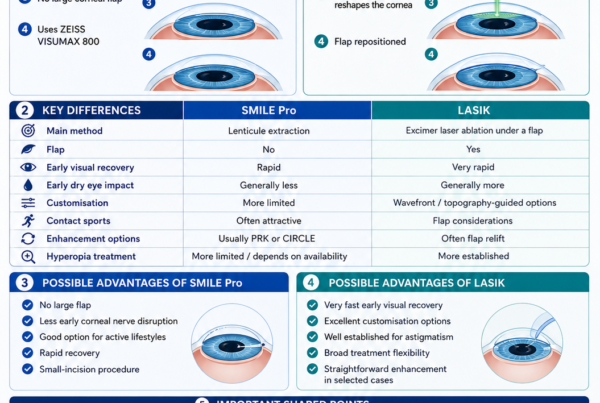
SMILE Pro is performed using the ZEISS VISUMAX 800 femtosecond laser.
The laser creates:
- The front surface of the lenticule
- The back surface of the lenticule
- The lenticule edge
- A small peripheral incision
The surgeon then removes the lenticule.
For myopia, this reduces central corneal curvature.
The VISUMAX 800 provides:
- Faster laser delivery than first-generation SMILE
- CentraLign-assisted treatment positioning
- OcuLign cyclotorsion adjustment for astigmatism
Singapore National Eye Centre currently lists a treatment range of approximately -1.00 to -10.00 D of myopia and astigmatism up to -5.00 D for its SMILE Pro programme, although anatomical suitability remains essential and treatment ranges vary by centre, platform and jurisdiction.
How ICL Works
Modern ICL surgery places a thin collamer lens inside the eye.
It sits:
- Behind the iris
- In front of the natural lens
The natural lens remains untouched.
This differs from cataract surgery, where the natural lens is removed.
What Is Collamer?
Collamer is a proprietary lens material designed for intraocular implantation.
The lens is:
- Thin
- Foldable
- Biocompatible
It can be inserted through a relatively small corneal incision.
What Is EVO ICL?
Modern EVO ICL designs contain a small central port.
This allows aqueous fluid to flow through the centre of the lens.
Earlier ICL models generally required a peripheral iridotomy before implantation to reduce pupillary-block risk.
The central-port EVO design was developed to allow physiologic aqueous circulation without routine preoperative iridotomy.
The current US FDA EVO ICL approval includes central-port spherical and toric models for myopia and myopic astigmatism.
Where Does the ICL Sit?
The lens is positioned in the posterior chamber.
Its haptics rest within the ciliary sulcus behind the iris.
The ICL therefore lies between:
iris → ICL → natural crystalline lens
A space normally remains between the back surface of the ICL and the front of the natural lens.
This space is called the vault.
What Is ICL Vault?
Vault is one of the most important measurements after ICL surgery.
It describes the distance between:
- The posterior surface of the ICL
- The anterior surface of the natural crystalline lens
A vault that is too low may theoretically increase contact or interaction with the natural lens.
A vault that is excessively high may:
- Narrow the drainage angle
- Affect aqueous outflow
- Increase concerns about intraocular pressure
Vault therefore needs to be assessed after surgery.
Why Can’t the ICL Size Be Perfectly Predicted Every Time?
Unlike a contact lens sitting on the cornea, the ICL is positioned within the ciliary sulcus.
Internal anatomy varies.
Preoperative measurements may include:
- White-to-white distance
- Anterior chamber depth
- Angle-to-angle measurements
- Ultrasound biomicroscopy
- Sulcus-to-sulcus anatomy
- Crystalline-lens rise
Despite sophisticated measurements, the final vault remains partly biologically determined.
Modern studies continue to investigate improved methods for predicting ICL sizing and orientation.
What Happens During ICL Surgery?
Step 1: Anaesthetic Drops
The eye is numbed.
The patient is usually awake.
Step 2: A Small Corneal Incision Is Made
A small opening provides access to the anterior chamber.
Step 3: The Folded ICL Is Injected
The lens is inserted through the incision using an injector system.
Step 4: The Lens Unfolds
The ICL unfolds inside the eye.
Step 5: The Haptics Are Positioned Behind the Iris
The surgeon gently positions the lens into the posterior chamber.
Step 6: The Eye Is Checked
The surgeon confirms:
- Lens position
- Pupil appearance
- Anterior chamber
- Wound integrity
For toric ICL:
- Rotational alignment is also checked.
Are Stitches Required?
Usually not.
The incision is normally self-sealing.
Which Procedure Removes More Corneal Tissue?
SMILE Pro.
Its refractive effect depends on removing stromal tissue.
The higher the correction, the thicker the lenticule generally needs to be.
ICL does not create its refractive correction by removing corneal stroma.
This is one of its greatest attractions in:
- Thin corneas
- High myopia
- Patients where large corneal shape changes are undesirable
Does That Mean Thin Corneas Automatically Need ICL?
No.
ICL requires suitable internal eye anatomy.
Important considerations include:
- Anterior chamber depth
- Angle anatomy
- Endothelial cell density
- Natural-lens status
- Age
- Glaucoma risk
A patient may be unsuitable for SMILE because of the cornea but also unsuitable for ICL because of anterior-segment anatomy.
Which Is Better for a -3.00 D Patient?
In a healthy adult with:
- Normal tomography
- Adequate corneal thickness
- Healthy ocular surface
SMILE Pro may provide an excellent correction without entering the eye.
ICL can also produce excellent outcomes at moderate and even low myopia.
A one-year moderate-myopia study found similar visual outcomes between ICL and SMILE, with less induced coma after ICL.
For relatively modest corrections, the discussion therefore becomes:
Does the optical or corneal-preservation advantage of ICL justify intraocular surgery?
For many normal corneas, the answer may still favour corneal laser treatment.
For selected patients, it may favour ICL.
Which Is Better for -6.00 D?
This is a genuine overlap zone.
Both procedures can be excellent options.
The decision increasingly depends on:
- Corneal thickness
- Corneal shape
- Dry-eye status
- Pupil size
- Night-vision requirements
- Lifestyle
- Personal preference
- Anterior-chamber anatomy
Which Is Better for -8.00 D or -10.00 D?
ICL becomes increasingly attractive.
SMILE Pro may still be technically possible in suitable eyes.
However, high laser corrections create larger changes in:
- Corneal curvature
- Stromal thickness
- Higher-order aberrations
ICL avoids this large corneal refractive change.
Comparative high-myopia studies generally show a visual-quality advantage for ICL.
What About Myopia Above -10.00 D?
ICL is commonly the more logical refractive option if anatomy is suitable.
Singapore’s current public SNEC information lists ICL correction for substantially higher myopia than its SMILE Pro range.
The exact treatment limits vary by:
- Lens model
- Country
- Regulatory approval
- Available lens powers
- Surgeon assessment
Visual Quality: Why Might ICL Have an Advantage?
Visual acuity measures whether someone can read small letters.
It does not capture every aspect of optical quality.
A patient may see 6/6 while still noticing:
- Halos
- Starbursts
- Glare
- Reduced contrast
- Ghosting
Higher-Order Aberrations
Higher-order aberrations are complex optical distortions that ordinary sphere and cylinder spectacles cannot completely correct.
Examples include:
- Spherical aberration
- Coma
- Trefoil
Corneal laser surgery changes the shape of the cornea and can induce some higher-order aberrations.
The effect generally becomes more important with:
- Higher corrections
- Larger treatment-induced shape changes
- Large pupils
- Decentration
What Does the Evidence Show?
A 2026 network meta-analysis of 50 studies involving more than 5,000 eyes found ICL ranked best among the refractive procedures studied for minimising:
- Total higher-order aberrations
- Spherical aberration
- Coma
compared with procedures including:
- SMILE
- LASIK
- PRK
- TransPRK
A separate SMILE-versus-ICL meta-analysis found ICL produced:
- Fewer total higher-order aberrations
- Less coma
- Less spherical aberration
with broadly similar efficacy and refractive predictability.
Why Is This Difference More Relevant in High Myopia?
Correcting -2.00 D requires much less corneal shape change than correcting -9.00 D.
As laser correction increases:
- More tissue must be removed.
- Central flattening becomes greater.
- Corneal asphericity changes more.
ICL instead adds the required optical power internally.
This may preserve corneal optical quality better.
Does ICL Always Give Better Night Vision?
No.
ICL has its own optical symptoms.
Some patients experience:
- Halos
- Glare
- Rings around lights
A high-myopia meta-analysis found ICL produced fewer higher-order aberrations but a higher reported halo risk than SMILE.
A 2025 comparison of persistent postoperative symptoms similarly found:
- More dryness after lenticule-extraction surgery
- More persistent glare and halos after ICL
at one year.
This illustrates why “better optical quality” should not be translated into:
“ICL has no halos.”
Dry Eye: SMILE Pro vs ICL
SMILE Pro is already relatively favourable compared with LASIK for early dry-eye effects because it uses a small corneal incision.
However, it still:
- Creates internal stromal planes
- Alters corneal nerves
- Changes corneal sensation
- Can temporarily disturb the tear film
ICL does not create a large central corneal laser treatment.
What Does Comparative Evidence Show?
A prospective study directly comparing SMILE and ICL found that both temporarily affected the ocular surface.
However, the SMILE group had:
- Lower tear measurements
- Higher dry-eye symptom scores
- More prolonged ocular-surface effects
during early follow-up.
This gives ICL an important potential advantage in a patient with:
- Significant pre-existing dry eye
- Contact-lens intolerance
- Meibomian-gland dysfunction
provided the patient is otherwise an appropriate ICL candidate.
Can ICL Still Cause Dry Eye?
Yes.
A small corneal incision is still made.
Postoperative medication and inflammation may also temporarily affect the ocular surface.
Patients with pre-existing dry eye remain more likely to experience symptoms after ICL surgery.
Therefore:
ICL generally disturbs the corneal surface less than SMILE, but it is not a dry-eye treatment.
Corneal Ectasia
Can SMILE Pro Cause Ectasia?
Rarely, yes.
Corneal ectasia is progressive weakening and bulging of the cornea after refractive surgery.
It may produce:
- Increasing myopia
- Increasing astigmatism
- Irregular vision
- Ghosting
- Reduced corrected visual acuity
Careful preoperative tomography is essential.
Can ICL Cause Corneal Ectasia?
ICL does not create ectasia through refractive stromal tissue removal because it does not use corneal ablation to correct the prescription.
This can be a major advantage when corneal tissue preservation is important.
However, an eye with true keratoconus may still have progressive corneal disease regardless of whether an ICL is implanted.
The ICL corrects refractive error.
It does not cure keratoconus.
ICL and Keratoconus
Selected patients with:
- Stable keratoconus
- Stable refraction
- Appropriate internal anatomy
may sometimes receive ICL after appropriate corneal stabilisation.
This is a specialist situation.
The ICL does not regularise significant irregular astigmatism in the same way as glasses or rigid contact lenses.
Is ICL Reversible?
This requires careful wording.
The ICL can usually be:
- Removed
- Exchanged
- Rotated
if clinically necessary.
This makes it removable, unlike the stromal tissue removed by SMILE Pro.
However:
removable does not mean completely reversible.
Any intraocular operation can leave:
- Surgical effects
- Endothelial changes
- Inflammation
- Complications
Removing the lens does not make it as though surgery never occurred.
Can SMILE Pro Be Reversed?
No.
The stromal lenticule removed during SMILE Pro does not regenerate.
The corneal reshaping is permanent.
Future refractive change can still occur because the eye itself continues ageing.
Can an ICL Be Upgraded Later?
Potentially.
An ICL can be exchanged when necessary because of:
- Residual refractive error
- Incorrect sizing
- Vault concerns
- Toric rotation
- Changing clinical circumstances
However, another intraocular operation is required.
Toric ICL and Astigmatism
A toric ICL corrects:
- Myopia
- Astigmatism
through the optical power built into the implanted lens.
The lens must remain appropriately aligned.
Can a Toric ICL Rotate?
Yes.
Small rotations may have little clinical effect.
Greater rotation reduces astigmatic correction.
If clinically significant, the lens may sometimes be repositioned.
A 2026 matched study of SMILE and toric ICL for oblique astigmatism found both procedures effective and safe, with toric ICL showing slightly greater axis precision and refractive predictability.
Does SMILE Pro Correct Astigmatism?
Yes.
The VISUMAX 800 incorporates:
- OcuLign cyclotorsion compensation
- CentraLign positioning assistance
and can correct substantial myopic astigmatism in suitable eyes.
The choice between toric ICL and SMILE Pro therefore depends on more than cylinder alone.
Recovery After SMILE Pro
Many patients have useful vision by the following day.
Early symptoms may include:
- Mild grittiness
- Tearing
- Light sensitivity
- Haze
- Fluctuating vision
- Dryness
Vision usually improves substantially during the first few days and weeks.
Recovery After ICL
Visual recovery is also typically rapid.
Patients may notice clearer vision within hours or by the following day.
Early symptoms may include:
- Slight blur
- Light sensitivity
- Halos
- Mild discomfort
- Awareness of dilated pupils
The first postoperative assessment is especially important because the surgeon checks:
- Eye pressure
- Vault
- Lens position
- Corneal clarity
- Anterior chamber inflammation
Which Recovers Faster?
For most patients:
both are fast-recovery procedures.
There is not a clinically useful universal winner.
The more important distinction is what needs to be monitored.
After SMILE Pro, early concerns are mainly:
- Corneal healing
- Dry eye
- Interface appearance
- Refractive result
After ICL, early concerns include:
- Eye pressure
- Vault
- Lens position
- Inflammation
- Toric alignment
Can I Go Back to Work Quickly?
Many office workers return within several days after either procedure.
Individual recovery depends on:
- Visual demands
- Night driving
- Screen exposure
- Dryness
- Bilateral versus sequential surgery
- Doctor’s instructions
Exercise After Surgery
Light activity generally resumes relatively early after either operation.
Avoid during early healing:
- Eye rubbing
- Dirty environments
- Swimming
- Significant eye trauma
Follow the treating surgeon’s specific protocol.
Which Is Better for Contact Sports?
Both are flapless.
Neither has the permanent LASIK flap interface.
This makes both attractive for:
- Martial arts
- Rugby
- Football
- Military activity
- Other high-impact lifestyles
However, the risk profile is different.
With SMILE Pro, trauma affects a post-laser cornea.
With ICL, trauma occurs in an eye containing an intraocular lens.
Severe blunt trauma can potentially affect:
- Iris
- Natural lens
- ICL position
- Retina
Neither procedure makes the eye trauma-proof.
The Major Difference in Risk: Corneal vs Intraocular
This is probably the most important section of the comparison.
SMILE Pro Risks
Potential complications include:
- Dry eye
- Residual myopia
- Residual astigmatism
- Regression
- Halos
- Glare
- Difficult lenticule separation
- Retained lenticule tissue
- Interface inflammation
- Infection
- Rare corneal ectasia
ICL Risks
Potential complications include:
- Infection inside the eye
- Inflammation
- Raised intraocular pressure
- Pupillary block
- Suboptimal vault
- Cataract
- Endothelial cell loss
- Pigment dispersion
- Lens rotation
- Lens exchange
- Glaucoma
- Rare retinal complications
Modern EVO ICL designs have reduced some of the problems seen with earlier phakic-lens designs.
But they have not made intraocular surgery risk-free.
How Common Are Serious ICL Complications?
A 2026 systematic review pooled 214 studies involving more than 45,000 eyes, most using the V4c ICL.
The authors found:
- Rotation or displacement was uncommon
- Explantation was uncommon
- Retinal detachment and macular oedema were rare
- Vision-threatening complications were very rare overall
However, the authors emphasised that many included studies had relatively short follow-up and potential bias, meaning late complications may be underestimated.
This supports an important principle:
ICL is highly successful modern intraocular refractive surgery, but long-term follow-up remains appropriate.
Cataract After ICL
Because the ICL sits in front of the natural lens, cataract formation has historically been an important concern.
Modern EVO central-port designs appear to have reduced this risk substantially.
A 10-year V4c ICL study involving 103 eyes reported:
- Good visual outcomes
- No cataract formation
- No glaucoma
- No ICL removal
during the study period.
Another 10-year study found no ICL-induced anterior subcapsular cataract and stable intraocular pressure, although some lenses required exchange for other reasons.
These are reassuring results.
They do not mean cataract is impossible.
Endothelial Cell Density
The corneal endothelium is the single layer of cells lining the inner corneal surface.
These cells help keep the cornea clear.
They do not meaningfully regenerate.
Because ICL is intraocular surgery, endothelial cell density is considered during:
- Preoperative selection
- Long-term follow-up
A 10-year study of central-port ICL found an average endothelial-cell loss of approximately 6.8% over the decade.
Another 10-year series found a continuing but gradually slowing decline in endothelial density and emphasised closer surveillance in patients starting with lower endothelial counts.
Does SMILE Pro Affect the Endothelium?
SMILE Pro is not intraocular surgery.
Routine long-term endothelial monitoring is therefore not required for the same reason as after ICL implantation.
Eye Pressure
After SMILE Pro
Eye-pressure interpretation can become more complicated after corneal refractive surgery because:
- The cornea becomes thinner.
- Corneal curvature changes.
- Biomechanical properties change.
Standard tonometry may therefore underestimate pressure.
Future eye-care professionals should know that SMILE has been performed.
After ICL
The cornea is not substantially reshaped, so this refractive-surgery effect on tonometry is less relevant.
However, ICL introduces different pressure concerns, including:
- Excessively high vault
- Angle narrowing
- Inflammation
- Steroid response
- Rare pupillary block
Eye pressure must therefore be checked after surgery.
What Happens to the ICL Vault Over Time?
Vault is not necessarily constant.
Multiple long-term studies show that it tends to decrease gradually.
A 2025 10-year study found both:
- Endothelial cell density
- Vault
declined over time in a nonlinear fashion.
A separate 10-year study developed a mathematical model describing long-term vault decay.
This is another reason ICL should be viewed as:
a long-term implanted medical device rather than a one-off operation that never needs review.
What Happens When I Eventually Develop a Cataract?
After SMILE Pro
The cataract surgeon removes the natural lens and implants an intraocular lens.
Previous SMILE changes the corneal curvature, so post-refractive IOL-calculation methods may be required.
Cataract surgery is otherwise routinely possible.
After ICL
The ICL usually needs to be removed when cataract surgery is performed.
The surgeon then:
- Removes the ICL.
- Removes the cataract.
- Implants a cataract intraocular lens.
This is an expected future possibility rather than necessarily a complication.
Which Makes Future Cataract Surgery Easier?
Neither prevents cataract surgery.
Each changes future planning differently.
SMILE Pro:
- Leaves no implant
- Alters corneal refractive power
ICL:
- Leaves corneal optics relatively natural
- Requires removal of the phakic lens during cataract surgery
Presbyopia
Neither SMILE Pro nor ICL stops presbyopia.
Presbyopia occurs because the natural lens becomes less flexible with age.
Someone treated successfully at age 25 or 30 may still require:
- Reading glasses
- Near support
in their 40s.
Can ICL Be Used for Monovision?
Potentially, yes.
One eye can be targeted for mild myopia to assist near vision.
Similarly, SMILE Pro can use a monovision strategy in selected patients.
A contact-lens trial is useful before permanently targeting different powers between the two eyes.
Which Is Better for Someone Approaching 45 or 50?
This becomes increasingly individual.
The surgeon should consider:
- Presbyopia
- Natural-lens clarity
- Early cataract
- Desired near vision
- Remaining accommodation
- Future cataract timing
In an eye already developing lens changes, neither SMILE Pro nor a new phakic ICL may be the logical long-term solution.
Does Either Procedure Stop Myopia Progression?
No.
Both correct the refractive error present at the time of treatment.
Neither necessarily stops:
- Axial elongation
- Biological myopic progression
This is why refractive stability is important before surgery.
Does Either Procedure Remove Retinal Risks from High Myopia?
No.
This is particularly important for ICL patients because many have high or very high myopia.
Imagine someone with:
-10.00 D myopia
who achieves:
6/6 unaided vision
after ICL or SMILE Pro.
The eye may still be anatomically elongated.
The patient retains increased lifetime risk of:
- Retinal tears
- Retinal detachment
- Myopic macular degeneration
- Myopic choroidal neovascularisation
A five-year EVO ICL study in high and super-high myopia specifically noted that axial elongation can continue after successful refractive correction.
Clear unaided vision does not make a highly myopic retina normal.
Which Procedure Is More “Permanent”?
Both provide long-lasting refractive correction.
SMILE Pro permanently removes corneal tissue.
ICL is designed as a long-term intraocular implant but can be removed.
However, the person’s refraction may still change after either procedure because of:
- Continued myopic progression
- Age
- Presbyopia
- Cataract
Which Is More Reversible?
ICL.
But a better description is:
removable and exchangeable
rather than fully reversible.
SMILE Pro is not reversible because the lenticule has been removed.
Which Is Easier to Enhance?
After SMILE Pro
Possible enhancement approaches include:
- PRK
- CIRCLE
- Other selected laser strategies
depending on:
- Residual prescription
- Corneal thickness
- Previous cap depth
After ICL
A residual prescription may be addressed with:
- Observation
- Spectacles
- Corneal laser enhancement
- ICL rotation if toric alignment is responsible
- ICL exchange in selected cases
The solution depends on the cause.
Which Is Better for Large Pupils?
Large pupils may increase awareness of:
- Halos
- Glare
- Optical aberrations
after either procedure.
Because ICL typically induces fewer higher-order aberrations, it may be attractive in high-myopic patients where optical quality is a priority.
The 2026 network meta-analysis specifically suggested that ICL may be advantageous in patients with high myopia or larger pupils when minimising higher-order aberrations is important.
However, ICL itself can produce characteristic halos.
Patient counselling remains essential.
Which Is Better for Night Driving?
There is no universal answer.
Important variables include:
- Prescription
- Pupil size
- Astigmatism
- Tear film
- Optical aberrations
- ICL central-port symptoms
- Residual refractive error
For high myopia, ICL often has an objective optical-quality advantage.
But individual symptoms can differ.
Which Is Better for Dry Eyes?
When both options are otherwise anatomically suitable:
ICL may have the ocular-surface advantage.
It avoids large central corneal nerve alteration.
However, dry-eye disease should still be treated before elective surgery.
Which Is Better for Thin Corneas?
ICL may become particularly attractive because it does not require refractive stromal tissue removal.
But internal eye anatomy must also be suitable.
Which Is Better for Abnormal Corneal Tomography?
This requires caution.
An abnormal cornea may make SMILE Pro unsafe.
ICL may sometimes avoid the need to remove corneal tissue.
However, if the abnormality represents progressive keratoconus, the corneal disease itself may require:
- Monitoring
- Cross-linking
- Other treatment
before refractive correction is considered.
Which Is Better for Contact Sports?
Both avoid a LASIK flap.
SMILE Pro has no intraocular implant.
ICL has no weakened laser optical zone but places a lens inside the eye.
The choice should be based on the full anatomy rather than sports participation alone.
Which Is Better for Someone Afraid of Eye Surgery?
This depends on what the patient fears.
SMILE Pro:
- Is laser-based
- Does not enter the eye
- Has no permanent implant
ICL:
- Does enter the eye
- Leaves an implant
- Does not permanently remove corneal refractive tissue
Some patients prefer the idea of an ICL because it can be removed.
Others strongly prefer avoiding intraocular surgery.
Both preferences are reasonable once the risks are properly understood.
Common Myths
“ICL Is Only for People Who Cannot Have Laser”
False.
ICL can be a first-choice refractive option in selected patients, particularly with higher myopia or when optical quality and corneal preservation are priorities.
“SMILE Pro Is Better Because There Is Nothing Inside the Eye”
Not universally.
Avoiding intraocular surgery is a major advantage, but higher corneal corrections come with their own trade-offs.
“ICL Is Better Because It Does Not Remove Corneal Tissue”
Not universally.
It replaces corneal risks with intraocular considerations.
“ICL Is Completely Reversible”
Too simplistic.
The lens can be removed, but the operation itself cannot be erased from the eye’s history.
“SMILE Pro Can Be Reversed”
False.
The removed corneal tissue does not regenerate.
“ICL Cannot Cause Cataract”
False.
Modern EVO designs appear safer than earlier generations, but cataract remains a recognised consideration.
“Everyone with an ICL Will Develop Cataract”
False.
Ten-year modern central-port ICL studies have reported very low cataract rates and some series reported no ICL-induced cataracts.
“ICL Causes Glaucoma”
Not routinely.
Most appropriately selected patients maintain normal pressure.
However:
- High vault
- Angle narrowing
- Pigment dispersion
- Steroid response
- Other mechanisms
can cause pressure problems.
“SMILE Pro Has No Glaucoma Considerations”
False.
Corneal refractive surgery can cause standard pressure measurements to read artificially lower.
“ICL Has No Dry Eye”
False.
Its ocular-surface effect is generally smaller, but dry-eye symptoms can still occur.
“SMILE Pro Always Causes Dry Eye”
False.
Most dryness is temporary.
“ICL Always Gives Better Night Vision”
False.
Halos can occur after ICL.
“SMILE Pro Is Better for Low Myopia and ICL Is Better for High Myopia”
This is a useful general tendency, but not a rule.
Anatomy matters more than a single prescription threshold.
“A -10.00 D Eye Should Automatically Have ICL”
Not automatically.
However, ICL deserves serious consideration as the amount of myopia increases.
“A Thin Cornea Means I Need ICL”
Not necessarily.
The entire eye must be assessed.
“ICL Corrects the Retina”
False.
It changes the eye’s optics.
It does not shorten an elongated eyeball or remove myopic retinal risk.
“SMILE Pro Stops Myopia Progression”
False.
“ICL Stops Myopia Progression”
False.
“Once I Have Refractive Surgery, I Never Need Eye Examinations”
False.
This is especially important after ICL because long-term monitoring may include:
- Vault
- Eye pressure
- Endothelial cells
- Natural-lens clarity
Frequently Asked Questions
Which Is Safer: SMILE Pro or ICL?
They have different safety profiles.
SMILE Pro avoids intraocular surgery but permanently changes the cornea.
ICL preserves the cornea but requires intraocular implantation.
Both are highly successful when appropriately selected.
Which Has Better Final Vision?
For many low-to-moderate prescriptions, final vision is similar.
At high myopia, studies often favour ICL for optical quality.
Which Is More Accurate?
Both can be highly predictable.
Results vary by:
- Prescription
- Astigmatism
- Surgical planning
- Anatomy
- Follow-up duration
A four-year high-myopia comparison actually found slightly better ±0.50 D predictability with SMILE despite lower induced aberrations with ICL, illustrating why no single metric determines superiority.
Which Has Better Contrast Sensitivity?
Several comparative studies and meta-analyses favour ICL, especially in higher myopia.
Which Causes More Halos?
Both can.
Some comparative studies report more halos after ICL.
Which Causes More Dry Eye?
On average, SMILE affects the corneal surface and nerves more than ICL.
ICL may therefore have an advantage in susceptible patients.
Which Is More Painful?
Neither is usually significantly painful.
Mild irritation is expected.
PRK generally causes much more early discomfort than either.
Which Recovers Faster?
Both generally provide rapid functional recovery.
Does ICL Need to Be Replaced Every Ten Years?
No.
It is not routinely exchanged at a fixed ten-year interval.
Long-term studies demonstrate functioning central-port ICLs at ten years.
How Long Can an ICL Stay Inside the Eye?
Potentially for many years as long as:
- Vision remains satisfactory
- Vault is appropriate
- Endothelium remains healthy
- Eye pressure remains acceptable
- The natural lens remains clear
- No other indication for removal develops
Does an ICL Need to Be Removed for Cataract Surgery?
Usually yes.
The ICL is removed as part of planning cataract surgery.
Can I Have SMILE Pro After ICL?
A corneal laser enhancement may be possible in selected eyes, although the procedure chosen depends on:
- Corneal thickness
- Tomography
- Residual prescription
It is not automatically necessary to use SMILE Pro.
Can I Have ICL After Previous SMILE?
Potentially, in selected eyes with:
- Residual or recurrent myopia
- Appropriate anterior-chamber anatomy
- Suitable endothelial cells
A complete reassessment is required.
Does ICL Change Corneal Thickness?
The refractive correction does not depend on stromal removal.
A small corneal incision is made, but the central corneal thickness is essentially preserved compared with a laser-ablation procedure.
Does SMILE Pro Affect Future ICL Surgery?
Potentially an ICL can still be implanted later if anatomy is suitable.
Previous SMILE does not automatically prevent ICL surgery.
Can ICL Correct Astigmatism?
Yes.
Toric ICL models correct myopia and astigmatism.
What if a Toric ICL Rotates?
Minor movement may be observed.
Clinically meaningful misalignment can sometimes be corrected by surgically rotating the lens.
Can an ICL Be the Wrong Size?
Sizing is estimated before surgery.
Occasionally the resulting vault may be too high or too low.
Management may include:
- Observation
- Rotation in selected non-toric lenses
- Lens exchange
depending on the anatomy and degree of vault abnormality.
Does Everyone Need Endothelial Cell Counts After ICL?
Endothelial health is an important part of ICL assessment and long-term monitoring.
The frequency should be determined by the treating ophthalmologist.
Can ICL Cause Retinal Detachment?
Retinal detachment is rare after ICL surgery.
Many ICL patients already have high myopia, which independently increases retinal-detachment risk.
A large 2026 complication meta-analysis found retinal detachment after posterior-chamber phakic IOL implantation to be rare.
Does SMILE Pro Cause Retinal Detachment?
SMILE Pro does not remove the underlying retinal risk associated with axial myopia.
New flashes and floaters require assessment regardless of which procedure was performed.
Which Should a -5.00 D Patient Choose?
Both can be reasonable.
The decision may depend on:
- Corneal thickness
- Tomography
- Dry eye
- Night-vision priorities
- Personal comfort with intraocular surgery
Which Should a -9.00 D Patient Choose?
ICL deserves strong consideration.
SMILE Pro may remain possible in selected eyes, but the optical and tissue-preservation advantages of ICL become more important at higher prescriptions.
Which Should a -15.00 D Patient Choose?
Corneal laser surgery is generally unlikely to be the preferred solution.
ICL is often much more appropriate when anatomical measurements permit.
Which Is Better for Athletes?
Both are flapless.
The full risk profile should guide selection.
Which Is Better for Someone with Severe Dry Eye?
Treat the dry-eye disease first.
When ICL anatomy is suitable, its lower corneal-nerve impact may be advantageous.
Which Is Better for Someone with Keratoconus?
Ordinary SMILE Pro is generally inappropriate.
ICL may be considered only in carefully selected, stable keratoconus after appropriate specialist assessment.
Which Is Better if I Am 45?
The natural lens, presbyopia and early cataract become increasingly important.
The answer may be neither.
Warning Signs After SMILE Pro
Contact the treating clinic promptly for:
- Increasing pain
- Increasing redness
- Significant discharge
- A white corneal spot
- Sudden deterioration in vision
- Significant light sensitivity
Warning Signs After ICL
Seek prompt assessment for:
- Significant pain
- Increasing redness
- Rapidly worsening vision
- Severe headache
- Nausea or vomiting with eye pain
- Marked light sensitivity
- New persistent halos associated with discomfort
These may indicate:
- Infection
- Significant inflammation
- Raised eye pressure
- Another intraocular complication
Retinal Warning Signs After Either Procedure
Seek urgent retinal assessment for:
- New flashes
- A sudden shower of floaters
- A curtain or shadow
- Sudden peripheral-field loss
This remains particularly important for people with high myopia.
A SMILE Pro vs ICL Decision Checklist
Your Prescription
- How much myopia do I have?
- How much astigmatism?
- Is my prescription still changing?
- Is the correction sufficiently high that ICL may offer an optical advantage?
Your Cornea
- Is my tomography completely normal?
- How thick is my cornea?
- How much tissue would SMILE Pro remove?
- Is there any keratoconus or ectasia concern?
Your Internal Eye Anatomy
- Is my anterior chamber deep enough?
- Are my drainage angles suitable?
- Is my endothelial cell density healthy?
- Is my natural lens clear?
Your Ocular Surface
- Do I have dry eye?
- Do I have meibomian-gland dysfunction?
- Am I contact-lens intolerant?
- Would preserving corneal nerves be particularly valuable?
Your Visual Priorities
- Is night driving important?
- Do I have large pupils?
- Am I particularly sensitive to glare?
- Is maximal optical quality at a high prescription important?
Your Attitude Towards Surgery
- Am I comfortable with an implant inside my eye?
- Is removability important to me?
- Would I prefer to avoid intraocular surgery?
- Am I comfortable with permanent corneal tissue removal?
Long-Term Commitment
For ICL:
- Am I prepared for long-term eye-pressure checks?
- Vault monitoring?
- Endothelial-cell assessment?
- Future ICL removal when cataract surgery is required?
For SMILE Pro:
- Do I understand that the corneal change is permanent?
- Do I understand that future pressure readings may be affected?
- Do I understand that enhancement may require another laser technique?
Which One Would I Choose?
There is no responsible answer without examining the eye.
However, a practical decision framework is:
SMILE Pro Often Makes Sense When
- Myopia is low to moderate
- Corneal thickness is generous
- Tomography is completely normal
- The ocular surface is reasonably healthy
- The patient wants to avoid intraocular surgery
- Rapid recovery is important
- A flapless procedure is preferred
ICL Becomes Increasingly Attractive When
- Myopia is high
- The cornea is relatively thin
- Preserving corneal tissue is important
- Dry eye is a significant concern
- High-order optical quality is a priority
- The patient has suitable anterior-segment anatomy
- The patient accepts long-term implant monitoring
ICL May Be Particularly Attractive in High Myopia Because
Comparative evidence shows:
- Less induced spherical aberration
- Less induced coma
- Lower total higher-order aberrations
- Often better contrast sensitivity
- Excellent efficacy and safety indices
But these benefits must be balanced against intraocular risks.
The Bottom Line
SMILE Pro and ICL can both provide excellent vision correction.
They do so in fundamentally different ways.
SMILE Pro:
- Reshapes the cornea
- Removes a stromal lenticule
- Uses no LASIK flap
- Requires no permanent implant
- Avoids intraocular surgery
- Provides rapid recovery
- Can cause temporary dry eye
- Requires sufficient healthy corneal tissue
- Carries a rare ectasia risk
ICL:
- Places an optical lens inside the eye
- Preserves central corneal tissue
- Can treat substantially higher myopia
- Is removable and exchangeable
- Often induces fewer higher-order aberrations
- May offer better optical quality in high myopia
- Usually has less effect on the ocular surface
- Requires intraocular surgery
- Requires appropriate anterior-chamber anatomy
- Requires monitoring of vault, eye pressure, endothelium and natural-lens health
For low and moderate myopia, comparative studies show that both procedures can achieve excellent and similar refractive outcomes.
For high myopia, the evidence increasingly favours ICL for certain measures of optical quality.
Meta-analyses demonstrate fewer:
- Higher-order aberrations
- Coma
- Spherical aberration
after ICL than after SMILE.
A matched high-myopia study also found better subjective quality of vision and refractive predictability with ICL.
However, ICL achieves these benefits through intraocular surgery.
Modern EVO ICL has reassuring long-term data, including studies extending to ten years with:
- Good visual outcomes
- Stable intraocular pressure
- Relatively modest endothelial loss
- Low rates of serious complications
These results do not eliminate the need for long-term monitoring.
SMILE Pro, by comparison, avoids an implanted device and its associated intraocular risks.
The most important message is:
For lower prescriptions and a robust healthy cornea, SMILE Pro may offer an elegant way to achieve excellent vision without entering the eye. As myopia increases—or when corneal tissue, dry eye or optical quality becomes increasingly important—ICL deserves progressively stronger consideration.
The best refractive procedure is not the one capable of treating the highest number on a spectacle prescription.
It is the procedure that achieves the desired visual result while placing the least appropriate long-term burden on that particular eye.
References
- Chen D, Zhao X, Chou Y, Luo Y. Comparison of visual outcomes and optical quality of SMILE and ICL V4c implantation for moderate to high myopia: a meta-analysis. J Refract Surg. 2022;38:332–338. PMID: 35686713.
- Postoperative efficacy, safety, predictability and visual quality of ICL implantation versus SMILE in myopic eyes: a meta-analysis. PMID: 36935780.
- Implantable collamer lens versus SMILE for high-myopia correction: systematic review and meta-analysis. PMID: 34961514.
- Higher-order aberrations and visual quality after refractive surgeries for myopia: systematic review and network meta-analysis. 2026. PMID: 42467198.
- SMILE versus ICL implantation for high myopia: matched comparative study. J Refract Surg. 2020;36:150–159. PMID: 32159819.
- Four-year visual outcomes and optical quality of SMILE and EVO ICL implantation for high myopia. PMID: 37525155.
- One-year visual outcomes and optical quality of SMILE and ICL V4c implantation for high myopia. PMID: 32003129.
- Visual outcomes after SMILE and ICL V4c for moderate myopia: one-year results. PMID: 33661364.
- Two-year visual outcomes of EVO ICL and SMILE for low myopia. PMID: 35492322.
- Visual outcomes with ICL versus SMILE in moderate-high myopia: a prospective pilot study. PMID: 39257104.
- Comparative analysis of SMILE and toric ICL for myopic oblique astigmatism. 2026. PMID: 41697454.
- SMILE and ICL implantation effects on the ocular surface and meibomian glands. 2024. PMID: 39633296.
- Comparison of persistent postoperative discomfort after keratorefractive lenticule extraction and ICL implantation. PMID: 40653830.
- Ten-year clinical outcomes of V4c implantable collamer lens implantation. Am J Ophthalmol. 2025;269:1–10. PMID: 39142448.
- Ten-year follow-up of posterior-chamber phakic IOL with central-port design in eyes with low and normal vault. PMID: 38085219.
- Vault-decay prediction after central-hole ICL implantation: 10-year follow-up. PMID: 41642700.
- Potential harms of posterior-chamber phakic IOL: systematic review and meta-analysis of complication incidence. 2026. PMID: 41611001.
- Five-year outcomes of EVO ICL for high and super-high myopia. PMID: 34753516.
- US Food and Drug Administration. EVO/EVO+ ICL and EVO Toric ICL Summary of Safety and Effectiveness Data.
- Singapore National Eye Centre. SMILE Pro and Implantable Contact Lens refractive-surgery guidance. Current information accessed August 2026.