Author: Dr Val Phua
Estimated reading time: 23 minutes
SMILE Pro and LASIK are two of the most established ways of correcting myopia and astigmatism with laser refractive surgery.
Both aim to achieve the same fundamental goal:
reshape the cornea so that light focuses more accurately on the retina, reducing dependence on spectacles or contact lenses.
However, they achieve this in very different ways.
With LASIK:
- A thin corneal flap is created.
- The flap is lifted.
- An excimer laser removes microscopic amounts of corneal tissue.
- The flap is repositioned.
With SMILE Pro:
- A femtosecond laser creates a thin lens-shaped piece of tissue, called a lenticule, within the cornea.
- A small peripheral incision is created.
- The surgeon separates the lenticule.
- The lenticule is removed through the small incision.
- No LASIK-style flap is created.
This is why SMILE Pro is often described as flapless laser vision correction.
The difference is not simply cosmetic.
It changes:
- How much of the anterior cornea is disturbed
- How corneal nerves are affected
- Early dry-eye recovery
- The possibility of flap-related complications
- Treatment customisation
- Enhancement options
- The experience during surgery
However, it is important not to turn these differences into exaggerated claims.
Randomised trials and meta-analyses comparing established SMILE with femtosecond LASIK consistently show that both procedures are highly effective, safe and predictable for appropriately selected patients. A meta-analysis of 11 randomised controlled trials found no significant difference in the proportion achieving 20/20 unaided vision, final refractive spherical equivalent or major safety outcomes. LASIK showed a small advantage in the proportion of eyes within ±0.50 D of target in that analysis.
SMILE Pro is the newer generation of the same lenticule-extraction procedure, performed with the ZEISS VISUMAX 800.
Compared with the original SMILE platform, the newer system offers:
- Much faster lenticule creation
- Computer-assisted centration
- Cyclotorsion compensation for astigmatism
- Updated digital surgical workflow
Recent studies show excellent refractive outcomes with SMILE Pro, including a prospective international study in which 93.2% of eyes achieved 20/20 or better unaided vision at six months and 95.1% were within ±0.50 D of the intended spherical-equivalent target.
The practical conclusion is:
SMILE Pro and LASIK can both produce excellent vision. The more meaningful question is not “Which procedure is better?” but “Which procedure better matches this patient’s cornea, prescription, ocular surface and lifestyle?”
The Quick Answer
What Is the Main Difference Between SMILE Pro and LASIK?
LASIK creates a corneal flap.
SMILE Pro does not.
LASIK uses an excimer laser underneath the flap to reshape the cornea.
SMILE Pro uses a femtosecond laser to create a lenticule within the cornea, which is removed through a small incision.
Which Gives Better Vision?
For most appropriately selected patients with myopia and regular astigmatism:
final visual outcomes are very similar.
Meta-analyses of randomised trials comparing conventional SMILE with LASIK show comparable:
- Unaided visual acuity
- Corrected visual acuity
- Refractive accuracy
- Overall safety
The visual difference between two well-selected patients undergoing different procedures is usually much smaller than the difference between:
- A well-selected and poorly selected patient
- A normal and abnormal cornea
- A healthy and unhealthy ocular surface
- Accurate and inaccurate preoperative measurements
Which Recovers Faster?
Both recover quickly.
LASIK may still provide slightly faster initial crispness, particularly during the first day or two.
SMILE Pro also provides rapid functional recovery, and many patients see well the following day.
The important difference is that neither requires the several-day epithelial-healing period associated with PRK.
Which Causes Less Dry Eye?
SMILE generally produces:
- Less early corneal nerve disruption
- Faster recovery of corneal sensation
- Better early tear-film measurements
than LASIK.
Meta-analyses have repeatedly found better early tear-film stability and corneal sensitivity after SMILE.
However:
SMILE Pro does not eliminate dry eye.
Both procedures can cause temporary postoperative dryness, and the difference in patient-reported symptoms is not always dramatic.
Which Is Better for Contact Sports?
SMILE Pro has an advantage because there is no large flap that can be traumatically displaced.
Late traumatic LASIK flap displacement is rare but has been reported years after surgery.
For someone involved in:
- Martial arts
- Boxing
- Rugby
- Contact sports
- Military activities
- Occupations with facial-trauma risk
this may favour SMILE Pro.
Which Is Better for Astigmatism?
Modern LASIK has historically provided highly accurate astigmatic treatment because of:
- Eye tracking
- Iris registration
- Cyclotorsion compensation
- Customised excimer ablation
Earlier-generation SMILE showed a modest tendency towards astigmatic under-correction in some studies.
SMILE Pro addresses some of this limitation through:
- OcuLign cyclotorsion compensation
- CentraLign-assisted centration
Recent VISUMAX 800 studies report favourable results even in higher astigmatism, although the evidence is still newer and shorter-term than the LASIK literature.
Which Is Better for Very High Myopia?
Neither should automatically be chosen simply because the prescription falls within a laser’s technical treatment range.
As myopia increases:
- More corneal tissue must be altered.
- Residual stromal tissue decreases.
- Optical quality becomes increasingly important.
- Regression risk may increase.
For selected patients with high myopia, ICL should also be considered.
The best treatment may therefore be:
- SMILE Pro
- LASIK
- PRK
- ICL
depending on the eye.
How LASIK Works
Step 1: The LASIK Flap Is Created
Modern LASIK usually uses a femtosecond laser to create a thin flap across the central cornea.
The flap consists of:
- Epithelium
- Bowman layer
- Anterior stroma
and remains attached by a hinge.
Step 2: The Flap Is Lifted
The surgeon gently lifts the flap.
This exposes the underlying corneal stroma.
Step 3: The Excimer Laser Reshapes the Cornea
An excimer laser removes microscopic amounts of stromal tissue.
The ablation pattern depends on:
- Myopia
- Astigmatism
- Hyperopia where applicable
- Optical zone
- Wavefront data
- Corneal topography
- Treatment platform
Step 4: The Flap Is Repositioned
The flap is placed back into position.
It adheres without stitches.
The surface epithelium remains largely intact, which explains why LASIK recovery is usually rapid and relatively comfortable.
How SMILE Pro Works
Step 1: The Lenticule Is Created
The VISUMAX 800 femtosecond laser creates two internal stromal planes.
Together, these define a small lens-shaped piece of corneal tissue.
This is the lenticule.
Step 2: A Small Incision Is Created
The laser creates a small peripheral access incision.
There is no circumferential flap.
Step 3: The Lenticule Is Separated
The surgeon manually separates the front and back surfaces of the lenticule.
Step 4: The Lenticule Is Removed
The lenticule is extracted through the small incision.
Removing this tissue changes corneal curvature.
For myopia, this generally flattens the central cornea.
Step 5: The Incision Heals
No sutures are usually required.
The small incision heals naturally.
SMILE Pro Uses One Laser; LASIK Usually Uses Two Laser Functions
A common simplification is:
SMILE Pro
Uses:
- Femtosecond laser
The femtosecond laser creates the lenticule and incision.
LASIK
Usually uses:
- Femtosecond laser for flap creation
- Excimer laser for refractive reshaping
Some LASIK platforms integrate these into a coordinated workflow, but they remain different laser processes.
What Does “Flapless” Actually Mean?
SMILE Pro is frequently marketed as flapless.
That description is accurate, but it does not mean:
- No corneal incision
- No tissue removal
- No corneal weakening
- No healing response
- No complications
The procedure still creates:
- Internal stromal tissue planes
- A small incision
- A permanent change in corneal structure
The meaningful advantage is that it avoids the large hinged flap characteristic of LASIK.
SMILE Pro vs LASIK: At a Glance
| Feature | SMILE Pro | LASIK |
|---|---|---|
| Main technique | Lenticule extraction | Excimer ablation |
| Large corneal flap | No | Yes |
| Small access incision | Yes | Not in the same way |
| Excimer laser needed for primary procedure | No | Yes |
| Femtosecond laser | Yes | Usually yes |
| Early recovery | Rapid | Very rapid |
| Early discomfort | Usually mild | Usually mild |
| Dry-eye impact | Generally less early nerve disruption | Generally greater early nerve disruption |
| Astigmatism treatment | Good; improved with VISUMAX 800 alignment | Highly established |
| Custom wavefront/topography treatment | More limited | Strong advantage |
| Flap trauma risk | No LASIK flap | Rare but lifelong flap interface remains |
| Primary hyperopic flexibility | More limited / jurisdiction-dependent | More established |
| Enhancement | Usually PRK, CIRCLE or other strategy | Often flap relift + excimer |
| Contact sports | Attractive | Flap considerations |
| Final vision | Excellent | Excellent |
Which Procedure Has Better Refractive Accuracy?
Both are highly accurate.
A systematic review restricted to randomised trials found:
- No significant difference in final spherical equivalent
- No significant difference in achieving 20/20 or better
- No significant difference in achieving within ±1.00 D of target
LASIK had a modest advantage for achieving within ±0.50 D in that particular pooled analysis.
This evidence primarily reflects first-generation SMILE rather than SMILE Pro.
Newer VISUMAX 800 data are encouraging.
In a prospective multicentre SMILE Pro study of 473 eyes:
- 93.2% achieved 20/20 or better
- 98.3% achieved 20/25 or better
- 95.1% were within ±0.50 D of intended spherical equivalent
- 99.6% were within ±1.00 D
at six months.
The current evidence therefore does not justify telling patients that one procedure universally gives sharper final eyesight.
Does SMILE Pro Improve on Earlier SMILE?
Yes in important technical ways.
A 2025 comparison between VISUMAX 800 and VISUMAX 500 found that lenticule creation took approximately:
- 10.3 seconds with VISUMAX 800
- 28.3 seconds with VISUMAX 500
There was no significant difference in final visual acuity or refractive outcome at three months, but the newer platform produced:
- Less optical-zone decentration
- Less induced vertical coma
A separate 2026 study similarly found:
- Lenticule creation approximately 9.5 versus 27.4 seconds
- Better centration
- Less vertical coma
- Slightly better astigmatic vector outcomes
with VISUMAX 800.
This supports an important distinction:
SMILE Pro appears to improve how SMILE is delivered more clearly than it changes the fundamental long-term result of lenticule extraction.
Dry Eye: One of the Most Important Differences
Why LASIK Can Cause Dry Eye
Corneal nerves help regulate:
- Blinking
- Tear secretion
- Corneal sensation
- Ocular-surface feedback
Creating a LASIK flap transects many anterior corneal nerves.
This temporarily reduces corneal sensitivity and can disturb the lacrimal functional unit.
Symptoms may include:
- Dryness
- Burning
- Grittiness
- Fluctuating vision
- Tired eyes
- Contact-lens-like awareness
Why SMILE May Preserve More Nerves
SMILE uses a much smaller peripheral incision.
The anterior corneal surface remains more structurally continuous.
This means fewer superficial nerve fibres may be transected.
What Does the Evidence Show?
A meta-analysis comparing SMILE with femtosecond LASIK found:
- Better tear break-up time after SMILE
- Better corneal sensitivity
- Greater sub-basal nerve density early after surgery
A newer meta-analysis of 18 studies also found significantly better tear-film stability after lenticule extraction at three and six months, although differences in symptom scores were smaller.
Therefore:
SMILE Pro has a reasonable advantage when early ocular-surface preservation is a priority.
But it is not accurate to say:
“SMILE Pro does not cause dry eye.”
Both procedures can.
Who Should Be Particularly Concerned About Dry Eye?
Patients with:
- Existing dry-eye disease
- Meibomian-gland dysfunction
- Long screen hours
- Contact-lens intolerance
- Ocular allergy
- Incomplete blinking
- Autoimmune disease
require careful assessment before either surgery.
In some patients, neither SMILE Pro nor LASIK should proceed until the ocular surface has been treated.
Early Visual Recovery
LASIK Recovery
LASIK is famous for rapid visual recovery.
Many patients notice a dramatic improvement within hours.
By the following day, vision is commonly sufficient for ordinary daily activities.
Possible early symptoms include:
- Mild haze
- Grittiness
- Tearing
- Dryness
- Glare
- Halos
SMILE Pro Recovery
SMILE Pro also recovers rapidly.
Many patients have good functional vision the next day.
However, some describe early vision as:
- Slightly misty
- Less crisp
- Fluctuating
- Mildly hazy
The quality generally improves over the first days and weeks.
Which Is Faster?
Historically, LASIK has had the edge for very early visual clarity.
The difference becomes much less important after the early postoperative period.
Because SMILE Pro has:
- Faster laser delivery
- Better centration tools
- Refined energy settings
its early recovery may be better than older-generation SMILE.
However, direct randomised evidence comparing SMILE Pro specifically with modern LASIK remains more limited than the established conventional-SMILE versus LASIK literature.
Pain and Comfort
Both procedures are generally much more comfortable than PRK.
Anaesthetic drops are used during surgery.
After LASIK
Patients may experience:
- Burning
- Tearing
- Grittiness
- Light sensitivity
during the first several hours.
After SMILE Pro
Patients may experience:
- Mild stinging
- Grittiness
- Watering
- Light sensitivity
Significant pain is unusual with either procedure.
Increasing pain after initial improvement requires assessment.
Astigmatism: Is LASIK More Accurate?
This question has become more nuanced with SMILE Pro.
Earlier SMILE
Meta-analysis of 1,985 eyes found both SMILE and LASIK effective for astigmatism but identified a tendency towards astigmatic under-correction with SMILE, particularly in low-to-moderate cylinder.
When SMILE was compared specifically with wavefront-guided LASIK, LASIK showed:
- Lower astigmatic angle error
- A slightly more favourable correction index
while overall refractive and visual outcomes remained similar.
Why Was This a Challenge?
Astigmatism is sensitive to rotational error.
When a patient goes from sitting upright to lying down, the eye may rotate slightly.
This is called cyclotorsion.
A small axis error matters increasingly as cylinder increases.
What Changes with SMILE Pro?
The VISUMAX 800 incorporates:
- OcuLign for cyclotorsion compensation
- CentraLign for centration assistance
Recent 2026 data in eyes with mean preoperative cylinder around -2.5 D found:
- Mean residual cylinder approximately -0.52 D
- 98% of eyes within 1.00 D residual cylinder
- No eye losing two or more lines of corrected acuity
at three months.
Another six-month study using automated cyclotorsion compensation found favourable vector outcomes even in eyes just above 2.00 D of astigmatism.
Therefore:
The historical astigmatism gap between SMILE and LASIK may be narrowing with SMILE Pro, but modern wavefront-guided or topography-guided LASIK retains a very mature evidence base for customised astigmatic correction.
Higher-Order Aberrations and Visual Quality
Vision is not only about reading 6/6.
Visual quality is also influenced by higher-order aberrations such as:
- Spherical aberration
- Coma
- Trefoil
These may influence:
- Night vision
- Halos
- Glare
- Contrast
- Ghosting
Conventional SMILE vs LASIK
Results depend on the LASIK profile used.
A meta-analysis comparing SMILE with wavefront-guided LASIK found:
- Similar total higher-order aberrations
- Less spherical aberration after SMILE
- More vertical coma and trefoil after SMILE
Another 2024 meta-analysis similarly found:
- Similar overall efficacy
- Similar total HOA
- Less coma with wavefront-guided LASIK
Therefore it is not accurate to claim that SMILE universally produces better optical quality.
How Might SMILE Pro Help?
Decentration can increase coma.
The VISUMAX 800 appears to improve centration.
Recent studies comparing VISUMAX 800 with VISUMAX 500 have shown:
- Less treatment-zone decentration
- Less induced vertical coma
This may improve some of the optical limitations reported with older-generation SMILE.
Longer-term comparative data remain desirable.
Customised Treatment: A Major LASIK Strength
LASIK has an important advantage when the surgeon wants to use an excimer-laser treatment specifically customised to the eye.
Depending on the platform, LASIK can be:
- Wavefront-optimised
- Wavefront-guided
- Topography-guided
Wavefront-Guided LASIK
Wavefront-guided treatment incorporates measurements of the eye’s optical aberrations.
This may be useful in selected eyes where higher-order optical quality is a priority.
Topography-Guided LASIK
Topography-guided treatment uses detailed corneal-surface information.
It may be particularly useful in selected:
- Irregular corneas
- Decentered previous treatments
- Refractive-surgery enhancements
- Eyes where corneal optical regularisation is required
SMILE Pro currently does not provide the same type of point-by-point excimer customisation.
For an ordinary symmetrical myopic cornea, this may not be clinically important.
For a highly customised optical problem, LASIK or surface ablation may be preferable.
Corneal Biomechanics
One theoretical attraction of SMILE is preservation of the strong anterior corneal lamellae because no large flap is created.
The reality is more complicated.
What Does the Evidence Show?
A 2019 meta-analysis found biomechanical parameters measured with the Ocular Response Analyzer favoured SMILE over LASIK, but heterogeneity between studies was substantial.
A newer 2023 systematic review and meta-analysis of 16 studies found no statistically significant overall biomechanical superiority of SMILE over femtosecond LASIK at three months across a broader range of measured parameters.
Therefore the cautious conclusion is:
SMILE has theoretical biomechanical advantages because it avoids a flap, but current clinical measurement techniques have not demonstrated a consistent major biomechanical superiority over modern femtosecond LASIK.
Does SMILE Pro Prevent Corneal Ectasia?
No.
Ectasia is progressive:
- Corneal thinning
- Steepening
- Irregular astigmatism
- Visual distortion
after refractive surgery.
It is rare but serious.
Which Has a Higher Ectasia Risk?
A systematic review attempting to estimate reported ectasia rates in eyes without identifiable preoperative risk factors found approximately:
- 90 cases per 100,000 LASIK eyes
- 11 cases per 100,000 SMILE eyes
However, these were based on reported cases and estimated procedure volumes rather than prospective population registries. SMILE was also newer, with shorter observation time.
These figures should therefore not be used to promise an individual patient that SMILE is eight times safer.
The strongest protection against ectasia is:
- Proper patient selection
- Normal corneal tomography
- Adequate corneal thickness
- Appropriate treatment magnitude
- Recognition of keratoconus or forme-fruste ectasia
A flapless procedure does not make an abnormal cornea safe.
LASIK Flap Complications
Because LASIK creates a flap, unique complications may include:
- Flap striae
- Flap displacement
- Interface inflammation
- Epithelial ingrowth
- Flap-edge problems
- Traumatic displacement
Modern femtosecond LASIK has reduced many flap-related complications substantially.
Can the Flap Move Years Later?
Rarely, yes.
The LASIK interface does not heal with the same tensile strength as untouched cornea.
Published cases describe traumatic displacement many years after surgery.
Most patients will never experience this.
It becomes more relevant in someone exposed to repeated:
- Finger or fist contact
- Eye gouging
- Combat
- Facial trauma
SMILE-Specific Complications
SMILE Pro avoids a flap but introduces a different set of possible complications.
These include:
- Suction loss
- Difficult lenticule separation
- Incomplete lenticule extraction
- Lenticule remnant
- Cap tear
- Interface inflammation
- Epithelial ingrowth
- Infection
- Residual refractive error
A 2026 series of 916 SMILE Pro eyes found successful completion as planned in 99.45% of eyes. Suction loss occurred in 0.66%.
These are uncommon events, but they illustrate why SMILE Pro remains surgeon-dependent surgery, not simply a laser treatment.
Infection
Infection is rare after both procedures.
Possible symptoms include:
- Increasing pain
- Increasing redness
- Falling vision
- Light sensitivity
- Discharge
- A visible white corneal spot
These require urgent review.
Which Is Better for Contact Sports?
For patients involved in high-impact activities, SMILE Pro may be particularly attractive because there is no LASIK flap.
Examples include:
- Boxing
- Muay Thai
- MMA
- Rugby
- Martial arts
- Military combat training
The advantage is specifically the absence of flap-displacement risk.
However, SMILE Pro does not protect against:
- Corneal abrasion
- Traumatic iritis
- Cataract
- Retinal tear
- Retinal detachment
- Globe rupture
Protective eyewear remains important where practical.
Which Is Better for Military Personnel?
Historically, flap-free procedures have attracted interest in military populations because of concerns regarding:
- Trauma
- Dust
- Harsh environments
- Deployment
- Contact activity
PRK has traditionally been widely used in military refractive programmes.
SMILE provides a flap-free option with faster recovery than PRK.
Suitability depends on:
- The specific military authority
- Current medical standards
- Occupation
- Deployment requirements
Patients should check occupational regulations before surgery.
Which Is Better for Thin Corneas?
There is no simple answer.
SMILE removes a stromal lenticule.
LASIK removes stromal tissue after creating a flap.
The surgeon must consider:
- Central corneal thickness
- Corneal tomography
- Cap or flap thickness
- Treatment magnitude
- Residual tissue
- Overall ectasia risk
In selected cases:
- PRK may preserve more structural tissue.
- ICL may avoid corneal tissue removal altogether.
A thin cornea should not automatically trigger selection of SMILE Pro.
Which Is Better for High Myopia?
Both SMILE and LASIK can correct substantial myopia in suitable corneas.
Meta-analysis of high-myopia studies found both procedures:
- Safe
- Effective
- Predictable
with some optical outcomes favouring SMILE in the included studies.
However, high myopia requires more tissue alteration regardless of technique.
At higher prescriptions, the discussion should include ICL.
ICL may offer advantages because:
- No corneal tissue is removed.
- Optical quality can be excellent in high corrections.
- The treatment does not induce large corneal curvature changes.
The disadvantage is that ICL is intraocular surgery.
Which Is Better for Low Myopia?
Both may perform extremely well.
In very low myopia, practical considerations may become more important than tissue conservation, including:
- Treatment range
- Visual demands
- Surgeon preference
- Corneal anatomy
- Enhancement strategy
PRK may also be reasonable.
Which Is Better for Hyperopia?
LASIK currently has a more established role in hyperopic laser correction.
Hyperopic SMILE Pro is becoming available on the newer platform in selected jurisdictions, but availability and regulatory approval vary.
LASIK therefore remains more flexible for many hyperopic patients at present.
Presbyopia
Neither procedure stops presbyopia.
A patient with perfect distance vision after either surgery may later require reading glasses.
Monovision
Both procedures can potentially be used for monovision.
One eye is targeted for distance.
The other is left mildly myopic for near.
A contact-lens simulation before surgery is useful because monovision can reduce:
- Stereopsis
- Distance crispness
- Binocular quality
in some patients.
Enhancement: What Happens if Some Degree Remains?
This is one of the clearest practical differences.
Enhancement After LASIK
If the cornea remains suitable, the existing flap can sometimes be lifted and additional excimer ablation performed.
Advantages include:
- Familiar technique
- Rapid visual recovery
- No need for another new flap
In older flaps or selected eyes, surgeons may choose surface ablation instead because flap relifting can increase the risk of epithelial ingrowth.
Enhancement After SMILE Pro
There is no conventional flap to relift.
Options may include:
- PRK / surface ablation
- CIRCLE conversion
- Thin-flap LASIK in selected eyes
- Other specialised strategies
A review of enhancement techniques concluded that these options can all be effective when appropriately selected.
PRK Enhancement After SMILE
Surface ablation preserves the flapless nature of the original surgery.
The disadvantage is:
- Greater early discomfort
- Slower recovery
- Surface-healing requirements
Singapore data from 524 conventional SMILE eyes found a two-year enhancement incidence of 2.9%, with good visual outcomes after PRK enhancement.
CIRCLE Enhancement
CIRCLE uses the femtosecond laser to convert the existing SMILE cap into a LASIK-style flap.
The flap can then be lifted and excimer laser treatment performed.
A comparative study found similar three-month refractive results between surface ablation and CIRCLE, but faster early visual recovery after CIRCLE.
The trade-off is obvious:
the eye becomes a flap-based eye after CIRCLE.
Does Easier Enhancement Make LASIK Better?
Not necessarily.
Enhancements are needed only in a minority of appropriately selected patients.
However, when the preoperative risk of residual prescription is relatively high, the ease of future retreatment may influence procedure choice.
What About Long-Term Results?
LASIK has several decades of clinical experience.
Traditional SMILE now has more than a decade of follow-up.
Both demonstrate good long-term effectiveness in appropriately selected patients.
SMILE Pro itself is newer.
Therefore, direct 10-year SMILE Pro data do not yet exist.
Long-term evidence for the lenticule-extraction concept comes from first-generation SMILE, while current VISUMAX 800 studies demonstrate strong short- to medium-term outcomes.
This distinction is important.
Newer technology should not be credited with follow-up time it has not yet accumulated.
Does Either Procedure “Wear Off”?
The tissue removed during:
- LASIK
- SMILE Pro
does not grow back.
The corneal reshaping is permanent.
However, the eye remains biologically active.
Future changes may occur because of:
- Continued myopic progression
- Refractive regression
- Presbyopia
- Cataract
- Other ageing changes
Does Either Procedure Prevent Cataracts?
No.
Both reshape the cornea.
Neither removes or replaces the natural lens.
A cataract may still develop later.
Does Either Procedure Affect Cataract Surgery?
Yes.
Both alter corneal optics and therefore affect future intraocular-lens calculations.
Modern formulas are designed to manage post-refractive eyes.
Still:
- Tell your cataract surgeon about the previous procedure.
- Keep old refractive-surgery records where possible.
Does Either Procedure Remove the Retinal Risks of High Myopia?
No.
This is extremely important.
Suppose a patient was:
-8.00 D before SMILE Pro or LASIK
and becomes:
plano with 6/6 unaided vision afterwards.
The eye may still remain anatomically elongated.
The lifetime risk of:
- Retinal tears
- Retinal detachment
- Myopic macular degeneration
- Myopic choroidal neovascularisation
does not disappear.
Laser surgery corrects the cornea.
It does not shorten the eyeball.
What About Eye-Pressure Measurements?
Both LASIK and SMILE alter:
- Corneal thickness
- Curvature
- Biomechanics
This can cause standard tonometry to underestimate intraocular pressure.
Studies demonstrate changes in measured IOP after both procedures.
Future eye-care professionals should know that refractive surgery has been performed.
A seemingly low pressure should not be interpreted without considering:
- Corneal history
- Optic nerve
- OCT
- Visual field
- Other glaucoma risk factors
Who Might Prefer SMILE Pro?
SMILE Pro may be particularly attractive for someone who:
- Has myopia with or without regular astigmatism
- Has suitable corneal anatomy
- Wants a flapless procedure
- Participates in contact sport
- Is concerned about early dry eye
- Wants rapid recovery without PRK surface healing
- Has no need for highly customised excimer treatment
Who Might Prefer LASIK?
LASIK may be particularly attractive when:
- Very rapid initial visual clarity is important
- A highly customised wavefront-guided treatment is desirable
- A topography-guided treatment is indicated
- The refractive error is better suited to excimer ablation
- Hyperopia needs treatment
- Straightforward future flap-relift enhancement is considered advantageous
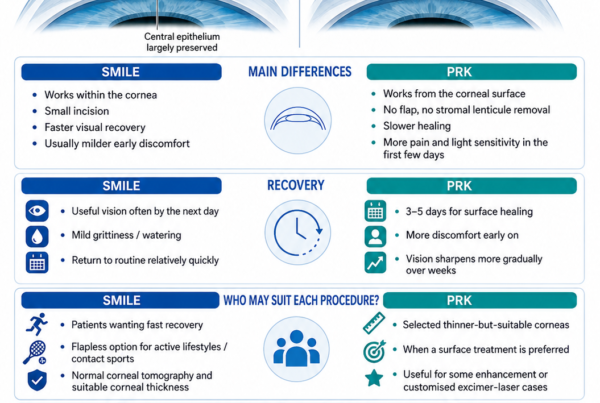
Who Might Prefer PRK Instead?
PRK may be selected when:
- Avoiding a flap is desirable
- Surface treatment better preserves available stromal architecture
- Topography-guided treatment is required
- Previous refractive surgery requires a surface enhancement
- The corneal anatomy suits PRK better
Its major disadvantage is slower recovery.
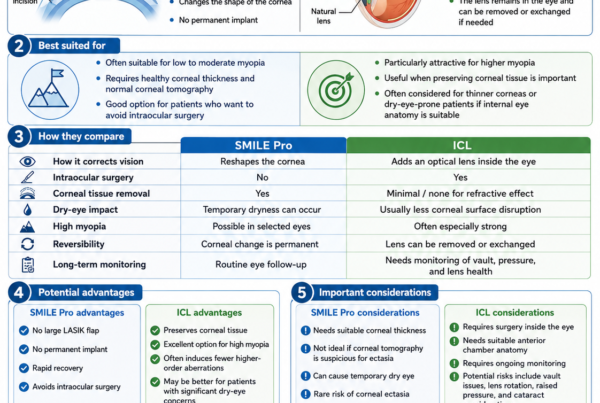
Who Might Prefer ICL?
ICL should be considered when:
- Myopia is high
- Corneal tissue is limited
- Corneal laser treatment would require substantial tissue removal
- Optical quality is a major priority
- Ocular surface concerns make corneal laser less attractive
ICL is intraocular surgery and has its own distinct risks.
How Do I Know Which Procedure I Am Suitable For?
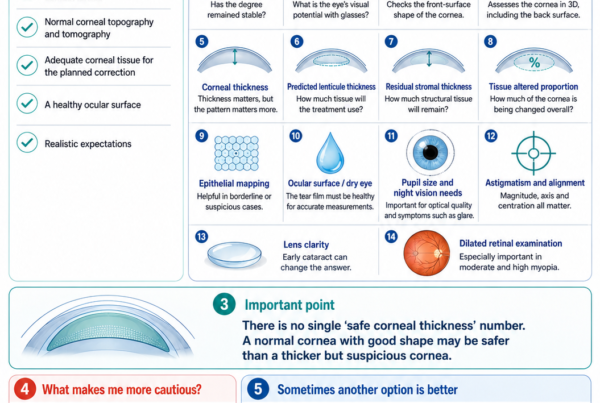
The choice should follow a detailed refractive assessment.
Refraction
The surgeon needs to know:
- Sphere
- Cylinder
- Axis
- Stability over time
Corneal Topography and Tomography
These assess:
- Corneal curvature
- Posterior corneal elevation
- Thickness distribution
- Asymmetry
- Keratoconus risk
Corneal Thickness
The surgeon calculates the structural consequences of each procedure.
Ocular Surface
Dry eye and meibomian-gland disease should be identified and treated.
Pupil Size
This may influence:
- Glare
- Halos
- Optical-zone planning
Retinal Examination
Particularly important in:
- Moderate myopia
- High myopia
- Flashes and floaters
- Lattice degeneration
- Previous retinal tears
Lifestyle
Tell your surgeon about:
- Contact sports
- Military work
- Night driving
- Screen demands
- Travel
- Work deadlines
- Pregnancy plans
A technically successful procedure can still be the wrong procedure if it does not match the patient’s life.
Common Myths
“SMILE Pro Is Better Because It Is Newer”
False.
Newer does not automatically mean better for every patient.
“LASIK Is Old Technology”
False.
Modern femtosecond LASIK uses sophisticated:
- Eye tracking
- Iris registration
- Wavefront guidance
- Topography guidance
- Excimer-laser profiles
It remains one of the most advanced refractive platforms available.
“SMILE Pro Gives Better Final Vision Than LASIK”
Not generally established.
Final safety and efficacy are broadly comparable.
“LASIK Always Gives Better Vision”
Also false.
Both procedures can produce excellent outcomes.
“SMILE Pro Has No Flap, So It Has No Risks”
False.
“LASIK Flaps Usually Fall Off”
False.
Flap displacement is rare.
“A LASIK Flap Heals Exactly Like Untouched Cornea”
False.
A persistent interface remains, explaining why late traumatic displacement is possible, although uncommon.
“SMILE Pro Cannot Cause Dry Eye”
False.
“LASIK Causes Permanent Severe Dry Eye in Everyone”
False.
Most postoperative dryness improves with time.
“SMILE Pro Is Always Better for Dry Eyes”
Not necessarily.
Severe pre-existing dry eye may make both procedures inappropriate until the surface is treated.
“SMILE Pro Is Stronger Than LASIK”
Too simplistic.
There are theoretical biomechanical advantages, but clinical meta-analysis has not consistently demonstrated a major superiority across available biomechanical measurements.
“SMILE Pro Cannot Cause Ectasia”
False.
“LASIK Always Causes Ectasia”
False.
It is rare after properly selected surgery.
“SMILE Cannot Correct Astigmatism Well”
Outdated.
Modern SMILE Pro includes improved cyclotorsion and centration tools.
“LASIK Is Always Better for Astigmatism”
Also too broad.
Wavefront-guided LASIK has a very strong astigmatism record, while recent SMILE Pro results are increasingly competitive.
“SMILE Pro Is a Ten-Second Operation”
Misleading.
The laser portion is very short.
The surgeon must still separate and remove the lenticule.
“LASIK Is Fully Automated”
False.
LASIK also requires surgical judgement and flap management.
“SMILE Pro Is Better for Everyone Who Plays Sport”
Not necessarily.
The absence of a flap is advantageous, but PRK may also be appropriate and other anatomical factors remain more important.
“Once I Have Laser Surgery, I Will Never Need Glasses”
Not guaranteed.
“Laser Surgery Stops Presbyopia”
False.
“Laser Surgery Removes the Retinal Risk of Myopia”
False.
Frequently Asked Questions
Which Is Safer: SMILE Pro or LASIK?
Both have excellent safety profiles in appropriately selected patients.
The risk profile differs rather than one procedure being universally safer.
SMILE Pro avoids:
- LASIK flap complications
LASIK avoids:
- Lenticule-dissection complications
The most important safety determinant is appropriate patient selection.
Which Has Better 20/20 Rates?
Both have high 20/20 rates.
Randomised-trial meta-analysis does not show a clinically meaningful overall superiority in final unaided acuity.
Which Is More Accurate?
LASIK showed a modest advantage for ±0.50 D predictability in one RCT meta-analysis of older-generation SMILE.
Current SMILE Pro outcomes are highly predictable, but long-term direct randomised comparison against current-generation customised LASIK remains limited.
Which Has Better Night Vision?
Neither universally.
Night vision depends on:
- Pupil size
- Prescription
- Treatment centration
- Tear film
- Residual astigmatism
- Higher-order aberrations
Which Causes Fewer Halos?
There is no reliable guarantee.
Most early halos improve after either procedure.
Which Causes Less Dry Eye?
On average, SMILE produces less early corneal nerve disruption and better early tear-film stability.
Which Is More Comfortable?
Both are usually comfortable.
Neither has the typical first-three-day pain profile of PRK.
Which Procedure Is Faster?
The VISUMAX 800 creates the SMILE Pro lenticule extremely quickly.
However, total procedure time also includes lenticule dissection.
LASIK laser treatment is also brief.
The difference usually matters less than patients expect.
Which Has Faster Visual Recovery?
LASIK may provide the fastest initial crispness.
SMILE Pro also has rapid recovery.
Can I Drive the Next Day?
Possibly after either procedure.
Do so only when:
- Vision meets legal standards
- Glare is manageable
- You feel safe
- The postoperative examination is satisfactory
Which Is Better for Office Workers?
Either may be suitable.
Patients with significant dry-eye tendency may lean towards SMILE Pro, but ocular-surface treatment is more important than procedure choice alone.
Which Is Better for Pilots?
This depends on:
- Regulatory authority
- Prescription
- Optical requirements
- Occupational medical rules
Check requirements before surgery.
Which Is Better for Soldiers?
Flap-free procedures may be attractive, but military policy and individual anatomy should determine the choice.
Which Is Better for Boxing?
SMILE Pro or PRK may be more attractive than LASIK because they do not leave a LASIK flap.
Can I Rub My Eyes After SMILE Pro?
Avoid rubbing during recovery.
Long-term vigorous eye rubbing should also be avoided because of its association with corneal ectatic disorders.
Can I Rub My Eyes After LASIK?
Avoid rubbing, particularly early after surgery.
Traumatic flap movement later is rare but possible.
Can SMILE Pro Treat -10.00 D?
Some regulatory indications extend to high myopia.
That does not mean it is automatically the best procedure.
ICL should be discussed for high corrections.
Can LASIK Treat -10.00 D?
Technically possible on some platforms and in selected corneas, but again:
technical possibility is not the same as optimal treatment selection.
Which Is Better if My Cornea Is Thin?
Neither can be chosen from thickness alone.
Tomography and expected tissue alteration matter.
PRK or ICL may be better.
Which Is Better if I Have Dry Eye?
Treat the dry eye first.
If both are otherwise suitable, SMILE Pro may have an early ocular-surface advantage.
Which Is Better if I Have Keratoconus?
Ordinary elective SMILE Pro and LASIK are generally inappropriate.
Can I Have SMILE Pro After LASIK?
Not routinely.
An enhancement strategy requires specialised assessment.
Can I Have LASIK After SMILE?
Selected eyes can undergo a flap-based enhancement strategy such as CIRCLE or thin-flap LASIK, but this is not equivalent to simple primary LASIK.
Can I Have Cataract Surgery Later?
Yes after either procedure.
Will My Cataract Surgeon Know Which I Had?
Tell them.
Ideally retain your refractive-surgery records.
Can My Myopia Return?
Yes after either procedure.
Possible reasons include:
- Natural myopic progression
- Regression
- Lens changes
Can Either Surgery Be Reversed?
No.
Corneal tissue removed during LASIK or SMILE Pro does not regrow.
Can SMILE Pro Be Enhanced More Than Once?
Potentially in selected circumstances, but each further procedure must be assessed according to:
- Remaining tissue
- Corneal shape
- Previous treatment
- Refractive need
Can LASIK Be Enhanced More Than Once?
Sometimes, but repeated surgery is not automatically safe or advisable.
Warning Signs After Either Procedure
Contact the treating clinic promptly for:
- Increasing pain
- Increasing redness
- Sudden loss of vision
- Significant light sensitivity
- Significant discharge
- A visible white corneal spot
- Eye trauma
Additional Warning Signs After LASIK
Seek review after trauma if there is:
- Sudden blur
- Significant discomfort
- A visible flap wrinkle
- Foreign-body sensation
even many years after LASIK.
Retinal Warning Signs After Either Procedure
Patients who were myopic before surgery should seek urgent assessment for:
- New flashes
- A sudden shower of floaters
- A curtain or shadow
- Sudden peripheral-field loss
Laser correction does not remove retinal-detachment risk.
SMILE Pro vs LASIK: Which Should I Choose?
A useful way to think about the decision is:
SMILE Pro May Have the Edge When You Prioritise
- No LASIK flap
- Contact-sport compatibility
- Less early corneal nerve disruption
- Rapid recovery without surface ablation
- A small-incision procedure
- Myopia with suitable regular astigmatism
LASIK May Have the Edge When You Prioritise
- Maximum excimer-laser customisation
- Wavefront-guided treatment
- Topography-guided treatment
- Very rapid initial crispness
- Established hyperopic treatment
- Straightforward flap-relift enhancement in selected cases
Neither May Be Best When
- Corneal tomography is abnormal
- Myopia is very high
- Corneal tissue is limited
- There is significant uncontrolled dry eye
- Cataract is developing
- The prescription is unstable
In those situations, alternatives such as:
- PRK
- ICL
- Lens-based surgery
- Spectacles
- Contact lenses
may be safer.
A Pre-Surgery Checklist
Ask About Your Cornea
- Is my tomography completely normal?
- Is there any keratoconus suspicion?
- How thick is my cornea?
- How much tissue will be affected?
- What is my calculated ectasia risk?
Ask About Your Prescription
- Is my prescription stable?
- How much astigmatism do I have?
- Is my correction particularly high?
- Should I also consider ICL?
Ask About Visual Quality
- Do I have large pupils?
- Do I have significant higher-order aberrations?
- Would wavefront-guided or topography-guided LASIK offer an advantage?
- How accurately can SMILE Pro treat my astigmatism?
Ask About Dry Eye
- Is my ocular surface healthy?
- Do I have meibomian-gland dysfunction?
- Should this be treated before surgery?
- Does my dry-eye profile favour SMILE Pro?
Ask About Lifestyle
- Do I play contact sports?
- Do I work in a high-trauma environment?
- How quickly do I need to return to driving or work?
- Do I have important night-vision requirements?
Ask About Future Retreatment
- What happens if I have residual myopia?
- How do you enhance LASIK?
- How do you enhance SMILE Pro?
- Would the enhancement create a flap?
- Would I require PRK?
The Bottom Line
SMILE Pro and LASIK are both highly effective forms of laser vision correction.
Their fundamental difference is how the cornea is reshaped.
With LASIK:
- A large corneal flap is created.
- An excimer laser reshapes the underlying stroma.
- The flap is repositioned.
With SMILE Pro:
- The VISUMAX 800 creates an internal stromal lenticule.
- The surgeon removes it through a small incision.
- No LASIK flap is created.
For most appropriately selected myopic patients, established evidence shows that SMILE and LASIK provide broadly comparable:
- Safety
- Efficacy
- Unaided vision
- Refractive outcomes
SMILE Pro’s main potential advantages include:
- No large flap
- Less early corneal nerve disruption
- Better early tear-film stability
- No late flap-displacement risk
- Attractive profile for contact sports
- Faster laser delivery and improved centration compared with earlier-generation SMILE
LASIK’s main advantages include:
- Very rapid visual recovery
- Extensive long-term experience
- Excellent astigmatism predictability
- Wavefront-guided treatment
- Topography-guided treatment
- Greater flexibility for certain prescriptions
- Relatively straightforward enhancement in selected patients
Earlier studies suggested that LASIK had a modest advantage in fine refractive predictability and astigmatic accuracy compared with first-generation SMILE.
SMILE Pro may narrow some of these differences because the VISUMAX 800 improves:
- Centration
- Cyclotorsion compensation
- Lenticule-creation speed
Early evidence is encouraging, particularly for astigmatism, but the SMILE Pro evidence base is necessarily shorter than the decades of data available for LASIK.
Neither procedure is universally better.
A patient with:
- Significant dry-eye tendency
- A high-impact lifestyle
- Completely normal corneal anatomy
may lean towards SMILE Pro.
A patient who would benefit from:
- Topography-guided treatment
- Wavefront-guided treatment
- Hyperopic correction
- Maximum excimer customisation
may be better suited to LASIK.
A patient with:
- Very high myopia
- Limited corneal tissue
may be better suited to ICL.
A patient with:
- Abnormal tomography
- Keratoconus
may be unsuitable for both.
The most important message is:
Do not choose SMILE Pro simply because it is newer, and do not dismiss LASIK simply because it uses a flap. Both are excellent procedures when used for the right eye. The best refractive operation is the one that achieves the desired vision while respecting the patient’s corneal anatomy and long-term safety.
References
- Yao L, et al. Small incision lenticule extraction and LASIK for myopia and myopic astigmatism: systematic review and meta-analysis of randomised clinical trials. Semin Ophthalmol. 2023. PMID: 35912896.
- Zhang Y, et al. Clinical outcomes of SMILE and femtosecond LASIK used to treat myopia: meta-analysis. PMID: 27070233.
- Kobashi H, Kamiya K, Shimizu K. Dry eye after small incision lenticule extraction and femtosecond LASIK: meta-analysis. PMID: 27560032.
- KLEx versus LASIK for dry-eye outcomes: systematic review and meta-analysis. 2025. PMID: 40778870.
- Tian H, et al. Wavefront-guided LASIK versus SMILE: clinical outcomes and higher-order aberrations. Acta Ophthalmol. 2023. PMID: 36726315.
- Clinical outcomes of SMILE and wavefront-guided LASIK for myopia and astigmatism: systematic review and meta-analysis. 2024. PMID: 38377878.
- SMILE versus LASIK for astigmatic correction: systematic review and meta-analysis. 2022. PMID: 36410469.
- Sekundo W, Chang JSM, Ganesh S, Hjortdal J, Wiltfang R. Keratorefractive lenticule extraction with the VISUMAX 800: six-month prospective multicentre outcomes. J Refract Surg. 2025. PMID: 40067668.
- Chung YT, et al. Comparison of SMILE using VISUMAX 800 versus VISUMAX 500. 2025. PMID: 40664759.
- Yang et al. Early visual and optical-quality outcomes after SMILE using VISUMAX 800 versus VISUMAX 500. 2026. PMID: 42145766.
- Tran LHT, et al. Refractive and vector outcomes of SMILE Pro with VISUMAX 800 for high astigmatism. 2026. PMID: 42496490.
- Mei Y, et al. Vector outcomes after SMILE Pro using automated cyclotorsion compensation. 2026. PMID: 42318400.
- Guo H, et al. Corneal biomechanical properties after SMILE versus LASIK, PRK and related procedures: systematic review and meta-analysis. 2019. PMID: 31370817.
- Corneal biomechanics after SMILE and femtosecond LASIK: systematic review and meta-analysis. 2023. PMID: 37565903.
- Moshirfar M, et al. Ectasia after corneal refractive surgery: systematic review. Ophthalmol Ther. 2021. PMID: 34417707.
- Xiao J, et al. Traumatic corneal flap displacement after LASIK and literature review. 2017. PMID: 28458585.
- Late traumatic flap dislocations after LASIK. PMID: 16722490.
- Liu YC, Rosman M, Mehta JS. Enhancement after small-incision lenticule extraction: incidence, risk factors and outcomes. Ophthalmology. 2017. PMID: 28318639.
- Siedlecki J, et al. Surface ablation versus CIRCLE for myopic enhancement after SMILE. J Refract Surg. 2019. PMID: 31059578.
- Beckers D, et al. Intraoperative safety and postoperative complications after SMILE Pro: 916-eye case series. 2026. PMID: 42355753.