Author: Dr Val Phua
Estimated reading time: 23 minutes
SMILE Pro is a modern form of laser vision correction used primarily to correct:
- Myopia
- Myopic astigmatism
It is performed using the ZEISS VISUMAX 800 femtosecond laser.
Unlike LASIK, SMILE Pro does not create a large corneal flap.
Unlike PRK, it does not remove the surface epithelium over a large treatment area.
Instead, the femtosecond laser creates a thin, lens-shaped piece of tissue—called a lenticule—within the cornea.
The surgeon then removes this lenticule through a small peripheral corneal opening.
Removing the lenticule changes the shape and focusing power of the cornea, allowing light to focus more accurately on the retina.
The basic surgical principle is the same as the original SMILE procedure.
The important difference is the platform.
Original SMILE was performed using the ZEISS VisuMax 500.
SMILE Pro uses the newer ZEISS VISUMAX 800, which has:
- A laser repetition rate of up to 2 MHz
- Much faster lenticule creation
- Computer-assisted centration with CentraLign
- Cyclotorsion adjustment using OcuLign
- Updated digital surgical workflow
ZEISS reports that a myopic lenticule can be created in less than 10 seconds using the VISUMAX 800.
Clinical comparisons confirm that the newer platform substantially reduces laser cutting time. In one 2025 study, mean lenticule creation time was approximately 10.3 seconds with the VisuMax 800 compared with 28.3 seconds with the VisuMax 500. Final three-month visual acuity and refractive outcomes were similar, while treatment centration was better with the newer system.
This shorter laser time does not mean that the entire surgery lasts ten seconds.
The laser creates the lenticule rapidly, but the surgeon must still:
- Separate the lenticule
- Free its anterior and posterior surfaces
- Remove it through the small incision
- Check that the lenticule is complete
A useful way to understand SMILE Pro is therefore:
SMILE Pro is the latest generation of SMILE, combining the established flapless lenticule-extraction concept with a faster laser and improved digital alignment tools.
The Quick Answer
What Does SMILE Stand For?
SMILE stands for:
Small Incision Lenticule Extraction.
A small piece of corneal tissue is created inside the cornea and removed through a small incision.
What Makes SMILE Pro Different from Ordinary SMILE?
Both operations follow essentially the same surgical principle.
The main difference is that SMILE Pro is performed using the newer ZEISS VISUMAX 800.
Compared with the VisuMax 500 generation, the VISUMAX 800 provides:
- Faster laser scanning
- A maximum repetition rate of 2 MHz
- Shorter suction and laser time
- CentraLign-assisted centration
- OcuLign cyclotorsion adjustment
- An updated surgical interface and workflow
Recent comparative clinical studies have found similar overall efficacy, safety and refractive predictability between the two generations, but shorter laser time and less treatment-zone decentration with SMILE Pro.
Is SMILE Pro Flapless?
Yes.
SMILE Pro does not create the large hinged corneal flap used in LASIK.
Instead, the surgeon works through a small incision.
ZEISS describes an opening of approximately 4 mm for its current SMILE Pro procedure, while incision size can vary according to surgical settings and technique.
This means there are no LASIK-flap-related complications such as:
- Traumatic flap displacement
- Flap folds
- Flap-edge problems
- Flap-interface epithelial ingrowth
However, SMILE Pro has its own potential complications and should not be described as risk-free.
Does SMILE Pro Use an Excimer Laser?
No.
Standard SMILE Pro does not require an excimer laser for the primary procedure.
A femtosecond laser creates:
- The front surface of the lenticule
- The back surface of the lenticule
- The edge of the lenticule
- The small access incision
The surgeon then physically removes the lenticule.
LASIK, by comparison, usually uses:
- A femtosecond laser to create the flap
- An excimer laser to reshape the cornea
PRK uses an excimer laser after removal of the corneal epithelium.
Is SMILE Pro Painful?
The procedure is performed using anaesthetic eye drops.
Patients generally feel:
- Pressure
- Touch
- Water or fluid
- Awareness that something is happening
rather than sharp pain.
Mild postoperative symptoms may include:
- Grittiness
- Watering
- Light sensitivity
- Mild stinging
- Fluctuating vision
These are usually considerably less intense than the first few days after PRK because there is no large epithelial defect.
How Quickly Does Vision Recover?
Many patients have useful vision by the following day.
Vision can nevertheless remain:
- Slightly hazy
- Fluctuating
- Less crisp than expected
- Associated with halos or glare
during the early recovery period.
Visual quality generally improves over:
- The first few days
- The first several weeks
- Occasionally several months for finer optical changes
Early clinical SMILE Pro studies have demonstrated favourable one-day to one-month visual recovery, although results differ according to initial prescription and surgical parameters.
How Successful Is SMILE Pro?
Early clinical studies are encouraging.
In a study of 152 SMILE Pro eyes:
- 91% were within ±0.50 D of the intended refractive target
- 99% were within ±1.00 D at three months
No intraoperative or postoperative complications were reported in that series.
A larger study involving 765 eyes with myopic astigmatism reported:
- 81% within ±0.50 D
- 97% within ±1.00 D
- 92% achieving 20/25 or better unaided vision
- No change in corrected visual acuity in 99% of eyes
at three months.
These results are population averages.
They do not mean that every individual will achieve perfect unaided vision.
How Does SMILE Pro Correct Myopia?
Why Is a Myopic Eye Blurry?
In myopia, incoming light focuses in front of the retina rather than directly on it.
This commonly occurs because:
- The eye is too long
- The cornea has too much focusing power
- Both factors contribute
Spectacles and contact lenses compensate optically.
SMILE Pro permanently changes the shape of the cornea itself.
Creating the Lenticule
The femtosecond laser creates a precisely shaped piece of stromal tissue within the cornea.
For myopia, the lenticule is generally thicker centrally.
Removing it causes the central cornea to flatten.
This reduces the cornea’s focusing power.
Light can then focus closer to the retinal plane.
Correcting Astigmatism
Astigmatism occurs when the eye has different refractive power along different meridians.
The lenticule is therefore designed asymmetrically when astigmatism needs to be corrected.
Accurate rotational alignment becomes increasingly important as astigmatism increases.
This is relevant because the eye may rotate slightly when a patient moves from an upright examination position to lying beneath the laser.
What Does OcuLign Do?
OcuLign allows the surgeon to compensate for cyclotorsional rotation by rotating the treatment pattern before laser delivery.
This is particularly relevant to astigmatic treatment.
Recent VisuMax 800 studies have reported favourable astigmatic correction, including in eyes with higher degrees of astigmatism.
What Does CentraLign Do?
Centration determines where the optical treatment is positioned relative to the eye.
CentraLign provides computer-assisted guidance during docking to help the surgeon align the treatment.
Studies comparing VisuMax 800 with VisuMax 500 treatments have reported lower treatment-zone decentration with the newer platform.
This does not mean that software replaces surgical judgement.
The surgeon remains responsible for:
- Patient positioning
- Docking
- Centration
- Lenticule dissection
- Lenticule removal
- Managing unexpected events
Step-by-Step: What Happens During SMILE Pro?
Step 1: Anaesthetic Eye Drops
Local anaesthetic drops numb the surface of the eye.
General anaesthesia is not normally required.
Step 2: The Eyelids Are Kept Open
A small instrument holds the eyelids apart.
You do not need to consciously stop yourself from blinking.
Step 3: The Eye Is Positioned Beneath the VISUMAX 800
The surgeon aligns the eye with the laser.
The cornea gently contacts the curved treatment interface.
Step 4: Suction Is Applied
Gentle suction stabilises the eye during the femtosecond treatment.
You may notice:
- Pressure
- The fixation light becoming less clear
- A temporary change in what you see
Step 5: The Laser Creates the Lenticule
The femtosecond laser creates microscopic cleavage planes within the corneal stroma.
For typical myopic treatment, this laser portion takes less than ten seconds on the VISUMAX 800 according to the manufacturer.
Step 6: A Small Incision Is Created
The laser also creates the small peripheral access opening.
There is no large circumferential LASIK flap.
Step 7: Suction Is Released
The laser portion is complete.
Step 8: The Surgeon Separates the Lenticule
Using fine instruments, the surgeon identifies and separates:
- The anterior lenticule plane
- The posterior lenticule plane
This is a surgical step rather than an automated laser step.
Step 9: The Lenticule Is Removed
The lenticule is gently extracted through the small incision.
Removing the tissue changes the curvature of the cornea.
Step 10: The Interface Is Checked
The surgeon confirms:
- Complete lenticule removal
- Appropriate corneal appearance
- Absence of significant retained tissue or debris
The incision does not normally require stitches.
How Long Does the Whole Procedure Take?
The laser portion is measured in seconds.
The entire treatment takes longer because it includes:
- Positioning
- Docking
- Lenticule creation
- Dissection
- Removal
- Final examination
The complete procedure is nevertheless usually brief.
Do I See What the Surgeon Is Doing?
No.
Vision becomes blurred during treatment.
You may see:
- A green fixation light
- Changing brightness
- Hazy colours
- Shadows
- Light movement
You do not see instruments approaching the eye in sharp detail.
What Happens If I Move?
Small movements are expected.
The eye is stabilised with suction during the laser portion.
If suction is lost, the surgeon assesses the stage at which it occurred and determines whether to:
- Redock
- Restart part of the procedure
- Convert to another treatment
- Postpone treatment
Suction loss is uncommon but recognised.
In a 2026 real-world series of 916 SMILE Pro eyes, suction loss occurred in six eyes, or 0.66%.
Why Does the Faster Laser Matter?
The original VisuMax 500 usually required substantially longer to create the lenticule.
The VISUMAX 800 can complete laser scanning much faster.
Theoretically, reducing the time during which suction must remain stable may reduce the opportunity for:
- Eye movement
- Fixation loss
- Anxiety
- Suction loss
The clearest proven difference is shorter laser time.
Comparative evidence also suggests improvements in treatment centration, while the eventual standard visual outcomes remain broadly comparable with first-generation SMILE.
It would therefore be inaccurate to say:
“SMILE Pro gives dramatically better vision than ordinary SMILE.”
A more evidence-based statement is:
SMILE Pro delivers the same fundamental lenticule-extraction treatment using a substantially faster platform with improved alignment and workflow tools.
Who May Be Suitable for SMILE Pro?
Suitability depends on much more than spectacle prescription.
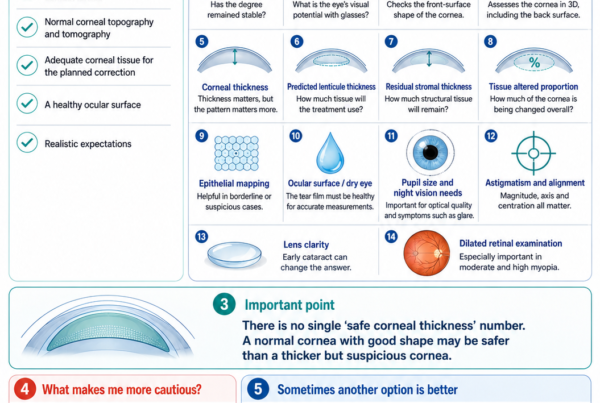
A suitable patient generally needs:
- A stable prescription
- Healthy corneal tomography
- Adequate corneal thickness
- Healthy ocular surface
- Appropriate refractive error
- Realistic expectations
- No significant untreated eye disease
What Prescription Can SMILE Pro Correct?
The exact approved range varies according to:
- Country
- Regulatory approval
- Software version
- Laser platform
- Corneal anatomy
In Singapore, SNEC currently lists SMILE Pro eligibility for myopia approximately -1.00 to -10.00 D and astigmatism up to -5.00 D, subject to adequate corneal thickness and full ophthalmic assessment.
These numbers should not be treated as automatic eligibility thresholds.
A patient within the numerical range may still be unsuitable.
A patient near the upper end of the range may be better served by ICL.
What About Hyperopia?
The VISUMAX 800 platform now supports SMILE Pro hyperopic lenticule extraction in some markets.
ZEISS describes treatment capability for hyperopia with or without astigmatism, but regulatory approval and software availability differ geographically.
Patients should therefore ask what treatment is currently approved and offered in their country rather than assuming that every VISUMAX 800 provides the same treatment range.
Stable Prescription
Laser surgery should not normally be performed while the prescription is still changing significantly.
Stability is particularly important in:
- Younger adults
- Progressive myopia
- Recent pregnancy
- Rapidly changing diabetes control
Corneal Thickness
SMILE removes corneal stromal tissue.
The higher the refractive correction, the thicker the required lenticule.
The surgeon therefore evaluates:
- Total corneal thickness
- Cap thickness
- Lenticule thickness
- Residual stromal tissue
- Corneal shape
- Expected biomechanical effect
Corneal Tomography
Normal corneal tomography is essential.
Testing should assess:
- Anterior curvature
- Posterior elevation
- Pachymetric distribution
- Corneal asymmetry
- Keratoconus indicators
A cornea that looks clear and achieves 6/6 vision can still have abnormal tomography.
Who May Not Be Suitable?
Reasons SMILE Pro may be unsuitable include:
- Keratoconus
- Corneal ectasia
- Suspicious corneal tomography
- Inadequate corneal thickness
- Unstable refraction
- Significant untreated dry eye
- Active ocular infection
- Active inflammation
- Significant cataract
- Certain corneal dystrophies
- Poorly controlled systemic disease
- Pregnancy or unstable postpartum refraction
The final decision should be based on the entire eye rather than one measurement.
Keratoconus and SMILE Pro
SMILE Pro is flapless, but this does not make it safe for a structurally abnormal cornea.
Ectasia has been reported after SMILE.
A literature review found that many reported post-SMILE ectasia cases had evidence of pre-existing abnormal or suspicious corneal topography.
A larger systematic review estimated a low reported rate of ectasia after SMILE in eyes without recognised preoperative risk factors, but the authors emphasised the limitations of using published case reports to calculate true incidence.
The practical message is:
No form of corneal laser surgery should be used simply to bypass abnormal corneal tomography.
What Tests Are Needed Before SMILE Pro?
Visual Acuity
Testing determines:
- Unaided vision
- Corrected vision
- Best visual potential
Manifest Refraction
The spectacle prescription is carefully measured.
Cycloplegic Refraction
Selected patients may undergo cycloplegia to reduce accommodation and confirm the true refractive error.
Corneal Topography and Tomography
These are essential for:
- Keratoconus screening
- Corneal-shape analysis
- Posterior-surface assessment
- Thickness distribution
- Surgical planning
Pachymetry
Pachymetry measures corneal thickness.
Ocular Surface Assessment
The surgeon checks for:
- Dry eye
- Meibomian-gland dysfunction
- Allergy
- Blepharitis
- Corneal staining
Poor ocular-surface health may reduce:
- Measurement accuracy
- Visual quality
- Postoperative comfort
Pupil Assessment
Pupil size may influence:
- Night vision
- Optical-zone planning
- Glare and halo counselling
Dilated Retinal Examination
This is particularly important in patients with moderate or high myopia.
SMILE Pro corrects the cornea.
It does not shorten an elongated myopic eye.
A highly myopic person remains at increased lifetime risk of:
- Retinal tears
- Retinal detachment
- Myopic macular degeneration
- Myopic choroidal neovascularisation
even after achieving 6/6 unaided vision.
SMILE Pro Recovery
Immediately After Surgery
Vision is usually:
- Hazy
- Misty
- Functional but imperfect
Patients may notice:
- Watering
- Mild stinging
- Grittiness
- Light sensitivity
Someone else should take you home.
The First Evening
Vision usually begins improving.
Do not:
- Rub the eyes
- Allow water into the eyes
- Drive
- Use eye make-up
Use prescribed eye drops exactly as directed.
Day 1
Many patients have useful unaided vision.
However, vision may still feel:
- Slightly foggy
- Less crisp than with glasses
- Different between the eyes
A next-day review is commonly performed.
The First Week
Vision generally becomes clearer and more stable.
Possible symptoms include:
- Dryness
- Halos
- Glare
- Mild fluctuation
- Slightly reduced night clarity
The First Month
For many patients:
- Distance vision is good
- Visual fluctuation is reduced
- Dryness continues improving
- Night vision becomes more comfortable
One to Three Months
Fine visual quality continues to stabilise.
The surgeon may assess:
- Refraction
- Corneal shape
- Visual acuity
- Ocular surface
- Whether any residual refractive error remains
Is Recovery Faster Than PRK?
Usually, yes.
PRK requires regeneration of a large epithelial surface.
SMILE Pro does not.
PRK commonly produces:
- More pain
- Greater early light sensitivity
- Slower functional visual recovery
SMILE Pro generally produces much less postoperative discomfort.
Is Recovery Faster Than LASIK?
Both can provide rapid recovery.
LASIK has historically produced exceptionally rapid first-day visual clarity.
Older randomised studies found LASIK vision somewhat clearer during the very early postoperative period, while later outcomes were similar.
Modern SMILE Pro may narrow this early difference because of:
- Faster laser delivery
- Improved centration
- Refined energy settings
- Improved lenticule separation
However, it should not be promised that every SMILE Pro patient will see perfectly the next morning.
Dry Eye After SMILE Pro
Why Can Laser Surgery Cause Dry Eye?
Corneal nerves contribute to:
- Tear production
- Blinking
- Ocular-surface sensation
Any corneal refractive procedure may temporarily alter corneal sensation.
Why Might SMILE Cause Less Nerve Disruption?
LASIK creates a relatively large flap side cut.
SMILE uses a much smaller incision.
This theoretically preserves more of the anterior corneal nerve network.
Randomised clinical evidence supports greater early corneal denervation after LASIK than after SMILE.
In a paired-eye randomised trial:
- LASIK eyes had significantly lower corneal sensitivity at 1, 3 and 6 months
- The difference disappeared by 12 months
Importantly, patient-reported dry-eye symptom scores were not significantly different between the procedures in that study.
Therefore, the careful message is:
SMILE tends to preserve corneal sensation better during early recovery, but it does not guarantee freedom from postoperative dry eye.
Who Has Greater Dry-Eye Risk?
Risk may be increased by:
- Pre-existing dry eye
- Meibomian-gland dysfunction
- Contact-lens intolerance
- Long screen hours
- Allergy
- Autoimmune disease
Ocular-surface treatment before surgery is important.
SMILE Pro and Corneal Strength
SMILE avoids a large LASIK flap.
This preserves more continuous anterior stromal tissue.
Biomechanical modelling and laboratory evidence suggest potential structural advantages to lenticule extraction.
However, it is misleading to say that:
SMILE Pro does not weaken the cornea.
Tissue is still removed from the stroma.
The cornea is still biomechanically altered.
Ectasia remains possible.
Careful screening is therefore essential regardless of whether the procedure is:
- SMILE Pro
- LASIK
- PRK
SMILE Pro Versus LASIK
Surgical Method
SMILE Pro
- One femtosecond laser
- Internal lenticule
- Small access incision
- No large flap
- No excimer ablation during the primary procedure
LASIK
- Femtosecond flap creation
- Flap lifted
- Excimer-laser ablation
- Flap repositioned
Recovery
Both generally recover rapidly.
LASIK may have slightly faster initial crispness in some patients.
SMILE Pro avoids flap healing.
Dry Eye
SMILE generally causes less early corneal denervation than LASIK.
The difference in subjective dry-eye symptoms is less consistent.
Visual Results
Randomised studies of conventional SMILE and femtosecond LASIK show similar:
- Safety
- Efficacy
- Predictability
at later follow-up.
SMILE Pro preserves this same underlying surgical principle while improving the laser platform.
Customisation
Modern LASIK can offer:
- Wavefront-guided treatment
- Topography-guided treatment
because an excimer laser directly ablates a customised corneal pattern.
SMILE relies on lenticule geometry.
For highly unusual corneal optical aberrations, topography-guided surface or LASIK treatment may offer advantages.
The best technology depends on the eye rather than the brand name.
Flap Trauma
Late traumatic LASIK flap displacement is rare but possible.
SMILE Pro has no LASIK flap to displace.
This may be attractive for people involved in:
- Martial arts
- Boxing
- Rugby
- Military activity
- Contact sport
- Occupations with facial-trauma risk
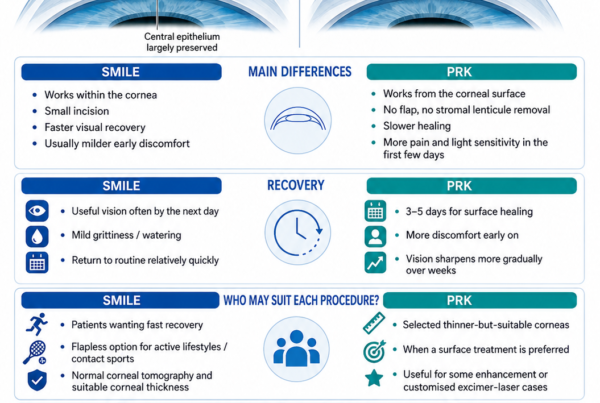
SMILE Pro Versus PRK
Surface Healing
PRK removes the epithelium.
SMILE Pro largely preserves it.
Pain
PRK usually causes significantly more discomfort during the first few days.
SMILE Pro is generally associated with relatively mild discomfort.
Recovery
PRK:
- Days of epithelial healing
- Several weeks of visual refinement
- Months of fine stabilisation
SMILE Pro:
- Often useful vision the next day
- Faster return to ordinary daily function
Haze
PRK has a specific postoperative stromal-haze risk.
SMILE Pro does not produce the same surface-ablation wound response.
Thin Corneas
PRK may sometimes be preferable when tissue conservation makes SMILE or LASIK unsuitable.
However, treatment choice depends on:
- Prescription
- Tomography
- Thickness
- Expected tissue removal
A thin cornea is not automatically a SMILE Pro candidate.
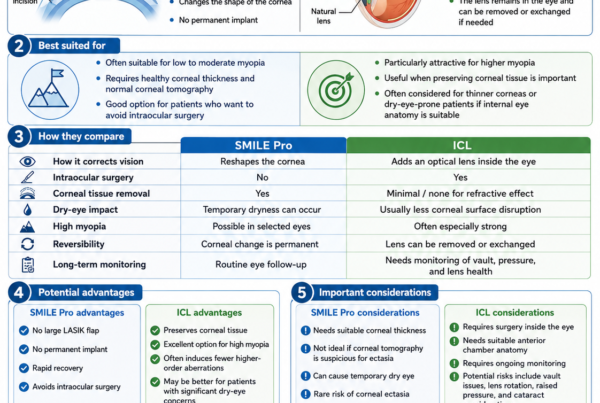
SMILE Pro Versus ICL
SMILE Pro and ICL solve refractive error in very different ways.
SMILE Pro
- Corneal procedure
- Removes stromal tissue
- No implant remains inside the eye
- No intraocular surgery
ICL
- Does not remove corneal tissue
- Places a phakic lens behind the iris
- Preserves the natural crystalline lens
- Requires intraocular surgery
When Might SMILE Pro Be Attractive?
When the patient has:
- Low-to-moderate or appropriately selected higher myopia
- Healthy corneas
- Adequate tissue
- Preference for a corneal procedure
When Might ICL Be Attractive?
Particularly when there is:
- High myopia
- Limited corneal tissue
- Significant dry-eye concerns
- Optical reasons to avoid a large corneal correction
- Suitable anterior-segment anatomy
For very high prescriptions, the question should not be:
Can the laser technically remove enough tissue?
It should be:
Which treatment gives the best balance of visual quality, predictability and long-term anatomical safety?
SMILE Pro and High Myopia
SMILE can produce good results for high myopia in carefully selected patients.
Randomised studies comparing conventional SMILE with LASIK in very high myopia found good outcomes with both, with some optical and refractive advantages favouring SMILE in that particular study population.
However, as myopia increases:
- The lenticule becomes thicker.
- More corneal tissue must be removed.
- Residual stromal thickness decreases.
- Refractive predictability may be less exact.
Recent SMILE Pro data also suggest that early unaided visual outcomes may be less predictable in high myopia than in low or moderate myopia.
ICL should therefore always be considered when the degree is high.
SMILE Pro and Astigmatism
SMILE has historically faced particular challenges with high astigmatism because astigmatic treatment is sensitive to:
- Centration
- Cyclotorsion
- Axis accuracy
The VISUMAX 800 addresses this with:
- CentraLign
- OcuLign
Recent clinical studies suggest favourable astigmatic outcomes and potentially less residual cylinder than older-generation treatment, although much of the comparative evidence remains relatively short-term.
Long-Term Results
SMILE Pro itself is newer, so it cannot yet have the same 10-year direct follow-up as the original SMILE platform.
However, the underlying SMILE procedure has substantial long-term data.
One 10-year study found:
- Safety index 1.19
- Efficacy index 1.04
- 81% of eyes within ±0.50 D
- 94% within ±1.00 D
- Mean regression of approximately -0.32 D over ten years
Another original SMILE cohort demonstrated stable outcomes at 10 years without significant change from its six-month result.
Because SMILE Pro is fundamentally the same lenticule-extraction concept performed on a newer laser platform, these studies provide useful evidence about the long-term principle of the operation.
They should not, however, be presented as 10-year VisuMax 800 data.
Does SMILE Pro Last Forever?
The corneal tissue removed during surgery does not grow back.
The corneal reshaping is therefore permanent.
However, your eyes continue ageing.
Future changes may include:
- Myopic progression
- Refractive regression
- Presbyopia
- Cataract
- Retinal disease
A permanent operation does not guarantee an unchanging prescription for life.
Does SMILE Pro Prevent Presbyopia?
No.
Presbyopia occurs because the natural lens progressively loses focusing flexibility.
Someone who undergoes perfect distance correction at age 30 may require reading glasses in their 40s.
Monovision
Selected patients may choose:
- One eye primarily for distance
- One eye mildly short-sighted for near
This may reduce dependence on reading glasses.
A contact-lens trial before surgery can help determine whether the patient tolerates:
- Reduced binocular distance sharpness
- Reduced stereopsis
- Different focus between the eyes
Does SMILE Pro Prevent Cataracts?
No.
SMILE Pro changes the cornea.
A cataract develops in the natural lens inside the eye.
Cataract surgery may still be required later in life.
Does SMILE Pro Affect Future Cataract Surgery?
Cataract surgery remains possible.
However, previous corneal refractive surgery changes the relationship between:
- Corneal curvature
- Corneal power
- IOL calculation
Modern formulas can account for this, but future cataract surgeons should always be told about previous SMILE Pro.
Keeping preoperative refractive records is useful.
Does SMILE Pro Remove the Retinal Risks of Myopia?
No.
This is particularly important.
A person may be -8.00 D before surgery and see 6/6 without spectacles afterwards.
The eyeball may still remain anatomically long.
The patient still retains the increased lifetime risks associated with high axial myopia, including:
- Retinal tear
- Retinal detachment
- Myopic macular degeneration
- Myopic choroidal neovascularisation
Seek urgent retinal assessment for:
- New flashes
- Sudden increase in floaters
- A curtain or shadow
- Sudden visual loss
Can SMILE Pro Cause Corneal Ectasia?
Rarely, yes.
Ectasia means progressive corneal weakening and bulging.
Symptoms may include:
- Increasing myopia
- Increasing astigmatism
- Ghosting
- Distortion
- Reduced corrected vision
A systematic review found reported post-SMILE ectasia to be uncommon, but publication-based incidence estimates have important limitations.
A high-volume clinical series also found that most ectasia cases occurred in eyes categorised preoperatively as borderline rather than normal, reinforcing the importance of patient selection.
Other Possible Risks and Complications
Potential complications include:
- Suction loss
- Difficult lenticule separation
- Incomplete lenticule removal
- Retained lenticule tissue
- Cap tear
- Epithelial defect
- Interface inflammation
- Infection
- Residual refractive error
- Regression
- Dry eye
- Halos
- Glare
- Reduced contrast
- Rare ectasia
Most are uncommon in experienced hands, but no elective refractive operation should be described as complication-free.
What Is Suction Loss?
During laser treatment, the eye is stabilised by suction.
Suction may occasionally release before the laser cut has been completed.
The appropriate response depends on when this occurs.
Published literature shows that SMILE procedures can often be completed successfully after appropriate management of suction loss.
The shorter VISUMAX 800 laser time reduces the duration during which suction needs to remain stable, although it cannot completely eliminate suction loss.
Can Infection Occur?
Yes, although it is uncommon.
Any corneal surgery can become infected.
Seek urgent assessment after SMILE Pro for:
- Increasing pain
- Increasing redness
- Increasing light sensitivity
- Significant discharge
- Falling vision
- A visible white corneal spot
Do not self-treat with leftover steroid drops.
Can Some Prescription Remain?
Yes.
Possible outcomes include:
- Small residual myopia
- Residual astigmatism
- Over-correction
- Later regression
The appropriate response depends on:
- Magnitude
- Symptoms
- Corneal health
- Stability
- Age
A tiny residual prescription does not automatically justify more surgery.
Can SMILE Pro Be Enhanced?
Yes, selected patients can undergo enhancement.
The strategy differs from routine LASIK because there is no conventional flap to simply relift.
Established options after SMILE include:
- PRK or surface ablation
- CIRCLE cap-to-flap conversion
- Thin-flap LASIK in selected eyes
- Other carefully selected approaches
A Singapore cohort of 524 eyes reported a two-year enhancement incidence of 2.9% after conventional SMILE; PRK with mitomycin C produced good enhancement outcomes.
In another comparison, surface ablation and CIRCLE produced similar three-month refractive outcomes, although CIRCLE offered faster early visual recovery by converting the SMILE cap into a LASIK-style flap.
A more recent SMILE Pro series reported an enhancement rate of 1.54%, although longer follow-up is required before concluding that SMILE Pro definitively requires fewer enhancements than the older platform.
Can SMILE Pro Be Repeated?
Repeat lenticule extraction has been described, but it is not the usual enhancement strategy in many settings.
The surgeon must consider:
- Previous cap depth
- Remaining corneal tissue
- Residual prescription
- Regulatory approval
- Available software
- Long-term biomechanics
Exercise After SMILE Pro
Gentle activity can usually resume relatively early.
Follow the surgeon’s instructions regarding:
- Running
- Gym
- Heavy lifting
- Contact sports
Although there is no LASIK flap, the incision and interface still need time to heal.
Contact Sports
SMILE Pro may be attractive for people participating in:
- Martial arts
- Boxing
- Rugby
- Football
- Military activities
because there is no large flap to displace after trauma.
This does not make the eye injury-proof.
Protective eyewear remains important where appropriate.
Swimming
Avoid swimming during early postoperative healing.
This includes:
- Swimming pools
- Sea water
- Hot tubs
Water exposure introduces microorganisms and can irritate the healing incision.
Resume according to the surgeon’s advice.
Showering
You can usually shower carefully.
During the early postoperative period:
- Keep the eyes closed.
- Avoid direct shower spray.
- Avoid shampoo entering the eye.
- Do not rub afterwards.
Screen Use
Screens do not damage the SMILE Pro correction.
You may use:
- Phones
- Computers
- Tablets
when comfortable.
Early screen use may worsen:
- Dryness
- Eye fatigue
- Fluctuating vision
Use lubricants as prescribed and blink regularly.
Eye Make-Up
Avoid eye make-up during early healing.
Resume when advised.
Flying
Flying generally does not damage a SMILE Pro treatment.
Cabin dryness may temporarily increase:
- Grittiness
- Dryness
- Fluctuating vision
The greater concern about travelling immediately after surgery is access to scheduled postoperative review.
Common Myths
“SMILE Pro Is Completely Different from SMILE”
False.
It is the newer-generation implementation of the same basic SMILE lenticule-extraction concept.
“SMILE Pro Is LASIK Without a Flap”
Not exactly.
Both reshape the cornea, but the mechanisms are different.
LASIK removes tissue by excimer ablation beneath a flap.
SMILE Pro removes a preformed stromal lenticule through a small incision.
“SMILE Pro Is a Ten-Second Surgery”
Misleading.
The laser can create a myopic lenticule in less than ten seconds.
The complete operation takes longer because the surgeon still needs to dissect and remove the lenticule.
“No Flap Means No Cutting”
False.
The femtosecond laser still creates internal tissue planes and a small corneal incision.
“No Flap Means No Dry Eye”
False.
Dryness can occur.
SMILE generally preserves early corneal sensation better than LASIK, but it does not eliminate postoperative dry-eye symptoms.
“No Flap Means No Ectasia”
False.
Ectasia has been reported after SMILE.
“SMILE Pro Is Always Better Than LASIK”
False.
Different eyes benefit from different procedures.
LASIK may offer advantages for:
- Customised excimer treatments
- Certain hyperopic corrections
- Selected enhancements
- Very rapid initial visual recovery
SMILE Pro may offer advantages including:
- No large flap
- Small incision
- Less early corneal nerve disruption
- Attractive profile for active lifestyles
“SMILE Pro Is Always Better Than PRK”
False.
PRK may be preferable for some:
- Thin corneas
- Surface-treatment indications
- Customised topography-guided treatments
- Enhancement cases
“SMILE Pro Is Better Than ICL Because It Is Laser Surgery”
False.
For high myopia, ICL may sometimes be preferable because it avoids removing large amounts of corneal tissue.
“The Newest Procedure Must Give the Best Vision”
False.
Modern:
- SMILE Pro
- LASIK
- PRK
- ICL
can all produce excellent results in the right patient.
Patient selection matters more than choosing surgery based on novelty.
“SMILE Pro Cannot Treat Astigmatism Accurately”
Outdated.
The VISUMAX 800 includes cyclotorsion and centration assistance, and recent studies demonstrate favourable astigmatic outcomes.
“I Will Never Need Glasses Again”
Not guaranteed.
Possible future reasons for glasses include:
- Residual prescription
- Regression
- Presbyopia
- Cataract-related change
- Specific night-driving requirements
“SMILE Pro Stops Myopia”
False.
It corrects the refractive error present at the time of surgery.
It does not biologically stop axial eye growth.
“SMILE Pro Removes the Retinal Risk from High Myopia”
False.
The retinal risks related to an elongated eyeball remain.
“Once I See 6/6, I Never Need Another Eye Examination”
False.
SMILE Pro does not prevent:
- Cataract
- Glaucoma
- Retinal tears
- Macular disease
- Other age-related eye disease
Frequently Asked Questions
Is SMILE Pro Safe?
Current evidence shows favourable safety and efficacy in appropriately selected patients.
A 2026 routine-practice series involving 916 eyes found that 99.45% of planned SMILE Pro procedures were completed as intended.
No refractive procedure is risk-free.
How Old Must I Be?
The patient should be an adult with a sufficiently stable prescription.
The exact regulatory minimum age varies by country.
More important than reaching a particular birthday is demonstrating refractive stability and ocular suitability.
Is There a Maximum Age?
No simple maximum exists.
With increasing age, the surgeon must consider:
- Presbyopia
- Natural-lens changes
- Cataract
- Glaucoma
- Retinal health
A lens-based option may become more appropriate for some older patients.
Can Both Eyes Be Treated Together?
Yes, bilateral treatment is commonly performed when appropriate.
How Long Does SMILE Pro Take?
The laser portion for typical myopic treatment is under ten seconds.
The entire procedure takes several minutes because lenticule separation and removal are performed afterwards.
Will I Feel the Laser?
You may feel pressure but should not feel the laser pulses themselves.
Does SMILE Pro Use a Blade?
No surgical blade is used to create a LASIK flap.
The femtosecond laser creates the lenticule and small incision.
Fine surgical instruments are then used to separate and remove the tissue.
Are There Stitches?
No stitches are normally required.
Will My Vision Be Clear Immediately?
Vision is usually improved immediately but initially hazy.
It generally sharpens during the first few days.
Can I Drive the Next Day?
Some patients may meet driving requirements quickly, but this should not be assumed.
Drive only when:
- Vision is adequate
- Glare is acceptable
- You feel confident
- Your treating doctor has no concern
How Much Time Should I Take Off Work?
Many office workers return relatively quickly.
Consider more recovery time if your work involves:
- Prolonged driving
- Fine visual detail
- Dust
- Water
- Physical trauma
Can I Exercise the Next Day?
Light activity may be possible.
Follow the surgeon’s advice for:
- Gym
- Running
- Heavy weights
- Contact sport
When Can I Swim?
Wait until the early healing period has passed and your surgeon approves.
Can I Rub My Eyes?
Avoid rubbing during recovery.
Long-term vigorous eye rubbing is also undesirable because it is associated with corneal ectatic disorders.
Can SMILE Pro Correct -10.00 D?
Some treatment protocols allow high-myopic corrections, but numerical eligibility does not prove that the procedure is the best option.
Corneal thickness, tomography and alternative procedures—particularly ICL—must be considered.
Can SMILE Pro Correct Astigmatism?
Yes.
Current treatment platforms can correct substantial myopic astigmatism in appropriately selected patients.
Is SMILE Pro Suitable for Thin Corneas?
Sometimes, but not automatically.
PRK or ICL may be preferable depending on:
- Corneal thickness
- Prescription
- Tomography
- Expected tissue removal
Can I Have SMILE Pro if I Have Dry Eye?
Possibly, after the ocular surface has been assessed and treated.
Severe uncontrolled dry eye should be managed before elective surgery.
Can I Have SMILE Pro if I Have Keratoconus?
Ordinary refractive SMILE Pro is generally inappropriate in keratoconus or a cornea suspicious for ectasia.
Can I Have SMILE Pro After Previous LASIK?
Usually this requires a specialised assessment and is not a routine primary indication.
Other enhancement strategies may be more appropriate.
Can I Have SMILE Pro After PRK?
Again, this requires individualised corneal assessment and is not a standard assumption.
Can I Have Cataract Surgery After SMILE Pro?
Yes.
Tell the cataract surgeon about the previous surgery.
Can I Wear Contact Lenses Again?
If needed, contact lenses can usually be worn after complete healing.
The new corneal shape may affect fitting.
Does SMILE Pro Affect Eye-Pressure Measurements?
Yes.
Like other corneal refractive procedures, SMILE changes:
- Corneal thickness
- Corneal curvature
- Corneal biomechanics
These changes may influence tonometry.
Tell future eye-care professionals that you have undergone refractive surgery.
Can I Become Short-Sighted Again?
Yes.
Possible causes include:
- Continued myopia progression
- Regression
- Cataract-related refractive change
Can SMILE Pro Be Touched Up?
Yes in selected cases.
Options may include:
- PRK
- CIRCLE
- LASIK-type enhancement
depending on corneal anatomy and the residual prescription.
Is the Lenticule Put Back if Something Goes Wrong?
Normally, no.
Once completely removed, it is not routinely reimplanted.
What Happens to the Removed Lenticule?
It is normally discarded unless it is being used within an approved research or tissue programme.
Warning Signs After SMILE Pro
Contact the treating clinic promptly for:
- Increasing pain
- Increasing redness
- Sudden deterioration in vision
- Significant light sensitivity
- Significant discharge
- A white corneal spot
- Eye trauma
Do not assume that worsening symptoms are ordinary recovery.
Retinal Warning Signs
At any stage after surgery, seek urgent retinal assessment for:
- New flashes
- A sudden shower of floaters
- A curtain or shadow
- Sudden visual loss
These symptoms are especially important in people who were highly myopic before surgery.
A SMILE Pro Suitability Checklist
Prescription
- Is my prescription stable?
- How much myopia do I have?
- How much astigmatism?
- Is my prescription within the locally approved treatment range?
- Would an ICL provide better optics for my degree?
Cornea
- Is the corneal thickness adequate?
- Is the anterior curvature normal?
- Is the posterior corneal elevation normal?
- Is there any keratoconus suspicion?
- How much stromal tissue will remain?
Ocular Surface
- Do I have dry eye?
- Do I have meibomian-gland dysfunction?
- Do I have ocular allergy?
- Do I rub my eyes?
- Should these be treated first?
Retina
- Am I highly myopic?
- Has my peripheral retina been examined?
- Have I ever had flashes or floaters?
- Do I have lattice degeneration?
- Have I had previous retinal laser?
Lifestyle
- Do I participate in contact sport?
- How quickly do I need to return to work?
- Do I drive extensively at night?
- Can I attend postoperative reviews?
- Do I have realistic expectations?
Questions to Ask the Surgeon
- Why are you recommending SMILE Pro for my eyes?
- Why not LASIK?
- Why not PRK?
- Why not ICL?
- Is my corneal tomography completely normal?
- How much corneal tissue will be removed?
- Is my prescription high enough that ICL should be considered?
- How much astigmatism can be corrected?
- How quickly should I expect useful vision?
- What is your enhancement strategy if some prescription remains?
- What are my individual risks of dry eye?
- What symptoms require urgent review?
The Bottom Line
SMILE Pro is a modern flapless laser vision-correction procedure performed with the ZEISS VISUMAX 800.
The femtosecond laser creates:
- A precisely shaped corneal lenticule
- A small access incision
The surgeon then removes the lenticule, permanently changing the shape of the cornea.
The key distinction is:
SMILE Pro is not an entirely new operation compared with SMILE. It is the newer-generation SMILE platform.
The VISUMAX 800 improves the surgical process through:
- A 2 MHz maximum laser repetition rate
- Lenticule creation in less than approximately ten seconds for typical myopic treatment
- CentraLign-assisted centration
- OcuLign cyclotorsion adjustment
Comparative studies suggest that SMILE Pro produces similar overall safety, efficacy and predictability to first-generation SMILE while providing:
- Much shorter laser time
- Better treatment-zone centration
- Potential improvements in astigmatic alignment and vertical coma
Compared with LASIK, SMILE Pro:
- Avoids a large flap
- Disrupts fewer anterior corneal nerves
- Eliminates flap-specific complications
- Provides broadly comparable long-term refractive results based on the established SMILE literature
Randomised studies show that SMILE and femtosecond LASIK both provide excellent refractive outcomes, while SMILE causes less early corneal denervation.
Compared with PRK, SMILE Pro generally provides:
- Less early pain
- Faster functional visual recovery
- No large epithelial wound
- No classic PRK haze response
However, SMILE Pro still removes corneal tissue.
It can still result in:
- Dry eye
- Residual prescription
- Regression
- Suction loss
- Interface complications
- Infection
- Rare corneal ectasia
A flapless operation is not the same as a risk-free operation.
For patients with high myopia, ICL should also be considered rather than automatically choosing the maximum possible laser correction.
Long-term studies of the established SMILE procedure now extend to ten years and show favourable stability and safety, although direct 10-year data for the newer VISUMAX 800 platform are not yet possible because the technology is newer.
The most important message is:
SMILE Pro is an excellent refractive option for the right eye, but there is no universally “best” laser procedure. The safest choice comes from matching the treatment to the patient’s prescription, corneal anatomy, ocular surface, retinal status, age and lifestyle—not simply choosing the newest technology.
References
- Saad A, et al. Refractive outcomes of small lenticule extraction (SMILE) Pro with a 2 MHz femtosecond laser. 2024. PMID: 38340212.
- Chung YT, et al. Comparison of clinical outcomes following small-incision lenticule extraction performed with the VisuMax 800 versus VisuMax 500 femtosecond laser. 2025. PMID: 40664759.
- Cung HS, et al. Three-month outcomes of SMILE Pro with the VISUMAX 800 for myopic astigmatism in a large population. 2025. PMID: 39935797.
- Tran LHT, et al. Refractive and vector outcomes of SMILE Pro with the VISUMAX 800 for high astigmatism. 2026. PMID: 42496490.
- Beckers D, et al. Intraoperative safety and postoperative complications after SMILE Pro: a retrospective case series of 916 eyes. 2026. PMID: 42355753.
- Yang et al. Comparison of early clinical and optical-quality outcomes after SMILE using VisuMax 800 versus VisuMax 500. 2026. PMID: 42145766.
- Liu M, et al. Clinical outcomes after SMILE and femtosecond laser-assisted LASIK for myopia and myopic astigmatism: prospective randomised comparative study. Cornea. 2016. PMID: 26684046.
- Ang M, et al. Randomized clinical trial comparing femtosecond LASIK and small-incision lenticule extraction. Ophthalmology. 2020. PMID: 31619358.
- Han T, et al. Three-year outcomes of SMILE and FS-LASIK for myopia and myopic astigmatism. Br J Ophthalmol. 2019. PMID: 30061116.
- Ma KK, Manche EE. Corneal sensitivity and patient-reported dry-eye symptoms in a prospective randomised contralateral-eye trial comparing LASIK and SMILE. Am J Ophthalmol. 2022. PMID: 35594919.
- Xia F, et al. Ten-year outcomes following SMILE for up to -10 D myopia. 2024. PMID: 37194118.
- Blum M, et al. Ten-year results of small incision lenticule extraction. J Refract Surg. 2019. PMID: 31610002.
- Moshirfar M, et al. Ectasia following SMILE: a review of the literature. Clin Ophthalmol. 2017. PMID: 28979096.
- Moshirfar M, et al. Ectasia after corneal refractive surgery: a systematic review. 2021.
- Liu YC, et al. Enhancement after SMILE: incidence, risk factors and outcomes. Ophthalmology. 2017. PMID: 28318639.
- Siedlecki J, et al. CIRCLE enhancement after myopic SMILE. J Refract Surg. 2018. PMID: 29738585.
- Siedlecki J, et al. Surface ablation versus CIRCLE for myopic enhancement after SMILE. J Refract Surg. 2019. PMID: 31059578.
- Qian Y, et al. Comparison of SMILE and FS-LASIK for high myopia. Acta Ophthalmol. 2020. PMID: 31912660.
- ZEISS Medical Technology. VISUMAX 800 technical specifications and SMILE Pro platform information.
- Singapore National Eye Centre. SMILE Pro: treatment, suitability and current Singapore treatment range. Accessed August 2026.