Author: Dr Val Phua
Estimated reading time: 22 minutes
PRK can provide excellent long-term vision correction, but its recovery is very different from LASIK.
With LASIK, the corneal surface remains largely intact because the laser treatment is performed beneath a thin flap.
With photorefractive keratectomy (PRK), the corneal epithelium—the thin protective layer covering the front of the eye—is deliberately removed before the excimer laser reshapes the cornea.
The epithelium must then grow back.
That healing process explains why PRK recovery involves:
- More discomfort during the first few days
- Blurred and fluctuating vision initially
- A temporary bandage contact lens
- A longer course of eye drops
- Gradual rather than immediate visual improvement
- Continued fine visual changes over several weeks or months
Many patients become concerned because their vision does not improve in a perfectly straight line.
It is common to experience:
Better vision one day, slightly blurrier vision the next, then clearer vision again.
This does not necessarily mean anything has gone wrong.
Healing after PRK occurs in several overlapping phases:
- The epithelium closes over the first few days.
- The surface smooths and reorganises over the following weeks.
- The tear film and corneal nerves recover.
- The stromal wound-healing response settles.
- The final refractive result stabilises.
Studies following patients after PRK demonstrate that epithelial healing commonly occurs within approximately three to five days, while deeper corneal remodelling and nerve recovery continue for months.
The central message is:
PRK recovery should be judged in weeks and months, not hours. The first few days are mainly about epithelial healing and comfort; the following weeks are about improving visual quality; and the final months allow the cornea and refraction to settle.
The Quick Answer
How Long Does PRK Recovery Take?
A typical recovery looks approximately like this:
- Surgery day: blurred vision, increasing tearing and discomfort as the anaesthetic wears off
- Days 1–3: usually the most uncomfortable period; vision remains hazy
- Days 3–5: epithelium commonly closes and the bandage contact lens may be removed
- End of week 1: vision is often functional but still fluctuating
- Weeks 2–4: clarity improves substantially for many patients
- 1–3 months: vision becomes increasingly crisp and stable
- 3–6 months: fine changes in refraction, dryness, night vision and corneal healing continue
- Beyond 6 months: most routine refractive healing is stable, although subtle biological remodelling can continue longer
These are approximate timelines rather than promises.
Recovery varies according to:
- Degree of myopia
- Amount of astigmatism
- Ablation depth
- Conventional PRK versus TransPRK
- Ocular-surface health
- Individual epithelial healing
- Dry eye
- Age
- Medication use
- Corneal wound-healing response
When Is PRK Pain the Worst?
Discomfort is usually greatest during the first 24 to 72 hours.
Patients may experience:
- Burning
- Stinging
- Tearing
- Light sensitivity
- Foreign-body sensation
- Difficulty keeping the eyes open
Bandage contact lenses and appropriate postoperative pain control substantially reduce discomfort. The American Academy of Ophthalmology’s evidence review found support for several approaches including bandage contact lenses and systemic or topical anti-inflammatory treatment, although individual surgeons use different postoperative regimens.
When Is the Bandage Contact Lens Removed?
Commonly around day 3 to day 5, once the surgeon confirms that the epithelium has adequately healed.
In clinical studies, a large proportion of eyes achieved complete epithelial closure by approximately day 3, although some take longer.
Do not remove the bandage lens yourself.
When Will My Vision Become Clear?
Useful vision usually returns before perfect vision.
A common pattern is:
- Very blurry immediately after surgery
- Improving but unstable during the first week
- Increasingly functional during weeks 1–2
- Significantly sharper over weeks 2–4
- More stable over one to three months
Some patients are surprised that they briefly see well shortly after surgery and then become blurrier.
This can occur because:
- The anaesthetic is still active.
- The epithelium has not yet begun its full healing response.
- Tear-film quality changes.
- Epithelial cells temporarily become irregular as they migrate across the treatment zone.
When Can I Return to Work?
For ordinary office work, it is sensible to allow approximately several days to one week rather than planning to work the following morning.
Some people return earlier.
Others require longer because of:
- Light sensitivity
- Screen discomfort
- Fluctuating vision
- Driving requirements
- High refractive correction
People whose occupations involve:
- Driving
- Fine visual detail
- Construction
- Dust
- Water
- Outdoor UV exposure
- Physical contact
may require additional recovery time.
When Can I Drive?
Do not use a fixed number of postoperative days as the sole criterion.
Drive only when:
- Vision meets the legal requirement.
- Vision feels sufficiently stable.
- Glare is manageable.
- You can judge road hazards confidently.
- Your surgeon has no concerns.
Many patients are not ready to drive during the first several days.
When Can I Exercise?
Gentle walking is generally possible early.
More strenuous activity is usually resumed gradually once:
- The corneal surface has healed.
- The bandage contact lens has been removed.
- The eyes are comfortable.
- The surgeon is satisfied.
Avoid early activities involving:
- Sweat running into the eyes
- Eye rubbing
- Dust
- Impact
- Water exposure
When Can I Swim?
Swimming generally requires a longer pause than ordinary exercise because of the infection risk associated with:
- Swimming pools
- Sea water
- Hot tubs
Do not swim while the bandage contact lens remains in place.
Resume only when the surgeon confirms that epithelial healing is secure.
Why PRK Recovery Takes Longer Than LASIK
The Corneal Surface Is Removed During PRK
The corneal epithelium normally forms a smooth protective barrier.
During PRK it is removed across the treatment area.
After surgery, epithelial cells from the edge of the treatment zone:
- Flatten
- Migrate
- Divide
- Join together
- Re-establish a continuous surface
Until this occurs, the underlying corneal nerves are more exposed.
This contributes to:
- Pain
- Tearing
- Photophobia
- Foreign-body sensation
Closing the Epithelium Is Only the First Stage
Once the epithelial defect has closed, the surface is not yet fully mature.
The new epithelium must reorganise into a smooth optical layer.
This is one reason vision may still be:
- Hazy
- Variable
- Slightly ghosted
- Better at some times of day than others
even after the bandage lens has been removed.
The Corneal Stroma Is Also Healing
The excimer laser removes microscopic amounts of stromal tissue.
Corneal cells respond to this treatment.
Healing includes changes in:
- Keratocyte activity
- Extracellular matrix
- Epithelial thickness
- Corneal nerves
- Light scattering
A three-year confocal-microscopy study found that corneal wound-healing changes continue long after the surface has closed. Activated stromal cells and measured haze peaked around three months in that study, while other microscopic changes persisted substantially longer.
This does not mean patients normally have poor vision for three years.
It means that biological healing continues long after the eye feels normal.
PRK Recovery Timeline at a Glance
Surgery Day: Day 0
Immediately after surgery:
- Vision is blurry.
- A bandage contact lens covers the cornea.
- The eye is usually comfortable initially because anaesthetic drops are still working.
- Light may appear hazy.
- There may be halos around lights.
- Tears may begin flowing.
During the following hours, the anaesthetic wears off.
Discomfort often increases.
What May Feel Normal on Surgery Day?
Common symptoms include:
- Burning
- Grittiness
- Watery eyes
- Light sensitivity
- Blurred vision
- Mild eyelid swelling
- Difficulty keeping the eyes open
- A sensation similar to having an eyelash or grain of sand in the eye
Both eyes may feel slightly different even when they underwent the same treatment.
What Should I Do?
Prioritise:
- Rest
- Prescribed medication
- Avoiding eye rubbing
- Keeping water out of the eyes
Many patients find it more comfortable to:
- Rest with the eyes closed.
- Stay in a dimly lit environment.
- Wear sunglasses outdoors.
- Use prescribed preservative-free lubricants.
- Take the prescribed oral pain medication.
Can I Use My Phone?
You can, but you may not want to.
Screens do not damage the laser correction.
However, looking at a screen may worsen:
- Light sensitivity
- Dryness
- Eye strain
Audio entertainment may be more comfortable during the first day.
The First Night
The first night is commonly uncomfortable.
You may notice:
- Tearing
- Difficulty sleeping
- A burning sensation
- Light sensitivity
- Watery discharge
Follow the prescribed eye-drop schedule.
Do not:
- Rub the eyes.
- Press your face into the pillow.
- Remove the bandage contact lens.
- Use leftover anaesthetic drops.
- Use unprescribed medication in the eye.
Day 1: The Healing Surface
For many patients, day 1 is one of the more uncomfortable stages of recovery.
Clinical studies measuring postoperative PRK pain consistently demonstrate substantial symptoms during this early period, which is why bandage lenses and pain-control strategies are used.
What Does Vision Usually Look Like?
Vision may be:
- Hazy
- Foggy
- Soft-focused
- Unequal between the two eyes
Reading small text may be difficult.
Some patients are pleasantly surprised by their distance vision.
Others see worse than expected.
Both patterns can occur normally.
Why Is Vision So Variable?
The epithelium is migrating across the cornea.
Think of the optical surface as temporarily being rebuilt.
Until that surface becomes smooth, light will not focus perfectly.
What Should I Avoid?
Avoid:
- Driving
- Eye rubbing
- Water entering the eyes
- Eye make-up
- Dusty environments
- Vigorous exercise
- Swimming
Day 2: Often Still Uncomfortable
Day 2 can be similar to or occasionally more uncomfortable than day 1.
Symptoms may include:
- Burning
- Tearing
- Photophobia
- Fluctuating blur
- Foreign-body sensation
This does not automatically mean the eye is getting worse.
The corneal nerves remain exposed while the epithelial defect continues closing.
Is Severe Pain Normal?
A considerable degree of discomfort can occur during routine PRK healing.
However, contact your treating clinic when there is:
- Pain dramatically worse in one eye
- Increasing redness
- Sudden loss of vision
- Thick discharge
- A new white corneal spot
These features raise concern for something more than normal epithelial healing.
Day 3: Many Eyes Are Closing
For many patients, the epithelial defect is becoming small or has closed by approximately day 3.
In one randomised study, complete healing was documented in roughly two-thirds to three-quarters of eyes by day 3.
Other studies following PRK patients daily have likewise found rapid reduction in epithelial defects over the first three days.
What Usually Happens to the Pain?
As the epithelium closes, pain typically improves.
Tearing and light sensitivity also begin to reduce.
The improvement may feel surprisingly rapid once surface closure occurs.
Does Better Comfort Mean Perfect Vision?
No.
The surface may have closed but still be:
- Irregular
- Mildly swollen
- Optically unstable
Your vision may remain blurry.
Days 4–5: Bandage Contact Lens Removal
Many surgeons assess epithelial closure around this stage.
If healing is adequate, the bandage contact lens may be removed.
Does Contact-Lens Removal Hurt?
Removal is usually brief and well tolerated.
Anaesthetic drops may be used if necessary.
Will Vision Immediately Become Clear?
Not necessarily.
Some patients experience:
- Slightly clearer vision
Others temporarily notice:
- More scratchiness
- Fluctuating vision
- Greater dryness
The newly formed epithelium is still immature.
Can the Epithelium Reopen?
Occasionally, fragile early epithelium can become disturbed.
This is one reason the surgeon checks healing before removing the lens.
Do not rub the eye after lens removal.
What Happens If My Eye Has Not Healed by Day 5?
Some eyes simply require longer.
Factors that may delay healing include:
- Dry eye
- Large treatment areas
- Older age
- Ocular-surface disease
- Diabetes
- Medication
- Individual wound healing
The surgeon may:
- Leave the bandage lens in place longer.
- Replace it.
- Modify medication.
- Monitor more closely.
Delayed epithelial healing deserves appropriate follow-up but does not automatically mean a permanent problem.
Days 5–7: The First Major Turning Point
By the end of the first week, many patients notice a substantial improvement in comfort.
The main complaint often changes from:
“My eyes hurt.”
to:
“My eyes feel okay, but why isn’t my vision perfectly sharp yet?”
This is a normal transition.
What Is Vision Like at the End of Week 1?
Vision may be good enough for many daily activities but can remain:
- Slightly foggy
- Variable
- Different between eyes
- Worse later in the day
- Less crisp in dim light
- Associated with halos
Historical prospective PRK studies demonstrate significant early visual improvement over the first week and month after epithelial healing, although the exact rate varies with technique and treatment.
Why Does Vision Sometimes Get Worse After Initially Improving?
Common reasons include:
- Epithelial remodelling
- Dryness
- Tear-film instability
- Medication effects
- Mild early wound healing
- Temporary refractive fluctuation
Vision after PRK does not improve like a computer loading bar.
Fluctuation is expected.
Week 2: Increasingly Functional Vision
During the second week, many patients notice:
- Better distance vision
- Improved screen tolerance
- Less photophobia
- Less foreign-body sensation
However, you may still notice:
- Dryness
- Halos
- Glare
- Slight ghosting
- Mild difficulty focusing
- Different clarity between mornings and evenings
Is Dryness Normal?
Yes.
Corneal laser surgery temporarily alters corneal nerves and tear-film regulation.
A prospective study of tear function after PRK demonstrated postoperative tear abnormalities that gradually improved over subsequent months.
Why Does Vision Improve After Blinking?
If clarity temporarily improves after a blink, tear-film instability may be contributing.
The tear film forms the first optical surface of the eye.
When it breaks up between blinks, vision may fluctuate.
Preservative-free lubricants may help.
Can I Work Normally During Week 2?
Many patients can perform ordinary desk work.
You may still benefit from:
- Larger font size
- Regular breaks
- Lubricants
- Avoiding strong direct air-conditioning
- Good lighting
Weeks 3–4: Vision Becomes More Predictable
During this phase, many patients feel significantly more confident about their result.
Common improvements include:
- Sharper distance vision
- More stable focusing
- Less dryness
- Reduced glare
- Better night vision
- Less difference between the eyes
However, small changes remain normal.
Should My Prescription Be Zero by One Month?
Not necessarily.
A small temporary residual prescription may remain.
The eye may appear:
- Mildly short-sighted
- Mildly long-sighted
- Slightly astigmatic
as healing continues.
An early refraction does not necessarily represent the final result.
Should I Order New Glasses at One Month?
Usually not as a permanent prescription unless there is a specific reason.
If temporary glasses are required for:
- Work
- Driving
- Safety
they may be prescribed.
Otherwise, waiting for greater refractive stability is often preferable.
One Month After PRK
At approximately one month, many patients have:
- Good functional vision
- Little or no pain
- No bandage contact lens
- Substantially reduced light sensitivity
Possible remaining symptoms include:
- Dryness
- Mild glare
- Halos
- Slight fluctuations
- Reduced crispness at night
Why Is Night Vision Slower to Improve?
Night-time visual quality can be affected by:
- Larger pupils
- Tear-film instability
- Residual refractive error
- Epithelial irregularity
- Higher-order aberrations
- Early corneal light scatter
As the surface stabilises, these commonly improve.
One to Three Months: Refinement Phase
This period is less about wound closure and more about visual refinement.
Patients may notice gradual improvements in:
- Crispness
- Contrast
- Night driving
- Glare
- Halos
- Dryness
- Refractive stability
Corneal Nerve Recovery
Corneal nerve regeneration is gradual.
A prospective TransPRK study found a measurable reduction in corneal nerve density after surgery, although corneal sensitivity itself returned towards baseline much earlier—within approximately one month in that study.
Older confocal studies also show that structural nerve regeneration continues for many months.
This helps explain why:
- The eye may feel normal before microscopic recovery is complete.
- Dry-eye symptoms may fluctuate for several months.
Why Am I Still Using Steroid Drops?
Postoperative steroids regulate the inflammatory wound-healing response.
They may help reduce the risk of excessive corneal haze.
The dose is commonly tapered gradually.
Do not alter the steroid schedule without advice.
Why Is Eye Pressure Checked?
Steroid drops can increase intraocular pressure in susceptible patients.
This usually produces no symptoms.
Follow-up pressure measurement is therefore important during prolonged steroid treatment.
Corneal Haze: When Does It Occur?
Haze is part of an abnormal or exaggerated stromal healing response.
Modern PRK techniques and mitomycin C have greatly reduced clinically important haze.
However, haze does not necessarily appear during the first week.
Studies of corneal healing show that stromal cellular activity and haze can become most apparent weeks to months after surgery. A confocal study found peak measured haze at approximately three months, and studies of breakthrough haze after mitomycin C have reported early haze around two months and more severe late haze later.
This is why follow-up remains important even when the epithelium healed perfectly during the first week.
What Does Haze Feel Like?
Mild haze may cause no symptoms.
More substantial haze may cause:
- Foggy vision
- Reduced contrast
- Glare
- Halos
- Refractive regression
An ophthalmologist can identify haze on slit-lamp examination.
Does Haze Mean the Surgery Has Failed?
No.
Many mild haze changes improve.
Management depends on:
- Timing
- Severity
- Visual effect
- Depth
- Refraction
Treatment may involve:
- Modification of steroid therapy
- Lubrication
- Observation
- Additional treatment in selected significant cases
A contemporary review emphasises that haze management should be individualised according to its timing, depth, visual effect and imaging findings.
Months 3–6: Increasing Stability
By this stage, most uncomplicated PRK patients experience stable functional vision.
There may still be gradual improvements in:
- Fine clarity
- Night vision
- Dryness
- Contrast
- Refractive stability
Higher corrections may take longer to stabilise than lower corrections.
Can the Prescription Still Change?
Yes.
Small changes may occur from:
- Epithelial remodelling
- Stromal wound healing
- Regression
- Continued natural refractive change
The surgeon generally avoids rushing into an enhancement until stability has been demonstrated.
When Can an Enhancement Be Considered?
There is no universal date.
An enhancement is considered only when:
- A meaningful residual prescription remains.
- The prescription is stable.
- The corneal surface is healthy.
- Tomography remains satisfactory.
- Adequate corneal tissue remains.
- The residual error causes a genuine functional problem.
Waiting is important because some apparent residual error improves naturally.
Six Months and Beyond
For most patients, routine refractive healing has largely stabilised by this stage.
However, the cornea continues to undergo microscopic changes.
Confocal studies demonstrate that:
- Nerve architecture
- Epithelial thickness
- Stromal cellularity
can continue changing beyond the point at which vision appears clinically stable.
Does This Mean My Vision Will Keep Changing?
Not necessarily.
Biological healing and clinically meaningful refractive change are different.
A patient may have:
- Stable 6/6 vision
- Stable refraction
while microscopic corneal recovery continues.
One Year After PRK
By one year, the result is generally considered long-term rather than postoperative recovery.
You should still attend routine eye examinations because PRK does not prevent:
- Cataract
- Glaucoma
- Retinal tears
- Macular degeneration
- Presbyopia
- Future refractive change
What Symptoms Are Normal During PRK Recovery?
Common early symptoms include:
- Burning
- Tearing
- Light sensitivity
- Grittiness
- Blurred vision
- Fluctuating vision
- Halos
- Mild redness
- Dryness
Common later symptoms include:
- Intermittent dryness
- Mild night glare
- Small fluctuations in clarity
- Temporary residual prescription
The general direction should be towards improvement.
Symptoms That Are Not Typical
Contact your treating clinic urgently for:
- Increasing pain after the eye had begun improving
- Markedly greater pain in one eye
- Increasing redness
- Significant discharge
- A white spot on the cornea
- Sudden reduction in vision
- Severe worsening of light sensitivity
- Significant trauma
- A bandage lens falling out with pain or visual deterioration
Why Worsening After Improvement Matters
Ordinary PRK pain usually improves as the epithelium closes.
A pattern of:
better → then significantly worse
deserves attention because it may indicate:
- Corneal infection
- Epithelial breakdown
- Significant inflammation
- Another complication
Corneal Infection
Infectious keratitis after PRK is uncommon but potentially sight-threatening.
During early healing, the normal epithelial barrier is temporarily incomplete.
Seek urgent assessment for:
- Significant increasing pain
- Redness
- Reduced vision
- Light sensitivity
- Discharge
- A white corneal infiltrate
Do not self-treat with leftover steroid drops.
The Bandage Contact Lens
The bandage lens is an important part of early PRK recovery.
It:
- Covers the epithelial defect
- Reduces eyelid friction
- Improves comfort
- Supports re-epithelialisation
A systematic review found that bandage lens characteristics can influence postoperative comfort and epithelial healing.
Can I Feel the Bandage Lens?
Sometimes.
You may experience:
- Mild awareness
- Grittiness
- Intermittent movement sensation
Severe pain is not simply assumed to be the lens.
What if the Lens Falls Out?
Do not:
- Pick it up
- Rinse it
- Reinsert it yourself
Contact the treating clinic.
Whether it needs replacement depends on:
- Day of healing
- Size of the remaining epithelial defect
- Symptoms
Eye Drops During Recovery
The exact regimen varies between surgeons and procedures.
Antibiotic Drops
Antibiotic drops are generally used during the period when:
- The epithelium is healing
- The bandage contact lens is present
They reduce infection risk.
Steroid Drops
Steroids may be continued for:
- Several weeks
- Occasionally longer
depending on:
- Prescription
- Ablation depth
- Haze risk
- Corneal appearance
Lubricating Drops
Preservative-free lubricants may be used frequently because postoperative dryness can contribute to:
- Blur
- Burning
- Fluctuation
- Night glare
Do Not Use Old Eye Drops
Do not add:
- Leftover antibiotics
- Old steroid drops
- Anaesthetic drops
- Redness-relieving drops
without medical advice.
Why Topical Anaesthetic Drops Are Not Routinely Used at Home
Anaesthetic drops can make the cornea feel dramatically better.
Repeated unsupervised use may also:
- Delay epithelial healing
- Cause corneal toxicity
- Mask serious symptoms
Pain management should follow the surgeon’s prescribed protocol.
Showering After PRK
You can usually shower, but during early recovery:
- Keep the eyes closed.
- Avoid direct shower spray.
- Avoid shampoo entering the eyes.
- Do not rub afterwards.
Tap water should not contact the healing cornea or bandage contact lens.
Washing Your Face
Use caution around the eyes during the first few days.
Do not:
- Splash water forcefully
- Rub the eyelids
- Use facial products that may enter the eyes
Swimming
Avoid:
- Swimming pools
- Sea water
- Hot tubs
during early healing.
The surgeon will advise when it is safe to resume.
A bandage contact lens and incompletely healed epithelium create a particularly important reason to avoid contaminated water.
Exercise
First Few Days
Prioritise healing.
Gentle walking is generally more appropriate than:
- Running
- Gym workouts
- Heavy lifting
After the Epithelium Heals
Activity can usually increase progressively.
Avoid anything likely to result in:
- Sweat entering the eye
- Rubbing
- Dust contamination
- Trauma
until cleared.
Contact Sports
One advantage of PRK is the absence of a LASIK flap.
However, early postoperative corneal healing still needs protection.
Do not return immediately to:
- Boxing
- Martial arts
- Rugby
- Contact sports
simply because PRK is flap-free.
Screens and Reading
Screens do not reverse or damage the laser correction.
During the first few days, they may simply be uncomfortable.
Useful strategies include:
- Increase font size.
- Reduce screen brightness.
- Take frequent breaks.
- Blink deliberately.
- Use prescribed lubricants.
Eye Make-Up
Avoid eye make-up during early healing.
Products such as:
- Mascara
- Eyeliner
- Eye shadow
- Make-up remover
can introduce particles or chemicals around the healing surface.
Resume according to the surgeon’s instructions.
Sunglasses
Sunglasses can be useful after PRK because they reduce:
- Light sensitivity
- Glare
- UV exposure
Choose lenses with:
- UV400 protection
- Good coverage
They are particularly useful during the early postoperative months when the corneal wound-healing process remains active.
Sleep
You can sleep normally unless your surgeon gives specific instructions.
During the first few nights:
- Avoid rubbing the eyes while half asleep.
- Avoid pressing the eye heavily into a pillow.
- Use protective shields if your surgeon recommends them.
Flying
Flying does not generally damage the PRK treatment.
However, cabin air is dry.
Consider:
- Frequent lubricating drops
- Avoiding air vents directed at the face
- Carrying all medication in hand luggage
The bigger problem with immediate overseas travel is loss of access to postoperative follow-up.
Alcohol
Alcohol may:
- Dehydrate
- Interact with pain medication
- Make eye-drop adherence less reliable
Avoid or limit it during the early postoperative period according to your surgeon’s advice.
Smoking
Smoking may:
- Irritate the ocular surface
- Expose the healing eye to smoke particles
- Worsen dryness
Avoid cigarette and second-hand smoke during recovery.
Driving at Night
Night driving often becomes comfortable later than daytime driving because it places greater demands on:
- Contrast sensitivity
- Tear-film quality
- Glare control
- Pupil-dependent optics
Do not rush into night driving while you still experience significant:
- Halos
- Starbursts
- Ghosting
- Glare
Why One Eye May Recover Faster
Even when both eyes receive nearly identical treatment, they are biologically independent.
One eye may:
- Heal the epithelium faster.
- Produce fewer dry-eye symptoms.
- Have a slightly different prescription.
- Develop less temporary inflammation.
Minor asymmetry is common.
A large or increasing difference should be reviewed.
Why Vision May Be Better in the Morning
Some patients have clearer vision soon after waking because:
- The tear film has been protected overnight.
- There has been less evaporation.
- The ocular surface is well lubricated.
Vision may deteriorate slightly during prolonged:
- Screen use
- Air-conditioning
- Concentration
because blinking decreases.
Why Vision May Be Worse in the Morning
The opposite can also occur.
Morning blur may result from:
- Overnight corneal hydration
- Dryness on waking
- Mucus
- Healing epithelial changes
The pattern usually becomes more stable with time.
Ghosting and Double Edges
Early optical symptoms may include:
- Shadow images around letters
- Double edges
- Starbursts
- Slight monocular doubling
Possible causes include:
- Tear instability
- Residual astigmatism
- Epithelial irregularity
- Higher-order aberrations
- Haze
These often improve during healing.
Persistent symptoms require assessment.
Halos
Halos commonly occur around:
- Street lamps
- Headlights
- Bright text on a dark background
They frequently improve over the first few weeks or months.
Starbursts
Starbursts may become more noticeable with:
- Large pupils
- Dryness
- Residual refractive error
Improvement commonly parallels surface and refractive stabilisation.
Dry Eye After PRK
Dryness may persist longer than pain.
Symptoms include:
- Burning
- Grittiness
- Fluctuating vision
- Reflex tearing
- Eye fatigue
- Intermittent blur
A prospective study found postoperative abnormalities in tear-film measurements at two months after PRK, with substantial recovery towards baseline by four months.
Individual recovery can be shorter or longer.
Managing Dryness
Management may include:
- Preservative-free lubricants
- Warm compresses where appropriate
- Meibomian-gland treatment
- Temporary punctal plugs in selected patients
- Anti-inflammatory dry-eye therapy
The appropriate treatment depends on the cause.
What Is Regression?
Regression means that some refractive error gradually returns after the initial result.
It is different from normal early visual fluctuation.
True regression is assessed after:
- The epithelium has healed.
- The tear film is stable.
- Repeated refractions demonstrate a trend.
It is more common after larger refractive corrections.
What If I Am Still Slightly Short-Sighted at Three Months?
This may or may not require treatment.
The surgeon will consider:
- Magnitude
- Symptoms
- Stability
- Distance and near needs
- Corneal measurements
A tiny residual prescription may have no practical significance.
What If I Am Slightly Long-Sighted?
Temporary hyperopic shifts can occur during healing.
Again, the trend over repeated examinations is more important than one early measurement.
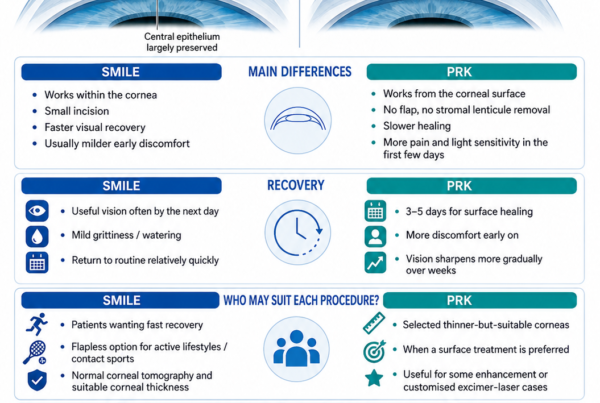
PRK Recovery Versus LASIK Recovery
PRK
- More discomfort during days 1–3
- Epithelial healing required
- Bandage contact lens
- Functional recovery over days to weeks
- Fine stabilisation over weeks to months
LASIK
- Usually mild early discomfort
- No large epithelial defect
- Rapid functional visual recovery
- Often useful vision by the following day
Does Slower Recovery Mean PRK Gives Worse Final Vision?
No.
Recovery speed and final outcome are separate issues.
PRK may take longer to reach the same level of visual clarity, but modern studies demonstrate strong long-term refractive outcomes in appropriately selected patients.
PRK Versus TransPRK Recovery
TransPRK uses the excimer laser to remove the epithelium rather than removing it manually or with alcohol.
Some studies report:
- Faster early epithelial healing
- Less discomfort
- Faster early visual rehabilitation
while others show only small differences.
Regardless of technique:
TransPRK is still surface ablation.
The epithelium still needs to regenerate.
Patients should not expect LASIK-like next-day recovery simply because the procedure is described as “no-touch”.
Can I Speed Up PRK Recovery?
There is no safe shortcut around corneal biology.
The most useful actions are:
- Use prescribed medication correctly.
- Attend every scheduled review.
- Use lubricants as instructed.
- Avoid rubbing.
- Avoid contaminated water.
- Avoid unnecessary UV exposure.
- Sleep adequately.
- Treat pre-existing dry eye.
- Report worrying symptoms early.
What Can Slow Recovery?
Possible factors include:
- Dry eye
- Eyelid disease
- Poor medication adherence
- Infection
- Diabetes
- Abnormal wound healing
- Higher correction
- Significant haze
- Ocular allergy and eye rubbing
Do Supplements Speed Up PRK Healing?
There is no standard nutritional supplement proven to meaningfully accelerate routine PRK visual recovery in well-nourished adults.
A balanced diet and normal nutrition support general healing.
Do not replace prescribed postoperative treatment with:
- Vitamins
- Herbal products
- Fish oil
- Unproven “corneal healing” supplements
When Should I Be Worried?
Usually Normal
During early recovery:
- Burning
- Tearing
- Light sensitivity
- Blurred vision
- Mild redness
- Fluctuating clarity
- Halos
- Dryness
Contact the Clinic Promptly
When there is:
- Increasing rather than decreasing pain
- Significant asymmetric pain
- Increasing redness
- Falling vision
- Purulent discharge
- A white corneal spot
- Bandage lens displacement with symptoms
Seek Urgent Care
For:
- Sudden severe visual loss
- Major trauma to the eye
- Chemical exposure
- Severe pain with marked redness
- A sudden curtain or shadow
- New flashes with a shower of floaters
The last two symptoms may indicate a retinal problem and are not ordinary PRK recovery symptoms.
Common Myths
“I Should See Perfectly the Day After PRK”
False.
That expectation is more appropriate for LASIK than PRK.
“If My Vision Is Blurry at One Week, Something Has Gone Wrong”
Not necessarily.
Visual fluctuation during the first several weeks is common.
“The Bandage Contact Lens Means My Cornea Has Not Been Lasered”
False.
The lens is simply protecting the healing surface.
“Once the Bandage Lens Comes Out, Recovery Is Finished”
False.
Epithelial remodelling, tear recovery and stromal healing continue.
“Pain Should Last for Weeks”
Usually false.
Significant epithelial pain is generally concentrated in the first few days.
Persistent or increasing pain requires assessment.
“I Can Judge the Final Result at One Week”
False.
One week is far too early.
“Blur After PRK Means the Prescription Was Wrong”
Not necessarily.
Early blur is often biological rather than refractive.
“One Eye Being Clearer Means the Other Eye Failed”
False.
Asymmetric recovery is common.
“Fluctuating Vision Means the Laser Is Wearing Off”
False.
Early fluctuations usually reflect healing and tear-film instability.
“Once I See 6/6, I Can Stop My Steroid Drops”
False.
Medication duration is determined by wound-healing considerations, not visual acuity alone.
“Steroid Drops Are Only for Pain”
False.
Their main postoperative role is regulation of inflammation and corneal healing.
“Haze Always Happens in the First Week”
False.
Clinically important haze may develop weeks or months later.
“TransPRK Has No Recovery Period”
False.
The surface epithelium is still removed.
“Screens Slow Corneal Healing”
Normal screen use does not damage the treatment.
It may increase dryness and discomfort.
“Reading Will Change My Laser Result”
False.
“Once PRK Is Healed, I Never Need an Eye Examination Again”
False.
PRK does not prevent future:
- Cataract
- Glaucoma
- Retinal disease
- Presbyopia
Frequently Asked Questions
What Is the Worst Day After PRK?
For many patients, the first 24 to 72 hours are the most uncomfortable.
The exact peak varies.
When Does the Burning Stop?
It usually improves substantially as the epithelium closes, commonly over three to five days.
How Long Will My Eyes Water?
Heavy tearing is most common during the first few days and usually reduces as the surface heals.
How Long Will I Be Light-Sensitive?
Significant photophobia commonly improves during the first week.
Milder sensitivity may persist longer.
Why Are My Eyes Still Dry at One Month?
Corneal nerves and tear-film regulation are still recovering.
Dry-eye symptoms can persist for several months in some patients.
Is It Normal for Vision to Change Hour by Hour?
Yes, particularly during the first few weeks.
Dryness and epithelial remodelling are common causes.
Is It Normal to See Halos at One Month?
Yes, provided they are improving and examination is reassuring.
Persistent or worsening halos should be investigated.
When Can I Read Normally?
Many people can read within the first several days, although it may be uncomfortable or blurry.
Comfort typically improves over the following week.
When Can I Use a Computer for a Full Day?
Many patients gradually return during the first week.
Long sessions may remain tiring because of dryness.
When Can I Return to the Gym?
The answer depends on the surgeon’s protocol and the type of exercise.
Gentle exercise returns earlier than:
- Heavy lifting
- Contact sports
- Swimming
Can Sweat Damage PRK?
Sweat itself does not reverse the laser correction, but sweat entering a healing eye can:
- Irritate
- Encourage rubbing
- Contaminate the surface
When Can I Wash My Hair?
Usually early, provided water and shampoo are carefully kept out of the eyes.
When Can I Wear Make-Up?
Wait until the corneal surface has healed and the surgeon permits it.
When Can I Swim in a Pool?
Not while the epithelium is healing or the bandage lens remains in place.
Follow the surgeon’s specific timeline.
When Can I Go to the Beach?
Outdoor activity may resume earlier than swimming.
Use:
- UV400 sunglasses
- Good eye protection
Avoid sand entering the eyes.
Can I Travel One Week After PRK?
Possibly, provided:
- Healing is normal.
- Follow-up requirements are met.
- Medication is available.
- The destination has access to eye care if necessary.
When Can I Fly?
Flying itself usually does not harm PRK.
Cabin dryness may worsen symptoms.
Can I Take a Long-Haul Flight?
The bigger considerations are:
- Dryness
- Medication schedule
- Access to follow-up
rather than cabin pressure.
Why Do My Eyes Feel Good but Vision Is Still Hazy?
Pain is mainly related to epithelial exposure.
Once the surface closes, pain can improve quickly while optical smoothness continues developing.
Why Is My Near Vision Strange?
Temporary refractive fluctuation can affect both distance and near vision.
Older patients may also notice previously compensated presbyopia after distance correction.
Why Do White Letters on a Black Background Look Worse?
High-contrast lights in darkness emphasise:
- Halos
- Tear instability
- Optical aberrations
These often improve during recovery.
Can My Vision Become Worse Again at Two Months?
Small fluctuations may occur.
A meaningful sustained deterioration deserves assessment for:
- Dry eye
- Residual prescription
- Haze
- Other ocular causes
Can Haze Appear After I Was Seeing Well?
Yes.
Some haze develops later in the wound-healing process rather than immediately after surgery.
Does Every Patient Develop Haze?
No.
Clinically significant haze is uncommon with modern PRK, careful patient selection and appropriate use of mitomycin C.
How Long Should I Use Sunglasses?
Follow the surgeon’s recommendation.
UV400 sunglasses are particularly sensible during the early healing months.
When Is My Prescription Final?
For many patients it becomes increasingly stable over one to three months.
Higher corrections or unusual healing may take longer.
When Can I Decide Whether I Need Enhancement?
Only once repeated measurements demonstrate stable residual refractive error.
Could My PRK Continue Improving After Three Months?
Yes.
Fine improvements in:
- Clarity
- Dryness
- Night vision
can continue beyond three months.
When Should I Stop Thinking of Myself as Postoperative?
There is no exact date.
Most day-to-day limitations disappear relatively early, while corneal remodelling continues much longer.
A Simple PRK Recovery Calendar
Day 0
Expect:
- Blurred vision
- Increasing discomfort
- Tearing
- Light sensitivity
Priorities:
- Rest
- Medication
- No rubbing
- Keep eyes dry
Day 1
Expect:
- Significant blur
- Burning or foreign-body sensation
- Photophobia
Priorities:
- Continue drops
- Rest
- Attend follow-up if scheduled
Day 2
Expect:
- Similar or improving discomfort
- Very variable vision
Watch for:
- Increasing redness
- Severe asymmetric pain
- Falling vision
Day 3
Expect:
- Pain often beginning to improve
- Epithelial defect becoming much smaller
The surgeon may assess whether the surface has closed.
Days 4–5
The bandage lens may be removed if healing is adequate.
Expect:
- Major improvement in comfort
- Vision still not fully sharp
Week 1
Expect:
- Functional but fluctuating vision
- Dryness
- Halos
- Improving light sensitivity
Week 2
Expect:
- Better daily function
- Increasingly stable distance vision
- Some dryness and night glare
Weeks 3–4
Expect:
- Sharper vision
- Less fluctuation
- Improving screen and driving comfort
Months 1–3
Expect:
- Refinement of visual quality
- Improving dryness
- Increasing refractive stability
Continue:
- Steroid taper as prescribed
- Lubricants
- Follow-up
Months 3–6
Expect:
- Stable functional vision for most patients
- Further fine improvement possible
The surgeon assesses:
- Refraction
- Corneal clarity
- Haze
- Need for any future enhancement
The Bottom Line
PRK recovery occurs in stages.
The first few days are dominated by surface healing.
During approximately days 1 to 3, patients commonly experience:
- Pain
- Burning
- Tearing
- Light sensitivity
- Blurred vision
Bandage contact lenses help protect the cornea and reduce discomfort.
The epithelium commonly closes within approximately three to five days.
After that:
- Comfort improves faster than vision.
- The surface continues smoothing.
- Tear-film stability gradually improves.
- Refraction becomes more predictable.
- Night glare and halos generally decrease.
Many patients have functional vision by the end of the first week, but one week is too early to judge the final result.
During the first month, it is normal for vision to:
- Fluctuate
- Differ between the eyes
- Change during the day
- Become temporarily blurrier when the eyes are dry
During months 1 to 3:
- Vision becomes increasingly crisp.
- Dryness usually improves.
- Night vision stabilises.
- The corneal wound-healing response continues.
Corneal haze, when it occurs, may become apparent weeks or months rather than days after PRK, which is one reason steroid adherence and scheduled postoperative reviews remain important.
Microscopic corneal nerve and stromal healing continues even longer, despite the patient already seeing well.
The most important practical message is:
Do not judge PRK by how clearly you see on day 1, day 3 or even day 7. Early PRK recovery is about allowing the corneal surface to heal safely. Visual quality then improves progressively over the following weeks and months.
At the same time, recovery should generally trend towards improvement.
Increasing pain, redness, discharge, a white corneal spot or a sudden drop in vision is not something to simply “wait out”. Contact the treating ophthalmologist promptly.
References
- AlDahash F, AlAmeer A, Ben Hussain O, et al. Effect of bandage contact lens exchange on pain and healing after photorefractive keratectomy: a randomised controlled trial. Eye Contact Lens. 2021. PMID: 33492010.
- Grentzelos MA, et al. Bandage contact lens use after photorefractive keratectomy. J Cataract Refract Surg. 2019. PMID: 31213328.
- Duru Z, et al. Effects of senofilcon A and lotrafilcon B bandage contact lenses on epithelial healing and pain management after bilateral photorefractive keratectomy. 2019. PMID: 31495762.
- American Academy of Ophthalmology. Management of pain after photorefractive keratectomy: an evidence report. Ophthalmology. 2023. PMID: 36207168.
- Shetty R, et al. Cold bandage contact lens use reduces post-photorefractive keratectomy pain perception. 2023. PMID: 37203044.
- Zarei-Ghanavati S, et al. Comparison of mechanical debridement and transepithelial myopic photorefractive keratectomy: a contralateral-eye study. J Curr Ophthalmol. 2019. PMID: 31317090.
- Shahinian L Jr, et al. Laser-assisted subepithelial keratectomy versus photorefractive keratectomy: prospective comparative study. PMID: 12160800.
- Liu C, Yu A, Zhang C, et al. Structural and functional alterations in corneal nerves after single-step TransPRK. J Cataract Refract Surg. 2022;48:778–783. PMID: 34864776.
- Erie JC, et al. Corneal wound healing after photorefractive keratectomy: a three-year confocal microscopy study. Am J Ophthalmol. 2004. PMID: 14971584.
- Kymionis GD, et al. In vivo observation of corneal nerve regeneration after photorefractive keratectomy. PMID: 9479521.
- Balestrazzi A, et al. Evaluation of tear osmolarity changes after photorefractive keratectomy. PMID: 26488623.
- Varshovi I, et al. Dry eye after photorefractive keratectomy and transepithelial PRK: a comparative clinical study. 2025. PMID: 40540100.
- Moshirfar M, et al. Management of corneal haze after photorefractive keratectomy. Ophthalmol Ther. 2023. PMID: 37603162.
- Kaiserman I, et al. Corneal breakthrough haze after photorefractive keratectomy with mitomycin C: incidence and risk factors. PMID: 28542088.
- Corneal haze after photorefractive keratectomy: current concepts and prevention. PMID: 34538661.