Author: Dr Val Phua
Estimated reading time: 23 minutes
Photorefractive keratectomy, usually shortened to PRK, is a type of laser vision-correction surgery used to reduce dependence on spectacles or contact lenses.
PRK can correct refractive errors including:
- Myopia
- Astigmatism
- Selected cases of hyperopia
Like LASIK, PRK uses an excimer laser to reshape the cornea so that light is focused more accurately onto the retina.
The major difference is how the surgeon reaches the corneal tissue that must be reshaped.
With LASIK, a thin corneal flap is created and lifted before the excimer laser treatment.
With PRK:
- No corneal flap is created.
- The thin surface epithelial layer is removed.
- The excimer laser reshapes the underlying anterior cornea.
- A bandage contact lens is placed while the epithelium grows back.
PRK was the first widely adopted excimer-laser refractive procedure and has now been used for several decades. Although LASIK and newer procedures such as SMILE offer faster early visual recovery, modern PRK remains an established and useful refractive-surgery option. A 2024 review concluded that PRK continues to have an important role, particularly in situations where surface ablation is preferable to creating a corneal flap.
Modern variations include:
- Conventional PRK
- Alcohol-assisted PRK
- Mechanical PRK
- Transepithelial PRK, or TransPRK
The eventual visual outcomes of modern PRK, LASIK and SMILE are generally similar in appropriately selected patients. The main differences relate more to:
- Recovery speed
- Early discomfort
- Corneal anatomy
- Presence or absence of a flap
- Treatment range
- Dry-eye considerations
- Corneal thickness
- Individual lifestyle
A 2026 meta-analysis comparing TransPRK with LASIK and SMILE found no significant overall differences in efficacy or refractive predictability, although there were differences in selected safety outcomes and recovery characteristics.
The main trade-off is straightforward:
PRK avoids a corneal flap, but the surface of the cornea must heal after surgery. This means more discomfort and slower visual recovery than LASIK or SMILE during the first days and weeks.
The Quick Answer
What Does PRK Stand For?
PRK stands for:
Photorefractive keratectomy.
It is a laser procedure that permanently changes the shape of the cornea to correct refractive error.
Is PRK the Same as LASIK?
No.
Both procedures use an excimer laser to reshape the cornea, but they access the corneal stroma differently.
With LASIK:
- A thin flap is created.
- The flap is lifted.
- The laser reshapes the tissue underneath.
- The flap is replaced.
With PRK:
- No flap is created.
- The surface epithelium is removed.
- The laser reshapes the anterior corneal stroma.
- The epithelium naturally grows back.
Is PRK Permanent?
The corneal reshaping produced by PRK is permanent.
However, your eyes can continue changing with age.
You may later develop:
- Myopic progression
- Refractive regression
- Presbyopia
- Cataract
- Other age-related eye conditions
PRK therefore permanently changes the corneal shape but does not permanently freeze the eye at one prescription.
Is PRK Painful?
The surgery itself should not be painful because anaesthetic eye drops are used.
Discomfort usually develops after the anaesthetic wears off because the corneal epithelium has been removed.
During the first two to three days, patients may experience:
- Stinging
- Burning
- Tearing
- Light sensitivity
- Foreign-body sensation
- Difficulty keeping the eyes open
A bandage contact lens is normally placed after surgery to protect the healing surface and reduce discomfort. Reviews confirm that bandage contact lenses help reduce pain following PRK.
How Long Does PRK Take to Heal?
The epithelium commonly closes over approximately three to five days.
Visual recovery takes longer.
A typical pattern is:
- First few days: blurred and uncomfortable
- First week: vision improves but fluctuates
- First few weeks: increasingly functional vision
- One to three months: vision becomes more stable
- Several months: fine optical quality may continue improving
Healing varies according to:
- Prescription
- Treatment size
- Individual biology
- Dry eye
- Surgical technique
- Medication adherence
- Corneal healing response
How Long Does PRK Last?
Long-term studies extending beyond ten years demonstrate that PRK can remain effective and safe.
Some gradual myopic shift may nevertheless occur, particularly after treatment of higher degrees of myopia. Long-term studies have found greater stability for low-to-moderate myopia than for high myopia.
Understanding How the Eye Focuses Light
The Cornea Provides Most of the Eye’s Focusing Power
The cornea is the clear curved window at the front of the eye.
Together with the natural lens inside the eye, it focuses light onto the retina.
If the optical power of the eye does not match its length, refractive error occurs.
Myopia
In myopia, distant light focuses in front of the retina.
PRK corrects myopia by flattening the central cornea.
This reduces its focusing power.
Astigmatism
Astigmatism occurs when the eye has different focusing power in different directions.
The cornea may be:
- Steeper vertically
- Steeper horizontally
- Unequally curved along oblique axes
Modern laser systems can selectively reshape different corneal meridians to reduce astigmatism.
Hyperopia
In hyperopia, light tends to focus behind the retina.
Hyperopic laser treatments generally steepen the central cornea by applying a different ablation pattern to the peripheral cornea.
Not every refractive error is best treated with PRK.
The treatment decision depends on:
- Prescription
- Corneal thickness
- Corneal shape
- Age
- Pupil size
- Ocular surface
- Expected tissue removal
- Other available procedures
What Happens to the Cornea During PRK?
The cornea contains several layers.
From front to back, these include:
- Epithelium
- Bowman layer
- Stroma
- Descemet membrane
- Endothelium
The Epithelium
The epithelium is a thin protective layer covering the front of the cornea.
It continually renews itself.
During PRK, this layer is removed over the treatment area.
It then grows back after surgery.
The Corneal Stroma
The stroma forms most of the corneal thickness.
The excimer laser removes microscopic amounts of stromal tissue according to a programmed treatment pattern.
The Excimer Laser
An excimer laser uses ultraviolet laser energy to break molecular bonds within corneal tissue.
This allows extremely precise tissue removal without cutting or burning in the conventional sense.
The amount removed is measured in micrometres.
The treatment pattern is calculated according to factors including:
- Sphere
- Cylinder
- Astigmatism axis
- Corneal shape
- Optical zone
- Laser platform
- Treatment profile
Modern systems may incorporate:
- Wavefront-optimised treatment
- Wavefront-guided treatment
- Topography-guided treatment
- Eye tracking
- Cyclotorsion compensation
The exact technology selected depends on the patient and laser platform.
Step-by-Step: What Happens During PRK?
Step 1: Anaesthetic Drops
Local anaesthetic drops numb the surface of the eye.
The patient remains awake.
General anaesthesia is not normally required.
Step 2: The Eyelids Are Kept Open
A small eyelid holder prevents blinking during the laser treatment.
You do not need to consciously keep your eye open.
Step 3: The Epithelium Is Removed
Depending on the PRK technique, the epithelium may be removed using:
- A mechanical instrument
- Alcohol
- A rotating brush
- The excimer laser itself
Once the epithelium is removed, the underlying treatment area is exposed.
Step 4: The Excimer Laser Reshapes the Cornea
You look towards a fixation light.
The laser applies the programmed ablation pattern to the cornea.
Modern eye-tracking systems compensate for small eye movements.
You do not have to keep the eye perfectly motionless.
Step 5: Mitomycin C May Be Applied
In selected treatments, the surgeon may briefly apply mitomycin C, often abbreviated MMC.
Mitomycin C modifies the corneal wound-healing response and reduces the risk of significant postoperative haze.
A meta-analysis of more than 3,500 eyes found strong evidence that intraoperative MMC reduces both early and late corneal haze following PRK.
Another meta-analysis found that MMC reduced the risk of postoperative haze substantially without demonstrating a significant increase in complications within the included studies.
The concentration and exposure duration should be selected by the surgeon according to:
- Ablation depth
- Prescription
- Corneal characteristics
- Treatment technique
- Individual haze risk
Step 6: The Eye Is Rinsed
The treatment area is irrigated.
Step 7: A Bandage Contact Lens Is Placed
A soft bandage contact lens is placed over the cornea.
It:
- Protects the healing epithelium
- Reduces eyelid friction
- Improves comfort
- Supports epithelial healing
The lens usually remains until the surface has closed sufficiently.
Does the Bandage Contact Lens Correct My Vision?
Its primary purpose is protection rather than refractive correction.
Do not remove it yourself unless specifically instructed.
Conventional PRK Versus TransPRK
What Is Conventional PRK?
In conventional PRK, epithelial removal and stromal laser treatment occur as separate steps.
The epithelium may be removed:
- Mechanically
- Using dilute alcohol
- With another surgical technique
The excimer laser then performs the refractive ablation.
What Is TransPRK?
In transepithelial PRK, commonly called TransPRK, the excimer laser removes both:
- The epithelium
- The required stromal tissue
In modern single-step systems, this occurs as one programmed laser sequence.
TransPRK is sometimes marketed as:
- No-touch PRK
- All-laser PRK
- Touch-free PRK
These terms describe the epithelial-removal technique rather than a completely different principle of vision correction.
Is TransPRK Better?
Evidence suggests that both conventional PRK and TransPRK provide excellent final visual outcomes.
A 2025 meta-analysis involving more than 10,000 eyes found no significant differences in major efficacy and safety outcomes between TransPRK and conventional PRK.
Individual studies have reported that TransPRK may offer:
- Shorter procedure time
- Faster epithelial recovery
- Less early discomfort
- Faster early visual recovery
although results vary between laser systems and study designs.
A 2025 randomised contralateral-eye trial found conventional PRK and TransPRK to be similarly safe and effective at six months.
The practical conclusion is:
TransPRK changes how the surface epithelium is removed. It does not eliminate the fundamental surface-healing process that distinguishes PRK from LASIK and SMILE.
Who May Be Suitable for PRK?
PRK may be considered when the patient:
- Is an adult
- Has a stable prescription
- Has healthy corneal tomography
- Has adequate corneal thickness
- Has realistic expectations
- Has an appropriate refractive error
- Has a reasonably healthy ocular surface
It may be particularly attractive when avoiding a permanent LASIK flap is desirable.
Why Might PRK Be Preferred Over LASIK?
Possible reasons include:
- Relatively thin corneas
- Greater concern about flap-related complications
- Contact or combat sports
- Occupations with a possibility of eye trauma
- Previous LASIK requiring a surface enhancement
- Corneal anatomy less suited to flap creation
However, PRK is not automatically safe simply because LASIK is unsuitable.
A patient who should not undergo LASIK because of abnormal corneal tomography may also be unsuitable for PRK.
PRK and Thin Corneas
Because PRK does not require creation of a LASIK flap, it can preserve more untreated stromal tissue.
This sometimes makes PRK suitable for patients whose corneas are too thin for LASIK.
However:
Thin cornea does not automatically mean PRK is safe.
The surgeon must still evaluate:
- Total corneal thickness
- Expected ablation depth
- Corneal tomography
- Corneal biomechanics
- Prescription
- Age
- Family history
- Evidence of ectasia
A 2025 systematic review of 946 eyes with average central corneal thickness below 500 micrometres found favourable PRK outcomes in carefully selected eyes without other corneal abnormalities. No ectasia was reported in the included studies. However, all studies were case series and follow-up was insufficient to establish universal safety.
Who May Not Be Suitable for PRK?
Important contraindications or reasons for caution include:
- Unstable prescription
- Keratoconus
- Corneal ectasia
- Suspicious corneal tomography
- Insufficient corneal thickness
- Significant untreated dry eye
- Active eye infection
- Significant cataract
- Uncontrolled glaucoma
- Poorly controlled diabetes
- Active autoimmune disease
- Pregnancy
- Breastfeeding
- Certain corneal dystrophies
- Selected medications affecting corneal healing
A review of current refractive-surgery contraindications identifies age below 18, unstable refraction, keratoconus and poorly controlled dry eye among important contraindications, with pregnancy, breastfeeding and several systemic conditions requiring additional caution.
In one refractive-surgery screening study, the two most common reasons patients were excluded from PRK and LASIK were abnormal corneal topography and inadequate corneal thickness.
Keratoconus
Keratoconus causes progressive:
- Corneal thinning
- Corneal steepening
- Irregular astigmatism
- Visual distortion
Ordinary refractive PRK removes corneal tissue.
It is therefore generally inappropriate in an eye with untreated keratoconus or another ectatic disorder.
Corneal topography and tomography are essential parts of refractive-surgery screening.
Very High Myopia
PRK can treat substantial myopia on appropriate laser platforms, but higher corrections require greater stromal tissue removal.
Higher myopia is associated with greater concerns regarding:
- Haze
- Regression
- Optical quality
- Tissue removal
- Long-term predictability
Historical long-term studies found significantly more regression and retreatment after PRK for higher degrees of myopia.
For some patients with high myopia, an implantable collamer lens may provide a better balance of:
- Optical quality
- Corneal preservation
- Predictability
The choice should be individualised rather than based solely on spectacle prescription.
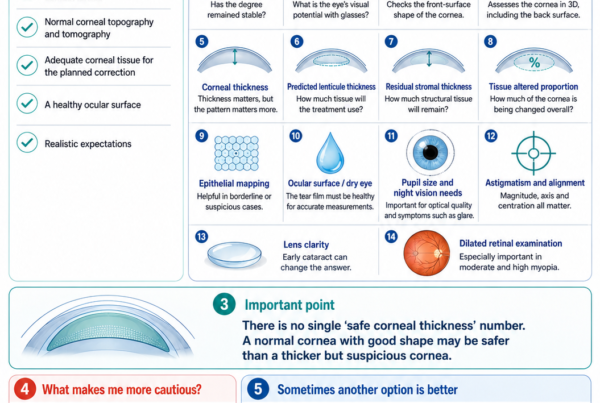
Before PRK: The Refractive Surgery Assessment
The assessment is at least as important as the laser treatment itself.
Visual Acuity
Testing includes:
- Unaided vision
- Current corrected vision
- Best-corrected vision
The surgeon needs to know whether the eye has the potential to see normally.
Refraction
The prescription is checked carefully.
It may include:
- Manifest refraction
- Cycloplegic refraction
- Comparison with previous prescriptions
A stable prescription is important because surgery should not be performed while significant myopic progression continues.
Corneal Topography and Tomography
These tests examine:
- Anterior corneal curvature
- Posterior corneal shape
- Corneal thickness
- Corneal asymmetry
- Abnormal steepening
- Signs of keratoconus or ectasia
Normal-looking vision does not prove normal corneal structure.
Pachymetry
Pachymetry measures corneal thickness.
The surgeon calculates how much tissue is expected to be removed.
Ocular Surface Assessment
The examination evaluates:
- Tear-film quality
- Meibomian glands
- Dry eye
- Allergy
- Blepharitis
- Corneal staining
Existing ocular-surface disease should be treated before surgery.
Pupil Size
Pupil size may be relevant to:
- Night vision
- Glare
- Halos
- Optical-zone planning
It is one factor rather than a stand-alone determinant of suitability.
Retinal Examination
This is particularly relevant in patients with:
- Moderate or high myopia
- Flashes
- Floaters
- Peripheral retinal degeneration
- Previous retinal tears
PRK corrects corneal focusing.
It does not shorten a myopic eyeball or remove the retinal risks associated with high axial myopia.
What Should I Expect on the Day of PRK?
The procedure is usually performed as day surgery.
Before treatment:
- The prescription and treatment plan are confirmed.
- The eye may be marked if required for astigmatic alignment.
- Anaesthetic drops are given.
- The skin around the eyes is cleaned.
- A sterile drape may be placed.
The actual laser treatment is usually brief.
Both eyes may be treated during the same session when appropriate.
You should arrange transport home.
What Do I See During Surgery?
You may see:
- A fixation light
- Blurred lights
- Changing colours
- Increasing haze during treatment
Vision is not blacked out.
The appearance differs between laser systems and stages of treatment.
What if I Move My Eye?
Modern lasers incorporate eye-tracking systems.
Small movements are expected.
The system may:
- Track the eye
- Adjust laser position
- Pause treatment when tracking is lost
You do not need to hold the eye perfectly still.
PRK Recovery: The First 24 Hours
Once the anaesthetic wears off, discomfort may increase.
Common symptoms include:
- Burning
- Stinging
- Tearing
- Light sensitivity
- Eyelid swelling
- Foreign-body sensation
- Blurred vision
Resting with the eyes closed may be more comfortable.
Use all prescribed medication exactly as directed.
Days 2 to 3
These may be the most uncomfortable days.
The epithelium grows inward across the treated surface.
Vision may fluctuate considerably.
Activities should be limited according to the surgeon’s advice.
Days 3 to 5
Most uncomplicated eyes are approaching or achieving epithelial closure.
Studies of modern bandage contact lenses and PRK have reported high rates of complete epithelial closure by approximately day three, although individual healing varies.
The surgeon examines the cornea before removing the bandage contact lens.
After the Bandage Lens Is Removed
The eye can still feel:
- Dry
- Slightly gritty
- Light-sensitive
Vision may remain hazy.
Removal of the contact lens does not mean the entire healing process has finished.
Week 1
Many patients can perform ordinary daily activities, although vision may not yet feel crisp.
You may notice:
- Variable clarity
- Halos
- Glare
- Mild haze
- Dryness
- Different vision between the two eyes
Weeks 2 to 4
Vision generally becomes progressively clearer.
Driving ability depends on:
- Visual acuity
- Stability
- Glare
- Confidence
- Legal driving requirements
Do not drive simply because a certain number of days has passed.
One to Three Months
Fine visual quality continues to improve.
Refraction becomes more stable.
Dryness and night-vision symptoms usually reduce.
Three to Six Months
Most routine healing has stabilised.
The final timeline is longer when:
- The original prescription was high.
- Healing is unusually slow.
- Haze develops.
- Significant dry eye is present.
- An enhancement is required.
Why Is PRK Recovery Slower Than LASIK?
LASIK preserves the corneal epithelium on top of the flap.
PRK deliberately removes it.
Before clear stable vision can return:
- The epithelium must close.
- The epithelial cells must reorganise.
- The corneal surface must smooth.
- Stromal wound healing must stabilise.
- Tear-film function must recover.
- The refractive result must settle.
This biological healing process takes time.
How Much Pain Should I Expect?
Pain varies substantially.
Some patients experience:
- Mild irritation
Others experience:
- Significant burning
- Tearing
- Light sensitivity
- Difficulty opening the eyes
The first 48 to 72 hours are usually the most uncomfortable.
The treatment plan may include:
- Bandage contact lens
- Lubricating drops
- Oral pain medication
- Cold compresses
- Other prescribed medication
Do not use unprescribed anaesthetic drops at home.
Repeated topical anaesthetic use can cause severe corneal toxicity and delay healing.
What Eye Drops Are Used After PRK?
The exact regimen varies.
It commonly includes:
- Antibiotic drops during epithelial healing
- Steroid drops
- Preservative-free lubricants
Steroid treatment is often continued longer after PRK than after LASIK because it helps regulate inflammation and haze formation.
The steroid may be tapered gradually over weeks or months.
Why Is Eye Pressure Checked?
Steroid drops can raise intraocular pressure in susceptible patients.
This is called a steroid response.
Follow-up may therefore include:
- Eye-pressure measurement
- Corneal examination
- Review of steroid dosage
Do not continue steroid drops for longer than instructed.
Do not stop them abruptly when a taper has been prescribed.
What Is Corneal Haze?
Haze is increased light scattering within the healing anterior corneal stroma.
Mild microscopic haze may have little visual effect.
More significant haze may cause:
- Blurred vision
- Glare
- Halos
- Reduced contrast
- Refractive regression
Why Does Haze Occur?
After epithelial removal and stromal ablation, the cornea begins a wound-healing response.
In some eyes, activated cells and extracellular matrix produce excessive stromal fibrosis.
Risk is influenced by factors including:
- Ablation depth
- High myopic treatment
- Corneal wound response
- Inflammation
- UV exposure
- Surgical technique
Modern ablation profiles and mitomycin C have substantially reduced clinically important haze compared with early-generation PRK.
How Does Mitomycin C Prevent Haze?
Mitomycin C modifies the proliferation of cells involved in stromal fibrosis.
A meta-analysis of randomised and observational studies found a clear reduction in postoperative haze following MMC use.
MMC is not simply placed in every eye for the same duration.
Its use should be tailored to the procedure.
Should I Wear Sunglasses After PRK?
UV-protective sunglasses are sensible during outdoor recovery, particularly during the early healing period.
Choose sunglasses with:
- UV400 protection
- Good coverage
- Comfortable fit
Follow the surgeon’s specific advice regarding duration.
Sunglasses also reduce postoperative:
- Glare
- Light sensitivity
- Discomfort
Dry Eye After PRK
Dry-eye symptoms can occur after any corneal laser procedure.
Possible symptoms include:
- Grittiness
- Burning
- Fluctuating vision
- Tired eyes
- Contact-lens-like awareness
- Reflex tearing
PRK affects corneal nerves and temporarily disrupts the surface.
However, unlike LASIK, it does not create a large lamellar flap.
A meta-analysis comparing dry-eye outcomes following refractive procedures found statistically significant reductions in tear production and tear break-up time following LASIK, whereas pooled reductions following PRK were not statistically significant.
This does not mean PRK cannot cause dry eye.
A patient with significant pre-existing dry-eye disease should have it treated before surgery.
Infection After PRK
Infection after PRK is uncommon but potentially serious.
Until the epithelium has healed, the corneal barrier is temporarily incomplete.
Risk can be reduced through:
- Sterile surgery
- Antibiotic drops
- Bandage-lens care
- Avoiding contaminated water
- Not rubbing the eyes
- Attending early reviews
Seek urgent assessment for:
- Increasing pain
- Increasing redness
- Increasing light sensitivity
- Falling vision
- Discharge
- A white corneal spot
Symptoms that worsen after initially improving are particularly concerning.
Corneal Ectasia
Corneal ectasia is progressive weakening and bulging of the cornea after refractive surgery.
It may cause:
- Increasing myopia
- Increasing astigmatism
- Irregular vision
- Ghosting
- Reduced corrected vision
PRK avoids a LASIK flap and removes tissue more superficially.
Reported ectasia is therefore less common after PRK than after LASIK.
A systematic review estimated reported ectasia in eyes without identified preoperative risk factors at approximately:
- 20 per 100,000 PRK eyes
- 90 per 100,000 LASIK eyes
These figures are based on published cases and estimates rather than prospective population registries, so they should not be interpreted as exact individual probabilities.
The important point is:
Ectasia can still occur after PRK.
Preoperative tomography remains essential.
Under-Correction
Some refractive error may remain after treatment.
This may result from:
- Biological healing
- Original prescription
- Laser response
- Corneal shape
- Treatment limitations
A small residual prescription may not require further treatment.
Over-Correction
The laser result may occasionally go slightly beyond the intended target.
This may be more noticeable in:
- Older patients
- Hyperopic shifts
- Monovision strategies
Regression
Regression means that some refractive error returns after initially successful treatment.
It may result from:
- Epithelial remodelling
- Stromal healing
- High original correction
- Continued myopic progression
- Age-related change
Long-term PRK studies show that low-to-moderate myopia generally remains relatively stable, while higher corrections demonstrate more regression.
Can PRK Be Repeated?
Sometimes.
An enhancement may be possible when:
- The prescription has stabilised.
- The cornea remains healthy.
- Adequate tissue remains.
- The residual error is clinically meaningful.
- The expected benefit outweighs the risk.
Not every residual prescription should be retreated.
Alternatives include:
- Spectacles
- Contact lenses
- Observation
- Lens-based correction later in life
Night Glare and Halos
Early after PRK, patients may notice:
- Halos
- Starbursts
- Ghost images
- Glare
- Reduced contrast
These symptoms often improve as:
- The epithelium smooths
- Tear film stabilises
- Refraction settles
- Neural adaptation occurs
Persistent symptoms may relate to:
- Residual prescription
- Large pupils
- Dry eye
- Higher-order aberrations
- Decentration
- Haze
PRK Versus LASIK
Final Vision
Modern PRK and LASIK generally provide similarly effective refractive correction in appropriately selected patients.
A broad review of laser refractive procedures concluded that differences in eventual visual outcomes between established modern techniques are relatively small compared with differences in recovery and patient selection.
Recovery
LASIK:
- Usually clearer within a day or two
- Less early discomfort
- Faster return to work
PRK:
- More discomfort for several days
- Slower visual recovery
- Greater early fluctuation
Corneal Flap
LASIK creates a permanent flap interface.
PRK does not.
This removes flap-specific complications such as:
- Flap displacement
- Flap striae
- Epithelial ingrowth at the flap edge
- Traumatic late flap movement
Haze
PRK has a specific risk of stromal haze.
LASIK generally has much less haze because the central epithelium and Bowman layer are not removed in the same manner.
Dry Eye
Both can produce dry-eye symptoms.
LASIK often causes greater early corneal nerve disruption because of the flap.
Ectasia
Both require rigorous corneal screening.
Reported ectasia rates have historically been lower after PRK than LASIK, but PRK should never be used simply to bypass suspicious corneal tomography.
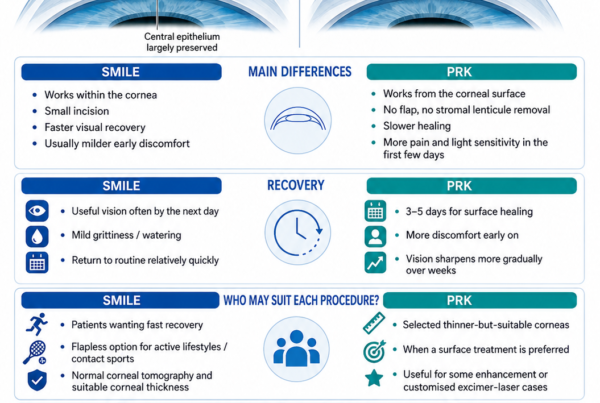
PRK Versus SMILE
Corneal Flap
Neither PRK nor SMILE requires a LASIK-style flap.
PRK is a surface-ablation procedure.
SMILE removes a stromal lenticule through a small corneal incision.
Recovery
SMILE generally provides:
- Faster epithelial recovery
- Less early pain
- Faster functional visual rehabilitation
PRK requires the epithelium to regrow.
Haze
PRK can produce corneal haze.
SMILE does not create the same large epithelial defect and is not generally associated with classic post-PRK haze.
Treatment Flexibility
PRK can be useful for:
- Primary refractive correction
- Selected customised treatments
- Some previous refractive-surgery enhancements
- Certain irregular corneal optical problems
The exact indications depend on the laser platform and corneal condition.
Final Results
A 2026 meta-analysis found no statistically significant overall differences in efficacy and predictability between TransPRK and SMILE.
Procedure selection should therefore depend on the individual eye rather than the assumption that the newest procedure is automatically superior.
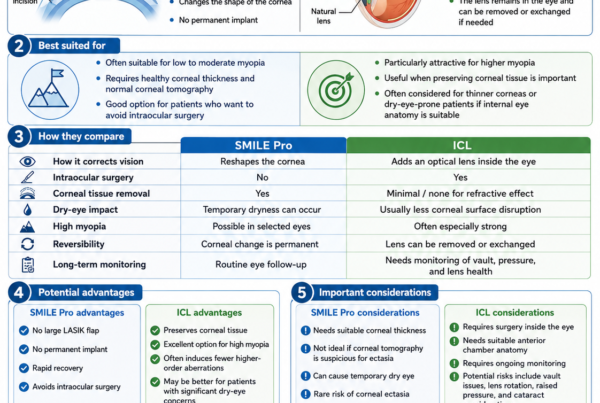
PRK Versus ICL
PRK reshapes the cornea.
ICL places an additional lens inside the eye without removing corneal tissue.
PRK May Be Attractive When
- Myopia is low to moderate.
- Corneal anatomy is suitable.
- The patient prefers a corneal laser procedure.
- No intraocular implant is desired.
ICL May Be Attractive When
- Myopia is high.
- Corneal tissue is limited.
- Optical quality is a priority in high correction.
- Dry-eye or corneal concerns favour avoiding laser ablation.
- The anterior chamber and other measurements are suitable.
ICL is intraocular surgery and therefore has a different group of risks.
The question should not simply be:
Which procedure is best?
It should be:
Which procedure gives this particular eye the best balance between visual quality, anatomical safety and long-term risk?
PRK and Contact or Combat Sports
PRK may be attractive for people participating in:
- Martial arts
- Boxing
- Rugby
- Contact sports
- Military activities
- Occupations with facial-trauma risk
because there is no LASIK flap to displace after trauma.
SMILE is also flapless and may be another option.
Protective eyewear remains important.
PRK does not make the eye immune to:
- Corneal abrasion
- Retinal tear
- Retinal detachment
- Traumatic cataract
- Globe injury
When Can I Exercise After PRK?
Follow the treating surgeon’s instructions.
A typical staged return may involve:
- Gentle walking early
- Gradual return to ordinary exercise once epithelial healing is secure
- Longer avoidance of swimming
- Longer avoidance of contact sports
The most important early concerns are:
- Sweat contamination
- Eye rubbing
- Trauma
- Water exposure
When Can I Swim?
Swimming should generally be avoided during early healing.
Pools, sea water and hot tubs contain microorganisms and contaminants.
The risk is particularly important while:
- The epithelium is healing
- A bandage contact lens remains in place
- Steroid drops are being used
Resume swimming only when your surgeon confirms that the surface is sufficiently healed.
Can I Shower?
Yes, but during the early postoperative period avoid allowing:
- Tap water
- Shampoo
- Soap
to enter the eyes.
Do not rub the eyes.
Can I Use Screens After PRK?
Screens do not damage the laser treatment.
However, early screen use may aggravate:
- Dryness
- Light sensitivity
- Eye strain
Short periods are usually more comfortable initially.
Blink regularly and use prescribed lubricants.
When Can I Return to Work?
This depends strongly on the job.
Desk work may be possible within several days for some patients.
More time may be needed when work involves:
- Driving
- Fine visual detail
- Dust
- Outdoor UV exposure
- Construction
- Water
- Physical contact
PRK should not be chosen immediately before an important examination, competition or work deadline if visual recovery is critical.
Can I Fly After PRK?
Commercial flying itself does not usually harm the corneal treatment.
Cabin dryness may increase discomfort.
Consider:
- Preservative-free lubricants
- Avoiding direct air vents
- Keeping postoperative medication accessible
Travel immediately after surgery may make follow-up difficult, which is a more important issue.
Can I Wear Eye Make-Up?
Avoid eye make-up during the early healing period and until the surgeon allows it.
Cosmetic products can introduce:
- Particles
- Bacteria
- Irritants
around the healing surface.
Can I Rub My Eyes?
Avoid rubbing.
This is especially important during early healing.
Eye rubbing is also undesirable long-term in patients with:
- Allergy
- Keratoconus risk
- Corneal ectatic tendencies
Will PRK Prevent Presbyopia?
No.
Presbyopia occurs when the natural lens gradually loses focusing flexibility with age.
A person who has excellent distance vision after PRK may eventually require reading correction.
What About Monovision PRK?
Selected patients may choose monovision:
- One eye is targeted for distance.
- The other is left mildly short-sighted for near vision.
A contact-lens monovision trial before surgery may help determine whether the brain tolerates the difference.
Potential compromises include:
- Depth perception
- Night vision
- Distance sharpness
- Fine near vision
Monovision does not stop presbyopia from progressing.
Does PRK Prevent Cataracts?
No.
PRK changes the cornea.
Cataract develops in the natural lens inside the eye.
You may still require cataract surgery later in life.
Does PRK Make Cataract Surgery More Difficult?
Cataract surgery remains possible after PRK.
However, previous laser refractive surgery changes the relationship between:
- Corneal curvature
- Corneal focusing power
- Intraocular-lens calculations
Modern formulas have improved IOL calculations after refractive surgery, but prediction may be less straightforward than in an untreated cornea.
Always tell your future cataract surgeon that you previously underwent PRK.
Retaining your preoperative refractive-surgery records can also be useful.
Does PRK Prevent Retinal Detachment?
No.
A highly myopic eye remains anatomically long after the cornea has been corrected.
PRK can make unaided vision clear but does not reverse:
- Axial elongation
- Peripheral retinal degeneration
- Myopic retinal risk
A previous high-myopia patient should continue to take new:
- Flashes
- Floaters
- Curtains
- Shadows
seriously even after becoming spectacle-free.
Does PRK Cause Glaucoma?
PRK itself is not generally considered a direct cause of ordinary chronic glaucoma.
However:
- Postoperative steroids may temporarily raise eye pressure.
- Corneal thinning alters how tonometry readings are interpreted.
- A lower measured pressure after PRK does not necessarily mean the true physiological pressure has fallen by the same amount.
Future eye-care professionals should know that you have undergone corneal refractive surgery.
Common Myths
“PRK Is Old Technology and Is No Longer Used”
False.
PRK is an older concept than LASIK or SMILE but remains an established modern procedure.
Laser platforms, treatment profiles, eye tracking, topography and wound-healing management have evolved substantially.
“PRK Is Just LASIK Without a Flap”
This is an oversimplification.
Both use excimer ablation, but PRK has a distinctly different biological healing response because the epithelium and anterior stromal surface must heal.
“PRK Is Completely Painless”
False.
The procedure is numbed, but several days of postoperative discomfort are expected.
“PRK Recovery Takes Six Months Before I Can See”
False.
Useful vision usually returns much earlier.
Fine stability and visual quality continue improving over weeks to months.
“PRK Is Always Safer Than LASIK”
False.
It avoids flap-related risks and reported ectasia rates are lower, but it has its own risks including:
- Pain
- Haze
- Slower recovery
- Infection during epithelial healing
- Regression
“Anyone with a Thin Cornea Can Have PRK”
False.
Thin or abnormal corneas require careful evaluation.
Keratoconus or suspicious tomography may make all corneal laser surgery inappropriate.
“PRK Cannot Cause Ectasia”
False.
It is uncommon but documented.
“TransPRK Does Not Involve a Wound”
False.
The epithelium is still removed and must regenerate.
“No-Touch PRK Means Nothing Touches the Eye”
Not literally.
The term generally refers to laser epithelial removal rather than mechanical scraping.
Eye drops, irrigation, a lid speculum and a bandage contact lens are still part of treatment.
“The Bandage Contact Lens Is Permanent”
False.
It is temporary and removed once epithelial healing is satisfactory.
“PRK Gives Better Vision Than Glasses”
The aim is usually to achieve unaided vision approaching the person’s best corrected potential.
PRK cannot restore vision lost from:
- Amblyopia
- Retinal disease
- Optic-nerve disease
- Corneal scarring
“PRK Stops Myopia”
PRK corrects the existing refractive error.
It does not stop the biological process of axial eye growth.
“Once I Have PRK, My Prescription Can Never Return”
False.
Regression and future refractive changes can occur.
“I Will Never Need Glasses Again”
Not guaranteed.
Glasses may later be useful for:
- Small residual prescription
- Night driving
- Presbyopia
- Age-related refractive change
“PRK Prevents Cataracts”
False.
“PRK Removes Retinal Risks from High Myopia”
False.
“I Can Skip Future Eye Examinations Because My Vision Is 6/6”
False.
PRK does not prevent:
- Glaucoma
- Cataract
- Macular disease
- Retinal tears
- Other age-related conditions
Frequently Asked Questions
Is PRK Safe?
Modern PRK has a strong long-term safety record in appropriately selected patients.
Long-term studies extending beyond ten years show generally favourable safety and stability, particularly for low-to-moderate myopia.
No refractive procedure is risk-free.
How Old Must I Be?
Laser refractive surgery is generally performed from adulthood once refractive stability has been demonstrated.
Age alone does not determine suitability.
A 21-year-old whose prescription is still increasing may be less suitable than an older patient with stable measurements.
Is There a Maximum Age?
There is no simple maximum.
As patients become older, the surgeon increasingly considers:
- Presbyopia
- Cataract
- Lens clarity
- Glaucoma
- Retinal health
A lens-based procedure may be more appropriate than PRK in selected older patients.
Can PRK Correct Astigmatism?
Yes, selected regular astigmatism can be treated.
Can PRK Correct Hyperopia?
Selected hyperopic prescriptions can be treated on appropriate laser platforms.
Hyperopic correction has different:
- Ablation patterns
- Regression characteristics
- Treatment limits
Can PRK Correct Very High Myopia?
Technically possible ranges depend on the laser platform, but high myopia may be better treated with another procedure such as ICL.
How Long Does the Surgery Take?
The entire procedure commonly takes only a short period per eye.
Actual excimer-laser time may be measured in seconds.
Preparation usually takes longer than the laser treatment itself.
Will I See the Laser?
You usually see a fixation light rather than the laser beam itself.
Can I Blink?
A lid holder keeps the eyelids open.
What if I Look Away?
Modern tracking systems detect small eye movements and can interrupt treatment if necessary.
Will I Smell Something?
Some patients notice a faint smell during excimer ablation.
This does not mean that the eye is burning.
Why Are My Eyes So Watery Afterwards?
The healing corneal surface triggers strong sensory reflexes.
Tearing commonly accompanies:
- Pain
- Photophobia
- Epithelial healing
When Is the Bandage Lens Removed?
Usually when the epithelium has sufficiently healed, commonly after several days.
The exact timing depends on examination.
Can the Bandage Lens Fall Out?
It can occasionally move or fall out.
Do not replace it yourself unless specifically trained and instructed.
Contact the clinic.
Can I Sleep Normally?
Yes.
Avoid pressing or rubbing the eyes during early recovery.
Can I Sleep on My Side?
Usually yes unless your surgeon gives different instructions.
Unlike certain retinal surgeries, PRK normally has no postoperative positioning requirement.
Can I Wash My Face?
Yes, cautiously.
Avoid water directly entering the eye during the early healing phase.
Why Does Vision Get Better and Worse During the Day?
Possible reasons include:
- Tear-film variation
- Epithelial healing
- Dryness
- Medication
- Temporary refractive fluctuation
This is common early after PRK.
When Will I Have 6/6 Vision?
Some patients achieve it quickly.
Others take:
- Several days
- Several weeks
- Occasionally longer
Do not compare the first-day result with someone who underwent LASIK.
Is One Eye Sometimes Clearer Than the Other?
Yes.
Each cornea may heal at a different rate.
A persistent or worsening asymmetry should be reviewed.
Can Haze Occur Months Later?
Yes.
Late haze is possible, although clinically significant haze is far less common with modern treatment and appropriate MMC use.
Is Haze Permanent?
Not necessarily.
Mild haze may fade over time.
Treatment may include:
- Steroid adjustment
- Lubrication
- UV protection
- Additional treatment in selected cases
Severe fibrosis can occasionally have a lasting effect.
Can I Wear Contact Lenses After PRK?
Yes if needed once the eye has fully healed.
Fitting may differ because the corneal shape has changed.
Can I Have PRK After LASIK?
Surface ablation is sometimes used to correct a residual prescription after previous LASIK.
Suitability depends on:
- Flap characteristics
- Corneal thickness
- Tomography
- Residual prescription
- Time since surgery
Can I Have LASIK After PRK?
Occasionally possible, but it is not automatically the preferred enhancement strategy.
The surgeon must reassess the cornea.
Can PRK Be Done Twice?
Selected eyes can undergo repeat surface ablation.
Not every eye has enough tissue or a suitable risk profile.
Can PRK Be Reversed?
No.
The stromal tissue removed by the excimer laser does not grow back.
The epithelium grows back, but the underlying refractive ablation is permanent.
Is PRK Better for Dry Eyes?
It may be considered when dry-eye risk influences the procedure choice, but PRK can still cause postoperative dryness.
Significant pre-existing dry eye should be treated first.
Should I Choose PRK Because It Has No Flap?
That is one advantage, not a complete decision.
Other factors may favour:
- LASIK
- SMILE
- ICL
- Continued spectacles or contact lenses
Is PRK Better Than SMILE?
Not universally.
PRK has particular advantages and disadvantages.
SMILE generally offers faster and more comfortable early recovery, while PRK offers flexibility for certain corneal situations and customised surface treatments.
Can PRK Be Used for Pilots or Military Personnel?
Refractive-surgery requirements are set by the relevant aviation, military or occupational authority.
PRK has historically been attractive in high-trauma occupations because it creates no flap.
Eligibility should be checked against the current organisation’s medical standards before surgery.
Can I Have PRK if I Have Allergic Eyes?
Possibly after the allergy has been controlled.
Active:
- Eye rubbing
- Inflammation
- Corneal staining
should be treated before elective refractive surgery.
Can I Have PRK During Pregnancy?
Elective laser refractive surgery is generally postponed during pregnancy because:
- Refraction may change.
- Corneal physiology may change.
- Postoperative medication is required.
Breastfeeding and postpartum refractive stability should also be discussed before treatment.
Does PRK Cause Cataract Later?
PRK has not been established as a cause of ordinary age-related cataract.
A patient can develop cataract later because the natural lens continues ageing normally.
Does PRK Affect Eye-Pressure Readings?
Yes.
Corneal thinning and shape changes can cause applanation-based pressure measurements to read differently after refractive surgery.
Tell future doctors that you previously underwent PRK.
Warning Signs After PRK
Contact your treating clinic urgently for:
- Increasing pain after initial improvement
- Increasing redness
- Sudden reduction in vision
- Increasing light sensitivity
- Significant discharge
- A white corneal spot
- Trauma to the eye
- A displaced bandage contact lens with significant symptoms
Seek urgent retinal assessment at any future time for:
- New flashes
- A sudden shower of floaters
- A curtain or shadow
These symptoms are not normal PRK healing symptoms.
A PRK Suitability Checklist
Prescription
- Is my prescription stable?
- How much myopia do I have?
- How much astigmatism?
- Would the required ablation be reasonable?
- Would ICL provide better optics for my prescription?
Cornea
- Is my corneal thickness adequate?
- Is my anterior topography normal?
- Is my posterior corneal elevation normal?
- Is there any keratoconus or ectasia concern?
- Is the expected residual corneal tissue acceptable?
Ocular Surface
- Do I have dry eye?
- Do I have meibomian-gland dysfunction?
- Do I have allergy?
- Do I rub my eyes?
- Should these conditions be treated first?
Lifestyle
- Do I participate in contact sports?
- Is early recovery time important?
- Can I take several days away from work?
- Can I avoid swimming and dusty environments?
- Can I attend all follow-up appointments?
Expectations
- Do I understand that reading glasses may still be needed later?
- Do I understand that perfect vision cannot be guaranteed?
- Do I understand that residual prescription or regression may occur?
- Do I understand that PRK does not remove retinal risks from high myopia?
Questions to Ask the Surgeon
- Why are you recommending PRK for my eyes?
- Why not LASIK?
- Why not SMILE?
- Why not ICL?
- Are my corneal tomography and thickness normal?
- How much tissue will be removed?
- Will mitomycin C be used?
- Am I at increased risk of haze?
- When should I expect functional vision?
- How long should I take off work?
- When can I drive?
- When can I exercise?
- When can I swim?
- What symptoms require urgent review?
- What happens if some prescription remains?
The Bottom Line
PRK is an established form of laser vision correction in which:
- The corneal epithelium is removed.
- An excimer laser reshapes the anterior corneal stroma.
- A bandage contact lens protects the eye while the epithelium regrows.
Unlike LASIK, PRK creates no corneal flap.
This can make PRK attractive for selected patients with:
- Relatively thin corneas
- High-impact lifestyles
- Previous LASIK requiring surface enhancement
- Other circumstances where avoiding a flap is desirable
However, PRK has a slower recovery.
Patients should expect:
- Pain or discomfort for several days
- Blurred and fluctuating vision initially
- Gradual improvement over several weeks
- Continued fine visual stabilisation over several months
Modern PRK is effective and predictable in appropriately selected patients, with final visual outcomes broadly comparable with other established laser procedures.
PRK also has specific risks including:
- Infection
- Corneal haze
- Dry eye
- Under-correction
- Over-correction
- Regression
- Night glare and halos
- Rare corneal ectasia
Mitomycin C has substantially reduced the risk of clinically important postoperative haze in appropriate treatments.
Reported ectasia is less frequent after PRK than after LASIK, but PRK does not make an abnormal cornea safe to operate on. Careful preoperative tomography and pachymetry remain essential.
Long-term studies extending beyond ten years show that PRK can provide durable correction, particularly for low-to-moderate myopia, although some refractive change may occur over time.
The most important message is:
PRK should not be considered an inferior version of LASIK simply because recovery is slower. It is a different refractive-surgery strategy with its own advantages. The best procedure is the one that matches the patient’s corneal anatomy, prescription, lifestyle and long-term safety—not simply the procedure with the fastest recovery.
References
- Torricelli AAM, Giglio VB, Garcia R, et al. Photorefractive keratectomy: technical evolution, refractive outcomes, corneal wound healing response, and complications. J Refract Surg. 2024;40. PMID: 39387384.
- Serfözö A, Abu Dail Y, Munteanu C, et al. The efficacy, safety and predictability in transepithelial photorefractive keratectomy versus LASIK/SMILE: a meta-analysis. Eur J Ophthalmol. 2026;36:837-855. PMID: 41734035.
- Serfözö A, et al. Efficacy, safety and predictability of transepithelial versus mechanical or alcohol-assisted photorefractive keratectomy: meta-analysis. J Cataract Refract Surg. 2025. PMID: 40929568.
- Ang RE. Transepithelial versus conventional PRK: a randomised controlled study. Ophthalmol Ther. 2025;14:1567-1579. PMID: 40445504.
- Alasbali T. Transepithelial photorefractive keratectomy compared with conventional photorefractive keratectomy: a meta-analysis. J Ophthalmol. 2022. PMID: 36051276.
- Chang YM, Liang CM, Weng TH, et al. Mitomycin C for prevention of corneal haze in photorefractive keratectomy: meta-analysis and trial sequential analysis. Acta Ophthalmol. 2021;99:652-662. PMID: 33326173.
- Mitomycin C application after photorefractive keratectomy in high, moderate or low myopia: systematic review and meta-analysis. PMID: 34826969.
- Grentzelos MA, et al. Bandage contact lens use after photorefractive keratectomy. J Cataract Refract Surg. 2019. PMID: 31213328.
- Zheng Y, Zhai CB. Performance of bandage contact lenses following ocular surgery: a systematic review. Eye Contact Lens. 2024. PMID: 37816246.
- Sambhi RS, et al. Dry eye after refractive surgery: a meta-analysis. Can J Ophthalmol. 2020. PMID: 31712000.
- Moshirfar M, et al. Ectasia after corneal refractive surgery: a systematic review. Ophthalmol Ther. 2021;10:753-776. PMID: 34417707.
- Koshimizu J, Dhanuka R, Yamaguchi T. Ten-year follow-up of photorefractive keratectomy for myopia. Graefes Arch Clin Exp Ophthalmol. 2010;248:1817-1825. PMID: 20300767.
- Alió JL, Muftuoglu O, Ortiz D, et al. Ten-year follow-up of photorefractive keratectomy for myopia of less than -6 dioptres. Am J Ophthalmol. 2008;145:29-36. PMID: 18154752.
- Alió JL, Soria FA, Abbouda A, Peña-García P. Fifteen-year follow-up of photorefractive keratectomy up to 10 D of myopia. Br J Ophthalmol. 2016;100:626-632. PMID: 26359339.
- Bower KS, Woreta F. Update on contraindications for LASIK and photorefractive keratectomy. Curr Opin Ophthalmol. 2014;25:251-257. PMID: 24837576.
- Torricelli AAM, Bechara SJ, Wilson SE. Screening of refractive-surgery candidates for LASIK and PRK. Cornea. 2014;33:1051-1055. PMID: 25014146.
- Ambrósio R Jr, Klyce SD, Wilson SE. Corneal topographic and pachymetric screening of keratorefractive patients. J Refract Surg. 2003;19:24-29. PMID: 12553601.
- Guo H, Hosseini-Moghaddam SM, Hodge W. Corneal biomechanical properties after SMILE versus LASIK, PRK and related procedures: systematic review and meta-analysis. BMC Ophthalmol. 2019;19:167. PMID: 31370817.