Author: Dr Val Phua
Estimated reading time: 20 minutes
Patients often ask, “Which premium lens is the best?”
It is an understandable question. Modern cataract surgery offers an increasing number of intraocular lens technologies, each promising clearer vision, a wider range of focus or reduced dependence on glasses.
However, there is no premium intraocular lens that is best for every patient.
The lens that provides the widest range of vision may not provide the most comfortable night vision. The lens that offers the sharpest optical quality may still require reading glasses. A lens that performs beautifully in a healthy eye may be unsuitable for an eye with macular disease, glaucoma, irregular astigmatism or an unstable tear film.
The most important principle is therefore:
The best premium lens is not necessarily the newest, most expensive or most heavily advertised lens. It is the lens that best matches your eyes, lifestyle, visual priorities and expectations.
Current reviews of premium-IOL selection emphasise careful evaluation of the cornea, ocular surface, macula, optic nerve, astigmatism and patient expectations rather than applying one lens to everyone.
The Quick Answer
Which Lens Is Best for the Widest Range Without Glasses?
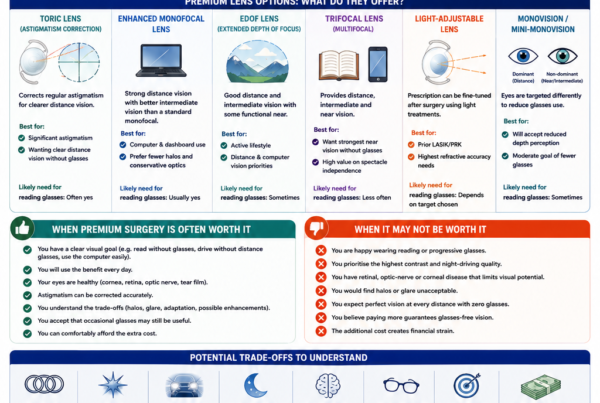
A modern trifocal or multifocal IOL generally offers the strongest combined distance, intermediate and near vision and the greatest chance of reading without glasses.
The trade-off is a greater possibility of:
- Halos
- Glare
- Starbursts
- Reduced contrast in dim light
- A period of neuroadaptation
Network meta-analyses generally find that trifocal lenses provide the strongest unaided near vision, while both trifocal and EDOF lenses improve intermediate vision compared with conventional monofocal lenses.
Which Lens Is Best for Computer Work and an Active Lifestyle?
An extended-depth-of-focus lens, or EDOF IOL, is often a strong choice for patients who prioritise:
- Distance vision
- Computer screens
- Car dashboards
- Cooking
- Sports
- Shopping
- Social and household activities
EDOF lenses usually provide less close-reading ability than trifocal lenses, so reading glasses may still be needed for small print.
Which Lens Is Best for Optical Quality and Night Driving?
A monofocal or enhanced monofocal IOL, with toric correction when necessary, is usually the most conservative option for patients prioritising:
- Crisp distance vision
- Contrast sensitivity
- Night driving
- Fewer halos
- Predictability
- Tolerance of mild ocular imperfections
Enhanced monofocal lenses may provide somewhat better intermediate vision than conventional monofocal lenses while retaining a broadly monofocal-like optical profile. A 2025 systematic review found improved intermediate and near acuity with enhanced monofocal lenses compared with conventional monofocal lenses, while corrected distance acuity remained similar.
Which Lens Is Best When the Final Prescription Must Be Highly Accurate?
A light-adjustable lens, where available and suitable, allows the refractive power to be modified after cataract surgery.
This may be particularly attractive for:
- Previous LASIK or PRK patients
- Eyes in which lens-power prediction is less certain
- Patients wanting postoperative refractive fine-tuning
- Patients considering customised monovision
However, it requires additional visits, light treatments and strict compliance with ultraviolet-protective eyewear until the lens has been locked in.
Which Lens Is Best for Astigmatism?
A toric IOL is usually the most effective premium feature when clinically significant regular corneal astigmatism is present.
“Toric” describes astigmatism correction rather than focusing range. Depending on availability and suitability, toric correction may be incorporated into:
- A monofocal lens
- An enhanced monofocal lens
- An EDOF lens
- A trifocal lens
Evidence reviewed by the American Academy of Ophthalmology found that toric monofocal IOLs provide better unaided distance vision and less residual refractive astigmatism than non-toric monofocal lenses in appropriately selected patients.
What Does “Premium Lens” Mean?
It Is a Broad Commercial Term
“Premium lens” is not one precise scientific category.
It generally refers to an IOL that provides an additional optical function beyond a basic spherical monofocal lens.
These additional functions may include:
- Correction of astigmatism
- Improved intermediate vision
- Extended depth of focus
- Multiple focal distances
- Reduced dependence on reading glasses
- Postoperative adjustability
- Small-aperture optics for selected irregular corneas
A premium lens does not remove the general risks of cataract surgery and does not guarantee freedom from glasses.
Premium Does Not Necessarily Mean Presbyopia-Correcting
A toric monofocal lens may be considered a premium lens because it corrects astigmatism, but it usually does not provide strong near vision when targeted for distance.
Similarly, a light-adjustable lens may improve refractive precision but is not automatically a multifocal lens.
The term “premium” therefore describes additional technology—not one particular visual outcome.
The Main Premium-Lens Categories
Toric Monofocal IOLs
A toric monofocal lens combines:
- One principal focusing distance
- Correction of regular corneal astigmatism
It may be ideal for a patient who wants:
- Clear distance vision
- Good contrast
- Fewer halos
- Reliable night vision
- Reduced dependence on distance glasses
Reading glasses are usually still required when both eyes are targeted for distance.
Enhanced Monofocal IOLs
Enhanced monofocal lenses are sometimes called:
- Monofocal-plus lenses
- Enhanced-range monofocals
- Intermediate-enhancing monofocals
They aim to maintain strong distance vision while providing more functional intermediate vision than a conventional monofocal lens.
They may help with:
- Computer work
- Car dashboards
- Cooking
- Seeing across a desk
- Supermarket shelves
- Larger phone text
They generally do not provide the same close-reading vision as a trifocal lens.
The 2025 meta-analysis of enhanced monofocal lenses found better intermediate and some near performance than conventional monofocals, although results varied and further work is needed regarding patient-reported outcomes and contrast.
Extended-Depth-of-Focus IOLs
An EDOF lens creates an elongated or extended focal range rather than relying entirely on several sharply separated focal points.
It generally aims to provide:
- Excellent distance vision
- Strong intermediate vision
- Functional near vision
- A smoother transition between distances
EDOF technologies differ considerably. They may use:
- Diffractive optics
- Non-diffractive wavefront shaping
- Refractive transitions
- Spherical-aberration manipulation
- Small-aperture principles
- Hybrid designs
For this reason, two EDOF lenses may have different near performance and different halo profiles.
Multifocal and Trifocal IOLs
Multifocal lenses divide or distribute light between more than one focusing distance.
Modern trifocal lenses generally aim to provide useful vision at:
- Distance
- Intermediate range
- Near range
Their main advantage is greater spectacle independence, particularly for near tasks.
Their most important compromises may include:
- Halos
- Glare
- Starbursts
- Reduced low-light contrast
- Greater sensitivity to residual astigmatism
- Dependence on neuroadaptation
Systematic reviews generally find that trifocal lenses provide the strongest unaided near vision among common presbyopia-correcting categories.
Light-Adjustable IOLs
A light-adjustable lens is implanted during cataract surgery similarly to a conventional IOL.
After the eye has healed sufficiently, the lens power can be altered using controlled ultraviolet-light treatments. Once the desired refractive result has been reached, further treatments lock the lens power in place.
Its main advantage is that the refractive result can be refined after surgery rather than relying entirely on preoperative calculations.
Potential disadvantages include:
- Multiple additional appointments
- A longer treatment pathway
- Strict ultraviolet-protective eyewear requirements
- The need for good fixation during treatment
- The need for reliable patient compliance
- Limited availability in some regions
- Reading glasses unless monovision or another near strategy is used
A 2024 review described the technology as promising, particularly where postoperative refractive adjustability is valuable.
Small-Aperture IOLs
Small-aperture lenses use a pinhole principle to block unfocused peripheral rays and increase depth of focus.
They may have a specialised role in eyes with:
- Irregular corneas
- Previous corneal trauma
- Keratoconus
- Decentered previous laser surgery
- Significant higher-order aberrations
They are not a routine first choice for every cataract patient.
Premium-IOL selection reviews describe small-aperture lenses as a potential alternative for selected patients with irregular corneal optics.
A Practical Comparison
| Priority | Lens category often considered |
|---|---|
| Crisp distance vision | Monofocal or enhanced monofocal |
| Frequent night driving | Monofocal or selected enhanced monofocal |
| Computer and dashboard vision | EDOF or enhanced monofocal |
| Strongest reading vision without glasses | Trifocal or multifocal |
| Maximum overall spectacle independence | Trifocal |
| Fewer halos | Monofocal; selected enhanced monofocal or EDOF |
| Significant regular astigmatism | Toric version of the selected lens |
| Refractive fine-tuning after surgery | Light-adjustable lens |
| Previous LASIK or PRK | Monofocal, LAL or selected EDOF after detailed assessment |
| Irregular cornea | Monofocal, toric where appropriate, or selected small-aperture strategy |
| Macular or advanced optic-nerve disease | Usually monofocal or carefully selected enhanced monofocal |
| Strong near priority but accepts halos | Trifocal |
| Active lifestyle and accepts reading glasses | EDOF |
| Greatest optical predictability | Monofocal or light-adjustable monofocal strategy |
This table is a framework rather than a prescription. The health of the eye can override lifestyle preference.
Which Premium Lens Gives the Best Distance Vision?
Most Modern Lenses Can Provide Excellent Distance Acuity
Monofocal, enhanced monofocal, EDOF and trifocal lenses can all provide excellent distance visual acuity when:
- The lens calculation is accurate.
- Astigmatism is controlled.
- The cornea is healthy.
- The macula and optic nerve function normally.
- The IOL is well positioned.
- The ocular surface is stable.
Large reviews generally find relatively similar corrected distance acuity across modern IOL categories.
Distance Acuity Is Not the Same as Distance Quality
Two patients may both read 6/6 on an eye chart but have different experiences.
One may describe:
- Crisp road signs
- Good contrast
- Comfortable night driving
- Minimal light scatter
Another may notice:
- Halos
- Starbursts
- Slightly waxy vision
- Reduced contrast in rain
- Difficulty around headlights
A high-contrast eye chart does not assess every aspect of real-world vision.
Monofocal Optics Are the Reference Standard
Monofocal lenses direct most available light towards one principal focus.
They are therefore often selected when the patient prioritises:
- Maximum optical simplicity
- Strong contrast
- Reduced night-time photic phenomena
- Reliability in less-than-perfect eyes
Which Premium Lens Gives the Best Computer Vision?
EDOF Is Often the Strongest Distance-to-Intermediate Option
EDOF lenses are designed primarily to extend vision from distance into intermediate range.
This may suit patients whose daily tasks include:
- Desktop computers
- Laptops
- Car dashboards
- Cooking
- Presentations
- Musical instruments
- Seeing across a meeting table
Enhanced Monofocal Lenses May Be Sufficient
Patients who do not require complete spectacle independence may obtain useful computer vision with an enhanced monofocal lens.
However, results vary according to:
- Working distance
- Pupil size
- Residual refractive error
- Lens design
- Whether mild monovision is used
Trifocal Lenses Also Provide Strong Intermediate Vision
Modern trifocal lenses usually include a dedicated intermediate focus.
Their advantage over EDOF is not necessarily computer vision; it is generally the addition of stronger close-reading vision.
Which Premium Lens Gives the Best Reading Vision?
Trifocal Lenses Usually Lead
Trifocal lenses generally provide the strongest unaided vision for:
- Phone use
- Books
- Menus
- Medicine labels
- Price tags
- Printed documents
- Fine near tasks
Network meta-analysis evidence places trifocal and diffractive bifocal lenses among the strongest options for unaided near vision.
No Lens Guarantees Every Near Task
Even after trifocal implantation, glasses may help with:
- Very small print
- Dim lighting
- Prolonged reading
- Low-contrast text
- Detailed needlework
- Very close working distances
The likely reading distance should be discussed before surgery.
EDOF Near Vision Is Usually Functional Rather Than Complete
Many EDOF patients can read:
- Larger phone text
- A menu in good light
- A smartwatch
- Brief messages
- Price labels
They are more likely to need reading glasses for demanding or prolonged close work.
Which Premium Lens Produces the Fewest Halos?
Monofocal Lenses Usually Produce the Fewest
A monofocal lens generally produces fewer optical rings and competing images because it does not intentionally distribute light between several focal points.
Enhanced monofocal lenses may provide additional intermediate function without the full light-splitting pattern of a trifocal lens.
EDOF Halos Depend on the Design
EDOF is not one uniform category.
A non-diffractive EDOF lens may have a different halo profile from a diffractive EDOF lens.
Patients should ask:
- Is the lens diffractive?
- Is it non-diffractive?
- What visual-disturbance data exist for this specific model?
- How does it compare with a monofocal lens?
Trifocal Lenses Have the Greatest Halo Trade-Off
Trifocal lenses provide greater near spectacle independence by distributing light among distance, intermediate and near foci.
Halos and starbursts are therefore a recognised compromise.
Many patients become less aware of them through neuroadaptation, but not every patient adapts completely.
A 2025 review of night-driving performance noted that photic phenomena and reduced contrast remain relevant considerations after presbyopia-correcting IOL implantation.
Which Premium Lens Is Best for Night Driving?
Monofocal or Enhanced Monofocal Is the Conservative Choice
Patients who regularly drive at night may prioritise:
- Contrast
- Pedestrian detection
- Road markings
- Wet-road reflections
- Headlight tolerance
- Rapid dark adaptation
A toric monofocal or selected enhanced monofocal lens is often the safest optical strategy when these are the overriding priorities.
EDOF May Offer a Middle Ground
A selected EDOF lens may provide:
- Good distance vision
- Strong dashboard vision
- A broader range than a monofocal
- Potentially fewer photic phenomena than a full trifocal design
However, this is lens-specific. EDOF does not mean halo-free.
Trifocal May Still Be Acceptable
Many trifocal patients drive comfortably at night.
A patient who drives infrequently at night may accept some halos in exchange for greater freedom from glasses.
A professional night driver may make the opposite choice.
Which Premium Lens Is Best for Astigmatism?
Correcting Astigmatism Is Often More Important Than Choosing the Focal Technology
A sophisticated presbyopia-correcting IOL may perform poorly if clinically significant corneal astigmatism remains untreated.
Residual astigmatism can cause:
- Blur
- Ghost images
- Shadowed letters
- Halos
- Reduced contrast
- Poor reading vision
Toric Correction Can Be Combined With Other Technologies
Depending on availability, patients may receive:
- Toric monofocal
- Toric enhanced monofocal
- Toric EDOF
- Toric trifocal
The focal-range decision and the astigmatism-correction decision are related but separate.
Rotational Stability Matters
A toric lens must remain aligned with the intended axis.
A 2024 systematic review of 4,863 eyes found that modern toric IOLs generally demonstrated strong rotational stability, although performance varied among lens designs.
Which Premium Lens Is Best After LASIK or PRK?
Previous Laser Surgery Makes Calculations More Challenging
LASIK and PRK alter the corneal shape and can reduce the predictability of conventional IOL-power calculations.
Modern formulas and measurements have improved accuracy, but postoperative refractive error remains more likely than in an untreated cornea.
Corneal Optical Quality Must Be Assessed
A post-LASIK cornea may be:
- Regular and well centred
- Irregular
- Decentered
- Dry
- Associated with higher-order aberrations
- Already prone to night halos
A multifocal or diffractive lens may magnify pre-existing optical symptoms in a less-than-ideal cornea.
Light-Adjustable Lenses May Be Attractive
Because a light-adjustable lens can be refined after surgery, it may reduce some of the uncertainty associated with preoperative calculations.
A 2024 study reported favourable visual and refractive outcomes with second-generation LAL implantation in carefully selected eyes with previous LASIK or PRK.
Previous LASIK Does Not Automatically Exclude EDOF or Trifocal IOLs
Some carefully selected post-LASIK patients can do well with presbyopia-correcting lenses.
Assessment may include:
- Corneal topography
- Corneal tomography
- Higher-order aberration analysis
- Ocular-surface evaluation
- Macular OCT
- Several lens-power calculation methods
- Detailed counselling about refractive uncertainty
Which Premium Lens Is Best for Glaucoma?
Glaucoma Can Reduce Contrast
Even when central visual acuity remains good, glaucoma may affect:
- Contrast sensitivity
- Peripheral vision
- Low-light vision
- Visual processing
A lens that divides light between multiple foci may add an optical compromise to an already compromised visual system.
Early Glaucoma Requires Individual Assessment
A patient with very early, stable glaucoma and good contrast may still be considered for selected premium options.
The decision depends on:
- Visual-field loss
- Optic-nerve damage
- Rate of progression
- Contrast sensitivity
- Future surgical needs
- The lens design
Advanced Glaucoma Usually Favours Monofocal Optics
A monofocal or carefully chosen enhanced monofocal lens is generally the more conservative option when there is meaningful optic-nerve damage.
Which Premium Lens Is Best for Retinal Disease?
Macular Health Is Critical
Presbyopia-correcting IOLs cannot compensate for retinal dysfunction.
Conditions requiring caution include:
- Epiretinal membrane
- Age-related macular degeneration
- Diabetic macular oedema
- Vitreomacular traction
- Macular hole
- Previous retinal-vein occlusion
- Previous macular surgery
Macular OCT Is Valuable
A retinal examination may appear relatively normal while OCT reveals subtle macular disease.
Macular OCT can identify abnormalities that may reduce:
- Contrast
- Reading ability
- Image quality
- Satisfaction with multifocal optics
Monofocal Is Often the Safer Strategy
When retinal image quality is already limited, concentrating light into one main focus may be preferable to dividing it among several foci.
Which Premium Lens Is Best for Dry Eyes?
Treat the Ocular Surface Before Choosing
Dry eye can affect:
- Keratometry
- Corneal topography
- Astigmatism measurement
- Lens-power calculations
- Visual quality
- Halo perception
- Postoperative satisfaction
The ocular surface should be stabilised before final measurements whenever possible.
Dry Eye Can Make Any Premium Lens Seem Poor
An unstable tear film may cause:
- Fluctuating vision
- Ghosting
- Glare
- Intermittent blur
- Reduced reading comfort
These symptoms may be wrongly blamed on the lens.
Multifocal Optics Are Particularly Sensitive
Because a multifocal lens already distributes light, an unstable tear film can further degrade image quality.
A patient with persistent uncontrolled dry eye may be better served by a monofocal or carefully selected enhanced monofocal strategy.
Which Premium Lens Is Best for Irregular Corneas?
Regular and Irregular Astigmatism Are Different
A toric IOL corrects regular astigmatism.
It does not fully correct irregular optics caused by:
- Keratoconus
- Corneal scars
- Decentered laser treatment
- Radial keratotomy
- Significant higher-order aberrations
Small-Aperture Optics May Help Selected Eyes
A small-aperture IOL can reduce the effect of peripheral aberrated rays and increase depth of focus.
It may have a specialised role in selected eyes with irregular corneas, although careful assessment is essential.
A Simple Lens May Still Be Best
In many irregular corneas, the safest choice remains:
- A monofocal IOL
- A toric monofocal where the astigmatism is sufficiently regular
- A target that suits the patient’s established visual habits
- Postoperative glasses or specialty contact lenses when required
What About Monovision?
One Eye for Distance and One for Nearer Vision
Monovision uses different refractive targets:
- The dominant eye is generally targeted for distance.
- The non-dominant eye is targeted for intermediate or near vision.
It can be used with:
- Monofocal lenses
- Enhanced monofocal lenses
- EDOF lenses
- Light-adjustable lenses
Advantages
Monovision may provide:
- Reduced glasses dependence
- Fewer multifocal rings
- Good distance and intermediate function
- Lower cost than some trifocal options
- Customisable near targeting
Disadvantages
Possible compromises include:
- Reduced fine depth perception
- Blur in one eye at each extreme
- Difficulty in dim light
- Visual imbalance
- Failure to adapt
Mini-Monovision Is Often Better Tolerated
A smaller difference between the two eyes may provide a useful range while preserving more binocular function.
A 2025 review found broadly low complication and enhancement rates for mini-monovision strategies using monofocal, enhanced monofocal and EDOF lenses, although spectacle-independence results varied.
What Is Neuroadaptation?
The Brain Must Learn the New Optical System
Multifocal and some EDOF lenses create retinal images that differ from those produced by a young natural lens.
The brain gradually learns to:
- Select the relevant focal information
- Suppress competing images
- Ignore halos
- Combine the two eyes
- Adapt to new contrast patterns
Adaptation May Take Time
Patients may improve over:
- Days
- Weeks
- Several months
Adaptation is influenced by:
- Ocular-surface recovery
- Correction of residual prescription
- Pupil size
- Surgery on the second eye
- Personality
- Visual demands
Adaptation Is Not Guaranteed
A minority of patients remain troubled despite technically successful surgery.
Persistent symptoms should be investigated rather than dismissed as failure to adapt.
Why Might a Premium-Lens Patient Be Dissatisfied?
Residual Refractive Error
Even small amounts of:
- Short-sightedness
- Long-sightedness
- Astigmatism
can impair premium-IOL performance.
Dry Eye
Tear-film instability may cause fluctuating blur, glare and halos.
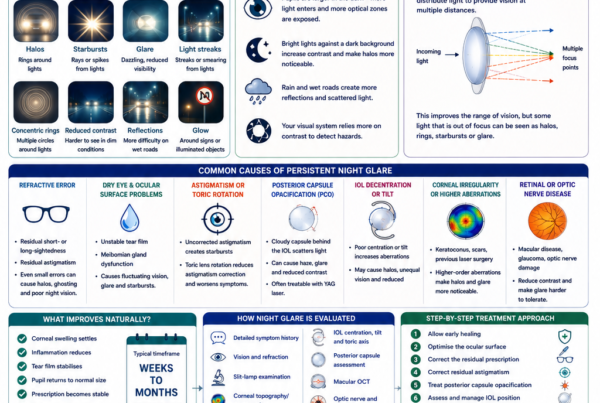
Posterior Capsule Opacification
Clouding of the capsule behind the IOL may cause:
- Blur
- Glare
- Reduced contrast
- Worsening halos
This can often be treated with YAG laser capsulotomy.
Lens Decentration or Rotation
Presbyopia-correcting and toric optics are more dependent on accurate positioning.
Retinal or Optic-Nerve Disease
Subtle ocular disease may limit the visual result despite clear optics.
Expectations Were Unrealistic
No premium lens guarantees:
- Perfect vision at every distance
- Zero glasses
- Zero halos
- Immediate adaptation
- Perfect night driving
- An exact refractive result
- Vision identical to that of a healthy 20-year-old
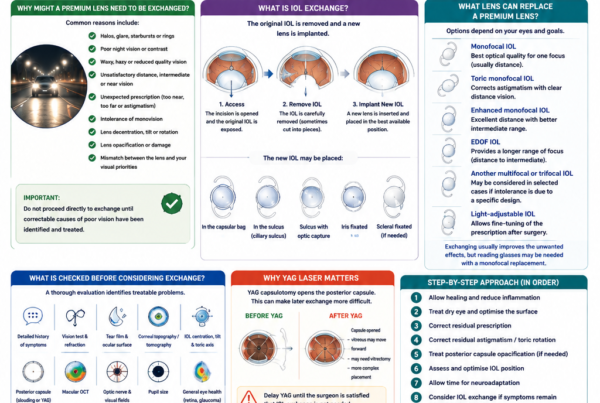
Can a Premium Lens Be Exchanged?
Exchange Is Possible but Carries Risk
A premium lens can sometimes be exchanged for:
- A monofocal lens
- An enhanced monofocal lens
- A different EDOF lens
- A different multifocal lens
However, lens exchange is another intraocular operation.
Potential risks include:
- Capsular damage
- Vitreous loss
- Corneal injury
- Retinal complications
- Infection
- Residual refractive error
- Need for an alternative lens position
Investigate Correctable Causes First
Before considering exchange, the ophthalmologist should assess:
- Refraction
- Tear film
- Corneal shape
- Astigmatism
- Lens position
- Posterior capsule
- Macula
- Optic nerve
- Pupil size
- Binocular function
YAG Laser May Complicate Later Exchange
Opening the posterior capsule with YAG laser can make subsequent lens exchange more complex.
When lens exchange remains a serious possibility, the causes of dissatisfaction should be evaluated before proceeding with YAG treatment.
Is the Most Expensive Lens the Best?
Cost Reflects Technology and Services
Premium-lens fees may include:
- The IOL
- Advanced imaging
- Astigmatism planning
- Additional postoperative assessments
- Light-adjustment treatments
- Enhancement planning
- Additional counselling
Cost Does Not Determine Suitability
A more expensive lens may provide a wider range of vision but also create compromises that are unacceptable to a particular patient.
For example:
- A trifocal may be poor value for a patient with significant macular disease.
- An EDOF lens may disappoint someone demanding very close reading without glasses.
- An LAL may not suit someone unable to attend repeated treatments.
- A basic monofocal may under-correct a patient’s significant astigmatism.
- A toric monofocal may be more valuable than a non-toric multifocal in an astigmatic eye.
Does the Surgeon’s Experience Matter?
The Lens Is Only One Part of the Result
Premium-IOL success also depends on:
- Accurate biometry
- Corneal measurements
- Astigmatism planning
- Ocular-surface optimisation
- Macular assessment
- Appropriate lens-power calculations
- Surgical technique
- Lens centration
- Toric alignment
- Management of expectations
- Postoperative follow-up
Counselling Is Part of the Treatment
The surgeon should understand:
- Your preferred working distances
- Your night-driving habits
- Your occupation
- Your hobbies
- Your tolerance for glasses
- Your tolerance for halos
- Your prior experience with monovision
- Your willingness to accept an enhancement
A technically excellent lens may still feel wrong if it does not match the patient’s priorities.
Questions to Ask Yourself
Which Distance Matters Most?
Consider whether your daily activities prioritise:
- Distance driving
- Night driving
- Computer work
- Phone use
- Book reading
- Fine close work
- Sports
- Musical instruments
- Outdoor activities
Which Compromise Would Bother You More?
Ask yourself:
- Would reading glasses bother me more than halos?
- Would halos bother me more than reading glasses?
- Do I value crisp distance quality above spectacle independence?
- Am I comfortable with occasional glasses?
- Would I accept a possible enhancement?
- Am I willing to adapt over several months?
What Does “Glasses-Free” Mean to You?
Some patients mean:
- No glasses for driving
- No glasses for computer work
- No glasses for reading
- No glasses for most daily tasks
- No glasses under any circumstances
These are not the same goal.
Questions to Ask Your Ophthalmologist
About Your Eyes
- Is my cornea regular?
- Is my tear film stable?
- How much corneal astigmatism do I have?
- Is my macula normal on OCT?
- Do I have an epiretinal membrane?
- Is my optic nerve healthy?
- Do I have glaucoma?
- Does previous LASIK affect the calculation?
- Are both eyes suitable for the same lens?
About the Lens
- Is it monofocal, enhanced monofocal, EDOF or trifocal?
- Is a toric version required?
- Is the EDOF design diffractive or non-diffractive?
- What distances does the lens favour?
- How common are halos with this specific model?
- How often do patients still need reading glasses?
- Will monovision be used?
- What will each eye be targeted for?
About the Backup Plan
- What happens if the result is not exact?
- Would glasses correct the residual error?
- Is laser enhancement possible?
- Can the toric lens be rotated?
- Can the IOL be exchanged?
- When should YAG laser be considered?
- Are enhancements included in the surgical package?
Frequently Asked Questions
What Is the Best Premium Lens Overall?
There is no universal best lens.
Trifocal lenses provide the widest unaided range, EDOF lenses often favour distance and intermediate function, enhanced monofocals favour optical quality with some intermediate extension, toric lenses correct astigmatism and LALs offer postoperative adjustment.
Which Premium Lens Gives the Sharpest Vision?
A well-targeted monofocal or enhanced monofocal lens generally provides the most optically straightforward image at its main focal distance.
Other premium lenses can also provide excellent acuity but may create additional optical phenomena.
Which Lens Gives the Greatest Freedom From Glasses?
A trifocal IOL generally offers the highest probability of spectacle independence across distance, intermediate and near tasks.
No lens guarantees complete freedom from glasses.
Which Lens Causes the Fewest Halos?
Monofocal lenses generally cause the fewest halos.
Selected enhanced monofocal and non-diffractive EDOF lenses may provide a wider range with a relatively low halo profile.
Which Lens Is Best for Night Driving?
A monofocal or selected enhanced monofocal lens is usually the most conservative choice.
A carefully selected EDOF lens may provide a middle ground.
Which Lens Is Best for Reading?
A modern trifocal lens generally provides the strongest unaided close-reading vision.
Which Lens Is Best for Computer Work?
EDOF and trifocal lenses generally provide strong intermediate vision.
Enhanced monofocal lenses may be adequate for patients who accept occasional computer glasses.
Which Lens Is Best After LASIK?
There is no single answer.
A light-adjustable lens may be attractive because of postoperative fine-tuning. Monofocal, EDOF and occasionally trifocal lenses may also be considered after detailed corneal assessment.
Which Lens Is Best for Astigmatism?
A toric version of the otherwise appropriate lens is generally best when clinically significant regular corneal astigmatism is present.
Is a Toric Lens Also Multifocal?
It can be.
“Toric” describes astigmatism correction. The lens may also be monofocal, EDOF or trifocal.
Can I Have Premium Lenses if I Have Glaucoma?
Possibly in early, stable disease, depending on visual fields and contrast.
Moderate or advanced glaucoma usually favours monofocal optics.
Can I Have a Multifocal Lens if I Have an Epiretinal Membrane?
A significant epiretinal membrane may reduce retinal image quality and make multifocal optics unsuitable.
Macular OCT is important before selection.
Will I Ever Need Glasses With a Premium Lens?
Possibly.
Glasses may still help with:
- Fine print
- Dim lighting
- Prolonged reading
- Residual prescription
- Night driving
- Precision work
Can the Lens Be Changed Later?
Yes, but lens exchange is another operation with additional risks and should not be treated as a simple reversal.
A Practical Decision Guide
Choose a Toric Monofocal or Enhanced Monofocal Strategy When:
- Crisp distance quality is the main priority.
- You drive frequently at night.
- You accept reading glasses.
- You have significant regular astigmatism.
- You have mild ocular disease requiring conservative optics.
- You want a predictable, lower-halo result.
Choose an EDOF Strategy When:
- Distance and computer vision are most important.
- You want more range than a monofocal.
- You accept reading glasses for fine print.
- You value an active lifestyle.
- You want a compromise between range and optical quality.
- Mini-monovision is acceptable.
- Your ocular health is suitable.
Choose a Trifocal Strategy When:
- Maximum freedom from glasses is the main priority.
- Reading and phone use without glasses matter greatly.
- Your cornea, macula and optic nerve are healthy.
- You accept halos and glare as possible trade-offs.
- You understand neuroadaptation.
- Your measurements are accurate and stable.
Choose a Light-Adjustable Lens Strategy When:
- Postoperative refractive precision is a major priority.
- Previous LASIK or PRK increases calculation uncertainty.
- You want to test and refine the visual target after surgery.
- You can attend multiple treatment visits.
- You can comply with UV-protective eyewear and treatment instructions.
- You accept that near vision may require monovision or reading glasses.
Choose a Small-Aperture or Specialised Strategy When:
- The cornea is irregular.
- Previous corneal surgery has created significant aberrations.
- Conventional multifocal optics are unsuitable.
- Your surgeon believes the pinhole principle will improve functional vision.
The Bottom Line
There is no premium intraocular lens that is best for every cataract patient.
The practical answer is:
- Best for maximum optical quality: monofocal or enhanced monofocal
- Best for correcting regular astigmatism: toric version of the selected lens
- Best for distance and computer vision: EDOF
- Best for strong reading vision and maximum spectacle independence: trifocal
- Best for postoperative refractive customisation: light-adjustable lens
- Best for selected irregular corneas: small-aperture or another specialised strategy
- Best for eyes with significant retinal, optic-nerve or corneal disease: often a conservative monofocal approach
The lens should be selected according to:
- Corneal shape
- Tear-film stability
- Astigmatism
- Macular health
- Optic-nerve health
- Previous laser surgery
- Night-driving needs
- Reading priorities
- Willingness to wear glasses
- Tolerance for halos
- Ability to adapt
- Willingness to undergo additional treatment
The widest-range lens is not always the best-quality lens.
The most expensive lens is not always the most suitable lens.
The lens that worked well for a friend may not be appropriate for your eyes.
A carefully selected toric monofocal lens may provide a better outcome than an unsuitable trifocal lens. Conversely, a well-selected trifocal, EDOF or adjustable lens may provide excellent visual freedom for the right patient.
The best premium lens is therefore the lens that offers the most useful vision with compromises you personally find acceptable.
References
- Chen JL, Al-Mohtaseb ZN, Chen AJ. Criteria for premium intraocular lens patient selection. Curr Opin Ophthalmol. 2024;35(5):353–358. doi:10.1097/ICU.0000000000001067. PMID: 38920096.
- Cho JY, Won YK, Park J, Nam JH, Hong JY, Min S, et al. Visual outcomes and optical quality of accommodative, multifocal, extended depth-of-focus, and monofocal intraocular lenses in presbyopia-correcting cataract surgery: a systematic review and Bayesian network meta-analysis. JAMA Ophthalmol. 2022;140(11):1045–1053. doi:10.1001/jamaophthalmol.2022.3667. PMID: 36136323.
- Li J, Sun B, Zhang Y, et al. Comparative efficacy and safety of all kinds of intraocular lenses in presbyopia-correcting cataract surgery: a systematic review and meta-analysis. BMC Ophthalmol. 2024;24(1):172. doi:10.1186/s12886-024-03446-1. PMID: 38627651.
- Fernández J, et al. Visual and patient-reported outcomes of enhanced versus monofocal intraocular lenses in cataract surgery: a systematic review and meta-analysis. Eye. 2025;39(5):883–898. doi:10.1038/s41433-025-03625-4. PMID: 39893265.
- Al-Mohtaseb Z, Steigleman WA, Pantanelli SM, Lin CC, Hatch KM, Rose-Nussbaumer JR, et al. Toric monofocal intraocular lenses for the correction of astigmatism during cataract surgery: a report by the American Academy of Ophthalmology. Ophthalmology. 2024;131(3):383–392. doi:10.1016/j.ophtha.2023.10.010. PMID: 38149945.
- Li ES, Vanderford EK, Xu Y, Kang PC. Rotational stability of toric intraocular lenses by lens model and haptic design: systematic review and single-arm meta-analysis. J Cataract Refract Surg. 2024;50(9):976–984. doi:10.1097/j.jcrs.0000000000001486. PMID: 38768060.
- Jun JH, Lieu A, Afshari NA. Light adjustable intraocular lenses in cataract surgery: considerations. Curr Opin Ophthalmol. 2024;35(1):44–49. doi:10.1097/ICU.0000000000001015. PMID: 37916944.
- Jones M, Terveen DC, Berdahl JP, Thompson V, Kramer BA, Ferguson TJ. Clinical outcomes of the light-adjustable lens in eyes with a history of prior corneal refractive surgery. J Cataract Refract Surg. 2024;50(9):936–941. doi:10.1097/j.jcrs.0000000000001481. PMID: 38736178.
- Kohnen T, Berdahl J, Hong X, Bala C. The novel optical design and clinical classification of a wavefront-shaping presbyopia-correcting intraocular lens. Clin Ophthalmol. 2023;17:2671–2686. PMID: 37614847.
- Levy I, et al. Outcomes of mini-monovision with monofocal, enhanced monofocal and extended-depth-of-focus intraocular lenses: a systematic review. Eye. 2025. PMID: 40061383.
- Puente-Bustillo S, et al. Visual performance during night driving after intraocular refractive surgery procedures. Expert Rev Med Devices. 2025;22(7). doi:10.1080/17434440.2025.2512038. PMID: 40418587.
- U.S. Food and Drug Administration. Light Adjustable Lens and Light Delivery Device: Patient Information Brochure. FDA; 2017.