Author: Dr Val Phua
Estimated reading time: 20 minutes
Choosing an intraocular lens is one of the most important decisions made before cataract surgery.
During cataract surgery, the cloudy natural lens is removed and replaced with a clear artificial intraocular lens, or IOL. The implanted lens is intended to remain permanently inside the eye.
Modern lens technology can provide more than clear distance vision. Some intraocular lenses are designed to reduce dependence on glasses for computer work, phone use, reading and other everyday activities.
Two commonly discussed options are:
- Extended-depth-of-focus lenses, usually called EDOF IOLs
- Multifocal lenses, particularly modern trifocal IOLs
Both belong to the broader category of presbyopia-correcting intraocular lenses.
However, they achieve their range of vision differently and generally prioritise different outcomes.
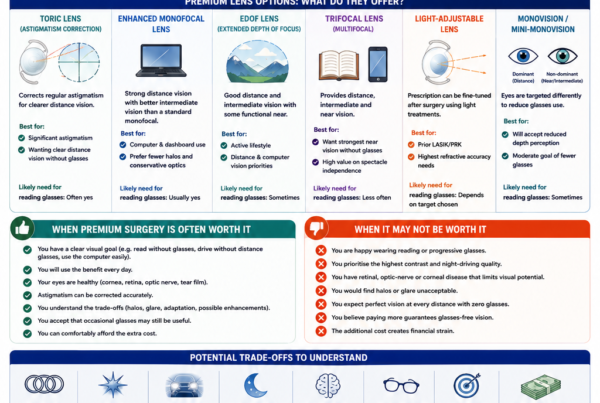
An EDOF lens usually aims to provide:
- Excellent distance vision
- Strong intermediate vision
- Some functional near vision
- A smoother transition between distances
- A lower or more monofocal-like dysphotopsia profile with some designs
A multifocal or trifocal lens usually aims to provide:
- Excellent distance vision
- Strong intermediate vision
- Better close-reading vision
- Greater near spectacle independence
- A wider overall range without glasses
The potential compromise is that multifocal lenses may be associated with more halos, glare, starbursts or reduced low-light image quality. However, the difference in visual phenomena between EDOF and multifocal lenses is not identical across all lens models, and high-quality direct evidence remains limited.
The 2024 Cochrane review concluded that distance vision may be similar with trifocal and EDOF lenses, while trifocal lenses may provide better near vision. Both lens groups can cause halos and glare, and the available studies were not sufficiently large or consistent to establish a reliable difference in these symptoms.
For practical purposes, this article mainly compares EDOF lenses with modern trifocal lenses, because that is the most relevant contemporary comparison. The word “multifocal” can also include older bifocal designs, and results from one lens should not automatically be applied to every other lens in the same category.
The Quick Comparison
| Feature | EDOF IOL | Multifocal or trifocal IOL |
|---|---|---|
| Main optical strategy | Creates an elongated or extended focal range | Creates two or three principal focal ranges |
| Distance vision | Usually excellent | Usually excellent |
| Intermediate vision | Major strength | Usually very good |
| Near reading vision | Functional but often weaker | Usually stronger |
| Reading-glasses dependence | May still need readers for small print | Lower on average |
| Overall glasses independence | High, especially for distance and intermediate | Generally highest across all distances |
| Halos and glare | Possible; varies greatly by design | Possible and commonly discussed |
| Contrast in dim light | May be more forgiving with some designs | May be reduced by light distribution |
| Night driving | Often selected when visual quality is prioritised | May be affected by halos and starbursts |
| Sensitivity to residual prescription | Still important | Usually highly sensitive |
| Adaptation | Usually required | Usually required |
| Mini-monovision compatibility | Often useful | Less commonly required |
| Suitability with eye disease | May be more forgiving in selected cases | Requires particularly careful selection |
| Near task priority | Moderate | High |
| Computer and dashboard priority | High | High |
| Guaranteed freedom from glasses | No | No |
What Is Presbyopia?
The Natural Lens Loses Its Focusing Ability
When we are young, the natural lens changes shape to focus from distant objects to nearby objects.
This process is called accommodation.
With age, the natural lens becomes less flexible. The eye gradually loses the ability to focus clearly at near distances, leading to:
- Difficulty reading small print
- Holding a phone farther away
- Needing brighter lighting
- Dependence on reading glasses
- Difficulty moving focus between the dashboard and road
- Eye strain during prolonged near work
This age-related loss of near focusing is called presbyopia.
Cataract Surgery Removes the Natural Lens
During cataract surgery:
- A small corneal incision is created.
- The cloudy natural lens is broken into small pieces.
- The lens material is removed.
- An artificial intraocular lens is implanted.
- The lens usually unfolds inside the natural capsular bag.
A conventional monofocal IOL has one main focusing distance. Presbyopia-correcting lenses attempt to provide a wider functional range.
No artificial lens perfectly reproduces the flexible accommodation of a healthy young natural lens.
What Is an EDOF Lens?
EDOF Means Extended Depth of Focus
An EDOF lens is designed to extend the range over which objects remain acceptably clear.
Rather than creating three completely separate focal points, a true EDOF design attempts to form a longer or elongated focus.
In practical terms, this commonly provides a continuous range from:
- Distance
- Through intermediate
- Into some degree of near vision
The American Academy of Ophthalmology describes EDOF lenses as presbyopia-correcting lenses that extend the corrective zone to support distance and intermediate vision, with some near benefit depending on the design.
EDOF Is Not One Single Technology
The EDOF category includes lenses using different optical principles, such as:
- Diffractive echelette optics
- Non-diffractive wavefront-shaping optics
- Refractive surface transitions
- Spherical-aberration manipulation
- Small-aperture optics
- Hybrid multifocal-EDOF designs
These lenses do not all produce the same visual range, contrast sensitivity or halo profile.
A statement that applies to one EDOF lens may not apply equally to another.
EDOF Does Not Mean Full Near Vision
EDOF lenses are often strongest from distance to intermediate.
They may provide functional vision for:
- Computer screens
- Car dashboards
- Cooking
- Supermarket shelves
- Seeing across a table
- Phone use in good lighting
- Larger-print reading
However, patients may still require reading glasses for:
- Small print
- Prolonged reading
- Dimly lit menus
- Detailed needlework
- Medicine labels
- Fine technical work
- Close reading at approximately 30 to 40 centimetres
A 2019 systematic review found that EDOF lenses improved intermediate and near vision compared with monofocal lenses, but near vision remained weaker than with trifocal lenses.
What Is a Multifocal IOL?
Multifocal Lenses Create More Than One Focus
A multifocal IOL distributes incoming light across more than one focusing distance.
Depending on the design, it may provide:
- Distance and near vision
- Distance and intermediate vision
- Distance, intermediate and near vision
Modern lenses designed for all three distances are generally described as trifocal lenses.
How Does a Trifocal Lens Work?
A trifocal lens typically creates useful focal ranges for:
- Distance
- Intermediate tasks
- Near reading
Diffractive rings or refractive zones distribute light towards these focal ranges.
The visual system then learns to use the image most appropriate for the object being viewed.
Multifocal Does Not Mean That Every Distance Is Perfect
A trifocal lens may provide useful unaided vision across a wider range than an EDOF lens, but the performance still depends on:
- The exact lens design
- The reading distance
- Lighting
- Pupil size
- Residual prescription
- Corneal astigmatism
- Tear-film stability
- Macular health
- Whether both eyes have been operated on
- Neuroadaptation
Very small print or prolonged close work may still be easier with reading glasses.
What Is the Main Optical Difference?
EDOF Lenses Extend the Focus
The conceptual aim of an EDOF lens is to stretch the distance focal point into an extended range.
This can produce:
- Smooth distance-to-intermediate vision
- Fewer abrupt transitions between focal points
- Functional near vision
- Potentially more monofocal-like image quality with certain designs
Multifocal Lenses Divide Light Between Foci
A multifocal or trifocal lens creates distinct optical powers for different distances.
This can provide stronger near performance but may also result in:
- Multiple simultaneous retinal images
- Halos around point light sources
- Starbursts
- Glare
- Reduced contrast under some conditions
- Greater dependence on neuroadaptation
The Categories Can Overlap
Some lenses described commercially as EDOF use diffractive optics and may behave partly like low-add multifocal lenses.
Some hybrid lenses combine:
- Trifocal optics
- EDOF elements
- Refractive transitions
- Non-diffractive wavefront shaping
For this reason, the lens model and optical platform are often more informative than the broad label alone.
Which Lens Gives Better Distance Vision?
Distance Vision Is Usually Similar
Both EDOF and trifocal lenses are intended to provide strong distance vision when:
- Surgery is uncomplicated.
- The lens power is accurate.
- Astigmatism is controlled.
- The ocular surface is healthy.
- The retina and optic nerve function normally.
The updated 2023 meta-analysis of 22 studies involving approximately 2,200 eyes found no meaningful difference in uncorrected distance visual acuity between EDOF and trifocal lenses.
The 2024 Cochrane review also found little evidence of an important distance-vision difference between the lens categories, although the certainty of the evidence was low.
Eye-Chart Acuity Does Not Measure Everything
Two patients may both see 6/6 on an eye chart but report different visual experiences.
One patient may describe:
- Crisp vision
- Strong contrast
- Comfortable night vision
Another may notice:
- Halos
- Glare
- Slightly waxy vision
- Reduced clarity in dim lighting
- Intermittent blur from dry eye
Standard visual acuity measures high-contrast letter recognition. It does not fully assess real-world image quality.
Which Lens Gives Better Intermediate Vision?
Intermediate Vision Is a Major Strength of EDOF
Intermediate vision is used for:
- Desktop computers
- Laptops
- Car dashboards
- Cooking
- Supermarket shelves
- Musical instruments
- Seeing across a desk
- Household activities
- Social interactions across a table
EDOF technology was developed largely to provide a smooth and useful distance-to-intermediate range.
Trifocal Lenses Also Provide Strong Intermediate Vision
Modern trifocal lenses include a dedicated intermediate focal point and can provide very good computer-range vision.
The 2023 updated meta-analysis did not find a significant overall difference in uncorrected or corrected intermediate visual acuity between EDOF and trifocal lenses. Defocus-curve analysis suggested that some EDOF lenses may perform favourably at selected intermediate ranges while trifocal lenses perform better closer to near.
The Tested Distance Matters
Intermediate vision may be tested at:
- 60 centimetres
- 66 centimetres
- 80 centimetres
- 100 centimetres
A lens that performs strongly at 80 centimetres may be less effective at 60 centimetres.
Patients should consider their actual working distance.
For example:
- A desktop monitor may be 70 to 80 centimetres away.
- A laptop may be 50 to 60 centimetres away.
- A car dashboard may be approximately 60 to 80 centimetres away.
- A musical score may be placed farther away.
Which Lens Gives Better Near Vision?
Trifocal Lenses Usually Have the Advantage
Near vision is the most consistent difference between the two categories.
Trifocal lenses generally provide stronger unaided vision for:
- Reading books
- Looking at a phone
- Reading menus
- Seeing price labels
- Applying makeup
- Reading messages
- Reviewing printed documents
The 2023 meta-analysis found significantly better uncorrected and distance-corrected near visual acuity with trifocal lenses than with EDOF lenses.
The 2024 Cochrane review similarly concluded that people receiving trifocal lenses may achieve better near vision and may be less dependent on spectacles for near tasks.
EDOF Near Vision May Still Be Functional
An EDOF patient may be able to read:
- Larger phone text
- Menus in bright lighting
- Price tags
- A smartwatch
- Short messages
- A tablet held slightly farther away
However, reading performance may decrease when:
- Print is small
- Lighting is poor
- Contrast is low
- Reading is prolonged
- The target is very close
- The eyes are dry
- A residual prescription remains
Reading Distance Matters
Trifocal lenses may be designed around different near focal distances.
One lens may favour approximately:
- 40 centimetres
- 42 centimetres
- 45 centimetres
An EDOF lens may provide its best near function slightly farther away.
The lens should match how the patient naturally holds reading material.
Which Lens Gives Greater Freedom From Glasses?
Multifocal Lenses Usually Provide More Near Independence
Because trifocal lenses provide a stronger near focus, patients are generally more likely to read without glasses.
The 2023 meta-analysis reported greater overall spectacle independence with trifocal lenses.
However, the 2024 Cochrane review found that the direct evidence for overall spectacle independence was limited and did not clearly prove that one category was superior across every activity.
This difference in conclusions reflects:
- Limited randomised evidence
- Different questionnaire definitions
- Different EDOF technologies
- Different multifocal lenses
- Variations in surgical targeting
- Differences in lighting and task distance
EDOF Lenses Can Provide High Functional Independence
Many EDOF patients can function without glasses for:
- Driving
- Watching television
- Computer work
- Cooking
- Exercise
- Shopping
- Social activities
- Phone use in suitable conditions
They may primarily require glasses for:
- Small print
- Dim-light reading
- Prolonged reading
- Fine detail work
No Premium Lens Guarantees No Glasses
Glasses may still be required after either lens because of:
- Residual short-sightedness
- Residual long-sightedness
- Astigmatism
- Dry eye
- Macular disease
- Low light
- Very small print
- A specific working distance
- Lens decentration
- Posterior capsule opacification
The appropriate promise is reduced dependence on glasses—not guaranteed spectacle independence.
Which Lens Causes More Halos and Glare?
Both Can Cause Dysphotopsias
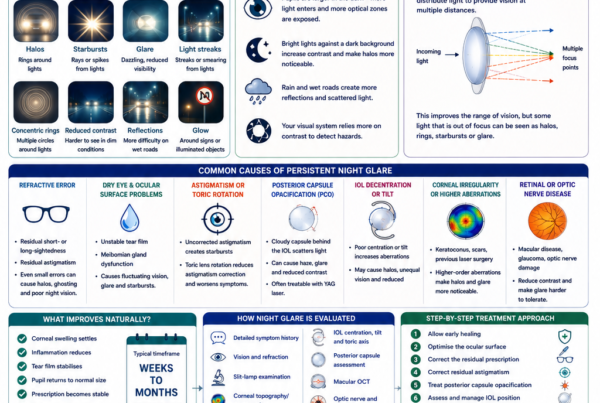
Dysphotopsias are unwanted visual phenomena such as:
- Halos
- Glare
- Starbursts
- Light streaks
- Rings
- Arcs
- Ghost images
Both EDOF and multifocal lenses can produce these symptoms.
EDOF Is Not Automatically Halo-Free
Some newer non-diffractive EDOF lenses have been developed specifically to provide a more monofocal-like visual-disturbance profile.
However, other EDOF lenses use diffractive optics and may still produce noticeable halos.
The 2019 meta-analysis found more halos with EDOF than monofocal lenses, illustrating that EDOF lenses should not be presented as free from photic phenomena.
Direct EDOF-versus-Trifocal Evidence Is Mixed
The 2023 updated meta-analysis found no statistically significant overall difference in halos or glare between EDOF and trifocal groups.
The 2024 Cochrane review also found that both groups reported halos and glare, but the studies were too small and inconsistent to determine a meaningful difference.
Therefore, it is more accurate to say:
- Some EDOF designs may cause fewer visual phenomena than some trifocal lenses.
- This is not true for every EDOF lens.
- Individual experience varies considerably.
- No presbyopia-correcting lens can guarantee zero halos.
When Are Halos Most Noticeable?
Halos and glare are usually most evident:
- At night
- Around headlights
- Around streetlights
- With LED lighting
- In rain
- In dark restaurants
- When the pupil is larger
- During the early adaptation period
Which Lens Is Better for Night Driving?
EDOF May Be the More Conservative Premium Option
For patients who prioritise:
- Night driving
- Contrast
- Distance clarity
- Intermediate vision
- Reduced dependence on computer glasses
an EDOF lens may represent a useful compromise.
This is especially true for non-diffractive or more monofocal-like EDOF designs.
Multifocal Lenses May Affect Headlight Vision
Trifocal lenses may cause:
- Rings around headlights
- Starbursts
- Light scatter
- Difficulty with wet-road reflections
- Reduced low-contrast clarity
Many patients adapt and drive comfortably. Others remain conscious of these phenomena.
Lens Model Matters More Than the Label
A diffractive EDOF lens may produce more halos than a non-diffractive EDOF design.
A modern trifocal lens may perform better than an older multifocal model.
Your ophthalmologist should discuss data specific to the proposed lens rather than relying only on the category name.
Professional Night Drivers Need Careful Counselling
Additional caution may be appropriate for:
- Taxi and private-hire drivers
- Bus drivers
- Truck drivers
- Emergency-service drivers
- Pilots
- Maritime workers
- Security personnel working at night
For these patients, the quality of low-light distance vision may be more important than reading without glasses.
Which Lens Has Better Contrast Sensitivity?
What Is Contrast Sensitivity?
Contrast sensitivity is the ability to see objects that do not stand out clearly from the background.
It is needed to identify:
- A pedestrian in dark clothing
- A grey kerb
- Stairs in dim lighting
- Lane markings in rain
- A low-contrast face
- Pale printed text
- Objects in fog or haze
Multifocal Optics Can Reduce Contrast
When light is divided between several focal points, less light is available for each individual image.
This can reduce contrast under certain conditions, especially:
- Dim lighting
- Large pupils
- Low-contrast tasks
- Eyes with other visual limitations
EDOF May Preserve Contrast Better, but Not Always
The 2019 meta-analysis found better contrast sensitivity with EDOF lenses than with trifocal lenses, although EDOF contrast was still lower than with monofocal lenses in some comparisons.
The 2023 updated meta-analysis did not find a statistically significant overall contrast-sensitivity difference between EDOF and trifocal lenses.
The variation may result from:
- Different optical designs
- Different testing conditions
- Different pupil sizes
- Diffractive versus non-diffractive lenses
- Different light levels
- Small study populations
Contrast Matters More in Eyes With Existing Disease
A small contrast reduction may be tolerated by an otherwise healthy eye.
It may be more significant in patients with:
- Glaucoma
- Macular degeneration
- Diabetic macular disease
- Epiretinal membrane
- Optic-nerve damage
- Corneal scarring
- Irregular astigmatism
- Reduced retinal function
Which Lens Is More Forgiving of a Residual Prescription?
Both Require Accurate Measurements
Presbyopia-correcting lenses work best when the postoperative prescription is close to the intended target.
Residual errors may include:
- Short-sightedness
- Long-sightedness
- Astigmatism
Multifocal Lenses Are Generally Less Forgiving
A small refractive error may cause:
- Blurred distance vision
- Reduced near performance
- Halos
- Ghosting
- Reduced contrast
- Patient dissatisfaction
because the lens is already distributing light between different focal points.
Some EDOF Designs May Tolerate Small Errors Better
An elongated focal range can provide greater tolerance to small defocus errors.
However, this should not be interpreted as permission to accept poor measurements or significant residual astigmatism.
EDOF lenses can still perform poorly when:
- Astigmatism is not corrected.
- The ocular surface is unstable.
- The IOL power is inaccurate.
- The lens is decentered.
- The cornea is irregular.
How Does Astigmatism Affect the Decision?
Astigmatism Can Blur Vision With Either Lens
Corneal astigmatism can cause:
- Blur
- Ghost images
- Shadowed letters
- Glare
- Halos
- Reduced near vision
- Poor low-light quality
Toric Versions May Be Available
Depending on the lens platform, patients may receive:
- Toric EDOF lenses
- Toric trifocal lenses
- Toric hybrid lenses
Toric lenses are designed to correct regular corneal astigmatism.
Accurate Alignment Is Important
A toric IOL must remain aligned with the intended axis.
Rotation can reduce astigmatic correction and impair the performance of the presbyopia-correcting optics.
Irregular Astigmatism Is Different
A toric lens corrects regular astigmatism. It does not fully correct:
- Keratoconus
- Corneal scars
- Decentered previous laser treatment
- Significant higher-order aberrations
- Highly irregular corneal shape
These conditions may limit suitability for either EDOF or multifocal lenses.
What Is Mini-Monovision With an EDOF Lens?
One Eye Is Targeted Slightly Nearer
With EDOF mini-monovision:
- The dominant eye is usually targeted close to distance.
- The non-dominant eye is targeted for a small amount of short-sightedness.
The aim is to extend near function while retaining useful binocular distance and intermediate vision.
Potential Advantages
Mini-monovision may provide:
- Better phone vision
- Better reading ability
- Greater spectacle independence
- A broader binocular defocus range
- Less imbalance than full monovision
Potential Disadvantages
It may cause:
- Mild distance blur in one eye
- Reduced fine depth perception
- Difficulty in very dim light
- Adaptation symptoms
- Need for glasses for precise distance tasks
The amount of near targeting should be individualised.
A Contact-Lens Trial May Help
A preoperative monovision trial may help assess tolerance.
However, the simulation is imperfect because:
- The cataract remains present.
- Contact-lens optics differ from IOL optics.
- Dry eye may affect the trial.
- EDOF optics cannot be fully simulated by a standard contact lens.
Can Mini-Monovision Be Used With Multifocal Lenses?
It Is Less Common but Possible
Multifocal lenses already provide a dedicated near focus.
Some surgeons may still use a small refractive offset to strengthen near performance, but excessive monovision can:
- Reduce distance crispness
- Increase imbalance
- Make night vision more difficult
- Complicate neuroadaptation
The strategy depends on the specific lens and the patient’s priorities.
Who Is a Good Candidate for an EDOF Lens?
Patients Prioritising Distance and Intermediate Vision
An EDOF lens may suit patients who frequently perform:
- Computer work
- Driving
- Sports
- Cooking
- Shopping
- Presentations
- Dashboard viewing
- Social and household activities
Patients Willing to Use Reading Glasses Occasionally
The ideal EDOF candidate accepts that glasses may still be useful for:
- Small print
- Dim-light reading
- Long reading sessions
- Fine near work
Patients Concerned About Night-Vision Quality
An EDOF lens—particularly a suitable non-diffractive design—may appeal to patients who want:
- A broader range than a standard monofocal lens
- Strong intermediate vision
- Potentially fewer optical phenomena than a full multifocal strategy
However, zero halos cannot be guaranteed.
Patients Considering Mini-Monovision
EDOF lenses may work well with a small difference between the eyes when the patient understands the trade-off.
Who Is a Good Candidate for a Multifocal or Trifocal Lens?
Patients Strongly Motivated to Reduce Glasses Use
A trifocal lens may be preferable when the patient places high value on:
- Reading without glasses
- Phone vision
- Menu reading
- Computer vision
- Distance vision
- Broad spectacle independence
Patients With Healthy Eyes
The strongest candidates generally have:
- A healthy cornea
- A stable tear film
- Regular corneal topography
- A healthy macula
- A healthy optic nerve
- Reliable measurements
- Realistic expectations
Patients Willing to Accept Halos and Adaptation
A suitable patient understands that:
- Halos may occur.
- Glare may be noticeable.
- Dim-light contrast may be different.
- Adaptation may take weeks or months.
- Glasses may occasionally still help.
- A refractive enhancement may sometimes be required.
Who May Not Be Suitable for Either Lens?
Significant Macular Disease
Caution is required with:
- Age-related macular degeneration
- Epiretinal membrane
- Macular hole
- Diabetic macular oedema
- Vitreomacular traction
- Retinal-vein occlusion
- Previous macular surgery
Presbyopia-correcting IOLs cannot restore visual information that the retina is unable to process.
Moderate or Advanced Glaucoma
Glaucoma can reduce:
- Contrast sensitivity
- Peripheral vision
- Low-light performance
A lens that further reduces optical contrast may not be appropriate when the optic nerve is significantly damaged.
Significant Corneal Irregularity
Potential concerns include:
- Keratoconus
- Corneal scarring
- Irregular astigmatism
- Decentered LASIK
- Significant higher-order aberrations
- Unstable corneal shape
Uncontrolled Dry Eye
Dry eye can affect:
- Preoperative measurements
- IOL calculations
- Visual clarity
- Contrast
- Halo perception
- Postoperative satisfaction
The ocular surface should be treated and stabilised before final measurements whenever possible.
Unrealistic Expectations
Neither lens is ideal for a patient expecting:
- Perfect vision at every distance
- Guaranteed freedom from glasses
- Zero halos
- Immediate adaptation
- Identical vision to a healthy 20-year-old eye
- A guarantee that no enhancement will ever be needed
What About Mild Eye Disease?
Suitability Is Not Always All-or-Nothing
A small retinal or optic-nerve finding does not automatically exclude every EDOF or multifocal lens.
The decision depends on:
- Disease severity
- Stability
- Contrast sensitivity
- Visual-field function
- Future progression risk
- The specific lens design
- The patient’s visual priorities
EDOF May Sometimes Be Considered More Forgiving
Some EDOF designs may be considered in carefully selected eyes with mild abnormalities because they may distribute light less aggressively than a full multifocal lens.
However, an EDOF lens remains a presbyopia-correcting optic and may still reduce contrast or cause dysphotopsias.
A standard or enhanced monofocal lens may remain the safest option when ocular quality is compromised.
Previous LASIK, PRK or SMILE
Measurements Can Be Less Predictable
Previous corneal laser surgery changes the relationship between measured corneal curvature and the eye’s true optical power.
Modern formulas have improved accuracy, but residual refractive error remains more likely than in an untreated cornea.
The Corneal Optical Pattern Matters
Some post-LASIK patients have:
- Regular corneas
- Good centration
- Minimal higher-order aberrations
- Excellent optical quality
Others may have:
- Irregular astigmatism
- Decentered ablation
- Spherical aberration
- Night halos
- Dry eye
- Variable measurements
Either Lens Requires Careful Selection
An EDOF lens may sometimes be preferred when the cornea is sufficiently regular but maximum near performance is not essential.
A multifocal lens may be suitable in selected patients with excellent corneal quality and realistic expectations.
Required investigations may include:
- Corneal topography
- Corneal tomography
- Aberrometry
- Ocular-surface assessment
- Macular OCT
- Multiple lens-power calculations
How Important Is Dry Eye?
Dry Eye Can Mimic Lens Failure
Dry eye may cause:
- Blur
- Ghosting
- Glare
- Halos
- Fluctuating vision
- Difficulty reading
- Reduced contrast
These symptoms can resemble problems caused by the IOL itself.
Dry Eye Can Affect Preoperative Accuracy
An unstable tear film can alter:
- Keratometry
- Astigmatism measurements
- Corneal topography
- IOL power calculations
Treating the ocular surface before surgery improves the reliability of lens selection and counselling.
Postoperative Dryness Is Common
Cataract surgery and postoperative drops may temporarily worsen ocular-surface symptoms.
Vision should not be judged too early while the eye is still dry and inflamed.
What Is Neuroadaptation?
The Brain Must Learn to Use the New Optics
Presbyopia-correcting lenses provide the brain with optical information that differs from the natural lens.
The brain gradually learns to:
- Select the appropriate focal image
- Suppress competing images
- Ignore halos
- Adjust to new contrast patterns
- Combine the two eyes effectively
Adaptation Takes Time
The duration varies from:
- Days
- To weeks
- To several months
Improvement is commonly noticed as:
- The pupil normalises.
- Inflammation settles.
- Dryness improves.
- The prescription stabilises.
- Both eyes are treated.
- The brain becomes accustomed to the lens.
Neuroadaptation Is Not Guaranteed
A minority of patients remain dissatisfied despite:
- Good eye-chart acuity
- Correct lens position
- A healthy retina
- An accurate prescription
Persistent symptoms require a structured assessment rather than being dismissed as failure to adapt.
Why Might a Patient Be Dissatisfied?
Residual Prescription
Even small amounts of:
- Short-sightedness
- Long-sightedness
- Astigmatism
may reduce the performance of a presbyopia-correcting lens.
Dry Eye
An unstable tear film may cause fluctuating blur and halos.
Posterior Capsule Opacification
Clouding of the capsule behind the IOL may cause:
- Blur
- Glare
- Reduced contrast
- Halos
It can often be treated with YAG laser capsulotomy.
Lens Decentration or Tilt
Presbyopia-correcting optics generally perform best when well centred.
Macular or Optic-Nerve Disease
Subtle pathology may limit visual quality even when central acuity remains relatively good.
Inappropriate Lens Selection
A lens may be technically successful but poorly matched to:
- The patient’s occupation
- Night-driving needs
- Reading expectations
- Personality
- Tolerance for optical symptoms
How Should Dissatisfaction Be Assessed?
Do Not Assume the Lens Must Be Removed
The ophthalmologist should assess:
- Refraction
- Tear film
- Corneal topography
- Corneal tomography
- Astigmatism
- Lens centration
- Posterior capsule
- Macular OCT
- Optic nerve
- Pupil size
- Binocular function
Many problems can be improved without lens exchange.
Possible Treatments
Management may include:
- Lubricating drops
- Dry-eye treatment
- Glasses
- Contact lenses
- Laser vision correction
- Astigmatism correction
- YAG capsulotomy
- Treatment of retinal disease
- Additional time for adaptation
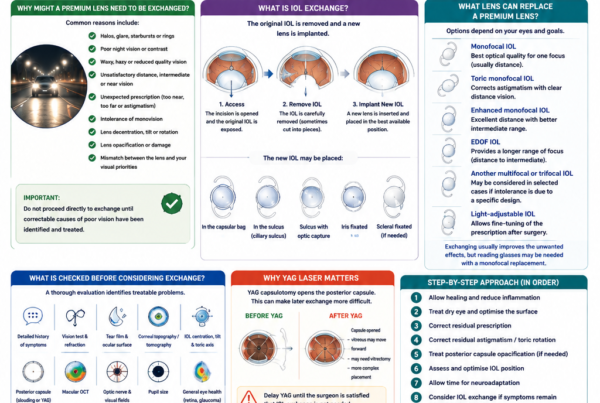
Can an EDOF or Multifocal Lens Be Exchanged?
Lens Exchange Is Possible
A lens may sometimes be exchanged for:
- A monofocal lens
- An enhanced monofocal lens
- A different EDOF lens
- A different multifocal lens
Exchange Is Another Intraocular Operation
Potential risks include:
- Capsular damage
- Vitreous loss
- Corneal injury
- Retinal tear or detachment
- Infection
- Residual prescription
- Need for an alternative lens position
YAG Capsulotomy Can Make Exchange More Complex
After YAG laser capsulotomy, the posterior capsule is open.
This may make subsequent lens exchange technically more difficult.
When lens intolerance is a serious possibility, the causes of dissatisfaction should be evaluated carefully before proceeding with YAG treatment.
Should Both Eyes Receive the Same Lens?
Bilateral EDOF Implantation
Using the same EDOF lens in both eyes may provide:
- Balanced optical quality
- Smooth binocular distance-to-intermediate vision
- Easier adaptation
- The option of mini-monovision
Bilateral Trifocal Implantation
Using the same trifocal design in both eyes may provide:
- Strong binocular near vision
- Better spectacle independence
- Consistent focal distances
- Improved binocular summation
Mix-and-Match Strategies
Selected patients may receive:
- An EDOF lens in one eye and a trifocal lens in the other
- Two EDOF lenses with different targets
- An enhanced monofocal in one eye and an EDOF lens in the other
- Different multifocal additions
The goal may be to combine:
- Better near vision from one eye
- Better intermediate or night quality from the other
However, mix-and-match strategies can also create:
- Different visual qualities between the eyes
- More complex adaptation
- Optical imbalance
- Less predictable subjective results
They should be planned carefully.
What Happens After the First Eye Is Operated On?
The Final Binocular Result May Not Yet Be Apparent
After first-eye surgery, the patient may have:
- A presbyopia-correcting lens in one eye
- A cataract in the other
- A large prescription difference
- Unequal colour perception
- Unequal contrast
- Different halos between the eyes
The final bilateral experience may be substantially better after the second eye is treated.
Significant Symptoms Should Still Be Investigated
Do not assume every problem will disappear after second-eye surgery.
Assessment is needed for:
- Severe blur
- Significant halos
- Lens decentration
- Corneal oedema
- Dry eye
- Macular pathology
- Unexpected refractive error
Cost Considerations
Both Are Premium-Lens Options
EDOF and multifocal lenses generally cost more than standard monofocal lenses.
Additional fees may relate to:
- The lens technology
- Advanced measurements
- Corneal imaging
- Astigmatism correction
- Laser-assisted procedures
- Postoperative enhancements
- Additional follow-up
More Expensive Does Not Mean More Suitable
A higher-priced lens is not automatically better for a particular patient.
The value depends on whether the lens provides the visual outcome that matters to that patient.
An expensive multifocal lens may be unsuitable for a frequent night driver with macular disease.
An EDOF lens may be disappointing to a patient whose overriding goal is reading very small print without glasses.
Questions to Ask Yourself
What Distances Matter Most?
Consider whether your daily life prioritises:
- Distance driving
- Computer work
- Phone use
- Reading books
- Fine near tasks
- Sports
- Night driving
- Musical instruments
How Do You Feel About Reading Glasses?
Ask yourself whether you would be comfortable using reading glasses for:
- Fine print
- Dim lighting
- Long reading sessions
If yes, EDOF may provide an attractive balance.
If avoiding reading glasses is your strongest priority, a trifocal lens may be more suitable.
How Do You Feel About Halos?
Consider whether halos would be:
- A minor inconvenience
- Acceptable in exchange for reduced glasses use
- A major concern because of night driving
- Unacceptable for your occupation
Questions to Ask Your Ophthalmologist
About Your Eye Health
- Is my cornea regular?
- Is my tear film stable?
- Do I have significant astigmatism?
- Is my macula healthy on OCT?
- Do I have an epiretinal membrane?
- Is my optic nerve healthy?
- Do I have glaucoma?
- Does previous laser surgery affect the choice?
About the Lens
- Is the proposed EDOF lens diffractive or non-diffractive?
- What is its best intermediate distance?
- How strong is its near vision?
- What percentage of patients still use reading glasses?
- How common are halos with this specific lens?
- Is a toric version available?
- Will mini-monovision be used?
- What will each eye be targeted for?
About the Backup Plan
- What happens if the result is not exact?
- Can glasses correct the problem?
- Is laser enhancement possible?
- What happens if I cannot adapt?
- Should YAG laser be delayed if exchange is being considered?
- Are enhancements included in the surgical package?
Frequently Asked Questions
Is EDOF Better Than Multifocal?
Not universally.
EDOF lenses generally prioritise distance and intermediate vision with functional near vision.
Multifocal or trifocal lenses generally provide stronger close-reading vision and greater near spectacle independence.
Which Lens Gives the Sharpest Distance Vision?
Both can provide excellent distance acuity.
Some patients find certain EDOF designs more monofocal-like in terms of visual quality, but this varies by lens and individual.
Which Lens Is Better for Computer Work?
Both can perform well.
EDOF lenses are particularly designed around a smooth distance-to-intermediate range.
The result depends on the distance of your monitor and the specific lens design.
Which Lens Is Better for Reading?
A trifocal lens generally provides stronger unaided near vision.
EDOF patients are more likely to require reading glasses for small print or prolonged close work.
Does EDOF Cause Halos?
Yes, it can.
The risk and intensity depend heavily on whether the EDOF design is:
- Diffractive
- Non-diffractive
- Refractive
- Hybrid
No EDOF lens guarantees zero halos.
Does Multifocal Always Cause Halos?
Not every patient is troubled by halos, but halos and glare are recognised effects of multifocal optics.
Many patients adapt and become less aware of them.
Which Is Better for Night Driving?
An EDOF lens may be the more conservative presbyopia-correcting option, particularly when a monofocal-like non-diffractive design is selected.
However, individual lens performance varies.
Will I Need Glasses With EDOF?
Possibly, especially for:
- Small print
- Dim lighting
- Prolonged reading
- Fine near work
Will I Need Glasses With a Multifocal Lens?
Possibly.
A multifocal lens reduces glasses dependence but cannot guarantee complete independence.
Can I Have EDOF in One Eye and Multifocal in the Other?
Yes, in selected cases.
This can widen the binocular visual range but may create different visual qualities between the eyes.
Is EDOF Suitable for Glaucoma?
It depends on:
- Disease severity
- Contrast sensitivity
- Visual-field loss
- Stability
- The specific EDOF design
Moderate or advanced glaucoma often favours a monofocal strategy.
Is Multifocal Suitable for an Epiretinal Membrane?
A significant epiretinal membrane may reduce image quality and make multifocal optics less suitable.
Macular OCT is important before selection.
Can I Have EDOF After LASIK?
Some post-LASIK patients are suitable, but careful corneal assessment and counselling about refractive uncertainty are required.
Can the Lens Be Removed?
Yes, but IOL exchange is another intraocular operation and carries additional risks.
It should not be considered a simple reversal.
A Practical Decision Guide
Consider an EDOF Lens if:
- Distance and computer vision are your main priorities.
- You want a broader range than a standard monofocal lens.
- You are willing to use readers for small print.
- Night vision is important.
- You prefer a smoother focal range.
- You are interested in mini-monovision.
- You accept that halos may still occur.
- Your eyes are suitable for a presbyopia-correcting lens.
Consider a Multifocal or Trifocal Lens if:
- Reading without glasses is a major priority.
- You want distance, intermediate and near vision.
- Maximum spectacle independence matters more than avoiding all halos.
- You have healthy corneas, maculae and optic nerves.
- You understand that low-light image quality may differ.
- You accept a period of neuroadaptation.
- You have realistic expectations.
Consider a Monofocal or Enhanced Monofocal Lens if:
- Crisp optical quality is your overriding priority.
- You drive extensively at night.
- You have significant retinal, optic-nerve or corneal disease.
- You do not mind using glasses.
- You want the most conservative and predictable optical strategy.
- You do not wish to accept the trade-offs of presbyopia-correcting optics.
The Bottom Line
EDOF and multifocal lenses can both provide excellent results after cataract surgery, but they emphasise different visual priorities.
An EDOF lens generally provides:
- Excellent distance vision
- Strong intermediate vision
- A smooth functional visual range
- Some near vision
- Potentially more forgiving visual quality with selected designs
Its main limitation is that reading glasses may still be needed for small print, dim lighting or prolonged close work.
A multifocal or trifocal lens generally provides:
- Excellent distance vision
- Strong intermediate vision
- Better close-reading vision
- Greater near spectacle independence
- A broader overall unaided range
Its main compromises may include:
- Halos
- Glare
- Starbursts
- Reduced low-light contrast
- Greater sensitivity to dry eye or residual prescription
- A need for neuroadaptation
The current evidence suggests that:
- Distance vision is broadly similar.
- Intermediate vision is generally good with both.
- Trifocal lenses provide stronger near vision.
- Both lens categories can cause halos and glare.
- The degree of visual disturbance depends greatly on the specific lens design.
- Evidence proving that every EDOF lens causes fewer halos than every trifocal lens is lacking.
The decision should not be based only on which lens is newer or more expensive.
The best lens is the one that most closely matches:
- The health of your eyes
- Your preferred working distances
- Your night-driving needs
- Your attitude towards reading glasses
- Your tolerance for optical symptoms
- Your expectations
For a patient who prioritises computers, dashboards, sport and night vision—and is willing to use occasional reading glasses—an EDOF lens may be an excellent option.
For a patient who prioritises phone use, reading and the greatest possible freedom from glasses—and accepts a greater possibility of halos—a trifocal lens may be more appropriate.
Careful examination, accurate measurements and realistic counselling are more important than the label printed on the lens box.
References
- Tavassoli S, Ziaei H, Yadegarfar ME, Gokul A, Kernohan A, Evans JR, et al. Trifocal versus extended depth of focus intraocular lenses after cataract extraction. Cochrane Database Syst Rev. 2024;7(7). doi:10.1002/14651858.CD014891.pub2. PMID: 38984608.
- Karam M, Alkhowaiter N, Alkhabbaz A, Aldubaikhi A, Alsaif A, Shareef E, et al. Extended depth of focus versus trifocal for intraocular lens implantation: an updated systematic review and meta-analysis. Am J Ophthalmol. 2023;251:52–70. doi:10.1016/j.ajo.2023.01.024. PMID: 36736751.
- Cho JY, Won YK, Park J, Nam JH, Hong JY, Min S, et al. Visual outcomes and optical quality of accommodative, multifocal, extended depth-of-focus, and monofocal intraocular lenses in presbyopia-correcting cataract surgery: a systematic review and Bayesian network meta-analysis. JAMA Ophthalmol. 2022;140(11):1045–1053. doi:10.1001/jamaophthalmol.2022.3667. PMID: 36136323.
- Liu J, Dong Y, Wang Y. Efficacy and safety of extended depth of focus intraocular lenses in cataract surgery: a systematic review and meta-analysis. BMC Ophthalmol. 2019;19(1):198. doi:10.1186/s12886-019-1204-0. PMID: 31477053.
- Webers VSC, Bauer NJC, Saelens IEY, Creten OJM, Berendschot TTJM, van den Biggelaar FJHM, et al. Comparison of the intermediate distance of a trifocal IOL with an extended depth-of-focus IOL: results of a prospective randomized trial. J Cataract Refract Surg. 2020;46(2):193–203. doi:10.1097/j.jcrs.0000000000000012.
- Monaco G, Gari M, Di Censo F, Poscia A, Ruggi G, Scialdone A. Visual performance after bilateral implantation of 2 new presbyopia-correcting intraocular lenses: trifocal versus extended range of vision. J Cataract Refract Surg. 2017;43(6):737–747. doi:10.1016/j.jcrs.2017.03.037.
- Cochener B, Boutillier G, Lamard M, Auberger-Zagnoli C. A comparative evaluation of a new generation of diffractive trifocal and extended depth of focus intraocular lenses. J Refract Surg. 2018;34(8):507–514. doi:10.3928/1081597X-20180530-02. PMID: 30089179.
- Zhong Y, Wang K, Yu X, Xin L, Yao K. Comparison of trifocal or hybrid multifocal-extended depth of focus intraocular lenses: a systematic review and meta-analysis. Sci Rep. 2021;11(1):6699. doi:10.1038/s41598-021-86222-1. PMID: 33758333.
- Guo Y, Wang Y, Hao R, et al. Comparison of patient outcomes following implantation of trifocal and extended depth of focus intraocular lenses: a systematic review and meta-analysis. J Ophthalmol. 2021;2021:1115076. PMID: 35003788.
- Pusnik A, Petrovski G, Lumi X. Dysphotopsias or unwanted visual phenomena after cataract surgery. Life. 2023;13(1):53. doi:10.3390/life13010053. PMID: 36676002.