Author: Dr Val Phua
Estimated reading time: 18 minutes
LASIK is one of the most established forms of laser vision correction, but it is also surrounded by myths.
Some myths make LASIK sound frightening:
- “The laser can easily make you blind.”
- “The flap can fall off at any time.”
- “Everyone develops permanent dry eye.”
- “LASIK always damages the cornea.”
Other myths make the procedure sound unrealistically simple:
- “LASIK is completely risk-free.”
- “Everyone achieves perfect vision.”
- “You will never need glasses again.”
- “The newest or most expensive laser must be the best.”
- “A thick cornea means LASIK is automatically safe.”
Neither extreme is accurate.
Modern LASIK can provide excellent unaided vision, rapid recovery and high patient satisfaction in appropriately selected patients. Long-term evidence supports a high level of safety within suitable treatment ranges. However, LASIK is still permanent elective surgery and can cause dry eye, glare, halos, residual refractive error, flap complications, infection and rare corneal ectasia.
The safest way to understand LASIK is to separate:
- What the operation can realistically achieve
- What it cannot prevent
- Which side effects are common but usually temporary
- Which complications are rare but potentially serious
- Why patient selection matters more than marketing claims
Myth 1: LASIK Is Just a Cosmetic Treatment
Fact: LASIK Is Real Corneal Surgery
LASIK is elective, but it is not merely a cosmetic surface treatment.
During LASIK:
- A thin corneal flap is created.
- The flap is lifted.
- An excimer laser permanently removes microscopic amounts of stromal tissue.
- The flap is repositioned.
The procedure changes the optical power and biomechanical structure of the cornea.
The tissue removed by the laser does not grow back, and the cornea cannot simply be returned to its original preoperative structure.
Patients should therefore approach LASIK with the same seriousness as any other elective surgical procedure.
Myth 2: Femto-LASIK Does Not Involve a Corneal Flap
Fact: Femto-LASIK Uses a Laser to Create the Flap
Femto-LASIK is sometimes advertised as “bladeless LASIK” or “all-laser LASIK.”
This means that a femtosecond laser creates the flap instead of a mechanical microkeratome blade.
It does not mean:
- No flap is created
- No corneal incision is made
- No tissue is removed
- No surgical instruments are used
- The procedure is reversible
Standard Femto-LASIK normally uses two lasers:
- A femtosecond laser to create the flap
- An excimer laser to correct the prescription
The laser-created flap can be more predictable in thickness and geometry than a mechanical flap, but flap-related risks remain.
Myth 3: LASIK Is Completely Painless
Fact: Surgery Should Not Be Sharply Painful, but Pressure and Early Discomfort Are Common
Anaesthetic eyedrops are used during LASIK.
Most patients do not experience sharp pain during the procedure, but they may feel:
- Pressure during femtosecond-laser docking
- Tightness around the eye
- Temporary dimming or loss of vision
- Water around the eye
- Mild awareness of the surgeon working
As the anaesthetic wears off, patients may experience:
- Burning
- Watering
- Grittiness
- Light sensitivity
- A sensation that something is in the eye
These symptoms are usually most noticeable during the first several hours and often improve after rest or sleep.
Severe or increasing pain is not considered a normal feature of routine recovery and requires prompt assessment.
Myth 4: LASIK Can Easily Make You Blind
Fact: Severe Permanent Visual Loss Is Rare, but It Is Not Impossible
Blindness is not a common LASIK outcome.
Most appropriately selected patients obtain good unaided vision and are satisfied with their result. In the FDA-supported PROWL studies, more than 95% of participants reported satisfaction with their postoperative vision.
However, it would also be incorrect to claim that serious visual loss can never occur.
Potential sight-threatening complications include:
- Severe infection
- Progressive corneal ectasia
- Significant corneal scarring
- Severe flap or interface inflammation
- Irregular astigmatism
- Delayed treatment of a complication
The appropriate message is not that LASIK commonly causes blindness or that it is completely risk-free.
The correct message is that severe permanent visual loss is uncommon, but patients must understand the possibility before undergoing elective surgery.
Myth 5: LASIK Is Guaranteed to Give Everyone 6/6 Vision
Fact: No Surgeon Can Guarantee a Particular Visual Result
LASIK can provide excellent unaided visual acuity, but the exact result varies.
Outcome depends on:
- The preoperative prescription
- Accuracy and stability of the refraction
- Corneal shape and thickness
- Tear-film quality
- Treatment centration
- Astigmatic alignment
- Pupil size
- Biological healing
- Retinal and optic nerve health
- Preoperative best-corrected visual potential
A patient whose eye never achieved normal vision with glasses because of amblyopia, retinal disease or optic nerve damage should not expect LASIK to create visual potential that was never present.
Even in a healthy eye, a small residual prescription may remain.
Some patients may see 6/6 on the eye chart but still notice:
- Dryness
- Glare
- Halos
- Reduced night-time contrast
- Fluctuating clarity
Eye-chart acuity is important, but it does not capture every aspect of visual quality.
Myth 6: LASIK Means You Will Never Need Glasses Again
Fact: LASIK Reduces Dependence on Glasses but Does Not Guarantee Lifelong Spectacle Independence
Some patients remain largely free from distance glasses for decades.
Others may later use spectacles for:
- Night driving
- Fine distance detail
- A small residual prescription
- Refractive regression
- Reading
- Computer work
- Cataract-related changes
The goal of LASIK is generally to reduce dependence on spectacles and contact lenses—not to guarantee that glasses will never again be useful.
A patient who previously required −7.00 D spectacles may still obtain substantial benefit even if −0.50 D of myopia later develops.
Occasional glasses should not automatically be considered a surgical failure.
Myth 7: LASIK Is Permanent, So Vision Can Never Change Again
Fact: The Corneal Treatment Is Permanent, but the Eye Continues to Age
LASIK permanently removes corneal tissue.
The laser effect does not simply disappear like a temporary medication.
However, vision may still change because of:
- Corneal remodelling
- Refractive regression
- Continued axial eye growth
- Presbyopia
- Cataract
- Hormonal change
- Diabetes-related fluctuation
- Dry eye
- Retinal or optic nerve disease
Long-term studies generally show good safety, but mild refractive change may occur, particularly after higher corrections.
LASIK permanently changes one part of the optical system. It does not freeze the entire eye at the age when surgery was performed.
Myth 8: LASIK Stops Myopia From Progressing
Fact: LASIK Corrects Existing Myopia but Does Not Shorten the Eyeball
Myopia is often associated with an elongated eyeball.
LASIK changes the corneal focusing power but does not:
- Shorten the eye
- Stop axial elongation
- Remove the biological tendency towards myopia
- Prevent retinal complications related to high myopia
If the eye continues to elongate, myopia can return even if the laser-treated cornea remains stable.
This is why LASIK is normally postponed when the prescription is still changing. The FDA identifies refractive instability—particularly in younger adults, pregnancy, breastfeeding or fluctuating diabetes—as an important reason to defer surgery.
Myth 9: LASIK Prevents Retinal Detachment
Fact: Retinal Risk From High Myopia Remains
A highly myopic patient may see clearly without glasses after LASIK, but the internal structure of the elongated eye has not become normal.
The lifetime risks associated with high myopia remain, including:
- Retinal holes
- Retinal tears
- Retinal detachment
- Myopic macular degeneration
- Myopic traction maculopathy
- Macular haemorrhage
Sudden flashes, a new shower of floaters or a curtain-like shadow requires urgent retinal examination regardless of whether LASIK was performed.
Clear unaided vision should never be mistaken for elimination of myopia-related retinal risk.
Myth 10: LASIK Prevents Presbyopia
Fact: The Natural Lens Continues to Age
Presbyopia is caused by age-related loss of flexibility in the natural crystalline lens.
LASIK reshapes the cornea. It does not make the natural lens younger or restore natural accommodation.
After approximately age 40, patients may notice:
- Difficulty reading small print
- The need to hold a phone farther away
- A need for brighter lighting
- Eye strain during near work
- Slower focusing between far and near
A patient may have excellent distance vision after LASIK while still requiring reading glasses.
This does not mean that the distance treatment has worn off.
Myth 11: LASIK Causes Presbyopia
Fact: LASIK May Reveal Presbyopia That Was Previously Hidden by Myopia
Before surgery, a short-sighted patient may read by removing their distance spectacles.
Their uncorrected myopia provides a near focal point.
After both eyes are fully corrected for distance:
- The myopia is removed optically
- The unaided near focal point disappears
- Existing presbyopia becomes more apparent
- Reading glasses may be required
LASIK has not necessarily accelerated natural-lens ageing.
It has removed the myopia that previously allowed the patient to see close objects without glasses.
Myth 12: Everyone Over 40 Is Too Old for LASIK
Fact: Age Alone Does Not Determine Suitability
Selected patients in their forties, fifties and beyond may remain suitable for LASIK.
More important considerations include:
- Natural-lens clarity
- Presence of presbyopia
- Prescription stability
- Corneal health
- Dry-eye status
- Glaucoma or retinal disease
- Expected time before cataract surgery
- Near-vision expectations
A patient aged 45 with a clear natural lens and stable prescription may be suitable.
A younger patient with abnormal tomography or severe dry eye may be unsuitable.
In older patients, early cataract may make cataract surgery more logical than reshaping the cornea in front of an ageing natural lens.
Myth 13: LASIK Causes Cataract
Fact: LASIK Does Not Normally Cause Age-Related Cataract
LASIK treats the cornea, while cataract develops within the natural crystalline lens.
The natural lens is not removed during LASIK.
Patients may still develop cataract later because cataract is a common age-related process.
Cataract symptoms can include:
- Increasing glare
- Poor night driving
- Faded colours
- Frequent prescription changes
- Reduced contrast
- Blurred vision that spectacles do not fully correct
A cataract-related myopic shift may sometimes be mistaken for LASIK regression.
Myth 14: LASIK Prevents Cataract
Fact: Cataract Can Still Develop Normally
LASIK neither causes nor prevents ordinary age-related cataract in most patients.
Cataract surgery can still be performed after LASIK, but intraocular-lens power calculation becomes more complex because LASIK changes the corneal curvature.
Patients should retain previous:
- Spectacle prescriptions
- Corneal measurements
- Laser treatment details
- Postoperative refractions
These records may assist future cataract planning.
Myth 15: Everyone Develops Permanent Dry Eye After LASIK
Fact: Temporary Dryness Is Common, but Persistent Severe Dry Eye Affects a Smaller Group
LASIK disrupts corneal nerves involved in:
- Corneal sensation
- Tear secretion
- Blinking
- Ocular-surface regulation
Dryness, burning, grittiness and fluctuating vision are therefore common during early recovery.
For many patients, symptoms improve over weeks or months as corneal sensation and tear regulation recover.
Persistent symptoms are more likely when there was pre-existing:
- Meibomian gland dysfunction
- Blepharitis
- Aqueous tear deficiency
- Contact lens intolerance
- Autoimmune ocular-surface disease
- Incomplete blinking
- Heavy screen exposure
Dry-eye disease is one of the most frequent postoperative concerns, but the severity and duration vary considerably.
Myth 16: LASIK Never Causes Dry Eye if the Eyes Felt Fine Before Surgery
Fact: New Symptoms Can Occur in Previously Comfortable Patients
A patient may have no obvious dryness before LASIK and still develop postoperative symptoms.
In the FDA-supported PROWL studies:
- Up to 28% of participants without preoperative dry-eye symptoms reported symptoms at three months.
- More than 95% were nevertheless satisfied with their postoperative vision.
- Less than 1% experienced major difficulty with ordinary activities from any single visual symptom.
These findings show that satisfaction and side effects can coexist.
Good preoperative comfort reduces concern but does not eliminate the possibility of postoperative dryness.
Myth 17: SMILE Cannot Cause Dry Eye
Fact: SMILE May Cause Less Early Dryness but Does Not Eliminate the Risk
SMILE avoids a broad hinged flap and generally preserves more of the anterior corneal nerve network.
Comparative reviews suggest that SMILE may provide:
- Less early dry-eye disturbance
- Faster corneal-sensation recovery
- No flap-related complications
However, SMILE still creates:
- An internal corneal cap
- A stromal lenticule
- A small incision
- Disruption of corneal nerves
SMILE can therefore still cause dryness, burning and fluctuating vision.
The choice between LASIK and SMILE should consider the entire eye and lifestyle rather than one risk alone.
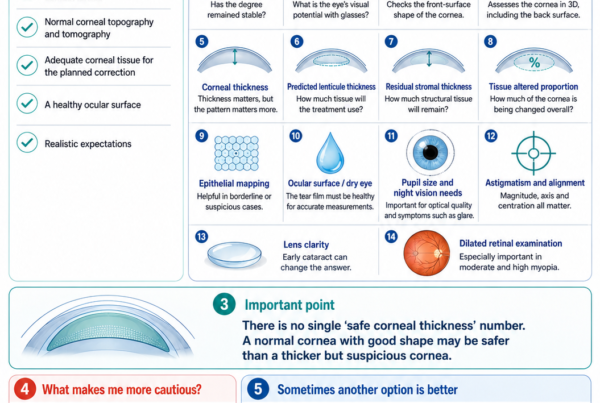
Myth 18: A Thick Cornea Means LASIK Is Automatically Safe
Fact: Thickness Is Only One Part of Corneal Safety
A thick cornea can still have:
- Abnormal tomography
- Early keratoconus
- Posterior corneal elevation
- Asymmetric thickness distribution
- Concerning epithelial compensation
- Excessive planned tissue removal
- Poor biomechanical characteristics
LASIK safety cannot be determined from a single central corneal-thickness number.
Assessment should include:
- Corneal topography
- Corneal tomography
- Corneal thickness distribution
- Epithelial thickness mapping
- Planned flap thickness
- Laser-ablation depth
- Residual stromal tissue
- Percentage of tissue altered
- Patient age and prescription
A structurally abnormal thick cornea may be less suitable than a thinner but regular and stable cornea.
Myth 19: A Thin Cornea Means No Refractive Surgery Is Possible
Fact: LASIK May Be Unsuitable, but Other Options May Remain
A relatively thin cornea may not have enough structural reserve for a LASIK flap and the planned excimer treatment.
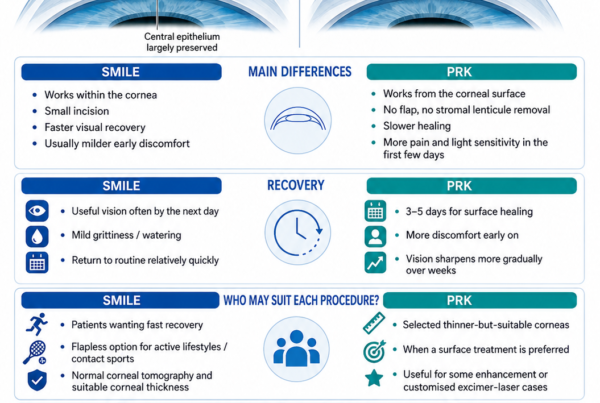
However, selected patients may still be suitable for:
- PRK
- TransPRK
- SMILE
- Implantable Collamer Lens surgery
The safest choice depends on:
- Corneal shape
- Degree of correction
- Total tissue affected
- Residual stromal tissue
- Internal eye anatomy
- Dry-eye status
A thin cornea with suspicious tomography may be unsuitable for every corneal laser procedure.
PRK should not be used simply to bypass an abnormal scan.
Myth 20: PRK Is Always Safe When LASIK Is Unsafe
Fact: PRK Avoids a Flap but Still Removes Corneal Tissue
PRK and TransPRK preserve more load-bearing stromal tissue because they do not create a LASIK flap.
They may therefore be safer for some relatively thinner corneas.
However, PRK still:
- Permanently removes stromal tissue
- Can cause corneal ectasia
- Can cause haze
- Requires epithelial healing
- Has a slower and more uncomfortable recovery
Final visual outcomes can be comparable to LASIK in appropriately selected patients, but PRK is not a universal escape route for keratoconus or structurally unstable corneas.
Myth 21: High Myopia Can Never Be Treated With LASIK
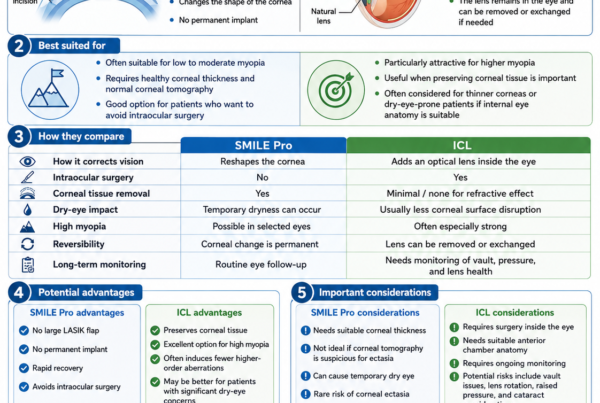
Fact: Some Highly Myopic Patients Are Suitable, but ICL May Offer a Better Safety Margin
High myopia is not an automatic contraindication.
Some patients with high myopia have:
- Thick, regular corneas
- Normal tomography
- Adequate residual stromal tissue
- Stable prescriptions
- Realistic expectations
Long-term studies have shown that LASIK can provide useful outcomes for selected high-myopia patients, although predictability, regression and enhancement concerns increase as the correction becomes larger.
An ICL may be preferable when:
- The required laser ablation is deep
- The cornea is relatively thin
- Night-vision quality is a major concern
- Preserving central corneal tissue is important
- Internal eye anatomy is suitable
The question is not whether LASIK can technically treat the prescription. It is whether LASIK provides the best risk-to-benefit balance.
Myth 22: Low Myopia Is Too Small to Treat
Fact: LASIK Can Treat Low Myopia, but Surgery May Not Always Be Necessary
Patients with low myopia can achieve good unaided vision after LASIK when the cornea and ocular surface are suitable.
However, the potential benefit should be weighed against the fact that all surgery carries risk.
A patient with −0.75 D who only occasionally uses glasses may decide that:
- Occasional spectacles are acceptable
- Contact lenses remain practical
- The surgical benefit is relatively modest
Being technically suitable does not mean that surgery is necessary.
Myth 23: The LASIK Flap Heals Completely and Disappears
Fact: The Flap Remains as a Permanent Corneal Interface
The flap edge seals and the flap becomes stable enough for ordinary activities.
However, the deeper interface does not regain the same structure or tensile strength as untouched corneal tissue.
This is why:
- The flap can sometimes be relifted for enhancement
- Epithelial ingrowth can occur beneath a reopened flap
- Severe trauma can rarely disturb the flap years later
The flap does not float freely and is not expected to fall off during ordinary daily life.
However, it also does not disappear.
Myth 24: The LASIK Flap Can Fall Off at Any Time
Fact: Ordinary Activity Does Not Normally Dislodge a Healed Flap
Normal activities such as:
- Blinking
- Walking
- Office work
- Sleeping normally
- Flying
- Gentle exercise
do not ordinarily cause the flap to fall off.
Early rubbing or direct trauma can displace the flap during the initial healing period.
Severe later trauma—such as a fingernail injury, sporting impact or substantial blow—can rarely disturb the interface years later.
This is why SMILE or PRK may be preferred for patients with repeated lifetime exposure to:
- Boxing
- Martial arts
- Rugby
- Wrestling
- Military training
- Occupational facial trauma
Myth 25: LASIK Is Reversible
Fact: The Laser-Removed Tissue Cannot Be Replaced
LASIK cannot be reversed in the same way that spectacles can be removed.
The flap can be lifted, but the stromal tissue removed by the excimer laser cannot simply be restored.
A later procedure can adjust the optical result but does not recreate the original corneal structure.
Possible later treatments include:
- LASIK enhancement
- PRK over the flap
- ICL implantation in selected eyes
- Cataract surgery
- Corneal cross-linking if ectasia occurs
These are additional procedures, not reversal.
Myth 26: LASIK Can Be Repeated as Many Times as Necessary
Fact: Every Additional Treatment Removes More Corneal Tissue
An enhancement may be possible when:
- The prescription is stable
- Corneal tomography is normal
- Adequate tissue remains
- Dry eye is controlled
- Cataract is excluded
- The residual prescription causes meaningful symptoms
An enhancement may be unsafe when there is:
- Insufficient residual tissue
- Abnormal tomography
- Corneal ectasia
- Significant dry eye
- Cataract
- Unstable refraction
- Reduced retinal or optic nerve visual potential
Relifting an old flap also increases the relevance of epithelial ingrowth and other interface complications.
Enhancement is a treatment option—not an unlimited guarantee.
Myth 27: Any Blurred Vision After LASIK Means the Prescription Has Returned
Fact: Many Conditions Can Cause Blur
Blur after LASIK may result from:
- Dry eye
- Residual prescription
- Refractive regression
- Presbyopia
- Cataract
- Corneal ectasia
- Flap problems
- Retinal disease
- Glaucoma
- Diabetes-related refractive fluctuation
Blur that clears after blinking often suggests tear-film instability.
Increasing glare and reduced contrast in an older patient may suggest cataract.
Progressive ghosting or irregular astigmatism requires corneal tomography to exclude ectasia.
An enhancement should not be planned until the actual cause has been identified.
Myth 28: Corneal Ectasia Is Either Extremely Common or Completely Preventable
Fact: Ectasia Is Uncommon but Important, and Screening Cannot Reduce the Risk to Zero
Corneal ectasia is progressive weakening and bulging of the cornea after refractive surgery.
Possible symptoms include:
- Increasing myopia
- Increasing or irregular astigmatism
- Ghosting
- Distorted vision
- Declining best-corrected vision
A systematic review found reported ectasia after LASIK, PRK and SMILE. The estimated rates differed among procedures, but direct comparison is limited by differences in the number of operations, follow-up duration, reporting and preoperative screening.
Risk is reduced by evaluating:
- Corneal tomography
- Corneal thickness distribution
- Residual stromal tissue
- Degree of myopia
- Patient age
- Epithelial mapping
- Biomechanical findings
- Keratoconus risk
- Habitual eye rubbing
No test or formula can promise that ectasia will never develop.
Myth 29: LASIK Always Causes Glare and Halos
Fact: Visual Symptoms Can Occur, but They Are Not Universally Severe or Permanent
Halos, glare, starbursts and ghosting may be noticed during early recovery.
Possible contributing factors include:
- Large pupils
- Dry eye
- Residual prescription
- High correction
- Optical-zone size
- Treatment decentration
- Higher-order aberrations
- Neural adaptation
In the FDA PROWL studies, up to 46% of participants without preoperative visual symptoms reported at least one visual symptom at three months, and halos were the most frequently reported new symptom. However, fewer than 1% reported major difficulty with ordinary activities from any single symptom, and more than 95% were satisfied with their vision.
This demonstrates why both exaggerated reassurance and exaggerated fear are inappropriate.
Myth 30: Large Pupils Automatically Rule Out LASIK
Fact: Pupil Size Is One Risk Factor, Not the Only Determinant
Large pupils in dim lighting may increase awareness of:
- Halos
- Glare
- Starbursts
- Ghosting
- Reduced night-time contrast
The effect also depends on:
- Treatment-zone size
- Degree of correction
- Centration
- Dry eye
- Pre-existing aberrations
- Laser profile
The FDA advises that pupils should be assessed under dim lighting and that patients with large pupils should receive appropriate counselling.
A large pupil may influence treatment planning and informed consent rather than automatically excluding surgery.
Myth 31: The Laser Can Easily Miss if You Move Your Eye
Fact: Modern Systems Use Fixation, Tracking and Safety Controls
During the excimer-laser treatment, the patient looks towards a fixation light.
Modern platforms may include:
- High-speed eye tracking
- Pupil tracking
- Iris registration
- Cyclotorsion compensation
- Automatic interruption if alignment is lost
Small involuntary movements are generally expected and accounted for.
Patients should still follow instructions and maintain fixation as steadily as possible.
No tracking system compensates for poor measurements, inappropriate patient selection or every possible movement. Technology improves precision but does not replace surgical judgement.
Myth 32: The Newest Laser Always Produces the Best Result
Fact: Screening and Planning Matter More Than Marketing Names
Newer technology may offer:
- Faster laser delivery
- More accurate tracking
- Refined treatment profiles
- Digital centration
- Improved flap creation
- Better workflow
However, the newest equipment cannot compensate for:
- An unstable prescription
- Abnormal tomography
- Untreated dry eye
- Incorrect refraction
- Inappropriate optical-zone planning
- Unrealistic expectations
Different customised profiles may produce subtle differences in predictability or higher-order aberrations, but several modern approaches provide excellent outcomes when used appropriately.
The best technology is the technology that safely matches the patient’s measurements and visual goals.
Myth 33: The Most Expensive Procedure Must Be the Best
Fact: Price Does Not Determine Individual Suitability
Cost may reflect:
- Laser and disposable costs
- Clinic location
- Surgeon experience
- Branding
- Follow-up arrangements
- Enhancement policies
- Diagnostic equipment
A higher price does not prove that LASIK is safer than SMILE, PRK or ICL for a particular eye.
Likewise, the lowest price should not be the primary reason for choosing an elective permanent procedure.
Important questions include:
- Is the cornea structurally normal?
- Is the ocular surface healthy?
- Why is this procedure recommended?
- What alternatives were considered?
- What follow-up is included?
- Who manages complications?
- What happens if an enhancement is required?
Myth 34: Anyone Who Cannot Tolerate Contact Lenses Is a Good LASIK Candidate
Fact: The Reason for Contact Lens Intolerance Matters
Contact lens intolerance caused by inconvenience, poor fit or lifestyle may support consideration of refractive surgery.
However, intolerance may also result from:
- Severe dry eye
- Meibomian gland dysfunction
- Allergy
- Blepharitis
- Corneal inflammation
- Contact lens-induced warpage
- Reduced corneal sensation
These conditions may also increase LASIK risk.
The ocular surface should be treated and corneal measurements repeated after contact lenses have been stopped for an appropriate period.
Myth 35: Pregnancy Has No Effect on LASIK Planning
Fact: LASIK Should Usually Be Postponed During Pregnancy and Breastfeeding
Hormonal and fluid changes can temporarily alter:
- Refraction
- Corneal curvature
- Corneal thickness
- Tear production
- Contact lens tolerance
Surgery performed during this period may be based on measurements that do not represent the patient’s stable long-term state.
The FDA identifies pregnancy and breastfeeding as circumstances associated with refractive instability and advises discussion of the additional risks.
LASIK can be reconsidered after:
- Pregnancy has ended
- Breastfeeding has stopped
- Hormonal changes have settled
- Repeat refraction and corneal scans are stable
Myth 36: Diabetes Automatically Means LASIK Is Impossible
Fact: Poorly Controlled Diabetes Is Unsuitable, but Selected Stable Patients May Be Considered
Uncontrolled diabetes can cause:
- Fluctuating prescription
- Delayed healing
- Corneal neuropathy
- Dry eye
- Infection risk
- Cataract
- Retinal or macular disease
These concerns may make surgery unsafe or unpredictable.
Selected patients with well-controlled diabetes may occasionally be considered when they have:
- Stable glucose control
- Stable refraction
- No significant retinopathy
- No macular oedema
- Healthy corneal sensation
- A stable ocular surface
- No major systemic healing problem
The decision must be individualised. FDA guidance identifies diabetes as a condition that may affect refractive stability and wound healing.
Myth 37: Autoimmune Disease Never Matters Because LASIK Only Treats the Eye
Fact: Systemic Disease Can Affect Corneal Healing and Dry Eye
Autoimmune and connective-tissue diseases may affect:
- Tear production
- Corneal epithelium
- Inflammation
- Wound healing
- Infection risk
- Medication requirements
Active disease or significant ocular-surface involvement may make LASIK unsuitable.
Stable and well-controlled disease may occasionally be considered after ophthalmic and medical assessment, but the decision should not be based on the prescription alone.
The FDA identifies diseases and medications that interfere with wound healing as important suitability concerns.
Myth 38: A Quick Screening Machine Can Confirm LASIK Safety
Fact: A Full Refractive Assessment Is Required
A reliable LASIK assessment should include more than:
- Spectacle degree
- Central corneal thickness
- A single topography image
Appropriate testing may include:
Refraction and Visual Acuity
- Manifest refraction
- Cycloplegic refraction when indicated
- Best-corrected visual acuity
- Assessment of prescription stability
Corneal Assessment
- Topography
- Tomography
- Pachymetry distribution
- Posterior corneal elevation
- Epithelial thickness mapping
- Tissue calculations
- Biomechanical testing where appropriate
Ocular-Surface Assessment
- Tear-film stability
- Corneal staining
- Meibomian glands
- Blepharitis
- Allergy
- Eyelid closure
Internal Eye Examination
- Eye pressure
- Optic nerve
- Natural-lens clarity
- Dilated retinal assessment when indicated
The purpose is not to find a way to approve the procedure. It is to identify when LASIK should not be performed.
Myth 39: If LASIK Is Unsuitable, There Are No Other Options
Fact: Several Alternatives May Be Considered
Depending on the reason LASIK is unsuitable, alternatives may include:
SMILE
May be considered when avoiding a flap and reducing early corneal-nerve disruption are priorities.
PRK or TransPRK
May be considered when avoiding a flap or preserving more load-bearing tissue is important.
Implantable Collamer Lens
May be considered for high myopia, thin corneas or when excessive corneal tissue would otherwise be removed.
Cataract Surgery
May be more appropriate when the natural lens is already causing glare, blur or prescription change.
Spectacles or Contact Lenses
Remain safe and effective options for many patients.
Being unsuitable for LASIK does not represent failure. It means another option provides a better safety margin.
Myth 40: LASIK Is Either Perfect or Terrible
Fact: LASIK Has High Satisfaction but Real Limitations
LASIK outcomes cannot be accurately represented by two extremes:
- “Everyone gets perfect vision with no side effects.”
- “LASIK is dangerous and ruins people’s eyes.”
The evidence is more balanced.
Most properly selected patients report high satisfaction and substantial reduction in dependence on corrective lenses.
Some experience temporary dryness or visual symptoms.
A smaller number have persistent difficulties, and rare serious complications can occur.
In the FDA PROWL studies:
- More than 95% of participants were satisfied with their postoperative vision.
- New visual symptoms were not uncommon.
- Up to 28% of previously asymptomatic participants reported dry-eye symptoms at three months.
- Fewer than 1% had major difficulty with usual activities from any one visual symptom.
Good informed consent must acknowledge all of these findings.
What LASIK Can Realistically Achieve
LASIK may:
- Correct myopia, hyperopia and regular astigmatism
- Reduce dependence on spectacles
- Reduce dependence on contact lenses
- Provide rapid functional recovery
- Improve convenience for sport and daily activities
- Provide long-lasting distance correction
LASIK cannot guarantee:
- Perfect vision
- Better visual quality than the patient’s best contact lens correction
- Lifelong spectacle independence
- No dry eye
- No glare or halos
- No future enhancement
- No reading glasses
- No cataract
- No glaucoma
- No retinal disease
- No future prescription change
Questions Patients Should Ask Before LASIK
Useful questions include:
- Is my prescription genuinely stable?
- Is my corneal tomography completely normal?
- How thick is my cornea?
- How much tissue will the laser remove?
- What will my residual stromal thickness be?
- Do I have any ectasia risk factors?
- Do I have dry eye or meibomian gland dysfunction?
- Are my pupils large in dim lighting?
- Why is LASIK preferable to SMILE, PRK or ICL?
- What result is realistic for my eyes?
- Will I still need reading glasses?
- What is the likelihood of an enhancement?
- How would an enhancement be performed?
- Who will manage complications?
- What symptoms require urgent attention?
- How will future eye pressure and cataract surgery be managed?
Frequently Asked Questions About LASIK Myths
Is LASIK Safe?
LASIK has a high safety record in appropriately selected patients.
It is not completely risk-free.
Is LASIK Painful?
Sharp pain should not occur during surgery, but pressure is felt during docking and burning or watering may occur afterwards.
Can LASIK Cause Blindness?
Severe permanent visual loss is rare but possible.
Does LASIK Last Forever?
The corneal tissue removal is permanent, but vision may change because the rest of the eye continues to age.
Will I Never Need Glasses Again?
Not necessarily.
Reading glasses, night-driving glasses or correction for a residual prescription may later be useful.
Does LASIK Prevent Presbyopia?
No.
Near focusing still declines as the natural lens ages.
Does LASIK Cause Cataract?
LASIK does not ordinarily cause age-related cataract.
Does LASIK Prevent Cataract?
No.
The natural lens remains inside the eye and continues to age.
Does Everyone Get Dry Eye?
Many patients experience temporary dryness.
Persistent severe symptoms affect a smaller group.
Is SMILE Completely Free From Dry Eye?
No.
SMILE may cause less early dryness than LASIK but does not eliminate the risk.
Can the Flap Fall Off?
The flap does not normally fall off during everyday life.
Early rubbing or severe later trauma can displace it.
Does the Flap Disappear?
No.
A permanent corneal interface remains.
Is LASIK Reversible?
No.
The laser-removed tissue cannot be replaced.
Can LASIK Be Repeated?
Sometimes, but only if the prescription is stable and adequate healthy corneal tissue remains.
Is a Thick Cornea Automatically Safe?
No.
Corneal shape, tomography and planned tissue removal are also essential.
Is a Thin Cornea Automatically Unsuitable for All Surgery?
No.
PRK, SMILE or ICL may remain possible, depending on the complete assessment.
Can High Myopia Be Treated?
Sometimes.
ICL may be a better option when laser treatment would remove excessive corneal tissue.
Does LASIK Stop Myopia Progression?
No.
The eyeball may continue to elongate.
Does LASIK Prevent Retinal Detachment?
No.
Myopia-related retinal risk remains.
Is LASIK Suitable After Age 40?
Possibly.
Presbyopia, cataract and near-vision goals require careful discussion.
Is the Newest Laser Always Best?
No.
Appropriate screening, measurements and planning are more important than the marketing name of the equipment.
Key Takeaway
LASIK myths arise from both excessive fear and excessive marketing.
The most important facts are:
- LASIK permanently reshapes the cornea.
- LASIK is not reversible.
- The flap remains as a permanent interface.
- Most suitable patients obtain excellent functional vision.
- No surgeon can guarantee perfect vision.
- Glasses may still be needed later.
- LASIK does not prevent presbyopia.
- LASIK does not prevent cataract.
- LASIK does not eliminate the retinal risks of myopia.
- Temporary dryness is common.
- Persistent severe dry eye is less common but possible.
- Halos and glare may occur, particularly during early recovery.
- Severe permanent visual loss is rare but possible.
- Corneal ectasia is uncommon but potentially serious.
- A thick cornea does not automatically mean LASIK is safe.
- An unsuitable cornea cannot be made safe simply by using a newer laser.
- Additional laser treatment is not always possible.
- SMILE, PRK, ICL, cataract surgery or no surgery may sometimes be safer.
The FDA’s patient-reported studies demonstrate the balanced reality: more than 95% of participants were satisfied with their postoperative vision, but new visual and dry-eye symptoms still occurred in some patients.
LASIK should therefore be presented neither as a miracle procedure nor as something that is inherently dangerous.
It is a powerful elective treatment whose success depends on:
- Careful patient selection
- Accurate measurements
- Appropriate technology
- Realistic expectations
- Thorough informed consent
- Proper postoperative care
The best refractive procedure is not the procedure with the strongest marketing claim. It is the option that achieves the patient’s visual goals while preserving the widest reasonable safety margin for the individual eye.
References
- US Food and Drug Administration. LASIK Quality of Life Collaboration Project: Patient-Reported Outcomes With LASIK Studies.
- US Food and Drug Administration. What Are the Risks and How Can I Find the Right Doctor for Me?
- US Food and Drug Administration. When Is LASIK Not for Me?
- US Food and Drug Administration. LASIK: Objective Patient Information and Approved Laser Guidance.
- Eydelman M, Hilmantel G, Tarver ME, et al. Symptoms and Satisfaction of Patients in the Patient-Reported Outcomes With LASIK Studies. JAMA Ophthalmology. 2017;135:13–22. PMID: 27893066.
- Taneri S, et al. Long-Term Outcomes of PRK, LASIK and SMILE. 2022. PMID: 34241701.
- Ikeda T, Shimizu K, Igarashi A, et al. Twelve-Year Follow-up of LASIK for Moderate to High Myopia. 2017.
- Reinstein DZ, et al. Long-Term Visual and Refractive Outcomes After LASIK for High Myopia and Astigmatism. 2016. PMID: 27163613.
- Moshirfar M, et al. Ectasia After Corneal Refractive Surgery: A Systematic Review. 2021. PMID: 34417707.
- Bohac M, et al. Incidence and Clinical Characteristics of Post-LASIK Ectasia. 2018. PMID: 30359155.
- Nair S, et al. Refractive Surgery and Dry Eye: An Update. 2023.
- Sahay P, Bafna RK, Reddy JC, Vajpayee RB, Sharma N. Complications of Laser-Assisted In Situ Keratomileusis. 2021. PMID: 34146007.
- Ahluwalia A, et al. Comparing Femtosecond LASIK and Small-Incision Lenticule Extraction. 2025. PMID: 40279261.
- Cheng SM, et al. Topography-Guided Versus Wavefront-Optimised LASIK for Myopia: A Meta-analysis. 2021. PMID: 34661478.
- Somani SN, Moshirfar M, Patel BC. Photorefractive Keratectomy. Updated 2025. PMID: 31751077.