uthor: Dr Val Phua
Estimated reading time: 23 minutes
Parents are often told that phones, tablets and computers are causing an epidemic of childhood myopia.
The real answer is more nuanced.
Current research suggests that greater digital-device use is often associated with myopia, but it has not proved that light from a screen directly makes the eye grow longer.
Screens may contribute to myopia risk because they encourage a combination of:
- Prolonged near work
- Very close viewing distances
- Long periods without looking into the distance
- Less outdoor time
- Reduced exposure to bright outdoor light
- Late-night routines and disrupted daily habits
However, screens are not the only form of near work.
Children may also spend long periods:
- Reading printed books
- Writing
- Drawing
- Completing worksheets
- Playing with small toys
- Studying music
- Performing other close visual tasks
A 2026 Singapore GUSTO birth-cohort study found that paper-based reading and writing at ages six and nine were associated with myopia at age nine, whereas reported screen time was not independently associated with myopia, axial length or refractive error after adjustment for factors including parental myopia and outdoor time. This finding argues against the simple claim that screens alone are uniquely responsible for childhood myopia.
Other studies have found associations between smartphone use and myopia-related measurements.
In the Myopia App Study, Dutch teenagers averaged nearly four hours of smartphone use on school days. Total smartphone time was not significantly associated with refractive error, but repeated periods of at least 20 minutes of uninterrupted use were associated with more myopic measurements, particularly among teenagers with low outdoor exposure. Because the study was cross-sectional, it could not prove that smartphone use caused the myopia.
Research therefore supports a balanced conclusion:
Screens may form part of a lifestyle that increases myopia risk, especially when they are used very close, continuously and instead of outdoor activity. However, screen use alone has not been established as a single direct cause of myopia.
Parents do not need to eliminate all educational or recreational screen use.
A more practical approach is to:
- Avoid extremely close viewing
- Break up prolonged near work
- Encourage children to look into the distance regularly
- Preserve substantial outdoor time
- Use good room lighting
- Keep screens out of bedtime routines
- Arrange appropriate eye examinations
- Begin evidence-based myopia control when progression is detected
The Quick Answer
Do Phones and Tablets Cause Myopia?
They may contribute to myopia risk, but the relationship is not proven to be directly causal.
Children who use screens heavily may also:
- Perform more total near work
- Hold devices closer
- spend longer without visual breaks
- Spend less time outdoors
- Have myopic parents
- Live in highly urbanised environments
- Have greater educational demands
These factors are difficult to separate in observational studies.
Is Screen Time Worse Than Reading a Book?
Not necessarily.
Both are near activities.
The aspects most likely to matter include:
- Viewing distance
- Duration
- Whether the task is continuous
- Amount of total near work
- Outdoor exposure
- The child’s age and genetic risk
A phone may be held closer than a book, while a printed worksheet may be used continuously for a longer period than a tablet.
The Singapore GUSTO study found an association between paper-based reading and writing and myopia but no independent association with reported screen time. This does not prove that screens are harmless; it shows that near-work behaviour cannot be reduced to one device category.
Are Phones Worse Than Televisions?
Phones and tablets are usually used at a shorter distance.
This produces:
- Greater focusing demand
- Greater convergence demand
- A greater tendency to hold the display extremely close
- More uninterrupted personal use
During a COVID-19 home-quarantine study, children using televisions and projectors for online learning had less myopic change than children using phones and tablets. However, the study was observational and took place during a period when many behaviours changed simultaneously, so it does not prove that changing devices alone prevents myopia.
How Far Should a Child Hold a Screen?
A practical target for handheld devices is approximately:
- At least 30 centimetres for a phone
- Approximately 40 centimetres or more for a tablet or book
- Farther away for a laptop or desktop monitor
The exact distance should be adjusted for:
- The child’s size
- Text size
- Posture
- Visual acuity
- Spectacle prescription
Objectively measured studies have found an association between time spent at working distances below 20 centimetres and myopia, although such studies cannot determine with certainty whether very close work causes the condition or whether myopic children adopt different behaviours.
How Often Should Children Take a Break?
There is no scientifically proven break interval that guarantees prevention of myopia.
A reasonable practical rule is:
- Interrupt near work every 20 to 30 minutes.
- Look across the room or out of a window.
- Relax the eyes for at least 20 seconds.
- Stand up and move when possible.
- Take a longer break after prolonged schoolwork.
The familiar “20-20-20 rule” is a useful reminder for comfort, but it should not be presented as a proven myopia treatment.
How Much Outdoor Time Is Recommended?
A practical goal is approximately two hours outdoors on most days when feasible.
Randomised school trials have shown that increasing outdoor time reduces the incidence of myopia and produces smaller average myopic shifts. The strongest benefit appears to be preventing or delaying myopia onset rather than reversing established myopia.
Does Reducing Screen Time Reverse Myopia?
No.
Reducing screen time does not shorten an already elongated eye.
It may:
- Reduce excessive near-work exposure
- Create more opportunities for outdoor activity
- Improve eye comfort
- Improve sleep routines
- Reduce dry-eye symptoms
A child with established progressive myopia may still require:
- Myopia-control spectacles
- Low-concentration atropine
- Dual-focus contact lenses
- Orthokeratology
- Another evidence-supported treatment
What Is Myopia?
Myopia, or short-sightedness, causes distant objects to appear blurred while nearer objects may remain clear.
In most children with progressive myopia, the eye grows longer than its ideal optical length.
Light entering the eye is then focused in front of the retina instead of directly on it.
Why Does Eye Length Matter?
As the eye becomes longer:
- The spectacle prescription becomes more negative.
- The retina and choroid are stretched over a larger internal surface.
- The lifetime risks of retinal, macular and glaucoma-related disease increase.
- The child has a greater chance of developing high myopia.
Screen use is relevant only if it influences the biological signals controlling this eye growth.
Does Looking at a Screen Temporarily Make Vision Blurry?
Yes.
After prolonged near work, some children experience:
- Temporary distance blur
- Slow refocusing
- Eye strain
- Headache
- Difficulty changing from near to distance
This may be caused by continued accommodative activity after the near task.
It is sometimes called near-work-induced transient myopia.
This is not necessarily the same as permanent axial myopia.
A 2026 experimental study found that 30 minutes of tablet use produced some short-term eye-strain symptoms and reduced tear-film stability. Changing the tablet’s colour temperature produced only a small difference in transient focusing behaviour, and the clinical significance was uncertain.
Does Temporary Blur Mean the Eye Has Grown?
No.
Axial elongation occurs over months and years.
A child who is briefly blurry after using a tablet may instead have:
- Accommodative fatigue
- Pseudomyopia
- Dry eye
- An inaccurate spectacle prescription
- Previously unrecognised myopia
Persistent distance blur requires an eye examination.
Why Might Screens Be Associated with Myopia?
Screens Are Near Work
A phone or tablet is commonly held closer than:
- A television
- Projected classroom material
- A desktop screen
- A distant classroom board
Closer viewing increases the accommodative and convergence demands placed on the visual system.
Smartphone-based reading has been shown to produce greater focusing demand than matched paper reading in experimental settings, although these measurements do not by themselves prove that smartphones cause axial elongation.
Screens Encourage Continuous Use
Digital content is designed to maintain attention.
Children may continue:
- Scrolling
- Gaming
- Messaging
- Watching short videos
- Completing online assignments
without natural stopping points.
In the Myopia App Study, episodes of at least 20 minutes of uninterrupted smartphone use were associated with more myopic refraction and a higher axial-length-to-corneal-radius ratio, particularly in teenagers with relatively low outdoor exposure. Total smartphone duration alone showed a weaker relationship.
This suggests that how a screen is used may matter as much as the total daily number of hours.
Phones May Be Held Extremely Close
Some children gradually bring a device closer when:
- Text is small
- They become absorbed in a game
- Their posture deteriorates
- They are already myopic
- Their glasses are not worn
- The room is dim
Objective monitoring found that myopic children spent more time at working distances below 20 centimetres than non-myopic children, while also receiving less high-intensity outdoor light.
However, other studies have found substantial individual variation and no consistent difference in handheld-device distance between myopic and non-myopic children.
Screens May Replace Outdoor Time
A day contains a limited number of discretionary hours.
Time spent indoors on a device may replace:
- Outdoor play
- Walking
- Sport
- Playground time
- Family outings
- Exposure to bright outdoor light
Outdoor time is one of the few behavioural interventions supported by randomised trials for reducing the onset of myopia.
A two-year cluster-randomised trial involving more than 6,000 children found less incident myopia, less myopic refractive change and less axial elongation in schools assigned additional outdoor time.
The protective effect of outdoor exposure appears to involve more than simply resting accommodation.
Possible mechanisms include:
- Higher light intensity
- Retinal dopamine signalling
- Different spatial visual environments
- Greater viewing distances
- Less continuous near work
- Circadian effects
Screens Are Part of a Larger Lifestyle Pattern
Heavy screen use may be associated with:
- High educational intensity
- Less physical activity
- Urban living
- Later bedtime
- Reduced sleep
- Less time outdoors
- Greater total near work
A study may identify screen time as a statistical risk factor without proving that the screen itself is the active biological cause.
What Does the Research Actually Show?
Studies Finding an Association
Some studies have found that children or teenagers with more digital-device exposure have:
- More myopic refraction
- Longer axial measurements
- A greater prevalence of myopia
- Faster progression during periods of intensive online learning
In the Myopia App Study, uninterrupted smartphone-use episodes were associated with myopic measurements, especially in teenagers with low outdoor exposure.
A 2026 repeated cross-sectional screening study of more than 33,000 kindergarten children found that weekend digital-screen use of at least two hours per day was modestly associated with newly detected myopia, while outdoor time of at least two hours per day was protective. Because screen exposure was reported by caregivers and measured at the same general period as myopia detection, causality cannot be assumed.
During COVID-19 home quarantine, a cohort of myopic children showed substantially faster refractive progression at a visit after quarantine than at the preceding visit. Greater screen use and reduced outdoor activity occurred at the same time, making it difficult to isolate one cause.
Studies Not Finding an Independent Association
Other studies have found no clear independent link once near work, outdoor exposure, parental myopia or other confounders were considered.
The 2026 GUSTO analysis followed reported screen exposure at ages two, three, six and nine and measured cycloplegic refraction and axial length at age nine.
It found:
- No significant association between screen time at any studied age and myopia at age nine
- No significant association between screen time and axial length
- An association between greater paper-based reading and writing and myopia
- Higher odds of myopia among children performing more than three hours of reading and writing per day at age nine
The study relied on parent-reported activities and had 471 children, so it does not settle the question. It does show why parents should focus on total visual behaviour rather than treating screens as the only form of near work.
A prospective Singapore study of adolescents also found no relationship between the reported duration of smartphone or tablet use and myopia one year later, although it identified associations with musculoskeletal symptoms and certain use patterns.
Why Do Studies Disagree?
Studies differ in:
- Children’s ages
- Ethnicity
- Myopia prevalence
- Definition of screen time
- Device types
- Educational use versus recreation
- Self-reported versus objective measurement
- Cycloplegic versus non-cycloplegic refraction
- Measurement of axial length
- Outdoor exposure
- Duration of follow-up
“Screen time” may combine:
- Television watched from several metres
- A phone held 15 centimetres away
- A desktop used at 60 centimetres
- Schoolwork
- Gaming
- Video calls
- Passive entertainment
These activities do not create identical visual environments.
Association Is Not the Same as Causation
A child with myopia may use a phone more because:
- Distance vision is blurred
- Near tasks remain easy
- Outdoor sport is less appealing
- The child already has an academically intensive routine
This is called reverse causation.
Researchers try to adjust for such factors, but observational studies cannot remove every source of bias.
Is Screen Time Uniquely Harmful Compared with Books?
The evidence does not show that digital near work is always more myopiagenic than printed near work.
What may matter more is:
- How close the material is held
- How long the task continues
- How many breaks occur
- Total hours of near work
- Outdoor exposure
- Whether the child is already genetically susceptible
A large study of Australian schoolchildren found that close reading below 30 centimetres and continuous reading for more than 30 minutes were associated with myopia, while total time in individual near-work activities showed weaker relationships.
This supports practical attention to distance and continuity, rather than demonising one particular medium.
Are Phones Worse Than Tablets?
Phones are often held closer because:
- Their displays are smaller
- Text and icons are smaller
- They are used with one hand
- They are highly portable
- They are often used while lying down
Tablets may allow a longer viewing distance but can still be held very close.
The risk is not determined by screen size alone.
Parents should consider:
- Actual viewing distance
- Font size
- Duration
- Posture
- Lighting
- Breaks
Are Laptops Better?
A laptop can usually be placed farther away than a phone.
However, a laptop used continuously for several hours still creates prolonged near or intermediate work.
Helpful adjustments include:
- Raising the screen
- Increasing text size
- Using an external keyboard
- Maintaining an appropriate distance
- Looking away regularly
- Avoiding hunching over the display
Are Desktop Computers Better?
A desktop monitor is usually the easiest digital display to position at a longer distance.
For prolonged schoolwork, it may be preferable to a phone because it allows:
- A larger display
- Larger text
- Better posture
- Greater viewing distance
- More stable positioning
This does not make unlimited desktop use harmless.
Are Televisions and Projectors Safer for the Eyes?
They are generally viewed from farther away and require less accommodation than handheld devices.
During the quarantine study, children using televisions and projectors for lessons had less myopic change than those using tablets and phones. This may reflect viewing distance, but the finding was not from a randomised device trial.
A television should not be considered a myopia-prevention treatment.
It may simply be a more distant display for content that does not require close interaction.
Does Using a Screen in the Dark Cause Myopia?
The evidence does not prove that one episode of screen use in darkness causes myopia.
Using a bright screen in a dark room may nevertheless cause:
- Glare
- Visual discomfort
- Squinting
- Headache
- Reduced blink rate
- Poor posture
- Closer viewing
Use moderate ambient lighting so that the screen is not the only bright object in the room.
A recent cross-sectional monitoring study found that higher ambient illumination during tablet use was associated with shorter axial length in preschool children. Because the study measured exposure and eye length at one point rather than prospectively altering lighting, it cannot establish that changing room brightness will prevent elongation.
Does Screen Brightness Cause Myopia?
No specific brightness setting has been proven to prevent or cause myopia.
The screen should be:
- Bright enough to read comfortably
- Not dazzling compared with the room
- Free from excessive reflections
- Adjusted to the child’s environment
Turning brightness to the lowest possible setting may make a child:
- Hold the screen closer
- Squint
- Strain to read
Turning it excessively high may increase glare and discomfort.
Does Night Mode Prevent Myopia?
No.
Night mode or warmer colour temperature may improve comfort for some children, particularly in the evening.
It has not been shown to prevent axial elongation.
In a small 2026 experiment, high versus low tablet colour temperature produced only a small difference in initial transient myopia after viewing, without a significant difference in most other visual-function or symptom measures.
Does Blue Light from Screens Cause Myopia?
Current human evidence does not establish blue light from ordinary phones or tablets as the mechanism causing axial childhood myopia.
Myopia is more plausibly related to:
- Eye-growth regulation
- Near-viewing behaviour
- Outdoor light exposure
- Genetics
- Age
- Environmental patterns
Blue-light-blocking spectacles have not been established as myopia-control treatment.
Can Screens Damage a Child’s Retina?
Ordinary screen exposure has not been demonstrated clinically to burn or permanently damage a healthy child’s retina under normal use.
This should not be confused with exposure to:
- Laser pointers
- High-powered light devices
- Direct sunlight
- Unregulated red-light devices
- Industrial or medical light sources
These may deliver much greater retinal energy and can cause injury.
Do Blue-Light Glasses Protect Against Myopia?
No.
Blue-light filters may change:
- Colour perception
- Screen appearance
- Subjective comfort
They do not provide the peripheral retinal defocus used by myopia-control lenses and do not replace:
- Outdoor time
- Appropriate working distance
- Myopia-control spectacles
- Atropine
- Contact-lens treatments
- Regular review
Screen Time, Dry Eye and Digital Eye Strain
Screens may cause discomfort even when they do not directly cause myopia.
Possible symptoms include:
- Dryness
- Burning
- Stinging
- Grittiness
- Watery eyes
- Intermittent blur
- Headache
- Eye fatigue
- Difficulty refocusing
- Neck or shoulder discomfort
Why Do Screens Cause Dryness?
During concentrated screen use, children may:
- Blink less frequently
- Blink incompletely
- Keep the eyes open wider
- Use air-conditioned rooms
- Sit near a fan
- Continue without breaks
A controlled study of school-aged children found that smartphone gaming reduced blink rate and increased dry-eye symptoms.
Cross-sectional paediatric studies have also linked longer digital-device use with poorer tear-film stability and dry-eye findings, although these designs cannot prove that screens were the only cause.
Can Dry Eye Make a Child Appear More Myopic?
An unstable tear film may cause fluctuating vision and variable measurements.
It does not usually produce true axial myopia, but it can:
- Reduce visual quality
- Cause squinting
- Affect autorefractor readings
- Make spectacle testing less consistent
- Increase screen-related discomfort
Practical Measures for Digital Eye Strain
Encourage the child to:
- Blink fully
- Take regular breaks
- Use adequate room lighting
- Avoid direct fan or air-conditioning flow
- Increase font size
- Keep the screen below or near eye level
- Maintain an appropriate distance
- Treat allergy or dry eye when present
Persistent symptoms require an eye examination.
Screen Time and Sleep
Evening screen use may delay bedtime because of:
- Engaging content
- Messaging
- Gaming
- Loss of time awareness
- Household routines
- Light exposure
Poor sleep has broader effects on:
- Attention
- Mood
- Learning
- Headaches
- General health
Evidence linking sleep directly to myopia is less consistent than the evidence supporting outdoor time.
A sensible family rule is to stop recreational screens before bedtime and keep devices out of the child’s sleeping area.
Does the Child’s Age Matter?
Infants and Toddlers
Myopia is not the only concern in very young children.
Excessive screen use may replace:
- Face-to-face interaction
- Physical play
- Language exposure
- Sleep
- Outdoor exploration
From an eye perspective, very young children should not spend prolonged periods fixated on a close display.
When screens are used:
- Keep sessions brief.
- Use them with an adult.
- Avoid using a phone as a continuous pacifier.
- Preserve physical and outdoor play.
Preschool Children
Preschool children may hold devices extremely close.
Parents should:
- Enlarge images and text
- Use a stand rather than allowing the child to hold the screen against the face
- Break up sessions
- Encourage outdoor play
- Attend vision screening
- Arrange assessment after a failed or incomplete screen
Primary-School Children
This is a common period for myopia onset.
Schoolwork may involve both:
- Printed materials
- Digital assignments
The goal is not to prevent the child from learning.
It is to create a healthier pattern:
- Appropriate viewing distance
- Alternating near tasks
- Regular outdoor time
- Timely eye checks
- Evidence-based control when myopia begins
Teenagers
Teenagers may accumulate many hours of:
- Schoolwork
- Messaging
- Social media
- Gaming
- Video entertainment
They are also more likely to use screens late at night and in long uninterrupted blocks.
The Myopia App Study suggests that continuous smartphone-use episodes and low outdoor exposure may be more relevant than total phone time alone.
Is There a Safe Daily Screen-Time Limit for Myopia?
No precise number of hours has been proven to separate safe from unsafe use.
Research uses many different thresholds, including:
- Two hours
- Three hours
- Four hours
- Total daily screen time
- Recreational screen time
- Smartphone time
- Uninterrupted episodes
The risk is unlikely to change suddenly at one exact minute.
A child who uses a screen for three hours with:
- Good distance
- Regular breaks
- Substantial outdoor time
does not have the same visual environment as a child using it for three hours:
- At 15 centimetres
- Without breaks
- In a dark room
- Instead of going outdoors
Educational Versus Recreational Screen Time
From an optical perspective, the eye does not know whether the child is:
- Reading a school document
- Messaging a friend
- Watching a video
- Playing a game
However, the behaviour may differ.
Educational use may involve:
- Longer sustained reading
- Smaller text
- Alternation with printed worksheets
- Less opportunity to stop
Recreational use may involve:
- Greater engagement
- Longer uninterrupted sessions
- Closer phone use
- Late-night exposure
Parents should consider the total pattern rather than assuming all educational screen time is harmless or all recreational use is dangerous.
Practical Screen Rules for Families
Rule 1: Protect Outdoor Time First
Schedule outdoor activity before free screen use when possible.
A useful target is approximately two hours outdoors on most days.
This can include:
- Walking
- Playground activity
- Cycling
- Sport
- Family outings
- Outdoor recess
- Reading outdoors in shade
The child does not need to stare at bright sunlight.
Ordinary outdoor light is substantially brighter than most indoor environments.
Randomised trials show that increased outdoor exposure reduces myopia onset.
Rule 2: Keep Near Work at a Reasonable Distance
Encourage:
- Phones at least approximately 30 centimetres away
- Books and tablets approximately 40 centimetres away when practical
- Computer monitors at arm’s length
- Televisions several metres away
Increase text size rather than bringing the screen closer.
Rule 3: Break Up Continuous Sessions
A practical routine is:
- Brief distance break every 20 to 30 minutes
- Longer physical break after approximately an hour
- Outdoor or active break between major homework blocks
The purpose is to interrupt continuous near fixation, not merely to look away for one second.
Rule 4: Avoid Extremely Close Use
Discourage:
- Phone held immediately in front of the face
- Screen use while curled up with the device against the eyes
- Reading with the head resting centimetres from the display
- Watching a phone while lying face-down
Rule 5: Use Adequate Lighting
Keep:
- The room comfortably lit
- The screen free from glare
- Printed material evenly illuminated
- Brightness matched to the environment
Rule 6: Use the Largest Practical Screen
For prolonged educational tasks, consider:
- Desktop monitor
- Laptop
- Larger tablet on a stand
rather than a small phone.
A larger screen allows:
- Larger text
- Greater distance
- Better posture
Rule 7: Preserve Sleep
Avoid unrestricted screens:
- In bed
- During the night
- Immediately before intended sleep
Charge devices outside the bedroom when practical.
Rule 8: Do Not Use Screen Reduction as Punishment for Myopia
Myopia is influenced by both genetic and environmental factors.
A child should not be blamed for developing it.
Family rules are more sustainable when they apply to:
- Parents
- Siblings
- Shared meals
- Bedtime
- Family activities
Rule 9: Monitor Vision
Ask the child whether:
- The board is clear
- Television subtitles are clear
- One eye sees differently
- Headaches occur during near work
- Vision remains blurred after a break
Watch for:
- Squinting
- Sitting closer
- Holding devices nearer
- Closing one eye
- Declining interest in distance activities
Rule 10: Treat Progressive Myopia Properly
Screen habits are not a substitute for evidence-supported myopia control.
What if the Child Is Already Myopic?
Once myopia is established, parents should focus on both:
- Behavioural support
- Clinical myopia control
Options may include:
- Defocus or lenslet spectacle lenses
- Low-concentration atropine
- Dual-focus soft contact lenses
- Orthokeratology
- Selected combination treatment
Outdoor time and good screen habits remain useful, but they may not provide sufficient control on their own.
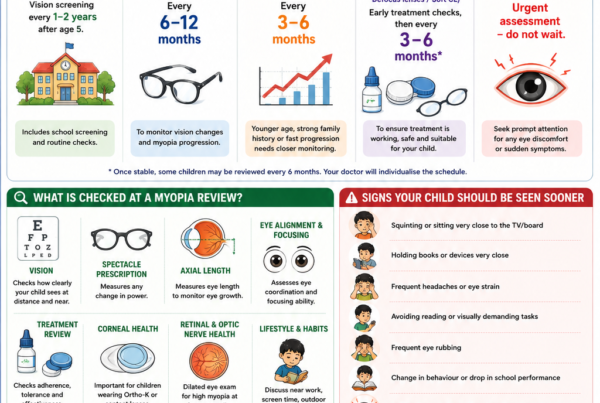
How Often Should Myopic Children Be Reviewed?
A child receiving myopia-control treatment is commonly reviewed approximately every six months.
Assessment may include:
- Visual acuity
- Refraction
- Axial length
- Corneal health
- Treatment adherence
- Side effects
- Outdoor and near-work habits
Earlier review may be required when:
- Vision changes rapidly
- The child is very young
- Contact lenses have recently been fitted
- Atropine has recently started
- Side effects occur
- Progression remains fast
Does Reducing Screen Time Improve Myopia-Control Treatment?
Reducing excessively close, uninterrupted screen use may improve the child’s overall visual environment.
However, it should not be assumed to replace or multiply the biological effect of:
- Atropine
- Defocus lenses
- Orthokeratology
- Dual-focus contact lenses
Treatment response should be measured using refraction and, when available, axial length.
When Should a Child Have an Eye Examination?
Arrange an assessment when the child:
- Squints
- Sits closer than before
- Cannot see the board
- Holds devices extremely near
- Reports persistent distance blur
- Develops frequent headaches with visual tasks
- Closes one eye
- Has an eye turn
- Fails school screening
- Has two myopic parents
- Has rapidly progressing myopia
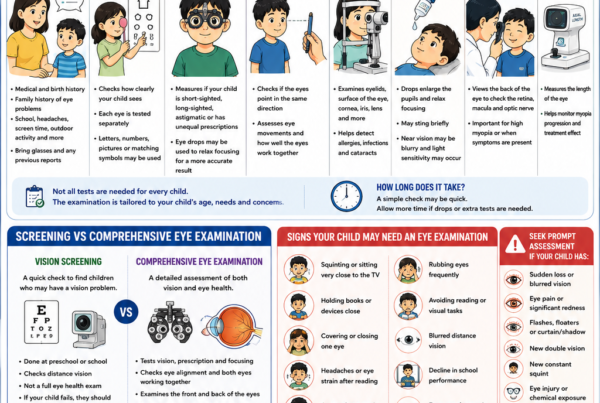
What Tests May Be Performed?
Depending on age, the assessment may include:
- Vision in each eye
- Cycloplegic refraction
- Eye-alignment testing
- Pupil examination
- Slit-lamp examination
- Dilated retinal examination
- Axial-length measurement
- Corneal topography when indicated
Common Myths
“Every Minute of Screen Time Makes the Eyes Longer”
False.
Myopia develops through complex genetic and environmental interactions.
“Screens Are the Only Reason Children Become Myopic”
False.
Important factors include:
- Parental myopia
- Age
- Outdoor exposure
- Educational intensity
- Total near work
- Urban environment
- Individual eye-growth biology
“Books Are Safe but Tablets Cause Myopia”
Not necessarily.
Both are near tasks.
The Singapore GUSTO study found an association with paper reading and writing but not screen time.
“Screen Light Burns the Retina”
Ordinary screens have not been demonstrated clinically to burn a healthy retina under normal use.
High-powered lasers, direct sunlight and unregulated light devices are different.
“Blue-Light Glasses Prevent Myopia”
False.
They are not established myopia-control lenses.
“Night Mode Prevents Myopia”
False.
It changes colour temperature, not the structural signals used in established myopia-control treatment.
“The 20-20-20 Rule Guarantees That Myopia Will Not Develop”
False.
It is a practical comfort reminder, not a proven preventive treatment.
“My Child Can Use a Screen All Day if the Brightness Is Low”
False.
Viewing distance, continuity, posture, outdoor time and total near work remain relevant.
“A Large Television Cannot Affect the Eyes”
A television is usually viewed from farther away, but excessive sedentary indoor time may still replace outdoor activity.
“My Child’s Myopia Will Improve if the Phone Is Taken Away”
Established axial myopia does not usually reverse.
“Glasses Make Screen-Related Myopia Worse”
Correct glasses do not weaken the eyes.
“Myopia-Control Glasses Mean Screen Habits No Longer Matter”
False.
Healthy visual and outdoor habits remain advisable.
“Only Recreational Screen Time Counts”
Educational screen time is still near work.
“A Child Who Can Read Small Phone Text Has Good Eyes”
One eye may compensate for the other, and a myopic child often sees close text clearly.
Frequently Asked Questions
How Many Hours of Screen Time Causes Myopia?
No exact number has been established.
Risk depends on the entire pattern of use.
Is Two Hours of Screen Time Safe?
Two hours is not a biological threshold.
Two hours of continuous close phone use differs from two hours divided into shorter sessions with outdoor breaks.
Should My Child Stop Using a Tablet for School?
Usually not.
Use practical measures:
- Larger text
- Appropriate distance
- Regular breaks
- Good lighting
- Outdoor time
- A larger display for prolonged work
Is Reading on Paper Better Than Reading on a Screen?
Not automatically.
Paper avoids glare and notifications, but it can still be held too close and read continuously.
Should Online Lessons Be Watched on a Television?
A television or projector may allow a longer viewing distance for passive content.
Interactive tasks may still require a computer or tablet.
Is a Laptop Better Than a Tablet?
For prolonged work, a well-positioned laptop or desktop may permit:
- Longer distance
- Better posture
- Larger text
A poorly positioned laptop can still be used too closely.
Should My Child Wear Glasses While Using a Screen?
Follow the prescribed wearing instructions.
A myopic child may remove distance glasses for close work in selected circumstances, but this should not be assumed without professional advice.
Myopia-control spectacles are usually intended for consistent wear.
Does Looking Out of a Window Count as a Break?
Yes, as a brief distance break.
It does not provide the same overall exposure as spending time outdoors.
Does Indoor Sport Protect Against Myopia?
Indoor exercise benefits general health.
The strongest preventive myopia evidence relates to outdoor exposure rather than exercise alone.
Does Sitting Near the Television Cause Myopia?
Sitting close may be a sign that the child is already myopic.
It does not prove that the television caused the condition.
Why Does My Child Hold the Phone So Close?
Possible reasons include:
- Myopia
- Uncorrected astigmatism
- Small text
- Habit
- Poor posture
- Visual impairment
- Desire for detail
Persistent close viewing warrants vision assessment.
Can Screens Cause Pseudomyopia?
Prolonged near work may contribute to temporary accommodative spasm or transient distance blur in susceptible children.
Cycloplegic refraction can distinguish this from established myopia.
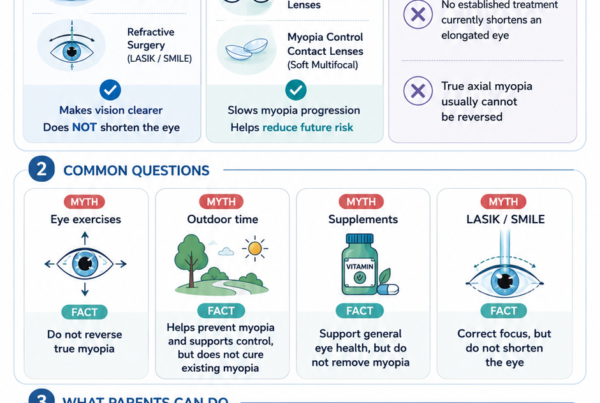
Will Eye Exercises Protect a Child Who Uses Screens?
No exercise has been shown to prevent axial elongation reliably.
Do Lubricating Drops Prevent Myopia?
No.
They may improve screen-related dryness.
Can Atropine Protect Against Heavy Screen Use?
Atropine may slow myopia progression but does not make unlimited close work advisable.
Can Screen Time Cause Astigmatism?
Ordinary screen use has not been established as a direct cause of corneal astigmatism.
Can Screen Time Cause an Eye Turn?
Screen use does not usually create permanent strabismus.
Prolonged near work may reveal symptoms in a child with:
- Poor convergence
- Intermittent exotropia
- Uncorrected hyperopia
- Another binocular-vision problem
A new or persistent eye turn requires assessment.
Can Screens Cause Headaches?
Yes, through:
- Eye strain
- Dryness
- Uncorrected prescription
- Poor posture
- Prolonged concentration
- Migraine triggers
- Sleep disruption
Headache may also have non-ocular causes.
Can Screens Cause Floaters?
No.
Ordinary screen use does not create vitreous floaters.
What if My Child’s Prescription Increased During Online Learning?
The increase may be related to:
- Natural progression
- Younger age
- Greater near work
- Reduced outdoor time
- Delayed eye review
- Inadequate myopia control
- Several factors together
The treatment plan should be reviewed rather than blaming one device alone.
When to Seek Prompt Eye Care
Screen-related tiredness is usually temporary.
Seek prompt assessment for:
- Sudden loss of vision
- Severe eye pain
- Marked redness
- Light sensitivity
- A new eye turn
- Sudden double vision
- New flashes or a shower of floaters
- A curtain or shadow
- Eye injury
- Chemical exposure
- A painful red eye during contact-lens wear
- Persistent vomiting or neurological symptoms with headache
These are not ordinary consequences of screen use and may indicate another eye or neurological condition.
A Parent’s Screen-and-Myopia Checklist
Daily Habits
- Is outdoor time protected?
- Is the device held at a reasonable distance?
- Is text large enough?
- Are long sessions interrupted?
- Is the room adequately lit?
- Are devices removed before bedtime?
- Is recreational use balanced with physical activity?
Signs of Possible Myopia
- Squinting
- Sitting closer
- Moving to the front of the classroom
- Holding screens unusually close
- Difficulty recognising distant faces
- Blurred board vision
- Frequent spectacle-prescription changes
Signs of Digital Eye Strain
- Burning
- Grittiness
- Watering
- Intermittent blur
- Headache
- Eye fatigue
- Neck discomfort
- Rubbing
Questions to Ask the Eye-Care Professional
- Is my child truly myopic?
- Was cycloplegic refraction performed?
- Is the axial length increasing?
- Is progression fast for the child’s age?
- Could dry eye or accommodative spasm be contributing?
- Does my child need myopia-control treatment?
- How frequently should the child be reviewed?
- What screen habits would be most useful to change?
- How much outdoor time should we aim for?
- Should the school be informed?
- Is the spectacle frame positioned correctly?
- Are contact lenses appropriate?
- Does the retina require examination?
The Bottom Line
Phones and tablets may contribute to childhood myopia risk, but screens have not been proved to be a single direct cause of short-sightedness.
The current evidence is mixed.
Some studies associate:
- Heavy screen exposure
- Uninterrupted smartphone sessions
- Very close working distances
- Low outdoor exposure
with myopia or more myopic measurements.
Other longitudinal evidence, including a 2026 Singapore GUSTO study, found no independent association between screen time and myopia after adjusting for other risk factors. In that study, paper-based reading and writing showed a clearer association.
The most plausible concern is therefore not simply the electronic display.
It is the visual and behavioural pattern around the display:
- Prolonged near work
- Close viewing
- Few breaks
- Reduced outdoor exposure
- Poor lighting
- Late-night use
- Less sleep and physical activity
Randomised trials provide strong evidence that increasing outdoor time reduces the onset of myopia.
There is less evidence that screen reduction alone can prevent or control established myopia.
Parents should:
- Preserve approximately two hours of outdoor activity on most days when feasible.
- Keep phones and tablets at an appropriate distance.
- Enlarge text instead of moving the screen closer.
- Break up prolonged near work.
- Use adequate ambient lighting.
- Avoid unrestricted screens near bedtime.
- Arrange timely eye checks.
- Use evidence-based myopia-control treatment when needed.
The most important message is:
Do not focus only on counting screen hours. A healthier visual environment combines reasonable viewing distance, regular breaks, substantial outdoor time and proper monitoring of the child’s vision and axial eye growth.
References
- Wu F, Sun CH, Htoon HM, et al. Longitudinal associations of reading, writing and screen time with myopia at age nine years among children from the GUSTO birth cohort. Acta Ophthalmol. 2026;104–e345. PMID: 41035125.
- Enthoven CA, Tideman JWL, Polling JR, et al. Smartphone use associated with refractive error in teenagers: the Myopia App Study. Ophthalmology. 2021;128:1681–1688. PMID: 34245754.
- Ma M, Xiong S, Zhao S, et al. COVID-19 home quarantine accelerated myopia progression in children aged seven to twelve years. Invest Ophthalmol Vis Sci. 2021;62:37. PMID: 34463719.
- Guan H, Yu NN, Wang H, et al. Impact of various types of near work and time spent outdoors on myopia in schoolchildren. Related Sunflower Myopia Asian Eye Epidemiology Consortium findings. PMID: 34142457.
- Wen L, Cao Y, Cheng Q, et al. Objectively measured near work, outdoor exposure and myopia in children. Br J Ophthalmol. 2020;104:1542–1547. PMID: 32075819.
- Ip JM, Saw SM, Rose KA, et al. Role of near work in myopia: findings in Australian schoolchildren. Invest Ophthalmol Vis Sci. 2008;49:2903–2910. PMID: 18579757.
- Xu X, et al. Time outdoors in reducing myopia: a school-based cluster-randomised trial with objective monitoring. Ophthalmology. 2022. PMID: 35779695.
- He M, Xiang F, Zeng Y, et al. Effect of time spent outdoors at school on myopia development among children in China. JAMA. 2015;314:1142–1148. PMID: 26372583.
- Wu PC, Tsai CL, Wu HL, Yang YH, Kuo HK. Outdoor activity during class recess reduces myopia onset and progression. Ophthalmology. 2013;120:1080–1085. PMID: 23462271.
- Wu PC, Chen CT, Lin KK, et al. Myopia prevention and outdoor light intensity in a school-based cluster-randomised trial. Ophthalmology. 2018. PMID: 29371008.
- Li SM, Ran AR, Kang MT, et al. Effect of text messaging parents on outdoor time to control myopia. JAMA Pediatr. 2022;176:1077–1083. PMID: 36155742.
- Chen J, et al. Time outdoors prevents myopia in hyperopic children, with weaker protection in premyopic children. Br J Ophthalmol. 2026. PMID: 41062253.
- Li M, Lanca C, Tan CS, et al. Near work, screen time, outdoor time and myopia in schoolchildren in the Sunflower Myopia Consortium. Acta Ophthalmol. 2022. PMID: 34142457.
- Toh SH, Coenen P, Howie EK, et al. Prospective longitudinal study of mobile touch-screen use and visual health in adolescents. Appl Ergon. 2020. PMID: 32174368.
- Chidi-Egboka NC, Jalbert I, Golebiowski B. Smartphone gaming induces dry-eye symptoms and reduces blinking in school-aged children. Eye. 2023;37:1342–1349. PMID: 35668140.
- Moon JH, Lee MY, Moon NJ. Association between video display terminal use and dry-eye disease in schoolchildren. J Pediatr Ophthalmol Strabismus. 2014. PMID: 24495620.
- Arya D, et al. Association of digital-device usage and dry-eye disease in schoolchildren. Indian J Ophthalmol. 2024. PMID: 38905463.
- Chen et al. Impact of tablet colour temperature on ocular and visual function in myopic children. Front Med. 2026. PMID: 42210963.
- Tanna et al. Objective measures of viewing behaviour in children during near tasks. Clin Exp Optom. 2022. PMID: 34538208.
- Tideman JWL, et al. Digital-device viewing behaviour in children. Ophthalmic Physiol Opt. 2024. PMID: 38379462.
- Bhandari KR, et al. Objective measures of near viewing and light exposure in schoolchildren during COVID-19. Optom Vis Sci. 2022. PMID: 35086121.
- Wang CY, et al. Cycloplegic autorefraction and modifiable behaviours in a decade-long kindergarten screening programme. Br J Ophthalmol. 2026. PMID: 41529935.
- Saw SM, Shankar A, Tan SB, et al. A cohort study of incident myopia in Singaporean children. Invest Ophthalmol Vis Sci. 2006;47:1839–1844. PMID: 16638989.
- Saw SM, Tong L, Chua WH, et al. Incidence and progression of myopia in Singaporean schoolchildren. Invest Ophthalmol Vis Sci. 2005. PMID: 15623754.
- Zhu Y, et al. Objective monitoring of tablet-related optical exposure and axial length in preschool children. 2026. PMID: 41604589.