Author: Dr Val Phua
Estimated reading time: 20 minutes
Cataract surgery is usually performed as a day procedure, and most patients can return home within a few hours of the operation. However, leaving the surgical centre does not mean that the eye has finished healing.
The small corneal incisions must seal, inflammation must settle, the surface of the eye must recover and the brain must adapt to the new intraocular lens. Vision may improve rapidly, but it can also fluctuate during the first few days or weeks.
Most patients recover smoothly following uncomplicated cataract surgery. Nevertheless, the speed of recovery differs between individuals. Some people see clearly by the following day, while others need several days or longer before their vision becomes consistently sharp.
Recovery may take longer if you have:
- A very dense cataract
- Corneal disease
- Dry-eye disease
- Glaucoma
- Diabetes
- Macular degeneration
- Diabetic retinopathy
- An epiretinal membrane
- Previous eye surgery
- Significant pre-existing astigmatism
- A complicated cataract operation
Appropriate postoperative care includes controlling inflammation, preventing infection, monitoring eye pressure, attending follow-up examinations and addressing any ocular conditions that may limit visual recovery.
This guide explains what you may experience during each stage of recovery, how to care for the operated eye and which symptoms require urgent medical attention.
How Long Does Recovery After Cataract Surgery Take?
Recovery Happens in Stages
There is no single day on which every patient can be considered completely recovered.
Different parts of the healing process occur at different speeds:
- The anaesthetic usually wears off within several hours.
- The dilated pupil may take several hours or occasionally longer to return to normal.
- Mild grittiness, watering and light sensitivity often improve over the first few days.
- Corneal swelling and inflammation usually reduce progressively.
- Vision may fluctuate during the first days or weeks.
- The spectacle prescription generally becomes more stable as the eye heals.
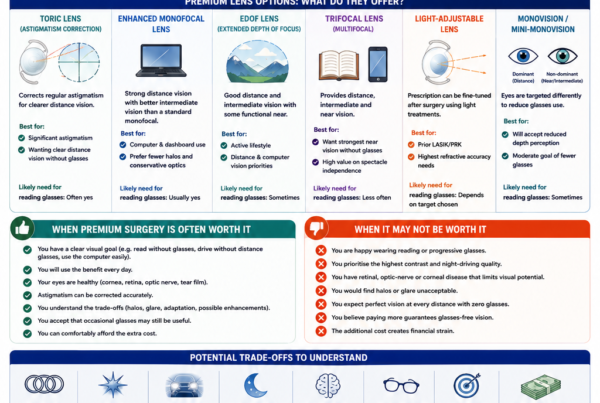
- Adaptation to multifocal, extended-depth-of-focus or monovision correction may take longer than the physical healing of the eye.
Although many patients resume light daily activities within one or two days, complete healing is often considered to take approximately four to six weeks after uncomplicated surgery.
Your personal recovery timeline may be shorter or longer.
A Typical Recovery Timeline
The First Few Hours
Immediately after surgery, your vision may be blurred because of:
- Pupil-dilating drops
- Anaesthetic medication
- Mild corneal swelling
- Ointment or medication on the eye
- Watering
- An eye pad or protective shield
You may notice that colours appear brighter or that the operated eye sees light with a cooler or slightly bluish tint.
The eye may feel numb initially. As the anaesthetic wears off, mild grittiness, watering or irritation may develop.
The First 24 Hours
Some patients notice a significant visual improvement by the following morning. Others still experience haze, glare or difficulty focusing.
Mild redness, watering and a foreign-body sensation can be expected. These symptoms should remain mild rather than becoming progressively worse.
A postoperative examination may be performed during this period, particularly if you have glaucoma, significant medical conditions, a complicated operation or other factors that require closer monitoring.
The First Week
Vision usually becomes clearer and more stable during the first week.
You may still notice:
- Mild fluctuation in vision
- Dryness or grittiness
- Light sensitivity
- Glare around lights
- Difficulty judging distances
- Imbalance between the operated and unoperated eyes
- Mild redness near the corneal incision
- Temporary focusing difficulty
Inflammation can still be present even when the eye feels comfortable. Continue all prescribed medication according to the schedule provided.
Postoperative complications are not always accompanied by obvious symptoms, which is one reason follow-up examinations remain important. In one study, several clinically important findings detected at a one-week review required changes to treatment even though many affected patients had few or no symptoms.
Two to Four Weeks
By this stage, many patients have returned to most normal activities.
The eye should generally feel more comfortable, although dry-eye symptoms or visual fluctuation may persist.
The vision may continue to improve as:
- Corneal swelling resolves
- Inflammation settles
- The tear film stabilises
- The pupil returns fully to its normal behaviour
- The brain adapts to the optical characteristics of the intraocular lens
Four to Six Weeks
The eye is usually largely healed following uncomplicated surgery.
A final refraction or spectacle assessment is often performed around this period, although modern small-incision surgery may produce stable measurements earlier in many patients.
A systematic review found no significant average difference between refraction measured at one week and four weeks after uncomplicated cataract surgery. However, a small proportion of patients had unstable astigmatic measurements at the earlier assessment, so the timing of new glasses should still be individualised.
Beyond Six Weeks
Persistent blurred vision, discomfort, redness or visual distortion should not simply be attributed to normal healing.
Possible explanations include:
- Dry-eye disease
- Residual spectacle power
- Corneal swelling
- Macular swelling
- Ongoing inflammation
- Posterior capsule opacification
- An intraocular lens positioning issue
- A retinal or optic-nerve condition
- Difficulty adapting to the chosen visual strategy
Your ophthalmologist may recommend additional examination or imaging to identify the cause.
What Is Normal After Cataract Surgery?
Blurred or Hazy Vision
Mildly blurred vision immediately after surgery is common.
The degree and duration of blur depend on factors such as:
- Cataract density
- Corneal health
- Surgical complexity
- Pupil dilation
- Tear-film quality
- Inflammation
- The health of the macula and optic nerve
- The intended refractive target
Should Vision Improve Every Day?
Recovery is not always perfectly linear.
The vision may seem clearer at one time of day and more blurred at another. Dryness, fatigue, eye-drop residue and changes in lighting can all affect visual quality.
However, a substantial or sudden deterioration in vision is not a normal fluctuation and requires prompt assessment.
Grittiness or a Foreign-Body Sensation
The eye may feel as though there is sand or an eyelash beneath the eyelid.
This can result from:
- The small corneal incision
- Temporary surface irritation
- Antiseptic preparation
- Postoperative eye drops
- Reduced tear-film stability
- Mild dryness
The discomfort should generally be mild. Severe pain, increasing pain or pain associated with worsening vision should be reported urgently.
Watering
Watering is a common response to surface irritation.
Paradoxically, a dry or unstable ocular surface can also cause excessive reflex tearing. The eye produces additional watery tears in response to irritation, but these tears may not remain on the surface long enough to provide stable lubrication.
Mild Redness
A small area of redness or a blood spot on the white part of the eye may occur.
This is often caused by:
- A small surface blood vessel breaking
- An anaesthetic injection
- The eyelid speculum
- Manipulation of the conjunctiva
A localised blood spot may initially look dramatic but usually clears gradually.
Increasing redness involving the whole eye, particularly when accompanied by pain or reduced vision, requires medical review.
Light Sensitivity
The pupil may remain enlarged for several hours after surgery.
The eye may also be temporarily more sensitive because the cataract is no longer filtering or scattering incoming light in the same way.
Sunglasses may improve comfort outdoors, but they do not need to be worn continuously indoors unless you find them helpful.
Brighter or Different Colours
Cataracts frequently develop slowly and can cause colours to appear dull, yellow or brown without the patient fully realising it.
After surgery, colours may look:
- Brighter
- Whiter
- Cooler
- More blue
- More vivid
The difference can be especially noticeable when only one eye has been operated on.
The brain usually adapts to the new colour balance over time.
Mild Eyelid Swelling
A small amount of eyelid puffiness may occur during the first day.
Marked swelling, difficulty opening the eye, increasing redness or discharge should be assessed.
Temporary Double Vision
Some patients experience temporary double vision or visual imbalance.
Possible reasons include:
- Residual anaesthetic effects
- Difference in prescription between the two eyes
- Poor vision in the unoperated eye
- Temporary changes in eye alignment
- Difficulty combining the images from each eye
- A monovision strategy that requires adaptation
Persistent or new double vision should be reported to your ophthalmologist.
Using Eye Drops After Cataract Surgery
Why Postoperative Eye Drops Are Important
Eye drops are used primarily to control inflammation and, depending on the surgeon’s protocol, reduce the risk of infection or macular swelling.
Your medication may include:
- A corticosteroid drop
- An antibiotic drop
- A combined antibiotic and steroid
- A non-steroidal anti-inflammatory drug
- Lubricating eye drops
- Eye-pressure-lowering medication
The medication regimen is not identical for every patient.
Patients with diabetes, uveitis, retinal disease, glaucoma, corneal disease or complicated surgery may require additional medication or a longer course.
Topical corticosteroids and non-steroidal anti-inflammatory drugs are widely used to control postoperative inflammation. Systematic reviews have found that topical NSAIDs can reduce postoperative inflammation and the risk of pseudophakic cystoid macular oedema, although the choice of treatment should consider the patient’s corneal health and individual risk factors.
How to Put in Eye Drops Correctly
Step 1: Wash Your Hands
Wash your hands thoroughly with soap and water.
Dry them with a clean towel before touching the bottle or the skin around the eye.
Step 2: Check the Bottle
Confirm:
- The name of the medication
- Which eye it is for
- The required frequency
- Whether the bottle needs to be shaken
Avoid using an old bottle unless your ophthalmologist has specifically instructed you to continue it.
Step 3: Create a Lower-Eyelid Pocket
Tilt your head backwards or lie down.
Look upwards and gently pull the lower eyelid down to create a small pocket.
Step 4: Instil One Drop
Hold the bottle above the eye and squeeze one drop into the lower-eyelid pocket.
Avoid touching the bottle tip against:
- The eye
- Eyelashes
- Eyelid
- Skin
- Fingers
One correctly placed drop is normally enough.
Step 5: Close the Eye Gently
Close the eyelids without squeezing tightly.
You may gently press the inner corner of the closed eye for approximately one minute. This can reduce drainage of medication into the nose and throat.
Step 6: Separate Different Drops
Leave approximately five minutes between different types of eye drops unless you have been given different instructions.
This prevents the second drop from immediately washing out the first.
What If You Miss a Dose?
Use the drop when you remember unless it is almost time for the next scheduled dose.
Do not repeatedly instil extra drops to compensate unless specifically instructed.
If you are uncertain, contact the clinic rather than stopping treatment.
Do Not Stop Steroid Drops Suddenly
Some anti-inflammatory drops are reduced gradually over several weeks.
Stopping them abruptly may allow inflammation to return in susceptible patients.
Follow the tapering schedule given by your ophthalmologist.
Lubricating Eye Drops
Preservative-free artificial tears may help relieve:
- Dryness
- Grittiness
- Intermittent blur
- Burning
- Tiredness
- A foreign-body sensation
Use them separately from medicated drops and follow your surgeon’s recommendations.
Dry Eyes After Cataract Surgery
Why Can Cataract Surgery Cause Dryness?
Cataract surgery can temporarily affect the ocular surface and tear film.
Possible contributing factors include:
- Small corneal nerves being affected by the incision
- Exposure of the ocular surface during surgery
- Antiseptic solutions
- Postoperative inflammation
- Frequent use of preserved eye drops
- Pre-existing meibomian gland dysfunction
- Reduced blinking during screen use
- Age-related tear-film changes
Studies have demonstrated temporary reductions in corneal sensitivity and tear-film stability following cataract surgery. Patients with pre-existing meibomian gland dysfunction may experience more pronounced postoperative dry-eye symptoms.
Symptoms of Postoperative Dry Eye
Dry-eye symptoms may include:
- Grittiness
- Burning
- Watering
- Intermittent blurred vision
- Tired eyes
- Light sensitivity
- Fluctuating vision when reading
- Temporary improvement after blinking
- Difficulty keeping the eyes open comfortably
How Long Does Dryness Last?
For many patients, dryness improves as the eye heals and the number of medicated drops is reduced.
Patients who already had dry-eye disease before surgery may require continuing treatment after the operation.
Persistent symptoms should be assessed rather than treated indefinitely without review. Other conditions can also cause discomfort or blurred vision.
Protecting the Operated Eye
The Eye Shield
Your surgeon may advise you to wear a transparent plastic shield, particularly while sleeping.
The shield is intended to reduce accidental rubbing or pressure on the eye.
Practices vary. A systematic review found considerable variation in postoperative eye-protection methods and limited evidence that one approach is universally best. Patients should therefore follow the instructions provided by their own surgeon.
How to Use the Shield
Keep It Clean
Clean the shield according to the instructions provided.
Allow it to dry before placing it over the eye.
Do Not Press It Against the Eyelid
Secure the shield gently with tape.
It should protect the eye without applying pressure.
Wear It for the Recommended Period
Some surgeons advise shield use only on the first night. Others recommend it for several nights, particularly for patients who rub their eyes during sleep.
Avoid Rubbing the Eye
Do not rub, press or squeeze the operated eye.
If the eye itches:
- Close the eyelids gently
- Use prescribed lubricants
- Wipe tears from the cheek rather than the eyelid margin
- Contact the clinic if itching is severe or persistent
Washing, Showering and Hair Care
Can You Wash Your Face?
You can usually clean your face carefully after surgery.
Avoid splashing water directly into the operated eye during the early recovery period.
Use a clean cloth to wipe around the eye without pressing on the eyelid.
Can You Shower?
Showering is generally possible, but take care to prevent:
- Soap entering the eye
- Shampoo running into the eye
- Forceful shower spray hitting the face
- Rubbing the eye with a towel
Keep the operated eye gently closed when washing around the face.
Washing Your Hair
Tilt your head backwards so that water flows away from your face.
You may prefer to have someone assist you during the first few days.
Avoid Contaminated Water
Do not expose the eye to potentially contaminated water, including:
- Swimming pools
- Hot tubs
- Lakes
- Rivers
- Seawater
Your surgeon will advise when swimming can be resumed.
Returning to Normal Activities
Walking
Gentle walking is usually safe soon after surgery.
Walk carefully because:
- The pupil may remain dilated
- Depth perception may be altered
- The two eyes may have different prescriptions
- Sedation may temporarily affect balance
- Steps and kerbs may be more difficult to judge
Reading and Screen Use
Reading, watching television and using a phone or computer do not normally damage the operated eye.
However, the eye may tire easily or become dry.
Use Screens Comfortably
Try to:
- Increase the font size
- Reduce glare
- Blink regularly
- Take short breaks
- Use lubricating drops when prescribed
- Avoid forcing the eye to focus when uncomfortable
Screen use does not wear out or displace the intraocular lens.
Bending
Gentle bending for ordinary activities is usually possible after modern small-incision cataract surgery.
Avoid prolonged straining, sudden exertion or bending that causes discomfort.
Follow any specific restrictions given by your surgeon, particularly after complicated surgery or combined eye procedures.
Lifting
Avoid heavy lifting during the early recovery period.
The definition of “heavy” depends on your health, occupation and type of surgery.
Light household objects can usually be handled carefully, but avoid:
- Holding your breath while lifting
- Straining
- Sudden jerking movements
- Carrying very heavy bags
- Lifting small children if you cannot do so safely
Exercise
Light Exercise
Walking and gentle movement can usually be resumed relatively early when you feel steady.
Strenuous Exercise
Running, intense gym workouts, heavy weight training and high-impact activity should be resumed gradually.
Wait for your surgeon’s approval if your activity involves:
- Heavy resistance
- Contact
- Rapid head movement
- Risk of falling
- Risk of being struck in the eye
Tennis, Padel and Racket Sports
The main concerns are exertion, rapid movement and accidental impact.
Return only after the eye has healed sufficiently and wear appropriate eye protection when there is a meaningful risk of injury.
Contact Sports
Boxing, martial arts, football and other contact sports should be avoided until your ophthalmologist confirms that it is safe.
Housework and Cooking
Light household activities can usually be resumed when you feel comfortable.
During the early recovery period, avoid:
- Dusty cleaning
- Shaking rugs
- Strong chemical fumes
- Steam or hot oil splashing towards the face
- Heavy buckets
- Vigorous scrubbing
Returning to Work
The appropriate timing depends on your occupation.
Office-Based Work
Some patients return within a few days if vision and comfort permit.
Physically Demanding Work
More time may be required when the job involves:
- Heavy lifting
- Dust
- Chemicals
- Outdoor debris
- Construction
- Machinery
- Risk of eye injury
Professional Driving or Precision Work
You may need formal confirmation that your vision is sufficiently stable.
Driving After Cataract Surgery
Do Not Drive Home After Surgery
You should not drive on the day of surgery.
Your vision, pupil size, depth perception and reaction time may be affected.
Sedation can impair judgement even when you do not feel obviously drowsy.
When Can You Drive Again?
You should resume driving only when:
- Your vision meets the legal requirement
- You can judge distance reliably
- Glare is manageable
- You are no longer affected by medication or sedation
- You can see adequately with both eyes together
- Your ophthalmologist has not advised you to avoid driving
Do not judge driving safety solely by how well you can read an eye chart.
You should also feel confident with:
- Peripheral awareness
- Traffic lights
- Pedestrians
- Night glare
- Lane position
- Judging approaching vehicles
Night Driving
Halos, glare and starbursts may be more noticeable at night during the early recovery period.
Allow time for visual adaptation and avoid night driving until you feel safe and comfortable.
Flying and Travelling After Cataract Surgery
Can You Fly?
Flying in a pressurised commercial aircraft is generally not prohibited after uncomplicated cataract surgery because no gas bubble is normally placed inside the eye.
However, travel plans should consider:
- The timing of follow-up appointments
- Access to urgent eye care
- Ability to use drops correctly
- Risk of lifting heavy luggage
- Dry aircraft-cabin air
- Whether the surgery was complicated
Different advice applies if a retinal procedure involving an intraocular gas bubble was also performed.
Travel Preparation
Bring:
- Sufficient eye drops
- A copy of your medication schedule
- Emergency contact information
- Sunglasses
- Preservative-free lubricants if advised
- Medication in your hand luggage
Avoid placing essential eye drops in checked baggage.
Vision During Recovery
Why Is Vision Clear One Moment and Blurred the Next?
Fluctuation may be caused by:
- Dryness
- Tear-film instability
- Residual inflammation
- Corneal swelling
- Eye-drop residue
- Fatigue
- Pupil-size changes
- Adaptation to the intraocular lens
Blur that clears after blinking often suggests a surface or tear-film component.
Residual Spectacle Power
Cataract surgery aims to place the eye close to a planned refractive target, but it does not guarantee zero spectacle power.
Residual prescription may include:
- Short-sightedness
- Long-sightedness
- Astigmatism
- Presbyopia
- A difference between the eyes
The final result depends on biometry, eye anatomy, corneal shape, lens position and healing.
Distance and Near Vision
Monofocal Lens Set for Distance
Distance vision may be clear, but reading glasses are usually required for near work.
Monofocal Lens Set for Near
Near vision may be useful without glasses, but distance glasses may be needed.
Monovision
One eye may be targeted for distance and the other for near or intermediate vision.
The brain may need time to adapt to the difference between the eyes.
Multifocal or Extended-Depth-of-Focus Lenses
These lenses are designed to provide a wider range of vision, but patients may initially notice:
- Halos
- Glare
- Starbursts
- Reduced contrast in dim light
- A need for brighter reading light
- Fluctuating visual quality
Some unwanted optical effects improve through healing and neuroadaptation. Dysphotopsias may appear as bright arcs, streaks, rings, halos or a temporal shadow. Persistent symptoms should be assessed to exclude dry eye, residual refractive error, posterior capsule opacification and other ocular causes.
Imbalance Between the Two Eyes
After the first eye has been operated on, there may be a large prescription difference between the eyes.
This is called anisometropia.
It may cause:
- Dizziness
- Headache
- Difficulty with depth perception
- Image-size difference
- Trouble wearing old glasses
- Difficulty walking on stairs
- Visual discomfort
Temporary options may include:
- Removing one spectacle lens
- Using a contact lens in the unoperated eye
- Wearing temporary glasses
- Proceeding with second-eye surgery when appropriate
Discuss the safest option with your ophthalmologist or optometrist.
When Will You Need New Glasses?
Do Not Rush to Make Expensive Glasses
Old glasses may no longer be suitable after surgery.
However, the operated eye may continue to change during healing.
Many ophthalmologists arrange the definitive spectacle prescription after several weeks, especially when:
- Corneal swelling is present
- Astigmatism is changing
- Dryness is affecting measurements
- The second eye will undergo surgery soon
- The operation was complicated
Although research suggests that refraction may stabilise within one or two weeks in many uncomplicated cases, a small proportion of eyes remain unstable at that stage. The timing of new glasses should therefore be based on the individual eye rather than a fixed rule.
Temporary Reading Glasses
Simple over-the-counter readers may be useful temporarily when both eyes have similar requirements.
They are less suitable when:
- The eyes have significantly different prescriptions
- Significant astigmatism is present
- One eye has limited vision
- You experience headaches or double vision
Follow-Up Appointments
Why Follow-Up Is Necessary
Follow-up examinations allow your ophthalmologist to assess:
- Visual acuity
- Eye pressure
- Corneal clarity
- Wound integrity
- Inflammation
- Intraocular lens position
- The retina and macula when indicated
- Response to medication
The schedule should be individualised according to the patient’s ocular conditions and surgical risk factors.
What Happens at the First Visit?
Your ophthalmologist may:
- Check vision
- Measure eye pressure
- Examine the corneal incision
- Assess inflammation
- Confirm the lens position
- Review your eye-drop technique
- Modify medication
- Reinforce activity and warning-sign advice
Later Visits
Subsequent reviews may assess:
- Resolution of inflammation
- Visual stability
- Macular health
- Dry-eye symptoms
- Need for glasses
- Readiness for second-eye surgery
- Adaptation to the selected lens strategy
Attend appointments even when the eye feels well.
Possible Problems During Recovery
Corneal Swelling
The cornea may be mildly swollen after surgery, causing:
- Hazy vision
- Halos
- Glare
- A misty appearance
- Worse vision in the morning
Most mild swelling improves as the endothelial cells restore normal corneal hydration.
More pronounced or persistent swelling may require additional medication or further assessment. Corneal oedema is a recognised cause of slow visual recovery after phacoemulsification.
Raised Eye Pressure
Eye pressure can rise during the early postoperative period.
Possible symptoms include:
- Eye pain
- Headache
- Nausea
- Vomiting
- Hazy vision
- Halos around lights
However, raised pressure may also cause no symptoms.
Patients with glaucoma, pseudoexfoliation or advanced optic-nerve damage may require closer monitoring.
Persistent Inflammation
Some inflammation is expected after surgery.
If inflammation remains excessive or returns while drops are being reduced, the eye may become:
- Red
- Achy
- Light-sensitive
- Blurred
- Watery
Do not restart, increase or stop steroid drops without medical advice.
Cystoid Macular Oedema
Cystoid macular oedema, also called pseudophakic macular oedema, occurs when fluid collects in the central retina.
It may cause:
- Blurred central vision
- Distorted vision
- Reduced contrast
- Difficulty reading
- Vision that initially improved and later worsened
It commonly becomes apparent several weeks after surgery rather than immediately.
Patients with diabetes, retinal vascular disease, uveitis or previous macular oedema may have a higher risk. Diagnosis is commonly confirmed using optical coherence tomography.
Posterior Capsule Opacification
The cataract itself cannot grow back because the cloudy natural lens has been removed.
However, cells can later cause clouding of the thin capsule behind the intraocular lens. This is called posterior capsule opacification, or PCO.
Symptoms may include:
- Gradual blurred vision
- Glare
- Halos
- Reduced contrast
- A return of cataract-like symptoms
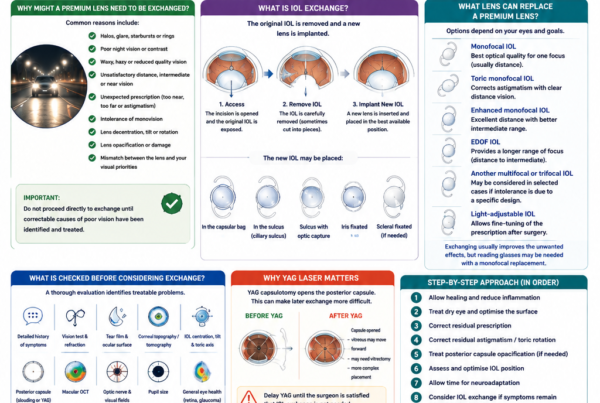
PCO can develop months or years after surgery. It is generally treated with a brief YAG laser capsulotomy when visually significant.
Posterior capsule opacification remains one of the most frequent longer-term causes of reduced vision after cataract surgery.
Dysphotopsia
Dysphotopsia refers to unwanted visual phenomena associated with the intraocular lens.
Positive Dysphotopsia
Symptoms may include:
- Halos
- Starbursts
- Light arcs
- Streaks
- Rings
- Flashes from external light sources
Negative Dysphotopsia
This is usually described as a dark crescent or shadow towards the outer side of the vision.
Many early symptoms improve with time and neuroadaptation, but persistent or disturbing effects require assessment.
Retinal Tear or Retinal Detachment
Cataract surgery does not prevent retinal disease.
Seek urgent assessment for:
- A sudden increase in floaters
- New flashes of light
- A dark curtain
- A missing area of peripheral vision
- Sudden visual loss
These symptoms are particularly important in patients with high myopia, previous retinal tears or retinal detachment in the other eye.
Endophthalmitis
Endophthalmitis is a rare but serious infection inside the eye.
Warning symptoms commonly include:
- Worsening vision
- Increasing eye pain
- Increasing redness
- Marked light sensitivity
- Eyelid swelling
- Discharge
Not every patient has severe pain, so worsening vision after surgery must be taken seriously even if the eye is not extremely painful.
Early recognition and urgent ophthalmic treatment are essential.
Warning Signs: When to Contact Your Ophthalmologist Urgently
Seek Urgent Medical Attention for:
- Severe or increasing eye pain
- Sudden or significant reduction in vision
- Vision that worsens after initially improving
- Increasing redness
- Thick or unusual discharge
- Marked eyelid swelling
- Persistent nausea or vomiting with eye pain
- A sudden shower of floaters
- New flashes of light
- A dark curtain or shadow
- Significant injury to the operated eye
- Chemical exposure
- Loss of part of the visual field
- Severe headache with blurred vision or halos
Do not wait for the next scheduled appointment when these symptoms occur.
General postoperative warning signs include worsening vision, increasing pain, redness, swelling and discharge.
Factors That Can Slow Recovery
A Dense Cataract
A very hard cataract may require more ultrasound energy during removal.
This can result in greater temporary corneal swelling.
Corneal Endothelial Disease
Conditions such as Fuchs endothelial dystrophy can reduce the cornea’s ability to clear fluid after surgery.
Dry-Eye Disease
An unstable tear film can cause discomfort and fluctuating visual quality even when the surgery itself was successful.
Diabetes
Patients with diabetes may be more prone to:
- Delayed surface recovery
- Dry-eye symptoms
- Macular swelling
- Diabetic retinopathy progression
- Fluctuating vision
Glaucoma
Eye-pressure changes and glaucoma medication may affect the postoperative plan.
Retinal and Macular Disease
Conditions such as:
- Epiretinal membrane
- Macular degeneration
- Diabetic macular oedema
- Retinal vein occlusion
- Myopic macular degeneration
may limit final visual acuity despite successful removal of the cataract.
Previous Eye Surgery
Recovery and refractive predictability may differ following:
- LASIK
- PRK
- Radial keratotomy
- Corneal transplantation
- Glaucoma surgery
- Retinal surgery
Complicated Surgery
Additional healing time may be needed if surgery involved:
- Weak zonules
- Pupil-expansion devices
- A capsular tear
- Vitreous loss
- Sutures
- An alternative lens position
- Combined glaucoma or retinal surgery
Frequently Asked Questions About Cataract Surgery Recovery
How Soon Should My Vision Improve?
Some patients notice clearer vision within hours. Others require several days.
The speed of improvement depends on the cornea, retina, optic nerve, cataract density, surgical complexity and intended refractive target.
Is It Normal for Vision to Be Worse the Next Morning?
Mild blur may occur because of corneal swelling, dryness, pupil dilation or medication.
However, substantially worse vision, particularly with pain or redness, should be assessed urgently.
Can I Sleep on the Operated Side?
Avoid direct pressure on the operated eye during the early recovery period.
Your surgeon may recommend sleeping on your back or the opposite side and using a protective shield.
Can I Cook After Cataract Surgery?
Light cooking is generally possible when you feel steady.
Avoid:
- Hot oil splashes
- Heavy pots
- Strong smoke
- Steam directly into the eye
- Straining or bending for prolonged periods
Can I Use My Phone?
Yes. Phone use does not damage the operated eye.
Increase the text size and take breaks if the eye becomes dry or tired.
Can I Read?
Yes, provided it is comfortable.
Reading does not loosen the lens or reopen the incision.
Can I Wear My Old Glasses?
You may try them, but they may no longer provide balanced vision.
Some patients are more comfortable without them or with one spectacle lens temporarily removed.
Can the New Lens Move?
The intraocular lens is normally positioned securely within the lens capsule.
Significant displacement is uncommon. Sudden blur, double vision or a visible edge of the lens should be assessed.
Can the Cataract Come Back?
The original cataract cannot return.
Posterior capsule opacification can produce similar symptoms later but is a different condition and can usually be treated with YAG laser.
Why Do I Still Need Glasses?
The intraocular lens is selected to achieve a particular visual target, but it may not eliminate:
- Presbyopia
- Astigmatism
- Residual short-sightedness
- Residual long-sightedness
- Small differences from the predicted outcome
The need for glasses also depends on the type of lens implanted.
When Can the Second Eye Be Operated On?
Timing depends on:
- Recovery of the first eye
- Refractive result
- General health
- Visual imbalance
- Surgeon preference
- Whether both eyes were planned for the same day
Your ophthalmologist will recommend an appropriate interval.
Supporting a Smooth Recovery
The Most Important Steps
To promote a safe recovery:
- Use all eye drops as directed.
- Wash your hands before touching the bottle or skin near the eye.
- Do not rub or press the eye.
- Wear the protective shield when instructed.
- Keep soap, shampoo and contaminated water away from the eye.
- Avoid heavy lifting and strenuous activity initially.
- Do not drive until your vision is safe and legal.
- Attend every scheduled follow-up.
- Report worsening pain, redness or vision urgently.
Be Patient With Visual Adaptation
Successful cataract surgery does not always mean that vision feels perfect immediately.
The eye needs time to heal, and the brain may need time to adapt to:
- A clearer retinal image
- Brighter colours
- A new refractive target
- Monovision
- Multifocal optics
- Differences between the two eyes
Most early symptoms improve progressively. Persistent or worsening problems deserve assessment rather than reassurance alone.
References
- National Institute for Health and Care Excellence. Cataracts in adults: management. NICE Guideline NG77. 2017. PMID: 29106797.
- Shoss BL, Tsai LM. Postoperative care in cataract surgery. Current Opinion in Ophthalmology. 2013;24(1):66–73. PMID: 23197268.
- Dhoot AS, Popovic MM, Lee S, El-Defrawy S, Schlenker MB. Eye protection following cataract surgery: a systematic review. Canadian Journal of Ophthalmology. 2023;58(3):179–186. PMID: 34863675.
- Kessel L, Tendal B, Jørgensen KJ, et al. Post-cataract prevention of inflammation and macular oedema by steroid and non-steroidal anti-inflammatory eye drops: a systematic review. Ophthalmology. 2014;121(10):1915–1924. PMID: 24935281.
- Lu Q, Lu Y, Zhu X. Dry eye and phacoemulsification cataract surgery: a systematic review and meta-analysis. Frontiers in Medicine. 2021;8:649030. PMID: 34307395.
- Oh T, Jung Y, Chang D, Kim J, Kim H. Changes in the tear film and ocular surface after cataract surgery. Japanese Journal of Ophthalmology. 2012;56(2):113–118. PMID: 22298313.
- Charlesworth E, Alderson AJ, de Juan V, Elliott DB. When is refraction stable following routine cataract surgery? A systematic review and meta-analysis. Ophthalmic and Physiological Optics. 2020;40(5):531–539. PMID: 32696501.
- Pusnik A, Petrovski G, Lumi X. Dysphotopsias or unwanted visual phenomena after cataract surgery. Life. 2023;13(1):53. PMID: 36676002.
- Maedel S, Buehl W, Findl O. Intraocular lens optic-edge design for the prevention of posterior capsule opacification after cataract surgery. Cochrane Database of Systematic Reviews. 2021. PMID: 34398965.
- Durand ML. Bacterial and fungal endophthalmitis. Clinical Microbiology Reviews. 2017;30(3):597–613. PMID: 28356323.
- Han JV, Patel DV, Squirrell D, McGhee CNJ. Cystoid macular oedema following cataract surgery: a review. Clinical & Experimental Ophthalmology. 2019;47(3):346–356. PMID: 30953417.
- Grzybowski A, Kanclerz P. Early postoperative intraocular pressure elevation following cataract surgery. Current Opinion in Ophthalmology. 2019;30(1):56–62. PMID: 30489361.
- McKellar MJ, Elder MJ. The early complications of cataract surgery: is routine review of patients one week after cataract extraction necessary? Ophthalmology. 2001;108(5):930–935. PMID: 11320024.