Author: Dr Val Phua
Estimated reading time: 17 minutes
LASIK and Photorefractive Keratectomy—commonly known as PRK—are established laser vision correction procedures used to reduce dependence on spectacles and contact lenses.
Both use an excimer laser to permanently reshape the cornea so that light focuses more accurately on the retina.
The main difference is how the surgeon reaches the corneal tissue being reshaped:
- LASIK creates a thin, hinged corneal flap. The excimer laser reshapes the tissue beneath the flap, which is then repositioned.
- PRK removes the thin surface epithelial layer without creating a flap. The excimer laser reshapes the exposed corneal surface, and the epithelium grows back over several days.
In suitable patients, LASIK and PRK generally provide similarly good final visual acuity, refractive accuracy and long-term safety. LASIK offers faster visual recovery and less early discomfort. PRK avoids flap-related risks and preserves more of the anterior corneal structure, but recovery is slower and corneal haze is a specific concern. [1–4]
Neither procedure is universally better.
The appropriate choice depends on:
- Corneal thickness and shape
- Degree of refractive error
- Dry-eye status
- Occupation and sporting activities
- Risk of eye trauma
- Previous eye surgery
- Healing characteristics
- Willingness to accept a slower recovery
- The need for customised treatment
- The possibility of future enhancement
LASIK vs PRK at a Glance
LASIK May Be Favoured When:
- Rapid visual recovery is a priority
- Minimal postoperative discomfort is important
- The cornea is sufficiently thick and regularly shaped
- Dry-eye disease is controlled
- There is a low risk of significant eye trauma
- A straightforward enhancement pathway is desirable
- Wavefront- or topography-guided correction is planned
PRK May Be Favoured When:
- Avoiding a corneal flap is important
- The cornea is relatively thin but remains suitable for surface ablation
- The patient participates in contact or combat sports
- Occupational eye trauma is a concern
- Previous corneal surgery makes a flap less desirable
- Surface-based customised treatment is preferred
- The patient can accept several uncomfortable days and a slower visual recovery
What Is LASIK?
LASIK stands for Laser-Assisted In Situ Keratomileusis.
Modern femtosecond LASIK generally involves two lasers:
- A femtosecond laser creates a thin, hinged corneal flap.
- The surgeon lifts the flap.
- An excimer laser reshapes the underlying corneal stroma.
- The flap is repositioned over the treatment area.
For myopia, the excimer laser removes more tissue centrally, flattening the cornea.
For hyperopia, treatment is applied more peripherally to make the central cornea relatively steeper.
For astigmatism, different amounts of tissue are removed along different meridians.
The LASIK flap usually remains in place without stitches. The surface seals quickly, but a permanent tissue interface remains within the cornea. FDA guidance describes LASIK as an effective but irreversible procedure that may cause undercorrection, overcorrection, glare, halos, dry eye or loss of lines of best-corrected vision in a small proportion of patients. [5,6]
What Is PRK?
PRK stands for Photorefractive Keratectomy.
During PRK:
- The corneal epithelium is removed.
- The excimer laser reshapes the tissue at the front of the corneal stroma.
- Medication such as mitomycin C may be applied when clinically appropriate.
- A soft bandage contact lens is placed over the cornea.
- The epithelium grows back beneath the contact lens over the following days.
No LASIK flap is created.
The excimer-laser treatment can use many of the same planning approaches available for LASIK, including:
- Standard treatment
- Wavefront-optimised treatment
- Wavefront-guided treatment
- Topography-guided treatment
- Aspheric treatment profiles
PRK has a longer and less comfortable initial recovery because the corneal surface must regenerate. Nevertheless, long-term corrected and unaided vision is generally comparable with LASIK in appropriately selected patients. [1,3,7]
What Is the Main Difference Between LASIK and PRK?
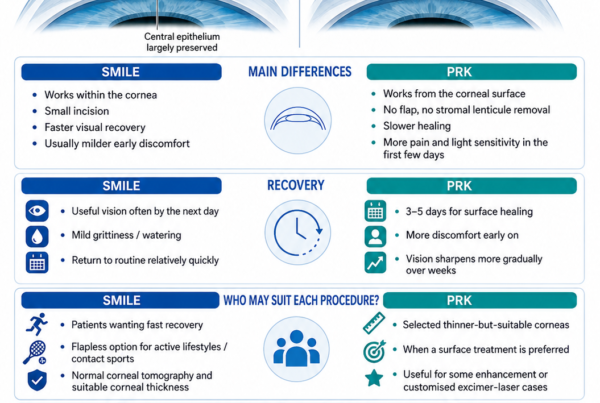
The main difference is whether a corneal flap is created.
LASIK
- A flap is created
- The laser treatment is placed beneath the flap
- The surface epithelium is largely preserved
- Vision recovers rapidly
- Early pain is usually mild
- Permanent flap-related considerations remain
PRK
- No flap is created
- The surface epithelium is removed
- The laser treatment is applied directly to the anterior stroma
- The epithelium must regrow
- Recovery is slower and more uncomfortable
- There is no permanent flap to displace
The excimer laser performs the refractive reshaping in both procedures.
Does PRK Remove More Tissue Than LASIK?
The excimer-laser ablation required to correct a given prescription may be similar when the same optical zone and treatment profile are used.
However, LASIK also requires the creation of a flap.
The flap tissue remains physically present, but most of it does not contribute fully to the strength of the deeper residual stromal bed. PRK does not require this additional flap-related separation.
PRK may therefore leave a thicker effective load-bearing stromal bed than LASIK for the same correction.
This does not mean that every thin cornea is suitable for PRK. PRK still permanently removes stromal tissue and can cause ectasia when performed in an unsuitable or structurally vulnerable cornea. [8,9]
Which Gives Better Final Vision?
For low-to-moderate myopia in properly selected patients, the final results are generally similar.
Studies comparing LASIK and PRK have found broadly comparable:
- Unaided distance visual acuity
- Best-corrected visual acuity
- Refractive accuracy
- Safety
- Long-term patient satisfaction
A Cochrane review found that LASIK provided faster recovery and less pain but that outcomes were similar approximately one year after surgery. A 2025 meta-analysis similarly found no significant overall clinical advantage of LASIK over PRK, apart from less early haze after LASIK. [1,4]
The quality of the result depends on more than the procedure name.
Important factors include:
- Accurate refraction
- Stable prescription
- Corneal topography and tomography
- Laser platform
- Treatment centration
- Optical-zone diameter
- Tear-film health
- Postoperative healing
- Compliance with medication and follow-up
Which Has Faster Visual Recovery?
LASIK generally has much faster initial visual recovery.
Many patients notice substantially clearer vision within hours and have functional vision by the following day.
PRK vision is usually blurred during the first several days because the epithelium is regenerating. Vision then improves progressively over the following weeks.
A typical functional pattern is:
LASIK
- Significant improvement within the first day
- Office-based work often possible within one to three days
- Fine visual quality may continue improving over several weeks
PRK
- Blurred vision during early epithelial healing
- Functional improvement over approximately one to two weeks
- Fluctuation may continue for several weeks
- Maximum clarity may take one to three months or longer, especially after higher corrections
Randomised and systematic-review evidence consistently shows faster early visual recovery after LASIK. [1,10]
Which Procedure Is More Painful?
PRK is more uncomfortable during the early recovery period.
The epithelium contains many nerve endings. Until it has regenerated, patients may experience:
- Burning
- Stinging
- Watering
- Light sensitivity
- A gritty or foreign-body sensation
- Difficulty opening the eyes
- Eyelid swelling
- Fluctuating vision
Discomfort is usually most noticeable during the first two to three days and improves as the epithelium heals.
A bandage contact lens protects the regenerating surface and is usually removed after the epithelium has closed.
LASIK commonly causes:
- Watering
- Mild burning
- Grittiness
- Light sensitivity
during the first several hours, but significant pain is less common. A randomised bilateral comparison found markedly less first-day pain after LASIK than PRK. [10]
What Is the PRK Recovery Timeline?
Recovery varies according to the prescription, healing response and epithelial-removal technique.
The First 24 Hours
Patients may notice:
- Blurred vision
- Watering
- Burning or stinging
- Significant light sensitivity
- Grittiness
- Difficulty keeping the eyes open
Prescribed medication may include:
- Antibiotic eyedrops
- Steroid eyedrops
- Lubricants
- Oral or topical pain relief
- Other medication according to the surgeon’s protocol
Days Two to Four
The epithelium continues growing across the treatment area.
Discomfort usually improves gradually but may fluctuate.
The bandage contact lens remains in place unless the surgeon advises otherwise.
Days Four to Seven
Once the epithelium has healed adequately, the bandage contact lens can usually be removed.
Vision may still be hazy or inconsistent.
Weeks One to Four
Vision becomes progressively clearer.
Patients may notice:
- Fluctuation
- Mild haze
- Dryness
- Glare
- Halos
- Different recovery rates between the two eyes
One to Three Months
Vision usually becomes more stable.
Higher corrections, haze or ocular-surface problems may lengthen the recovery period.
Steroid eyedrops are often continued longer after PRK than after LASIK to control inflammation and reduce haze risk.
What Is the LASIK Recovery Timeline?
The First Few Hours
Patients may experience:
- Watering
- Mild burning
- Light sensitivity
- Blurred or hazy vision
- A sensation of something in the eye
Resting with the eyes closed is often helpful.
The Following Day
Many patients have functional distance vision.
The surgeon checks:
- Flap position
- Corneal clarity
- Inflammation
- Eye pressure
- Vision
- The ocular surface
The First Week
Vision generally continues to stabilise.
Patients should avoid:
- Eye rubbing
- Contaminated water
- Eye makeup
- Strenuous contact activity
- Dusty or dirty environments
The First Month
Dryness, glare or mild fluctuation usually continues to improve.
Which Procedure Causes More Dry Eye?
LASIK generally causes more early corneal nerve disruption.
The LASIK flap cuts across many of the anterior stromal nerves that help regulate:
- Corneal sensation
- Tear secretion
- Blinking
- Ocular-surface maintenance
PRK removes the epithelial nerve endings, but the deeper anterior stromal nerve architecture is not separated by a broad flap.
PRK may therefore be preferred for selected patients with dry-eye risk. However, PRK can still cause:
- Temporary reduced corneal sensation
- Tear-film instability
- Burning
- Fluctuating vision
- Ocular-surface inflammation
Neither procedure should be performed while significant dry-eye disease, blepharitis or meibomian gland dysfunction remains uncontrolled. FDA data have shown that new dry-eye symptoms can occur after LASIK even in patients who did not report them preoperatively. [6,11]
Does PRK Completely Avoid Dry Eye?
No.
The corneal epithelium and superficial nerves are removed during PRK and must regenerate.
Temporary dryness can result from:
- Reduced corneal sensation
- Frequent postoperative eyedrops
- Preservatives
- Inflammation
- Reduced blinking
- Pre-existing eyelid-gland disease
PRK may reduce flap-related nerve disruption, but it does not eliminate ocular-surface symptoms.
What Is Corneal Haze?
Corneal haze is an abnormal healing response in which fibrotic material develops within the treated corneal stroma.
It may cause:
- Hazy vision
- Glare
- Halos
- Reduced contrast
- Regression of the refractive correction
- Reduced best-corrected vision in significant cases
Mild transient haze may be visible during routine examination without causing meaningful symptoms.
Clinically important haze has become less common because of:
- Improved laser profiles
- Smoother ablation
- Appropriate mitomycin C use
- Better steroid protocols
- Ultraviolet protection
- Improved patient selection
Haze remains a PRK-specific concern because the excimer treatment occurs directly beneath the regenerating epithelium. [12,13]
What Is Mitomycin C?
Mitomycin C is an anti-proliferative medication that may be applied briefly to the treated cornea during PRK.
It is used to reduce the activity of cells involved in scar and haze formation.
Its use is particularly considered when:
- The correction is relatively high
- The ablation is deep
- Previous corneal surgery has been performed
- Haze risk is otherwise increased
Meta-analyses have found that mitomycin C reduces early- and late-onset PRK haze. However, the concentration and application duration should be individualised because the medication is biologically active and is being used on healthy corneal tissue during elective surgery. [13–15]
Does LASIK Cause Haze?
Significant stromal haze is much less common after uncomplicated LASIK because the surface epithelium remains largely intact and the excimer treatment is performed beneath the flap.
LASIK has different interface-related complications, including:
- Diffuse lamellar keratitis
- Interface debris
- Epithelial ingrowth
- Flap folds
- Interface infection
LASIK’s lower haze risk is one reason visual recovery is generally faster.
What Is the LASIK Flap?
The flap is a thin layer of corneal tissue created by a femtosecond laser or, less commonly today, a mechanical microkeratome.
Once repositioned, the surface epithelium seals around the flap edge.
The flap is stable for normal daily life, but the deeper interface does not regain the tensile strength of untouched corneal tissue.
Possible flap complications include:
- Flap displacement
- Flap folds or striae
- Epithelial ingrowth
- Diffuse lamellar keratitis
- Interface debris
- Traumatic flap injury
These complications are uncommon, but they are unique to LASIK.
Can the LASIK Flap Move Years Later?
Significant late displacement is rare, but severe direct trauma can disturb a LASIK flap years after surgery.
The possibility is most relevant to people involved in:
- Boxing
- Martial arts
- Rugby
- Contact sports
- Military activities
- Police or security work
- Occupations with facial trauma risk
PRK may be preferred when avoiding any permanent flap is a major priority.
Which Is Better for Contact Sports?
PRK is often favoured for patients with substantial long-term risk of direct eye trauma because there is no flap to displace.
This does not make the eye injury-proof.
Trauma can still cause:
- Corneal abrasion
- Infection
- Traumatic inflammation
- Cataract
- Retinal tear
- Retinal detachment
Protective eyewear remains important whenever practical.
Which Procedure Preserves More Corneal Strength?
PRK generally preserves a thicker effective stromal bed because no flap is created.
This may be useful when:
- The cornea is relatively thin
- A LASIK flap would leave insufficient load-bearing tissue
- The planned correction is moderate
- Corneal tomography is otherwise reassuring
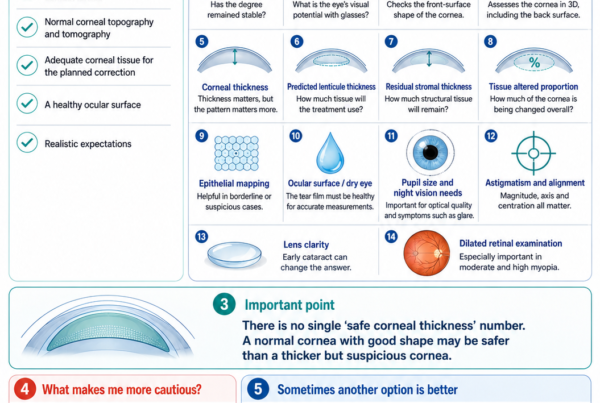
However, biomechanical safety cannot be determined by a single residual-thickness number.
Assessment should also consider:
- Anterior and posterior corneal elevation
- Pachymetry distribution
- Epithelial thickness
- Corneal asymmetry
- Percentage of tissue altered
- Family history
- Age
- Eye rubbing
- Biomechanical measurements
A systematic review of corneal biomechanical changes supports the concept that different refractive procedures affect the cornea differently, but no current test can guarantee that ectasia will never occur. [8]
Can Corneal Ectasia Occur After PRK?
Yes.
Postoperative corneal ectasia has been reported after both LASIK and PRK.
The reported risk is generally lower after PRK, but this may partly reflect:
- Different patient selection
- Lower historical treatment ranges
- The absence of flap creation
- Differences in total procedure numbers
- Underreporting
- Differences in follow-up
PRK should not be used as a way to treat a structurally suspicious cornea simply because it avoids a flap.
Patients with progressive keratoconus, forme-fruste keratoconus or clearly abnormal tomography are generally unsuitable for routine corneal laser vision correction.
Is PRK Better for Thin Corneas?
Sometimes, but not always.
PRK may be possible when a cornea is too thin for LASIK because it avoids the tissue commitment associated with a flap.
However, the cornea must still have:
- Adequate total thickness
- Normal or acceptably stable tomography
- Adequate residual stromal tissue
- No evidence of keratoconus
- No concerning epithelial pattern
- An acceptable treatment depth
A thin, weak or suspicious cornea may be unsuitable for both procedures.
Alternatives may include:
- Implantable Collamer Lens surgery
- Spectacles
- Contact lenses
- No refractive surgery
Which Procedure Can Treat a Wider Prescription Range?
The precise approved ranges depend on:
- Laser platform
- Country
- Treatment profile
- Patient anatomy
- Surgeon assessment
LASIK is commonly used for:
- Myopia
- Hyperopia
- Myopic astigmatism
- Hyperopic astigmatism
- Mixed astigmatism
- Monovision
PRK can also treat myopia, hyperopia and astigmatism using compatible excimer-laser platforms.
For high myopia, both procedures require substantial tissue removal. The relative advantage of avoiding a flap does not eliminate the concerns of:
- Deep ablation
- Haze
- Regression
- Reduced optical-zone quality
- Ectasia
- Night-vision symptoms
An ICL may be more appropriate when corneal tissue removal would be excessive.
Which Is Better for High Myopia?
LASIK may provide faster recovery and lower haze risk.
PRK avoids a flap but may have:
- More postoperative discomfort
- Slower recovery
- Greater haze concern
- Greater refractive regression after high corrections
Older ten-year data found both LASIK and PRK safe for moderate myopia, with LASIK showing slightly better efficacy, predictability and fewer retreatments in that historical cohort. Technology has changed considerably since those procedures were performed, so those numerical results should not be applied directly to modern treatment. [2]
For very high myopia, neither LASIK nor PRK may be the preferred option if the required tissue removal is excessive.
Which Is Better for Astigmatism?
Both LASIK and PRK can treat regular astigmatism using the same or similar excimer-laser platforms.
Accuracy depends on:
- Consistency of the measured cylinder
- Correct axis alignment
- Cyclotorsion control
- Eye tracking
- Treatment centration
- Corneal healing
- Magnitude of astigmatism
LASIK may stabilise faster because epithelial healing has less influence on the early refractive result.
PRK can still provide excellent astigmatic correction, but the result may take longer to stabilise.
Which Procedure Is Better for Hyperopia?
LASIK is often favoured for hyperopia because:
- Visual recovery is faster
- Haze risk is lower
- Hyperopic treatments may involve larger peripheral ablation areas
- Epithelial remodelling after PRK may influence regression
PRK remains an option for selected hyperopic patients when the cornea and treatment plan are suitable.
Hyperopic correction generally has a greater tendency to regress than low-to-moderate myopic correction, regardless of procedure.
What Is TransPRK?
Transepithelial PRK, or TransPRK, removes the epithelium using the excimer laser rather than a manual instrument or alcohol.
Depending on the platform, the epithelial and refractive treatment may be completed as one programmed sequence.
Potential advantages include:
- No alcohol exposure
- No mechanical epithelial removal
- A standardised treatment process
- Reduced instrument contact
- Potentially smoother early healing
However, TransPRK remains a form of surface ablation.
It still involves:
- Epithelial removal
- Postoperative discomfort
- A bandage contact lens
- Slower recovery than LASIK
- Haze risk
A comparative analysis of LASIK, TransPRK and SMILE found broadly similar final efficacy and safety, while TransPRK had the longest and most uncomfortable early recovery. [16]
What Are LASEK and Epi-LASIK?
LASEK and Epi-LASIK are surface-ablation variations.
LASEK
The epithelium is loosened, commonly using dilute alcohol, and moved aside before laser treatment.
Epi-LASIK
An epithelial separator is used to create an epithelial sheet before treatment.
The epithelial tissue may be repositioned, but much of it may not remain viable.
In practice, recovery and risk profiles are broadly similar to PRK because the surface epithelium must still regenerate.
Which Has Better Night Vision?
Most appropriately selected patients have satisfactory night vision after either procedure.
Both can cause:
- Glare
- Halos
- Starbursts
- Ghost images
- Reduced contrast
- Night-driving difficulty
Risk is influenced by:
- Pupil size
- Treatment zone
- Degree of correction
- Residual refractive error
- Astigmatism
- Decentration
- Dry eye
- Higher-order aberrations
- Corneal haze
PRK haze or slow epithelial remodelling may affect early night vision.
LASIK flap and interface effects may influence optical quality in other ways.
There is no universal rule that one procedure always produces better night vision.
Can LASIK or PRK Be Customised?
Yes.
Depending on the platform and the patient’s measurements, either procedure may use:
- Wavefront-optimised treatment
- Wavefront-guided treatment
- Topography-guided treatment
- Aspheric profiles
- Iris registration
- Cyclotorsion compensation
The same planned excimer-laser ablation may sometimes be delivered beneath a LASIK flap or directly to the corneal surface during PRK.
The choice of access method and the choice of laser-treatment profile are related but separate decisions.
What Is Wavefront-Guided Treatment?
Wavefront-guided treatment measures optical aberrations beyond ordinary sphere and cylinder.
The laser pattern is customised to the measured optical system.
Potential goals include:
- Reducing induced higher-order aberrations
- Improving low-contrast vision
- Improving night visual quality
- Treating certain optical irregularities
Reliable measurements and suitable anatomy are required.
What Is Topography-Guided Treatment?
Topography-guided treatment uses detailed maps of the corneal surface.
It may be considered for:
- Corneal asymmetry
- Decentred previous treatment
- Selected regular irregularities
- Higher-order corneal aberrations
- Certain enhancement procedures
Topography-guided treatment should not be used to conceal active or progressive keratoconus.
Which Procedure Is Easier to Enhance?
LASIK often provides a relatively direct early enhancement pathway.
If a residual prescription remains, options may include:
- Lifting the flap and applying further excimer treatment
- PRK over the flap
- Spectacles
- Contact lenses
The flap may become more difficult or less desirable to relift many years later because the risk of epithelial ingrowth may increase.
Enhancement After PRK
A PRK enhancement is usually another surface-ablation procedure.
The surgeon must consider:
- Remaining corneal thickness
- Previous haze
- Healing response
- Mitomycin C use
- Stability of the prescription
- Corneal topography and tomography
Recovery again follows a PRK-type timeline.
A large retreatment series found that both flap-lift enhancement and surface ablation could produce similar visual outcomes in selected eyes, although the complication profiles differed. [17]
Can PRK Be Performed After LASIK?
Yes, in selected cases.
PRK over a previous LASIK flap may be used when:
- The original flap is old
- Flap relifting carries a higher epithelial-ingrowth risk
- The residual correction is small
- Corneal thickness is adequate
- Tomography remains acceptable
Surface enhancement after LASIK has been reported to be safe and effective for selected residual refractive errors. [18]
Can LASIK Be Performed After PRK?
Potentially, but it is not always preferred.
Creating a flap in a previously surface-treated cornea may introduce additional biomechanical and healing considerations.
A repeat surface procedure may be more appropriate depending on:
- Corneal thickness
- Previous treatment depth
- Haze history
- Epithelial mapping
- Residual prescription
- Surgeon judgement
What Are the Main Risks of LASIK?
LASIK risks include:
- Dry eye
- Under- or overcorrection
- Residual astigmatism
- Glare and halos
- Flap displacement
- Flap folds
- Epithelial ingrowth
- Diffuse lamellar keratitis
- Interface infection
- Corneal ectasia
- Reduced contrast sensitivity
- Loss of best-corrected vision
- Need for enhancement
- Rare persistent neuropathic corneal pain
FDA guidance emphasises that some patients may experience persistent visual symptoms or dryness even when standard visual acuity is good. [6]
What Are the Main Risks of PRK?
PRK risks include:
- More postoperative pain
- Slower visual recovery
- Delayed epithelial healing
- Corneal haze
- Infection while the epithelium is healing
- Steroid-related eye-pressure elevation
- Under- or overcorrection
- Regression
- Residual astigmatism
- Glare and halos
- Corneal ectasia
- Loss of best-corrected vision
- Need for enhancement
Mitomycin C, topical steroids and ultraviolet protection have reduced but not eliminated the risk of haze. [12–15]
Is Infection More Common After PRK?
Serious infection is rare after either procedure.
The early infection pathways differ.
After PRK
The corneal surface remains temporarily open until the epithelium regenerates. During this period:
- A bandage contact lens is present
- The surface barrier is incomplete
- Medication adherence and hygiene are essential
After LASIK
The surface epithelium is more intact, but infection can develop within the flap interface.
Increasing pain, redness, discharge, light sensitivity or worsening vision after either procedure requires urgent assessment.
Can Steroid Drops Cause Glaucoma After PRK?
Yes.
Steroid eyedrops are often used for a longer period after PRK than LASIK.
Some patients are steroid responders and develop raised eye pressure.
Pressure should therefore be monitored during postoperative steroid treatment.
Patients should not stop steroids independently because uncontrolled inflammation may increase haze risk.
Does Either Procedure Prevent Presbyopia?
No.
LASIK and PRK reshape the cornea but do not restore the natural crystalline lens’s ability to accommodate.
Patients corrected fully for distance may require reading glasses as presbyopia develops.
Both procedures may be used for monovision:
- One eye is targeted for distance
- The other retains mild myopia for near or intermediate vision
A contact lens trial is advisable before permanent monovision correction.
Are LASIK and PRK Permanent?
Yes.
Both permanently remove corneal tissue.
The removed tissue does not grow back.
However, vision can change because of:
- Myopia progression
- Corneal remodelling
- Presbyopia
- Cataract
- Hormonal changes
- Diabetes-related refractive shifts
- Other eye disease
A permanent procedure does not guarantee a permanently unchanged prescription.
Which Has Better Long-Term Stability?
Within appropriate treatment ranges, both LASIK and PRK have extensive long-term evidence.
Studies extending to ten years and beyond generally show high safety for both procedures, although regression becomes more relevant after higher corrections. A long-term review concluded that late complications were uncommon and that effectiveness was most likely to decline when early-generation technology was used for high corrections. [2,3]
Modern lasers, larger optical zones, improved eye tracking and better nomograms may produce different results from procedures performed decades ago.
Who May Be Suitable for Either Procedure?
A typical candidate has:
- A stable prescription
- Adequate refractive maturity
- Healthy corneas
- Normal or acceptably stable tomography
- Adequate corneal thickness
- Controlled dry-eye disease
- No significant cataract
- No active infection or inflammation
- Realistic expectations
- Willingness to attend follow-up
Who May Not Be Suitable?
LASIK or PRK may be unsuitable when there is:
- Progressive keratoconus
- Suspicious corneal tomography
- Inadequate residual stromal tissue
- Severe uncontrolled dry eye
- Active blepharitis
- Active eye infection
- Unstable refraction
- Pregnancy or breastfeeding
- Uncontrolled systemic disease affecting healing
- Significant cataract
- Vision-limiting retinal or optic nerve disease
- Unrealistic expectations
FDA guidance also advises caution in patients with conditions that may impair healing or increase the risk of poor visual outcomes. [6,19]
What Tests Are Required Before LASIK or PRK?
Refraction and Visual Acuity
This determines:
- Myopia or hyperopia
- Astigmatism
- Best-corrected vision
- Prescription stability
Corneal Topography and Tomography
These scans assess:
- Corneal curvature
- Front and back elevation
- Pachymetry distribution
- Keratoconus risk
- Corneal asymmetry
- Treatment centration
Corneal Thickness
The surgeon calculates:
- Expected ablation depth
- Flap thickness for LASIK
- Residual stromal tissue
- Percentage of tissue altered
Epithelial Thickness Mapping
This may identify:
- Early keratoconus patterns
- Contact lens warpage
- Localised epithelial compensation
- Previous treatment changes
Corneal Biomechanical Assessment
Additional testing may provide information about how the cornea deforms under pressure.
No biomechanical test can guarantee the absence of future ectasia.
Dry-Eye and Eyelid Assessment
The surgeon evaluates:
- Tear-film stability
- Corneal staining
- Meibomian glands
- Blepharitis
- Allergy
- Eyelid closure
Pupil Size
Pupil measurements help with counselling about:
- Optical-zone planning
- Glare
- Halos
- Night vision
Eye Pressure and Optic Nerve
Glaucoma or ocular hypertension should be identified before surgery.
Dilated Retinal Examination
This is particularly important in moderate and high myopia.
Laser correction does not remove the retinal risks associated with an elongated myopic eye.
LASIK May Be the Better Choice When:
- The fastest possible recovery is important
- The patient cannot tolerate several painful recovery days
- The cornea is sufficiently thick and structurally normal
- Dry eye is well controlled
- There is little risk of direct ocular trauma
- Hyperopia is being treated
- Easy enhancement is important
- Flap-specific risks are acceptable
PRK May Be the Better Choice When:
- Avoiding a flap is important
- The patient has a relatively thin but otherwise healthy cornea
- Contact sports or occupational trauma are concerns
- Previous surgery makes a flap less desirable
- Surface topography-guided treatment is planned
- The patient can accept slower recovery
- The patient understands the risk of haze and regression
SMILE May Be Considered When:
- Myopia or myopic astigmatism is being treated
- Avoiding a LASIK flap is important
- Faster recovery than PRK is desirable
- The cornea is suitable for lenticule extraction
- Available treatment customisation meets the patient’s needs
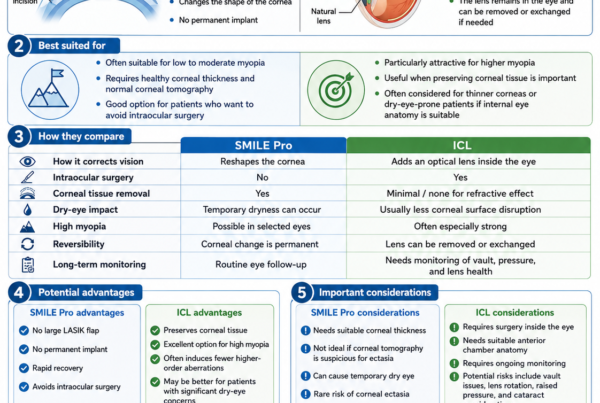
ICL May Be Better Than Both When:
- Myopia is very high
- Corneal tissue is insufficient
- Tomography is unsuitable for corneal laser correction
- Preserving central corneal tissue is a priority
- Internal eye anatomy is suitable for an implant
ICL avoids corneal ablation but introduces intraocular risks and requires implant-specific long-term monitoring.
Frequently Asked Questions About LASIK vs PRK
Is PRK Safer Than LASIK?
PRK avoids flap-related complications and may preserve more load-bearing stromal tissue.
It has different risks, including more pain, delayed healing and corneal haze.
Neither is universally safer.
Does PRK Give Better Vision Than LASIK?
Final visual acuity is generally similar in suitable patients.
LASIK reaches the final result faster.
Which Has Faster Recovery?
LASIK.
Many patients have functional vision by the next day, while PRK vision commonly takes several weeks to stabilise fully.
Which Is More Painful?
PRK.
Discomfort is usually greatest during the first two to three days while the epithelium heals.
Which Causes Less Dry Eye?
PRK may cause less flap-related corneal denervation, but temporary dryness can occur after either procedure.
Which Is Better for Thin Corneas?
PRK may be suitable when a LASIK flap would leave insufficient load-bearing tissue.
A thin or structurally abnormal cornea may be unsuitable for both.
Which Is Better for Contact Sports?
PRK is often preferred because there is no permanent corneal flap.
Can the LASIK Flap Move Years Later?
Severe trauma can disturb a LASIK flap even years later, although this is rare.
Does PRK Have a Flap?
No.
Is PRK Reversible?
No.
The excimer laser permanently removes corneal tissue.
Is LASIK Reversible?
No.
The flap can be lifted, but the laser-removed tissue cannot be replaced.
Can PRK Cause Scarring?
PRK can cause corneal haze or scarring.
Modern laser profiles, steroids and mitomycin C have reduced this risk substantially.
Why Is a Bandage Contact Lens Used After PRK?
It protects the exposed cornea, reduces discomfort and supports epithelial healing.
How Long Is the Bandage Contact Lens Worn?
It is usually worn until the epithelium has healed adequately, commonly several days.
The surgeon determines when it is safe to remove.
Can I Drive the Day After LASIK?
Some patients may have adequate vision, but driving should resume only after the postoperative examination and when legal visual standards are met.
Can I Drive the Day After PRK?
Usually not.
Vision is commonly blurred during the first several days.
When Can I Return to Work?
Many LASIK patients return to office work within one to three days.
PRK patients may require approximately one week or longer depending on comfort, vision and occupation.
When Can I Exercise?
Light activity can often resume relatively early, but swimming, contact sports and dusty environments should be avoided until the surgeon confirms that healing is adequate.
Can LASIK or PRK Cause Blindness?
Severe permanent visual loss is rare but possible.
Potential causes include:
- Infection
- Corneal ectasia
- Severe haze or scarring
- Irregular astigmatism
- Other uncommon complications
Can I Still Need Glasses?
Yes.
Glasses may still be needed for:
- Residual refractive error
- Night driving
- Reading after presbyopia develops
- Future prescription change
Which Is Easier to Enhance?
LASIK generally has a more straightforward early enhancement pathway.
PRK enhancement is possible but involves another surface-healing period.
Does PRK Last Longer Than LASIK?
Neither procedure universally lasts longer.
Long-term stability depends more on the original prescription, age, corneal healing and natural changes within the eye.
Does Either Procedure Prevent Cataract?
No.
The natural crystalline lens remains inside the eye and continues to age.
Do I Still Need Eye Examinations?
Yes.
Regular examinations remain important for:
- Corneal health
- Eye pressure
- Glaucoma
- Cataract
- Retinal health
- Myopia-related complications
Key Takeaway
LASIK and PRK are both effective excimer-laser vision correction procedures.
They use similar laser technology to reshape the cornea, but they reach the treatment area differently.
LASIK:
- Creates a corneal flap
- Causes less early discomfort
- Provides faster visual recovery
- Has a relatively straightforward enhancement pathway
- Carries permanent flap-related risks
- May cause more early corneal nerve disruption and dryness
PRK:
- Does not create a flap
- Preserves more load-bearing anterior stromal tissue
- May suit selected thinner corneas
- Is often favoured when eye trauma is a concern
- Causes more early discomfort
- Has slower visual recovery
- Carries a specific risk of corneal haze
Final visual acuity, safety and refractive accuracy are generally similar in appropriately selected low-to-moderate myopic patients.
LASIK may be preferred when speed and comfort are priorities.
PRK may be preferred when avoiding a flap or preserving additional stromal tissue is more important than rapid recovery.
Neither procedure:
- Is reversible
- Eliminates dry-eye risk
- Eliminates corneal ectasia risk
- Prevents presbyopia
- Prevents cataract
- Removes the retinal risks associated with high myopia
The safest procedure is the one that best matches the patient’s corneal anatomy, prescription, ocular-surface health, occupation and lifestyle.
References
- Shortt AJ, Allan BDS, Evans JR. Laser-Assisted In Situ Keratomileusis versus Photorefractive Keratectomy for Myopia. Cochrane Database of Systematic Reviews. 2013.
- Alió JL, Muftuoglu O, Ortiz D, et al. Ten-Year Follow-up of Photorefractive Keratectomy and Laser In Situ Keratomileusis for Moderate Myopia. 2009. PMID: 18292203.
- Taneri S, et al. Long-Term Outcomes of PRK, LASIK and SMILE. 2022. PMID: 34241701.
- Almutairi MN, et al. Clinical Outcomes of LASIK versus PRK: A Meta-analysis. 2025.
- US Food and Drug Administration. Patient Information Booklet for LASIK Laser Vision Correction.
- US Food and Drug Administration. LASIK Risks, Patient Selection and Postoperative Expectations.
- Somani SN, Moshirfar M, Patel BC. Photorefractive Keratectomy. Updated 2025. PMID: 31751077.
- Pniakowska Z, et al. Clinical Evaluation of Corneal Biomechanics Following Laser Vision Correction Procedures: A Systematic Review. 2022. PMID: 36615041.
- Moshirfar M, et al. Ectasia After Corneal Refractive Surgery: A Systematic Review. 2021. PMID: 34417707.
- El-Maghraby A, Salah T, Waring GO III, et al. Randomised Bilateral Comparison of LASIK and PRK for Myopia. 1999. PMID: 10080199.
- US Food and Drug Administration. LASIK Quality of Life Collaboration Project. 2021.
- Moshirfar M, et al. Management of Corneal Haze After Photorefractive Keratectomy. 2023. PMID: 37603162.
- Chang YM, et al. Mitomycin C for the Prevention of Corneal Haze in Photorefractive Keratectomy: A Meta-analysis. 2021. PMID: 33326173.
- Ouerdane Y, et al. Mitomycin C Application After Photorefractive Keratectomy: Systematic Review and Meta-analysis. 2021. PMID: 34826969.
- Arranz-Marquez E, et al. A Critical Overview of the Biological Effects of Mitomycin C in Corneal Refractive Surgery. 2019. PMID: 30859502.
- Chang JY, et al. Comparison of Clinical Outcomes of LASIK, TransPRK and SMILE.
- Ortega-Usobiaga J, et al. Comparison of Retreatment by Flap Lift and Surface Ablation After LASIK. 2018. PMID: 28651810.
- Beerthuizen JJG, et al. Surface Ablation After Laser In Situ Keratomileusis. 2007. PMID: 17662427.
- US Food and Drug Administration. FDA-Approved Lasers for PRK and Other Refractive Surgeries.
- Ryan DS, et al. A Comparative Analysis of Patient-Reported Outcomes After LASIK, PRK and SMILE. 2025. PMID: 39641610.