Author: Dr Val Phua
Estimated reading time: 13–15 minutes
What Are Glaucoma Eye Drops?
Glaucoma eye drops are medications used to lower the pressure inside the eye, known as intraocular pressure or IOP.
They lower pressure by:
- Reducing the amount of aqueous fluid produced inside the eye
- Improving drainage of aqueous fluid from the eye
- Combining both mechanisms
Lowering eye pressure reduces stress on the optic nerve and can slow or prevent further glaucomatous damage.
Glaucoma drops cannot normally:
- Restore optic-nerve tissue already lost
- Reverse an established visual-field defect
- Cure glaucoma permanently
- Improve vision immediately in the way new glasses might
Their purpose is preventive: to preserve the vision that remains. The National Eye Institute describes prescription eye drops as a common glaucoma treatment that lowers eye pressure to help prevent further optic-nerve damage.
Why Do I Need Drops When My Vision Feels Normal?
Most chronic glaucoma causes no pain or noticeable early visual symptoms.
The patient may still have:
- Clear central vision
- Comfortable white eyes
- No sensation of high pressure
- A normal spectacle prescription
- Significant optic-nerve damage or risk of progression
Glaucoma treatment is therefore similar to treating high blood pressure: the medication may not produce a sensation that confirms it is working.
The benefit is measured through:
- Eye-pressure reduction
- Stable optic-nerve appearance
- Stable OCT scans
- Stable visual fields
- Reduced rate of disease progression
Feeling no difference after using the drops does not mean they are unnecessary.
How Do Glaucoma Eye Drops Protect Vision?
The optic nerve may be damaged when eye pressure is too high for that particular nerve.
The safe pressure differs between patients.
A person with:
- Early glaucoma
- Minimal structural damage
- Slow progression
may tolerate a higher pressure than someone with:
- Advanced glaucoma
- Damage close to central fixation
- Rapid visual-field deterioration
- Severe glaucoma in the other eye
The ophthalmologist therefore sets an individual target pressure.
Drops are prescribed to lower pressure towards this target. The target may later be reduced if OCT or visual-field testing shows continued progression despite apparently acceptable readings. Current glaucoma guidelines emphasise individualised target-pressure reduction based on disease severity, baseline pressure and progression risk.
Do All Glaucoma Drops Work in the Same Way?
No.
The main medication classes are:
- Prostaglandin analogues
- Beta blockers
- Alpha-adrenergic agonists
- Carbonic anhydrase inhibitors
- Rho-kinase inhibitors
- Nitric-oxide-donating medications
- Miotic or cholinergic drops
- Fixed-combination drops
The National Eye Institute groups glaucoma medications according to whether they improve fluid drainage or reduce aqueous-fluid production.
The best drop depends on:
- Type of glaucoma
- Target pressure
- Current pressure
- Other eye conditions
- Asthma or lung disease
- Heart rate and cardiac history
- Kidney function
- Age
- Pregnancy or breastfeeding
- Ocular-surface health
- Medication cost and availability
- Ability to use the prescribed schedule reliably
Prostaglandin Analogues
Common examples include:
- Latanoprost
- Travoprost
- Bimatoprost
- Tafluprost
Related medications include latanoprostene bunod, which also releases nitric oxide.
Prostaglandin analogues are frequently used as an initial medication for open-angle glaucoma and ocular hypertension because they:
- Produce substantial pressure reduction
- Usually require only one dose daily
- Have relatively limited systemic effects
- Work primarily by increasing aqueous-fluid drainage
The exact product and availability vary by country.
How Are Prostaglandin Drops Used?
They are commonly prescribed once daily, often in the evening.
Using more doses than prescribed does not necessarily improve pressure control and may reduce effectiveness or increase side effects.
The patient should follow the exact label because formulations and recommended timing differ.
Common Prostaglandin Side Effects
Possible side effects include:
- Eye redness
- Mild stinging
- Longer or thicker eyelashes
- Darkening of the eyelashes
- Darkening of eyelid skin
- Increased iris pigmentation
- Mild blurred vision after instillation
- Changes in the tissues surrounding the eyelids
Latanoprost and related products may increase pigmentation of the iris, eyelid and eyelashes. Iris darkening may be permanent, while some eyelid and eyelash changes may partially reverse after treatment stops.
Can Prostaglandin Drops Make One Eye Look Different?
Yes.
This may become noticeable when treatment is used in only one eye.
Possible differences include:
- Darker iris colour
- Longer eyelashes
- Darker eyelid skin
- Greater eyelash density
- A deeper upper-eyelid crease
- A more hollow appearance around the eye
Prostaglandin-associated periorbital changes are not dangerous in most cases but can be cosmetically noticeable.
Patients should not stop treatment without discussing:
- Whether another prostaglandin is suitable
- Whether another medication class can be used
- Whether selective laser trabeculoplasty is an option
When Are Prostaglandins Used with Caution?
The ophthalmologist may exercise additional caution in eyes with:
- Active uveitis
- Previous herpetic keratitis
- Certain forms of macular oedema
- Recent intraocular surgery
- Significant ocular-surface irritation
The relevance differs between patients and medications.
A past cataract operation alone does not automatically mean that prostaglandin drops cannot be used.
Beta-Blocker Eye Drops
Common examples include:
- Timolol
- Betaxolol
Beta blockers reduce aqueous-fluid production inside the eye.
They may be prescribed:
- Once daily
- Twice daily
- As part of a fixed-combination product
Although they are placed in the eye, beta blockers can enter the bloodstream and affect the lungs, heart and other organs.
Who Should Not Use Timolol?
Timolol is generally contraindicated in patients with:
- Bronchial asthma
- A history of bronchial asthma
- Severe chronic obstructive pulmonary disease
- A very slow heart rate
- Second- or third-degree heart block
- Overt heart failure
- Cardiogenic shock
Topical timolol can be absorbed systemically and may produce the same categories of respiratory and cardiovascular effects seen with systemic beta blockers.
Patients should tell their ophthalmologist if they:
- Use an inhaler
- Have wheezing
- Have a slow pulse
- Have a pacemaker
- Have fainting episodes
- Take oral beta blockers
- Have previously had heart block
- Are awaiting surgery under anaesthesia
Possible Beta-Blocker Side Effects
Possible effects include:
- Stinging
- Dry eye
- Fatigue
- Dizziness
- Reduced exercise tolerance
- Slow heart rate
- Low blood pressure
- Shortness of breath
- Wheezing
- Sleep disturbance
- Cold hands or feet
Beta blockers may also mask some warning symptoms of low blood sugar, particularly in patients using insulin or other diabetes medication.
Is Betaxolol Safer for the Lungs?
Betaxolol is more selective for beta-1 receptors than timolol and may have less effect on the airways.
It is not completely free from respiratory or cardiac risk.
Patients with significant asthma or airway disease still require individual medical assessment rather than assuming that any beta-blocker drop is safe.
Alpha-Adrenergic Agonists
Common examples include:
- Brimonidine
- Apraclonidine
These medications can:
- Reduce aqueous production
- Increase an alternative drainage pathway
Apraclonidine is often used for shorter-term indications because allergy and reduced effectiveness can develop with continued use.
Brimonidine may be used as a longer-term glaucoma medication or as part of a fixed combination.
Common Brimonidine Side Effects
Possible side effects include:
- Eye redness
- Itching
- Follicular conjunctivitis
- Eyelid swelling
- Dry mouth
- Fatigue
- Drowsiness
- Headache
- Blurred vision
- Reduced blood pressure in susceptible patients
Allergic conjunctivitis may develop only after the medication has been used for months.
A patient who initially tolerated brimonidine can later develop:
- Increasing redness
- Itching
- Follicles
- Puffy eyelids
- Persistent watering
Brimonidine labels identify allergic eye reactions, dry mouth and visual disturbance among recognised adverse effects.
Can Brimonidine Be Used in Children?
Brimonidine is contraindicated in children younger than two years because severe systemic effects—including respiratory depression, marked drowsiness, low blood pressure and reduced alertness—have been reported in infants.
It is also used cautiously in older young children because sedation and systemic effects may still occur.
A child who becomes unusually sleepy, pale, weak or difficult to wake after receiving brimonidine requires urgent medical advice.
Carbonic Anhydrase Inhibitor Eye Drops
Common topical carbonic anhydrase inhibitors include:
- Dorzolamide
- Brinzolamide
They lower pressure by reducing aqueous-fluid production.
They may be prescribed:
- Two or three times daily
- With another medication
- As part of a fixed-combination bottle
Common Carbonic Anhydrase Inhibitor Side Effects
Possible side effects include:
- Stinging
- Burning
- Bitter or metallic taste
- Temporary blurred vision
- Redness
- Dry eye
- Superficial corneal irritation
- Eyelid or conjunctival allergy
A bitter taste occurs because medication may drain through the tear duct into the nose and throat. In clinical studies, ocular discomfort and altered taste were among the most frequent effects of dorzolamide.
Pressing the inner corner of the eyelids after using the drop can reduce this drainage.
Are These Drops Safe with a Sulfa Allergy?
Dorzolamide and brinzolamide are sulfonamide derivatives.
The relationship between antibiotic sulfonamide allergy and topical carbonic anhydrase inhibitor reactions is complex, and not every person with a reported “sulfa allergy” will react to these eye drops.
The ophthalmologist should know:
- Which medication caused the previous reaction
- Whether the reaction was a mild rash
- Whether there was facial swelling
- Whether there was Stevens–Johnson syndrome
- Whether hospital treatment was needed
Serious sulfonamide-type reactions are rare but are included in prescribing warnings because topical dorzolamide is systemically absorbed.
When Are Carbonic Anhydrase Inhibitors Used with Caution?
Additional caution may be appropriate in patients with:
- Severe kidney impairment
- Significant corneal endothelial disease
- Previous corneal transplantation
- Fuchs endothelial dystrophy
- Previous severe sulfonamide reaction
The medication may affect a vulnerable cornea’s ability to remain clear.
Rho-Kinase Inhibitors
The principal example is:
- Netarsudil
Rho-kinase inhibitors lower pressure mainly by improving drainage through the trabecular meshwork, the eye’s conventional outflow pathway.
Netarsudil is often prescribed once daily and may be used:
- As an additional medication
- When other medication classes are unsuitable
- Within a fixed combination with latanoprost, where available
Common Netarsudil Side Effects
Possible side effects include:
- Marked eye redness
- Small conjunctival haemorrhages
- Stinging or discomfort
- Corneal verticillata
- Watering
- Blurred vision
- Eyelid redness
In controlled trials, conjunctival redness was the most frequently reported effect. Corneal verticillata and small conjunctival haemorrhages were also common.
What Is Corneal Verticillata?
Corneal verticillata is a whorl-like pattern of deposits within the corneal epithelium.
It may be visible during slit-lamp examination.
In trials of netarsudil, it generally did not cause obvious functional visual changes and often resolved after treatment was stopped.
Can Netarsudil Affect an Unhealthy Cornea?
A honeycomb or bullous pattern of epithelial corneal swelling has been reported, particularly in eyes with:
- Pre-existing corneal oedema
- Reduced endothelial function
- Previous corneal procedures
- Complex anterior-segment surgery
Patients using netarsudil should report new eye pain or reduced vision promptly.
Nitric-Oxide-Donating Glaucoma Drops
Latanoprostene bunod combines:
- A prostaglandin-related component
- Nitric-oxide donation
It lowers pressure by enhancing aqueous drainage through more than one pathway.
Possible effects include:
- Redness
- Irritation
- Eye pain
- Instillation discomfort
- Prostaglandin-related pigmentation and eyelash changes
Availability differs between countries.
Miotic or Cholinergic Drops
The main example is:
- Pilocarpine
Pilocarpine makes the pupil smaller and contracts the ciliary muscle.
This can:
- Pull the trabecular meshwork open
- Improve conventional drainage
- Help reopen or manage certain angle-closure mechanisms
- Lower pressure in selected open-angle cases
Pilocarpine is used less frequently for routine long-term open-angle glaucoma than several newer medication classes, but it remains important in selected clinical situations.
Pilocarpine Side Effects
Possible effects include:
- Brow ache
- Headache
- Induced short-sightedness
- Difficulty focusing
- Dimmer vision in low light
- A very small pupil
- Reduced night vision
- Eye redness
- Retinal traction in susceptible eyes
Patients may find night driving more difficult because less light enters through the constricted pupil.
A dilated retinal examination may be considered before pilocarpine in patients with risk factors for retinal tears or detachment, particularly high myopia or peripheral retinal disease.
Is Pilocarpine Used During an Acute Glaucoma Attack?
It may be used as one part of treatment for acute angle closure, but timing matters.
When pressure is extremely high, the iris may initially respond poorly to pilocarpine.
Acute angle closure generally requires:
- Several pressure-lowering medications
- Urgent ophthalmic assessment
- Laser peripheral iridotomy or another definitive procedure
A patient should not self-treat a painful red eye using an old bottle of pilocarpine.
What Are Fixed-Combination Drops?
Fixed-combination drops place two medications in one bottle.
Examples may combine:
- A beta blocker with a prostaglandin
- A beta blocker with a carbonic anhydrase inhibitor
- A beta blocker with an alpha agonist
- An alpha agonist with a carbonic anhydrase inhibitor
- A prostaglandin with a Rho-kinase inhibitor
The exact combinations available vary between countries.
Advantages of Fixed Combinations
They may provide:
- Fewer bottles
- Simpler schedules
- Less risk of washing one drop out with another
- Reduced preservative exposure
- Better adherence
- Additional pressure reduction
Limitations of Fixed Combinations
They also have limitations:
- Each component’s contraindications still apply.
- It may be difficult to identify which ingredient caused a side effect.
- The individual components cannot always be adjusted separately.
- A beta-blocker combination remains unsuitable for some patients with asthma or cardiac disease.
- Dosing frequency may be determined by the combination rather than by each drug individually.
A combination bottle is not automatically safer simply because it is more convenient.
What Are Preservatives?
Multidose eye-drop bottles commonly contain preservatives to reduce microbial contamination.
One frequently used preservative is benzalkonium chloride.
Preservatives help keep the bottle safe during repeated use, but long-term exposure may contribute to ocular-surface symptoms in susceptible patients.
Possible symptoms include:
- Burning
- Grittiness
- Redness
- Dryness
- Fluctuating blur
- Eyelid inflammation
- Corneal staining
- Contact-lens intolerance
Who May Benefit from Preservative-Free Drops?
Preservative-free preparations may be considered when there is:
- Preservative allergy
- Clinically significant dry eye
- Chronic ocular-surface inflammation
- Multiple glaucoma medications
- Previous corneal surgery
- Intolerance of preserved formulations
NICE recommends preservative-free glaucoma drops for patients with preservative allergy or clinically significant symptomatic ocular-surface disease in relevant treatment settings.
Preservative-free drops may be supplied in:
- Single-use containers
- Special multidose bottles
The patient must follow the specific storage and disposal instructions.
Are Preservative-Free Drops Stronger?
Not necessarily.
“Preservative-free” describes the formulation, not the pressure-lowering strength.
The active medication may be identical or similar to a preserved product.
The main potential benefit is improved ocular-surface tolerance.
Can Glaucoma Drops Cause Dry Eye?
Yes.
Dry eye may result from:
- Preservative exposure
- The active medication
- Multiple daily doses
- Long-term ocular-surface inflammation
- Reduced tear-film stability
- Eyelid allergy
Glaucoma patients may develop:
- Burning
- Grittiness
- Watering
- Redness
- Fluctuating vision
- Difficulty keeping the eyes open
- Reduced tolerance of reading or screen use
Treatment options may include:
- Preservative-free glaucoma medication
- Fixed-combination drops
- Preservative-free lubricants
- Eyelid and meibomian gland treatment
- Selective laser trabeculoplasty
- Surgery in selected cases
The pressure-lowering treatment should not simply be stopped without an alternative plan.
Can Glaucoma Drops Affect the Whole Body?
Yes.
A large portion of a drop that overflows the eye may:
- Drain through the tear duct
- Enter the nose
- Be absorbed through the nasal mucosa
- Reach the bloodstream
This is why an eye drop can affect:
- Heart rate
- Blood pressure
- Breathing
- Alertness
- Dryness of the mouth
- Energy level
The National Eye Institute lists possible changes in energy, heartbeat or breathing among glaucoma-medication side effects.
How Can I Reduce Systemic Absorption?
After instilling the drop:
- Close the eyelids gently.
- Do not squeeze tightly.
- Press lightly over the inner corner of the eyelids beside the nose.
- Maintain the pressure for at least one minute—often one to two minutes when practical.
- Wipe away excess medication from the eyelid skin.
This technique is called:
- Punctal occlusion
- Nasolacrimal occlusion
It reduces drainage into the nose and may reduce systemic exposure.
How Should Glaucoma Drops Be Applied?
Step 1: Check the Bottle
Confirm:
- Patient name
- Medication name
- Right or left eye
- Dosing time
- Expiry date
Some bottles look very similar.
Step 2: Wash and Dry Your Hands
Use soap and water.
Dry the hands before handling the bottle.
Step 3: Position the Head
Tilt the head back or lie down.
Look upwards.
Step 4: Create a Lower-Eyelid Pocket
Pull the lower eyelid gently away from the eye.
Step 5: Instil One Drop
Hold the bottle above the eye without touching:
- Eyelashes
- Eyelids
- Eye surface
- Fingers
One correctly placed drop is generally sufficient.
Step 6: Close and Press
Close the eye gently and press the inner corner for at least one minute.
Step 7: Wipe Away Excess
This is particularly helpful with prostaglandins to reduce prolonged contact with eyelid skin.
The National Eye Institute recommends hand washing, avoiding contact between the bottle tip and the eye, punctal pressure and separation of different eye-drop types.
Why Should the Bottle Tip Not Touch the Eye?
Touching the eye, eyelids or fingers can contaminate the bottle.
Contamination may lead to:
- Conjunctivitis
- Corneal infection
- Recurrent irritation
- Contamination of future doses
The tip can also scratch the cornea if the patient moves suddenly.
How Long Should I Wait Between Different Drops?
Wait at least five minutes between different ophthalmic medications unless instructed otherwise.
This helps prevent the second drop from washing the first medication out of the eye.
Ointments and thick gels are generally used after liquid drops.
Should I Shake the Bottle?
Some medications are suspensions and must be shaken before use.
Other solutions do not require shaking.
Follow the instructions printed on the label.
A suspension that is not mixed properly may deliver inconsistent amounts of medication.
What If I Am Not Sure Whether the Drop Entered the Eye?
Do not repeatedly apply several extra drops.
A second drop may be reasonable when it is clear that the first missed the eye completely.
If the drop may have entered, adding more usually increases overflow rather than benefit.
Patients who frequently struggle should ask about:
- Instillation aids
- Bottle squeezers
- Family assistance
- Single-use preparations
- Alternative bottle designs
- Laser treatment
What If I Miss a Dose?
General advice is:
- Use the drop when remembered if the next dose is not due soon.
- Skip the missed dose when it is close to the next scheduled dose.
- Resume the normal schedule.
- Do not routinely double the dose.
Instructions may differ between medications, so follow the prescription label or contact the clinic when uncertain.
One missed dose is unlikely to cause immediate blindness, but repeated missed doses can leave pressure inadequately controlled.
Should I Use My Drops on the Day of My Appointment?
Usually, yes.
Continue the normal schedule unless the clinic specifically asks you to withhold a medication.
Stopping the drops before the visit may produce a pressure reading that does not reflect usual treatment.
Bring the bottles or an updated medication list when:
- Several drops are being used
- The bottle colours are confusing
- Another doctor changed the prescription
- Side effects have developed
- Adherence is uncertain
What If I Accidentally Use the Wrong Drop?
Do not panic.
Wipe away excess medication and contact the clinic or pharmacist for advice, particularly when:
- Timolol was used by someone with asthma or severe heart disease
- Brimonidine was given to a young child
- Several doses were accidentally applied
- The medication was swallowed
- Significant dizziness, weakness or breathing difficulty develops
Bring the bottle when seeking medical care.
Can I Use Glaucoma Drops While Wearing Contact Lenses?
Many preserved eye drops should not be applied while contact lenses are in place.
The lenses may:
- Absorb preservatives
- Increase ocular-surface exposure
- Alter medication distribution
- Become discoloured or uncomfortable
Product labels commonly advise:
- Remove contact lenses.
- Instil the medication.
- Wait approximately 15 minutes.
- Reinsert the lenses if the eye is comfortable.
The instructions vary by product, so follow the specific label. Tafluprost and netarsudil labels, for example, advise lens removal and a delay before reinsertion.
Can Glaucoma Drops Be Used During Pregnancy?
Pregnancy requires individual planning.
No single glaucoma medication is automatically appropriate for every stage of pregnancy.
The decision depends on:
- Glaucoma severity
- Risk of visual loss without treatment
- Medication class
- Stage of pregnancy
- Amount of systemic absorption
- Whether laser is suitable
- Whether treatment can be reduced safely
Patients who are:
- Pregnant
- Planning pregnancy
- Undergoing fertility treatment
should tell their ophthalmologist before changing or stopping medication.
Punctal occlusion is particularly important when minimising systemic exposure.
Can Glaucoma Drops Be Used While Breastfeeding?
Some ophthalmic medications or their metabolites may enter breast milk.
The clinical significance varies between products.
The ophthalmologist, obstetric doctor, paediatrician and pharmacist may need to consider:
- Infant age
- Prematurity
- Medication class
- Maternal glaucoma severity
- Alternative treatments
- Punctal occlusion
Drops should not be stopped abruptly without a vision-preserving plan.
Do Glaucoma Drops Interact with Other Medicines?
They can.
Important examples include:
- Timolol with oral beta blockers
- Timolol with medications that slow the heart rate
- Brimonidine with medications that increase sedation or affect blood pressure
- Carbonic anhydrase inhibitors with selected sulfonamide-related or renal concerns
- Multiple medications producing additive systemic effects
Patients should provide an updated list of:
- Prescription medications
- Inhalers
- Nasal sprays
- Supplements
- Traditional medication
- Heart medication
- Diabetes treatment
Eye drops should be included whenever another doctor asks for the current medication list.
Should I Tell My Anaesthetist About Glaucoma Drops?
Yes.
This is particularly important for beta-blocker drops such as timolol because they may affect:
- Heart rate
- Blood pressure
- Airway function
- Response during anaesthesia
Do not stop the medication independently. The anaesthetic and ophthalmic teams should decide whether any adjustment is required.
How Does the Doctor Know Whether the Drop Is Working?
Response is assessed using:
- Eye-pressure measurements
- Measurements at different times when needed
- Optic-nerve examination
- OCT
- Visual-field testing
- Adherence review
- Side-effect assessment
A pressure measurement taken shortly after treatment begins may be compared with the untreated or previous baseline.
The clinician also considers whether the effect lasts across the day and between doses.
Why Is My Pressure Still High Despite Using Drops?
Possible reasons include:
- The medication does not lower pressure enough
- The dose is being missed
- The bottle is empty or expired
- The drop is landing on the cheek
- Another drop is washing it out
- The prescribed schedule is unclear
- Pressure peaks occur outside clinic hours
- Steroid medication is raising pressure
- Angle closure or another mechanism is present
- Glaucoma has become more difficult to control
- More than one treatment is needed
The first step is not always adding another medication.
The clinician may first:
- Observe the instillation technique
- Confirm the bottles
- Review adherence
- Repeat tonometry
- Perform gonioscopy
- Check for steroids
- Assess disease progression
What Is Adherence?
Adherence means using the treatment:
- In the correct eye
- At the correct dose
- At approximately the correct time
- On a consistent basis
- With proper technique
Glaucoma adherence is difficult because:
- The disease is often symptomless.
- Several bottles may be required.
- Drops may sting.
- Bottles can be difficult to squeeze.
- The schedule may interfere with daily activities.
- Patients may forget whether the dose was given.
- The benefit is not immediately felt.
Patients should tell the doctor honestly when doses are being missed.
The solution may be:
- A simpler schedule
- A combination bottle
- A phone reminder
- Linking the dose to a daily routine
- Family assistance
- Selective laser trabeculoplasty
- Surgery in selected cases
Can Glaucoma Drops Stop Working?
The same medication may appear less effective over time because:
- Glaucoma has changed
- Pressure has become more difficult to control
- Adherence has declined
- The bottle or technique has changed
- Another medication is interacting
- The patient has developed tachyphylaxis or reduced response
- The original pressure fluctuation was underestimated
Apraclonidine and, in some patients, brimonidine may show a reduced effect with continued use.
Confirmed progression may require a lower target even when the drop itself continues to lower pressure.
When Should a Drop Be Changed?
A change may be considered when:
- Pressure remains above target
- Glaucoma continues progressing
- The medication causes intolerable side effects
- Allergy develops
- Asthma or cardiac disease makes a beta blocker unsafe
- Ocular-surface disease becomes clinically significant
- The patient cannot manage the dosing schedule
- Pregnancy or another medical condition changes the risk balance
- A more effective or simpler treatment is available
A patient should not change medication solely because the eye becomes temporarily red after one dose without first seeking advice.
Are Generic Drops as Effective as Branded Drops?
Approved generic products contain the same active ingredient and intended concentration, but patients may notice differences in:
- Bottle stiffness
- Drop size
- Preservative
- pH
- Comfort
- Cap colour
- Ability to squeeze the container
A formulation that is difficult to use reliably may produce poorer real-world control even when the active ingredient is equivalent.
Bring the bottle to the clinic if:
- The packaging changes
- Pressure rises unexpectedly
- The new formulation causes marked irritation
- The bottle appears to run out unusually quickly
Can I Stop the Drops After Laser Treatment?
Not automatically.
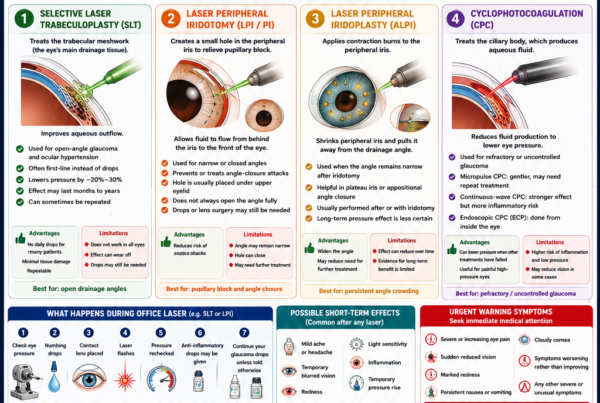
Selective laser trabeculoplasty may:
- Lower pressure
- Reduce the number of medications
- Delay the need for drops
- Provide drop-free control for some patients
The LiGHT trial found that initial selective laser trabeculoplasty provided successful drop-free pressure control in nearly 70% of treated eyes at six years and produced favourable long-term disease control compared with an initial medication pathway.
However:
- SLT does not work for every glaucoma type.
- Some patients obtain an incomplete response.
- The effect may reduce over time.
- Repeat laser may be required.
- Drops may still be necessary.
Only stop medication when instructed after pressure reassessment.
Is Laser Better Than Drops?
Neither option is universally best.
Possible Advantages of Drops
- No procedure
- Treatment can begin immediately
- Medication can be changed or stopped
- Useful for many different glaucoma mechanisms
- Can produce additional pressure reduction after laser
Possible Limitations of Drops
- Daily lifelong routine
- Ocular-surface irritation
- Systemic effects
- Adherence difficulties
- Ongoing cost
- Multiple bottles
Possible Advantages of SLT
- Avoids daily medication for some patients
- Limited systemic effects
- Repeatable in selected cases
- Effective first-line option for open-angle glaucoma and ocular hypertension
Possible Limitations of SLT
- Not effective for every patient
- Not appropriate for every glaucoma type
- Pressure may rise temporarily after treatment
- Effect can diminish
- Drops may still be needed
Treatment should be individualised according to angle anatomy, target pressure, disease severity and patient preference.
Do Drops Treat Acute Angle-Closure Glaucoma?
Drops may be part of emergency treatment, but acute angle closure cannot be managed by routine home medication alone.
Warning symptoms include:
- Severe eye pain
- Redness
- Sudden blurred vision
- Halos
- Headache
- Nausea
- Vomiting
Urgent treatment may include:
- Several pressure-lowering drops
- Oral or intravenous medication
- Laser peripheral iridotomy
- Other laser or surgical procedures
The National Eye Institute advises immediate emergency assessment for sudden symptoms of angle closure.
Warning Symptoms While Using Glaucoma Drops
Seek prompt medical advice for:
- Increasing eye pain
- Sudden reduction in vision
- Severe redness
- Marked light sensitivity
- Eyelid or facial swelling
- Generalised rash
- Wheezing
- Shortness of breath
- Fainting
- Very slow pulse
- Severe dizziness
- Unusual drowsiness in a child
- New corneal clouding
- Accidental swallowing
Do not simply continue the medication through a severe suspected allergic or systemic reaction without seeking advice.
Frequently Asked Questions
Do glaucoma drops improve eyesight?
Usually not.
They preserve vision by reducing the risk of further optic-nerve damage.
Do the drops cure glaucoma?
No.
They control pressure while they are being used.
Will I need the drops for life?
Many patients require long-term treatment, although medication may later be reduced or changed after laser or surgery.
Why do I need several drops?
Different classes act through different pathways and may provide additional pressure reduction when combined.
Is one drop enough?
Yes.
The eye cannot retain several full drops at once.
Can I use two drops immediately one after another?
Different medications should generally be separated by at least five minutes.
Which drop should be used first?
When both are liquid solutions, the order is often less important than allowing adequate separation.
Use thick gels or ointments last.
Why does the medication taste bitter?
It has drained through the tear duct into the nose and throat.
Punctal occlusion may reduce this.
Why are my eyelashes longer?
Prostaglandin analogues can increase eyelash growth.
Why is my iris darker?
Prostaglandin-related medication can increase iris pigmentation, particularly in mixed-colour irises.
Will the iris colour return to normal after stopping?
Iris darkening may be permanent.
Why do my eyes look hollow?
Long-term prostaglandin use may alter the eyelid and periorbital tissues in some patients.
Why are my eyes red after netarsudil?
Conjunctival redness is a common medication effect.
Persistent, painful or visually significant redness should still be assessed.
Can timolol trigger asthma?
Yes.
Timolol can be absorbed systemically and may cause bronchospasm.
Can timolol slow my heart?
Yes.
Patients with bradycardia, heart block or heart failure require particular caution.
Can glaucoma drops make me tired?
Beta blockers and alpha agonists may cause fatigue, reduced energy or drowsiness in some patients.
Can the drops cause depression?
Systemic mood or neuropsychiatric effects have been reported with some beta blockers, although many other causes are possible.
Discuss new persistent symptoms with the relevant doctors.
Can glaucoma drops cause dry mouth?
Brimonidine and some other medications can cause dry mouth.
Can dorzolamide cause a bitter taste?
Yes.
This is a well-recognised effect.
Can I use artificial tears with glaucoma medication?
Yes, in most cases.
Separate them from the medicated drop by at least five minutes.
Preservative-free lubricants may be preferable when used frequently.
Can I stop the drops for a holiday?
No.
Glaucoma continues during travel.
Bring enough medication, backup bottles and a copy of the prescription.
What happens if the bottle runs out?
Contact the clinic or pharmacy promptly.
Do not wait for the next scheduled review.
Can family members share the same glaucoma drops?
No.
The medication and dose are prescribed for an individual, and shared bottles can spread infection.
Can I transfer the drops into another container?
No.
This risks contamination, dosing error and loss of medication stability.
How should the drops be stored?
Follow the specific product instructions.
Storage requirements vary and may include:
- Room temperature
- Refrigeration before opening
- Protection from light
- Disposal a set time after opening
Should expired drops be used?
No.
The medication may be less reliable or contaminated.
Can glaucoma drops damage the cornea?
Some medications or preservatives can irritate the cornea.
Certain agents require particular caution in patients with endothelial disease or previous corneal surgery.
Can glaucoma drops cause cataract?
Routine topical pressure-lowering drops are not a common direct cause of cataract.
Steroid eye drops can cause both cataract and elevated pressure.
Can I take the drops on the morning of glaucoma surgery?
Follow the surgeon’s instructions.
Some medications are continued, while others may be adjusted around the operation.
Why is only one eye being treated?
Pressure, damage or glaucoma mechanism may differ between eyes.
Applying medication to an untreated eye can cause unnecessary side effects.
Can a drop lower pressure in the other eye?
A small systemic crossover effect can occur with some medications, especially beta blockers, but this is not a reliable treatment strategy.
Is the cap colour enough to identify the bottle?
No.
Cap conventions may vary by country or manufacturer.
Read the label.
What should I do if I cannot squeeze the bottle?
Ask about:
- Bottle aids
- Alternative packaging
- Single-dose units
- Family assistance
- Laser treatment
A Practical Glaucoma Drop Routine
Morning
- Confirm the correct bottle.
- Wash and dry the hands.
- Instil one drop.
- Close the eye gently.
- Press the inner corner.
- Record the dose when memory is a problem.
During the Day
- Carry a dose when required.
- Protect the bottle from excessive heat.
- Separate different drops by at least five minutes.
- Report systemic symptoms.
Evening
- Link the dose to a regular routine such as brushing the teeth.
- Remove contact lenses when required.
- Wipe away excess prostaglandin from the eyelid skin.
- Check that the bottle has not run out.
At Appointments
Bring:
- All current bottles
- Medication list
- Details of missed doses
- New medical diagnoses
- New inhalers or cardiac medication
- Information about side effects
A Practical Treatment Ladder
Step 1: Set the Target Pressure
Assess:
- Baseline pressure
- Optic-nerve damage
- OCT
- Visual field
- Age and progression risk
Step 2: Choose the Initial Treatment
Options may include:
- Prostaglandin analogue
- Selective laser trabeculoplasty
- Another class when prostaglandins are unsuitable
Step 3: Confirm the Response
- Recheck pressure.
- Confirm technique.
- Review adherence.
- Assess side effects.
Step 4: Escalate When Needed
Options include:
- Switching medication
- Adding another class
- Using a fixed combination
- Performing SLT
Step 5: Protect the Ocular Surface
Consider:
- Preservative-free medication
- Fewer bottles
- Lubrication
- Eyelid treatment
Step 6: Consider Surgery
Surgery may be required when:
- Target pressure cannot be reached
- Glaucoma continues progressing
- Drops are not tolerated
- Adherence is unreliable
- Disease is advanced
Common Myths About Glaucoma Drops
“I can stop because my pressure is normal.”
The pressure may be normal because the medication is working.
“The drops should improve my vision.”
Their main purpose is to prevent further loss.
“Eye drops cannot affect my heart or lungs.”
Some are systemically absorbed and can produce important body-wide effects.
“More drops lower the pressure more.”
Extra doses may increase side effects and do not necessarily improve control.
“Redness means the glaucoma is worsening.”
Redness is often caused by medication or ocular-surface disease.
“Preservative-free drops are weaker.”
They can contain the same active pressure-lowering medication.
“Laser means I will never need drops again.”
Laser may reduce medication dependence, but some patients still require drops.
“Missing doses occasionally does not matter.”
Repeated missed doses can allow pressure to remain above target and increase long-term risk.
The Bottom Line
Glaucoma eye drops lower eye pressure by:
- Reducing aqueous-fluid production
- Improving aqueous drainage
- Combining both mechanisms
The principal medication classes include:
- Prostaglandin analogues
- Beta blockers
- Alpha agonists
- Carbonic anhydrase inhibitors
- Rho-kinase inhibitors
- Nitric-oxide-donating drops
- Miotics
- Fixed combinations
Each class has different benefits and risks.
Important examples include:
- Prostaglandins may darken the iris and change the eyelashes or eyelid tissues.
- Timolol can affect breathing and heart rate.
- Brimonidine may cause allergy, fatigue and dry mouth.
- Dorzolamide and brinzolamide may sting or produce a bitter taste.
- Netarsudil commonly causes redness and may produce corneal changes.
- Pilocarpine can cause brow ache, focusing difficulty and poor night vision.
Correct technique matters:
- Use one drop.
- Avoid touching the bottle tip.
- Close the eye gently.
- Press the inner corner for at least one minute.
- Separate different drops by at least five minutes.
- Use the medication consistently.
Drops should be changed—not simply abandoned—when they cause significant side effects or fail to reach the target pressure.
Selective laser trabeculoplasty can reduce or delay medication use in many patients with open-angle glaucoma, but it is not suitable or sufficient for every eye.
The best glaucoma drop is not simply the strongest bottle. It is the safest effective treatment that reaches the target pressure, can be used consistently and keeps the optic nerve stable over time.
References
- National Eye Institute. Glaucoma Medicines. Updated December 2024.
- National Eye Institute. How to Put in Eye Drops. Updated December 2024.
- American Academy of Ophthalmology. Primary Open-Angle Glaucoma Preferred Practice Pattern. 2026.
- National Institute for Health and Care Excellence. Glaucoma: Diagnosis and Management. Reviewed March 2025.
- DailyMed. Latanoprost Ophthalmic Solution Prescribing Information. Revised 2026.
- DailyMed. Timolol Maleate Ophthalmic Solution Prescribing Information.
- DailyMed. Brimonidine Tartrate Ophthalmic Solution Prescribing Information.
- DailyMed. Dorzolamide Hydrochloride Ophthalmic Solution Prescribing Information.
- DailyMed. Netarsudil Ophthalmic Solution Prescribing Information. Revised January 2026.
- DailyMed. Latanoprostene Bunod Ophthalmic Solution Prescribing Information. Revised 2025.
- DailyMed. Pilocarpine Hydrochloride Ophthalmic Solution Prescribing Information.
- Gazzard G, et al. Selective Laser Trabeculoplasty Versus Eye Drops for First-Line Treatment of Ocular Hypertension and Glaucoma: The LiGHT Trial. The Lancet. 2019.
- Gazzard G, et al. LiGHT Trial: Six-Year Results of Primary Selective Laser Trabeculoplasty Versus Eye Drops. Ophthalmology. 2023.
- National Eye Institute. Laser Treatment for Glaucoma. Updated August 2025.