Author: Dr Val Phua
Estimated reading time: 25 minutes
Several treatments can slow childhood myopia, but no single option is best for every child.
The main evidence-supported treatments include:
- Myopia-control spectacle lenses
- Low-concentration atropine eye drops
- Dual-focus or multifocal soft contact lenses
- Orthokeratology
- Selected combinations of optical treatment and atropine
- Repeated low-level red-light therapy in selected settings, although important long-term safety questions remain
Each treatment has different:
- Expected effectiveness
- Side effects
- Hygiene requirements
- Wearing schedule
- Prescription limits
- Costs
- Monitoring needs
- Long-term evidence
- Practical advantages
The treatment producing the largest average effect in one clinical trial is not automatically the best choice for an individual child.
Clinical studies differ in:
- Age of the participating children
- Baseline prescription
- Ethnic and geographical population
- Rate of untreated progression
- Treatment duration
- Axial-length measurement
- Wearing time and adherence
- Control group
- Definition of treatment success
Directly comparing percentages from unrelated trials can therefore be misleading.
A treatment described as “60% effective” in one study cannot necessarily be assumed to outperform a treatment described as “50% effective” in another.
The more useful question is:
Which safe, evidence-supported treatment is the child most likely to use correctly and consistently, and does it slow that child’s axial elongation sufficiently?
For many families, myopia-control spectacles provide a practical first option because they are:
- Non-invasive
- Easy to use
- Familiar to children
- Free of contact-lens infection risk
- Able to correct vision and provide treatment simultaneously
For a younger child with early-onset or rapidly progressive myopia, atropine may be considered alone or combined with an optical treatment.
For a mature child who plays sports and is able to manage lenses safely, daily disposable dual-focus contact lenses may be attractive.
Orthokeratology may suit a carefully selected child who wants clear unaided daytime vision and whose family can reliably manage overnight lens care.
Repeated low-level red-light therapy has produced some of the largest short-term treatment effects reported in clinical trials. However, rebound, device-specific retinal exposure, long-term safety and the biological meaning of apparent axial shortening remain less certain than for established spectacle, atropine and contact-lens treatments. It should therefore not be treated as a universal first-line solution simply because its short-term numerical effect appears large.
The central message for parents is:
There is no universal “best” myopia treatment. The right choice balances expected control, safety, age, prescription, eye health, lifestyle, adherence and the child’s measured response over time.
The Quick Answer
Which Myopia Treatment Is Most Effective?
There is no single answer.
Current evidence suggests that substantial myopia control can be achieved with:
- Approximately 0.05% atropine
- DIMS or highly aspherical lenslet spectacles
- High-add multifocal or dual-focus soft contact lenses
- Orthokeratology
- Atropine combined with selected optical treatments
- Repeated low-level red-light therapy
The apparent ranking changes according to:
- Whether refractive progression or axial elongation is measured
- Age of the child
- Duration of follow-up
- Treatment adherence
- Which individual product or concentration is used
- Whether the result comes from a randomised trial or observational comparison
The LAMP randomised trial found that 0.05% atropine produced greater one-year control than 0.025% or 0.01% atropine. DIMS, highly aspherical lenslet, high-add multifocal contact-lens and orthokeratology trials have each demonstrated meaningful reductions in axial elongation compared with conventional correction.
What Is the Best First Treatment for Most Children?
For many children, a modern myopia-control spectacle lens is a reasonable initial option because it combines:
- Good clinical-trial evidence
- Vision correction
- Simple daily use
- Minimal medical side effects
- No requirement to touch the eye
- No contact-lens infection risk
This does not mean that spectacles are always the strongest treatment or the best choice for every child.
Atropine may be preferred or added when:
- The child is very young
- Myopia began early
- Progression is rapid
- The child cannot use a suitable optical design
- The optical treatment alone is insufficient
When Is Atropine the Best Option?
Atropine may be particularly useful when:
- The child is too young for contact lenses
- Contact-lens hygiene is unreliable
- The prescription falls outside the range of a chosen optical lens
- Myopia is progressing despite spectacle treatment
- Combination treatment is appropriate
- The cornea is unsuitable for orthokeratology
- The child has substantial astigmatism that limits contact-lens options
Among the concentrations tested in the LAMP trial, 0.05% atropine produced the strongest average control, but it also caused greater pupil dilation and reduction in accommodation than lower concentrations.
When Are Contact Lenses the Best Option?
Dual-focus or high-add multifocal soft contact lenses may suit a child who:
- Wants freedom from spectacles
- Plays sports
- Is mature enough to manage lenses
- Has reliable parental support
- Can attend follow-up
- Has a healthy ocular surface
Orthokeratology may suit a child who:
- Wants clear unaided vision during the day
- Can tolerate rigid lenses
- Has suitable corneal measurements
- Can maintain strict overnight-lens hygiene
- Has reliable parental supervision
Does Combining Treatments Work Better?
Sometimes.
Randomised studies show that adding low-concentration atropine to orthokeratology can reduce axial elongation more than orthokeratology alone. A two-year trial reported axial elongation of approximately 0.17 mm with combined treatment compared with 0.34 mm with orthokeratology alone.
However, not every combination produces an additional benefit.
In the BAM study, adding 0.01% atropine to high-add multifocal soft contact lenses did not provide a statistically demonstrated advantage over the contact lenses alone.
Combination treatment should therefore be selected according to evidence and the child’s response rather than assumed to be automatically superior.
What Does “Works Best” Actually Mean?
Slowing the Spectacle Prescription
A treatment may reduce the annual change in spherical equivalent refraction.
For example, a child who might otherwise progress by −1.00 D could progress by a smaller amount during treatment.
However, prescription measurements can be influenced by:
- Accommodation
- Cycloplegic drops
- Corneal shape
- Orthokeratology
- Choroidal thickness
- Measurement variability
Slowing Axial Elongation
Axial length measures the front-to-back length of the eye.
Because most childhood myopia is associated with excessive eye elongation, axial length provides important information about structural progression.
A treatment that slows axial elongation may reduce the child’s final risk of:
- High myopia
- Myopic macular degeneration
- Retinal detachment
- Glaucoma
- Other myopia-related disease
Maintaining Clear Vision
A highly effective treatment is not useful when the child cannot see comfortably through it or refuses to use it.
Vision should remain adequate for:
- School
- Reading
- Sports
- Social activities
- Night-time mobility
- Daily life
Avoiding Harm
The best treatment should not create an unacceptable risk of:
- Corneal infection
- Persistent light sensitivity
- Reading difficulty
- Allergic reaction
- Retinal injury
- Significant visual distortion
- Poor sleep
- Treatment-related anxiety
Consistency
A theoretically strong treatment may perform poorly when it is used inconsistently.
Examples include:
- Spectacles worn only during school
- Contact lenses worn for too few hours
- Atropine frequently forgotten
- Orthokeratology worn irregularly
- Red-light sessions missed
- Poor frame positioning
- Incorrect lens replacement
The best practical treatment is often the one that can be sustained safely for several years.
Understanding Treatment-Effect Percentages
Relative Treatment Effect
A relative percentage compares the treated group with a control group.
For example:
- Control axial elongation: 0.60 mm
- Treatment axial elongation: 0.30 mm
The relative reduction is 50%.
Absolute Treatment Effect
The absolute difference is 0.30 mm.
Absolute change is often more useful clinically because it represents the amount of eye growth potentially avoided.
Why Percentages Can Mislead
A treatment may appear to have a high percentage effect when the control group progresses slowly.
For example:
- Control: 0.20 mm
- Treatment: 0.10 mm
- Relative effect: 50%
- Absolute difference: only 0.10 mm
Another trial may report:
- Control: 0.60 mm
- Treatment: 0.35 mm
- Relative effect: approximately 42%
- Absolute difference: 0.25 mm
The second treatment appears to have a lower percentage but a larger absolute difference.
Why Trials Cannot Be Ranked Like a League Table
Differences include:
- Baseline age
- Baseline myopia
- Geographic population
- Duration
- Control-group progression
- Dropout
- Adherence
- Measurement technique
- Previous treatment
- Product design
Head-to-head trials provide more reliable comparisons than placing unrelated study percentages side by side.
Why Younger Children Often Need Stronger Control
Younger children generally progress faster and have more remaining years of eye growth.
Singaporean studies have shown that:
- Younger children tend to progress more rapidly.
- Earlier myopia onset predicts a greater risk of high myopia later in childhood.
- Rapid childhood progression is associated with teenage high myopia.
A child who develops myopia at six years old may therefore need a different strategy from a child whose myopia begins at fourteen.
Treatment intensity may be influenced by:
- Age of onset
- Current age
- Current prescription
- Axial length
- Rate of change
- Parental myopia
- Family history of high myopia
- Previous treatment response
Option 1: Myopia-Control Spectacle Lenses
How Do They Work?
Modern myopia-control spectacle lenses provide a clear central distance prescription together with surrounding optical elements designed to alter retinal defocus.
Designs include:
- Defocus Incorporated Multiple Segments
- Highly aspherical lenslets
- Other lenslet arrays
- Diffusion-optics designs
- Annular or peripheral defocus designs
Different products do not use identical optical mechanisms and should not be treated as interchangeable.
DIMS Spectacle Lenses
DIMS lenses contain a central distance zone surrounded by multiple small segments that create simultaneous myopic defocus.
In the original two-year randomised trial:
- Children wearing DIMS lenses progressed by approximately −0.41 D.
- Children wearing single-vision spectacles progressed by approximately −0.85 D.
- Axial elongation averaged 0.21 mm with DIMS compared with 0.55 mm with single-vision lenses.
A six-year follow-up supported a sustained treatment effect and did not identify evidence of rebound after children stopped wearing DIMS lenses. The later phases were no longer a continuously randomised comparison, so the results should be interpreted accordingly.
Highly Aspherical Lenslets
Highly aspherical lenslet spectacles use multiple aspherical lenslets surrounding a clear central zone.
A randomised trial found slower axial elongation and refractive progression with highly aspherical lenslets than with single-vision spectacles. Wearing time influenced the effect.
A five-year extension found continued slowing among children who remained in highly aspherical lenslet spectacles. Its long-term control group was mathematically extrapolated rather than observed throughout the full five years, which is an important limitation.
Advantages of Myopia-Control Spectacles
- Non-invasive
- Familiar to most children
- No corneal infection risk
- Simple for parents
- Suitable for many prescriptions
- Can correct astigmatism
- Can be combined with atropine
- No need to insert or remove lenses
- Suitable for younger children
- Long-term treatment is practical
Limitations
- Must be worn consistently
- Frame position matters
- The child may look over the lens
- Lenses may be thicker or more expensive than ordinary spectacles
- Some children notice peripheral blur or distortion
- Scratches may affect the optical zones
- The exact treatment effect varies between designs
- Spectacles may be inconvenient for selected sports
Who May Benefit Most?
Myopia-control spectacles are often suitable for:
- Younger children
- First-time myopia-control treatment
- Children with astigmatism
- Children unable to use contact lenses
- Families preferring a low-maintenance option
- Children with ocular-surface problems
- Children receiving atropine
Who May Be Less Suitable?
They may be less practical when:
- The child refuses spectacles
- The frame repeatedly slips
- The child plays a high-contact sport
- Peripheral optics are poorly tolerated
- The prescription is outside the product’s range
- The spectacles are worn only occasionally
Does One Spectacle Design Work Best?
No single spectacle design has been proven superior in every age and prescription group.
A 2025 observational comparison suggested that highly aspherical lenslets may outperform orthokeratology in younger children with low myopia, while orthokeratology performed better in selected children with moderate myopia. Because the comparison was not a randomised head-to-head trial, it should inform rather than dictate treatment choice.
The important questions are:
- Is the design supported by controlled clinical evidence?
- Is the prescription range suitable?
- Is the frame fitted correctly?
- Will the child wear it most of the day?
- Is progression actually slowing?
Option 2: Low-Concentration Atropine
How Does Atropine Work?
Atropine is an antimuscarinic medication.
Its myopia-control mechanism is not explained simply by relaxation of accommodation.
Research suggests that atropine influences signalling within structures such as:
- Retina
- Choroid
- Sclera
- Other ocular tissues involved in growth regulation
Atropine may produce concentration-dependent choroidal thickening, which is associated with slower refractive progression and axial elongation.
Which Concentration Is Best?
Commonly studied concentrations include:
- 0.01%
- 0.025%
- 0.05%
- Higher concentrations in selected circumstances
In the one-year LAMP trial:
- 0.05% produced the greatest control.
- 0.025% produced an intermediate effect.
- 0.01% produced a smaller average effect.
- Higher concentrations caused greater pupil dilation and accommodative reduction.
The five-year LAMP extension continued to support good long-term efficacy with 0.05% atropine. Most children assigned to stop treatment after year three subsequently met the study criteria for restarting atropine.
Why Is 0.01% Still Used?
Possible reasons include:
- Fewer light-sensitivity symptoms
- Less effect on near focus
- Better tolerance
- Availability
- Previous response
- Use in combination treatment
- Clinician preference
However, 0.01% should not be assumed to provide adequate control for every child.
A low side-effect concentration that does not slow the child’s axial elongation sufficiently is not necessarily the best treatment.
Advantages of Atropine
- No contact lens required
- Simple once-nightly dosing in many regimens
- Can be used in young children
- Can be combined with spectacles or contact lenses
- Does not depend on spectacle optical-zone positioning
- May suit high prescriptions and astigmatism
- Strong randomised-trial evidence, particularly for 0.05%
Limitations and Side Effects
Possible effects include:
- Light sensitivity
- Larger pupils
- Reduced accommodation
- Near blur
- Eye irritation
- Allergy
- Difficulty reading small print
- Need for photochromic or tinted lenses
- Need for a near addition in selected children
- Rebound after stopping
- Need for long-term adherence
Who May Benefit Most?
Atropine may be considered for:
- Younger children
- Early-onset myopia
- Rapid progression
- Children with a strong family history
- High or increasing axial length
- Children unable to tolerate optical myopia-control designs
- Children progressing despite spectacle treatment
- Combination treatment
Who May Be Less Suitable?
Extra caution may be needed when the child has:
- Severe light sensitivity
- Significant near-vision demands poorly tolerated with the selected concentration
- Previous allergy to the formulation
- Certain pupil, lens or anterior-segment abnormalities
- Poor adherence to daily drops
Does Atropine Correct Vision?
No.
The child still requires appropriate optical correction.
Atropine controls progression; it does not replace glasses or contact lenses.
Is Stronger Atropine Always Better?
Not necessarily.
Higher concentrations may provide greater control but also produce:
- More near blur
- More photophobia
- Greater pupil dilation
- Greater rebound after abrupt cessation
The best concentration is the lowest concentration that provides adequate control with acceptable side effects—not automatically the weakest or strongest available option.
Option 3: Dual-Focus and Multifocal Soft Contact Lenses
How Do They Work?
These lenses provide:
- A central or distributed distance correction
- Additional treatment zones creating myopic defocus
The exact optical design varies between products.
High-Add Multifocal Contact Lenses
The BLINK randomised trial compared:
- High-add multifocal lenses
- Medium-add multifocal lenses
- Single-vision contact lenses
After three years, adjusted axial growth was:
- 0.42 mm with high-add lenses
- 0.58 mm with medium-add lenses
- 0.66 mm with single-vision lenses
The high-add design performed better than both the medium-add and single-vision designs.
This finding shows that “multifocal contact lens” is not one uniform treatment.
The optical add and design matter.
Dual-Focus Contact Lenses
A six-year multicentre study found sustained slowing of myopia progression with a daily disposable dual-focus contact lens. Children who changed from the control lens to the treatment lens also showed slowing after the switch.
During a subsequent one-year cessation phase, eye growth returned towards age-expected levels while much of the accumulated treatment benefit was retained.
Advantages
- Clear vision without spectacles
- Suitable for sports
- Daily disposable options reduce cleaning complexity
- Good randomised-trial evidence
- Can provide both correction and treatment
- No overnight lens wear for daily soft lenses
- Less visible than spectacles
Limitations
- Requires maturity and hygiene
- The child must insert and remove lenses
- Daily wearing time matters
- The prescription and astigmatism range may be limited
- Lenses may cause dryness or discomfort
- Regular corneal review is required
- Infection is uncommon but potentially serious
- Cost continues throughout treatment
Infection Risk
Microbial keratitis is uncommon, but its risk is not zero.
Risk increases with:
- Sleeping in lenses not intended for overnight wear
- Water exposure
- Poor hand hygiene
- Reusing daily disposable lenses
- Inadequate cleaning
- Continuing wear during redness or pain
Risk modelling suggests that the lifetime visual risk associated with high axial myopia may exceed the microbial-keratitis risk of appropriately managed childhood contact-lens wear. This does not remove the need for careful selection and hygiene.
Who May Benefit Most?
Soft myopia-control contact lenses may suit:
- Active children
- Children involved in sports
- Children who dislike spectacles
- Mature and motivated wearers
- Families able to supervise hygiene
- Children with prescriptions within the lens range
- Children with a healthy ocular surface
Who May Be Less Suitable?
They may be unsuitable or require caution when there is:
- Poor hygiene
- Frequent swimming without lens removal
- Severe allergy
- Significant dry eye
- Recurrent corneal inflammation
- Inability to handle lenses
- Unreliable follow-up
- Significant astigmatism outside available ranges
Option 4: Orthokeratology
How Does Orthokeratology Work?
Orthokeratology uses rigid lenses worn during sleep.
The lens temporarily reshapes the corneal epithelium, producing:
- Central flattening
- Mid-peripheral steepening
- Clearer unaided daytime vision
- A retinal defocus pattern that can slow axial elongation
How Effective Is It?
In the two-year ROMIO randomised trial, mean axial elongation was:
- 0.36 mm with orthokeratology
- 0.63 mm with single-vision spectacles
This represented approximately 43% slower average axial elongation.
Younger control-group children progressed particularly rapidly, supporting early treatment in appropriate children.
Advantages
- Clear unaided daytime vision
- Useful for sports and swimming after lenses are removed
- Established myopia-control evidence
- Can treat selected degrees of astigmatism
- Parents may supervise lens wear at home
- Can be combined with atropine
- Treatment effect can be monitored with axial length
Limitations
- Lenses are worn overnight
- Requires strict cleaning
- Requires corneal topography
- Initial fitting may take several visits
- Lens loss or damage can interrupt correction
- Vision may fluctuate
- Glare or halos may occur
- The refractive effect is temporary
- Corneal infection is possible
- Not every cornea or prescription is suitable
Who May Benefit Most?
Orthokeratology may suit:
- Children wanting freedom from daytime spectacles
- Children active in sport
- Families capable of careful overnight-lens management
- Children with suitable corneal shape
- Children with low to moderate myopia
- Younger children with rapid progression under close parental supervision
Who May Be Less Suitable?
It may be unsuitable or require caution in children with:
- Poor hygiene
- Recurrent eye infections
- Severe allergy
- Significant dry eye
- Corneal scars
- Keratoconus or suspicious tomography
- Vigorous eye rubbing
- Poor follow-up
- Inability to tolerate rigid lenses
- Very high or irregular prescriptions outside fitting limits
Does Orthokeratology Cure Myopia?
No.
Its corneal reshaping is temporary.
When lens wear stops:
- The cornea returns towards its original shape.
- The previous refractive error returns.
- Unaided distance vision becomes blurred again.
The structural myopia-control objective is slower axial elongation, not permanent corneal correction.
Option 5: Combination Treatment
Why Combine Treatments?
Combination treatment may be considered when:
- A child progresses despite good adherence
- Myopia began very early
- Axial elongation remains fast
- The child has a strong family history
- Baseline myopia is already significant
- The predicted risk of high myopia is substantial
The aim is to use different mechanisms to achieve greater control.
Atropine Plus Orthokeratology
This is the best-studied combination.
Several randomised trials have found additional slowing when low-concentration atropine is added to orthokeratology.
A two-year AOK trial found mean axial elongation of:
- 0.17 mm with combination treatment
- 0.34 mm with orthokeratology alone
Photophobia was more common in the combined group.
Another stratified randomised trial found that combined atropine and orthokeratology outperformed monotherapy overall, although the size of the additional benefit varied by age.
A 2026 multicentre trial also found less two-year axial elongation with 0.01% atropine plus orthokeratology than with orthokeratology alone.
Atropine Plus Myopia-Control Spectacles
This is increasingly used when a child continues progressing on one treatment.
A Singapore prospective cohort studied children progressing rapidly despite low-dose atropine. Adding highly aspherical lenslet spectacles was associated with substantial slowing over the following six to twelve months. Because this was not a randomised control trial, the result supports but does not definitively prove synergy.
A randomised European comparison also found less one-year axial elongation with DIMS spectacles than with 0.01% atropine, illustrating that a weak response to low-concentration atropine does not mean all myopia-control treatments will perform poorly.
Atropine Plus Soft Multifocal Contact Lenses
The evidence is less convincing.
The BAM study did not demonstrate a clear additional benefit from adding 0.01% atropine to high-add multifocal soft lenses.
Possible explanations include:
- The contact lens already produced substantial control.
- The atropine concentration was too low to add a measurable effect.
- The biological mechanisms overlapped.
- The study was not designed as a new parallel randomised trial between the two active groups.
Parents should not assume that combining any two treatments automatically doubles the benefit.
Should Combination Treatment Be Used from the Start?
Not always.
Starting with combination treatment may be reasonable when the child has a particularly high-risk profile, such as:
- Very early onset
- Rapid pre-treatment progression
- Long axial length for age
- Strong family history of high myopia
- Significant myopia at a young age
For many children, starting one appropriate treatment and monitoring the response is reasonable.
Combination treatment can then be introduced if control is inadequate.
Option 6: Repeated Low-Level Red-Light Therapy
How Is It Performed?
A dedicated device exposes both eyes to a specified red-light wavelength for brief sessions.
Common research schedules involve:
- Approximately three minutes per session
- Twice daily
- Several days per week
- A minimum interval between sessions
These parameters are device-specific and should not be reproduced using ordinary lamps or consumer light products.
How Effective Does It Appear?
A multicentre randomised trial reported one-year axial elongation of approximately:
- 0.13 mm with red-light treatment
- 0.38 mm with single-vision spectacles
The difference was approximately 0.26 mm.
A double-masked trial comparing active treatment with a low-power sham device also reported significant control.
Some studies have reported apparent axial shortening during active treatment.
Why Is It Not Automatically the Best Treatment?
Questions remain about:
- Long-term retinal exposure
- Device calibration
- Variation between devices
- Rebound after treatment stops
- Whether axial shortening represents scleral shortening or temporary choroidal change
- Long-term outcomes outside Chinese populations
- Optimal treatment duration
- Appropriate monitoring
- Retinal safety in susceptible eyes
A post-trial study identified a modest rebound after treatment cessation. A 2026 synthesis concluded that short-term efficacy is promising but device-specific safety validation and standardised implementation remain incomplete.
What Should Parents Know?
- “Red light” is not one standardised treatment.
- Different devices may deliver different retinal doses.
- A consumer red lamp is not a substitute.
- Looking at laser pointers or intense lights can damage the retina.
- Short-term efficacy does not establish lifelong safety.
- Retinal examination and imaging may be appropriate.
- Cessation should be monitored for rebound.
- It should be used only under appropriately trained professional supervision.
Option 7: Outdoor Time and Visual Habits
Does Outdoor Time Control Existing Myopia?
Outdoor time is most strongly supported for reducing the risk of myopia developing.
It appears less powerful as a sole method for slowing established myopia.
Outdoor time should therefore accompany treatment rather than replace an effective intervention in a child who is already progressing.
How Much Outdoor Time?
Trials and consensus recommendations generally encourage substantial regular outdoor exposure.
The practical aim is approximately two hours a day when feasible, spread across the day.
A school-based cluster-randomised trial found that increasing outdoor time and light exposure reduced the incidence of myopia.
Outdoor activity should include:
- Sun protection
- Hydration
- Safe supervision
- Heat precautions
- Regular breaks from close work
Do Screens Cause Myopia?
Myopia is influenced by:
- Genetics
- Age
- Outdoor exposure
- Education
- Near-work intensity
- Viewing distance
- Individual eye-growth biology
Screens are one form of near work.
The concern is not that ordinary screens burn the retina but that prolonged, close and uninterrupted viewing may combine with reduced outdoor time.
Practical Habits
Children should be encouraged to:
- Avoid holding devices extremely close
- Take regular distance breaks
- Use adequate lighting
- Blink normally
- Alternate near and distance activities
- Spend regular time outdoors
- Avoid unnecessary prolonged recreational screen sessions
These habits support eye comfort and healthy routines but are not substitutes for clinical myopia control.
Treatments That Do Not Reliably Control Myopia
Ordinary Single-Vision Spectacles
They provide clear vision but do not usually offer meaningful myopia control.
Deliberate Undercorrection
Leaving a child blurred is not recommended as a myopia-control strategy.
A randomised study found that undercorrection increased rather than reduced progression.
Ordinary Soft Contact Lenses
Standard single-vision soft lenses correct vision but are not established myopia-control treatments.
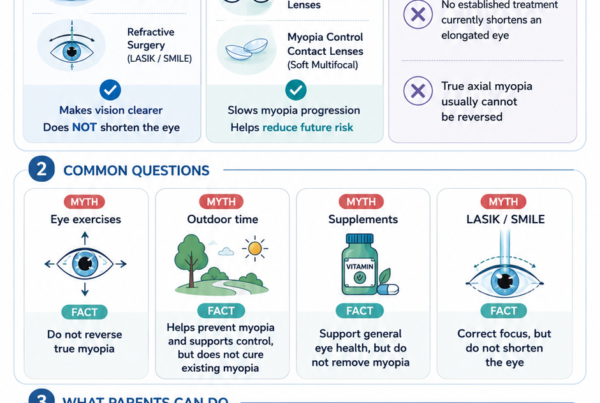
Eye Exercises
Eye exercises do not shorten an axially elongated eye.
They may help selected binocular-vision conditions, but that is different from myopia control.
Blue-Light Glasses
Blue-light filtration is not an established method of slowing axial elongation.
Vitamins and Supplements
No vitamin or supplement has been shown to provide reliable control of ordinary childhood axial myopia.
Pinhole Glasses
Pinhole apertures may temporarily improve clarity but do not control eye growth.
LASIK, SMILE and ICL Surgery
These procedures correct an adult’s existing refractive error.
They do not prevent a child’s eye from elongating and are not routine childhood myopia-control treatments.
Comparing the Main Options
| Treatment | Main strength | Main limitation | Often suits |
|---|---|---|---|
| Myopia-control spectacles | Simple, non-contact and broadly suitable | Requires consistent wear and good frame fit | Younger children and first-line treatment |
| Approximately 0.05% atropine | Strong pharmacological efficacy | Light sensitivity and near-focus effects | Young or fast-progressing children |
| Lower-dose atropine | Often easier to tolerate | May provide inadequate control in some children | Mild progression or combination treatment |
| Dual-focus soft lenses | Good control with spectacle-free sport use | Contact-lens hygiene and prescription limits | Mature, active children |
| Orthokeratology | Clear unaided daytime vision and established efficacy | Overnight-lens infection and fitting burden | Suitable corneas with strong family supervision |
| Combination treatment | May improve control in high-risk or poorly controlled cases | Greater cost, complexity and side effects | Fast progressors or inadequate monotherapy |
| Red-light therapy | Large short-term treatment effects in trials | Long-term, device-specific safety and rebound uncertainty | Selected closely monitored children |
| Outdoor time | Reduces myopia-onset risk and benefits general health | Insufficient as sole treatment for established fast progression | Every child as an adjunct |
The table provides a general framework, not an individual treatment prescription.
Which Treatment Is Best for Different Children?
A Young Child with Newly Diagnosed Myopia
Priorities include:
- Early treatment
- Simple adherence
- Minimising contact-lens risk
- Monitoring axial length
A myopia-control spectacle lens is often a practical starting point.
Atropine may be considered when:
- The child is particularly young
- Baseline risk is high
- Progression is already fast
A Child Progressing Rapidly in Ordinary Glasses
Ordinary single-vision glasses should be replaced or supplemented with an evidence-supported treatment.
Options include:
- Myopia-control spectacles
- Atropine
- Dual-focus contact lenses
- Orthokeratology
- Combination treatment
The choice depends on eye health, maturity and prescription.
A Child Progressing Despite 0.01% Atropine
The next step should not simply be to continue indefinitely without reassessment.
Consider:
- Confirming adherence
- Cycloplegic refraction
- Measuring axial length
- Increasing atropine concentration
- Adding a myopia-control optical treatment
- Changing to another treatment
- Reviewing near-work and outdoor habits
Evidence from LAMP shows a concentration-dependent response, while Singapore data support adding highly aspherical lenslet spectacles in selected children progressing despite low-dose atropine.
A Child Who Plays Competitive Sport
Possible options include:
- Daily disposable dual-focus contact lenses
- Orthokeratology
- Sports spectacles with myopia-control spectacles outside sport
- Atropine combined with appropriate correction
The choice should consider:
- Water exposure
- Contact sports
- Hygiene
- Need for protective eyewear
- Ability to handle lenses
A Child with Significant Astigmatism
Possible options include:
- Myopia-control spectacles
- Atropine
- Toric orthokeratology in suitable corneas
- Selected toric or customised contact-lens options
- Combination treatment
The prescription and corneal topography determine suitability.
A Child with Eye Allergy and Vigorous Rubbing
Contact-lens options may be more difficult.
Priorities include:
- Treating allergy
- Reducing rubbing
- Assessing the cornea
- Considering keratoconus risk
- Using spectacle or atropine treatment when appropriate
Orthokeratology should not be started without careful corneal assessment.
A Child with Poor Hygiene
A spectacle-based treatment with or without atropine is usually safer than a contact-lens-based strategy.
A Child Who Refuses Glasses
Possible alternatives include:
- Dual-focus soft contact lenses
- Orthokeratology
- Atropine with ordinary correction when required
- Continued counselling about spectacle options
The child should not be placed into contact lenses solely for cosmetic reasons when safe handling is unlikely.
A Child with High Myopia
Treatment goals include:
- Slowing further axial growth
- Maintaining clear vision
- Monitoring the retina
- Reducing the probability of even higher final myopia
Options may include:
- Atropine
- Myopia-control spectacles within the product range
- Orthokeratology within appropriate correction limits
- Soft lenses where available
- Combination treatment
High myopia does not mean that treatment is too late.
Slowing additional elongation remains valuable.
A Child Who Progresses Despite Treatment
The first step is not necessarily to declare treatment failure.
Review:
- Was the prescription accurate?
- Was cycloplegia used when necessary?
- Is axial-length measurement reliable?
- Is the treatment worn correctly?
- Is the frame slipping?
- Are contact lenses worn for enough hours?
- Are atropine doses missed?
- Has the child entered a faster growth phase?
- Has another eye condition developed?
The treatment can then be:
- Optimised
- Changed
- Strengthened
- Combined
How Treatment Should Be Chosen
Step 1: Confirm True Myopia
The examination may include:
- Visual acuity
- Cycloplegic refraction
- Axial length
- Keratometry
- Corneal topography when indicated
- Eye alignment
- Dilated retinal examination
Cycloplegia is particularly important in younger children and when pseudomyopia or accommodative spasm is possible.
Step 2: Estimate Progression Risk
Important risk factors include:
- Younger age
- Earlier onset
- More myopic starting prescription
- Rapid previous progression
- Longer axial length
- Two myopic parents
- Sibling with high myopia
- Limited outdoor time
- Significant educational or near-work load
Younger age is one of the most consistent predictors of faster progression.
Step 3: Consider Eye Health
Assess:
- Corneal shape
- Tear film
- Allergy
- Eye rubbing
- Pupil size
- Accommodation
- Strabismus
- Retinal health
- Contact-lens suitability
Step 4: Consider Lifestyle
Ask whether the child:
- Plays sport
- Swims frequently
- Can use drops
- Can handle contact lenses
- Regularly loses glasses
- Has strong night-vision demands
- Has reliable parental supervision
- Can attend follow-up
Step 5: Discuss Evidence and Uncertainty
Parents should understand:
- Expected benefit is an average, not a guarantee.
- Treatment may need to continue for years.
- Side effects vary.
- The treatment may need to be changed.
- Axial length may still increase during successful treatment.
- No treatment eliminates all future risk.
Step 6: Monitor Response
A child receiving active myopia control is commonly reviewed approximately every six months, with earlier visits after:
- Starting contact lenses
- Starting or increasing atropine
- Changing treatment
- Developing side effects
- Identifying rapid progression
A 2024 expert consensus recommended six-monthly axial-length monitoring after myopia-control treatment has begun.
How Do We Know Whether Treatment Is Working?
Compare with Previous Progression
For example:
- Before treatment: −1.00 D and 0.40 mm in one year
- During treatment: −0.25 D and 0.15 mm in one year
This suggests meaningful slowing.
Consider Age-Expected Growth
A small axial-length increase may represent excellent control in a young child.
The same increase may be less satisfactory in an older teenager.
Use More Than One Measurement
Assessment may include:
- Cycloplegic refraction
- Axial length
- Visual acuity
- Corneal topography
- Treatment adherence
- Wearing time
- Side effects
Do Not Judge Treatment Too Early
Short-term axial measurements may be affected by:
- Choroidal thickening
- Diurnal variation
- Instrument variability
- Atropine
- Orthokeratology
- Red-light treatment
A trend over several visits is generally more reliable than one isolated result.
What Is an Inadequate Response?
There is no universal definition.
Concern may arise when:
- Myopia continues progressing at approximately −0.50 D or more per year
- Axial elongation remains faster than expected for age
- The rate remains similar to pretreatment progression
- The child is approaching high myopia rapidly
- Adherence is good but control is poor
The treatment plan should be individualised rather than based on one rigid cut-off.
When Should Treatment Stop?
Treatment may be reconsidered when there has been sustained stability and the child is older.
Factors include:
- Age
- Pubertal development
- Duration of stability
- Axial-length trend
- Previous rebound
- Family history
- Treatment type
- Side effects
- Child and parent preference
Myopia can continue progressing through the teenage years and into early adulthood.
One stable six-month period does not prove that treatment can safely stop.
Rebound After Treatment Stops
Atropine
Rebound can occur, particularly with:
- Higher concentrations
- Younger age at cessation
- Abrupt discontinuation
- Previously rapid progression
In the five-year LAMP extension, most children assigned to stop after year three subsequently required retreatment.
Orthokeratology
The corneal refractive effect reverses when lens wear stops.
Axial progression may continue according to the child’s underlying growth pattern.
Myopia-Control Spectacles
The optical treatment stops when the lenses are no longer worn.
The DIMS extension did not identify a clear rebound signal after cessation, although participant numbers were relatively small.
Dual-Focus Contact Lenses
A seven-year study found that post-treatment growth returned towards age-normal rates while retaining previous treatment gains.
Red-Light Therapy
Rebound has been documented after cessation and remains an important area of investigation.
Common Myths
“There Is One Best Treatment for Every Child”
False.
Treatment must be individualised.
“The Treatment with the Highest Percentage Is Always Best”
False.
Percentages from different trials are not directly comparable.
“The Weakest Atropine Is Always Safest and Best”
Not necessarily.
A very well-tolerated treatment that does not control progression may provide inadequate protection.
“Stronger Atropine Is Always Better”
Not necessarily.
Greater efficacy must be balanced against side effects and rebound.
“Myopia-Control Glasses Work Even When Worn Occasionally”
The treatment is expected to work best with consistent wear.
“All Multifocal Contact Lenses Control Myopia”
False.
The optical design and add power matter.
“Orthokeratology Permanently Cures Myopia”
False.
The corneal effect is temporary.
“Combining Treatments Always Doubles the Effect”
False.
Some combinations produce additional control; others have not demonstrated it.
“Red-Light Therapy Is Proven Safest Because It Is Non-Contact”
False.
Non-contact treatment can still deliver energy to the retina.
Long-term, device-specific safety remains important.
“Outdoor Time Replaces Medical Treatment”
Usually false once a child has established, progressive myopia.
“Axial Length Should Never Increase During Treatment”
False.
The goal is usually slower growth, not necessarily zero growth.
“A Stable Prescription Means Treatment Is Working”
Not always.
Accommodation or corneal change may hide axial elongation.
“The Most Expensive Treatment Must Be the Best”
False.
Price is not a measure of biological effectiveness.
“Once Myopia Control Starts, It Cannot Be Changed”
False.
Treatment should be adjusted according to response and tolerability.
Frequently Asked Questions
Which Treatment Would You Usually Start First?
A myopia-control spectacle lens is often a practical first choice for a young child because of its safety and ease of use.
Atropine may be added or selected first when progression risk is high.
The final recommendation depends on the child.
Is 0.05% Atropine Better Than 0.01%?
In the LAMP trial, 0.05% produced stronger average control.
It also had greater effects on pupil size and accommodation.
Are Myopia-Control Glasses as Good as Atropine?
Both can be effective.
Their relative performance depends on the exact lens design and atropine concentration.
A recent randomised trial found less one-year axial elongation with DIMS lenses than with 0.01% atropine, but this does not establish that every spectacle design is superior to every atropine concentration.
Are Contact Lenses Stronger Than Spectacles?
Not universally.
High-quality myopia-control spectacles and contact lenses both produce meaningful control.
Suitability and adherence often matter more than a small average difference between products.
Is Orthokeratology Better Than Atropine?
It depends on:
- Age
- Prescription
- Corneal shape
- Hygiene
- Atropine concentration
- Side effects
- Treatment goals
Combination treatment may outperform either alone in selected children.
Can a Six-Year-Old Use Orthokeratology?
Some young children can use orthokeratology with close parental supervision.
Age alone is not the only consideration.
The child must have:
- Suitable corneal measurements
- Reliable hygiene
- Good follow-up
- A family capable of managing overnight lenses safely
Can a Child Use Atropine and Myopia-Control Glasses Together?
Yes.
This may be considered from the start in a high-risk child or added when one treatment provides inadequate control.
Should Every Child Start Combination Treatment?
No.
Combination treatment increases:
- Cost
- Complexity
- Side effects
- Monitoring burden
Many children respond adequately to one well-chosen treatment.
Which Treatment Has the Best Long-Term Evidence?
Atropine, orthokeratology, DIMS spectacles and dual-focus soft contact lenses have follow-up extending beyond the initial one- or two-year trial period.
The long-term studies differ in design and do not all retain randomised controls throughout.
Which Treatment Has the Best Safety?
Myopia-control spectacles generally have the lowest medical risk because they do not touch the eye and do not involve medication or retinal light exposure.
They can still produce:
- Adaptation symptoms
- Peripheral blur
- Frame-related problems
Atropine and contact lenses have different, generally manageable risks when used appropriately.
Which Treatment Works Fastest?
Some early physiological effects occur quickly, including:
- Choroidal thickening with atropine
- Corneal reshaping with orthokeratology
- Apparent axial change with red-light therapy
Myopia control should be judged over meaningful follow-up rather than by an immediate change.
Can We Try One Treatment and Change Later?
Yes.
Treatment should be reassessed when:
- Side effects are unacceptable
- The child refuses it
- Adherence is poor
- Axial elongation remains fast
- Prescription limits are reached
- Lifestyle changes
Does My Child Need Axial-Length Measurement?
Axial length is highly useful for:
- Baseline risk assessment
- Monitoring treatment
- Identifying continued structural growth
- Comparing treatments
Myopia control can still be managed when axial-length technology is unavailable, but refraction alone provides less complete information.
What if the Prescription Is Stable but Axial Length Is Increasing?
This may occur because changes in the cornea, lens or choroid partly compensate for elongation.
Continued axial growth may justify maintaining or intensifying treatment.
What if Axial Length Shortens?
Possible explanations include:
- Measurement variation
- Choroidal thickening
- Time-of-day effects
- Atropine
- Red-light therapy
- Instrument or fixation differences
Small apparent shortening does not automatically mean permanent structural reversal.
Will My Child Still Need Glasses?
Often yes.
Myopia-control treatment aims to slow worsening.
It does not usually eliminate the prescription already present.
Orthokeratology and contact lenses may provide spectacle-free vision while in use.
Is Treatment Worthwhile for Mild Myopia?
Yes.
Mild myopia may progress, particularly when it begins early.
Early treatment provides more opportunity to reduce the child’s final prescription.
Is Treatment Worthwhile Once Myopia Is Already High?
Yes.
Preventing further progression remains valuable.
Does Treatment Prevent Retinal Detachment?
It cannot guarantee prevention.
Slowing axial elongation may reduce the child’s future risk compared with allowing greater progression.
Can My Child Stop Once They Reach Thirteen?
Not automatically.
Progression commonly continues during adolescence.
Is Myopia Control Only for Asian Children?
No.
Myopia-control treatments can benefit children from different ethnic backgrounds.
However, much of the evidence was generated in East Asian populations, and treatment effects may not be identical in every population.
When to Seek Earlier Eye Assessment
Do not wait for the next routine myopia review when a child develops:
- Sudden loss of vision
- New flashes
- A sudden shower of floaters
- A curtain or shadow
- Distorted central vision
- Severe eye pain
- Marked redness
- Light sensitivity
- Contact-lens-related pain
- Discharge
- Eye injury
- Sudden double vision
These symptoms may indicate:
- Retinal tear
- Retinal detachment
- Corneal infection
- Inflammation
- Acute glaucoma
- Another ocular emergency
A Parent’s Myopia-Treatment Checklist
Before Choosing Treatment
- Confirm the prescription with appropriate refraction.
- Measure axial length when available.
- Review previous progression.
- Discuss the child’s age and risk.
- Assess corneal and ocular-surface health.
- Discuss sports and daily routines.
- Consider the child’s maturity.
- Review the family’s ability to supervise treatment.
- Ask about costs over several years.
- Discuss possible side effects.
- Plan how treatment response will be measured.
Questions About Spectacle Treatment
- Which optical design is being prescribed?
- What evidence supports it?
- How many hours should it be worn?
- How should the frame fit?
- What happens if the frame slips?
- Is the child’s astigmatism within range?
Questions About Atropine
- Which concentration is recommended?
- Why was this concentration selected?
- What side effects may occur?
- Will near glasses or tinted lenses be needed?
- How will adherence be monitored?
- How will treatment eventually be stopped?
- What is the plan if progression continues?
Questions About Contact Lenses
- Is the child mature enough?
- Is the lens daily disposable?
- Can the child swim in it?
- What symptoms require immediate lens removal?
- How often will the cornea be checked?
- Is the prescription within the treatment range?
Questions About Orthokeratology
- Is corneal topography normal?
- Who will manage lens insertion and cleaning?
- How often are reviews required?
- What if the child develops a red eye?
- Is atropine likely to be added?
- How quickly will unaided vision return if treatment stops?
Questions About Red-Light Therapy
- What device is used?
- Is its retinal exposure independently validated?
- What safety monitoring is performed?
- Is OCT required?
- What happens after treatment stops?
- How will rebound be monitored?
- What long-term data support this device?
Questions About Follow-Up
- What is the axial-length target?
- How often will measurements be repeated?
- How will age-expected growth be considered?
- When would treatment be intensified?
- When would treatment be changed?
- How will we decide when to stop?
The Bottom Line
There is no single best myopia-control treatment for every child.
The strongest established options include:
- Myopia-control spectacle lenses
- Low-concentration atropine
- Dual-focus or high-add soft contact lenses
- Orthokeratology
- Selected combination treatment
Myopia-control spectacles are often the simplest first option because they are:
- Non-invasive
- Easy to use
- Suitable for younger children
- Able to correct vision and provide control simultaneously
Approximately 0.05% atropine has stronger average clinical-trial efficacy than 0.025% or 0.01%, but causes greater pupil dilation and accommodative effects.
Dual-focus and high-add soft contact lenses provide useful control and freedom from spectacles, but require reliable hygiene.
Orthokeratology provides clear unaided daytime vision and meaningful control, but carries the responsibilities and risks of overnight rigid-lens wear.
Combining atropine with orthokeratology can provide additional control in selected children.
Adding atropine to every optical treatment does not automatically improve the result.
Repeated low-level red-light therapy has produced large short-term effects, but long-term retinal safety, device standardisation, rebound and the meaning of apparent axial shortening require further clarification.
Treatment choice should be based on:
- Age
- Age at myopia onset
- Current prescription
- Axial length
- Rate of progression
- Corneal and ocular-surface health
- Side effects
- Lifestyle
- Adherence
- Family preference
- Monitoring results
The best treatment is not merely the one with the highest percentage in a study.
It is the treatment that:
- Has credible evidence
- Is suitable for the child’s eyes
- Can be used safely
- Fits the child’s life
- Is used consistently
- Produces sufficient slowing when measured over time
Myopia-control treatment may need to be adjusted, strengthened or combined as the child grows.
References
- Yam JC, Jiang Y, Tang SM, et al. Low-Concentration Atropine for Myopia Progression Study: randomised trial of 0.05%, 0.025% and 0.01% atropine. Ophthalmology. 2019. PMID: 30514630.
- Yam JC, et al. Five-year clinical trial of the Low-Concentration Atropine for Myopia Progression Study. Ophthalmology. 2024. PMID: 38494130.
- Lam CSY, Tang WC, Tse DY, et al. DIMS spectacle lenses slow myopia progression: a two-year randomised clinical trial. Br J Ophthalmol. 2020. PMID: 31142465.
- Lam CSY, et al. Long-term myopia-control effect and safety in children wearing DIMS lenses for six years. Sci Rep. 2023. PMID: 37015996.
- Bao J, et al. One-year myopia-control efficacy of spectacle lenses with aspherical lenslets. Br J Ophthalmol. 2022. PMID: 33811039.
- Li X, et al. Myopia-control efficacy of highly aspherical lenslets: five-year follow-up. Eye Vis. 2025. PMID: 40038807.
- Walline JJ, Walker MK, Mutti DO, et al. High-add, medium-add or single-vision contact lenses: the BLINK randomised trial. JAMA. 2020. PMID: 32780139.
- Chamberlain P, et al. Long-term effect of dual-focus contact lenses on myopia progression: a six-year study. Optom Vis Sci. 2022. PMID: 35086120.
- Chamberlain P, et al. Eye growth following cessation of dual-focus soft contact-lens therapy. Optom Vis Sci. 2025. PMID: 40132119.
- Cho P, Cheung SW. Retardation of Myopia in Orthokeratology Study: a two-year randomised clinical trial. Invest Ophthalmol Vis Sci. 2012. PMID: 22969068.
- Tan Q, Ng ALK, Cheng GPM, et al. Combined 0.01% atropine with orthokeratology: a two-year randomised clinical trial. Contact Lens Anterior Eye. 2022. PMID: 35654683.
- Yang X, et al. Atropine, orthokeratology and combined treatment: a two-year stratified randomised clinical trial. Br J Ophthalmol. 2023. PMID: 36229177.
- Yuan Y, et al. Efficacy and safety of combined 0.01% atropine and orthokeratology: a two-year multicentre randomised trial. 2026. PMID: 42146920.
- Jones JH, Mutti DO, Jones-Jordan LA, Walline JJ. Combining 0.01% atropine with soft multifocal contact lenses. Optom Vis Sci. 2022. PMID: 35511120.
- Sim BX, Loh KL, Htoon HM, et al. Additive effect of highly aspherical lenslet spectacles in children inadequately controlled by atropine. Ophthalmol Sci. 2025. PMID: 40248821.
- Dong J, et al. Myopia-control effect of repeated low-level red-light therapy: a randomised, double-masked trial. Ophthalmology. 2023. PMID: 36049646.
- Jiang Y, et al. Effect of repeated low-level red-light therapy for myopia control: a multicentre randomised trial. Ophthalmology. 2022. PMID: 34863776.
- Xiong R, et al. Sustained and rebound effect of repeated low-level red-light therapy: two-year follow-up. Clin Exp Ophthalmol. 2022. PMID: 36054314.
- Lu H, et al. Repeated low-level red-light therapy: efficacy, rebound, safety boundaries and clinical standardisation. 2026. PMID: 42349599.
- Bullimore MA, Brennan NA. Childhood and lifetime risk comparison of myopia control with contact lenses. Ophthalmic Physiol Opt. 2020. PMID: 31796370.
- Lawrenson JG, et al. UK and Ireland modified Delphi consensus on myopia management in children and young people. Ophthalmic Physiol Opt. 2024. PMID: 39295273.
- Chua WH, Balakrishnan V, Chan YH, et al. Atropine for the treatment of childhood myopia. Ophthalmology. 2006. PMID: 16996612.
- Saw SM, Nieto FJ, Katz J, et al. Factors related to myopia progression in Singaporean children. Optom Vis Sci. 2000. PMID: 11100893.
- Chua SYL, et al. Age of myopia onset predicts high myopia in later childhood in Singaporean children. Ophthalmic Physiol Opt. 2016. PMID: 27350183.
- Lim DH, et al. Rapid childhood myopia progression and teenage high myopia. Invest Ophthalmol Vis Sci. 2021. PMID: 33851974.
- Wang SK, et al. Baseline factors associated with myopia progression and axial elongation in children. 2024. PMID: 39480129.
- He X, et al. Time outdoors in reducing myopia: a school-based cluster-randomised trial. Ophthalmology. 2022. PMID: 35779695.
- Chung K, Mohidin N, O’Leary DJ. Undercorrection of myopia enhances rather than inhibits progression. Vision Res. 2002. PMID: 12445849.
- Kinoshita N, et al. Orthokeratology and 0.01% atropine for slowing axial elongation: a two-year randomised trial. Sci Rep. 2020. PMID: 32728111.
- DIMS spectacle lenses versus 0.01% atropine for myopia control: a randomised trial in European children. 2025. PMID: 41225785.