Author: Dr Val Phua
Estimated reading time: 22 minutes
LASIK is a laser vision-correction procedure used to reduce dependence on spectacles or contact lenses.
The name stands for laser-assisted in situ keratomileusis.
During LASIK:
- A thin flap is created in the cornea.
- The flap is lifted.
- An excimer laser precisely reshapes the underlying corneal tissue.
- The flap is repositioned without stitches.
By altering the curvature of the cornea, LASIK changes how light is focused onto the retina.
It can treat selected patients with:
- Myopia, or short-sightedness
- Hyperopia, or long-sightedness
- Astigmatism
- Presbyopia using a monovision strategy in suitable patients
LASIK is generally highly effective in appropriately selected eyes. Modern studies report excellent refractive predictability and high rates of unaided distance vision, but the result depends on the prescription, corneal shape, tear film, healing response and laser platform. LASIK reduces refractive error; it does not guarantee perfect vision or freedom from spectacles under every condition.
Most patients recover functional vision rapidly. However, LASIK is still an operation on healthy corneal tissue and has genuine risks.
Possible problems include:
- Dry eye symptoms
- Glare, halos or starbursts
- Under-correction or over-correction
- Residual astigmatism
- Flap-related complications
- Inflammation beneath the flap
- Infection
- Corneal ectasia
- Persistent discomfort or neuropathic pain
- Rare loss of corrected vision
Careful patient selection is therefore more important than simply choosing the newest laser platform.
The Quick Answer
What Is LASIK?
LASIK is a corneal refractive procedure that changes the focusing power of the eye.
A femtosecond laser is usually used to create a thin corneal flap. An excimer laser then removes microscopic amounts of tissue from the deeper corneal layer according to the intended correction.
The flap is replaced and adheres naturally.
What Does LASIK Treat?
LASIK may correct:
- Short-sightedness
- Long-sightedness
- Regular astigmatism
- Selected residual prescriptions after previous eye surgery
- Presbyopia through monovision in appropriately counselled patients
The available treatment range depends on:
- The laser platform
- Corneal thickness
- Corneal curvature
- Prescription
- Optical-zone requirements
- Expected residual stromal thickness
- Local regulatory approval
- The surgeon’s assessment
Is LASIK Painful?
Most patients feel little or no pain during the procedure.
Anaesthetic eye drops numb the cornea.
The patient may notice:
- Pressure around the eye
- Temporary dimming of vision
- Bright lights
- Clicking sounds from the laser
- The smell of tissue molecules being released during laser ablation
The smell does not mean that the eye is burning.
How Long Does LASIK Take?
The complete procedure commonly takes approximately 10 to 20 minutes for both eyes.
The actual excimer-laser treatment may take only seconds, depending on the prescription and platform.
Additional time is needed for:
- Preparation
- Sterile cleaning
- Eye alignment
- Flap creation
- Laser checks
- Postoperative examination
How Quickly Does Vision Recover?
Many patients can see sufficiently well for basic activities by the following day.
Vision may continue to sharpen over:
- Several days
- Several weeks
- Occasionally several months
The speed of recovery varies with:
- Prescription
- Dry eye
- Degree of astigmatism
- Healing
- Treatment profile
- Pre-existing visual quality
Is LASIK Permanent?
The corneal tissue removed by the excimer laser does not grow back in its original form.
However, the eye can still change because of:
- Natural myopic progression
- Age-related refractive change
- Presbyopia
- Cataract formation
- Corneal biomechanical change
- Diabetes-related fluctuation
- Other eye disease
Long-term studies show that some patients develop gradual regression, especially after correction of higher prescriptions.
Will I Never Need Spectacles Again?
Not necessarily.
Spectacles may still be required for:
- Fine print
- Prolonged reading
- Night driving
- Very small residual refractive errors
- Age-related presbyopia
- Future cataract-related changes
- Tasks requiring exceptionally sharp vision
The goal is usually to reduce dependence on optical correction—not to guarantee that spectacles will never be needed again.
Understanding Refractive Error
Myopia
Myopia occurs when light focuses in front of the retina.
Patients can usually see near objects more clearly than distant objects.
Myopic LASIK flattens the central cornea to reduce its focusing power.
Hyperopia
Hyperopia occurs when the eye has insufficient focusing power or is relatively short.
Hyperopic LASIK steepens the central cornea by removing tissue in a surrounding ring.
Hyperopic treatments may be more prone to:
- Regression
- Decentration sensitivity
- Changes related to latent hyperopia
- Age-related refractive change
Astigmatism
Astigmatism occurs when the cornea has different curvatures in different meridians.
The laser applies an asymmetric treatment to make the corneal focusing power more regular.
Accurate astigmatism correction depends on:
- Reliable refraction
- Corneal shape
- Cyclotorsion compensation
- Eye tracking
- Treatment centration
- The distinction between corneal and internal astigmatism
Presbyopia
Presbyopia is the age-related loss of the natural lens’s ability to focus at near.
Standard LASIK reshapes the cornea but does not restore the flexibility of the natural lens.
A patient with excellent distance vision after LASIK will still develop presbyopia with age.
Monovision LASIK
Monovision is a strategy in which:
- One eye is corrected primarily for distance.
- The other eye is left mildly short-sighted for intermediate or near vision.
The brain learns to use the clearer image from each eye according to the viewing distance.
Monovision may reduce dependence on reading spectacles, but it may also reduce:
- Stereoacuity
- Fine depth perception
- Night-driving quality
- Maximum binocular distance sharpness
Historical studies report monovision acceptance rates of approximately 70% to 90% in selected patients, but outcomes depend on the amount of anisometropia and the patient’s visual priorities.
A contact-lens monovision trial is often helpful before permanent treatment.
PresbyLASIK
PresbyLASIK uses a specialised corneal ablation profile intended to provide more than one focal range.
Different designs may create:
- A central near zone
- A peripheral near zone
- Increased depth of focus
- A multifocal corneal profile
- A combination of multifocality and monovision
Current published evidence is less robust than the evidence supporting conventional myopic LASIK. A systematic review found that much of the presbyLASIK literature consisted of case series, with limited high-quality comparative evidence.
Patients considering presbyLASIK should understand the possible trade-offs between:
- Near vision
- Distance sharpness
- Contrast
- Glare
- Halos
- Ease of future cataract planning
Who May Be Suitable for LASIK?
A suitable patient generally has:
- A stable spectacle prescription
- Healthy corneas
- Adequate corneal thickness
- No evidence of keratoconus or ectasia
- A manageable degree of refractive error
- A sufficiently healthy tear film
- Realistic expectations
- No visually significant cataract
- No uncontrolled ocular or systemic disease
Age alone does not determine suitability.
The condition of the eye and the patient’s visual goals are more important.
How Stable Must the Prescription Be?
The prescription should generally be stable for at least approximately one year.
A small change does not automatically rule out surgery, but significant ongoing progression suggests that the result may not remain stable.
Refractive instability is more likely in:
- Younger adults
- Progressive myopia
- Pregnancy
- Breastfeeding
- Poorly controlled diabetes
- Certain medication use
- Hormonal change
- Lens-related refractive change
Refractive instability is recognised as an important contraindication to elective laser vision correction.
Is There a Minimum Age?
LASIK is generally not performed below 18 years of age.
Many patients in their late teens or early twenties still have progressive myopia.
Even after the legal minimum age has been reached, surgery should be delayed if the prescription is still changing.
Is There a Maximum Age?
There is no universal maximum age.
Older patients require careful assessment for:
- Presbyopia
- Early cataract
- Glaucoma
- Macular degeneration
- Dry eye
- Reduced corneal endothelial reserve
- Expectations regarding near vision
For a patient with early lens changes, cataract surgery or refractive lens exchange may sometimes provide a more appropriate long-term solution than LASIK.
Who May Not Be Suitable for LASIK?
LASIK may be inappropriate or require special caution in the presence of:
- Keratoconus
- Suspicious corneal tomography
- Corneal ectasia
- Inadequate corneal thickness
- Unstable refraction
- Significant dry eye
- Active blepharitis
- Recurrent corneal erosion
- Epithelial basement membrane dystrophy
- Previous herpetic keratitis
- Active uveitis
- Uncontrolled glaucoma
- Visually significant cataract
- Pregnancy or breastfeeding
- Poorly controlled diabetes
- Active autoimmune disease
- Medications affecting healing or refraction
- Unrealistic expectations
Reviews of current refractive-surgery guidance identify keratoconus, unstable refraction and poorly controlled ocular-surface or systemic disease among the principal contraindications.
Pregnancy and Breastfeeding
LASIK is generally postponed during pregnancy and breastfeeding.
Reasons include:
- Hormonal refractive fluctuation
- Corneal-curvature change
- Tear-film instability
- Medication considerations
- The elective nature of the procedure
Measurements should be repeated after the prescription and ocular surface have stabilised.
Diabetes
Diabetes does not automatically exclude every patient.
Suitability depends on:
- Quality of glucose control
- Stability of the prescription
- Presence of diabetic retinopathy
- Corneal sensation
- Wound healing
- Dry eye
- General health
Poorly controlled diabetes is a contraindication because it may produce refractive fluctuation and impaired healing.
Autoimmune and Connective-Tissue Disease
Active or poorly controlled autoimmune disease may increase the risk of:
- Delayed epithelial healing
- Severe dry eye
- Inflammation
- Corneal melting
- Infection
- Unpredictable healing
Patients with stable systemic disease require an individual risk assessment and, in selected cases, discussion with the treating physician.
Medications
The surgeon should know about all prescription and non-prescription medication.
Particular attention may be required for:
- Isotretinoin
- Amiodarone
- Immunosuppressive medication
- Steroids
- Antihistamines
- Antidepressants
- Hormonal medication
- Medication affecting tear production or refraction
Medication should not be stopped without consulting the prescribing doctor.
Contact Lenses Before Assessment
Contact lenses may temporarily alter the corneal shape.
They must usually be discontinued before final measurements.
The required interval depends on:
- Soft or rigid lens
- Duration of wear
- Corneal warpage
- Prescription
- Stability of repeat maps
Rigid gas-permeable and orthokeratology lenses may require a substantially longer period of discontinuation than ordinary soft lenses.
Measurements should not be accepted until the corneal shape is stable.
The Pre-LASIK Assessment
The assessment is designed to answer three questions:
- Can the prescription be treated accurately?
- Can the cornea be treated safely?
- Is LASIK the most appropriate procedure for this patient?
Medical and Ocular History
The surgeon should ask about:
- Previous eye surgery
- Contact-lens wear
- Dry eye
- Recurrent erosions
- Eye trauma
- Herpetic eye disease
- Glaucoma
- Retinal disease
- Autoimmune disease
- Diabetes
- Pregnancy plans
- Medication
- Occupational requirements
- Contact sports
- Night-driving needs
Visual-Acuity Testing
Both unaided and corrected vision are measured.
The corrected vision establishes the best level of clarity achieved with spectacles.
LASIK cannot be expected to produce vision substantially better than the eye’s true visual potential, although some customised treatments may improve selected measures of optical quality.
Manifest Refraction
The patient chooses between lenses to determine the subjective spectacle prescription.
The refraction may be repeated because small inconsistencies can affect the laser plan.
Cycloplegic Refraction
Dilating drops temporarily relax the eye’s focusing mechanism.
This is particularly useful for:
- Younger patients
- Hyperopia
- Suspected accommodative spasm
- A discrepancy between measurements
- Avoiding excessive myopic correction
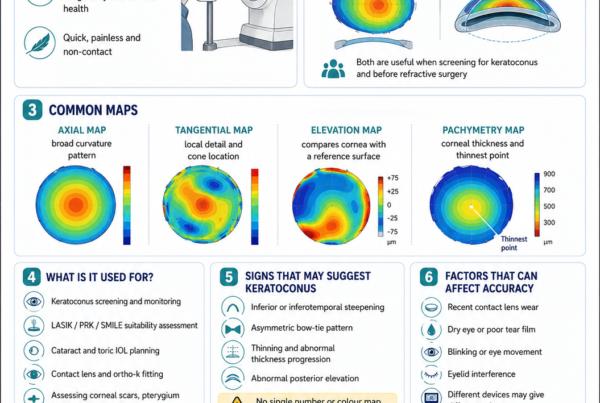
Corneal Topography
Topography maps the curvature of the front corneal surface.
It helps identify:
- Regular astigmatism
- Decentration
- Contact-lens warpage
- Irregular astigmatism
- Suspicious corneal patterns
- Previous refractive treatment
Corneal Tomography
Tomography assesses the three-dimensional structure of the cornea.
It may analyse:
- Anterior corneal curvature
- Posterior corneal curvature
- Corneal thickness
- Thickness distribution
- Elevation maps
- Ectasia-risk indices
Normal visual acuity does not exclude early keratoconus.
Tomographic screening is therefore fundamental to reducing the risk of postoperative ectasia.
Pachymetry
Pachymetry measures corneal thickness.
The surgeon considers:
- Starting corneal thickness
- Planned flap thickness
- Estimated ablation depth
- Residual stromal bed
- Percentage of tissue altered
- Corneal shape
- Patient age
- Prescription
A single minimum thickness value does not determine suitability by itself.
Epithelial Thickness Mapping
The corneal epithelium may redistribute itself to mask an underlying stromal irregularity.
Epithelial mapping can help identify:
- Early keratoconus
- Contact-lens warpage
- Irregular corneal shape
- Previous ablation patterns
- Epithelial compensation
It is an additional tool rather than a replacement for topography and tomography.
Wavefront Aberrometry
Wavefront testing measures how light travels through the entire optical system of the eye.
It identifies:
- Defocus
- Astigmatism
- Coma
- Spherical aberration
- Other higher-order aberrations
The information may be used for wavefront-guided treatment in selected patients.
Tear-Film and Dry-Eye Assessment
Evaluation may include:
- Symptoms
- Tear-break-up time
- Corneal staining
- Conjunctival staining
- Tear meniscus
- Meibomian gland function
- Eyelid inflammation
- Tear osmolarity
- Other ocular-surface tests
Dry eye should be treated before surgery because an unstable tear film can make both the measurements and postoperative vision unreliable.
Pupil Assessment
Pupil size may be assessed under dim lighting.
A large dark-adapted pupil does not automatically rule out LASIK, but it may influence:
- Optical-zone selection
- Night-vision counselling
- Treatment planning
- Expectations regarding halos
The FDA advises that large pupils and pre-existing dry eye be considered during risk assessment.
Eye-Pressure Measurement
Eye pressure is measured to screen for glaucoma.
After LASIK, standard pressure readings may appear artificially lower because the cornea has been thinned and reshaped.
Future eye-care providers should be told about the history of LASIK.
Dilated Retinal Examination
The retina and optic nerve are examined for:
- Retinal tears
- Retinal degeneration
- Myopic retinal disease
- Macular problems
- Glaucoma
- Other causes of limited visual potential
LASIK corrects corneal focus but does not remove the retinal risks associated with high myopia.
How Does LASIK Work?
Step 1: Confirming the Treatment
Before surgery, the team confirms:
- Patient identity
- Correct eye
- Prescription
- Treatment plan
- Laser calibration
- Corneal measurements
Eye-tracking and iris-registration data may be checked.
Step 2: Anaesthetic Drops
Anaesthetic drops numb the eye.
The skin and eyelids are cleaned.
A small instrument keeps the eyelids open.
The patient does not need to worry about blinking.
Step 3: Creating the Corneal Flap
A suction ring stabilises the eye.
The patient may feel pressure, and vision may dim temporarily.
A femtosecond laser creates a thin flap within the cornea.
Older LASIK techniques used a mechanical microkeratome. Femtosecond flap creation provides programmable flap diameter, depth and architecture and is now widely used in contemporary practice.
Step 4: Lifting the Flap
The surgeon gently lifts the flap to expose the underlying corneal stroma.
The flap remains attached by a hinge.
Step 5: Excimer-Laser Reshaping
The patient looks towards a fixation light.
The excimer laser removes microscopic quantities of stromal tissue.
The laser does not cut by heat. It breaks molecular bonds through photoablation.
Modern platforms may include:
- High-speed eye tracking
- Cyclotorsion compensation
- Pupil or limbal registration
- Wavefront optimisation
- Wavefront guidance
- Topography guidance
Step 6: Replacing the Flap
The flap is repositioned over the treated area.
The surgeon checks:
- Alignment
- Smoothness
- Edge position
- Interface cleanliness
- Flap adherence
No stitches are usually required.
Can Both Eyes Be Treated Together?
Yes.
Bilateral same-day treatment is common because:
- The prescription is usually bilateral.
- Recovery can occur simultaneously.
- Binocular imbalance is reduced.
- The patient needs only one main recovery period.
Each eye still requires independent checks and treatment planning.
Wavefront-Optimised LASIK
Wavefront-optimised treatment is designed to reduce the induction of spherical aberration by adjusting laser delivery across the cornea.
It does not use a fully individualised map of every higher-order aberration.
Wavefront-Guided LASIK
Wavefront-guided treatment incorporates measurements from the entire optical system of the eye.
It may be useful when:
- Measurements are reliable
- Higher-order aberrations are significant
- The pupil and iris registration are suitable
- The treatment platform supports the correction
Topography-Guided LASIK
Topography-guided treatment is based primarily on corneal surface shape.
It may aim to:
- Regularise corneal optics
- Improve treatment centration
- Reduce corneal asymmetry
- Correct refractive error
Randomised studies show that modern wavefront-guided, topography-guided and wavefront-optimised treatments can all produce excellent results. No single profile is consistently superior for every normal untreated cornea, and the relative advantages vary according to the platform, planning method and outcome being measured.
Does the Surgeon or the Laser Matter More?
Both matter.
The laser platform affects:
- Ablation speed
- Eye tracking
- Treatment profiles
- Optical-zone options
- Energy delivery
The surgeon and clinical team determine:
- Whether the patient should undergo LASIK at all
- The quality of the measurements
- Treatment selection
- Flap planning
- Management of the ocular surface
- Identification and treatment of complications
Advanced technology cannot compensate for poor patient selection.
What Happens Immediately After LASIK?
The patient may notice:
- Hazy or misty vision
- Watering
- Light sensitivity
- Burning
- Grittiness
- Difficulty keeping the eyes open
- Halos around lights
The discomfort is usually most noticeable during the first several hours.
The patient should go home and rest with the eyes closed when possible.
Eye Drops After LASIK
Medication may include:
- Antibiotic drops
- Steroid drops
- Preservative-free lubricants
- Other dry-eye treatment
The exact regimen varies.
Patients should:
- Wash their hands
- Avoid touching the bottle tip to the eye
- Use the drops as prescribed
- Space different drops apart
- Avoid stopping steroid medication without advice
The First Night
Protective shields may be worn during sleep.
The patient should avoid:
- Eye rubbing
- Pressing the eyelids
- Sleeping face-down
- Allowing a child or pet to strike the eye
The First Day
Vision is often significantly improved.
Temporary symptoms may still include:
- Haze
- Glare
- Halos
- Fluctuation
- Dryness
- Light sensitivity
A postoperative examination checks:
- Flap position
- Corneal surface
- Inflammation
- Infection
- Visual acuity
The First Week
Vision usually stabilises progressively.
Fluctuation may be more noticeable:
- Late in the day
- During prolonged screen use
- In air-conditioned environments
- When the tear film is unstable
- At night
The First Month
Dryness, glare and intermittent blur usually continue to improve.
The refractive result is often close to its intended target, but small changes may continue.
How Soon Can Normal Activities Resume?
Individual instructions take priority.
Many patients can return to desk work within a few days.
Temporary precautions commonly include avoiding:
- Eye rubbing
- Eye makeup
- Dusty environments
- Dirty water
- Swimming
- Contact sports
- Activities with risk of facial trauma
Can I Use a Computer or Phone?
Yes.
Screens do not damage the flap or reverse the laser correction.
However, prolonged screen use reduces blinking and may worsen:
- Dryness
- Burning
- Fluctuating vision
- Eye fatigue
Patients should take regular breaks and use lubricants when advised.
When Can I Drive?
Driving should resume only when:
- Vision is legally adequate
- The patient feels comfortable
- Glare is manageable
- Depth perception is satisfactory
- Sedative effects have resolved
- The surgeon has not advised otherwise
Patients should not drive themselves home after surgery.
When Can I Exercise?
Light walking is usually possible early.
Strenuous exercise may need to be avoided temporarily.
Activities with a risk of eye impact require greater caution.
When Can I Swim?
Swimming is generally avoided during the early healing period because pool, sea and spa water may contain organisms or irritants.
The surgeon will provide a specific timeline.
When Can I Wear Eye Makeup?
Eye makeup is usually avoided during the early postoperative period.
Old mascara or eye products may be contaminated and should not be used near a healing eye.
When Can I Fly?
Uncomplicated LASIK does not place a gas bubble inside the eye and usually does not prohibit flying.
Aircraft cabins may worsen dryness, so lubricating drops may be helpful.
Patients should consider the timing of postoperative appointments.
Expected Visual Results
Modern LASIK can produce excellent unaided distance vision in appropriately selected patients.
A recent prospective study of topography-guided LASIK reported 20/20 or better unaided distance vision in 97% of treated eyes at one year, while a contemporary randomised trial found similarly strong results with wavefront-guided and topography-guided treatments. These figures describe selected study populations and should not be treated as a guarantee for every patient.
A large Singapore clinical audit involving 37,932 eyes found that outcomes improved substantially over a decade as technology, nomograms and clinical governance evolved. In the later years of that audit, more than 93% of eyes were within one dioptre of the intended target.
Is 20/20 the Same as Perfect Vision?
No.
A high-contrast visual-acuity chart does not fully measure:
- Contrast sensitivity
- Glare
- Night vision
- Tear-film fluctuation
- Halos
- Starbursts
- Double images
- Visual comfort
- Quality of vision
A patient may read 20/20 but still notice visual symptoms.
Conversely, a patient with a small residual prescription may be highly satisfied if spectacles are rarely needed.
Patient Satisfaction
Most appropriately selected LASIK patients report high satisfaction.
In the FDA-associated PROWL studies, dissatisfaction with the surgery was approximately 1% to 2%, although some patients developed new visual or dry-eye symptoms. Among participants without a particular symptom before surgery, 43% to 46% reported at least one new visual symptom at three months. Most symptoms did not prevent ordinary activities, but the findings highlight the importance of counselling beyond the visual-acuity result.
More recent studies using modern treatment profiles also report high satisfaction, although individual outcomes remain dependent on patient selection and study design.
Night-Vision Symptoms
Possible symptoms include:
- Halos
- Glare
- Starbursts
- Ghost images
- Reduced contrast
- Smearing around headlights
These may be related to:
- Tear-film instability
- Residual refractive error
- Higher-order aberrations
- Large pupils
- Treatment centration
- Optical-zone transition
- Healing
Symptoms often improve over the first several months.
Persistent or severe symptoms require evaluation.
Dry Eye After LASIK
Dry eye is one of the most common postoperative concerns.
LASIK temporarily disrupts corneal nerves that contribute to:
- Corneal sensation
- Reflex tearing
- Blinking
- Tear-film regulation
- Epithelial health
Possible symptoms include:
- Burning
- Grittiness
- Fluctuating vision
- Redness
- Light sensitivity
- Tired eyes
- Excessive tearing
- Contact-lens intolerance
A systematic review identified pre-existing ocular-surface disease, meibomian gland dysfunction, deeper ablation and LASIK-related nerve disruption among the factors associated with post-refractive dry eye.
How Long Does Dry Eye Last?
For many patients, symptoms improve substantially within:
- Several weeks
- Three to six months
- Occasionally up to one year
A minority develop persistent symptoms.
The PROWL studies found that approximately 28% of participants with normal preoperative dry-eye scores reported some degree of dry-eye symptoms at three months, while overall dry-eye prevalence within the study populations decreased because many participants had symptoms before surgery.
Treating Dry Eye
Management may include:
- Preservative-free artificial tears
- Lubricating gel
- Warm compresses
- Lid hygiene
- Treatment of meibomian gland dysfunction
- Anti-inflammatory eye drops
- Punctal plugs
- Autologous serum
- Scleral lenses
- Other specialised therapy
Severe pain that appears disproportionate to the surface findings may require assessment for neuropathic corneal pain.
Under-Correction and Over-Correction
The achieved result may differ from the intended target.
Possible causes include:
- Biological healing
- Measurement variation
- Laser-tissue interaction
- Tear-film instability
- Treatment centration
- Higher prescriptions
- Hyperopic regression
- Astigmatic-axis error
Management may include:
- Observation
- Spectacles
- Contact lenses
- Enhancement surgery
- Treatment of dry eye
Regression
Regression means that part of the refractive error returns after an initially successful result.
It may be influenced by:
- High preoperative prescription
- Corneal healing
- Epithelial remodelling
- Residual stromal thickness
- Age-related lens change
- Continuing axial myopia
- Hyperopic treatment
Older ten-year LASIK studies show gradual myopic drift in some eyes, particularly after higher corrections. The results of historical treatments should not be assumed to represent current lasers exactly, but they demonstrate that the eye can continue changing after surgery.
Enhancement Surgery
An enhancement may be considered when:
- A meaningful residual prescription remains
- The prescription is stable
- The cornea remains suitable
- The visual problem is explained by the residual error
- The patient is significantly affected
- The expected benefit exceeds the additional risk
Options may include:
- Lifting the original flap
- Surface ablation over the flap
- Spectacle or contact-lens correction
- An intraocular procedure in selected patients
An enhancement is not automatically indicated for every small residual refractive error.
Flap Displacement
The LASIK flap does not regain the same structural strength as untouched cornea.
Early displacement may occur after:
- Eye rubbing
- Direct trauma
- Accidental contact
- Poor flap adherence
Symptoms may include:
- Sudden blur
- Pain
- Watering
- Light sensitivity
- A foreign-body sensation
Prompt repositioning generally produces a good result.
Late traumatic flap displacement is uncommon but can occur years after surgery following significant direct eye trauma.
Protective eyewear is important for contact sports and hazardous occupations.
Flap Striae
Striae are folds within the flap.
Fine peripheral folds may not affect vision.
Central or significant folds may cause:
- Blur
- Ghosting
- Irregular astigmatism
- Reduced corrected vision
Treatment may include flap lifting, stretching and repositioning.
Epithelial Ingrowth
Surface epithelial cells may grow beneath the edge of the flap.
It is more common after:
- Flap lifting for enhancement
- Flap trauma
- Epithelial defects
- Older age
- Previous ingrowth
Most small peripheral areas can be observed.
Treatment may be needed when ingrowth:
- Progresses
- Approaches the visual axis
- Causes flap melting
- Produces irregular astigmatism
- Reduces vision
Diffuse Lamellar Keratitis
Diffuse lamellar keratitis, or DLK, is sterile inflammation within the flap interface.
It may appear as fine white inflammatory cells beneath the flap.
The patient may notice:
- Blur
- Light sensitivity
- Discomfort
- Haze
Early treatment commonly involves intensive steroid drops.
More severe cases may require the flap to be lifted and irrigated.
A recent review distinguishes DLK from other uncommon non-infectious inflammatory conditions such as central toxic keratopathy and transient light-sensitivity syndrome.
Infection
Infectious keratitis after LASIK is rare but potentially sight-threatening.
A large study reported microbial keratitis after approximately 0.0046% of LASIK procedures—about one case per 21,700 treated eyes.
Warning signs include:
- Increasing pain
- Increasing redness
- Worsening vision
- Discharge
- Marked light sensitivity
- A white corneal spot
Urgent examination and antimicrobial treatment are required.
Corneal Ectasia
Corneal ectasia is progressive thinning and bulging of the cornea after refractive surgery.
It may cause:
- Increasing astigmatism
- Progressive short-sightedness
- Ghosting
- Reduced corrected vision
- Irregular corneal shape
- Contact-lens dependence
Risk factors include:
- Undiagnosed keratoconus
- Suspicious tomography
- Inadequate residual stromal tissue
- High percentage of tissue altered
- Young age
- Abnormal corneal shape
- Eye rubbing
- Genetic predisposition
A systematic review confirmed that post-refractive ectasia is uncommon but can occur after LASIK, PRK and SMILE, including occasionally in eyes without an obvious preoperative risk factor.
Treatment may involve:
- Corneal cross-linking
- Spectacles
- Rigid or scleral contact lenses
- Intracorneal ring segments
- Specialised laser treatment
- Corneal transplantation in advanced disease
Loss of Corrected Vision
Rarely, an eye may not see as clearly with spectacles after LASIK as it did before surgery.
Possible causes include:
- Irregular astigmatism
- Corneal scarring
- Infection
- Severe dry eye
- Ectasia
- Central flap folds
- Decentration
- Interface inflammation
Large modern series show that clinically significant loss of corrected vision is uncommon, but it cannot be reduced to zero.
Chronic Ocular Pain
A small number of patients develop persistent burning, aching or light sensitivity despite limited visible surface damage.
This may reflect:
- Severe dry eye
- Corneal nerve dysfunction
- Neuropathic corneal pain
- Central pain sensitisation
Risk may be more relevant in patients with:
- Pre-existing chronic pain
- Migraine
- Fibromyalgia
- Anxiety or depression
- Severe dry-eye symptoms
- Contact-lens intolerance
Persistent pain deserves specialist assessment and should not be dismissed merely because the cornea appears relatively normal.
Does LASIK Cause Cataracts?
LASIK reshapes the cornea and does not directly remove or replace the natural lens.
It does not prevent age-related cataract formation.
A patient who undergoes LASIK may still require cataract surgery later.
Cataract Surgery After LASIK
Previous LASIK changes the relationship between the front and back surfaces of the cornea.
This can make intraocular lens power calculation more challenging.
Patients should keep:
- Their original spectacle prescription
- Pre-LASIK corneal measurements
- Operative records
- Laser treatment details
Modern post-refractive formulas and tomography improve accuracy, but refractive prediction remains less straightforward than in an untreated cornea.
Eye-Pressure Measurement After LASIK
LASIK makes the central cornea thinner and flatter in myopic treatments.
Conventional applanation pressure readings may therefore underestimate true intraocular pressure.
This is particularly important in:
- Glaucoma suspects
- Patients with a strong family history
- High myopes
- Patients requiring steroid treatment
Future eye-care providers should be informed about the refractive surgery history.
Does LASIK Cause Retinal Detachment?
LASIK treats the cornea, not the retina.
Patients with high myopia may already have an increased lifetime risk of:
- Retinal tears
- Retinal detachment
- Myopic macular degeneration
- Other retinal complications
Correcting the spectacle prescription does not remove the underlying retinal risk.
New flashes, floaters or a curtain-like shadow require urgent retinal assessment whether or not LASIK has been performed.
LASIK Versus PRK
PRK removes the surface epithelium and applies the excimer laser without creating a permanent stromal flap.
Advantages of LASIK
- Faster visual recovery
- Less early discomfort
- Lower risk of corneal haze
- Rapid return to work
Advantages of PRK
- No flap-related complications
- More residual stromal tissue in selected eyes
- May be preferred for certain corneas or occupations
- May be preferable when trauma risk is high
Limitations of PRK
- More discomfort during early healing
- Slower visual recovery
- Risk of haze
- Longer medication course
- Greater early fluctuation
Comparative studies generally find that both procedures can produce effective long-term vision in appropriately selected patients, with LASIK offering faster recovery.
LASIK Versus SMILE
SMILE removes a laser-created stromal lenticule through a small incision without creating a LASIK flap.
Randomised-trial meta-analysis found similar overall efficacy, safety and predictability between SMILE and femtosecond LASIK for myopia.
Possible Advantages of LASIK
- Faster initial visual recovery
- Flexible customised excimer profiles
- Established eye tracking and cyclotorsion compensation
- Straightforward treatment of selected residual errors
Possible Advantages of SMILE
- No flap
- Smaller corneal incision
- Better early preservation of corneal sensitivity
- Less disruption of some corneal nerves
- Potentially fewer early dry-eye effects
Recent meta-analysis found better tear stability and corneal-sensitivity preservation after lenticule extraction than after femtosecond LASIK, although both procedures may cause temporary dry eye.
The choice depends on the eye, prescription, available platform, surgeon experience and patient priorities.
LASIK Versus ICL
An implantable collamer lens is placed inside the eye without removing the natural lens.
It may be considered for:
- High myopia
- Thin corneas
- Corneas unsuitable for laser ablation
- Patients seeking high optical quality
- Prescriptions outside an appropriate LASIK range
Advantages of LASIK
- No intraocular implant
- Rapid recovery
- No risk of intraocular lens-related cataract or vault problems
- No intraocular surgery
Advantages of ICL
- No removal of corneal stromal tissue
- Suitable for higher prescriptions
- Potentially better optical quality in selected high myopes
- Removable or exchangeable
Randomised-trial reviews have found phakic lenses to be competitive with, and in selected moderate-to-high myopia safer than, excimer-laser correction over short-term follow-up. However, ICL introduces separate intraocular risks and requires long-term monitoring.
Is LASIK Suitable for Athletes?
LASIK may be suitable for many athletes.
However, patients involved in:
- Boxing
- Martial arts
- Rugby
- Combat sports
- Activities involving facial impact
should discuss the permanent flap and alternative flap-free procedures such as PRK or SMILE.
Protective eyewear remains important after any refractive procedure.
Is LASIK Suitable for Pilots or Military Personnel?
Occupational standards vary.
Patients should confirm the requirements of their:
- Employer
- Licensing body
- Military service
- Aviation authority
- Professional organisation
before surgery.
The FDA specifically advises patients to ensure that refractive surgery will not jeopardise occupational eligibility.
Can LASIK Be Reversed?
LASIK is not considered fully reversible.
The flap can be lifted, but the corneal tissue removed by the excimer laser cannot simply be replaced.
Residual refractive error may sometimes be adjusted through:
- Additional laser treatment
- Spectacles
- Contact lenses
- Intraocular procedures
The original untreated cornea cannot be completely restored.
Can LASIK Treat Very High Myopia?
Technically treating a prescription does not necessarily mean that doing so is the best option.
Higher corrections require:
- More tissue removal
- A larger biomechanical effect
- Greater concern about regression
- More careful optical-zone planning
- More stringent ectasia screening
Historical studies of very high myopia showed substantial long-term regression and higher enhancement rates. Modern practice often considers an ICL rather than LASIK when the prescription is high or the cornea is not ideal.
Common Myths
“LASIK Guarantees Perfect Vision”
False.
Most suitable patients achieve good unaided vision, but residual prescription and optical symptoms remain possible.
“LASIK Prevents Presbyopia”
False.
The natural lens continues ageing.
Reading spectacles or monovision may eventually be needed.
“The Laser Can Slip if I Move”
Modern lasers use rapid eye tracking.
The laser can pause when alignment is lost.
The patient should still cooperate with fixation instructions.
“The Eye Can Be Accidentally Burned”
False.
The excimer laser reshapes tissue through photoablation rather than thermal burning.
“LASIK Wears Off After Ten Years”
Not exactly.
The removed tissue does not simply return, but the eye may change because of ageing, myopic progression, regression or cataract.
“Anyone with a Thin Cornea Should Have SMILE Instead”
False.
SMILE also alters corneal tissue and biomechanics.
A thin or suspicious cornea requires a complete assessment rather than automatic substitution of one procedure for another.
“LASIK Is Safer Than Contact Lenses for Everyone”
Not necessarily.
Both contact lenses and surgery have risks.
The comparison depends on contact-lens hygiene, wear duration, ocular surface, prescription and surgical suitability.
“Dry Eye Always Goes Away”
False.
Most cases improve, but persistent dry eye or neuropathic symptoms can occur.
“A Newer Laser Guarantees a Better Result”
False.
Outcomes depend on:
- Patient selection
- Measurements
- Treatment planning
- Surgeon experience
- Ocular-surface management
- Postoperative care
Frequently Asked Questions
Am I Too Short-Sighted for LASIK?
Suitability depends on more than the spectacle number.
The surgeon must consider:
- Corneal thickness
- Corneal shape
- Optical-zone size
- Residual stromal bed
- Age
- Retinal health
- Alternative treatments
Can Astigmatism Be Fully Corrected?
Regular astigmatism can often be treated effectively.
A small residual amount may remain.
Irregular astigmatism may require a different approach.
Can Both Eyes Have Different Treatments?
Yes.
In selected patients, one eye may undergo a different treatment profile or even a different procedure because of differences in:
- Corneal shape
- Prescription
- Thickness
- Visual target
- Ocular health
Can I Have LASIK Again?
An enhancement may be possible if:
- The residual error is stable
- The cornea remains suitable
- The flap and ocular surface are healthy
- The benefit justifies the risk
Surface ablation may be preferred to lifting an old flap in selected patients.
How Long Should I Wait Before an Enhancement?
The prescription should be stable.
This often requires at least several months and sometimes longer, depending on:
- Type of correction
- Healing
- Dry eye
- Degree of residual error
- Corneal thickness
Will LASIK Change My Eye Colour?
No.
The laser reshapes the transparent cornea and does not change iris pigmentation.
Will I See the Laser?
The patient sees fixation lights and brightness but does not usually see the surgical detail clearly.
What Happens if I Blink?
An eyelid holder prevents blinking during the critical part of the procedure.
What Happens if I Look Away?
The eye tracker follows small eye movements.
The laser pauses if alignment is outside the permitted range.
Can I Rub My Eyes After LASIK?
Eye rubbing should be avoided during early recovery.
Long-term vigorous eye rubbing should also be discouraged because it can:
- Injure the flap
- Worsen allergy-related inflammation
- Stress the cornea
- Contribute to ectatic change in susceptible eyes
When Can I Wash My Face?
Gentle facial washing is generally possible, but water, soap and pressure should be kept away from the eyes during the early postoperative period.
Follow the surgeon’s specific instructions.
When Can I Resume Contact Sports?
This depends on the sport and healing.
Sports involving direct eye or facial trauma require a longer precautionary period and protective eyewear.
Can LASIK Cause Blindness?
Severe permanent visual loss is very rare.
It may result from complications such as:
- Infection
- Severe ectasia
- Corneal scarring
- Uncontrolled inflammation
- Other unrelated ocular disease
The possibility is small but not zero.
Will I Need Reading Glasses?
Patients approaching or beyond the presbyopic age should expect near vision to become an issue unless monovision or another presbyopia strategy is selected.
Even with monovision, spectacles may be needed for fine print or prolonged near work.
Is LASIK Better Before or After Pregnancy?
It is generally better performed when the patient is not pregnant or breastfeeding and the prescription has stabilised.
Can I Have Cataract Surgery Later?
Yes.
The cataract surgeon should know that LASIK was performed and should use appropriate post-refractive lens-calculation methods.
Does LASIK Affect Future Glaucoma Testing?
It may affect interpretation of eye-pressure readings and certain corneal biomechanical measurements.
Optic-nerve imaging and visual-field testing remain important.
Can LASIK Correct Lazy Eye?
No.
LASIK can correct the optical prescription, but it does not reverse amblyopia that developed during childhood.
The final vision is limited by the eye’s established visual potential.
When to Seek Urgent Eye Care After LASIK
Seek urgent assessment for:
- Increasing pain
- Increasing redness
- Rapidly worsening vision
- Thick discharge
- Marked light sensitivity
- A white spot on the cornea
- Sudden flap displacement
- Trauma to the eye
- Vision that becomes worse after initially improving
- New flashes or floaters
- A curtain or shadow
Severe pain or worsening vision should never be assumed to be normal dry eye.
A LASIK Assessment Checklist
Visual Goals to Discuss
- Distance vision
- Near vision
- Computer distance
- Night driving
- Sports
- Occupational requirements
- Spectacle independence
- Monovision
- Tolerance of glare or halos
Medical Information to Report
- Diabetes
- Autoimmune disease
- Thyroid disease
- Pregnancy or breastfeeding
- Migraine
- Chronic pain
- Allergies
- Medication
- Previous healing problems
Eye History to Report
- Dry eye
- Contact-lens intolerance
- Eye rubbing
- Keratoconus in the family
- Herpetic eye disease
- Glaucoma
- Retinal tears
- Eye trauma
- Previous eye surgery
- Recurrent corneal erosion
Tests That May Be Used
- Unaided and corrected vision
- Manifest refraction
- Cycloplegic refraction
- Corneal topography
- Corneal tomography
- Pachymetry
- Epithelial mapping
- Wavefront aberrometry
- Tear-film testing
- Pupil measurement
- Eye-pressure measurement
- Dilated retinal examination
Questions to Ask the Surgeon
- Am I genuinely suitable for LASIK?
- Is my corneal tomography completely normal?
- Is the prescription stable?
- How much corneal tissue will remain?
- Would PRK, SMILE or ICL be safer?
- Which treatment profile will be used?
- What visual result is realistic?
- How likely am I to need reading spectacles?
- Should I consider monovision?
- What is my risk of dry eye?
- What is my risk of ectasia?
- What happens if residual prescription remains?
- What symptoms require urgent review?
- How frequently will I be examined afterwards?
The Bottom Line
LASIK uses a femtosecond laser and an excimer laser to reshape the cornea and reduce refractive error.
It may treat:
- Myopia
- Hyperopia
- Astigmatism
- Presbyopia through monovision in selected patients
The procedure usually:
- Takes only several minutes per eye
- Causes little pain
- Allows rapid visual recovery
- Reduces dependence on spectacles or contact lenses
However, LASIK does not guarantee perfect vision.
Possible limitations include:
- Residual refractive error
- Future spectacle use
- Presbyopia
- Regression
- Dry eye
- Night-vision symptoms
- Need for enhancement
Possible complications include:
- Flap displacement
- Flap folds
- Epithelial ingrowth
- Diffuse lamellar keratitis
- Infection
- Corneal ectasia
- Rare loss of corrected vision
- Persistent ocular pain
The quality of the result depends on:
- Stable refraction
- Healthy corneal shape
- Adequate corneal thickness
- A healthy ocular surface
- Accurate measurements
- Appropriate treatment selection
- Realistic expectations
- Careful postoperative follow-up
LASIK may not be the best procedure for every patient.
PRK may be preferable when avoiding a flap is important.
SMILE may offer advantages for selected myopic patients concerned about flap-related issues or early dry eye.
ICL may be more appropriate for high prescriptions or corneas unsuitable for laser treatment.
The most important message is:
The success of LASIK begins before the laser is used. A thorough assessment should determine not only whether LASIK is technically possible, but whether it is the safest and most appropriate vision-correction option for that individual eye.
References
- Eydelman M, Hilmantel G, Tarver ME, et al. Symptoms and satisfaction of patients in the Patient-Reported Outcomes With Laser In Situ Keratomileusis studies. JAMA Ophthalmol. 2017;135(1):13–22. doi:10.1001/jamaophthalmol.2016.4587. PMID: 27893066.
- Manche EE, et al. Prospective, randomised, contralateral-eye comparison of wavefront-guided and topography-guided LASIK. J Cataract Refract Surg. 2025. PMID: 40778939.
- Meide EVH, Ferguson TJ, Berdahl JP, Thompson VM, Terveen DC. Visual acuity and quality-of-life results in a randomised trial of topography-guided LASIK versus wavefront-optimised LASIK. J Refract Surg. 2025;41(7)–e634. PMID: 40626438.
- Wei S, Zheng Y, Fu C, et al. One-year outcomes of topography-guided LASIK for myopia and astigmatism. J Ophthalmol. 2026;2026:3410286. PMID: 41626317.
- Yuen LHY, Chan WK, Koh J, Mehta JS, Tan DTH; SingLasik Research Group. A 10-year prospective audit of LASIK outcomes for myopia in 37,932 eyes at a single institution in Asia. Ophthalmology. 2010;117(6):1236–1244.e1. doi:10.1016/j.ophtha.2009.10.042. PMID: 20153899.
- Alió JL, Muftuoglu O, Ortiz D, et al. Ten-year follow-up of LASIK for myopia of up to −10 dioptres. Am J Ophthalmol. 2008;145(1):46–54. PMID: 18154754.
- Alió JL, Muftuoglu O, Ortiz D, et al. Ten-year follow-up of LASIK for high myopia. Am J Ophthalmol. 2008;145(1):55–64. PMID: 17996210.
- Moshirfar M, et al. Ectasia after corneal refractive surgery: a systematic review. Ophthalmol Ther. 2021. PMID: 34417707.
- Eslami M, et al. Post-refractive surgery dry eye: a systematic review exploring pathophysiology, risk factors and management. Cureus. 2024. PMID: 38916023.
- Chen KY, Chan HC, Chan CM. Keratorefractive lenticule extraction compared with LASIK for dry-eye outcomes: a systematic review and meta-analysis. J Refract Surg. 2025;41(8)–e854. PMID: 40778870.
- Zhang Y, Chen Y. Topography-guided versus wavefront-optimised femtosecond LASIK for myopia and myopic astigmatism. J Refract Surg. 2019;35(9):575–582. PMID: 31498415.
- Sales CS, Manche EE. One-year comparison of wavefront-guided and wavefront-optimised LASIK in myopes. Ophthalmology. 2013;120(12):2396–2402. PMID: 23778091.
- Reinstein DZ, et al. Topography-guided LASIK versus SMILE for myopia and myopic astigmatism: a randomised contralateral-eye study. J Refract Surg. 2017;33(5):306–312. PMID: 28486721.
- Shen Z, Shi K, Yu Y, Yu X, Lin Y, Yao K. SMILE versus femtosecond LASIK for myopia: systematic review and meta-analysis. PLoS One. 2016. PMID: 27367803.
- Fu Y, Yin Y, Wu X, et al. SMILE and LASIK for myopia and myopic astigmatism: systematic review and meta-analysis of randomised clinical trials. Eye Contact Lens. 2023;38(3):283–293. PMID: 35912896.
- Zhang ZH, Jin HY, Suo Y, et al. Dry eye after refractive surgery: a meta-analysis. Can J Ophthalmol. 2020;55(2):99–106. PMID: 31712000.
- Moshirfar M, et al. Infectious keratitis after laser vision correction: incidence and risk factors. J Cataract Refract Surg. 2017. PMID: 28532931.
- Linebarger EJ, Hardten DR, Lindstrom RL. Diffuse lamellar keratitis: incidence, associations, outcomes and classification. J Cataract Refract Surg. 2000. PMID: 11687352.
- Moshirfar M, et al. Non-infectious inflammatory complications of lamellar refractive corneal surgery: DLK, central toxic keratopathy and transient light-sensitivity syndrome. Curr Opin Ophthalmol. 2025. PMID: 40601513.
- Fernández J, Molina-Martín A, Rocha-de-Lossada C, Rodríguez-Vallejo M, Piñero DP. Clinical outcomes of presbyopia correction with current presbyLASIK techniques: a systematic review. Eye. 2023;37(4):587–596. PMID: 35864161.
- Jain S, et al. Update on contraindications in laser corneal refractive surgery. Arch Soc Esp Oftalmol. 2022. PMID: 36114139.
- Sugar A, Rapuano CJ, Culbertson WW, et al. Laser in situ keratomileusis for myopia and astigmatism: safety and efficacy assessment. Ophthalmology. 2002.
- Barsam A, Allan BDS. Excimer laser refractive surgery versus phakic intraocular lenses for moderate-to-high myopia. Cochrane Database Syst Rev. 2014. PMID: 24937100.
- Moshirfar M, et al. Refractive eye surgery: helping patients make informed decisions about LASIK. Am Fam Physician. 2017;95(10):637–644. PMID: 28671403.