Author: Dr Val Phua
Estimated reading time: 10–12 minutes
When Are Dry Eyes More Than a Minor Irritation?
Occasional dryness after prolonged screen use, air conditioning, insufficient sleep or exposure to wind is common. Mild symptoms may settle after resting the eyes, blinking more frequently or using an appropriate lubricating eye drop.
However, persistent or worsening symptoms should not simply be accepted as part of modern life.
Dry eye disease is a complex condition involving instability of the tear film and ocular surface. It may be caused by rapid tear evaporation, blocked eyelid oil glands, inadequate tear production, inflammation, eyelid-closure problems or abnormal corneal nerve sensation. Several causes often occur together.
An eye assessment is advisable when symptoms:
- Persist despite reasonable home treatment
- Affect work, reading, driving or sleep
- Cause frequent fluctuation of vision
- Become progressively worse
- Are much more severe in one eye
- Occur after eye surgery
- Make contact-lens wear uncomfortable
- Require artificial tears repeatedly throughout the day
Severe pain, reduced vision, marked light sensitivity or a painful red eye in a contact-lens wearer requires prompt assessment rather than continued self-treatment.
What Does Dry Eye Disease Feel Like?
Dry eye disease does not always feel simply “dry”.
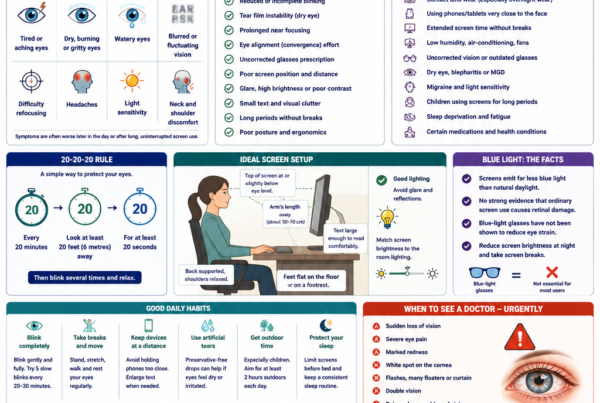
Symptoms may include:
- Burning or stinging
- A gritty, sandy or foreign-body sensation
- Tired or heavy eyes
- Redness
- Watery eyes
- Itching
- Light sensitivity
- Mucus around the eyes
- Difficulty wearing contact lenses
- Intermittent or fluctuating blurred vision
- Symptoms that worsen during screen use
- Discomfort in air-conditioned or windy environments
Vision may temporarily improve after blinking because the blink redistributes the tear film over the cornea.
Excessive tearing does not exclude dry eye. An irritated ocular surface may trigger reflex watery tears that overflow but evaporate quickly because the protective oil layer remains inadequate.
When Is Home Care Reasonable?
A brief trial of self-care may be reasonable when symptoms are:
- Mild
- Occasional
- Present in both eyes
- Clearly associated with screens, reading or air conditioning
- Not accompanied by pain, significant redness or reduced vision
- Improving with blinking, rest or lubrication
Helpful initial measures include:
- Taking regular screen breaks
- Blinking fully and frequently
- Avoiding direct airflow from fans or air-conditioning vents
- Using preservative-free artificial tears when drops are needed frequently
- Applying warm compresses when meibomian gland dysfunction or blepharitis is already known
- Reducing contact-lens wearing time
- Getting adequate sleep
- Removing eye makeup thoroughly
First-line dry-eye care commonly involves education, environmental modification and support of the tear film. Treatment should nevertheless be adjusted to the underlying mechanism rather than assuming that every patient simply needs more artificial tears.
When Should I Book a Routine Eye Examination?
Arrange a non-urgent eye examination when symptoms persist, recur frequently or interfere with daily life.
Symptoms Persist Despite Artificial Tears
Artificial tears may relieve mild symptoms, but repeated self-treatment without improvement suggests that lubrication alone is not addressing the cause.
You may have:
- Meibomian gland dysfunction
- Blepharitis
- Aqueous tear deficiency
- Ocular-surface inflammation
- Allergy
- Eyelid-closure problems
- Medication-related dryness
- Neuropathic ocular pain
The American Academy of Ophthalmology recommends professional assessment when dry-eye symptoms are persistent, worsening, affecting ordinary activities or not relieved by over-the-counter treatment.
You Need Drops Many Times Each Day
Frequent dependence on artificial tears may indicate more significant disease.
Preservative-free drops are generally preferable when lubrication is required frequently, but needing repeated drops without sustained relief should prompt an examination rather than endless switching between brands.
A clinician can determine whether treatment should include:
- A different lubricant formulation
- Eyelid and meibomian gland treatment
- Anti-inflammatory medication
- Tear-conservation strategies
- Treatment for incomplete eyelid closure
- Further investigation
Your Vision Frequently Fluctuates
The tear film is the first optical surface that light encounters when entering the eye.
When it breaks up, vision may become intermittently blurred and then improve after blinking. This is particularly noticeable during:
- Reading
- Computer work
- Night driving
- Prolonged concentration
- Exposure to air conditioning
Frequent fluctuation should be assessed because blur may also arise from an outdated spectacle prescription, cataracts, corneal disease, retinal disease, diabetes or another eye condition.
Symptoms Affect Work, Reading or Driving
Dry eye deserves proper treatment when it begins affecting:
- Productivity
- Reading endurance
- Screen tolerance
- Night driving
- Sleep
- Exercise
- Contact-lens wear
- Quality of life
Treatment should not be judged only by how red the eye looks. Some patients experience substantial symptoms despite relatively subtle surface findings, while others have significant corneal staining with limited discomfort. Modern dry-eye assessment therefore combines symptoms with tear-film and ocular-surface testing.
Your Eyes Are Persistently Red
Dry eye can cause redness, but persistent redness may also indicate:
- Blepharitis
- Allergy
- Infection
- Episcleritis or scleritis
- Uveitis
- Contact-lens complications
- Medication toxicity
- Glaucoma-related problems
Redness that is severe, painful, one-sided or associated with reduced vision should be assessed promptly.
Your Symptoms Are Much Worse in One Eye
Dry-eye disease often affects both eyes, although severity may differ.
Markedly one-sided symptoms raise the possibility of:
- Incomplete eyelid closure
- A local eyelid abnormality
- A retained foreign body
- Corneal disease
- Infection
- Previous surgery or injury
- Abnormal eyelash growth
- A blocked tear-drainage pathway
- Localised nerve dysfunction
Persistent asymmetry should not be repeatedly treated as ordinary dry eye without examination.
Contact Lenses Have Become Uncomfortable
Contact lenses alter the tear film and may increase evaporation, friction and deposit accumulation.
Arrange a review if you experience:
- Reduced wearing time
- Progressive discomfort
- Increasing dryness
- Frequent redness
- Blurred vision through the lenses
- Lenses that become uncomfortable later in the day
The assessment may identify dry eye, poor lens fit, excessive wearing time, allergy, meibomian gland dysfunction or corneal complications.
Remove the lenses immediately and seek prompt care if the eye becomes painful, intensely red, light-sensitive or visually blurred. These may be symptoms of contact lens-related corneal infection.
You Have Recurrent Styes or Chalazia
Recurrent eyelid lumps may indicate underlying:
- Meibomian gland dysfunction
- Posterior blepharitis
- Rosacea
- Demodex infestation
- Chronic gland obstruction
Treating only the individual lump may not prevent recurrence. An examination can assess the eyelid margins, gland secretions and tear film.
A lump that repeatedly returns in the same location, causes lash loss or has an unusual appearance should be examined carefully.
You Have Crusty, Itchy or Inflamed Eyelids
Dry eye commonly coexists with blepharitis.
Signs include:
- Flakes or crusts around the eyelashes
- Red or thickened eyelid margins
- Itching
- Recurrent styes
- Sticky eyelids on waking
- Blocked oil-gland openings
Blepharitis, meibomian gland dysfunction and aqueous-deficient dry eye overlap but may require different treatment approaches.
Your Symptoms Began After Eye Surgery
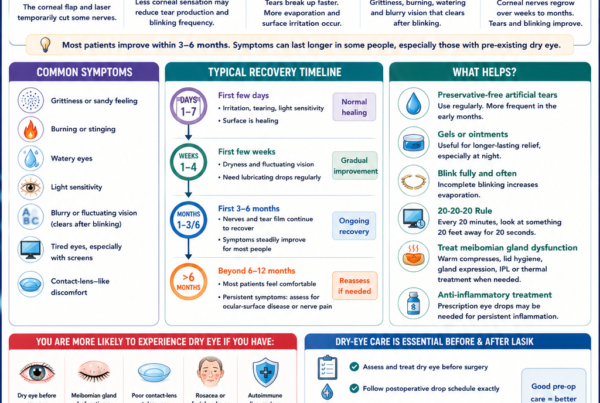
Temporary dryness may occur after:
- LASIK
- SMILE
- PRK
- Cataract surgery
- Eyelid surgery
An examination is appropriate when postoperative symptoms:
- Are worsening rather than improving
- Remain significant beyond the expected recovery period
- Require very frequent lubrication
- Are associated with persistent blur
- Are markedly worse in one eye
- Include significant pain or light sensitivity
Postoperative symptoms should not automatically be attributed to dry eye because infection, inflammation, wound problems or other surgical complications may produce similar complaints.
You Are Planning Cataract or Refractive Surgery
The ocular surface should ideally be stable before cataract measurements or refractive surgery.
An unstable tear film may affect:
- Corneal measurements
- Astigmatism assessment
- Intraocular lens calculations
- Refractive-surgery planning
- Postoperative comfort
- Visual recovery
Treating dry eye and eyelid disease before elective surgery can improve measurement consistency and reduce postoperative symptoms.
You Have Dry Mouth or Systemic Symptoms
Dry eye accompanied by other symptoms may indicate an underlying medical condition.
Mention symptoms such as:
- Persistent dry mouth
- Difficulty swallowing dry food
- Joint pain or swelling
- Fatigue
- Skin rashes
- Raynaud-type symptoms
- Salivary-gland swelling
Possible associated conditions include:
- Sjögren syndrome
- Rheumatoid arthritis
- Lupus
- Thyroid disease
- Rosacea
- Diabetes
- Other autoimmune or neurological disorders
An ophthalmologist may recommend further medical investigation or referral when severe aqueous tear deficiency or systemic disease is suspected.
You Take Medication That May Cause Dryness
Dry eye may be associated with medications such as:
- Antihistamines
- Some antidepressants
- Diuretics
- Certain blood-pressure medications
- Isotretinoin
- Selected bladder medications
- Hormonal treatments
- Long-term preserved glaucoma drops
Do not stop prescribed medication without speaking to the doctor who prescribed it.
An eye assessment can help determine whether medication is contributing and whether the ocular surface can be supported while treatment continues.
When Should I Seek an Earlier Appointment?
An earlier assessment—within days rather than waiting for a routine check—is advisable when:
- Symptoms are progressively worsening
- The eyes remain significantly red
- Vision does not consistently clear after blinking
- One eye is notably worse
- There is persistent light sensitivity
- The eyelids are increasingly swollen or tender
- You recently had eye surgery
- You have an autoimmune condition
- A new treatment appears to be worsening the symptoms
- Dry eye is interfering substantially with sleep or daily activities
These symptoms may still result from dry-eye disease, but the ocular surface should be examined for inflammation, epithelial damage and alternative diagnoses.
Which Symptoms Require Urgent Eye Assessment?
Certain symptoms are not typical of uncomplicated dry eye.
Seek prompt ophthalmic care if you develop any of the following.
Significant or Increasing Eye Pain
Ordinary dry eye may cause burning, grittiness or soreness, but severe or increasing pain may indicate:
- Corneal infection
- Corneal abrasion
- Uveitis
- Scleritis
- Acute glaucoma
- Chemical injury
- Another serious condition
Pain that wakes you from sleep or feels markedly worse than the visible redness deserves urgent review.
Sudden or Persistent Reduction in Vision
Fluctuating blur that clears after blinking may arise from tear-film instability.
Vision that remains reduced, deteriorates suddenly or does not improve after blinking requires prompt assessment. Dry eye should not be assumed to be the cause of a significant visual change.
Marked Sensitivity to Light
Mild light sensitivity may occur with dry eye, but prominent photophobia can indicate significant corneal inflammation, infection or inflammation inside the eye.
Seek prompt care when light sensitivity is:
- New
- Severe
- Associated with pain
- Associated with reduced vision
- Much worse in one eye
A White Spot on the Cornea
A white or grey spot on the clear front surface of the eye may represent a corneal infiltrate or ulcer.
This requires urgent examination, particularly in a contact-lens wearer.
Do not continue contact-lens wear or attempt to manage the problem using artificial tears alone.
A Painful Red Eye While Wearing Contact Lenses
This should be treated as potentially urgent.
Remove the contact lenses and arrange prompt ophthalmic assessment if there is:
- Pain
- Redness
- Light sensitivity
- Discharge
- Tearing
- Blurred or reduced vision
Contact lens-related microbial keratitis can progress rapidly and may cause permanent corneal scarring or visual loss if treatment is delayed.
Bring the lenses, storage case and solutions to the appointment if advised, but do not reinsert the lenses.
Thick Discharge
Dry eye may cause small amounts of stringy mucus.
Thick yellow or green discharge, increasing crusting or eyelids stuck together may suggest infection or another inflammatory condition.
Discharge accompanied by pain, light sensitivity or reduced vision needs prompt assessment.
Severe or One-Sided Redness
Intense redness confined mainly to one eye is less typical of ordinary dry-eye disease.
Seek timely assessment, particularly when redness is associated with:
- Pain
- Reduced vision
- Headache
- Nausea
- Light sensitivity
- Corneal haze
- Recent surgery
- Contact-lens use
Eye Injury or Chemical Exposure
Do not treat an injured eye as dry eye.
Following chemical exposure:
- Immediately rinse the eye with large amounts of clean water or saline.
- Continue irrigation rather than searching for a particular eye drop.
- Remove contact lenses if they come out easily.
- Seek urgent medical attention.
Following trauma, prompt assessment is needed for persistent pain, visual change, bleeding or suspected foreign material.
Symptoms After Eye Surgery
Contact your surgeon promptly if, after cataract or refractive surgery, you develop:
- Increasing pain
- Worsening vision
- Significant redness
- Marked light sensitivity
- Discharge
- Increasing corneal haze
- Symptoms that suddenly worsen after initially improving
These symptoms may indicate a postoperative complication rather than ordinary dryness.
Severe Pain but Few Visible Signs
Rarely, a patient may have severe burning, aching or light sensitivity that appears out of proportion to visible ocular-surface findings.
This can occur with neuropathic corneal pain, in which corneal nerves or pain pathways become abnormally sensitive.
Possible clues include:
- Burning or electric pain
- Severe wind or light sensitivity
- Symptoms triggered by air conditioning
- Poor response to repeated artificial tears
- Persistent symptoms after eye surgery
- Significant pain despite limited staining
This condition requires specialist evaluation. Simply increasing lubricating drops may provide little benefit.
Which Patients Should Have a Lower Threshold for Assessment?
Seek professional advice earlier if you:
- Wear contact lenses
- Recently underwent eye surgery
- Have Sjögren syndrome or another autoimmune condition
- Have diabetes
- Have thyroid eye disease
- Have facial-nerve weakness
- Use several long-term eye drops
- Have previously had a corneal infection
- Have only one well-seeing eye
- Are immunocompromised
- Cannot close your eyelids fully
- Have severe rosacea or recurrent eyelid disease
In these situations, ocular-surface problems may progress more quickly or require more specialised management.
What Happens During a Dry-Eye Examination?
A comprehensive assessment looks beyond whether the eye appears wet or dry at one moment.
Medical and Symptom History
Your ophthalmologist may ask about:
- Burning, watering and fluctuating vision
- Timing and triggers
- Screen exposure
- Contact-lens wear
- Air conditioning
- Medication
- Previous eye surgery
- Autoimmune symptoms
- Treatments already attempted
The pattern of symptoms may provide clues to the underlying cause.
Visual Acuity and Refraction
Vision is checked to determine whether blur is caused by the tear film or another optical or ocular condition.
Tear-Film Assessment
The clinician may examine:
- Tear volume
- Tear-film breakup
- Debris
- Evaporation
- Mucus
- The oily tear layer
Ocular-Surface Staining
Special dyes can reveal microscopic damage to the cornea and conjunctiva.
Staining helps establish disease severity and whether the ocular surface requires more intensive protection.
Eyelid and Meibomian Gland Assessment
The eyelids are examined for:
- Blocked gland openings
- Thickened oil
- Blepharitis
- Rosacea
- Demodex-related collarettes
- Incomplete blinking
- Incomplete eyelid closure
Gentle gland expression may show whether the oil is clear, cloudy, thick or absent.
Additional Testing
Selected patients may undergo:
- Tear-breakup measurements
- Tear osmolarity
- Schirmer tear-production testing
- Meibography
- Lipid-layer assessment
- Blink analysis
- Corneal topography
- Corneal-sensation testing
- Blood tests for suspected autoimmune disease
TFOS DEWS diagnostic guidance supports a combination of symptom evaluation, tear-film stability testing and ocular-surface assessment while excluding other conditions that can mimic dry eye.
Not every patient requires every test.
What Treatment Might an Eye Specialist Recommend?
Treatment depends on the underlying cause.
Possible options include:
- Preservative-free artificial tears
- Lipid-containing lubricants
- Gels or ointments
- Warm compresses
- Eyelid hygiene
- Treatment of blepharitis or Demodex
- Prescription anti-inflammatory eye drops
- Treatment for ocular allergy
- Punctal plugs
- Meibomian gland expression
- Thermal treatment
- Intense pulsed light in selected patients
- Serum eye drops
- Scleral lenses
- Treatment for incomplete eyelid closure
- Investigation of autoimmune disease
- Management of neuropathic corneal pain
Modern dry-eye management is stepwise and cause-directed. Patients with similar symptoms may require very different treatment plans.
How Long Does Dry-Eye Treatment Take?
Dry eye is often chronic and tends to fluctuate.
Some patients improve within days after correcting a clear trigger. Others require several weeks or months of consistent treatment before the tear film and ocular surface become more stable.
Improvement depends on:
- The underlying cause
- Disease duration
- Degree of gland obstruction or loss
- Presence of inflammation
- Eyelid closure
- Screen and environmental exposure
- Adherence to treatment
- Associated medical conditions
Stopping treatment as soon as symptoms improve may allow the condition to flare again. Maintenance therapy is often necessary.
Frequently Asked Questions
How long should I try artificial tears before seeing a specialist?
There is no universal waiting period.
Arrange an examination if symptoms persist despite appropriate use, repeatedly return or affect daily activities. Seek care sooner if there is pain, significant redness, light sensitivity or reduced vision.
Can an optometrist diagnose dry eye?
Optometrists can assess and manage many forms of dry eye. An ophthalmologist is particularly appropriate when symptoms are severe, persistent, one-sided, associated with visual loss, related to surgery or accompanied by suspected corneal, inflammatory or systemic disease.
Is watery eye a reason to see an ophthalmologist?
Yes, if tearing is persistent, one-sided or associated with redness, pain, discharge or visual change. Watery eyes may result from dry-eye irritation, allergy, eyelid problems or blocked tear drainage.
Should I see a specialist if artificial tears work?
Occasional symptoms that resolve fully with simple measures may not require urgent assessment.
However, examination is advisable if you need drops frequently, symptoms keep returning or you are unsure of the cause.
Can severe dry eye damage the cornea?
Yes. Significant untreated ocular-surface disease can lead to epithelial breakdown, infection, ulceration, scarring and visual impairment, although these complications are uncommon in ordinary mild dry eye.
Can dry eye cause permanent vision loss?
Mild dry eye typically causes fluctuating rather than permanent blur. Severe ocular-surface damage can affect vision and requires specialist treatment.
Should contact-lens wearers wait to see whether symptoms settle?
Remove the lenses immediately. Mild discomfort that resolves completely may be monitored, but pain, redness, light sensitivity, discharge or reduced vision requires prompt assessment.
Is severe pain normal in dry eye?
No. Dry eye can be uncomfortable, but severe pain should prompt assessment for infection, inflammation, injury or neuropathic corneal pain.
A Practical Triage Guide
| Situation | Recommended action |
|---|---|
| Mild, occasional dryness related to screens or air conditioning | Try healthy screen habits, environmental changes and appropriate lubrication |
| Symptoms repeatedly return | Book a routine comprehensive eye examination |
| Drops are required many times daily | Arrange an assessment to identify the underlying cause |
| Persistent fluctuating vision | Arrange an eye examination |
| Recurrent styes, crusting or eyelid inflammation | Book an eyelid and meibomian gland assessment |
| Symptoms after eye surgery | Contact the treating surgeon if persistent or worsening |
| Significant one-sided symptoms | Arrange an earlier examination |
| Painful, red eye with contact lenses | Remove lenses and seek prompt ophthalmic care |
| Severe pain, reduced vision or marked light sensitivity | Seek urgent assessment |
| White corneal spot, injury or chemical exposure | Seek urgent eye care |
The Bottom Line
Occasional mild dryness may improve with blinking, screen breaks, environmental changes and artificial tears.
You should see an eye specialist when symptoms:
- Persist or worsen
- Require frequent eye drops
- Affect vision or daily activities
- Make contact-lens wear difficult
- Are accompanied by eyelid inflammation
- Are significantly worse in one eye
- Develop after eye surgery
- Suggest an underlying medical condition
Seek prompt care for:
- Significant eye pain
- Sudden or persistent reduction in vision
- Marked light sensitivity
- A white corneal spot
- Thick discharge
- Severe one-sided redness
- A painful red eye while wearing contact lenses
- Eye injury or chemical exposure
Dry eye is not a single condition with a single treatment.
A comprehensive assessment can determine whether the main problem is tear evaporation, inadequate tear production, eyelid-gland dysfunction, inflammation, incomplete eyelid closure or abnormal nerve sensation—and guide treatment towards the actual cause rather than the symptoms alone.
References
- Amescua G, et al. Dry Eye Syndrome Preferred Practice Pattern. Ophthalmology. 2024.
- Wolffsohn JS, et al. TFOS DEWS III: Diagnostic Methodology. American Journal of Ophthalmology. 2025.
- Jones L, et al. TFOS DEWS III: Management and Therapy. American Journal of Ophthalmology. 2025.
- National Eye Institute. Dry Eye: Symptoms, Diagnosis and Treatment. Updated 2025.
- American Academy of Ophthalmology. What Is Dry Eye? Symptoms, Causes and Treatment. Updated 2025.
- American Academy of Ophthalmology. Contact Lens-Related Eye Infections. Updated 2026.
- Rhee MK, et al. Bacterial Keratitis Preferred Practice Pattern. Ophthalmology. 2024.