Author: Dr Val Phua
Estimated reading time: 10–12 minutes
Not All Artificial Tears Are the Same
Artificial tears are among the most commonly used treatments for dry, gritty or tired eyes. They are readily available without a prescription and are generally safe when used correctly.
However, the number of products available can be confusing. Some drops are watery, while others are gels, emulsions or ointments. Some contain preservatives, while others are preservative-free. Certain products are designed primarily to replace moisture, while others attempt to strengthen the oily layer of the tear film.
There is no single artificial tear that is best for everyone.
The most suitable formulation depends on:
- Why your eyes are dry
- How severe the symptoms are
- How frequently drops are required
- Whether you wear contact lenses
- Whether symptoms are worse during the day or at night
- Whether meibomian gland dysfunction is present
- Whether you have undergone eye surgery
Artificial tears remain a cornerstone of dry-eye treatment, but they relieve symptoms rather than correcting every underlying cause of dry-eye disease.
What Are Artificial Tears?
Artificial tears are lubricating eye drops designed to supplement or stabilise the natural tear film.
Depending on their formulation, they may:
- Add moisture to the eye
- Reduce friction between the eyelids and cornea
- Improve tear-film stability
- Slow tear evaporation
- Protect damaged ocular-surface cells
- Temporarily improve fluctuating vision
- Relieve burning, grittiness and irritation
Despite the name, artificial tears do not reproduce every component and function of natural tears.
Natural tears contain water, oils, mucins, electrolytes, proteins, enzymes, antibodies and growth factors. Most artificial tears replace only some of these functions.
Understanding the Natural Tear Film
The tear film has several interacting components.
The Oily Layer
The outer oily layer is produced mainly by the meibomian glands in the eyelids.
It helps prevent the watery tears from evaporating too quickly.
The Watery Component
The lacrimal glands produce the watery part of the tear film.
This provides moisture, nutrients and protective substances to the ocular surface.
Mucins
Mucins help tears spread evenly and adhere to the cornea and conjunctiva.
Dry-eye disease may develop when one or more of these components becomes inadequate. A patient with insufficient watery tears may benefit from a different formulation from someone whose tears are evaporating because of meibomian gland dysfunction.
What Can Artificial Tears Treat?
Artificial tears may relieve symptoms associated with:
- Mild dry-eye disease
- Prolonged computer or smartphone use
- Air-conditioned or low-humidity environments
- Contact-lens wear
- Meibomian gland dysfunction
- Blepharitis
- Age-related tear-film changes
- Temporary dryness after cataract or refractive surgery
- Exposure to wind, smoke or haze
They may also be used alongside prescription dry-eye treatments.
What Artificial Tears Cannot Do
Artificial tears do not usually:
- Permanently cure dry-eye disease
- Unblock significantly obstructed meibomian glands
- Eliminate blepharitis or Demodex
- Treat a bacterial corneal infection
- Replace anti-inflammatory treatment when significant inflammation is present
- Correct incomplete eyelid closure
- Treat an underlying autoimmune condition
- Reverse gland loss
Persistent symptoms despite regular lubrication suggest that the underlying dry-eye mechanism may need to be addressed.
Why Are There So Many Types?
Artificial tears differ in:
- Lubricating ingredients
- Viscosity or thickness
- Lipid content
- Electrolyte composition
- Osmolarity
- Preservatives
- Bottle design
- Duration of effect
Systematic reviews have found that artificial tears generally improve dry-eye symptoms, but the evidence does not establish one ingredient or formulation as universally superior. Treatment is therefore often individualised through clinical assessment and, sometimes, careful trial of an appropriate formulation.
Watery or Low-Viscosity Artificial Tears
These drops are relatively thin and usually cause little blurring after application.
They may contain lubricants such as:
- Carboxymethylcellulose
- Hypromellose
- Hydroxypropyl guar
- Polyvinyl alcohol
- Povidone
- Glycerin
They are often suitable for:
- Mild or intermittent dryness
- Screen-related discomfort
- Daytime use
- Patients who dislike temporary blur
- Use before visually demanding activities
Their disadvantage is that they may leave the eye relatively quickly and require more frequent application.
Hyaluronic Acid Eye Drops
Hyaluronic acid, also called sodium hyaluronate, is a water-binding molecule used in many modern artificial tears.
It can:
- Retain moisture
- Lubricate the ocular surface
- Increase the time the drop remains on the eye
- Support corneal epithelial healing
Different products contain different concentrations and molecular weights of hyaluronic acid, so they may not feel or perform identically.
Hyaluronic acid is a useful option for many patients, but it should not automatically be assumed to be better than every other lubricant. Overall performance depends on the complete formulation, the patient’s dry-eye mechanism and how well the product is tolerated.
Lipid-Based Artificial Tears
Lipid-containing drops or emulsions are intended to supplement the oily outer layer of the tear film.
They may be especially useful when dryness is associated with:
- Meibomian gland dysfunction
- Evaporative dry eye
- Rapid tear-film breakup
- Air conditioning
- Reduced blinking
- Prolonged screen use
These formulations may appear slightly milky and can cause brief visual blur after application.
Lipid drops can support the tear film, but they do not necessarily clear obstructed glands. Warm compresses, eyelid hygiene and other gland-directed treatments may still be required.
Gel Drops
Gel formulations are thicker than ordinary artificial tears.
They remain on the eye longer and may be useful for:
- Moderate dryness
- Symptoms that return quickly after ordinary drops
- Severe screen-related discomfort
- Evening use
- Exposure-related dryness
Because gels are thicker, they may cause temporary blurring or a sticky sensation.
Patients often prefer using them when they do not immediately need to drive, read fine print or perform visually demanding work.
Lubricating Ointments
Eye ointments are the thickest form of ocular lubrication.
They are usually used:
- Before sleep
- For significant nighttime dryness
- When the eyelids do not close fully
- For recurrent morning discomfort
- In more severe ocular-surface disease
Ointments commonly blur vision and should generally not be applied immediately before driving or daytime visual tasks.
They may also leave temporary residue around the eyelids.
Preserved Versus Preservative-Free Artificial Tears
This is one of the most important distinctions when choosing a lubricant.
Preserved Eye Drops
Preservatives help prevent microorganisms from growing inside a multidose bottle.
Preserved formulations may be convenient and economical for occasional use.
However, repeated exposure to certain preservatives—particularly benzalkonium chloride—may irritate or damage an already vulnerable ocular surface. The risk becomes more relevant with frequent, chronic use and when several preserved eye medications are being used simultaneously.
Preservative-Free Eye Drops
Preservative-free artificial tears are generally preferred when:
- Drops are required frequently
- Dry eye is moderate or severe
- The ocular surface is sensitive
- Contact lenses are worn
- Several other eye drops are being used
- There is significant corneal staining
- The patient has undergone recent eye surgery
- Preserved drops cause burning or redness
NICE’s British National Formulary recommends preservative-free tear replacement for frequent and chronic use.
Preservative-free drops may come in:
- Single-use vials
- Specially designed multidose bottles that prevent contamination without preservatives
Preservative-free does not mean contamination-free. Correct handling remains essential.
Are “Soft” or Disappearing Preservatives Safe?
Some products use preservatives designed to break down into less irritating substances after application.
These may be better tolerated than traditional preservatives in some patients.
However, a truly preservative-free formulation may still be preferable for people with:
- Severe dry eye
- Significant ocular-surface damage
- Preservative sensitivity
- Frequent dosing
- Multiple long-term eye medications
The complete clinical situation matters more than the marketing description on the box.
How Often Can Artificial Tears Be Used?
The appropriate frequency depends on the product and the severity of symptoms.
Some patients use drops only occasionally, while others require regular application throughout the day.
General principles include:
- Use the product according to its instructions.
- Apply drops regularly during known triggers rather than waiting for severe discomfort.
- Preservative-free formulations are preferable when drops are used frequently or chronically.
- Persistent need for repeated drops should prompt assessment for an underlying cause.
If you find yourself applying lubricants many times each day without meaningful relief, simply adding more drops may not solve the problem.
You may have:
- Meibomian gland dysfunction
- Blepharitis
- Significant ocular-surface inflammation
- Incomplete eyelid closure
- Allergy
- Neuropathic ocular pain
- Aqueous tear deficiency
- Another eye condition
Should Artificial Tears Be Used Regularly or Only When Symptoms Occur?
Artificial tears may be used as needed for occasional symptoms.
However, patients with predictable or persistent dryness often benefit from using drops regularly for a period rather than waiting until the eyes become very uncomfortable.
For example, someone whose symptoms worsen during computer work may use a lubricant before starting prolonged screen activity and then at suitable intervals during the day.
Clinical studies suggest that regular artificial-tear use can improve symptoms within weeks, although improvement in ocular-surface signs may take longer.
How Do I Choose the Right Type?
A practical guide is shown below.
| Dry-eye pattern | A formulation that may be considered |
|---|---|
| Mild, occasional irritation | Low-viscosity lubricating drop |
| Frequent daytime symptoms | Preservative-free artificial tear |
| Rapid evaporation or MGD | Lipid-containing formulation |
| Symptoms returning soon after drops | More viscous or gel formulation |
| Nighttime or morning dryness | Lubricating gel or ointment |
| Sensitive ocular surface | Preservative-free formulation |
| Contact-lens discomfort | A drop specifically approved for use with that lens type |
| Significant or persistent disease | Professional assessment rather than repeated self-treatment alone |
This table is a general guide and does not replace an examination.
Which Ingredient Is Best?
There is no universally superior ingredient.
Different patients may respond differently to:
- Hyaluronic acid
- Carboxymethylcellulose
- Hydroxypropyl guar
- Hypromellose
- Glycerin
- Lipid emulsions
- Combinations of several lubricants
The product that feels most soothing immediately is not always the one that produces the most stable tear film over time.
A reasonable approach is to match the formulation to the suspected mechanism, use it consistently and assess the response before changing products repeatedly.
Can I Use More Than One Type?
Yes.
Some patients use:
- A low-viscosity drop during the day
- A lipid-based drop when evaporation is prominent
- A gel or ointment before sleep
However, using several products without a clear plan may create confusion and make it difficult to identify what is helping.
It is often better to begin with one appropriate formulation and adjust treatment according to the response.
Artificial Tears and Contact Lenses
Not every artificial tear is suitable for use while contact lenses are being worn.
Some drops contain ingredients or preservatives that are not intended to be trapped beneath a lens.
Contact-lens wearers should:
- Check whether the product is approved for use with contact lenses.
- Use a designated contact-lens rewetting drop where appropriate.
- Remove lenses before applying drops unless the instructions specifically allow use with lenses.
- Wait for the recommended period before reinserting lenses.
- Stop lens wear if the eye becomes painful, red or light-sensitive.
Artificial tears may improve comfort, but persistent contact-lens intolerance may indicate poor lens fit, excessive wearing time, dry-eye disease or infection.
Artificial Tears After Eye Surgery
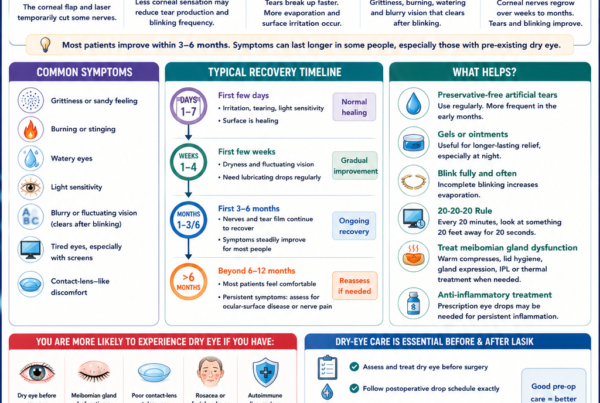
Lubricating drops are commonly used after cataract surgery, LASIK, SMILE and PRK.
However, patients should follow the surgeon’s instructions because:
- Some drops may not be suitable immediately after surgery.
- Postoperative antibiotics or steroids must not be replaced by artificial tears.
- Several drops may need to be spaced apart.
- Preservative-free products may be preferred in selected patients.
When using more than one eye drop, leaving approximately five minutes between different medications can reduce washout.
How to Apply Artificial Tears Correctly
- Wash and dry your hands.
- Check that the bottle or vial is intact and within its expiry date.
- Tilt your head back.
- Gently pull down the lower eyelid.
- Look upwards.
- Place one drop into the lower eyelid pocket.
- Avoid touching the bottle tip to the eye, lashes, fingers or another surface.
- Close the eye gently rather than squeezing tightly.
- Replace the cap immediately if using a multidose bottle.
One drop is usually sufficient because the eye cannot hold a large volume.
How to Use Single-Dose Vials Safely
Unless the product instructions specifically state otherwise:
- Open the vial only when ready to use it.
- Avoid touching the tip.
- Use it immediately.
- Do not share the vial.
- Discard it after use, even if some solution remains.
US over-the-counter ophthalmic labelling requires single-use containers to be discarded after opening because reuse may introduce contamination.
Why Eye-Drop Hygiene Matters
Eye drops must be sterile.
The dropper tip should never touch:
- The eye
- Eyelashes
- Skin
- Fingers
- Countertops or other surfaces
Contaminated eye drops can cause serious infections. Regulatory authorities have issued recalls and warnings after contaminated products were linked to sight-threatening infections, reinforcing the importance of purchasing approved products from reputable sources and following storage and handling instructions.
Do not use a bottle if:
- The seal was broken when purchased
- The solution has changed colour
- Particles are visible
- The bottle is damaged
- The expiry date has passed
- The product has been recalled
- The drop causes unexpected pain, discharge or worsening redness
Are Redness-Relieving Drops Artificial Tears?
Not necessarily.
Some “get the red out” products contain vasoconstrictors that temporarily narrow superficial blood vessels.
These products may make the eye look whiter without treating the cause of dryness or inflammation.
They should not be confused with lubricating artificial tears and should not be used repeatedly to conceal persistent redness.
Chronic or one-sided redness deserves proper assessment.
Are Artificial Tears the Same as Prescription Dry-Eye Medication?
No.
Artificial tears mainly lubricate or supplement the tear film.
Prescription dry-eye treatments may:
- Reduce inflammation
- Stimulate natural tear production
- Treat associated eyelid disease
- Address immune-mediated ocular-surface dysfunction
Examples include ciclosporin, short supervised courses of topical corticosteroids and other anti-inflammatory or tear-stimulating therapies.
Patients may require both artificial tears and prescription treatment.
Can Artificial Tears Cause Side Effects?
Possible effects include:
- Brief stinging
- Temporary blurred vision
- Sticky eyelids
- Residue around the lashes
- Sensitivity to a preservative or another ingredient
- Increased redness
- Allergic reactions
Brief mild blur after a gel or ointment is expected.
Persistent burning, swelling, discharge or worsening redness is not and should prompt discontinuation and assessment.
Why Do Some Drops Make My Eyes Feel Worse?
Possible reasons include:
- Sensitivity to the preservative
- Allergy to another ingredient
- The formulation being too thick or too thin
- Drops being used with incompatible contact lenses
- Contamination of the bottle
- An underlying condition other than dry eye
- Significant ocular-surface inflammation
- Neuropathic ocular pain
A product that works well for one person may not suit another.
When Are Artificial Tears Not Enough?
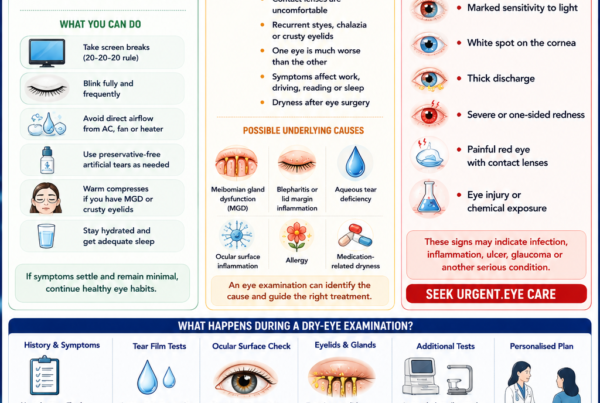
Seek professional assessment if:
- Symptoms persist despite regular lubrication
- Drops are required very frequently
- Vision repeatedly fluctuates
- Symptoms affect work, reading or driving
- Contact lenses are no longer comfortable
- You have recurrent styes or chalazia
- The eyes remain persistently red
- One eye is much worse than the other
- Symptoms began after surgery
- You have dry mouth, joint pain or an autoimmune condition
A dry-eye evaluation may include examination of the tear film, ocular-surface staining, eyelid assessment, meibomian gland expression and selected imaging or tear tests.
Warning Signs Requiring Prompt Assessment
Ordinary dry eye usually causes irritation rather than severe pain or marked loss of vision.
Seek prompt ophthalmic care for:
- Significant eye pain
- Sudden or persistent reduction in vision
- Marked sensitivity to light
- A white spot on the cornea
- Thick discharge
- Severe or one-sided redness
- Eye injury or chemical exposure
- A painful red eye while wearing contact lenses
- Symptoms that become worse after using a particular bottle of drops
These features may indicate infection, inflammation or another urgent condition.
Frequently Asked Questions
Can I use artificial tears every day?
Yes. Many people use them daily. Preservative-free formulations are generally preferred when drops are required frequently or over long periods.
Can I become dependent on artificial tears?
Artificial tears do not cause chemical dependence. However, symptoms may return when the drops wear off because the underlying dry-eye condition remains present.
Do artificial tears reduce natural tear production?
There is no good evidence that ordinary lubricating drops make the lacrimal glands “lazy” or stop natural tear production.
Are expensive drops always better?
No. Price does not reliably predict which formulation will suit an individual patient. Ingredients, preservatives, viscosity and the underlying dry-eye mechanism are more important.
Should I refrigerate artificial tears?
Only if the product instructions recommend or permit it. Some patients find cool drops soothing, but storage requirements vary.
Can I share eye drops with someone else?
No. Sharing eye drops increases the risk of contamination and infection.
How long can I keep a bottle after opening?
Follow the manufacturer’s instructions. The safe period varies according to the preservative and bottle design. Write the opening date on the bottle if this helps you keep track.
Can children use artificial tears?
Many lubricants can be used in children, but persistent redness or discomfort should be assessed rather than repeatedly self-treated.
Can artificial tears wash out my prescription drops?
They can dilute another medication if applied immediately afterwards. Separate different eye drops by approximately five minutes unless your doctor advises otherwise.
The Bottom Line
Artificial tears are an important first-line treatment for dry-eye disease, but not all formulations are interchangeable.
A useful general approach is:
- Choose a lighter drop for mild daytime symptoms.
- Consider a lipid-containing drop for evaporative dry eye or meibomian gland dysfunction.
- Use a gel or ointment when longer-lasting or nighttime lubrication is needed.
- Prefer preservative-free formulations for frequent or chronic use.
- Confirm compatibility before using drops with contact lenses.
- Handle every bottle or vial carefully to prevent contamination.
Artificial tears provide lubrication and symptom relief, but they may not address blocked eyelid glands, inflammation, eyelid closure problems or autoimmune tear deficiency.
If symptoms persist despite regular drops, the next step should not always be another brand. A comprehensive dry-eye assessment can identify the underlying cause and guide more effective treatment.
References
- Jones L, et al. TFOS DEWS III: Management and Therapy. American Journal of Ophthalmology. 2025.
- Amescua G, et al. Dry Eye Syndrome Preferred Practice Pattern. Ophthalmology. 2024.
- Semp DA, et al. Artificial Tears: A Systematic Review. Clinical Optometry. 2023.
- Walsh K, Jones L. The Use of Preservatives in Dry Eye Drops. Clinical Ophthalmology. 2019.
- British National Formulary. Dry Eye: Treatment Summary.
- US Food and Drug Administration. What You Should Know About Eye Drops.
- US Food and Drug Administration. OTC Monograph M018: Ophthalmic Drug Products for Human Use.