Author: Dr Val Phua
Estimated reading time: 22 minutes
Children should have age-appropriate eye and vision screening from infancy, with further examinations during the preschool and school years.
However, there is no single examination interval that is appropriate for every child.
How often a child’s eyes should be checked depends on:
- Age
- Symptoms
- Previous screening results
- Spectacle prescription
- Myopia progression
- Eye alignment
- Amblyopia risk
- Prematurity
- Developmental or neurological conditions
- Family history
- Contact-lens use
- Previous eye disease or surgery
For a healthy child with no symptoms or known risk factors, recurrent age-appropriate vision screening may be sufficient.
The American Association for Pediatric Ophthalmology and Strabismus recommends:
- Eye and visual assessment during infancy
- Screening during the toddler and preschool years
- Formal visual-acuity testing when the child can cooperate
- Repeat vision screening every one to two years after five years of age
Children who fail screening, cannot complete screening reliably or have symptoms or risk factors should receive a comprehensive eye examination rather than simply waiting for the next routine screen.
In Singapore, the Health Promotion Board provides vision screening in preschools and through primary-school health services. These programmes are valuable safety nets, but they should not delay an earlier examination when parents, teachers or healthcare professionals have concerns.
Children who already have an eye condition usually require more frequent reviews.
For example:
- A child receiving amblyopia treatment may need review within several weeks.
- A child undergoing myopia-control treatment is commonly assessed approximately every six months.
- A child with rapidly changing vision, strabismus or another active condition may need earlier follow-up.
- A child with stable glasses and otherwise healthy eyes may be reviewed every six to twelve months, depending on age and prescription.
The most important principle is:
Do not wait for a scheduled screening when a new symptom or visible abnormality develops.
The Quick Answer
How Often Should a Healthy Child Have an Eye Test?
A practical general schedule is:
- Birth and infancy: eye and red-reflex assessment during routine healthcare visits
- One to three years: age-appropriate visual assessment or instrument-based screening
- Three to five years: formal vision screening at least once, preferably with each eye tested separately
- Five years and older: repeat screening approximately every one to two years
- At any age: comprehensive examination when symptoms, risk factors or an abnormal screening result are present
Different countries and healthcare organisations use different schedules.
Research has not identified one globally accepted screening frequency that is superior for every population. Screening programmes also differ in their equipment, referral criteria and access to follow-up care.
Does Every Child Need a Comprehensive Eye Examination Every Year?
Not necessarily.
The AAPOS Choosing Wisely guidance states that annual comprehensive examinations are not required for every healthy, asymptomatic child who consistently passes properly conducted recurrent vision screening.
Comprehensive examinations remain appropriate when:
- Screening is failed
- Screening cannot be completed
- Symptoms are present
- Risk factors are present
- The child has an existing eye condition
- Parents or teachers remain concerned
This distinction helps avoid both extremes:
- Assuming that school screening replaces all eye care
- Assuming that every healthy child requires specialist examination every year
What if My Child Wears Glasses?
Children wearing glasses generally need more frequent reviews than children with no known eye condition.
A practical interval is commonly:
- Every three to six months for very young children, changing prescriptions or active amblyopia
- Every six to twelve months for many stable school-aged children
- Earlier when the child reports blur or the prescription appears to be changing
The exact schedule depends on:
- The child’s age
- Type and strength of prescription
- Difference between the two eyes
- Eye alignment
- Visual acuity
- Myopia progression
- Whether the glasses are part of amblyopia treatment
How Often Should a Child with Myopia Be Checked?
A child with myopia is commonly reviewed approximately every six months, particularly when:
- Myopia is progressing
- Axial length is being monitored
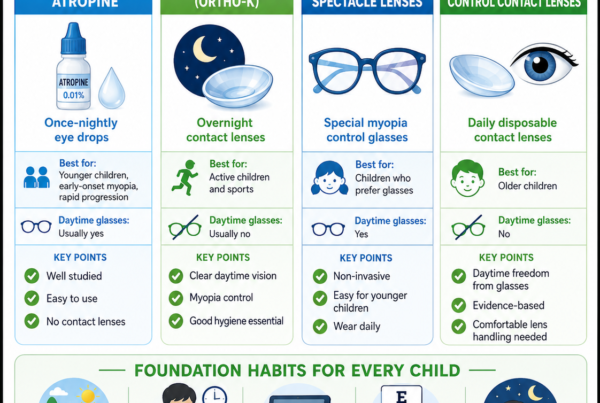
- Atropine is being used
- Myopia-control spectacles are worn
- Dual-focus contact lenses are worn
- Orthokeratology is used
A 2024 UK and Ireland consensus recommended six-monthly axial-length monitoring after a myopia-control intervention has begun. More frequent appointments may be required during initial lens fitting, when side effects occur or when progression is faster than expected.
How Often Should a Child with Amblyopia Be Checked?
Amblyopia treatment usually requires review over weeks or months rather than once a year.
Follow-up assesses:
- Vision in each eye
- Glasses wear
- Patching or atropine adherence
- Improvement in the amblyopic eye
- Vision in the better eye
- Eye alignment
- Need to increase, reduce or stop treatment
Clinical trials of amblyopia treatment frequently reassess children after approximately six to ten weeks because useful visual change may occur over this period. The exact interval should be individualised.
How Often Should a Child with Strabismus Be Checked?
The schedule depends on:
- Age
- Type of strabismus
- Frequency of the eye turn
- Control
- Visual acuity
- Amblyopia
- Glasses prescription
- Double vision
- Whether surgery has been performed or planned
A young child with newly diagnosed strabismus may need review within weeks or a few months.
An older child with stable alignment and equal vision may be reviewed less frequently.
Strabismus should not simply be observed indefinitely without confirming that both eyes are developing useful vision.
A Practical Eye-Check Schedule by Age
Newborn to Three Months
What Should Be Checked?
The newborn eye assessment commonly includes:
- External appearance of the eyes
- Eyelid position
- Pupil shape
- Red reflex
- Eye size
- Obvious structural abnormalities
- Relevant family and birth history
The red reflex should generally be present and reasonably symmetrical in both eyes.
An absent, dull, white or markedly unequal reflex requires prompt investigation.
When Should Parents Seek Earlier Assessment?
Seek prompt assessment for:
- A white pupil
- A cloudy cornea
- An unusually large eye
- Marked light sensitivity
- Constant tearing
- An abnormal pupil
- An obvious structural abnormality
- A strong family history of retinoblastoma or serious congenital eye disease
Infants who do not begin fixing or following appropriately after the early months should also be assessed. AAPOS recommends referral when an infant is not tracking well after approximately three months of age.
Three to Twelve Months
What Is Assessed During Infancy?
Healthcare professionals may observe:
- Fixation
- Following behaviour
- Eye alignment
- Eye movements
- Pupil responses
- Red reflexes
- Visual attention
- Whether both eyes appear to be used equally
A baby does not need to identify letters or pictures for useful assessment.
Are Brief Eye Turns Normal in Babies?
Eye control may appear immature during the earliest weeks.
However, persistent or recurrent misalignment should not automatically be dismissed.
Assessment is particularly important when:
- The turn is constant
- The same eye always turns
- The appearance persists beyond early infancy
- The baby has abnormal visual behaviour
- An unusual head position develops
- The eye turn is associated with a white pupil or abnormal red reflex
Twelve to Thirty-Six Months
How Can a Toddler Be Screened?
Testing may include:
- Visual behaviour
- Eye alignment
- Pupil examination
- Red-reflex examination
- Photoscreening
- Handheld autorefraction
- Picture or matching tests
- Objective refraction when indicated
Instrument-based screening is useful for toddlers who cannot yet perform a conventional visual-acuity test.
It may identify risk factors such as:
- High myopia
- High hyperopia
- Astigmatism
- Unequal prescriptions
- Strabismus
- Media opacity
Does Photoscreening Replace an Eye Examination?
No.
Photoscreening identifies children at increased risk and refers them for further assessment.
It does not directly measure all aspects of vision or exclude every retinal, optic-nerve or binocular-vision disorder.
A meta-analysis of photoscreening in children younger than three found that approximately 13% were referred, 8% could not be screened and the pooled positive predictive value was about 56%. Screening performance varied substantially between studies and programmes.
What if My Toddler Cannot Complete the Test?
An untestable result should not automatically be treated as a pass.
The child may require:
- A repeat screen
- An instrument-based test
- A comprehensive eye examination
- Referral based on age, risk factors and observations
Updated preschool-screening recommendations emphasise follow-up systems for children who fail or cannot complete screening.
Three to Five Years
Why Is the Preschool Period Important?
Preschool screening aims to detect conditions that may interfere with visual development, including:
- Amblyopia
- Strabismus
- Unequal refractive error
- High refractive error
- Cataract
- Ptosis
- Other causes of reduced vision
Amblyopia is often asymptomatic because the stronger eye compensates.
The preschool period provides an important opportunity to begin treatment while the visual system remains highly adaptable.
How Often Should Preschoolers Be Screened?
A child should have at least one reliable monocular visual-acuity or instrument-based screening assessment during the preschool years.
Screening may occur more than once through:
- Well-child visits
- Preschool programmes
- Community screening
- Eye-care visits
AAPOS recommends age-appropriate visual-acuity screening from 36 months onward when the child can cooperate.
What Are Typical Screening Thresholds?
AAPOS screening guidance uses age-based thresholds:
- Between 36 and 47 months, the child should identify most symbols on the 20/50 line
- Between 48 and 59 months, the child should identify most symbols on the 20/40 line
- From five years onward, most symbols on the 20/32 line should be identified
These are screening referral thresholds rather than final diagnostic definitions.
What if One Eye Sees Better Than the Other?
A difference between the eyes can be important even when both eyes appear to pass a broad screening threshold.
Unequal vision may indicate:
- Anisometropic amblyopia
- Strabismic amblyopia
- Corneal or lens disease
- Retinal or optic-nerve disease
- Variable cooperation
A comprehensive assessment may be needed.
Five Years and Older
How Often Should School-Aged Children Be Screened?
For children aged five and older without known risk factors, AAPOS recommends repeat vision screening every one to two years.
Screening commonly includes:
- Distance visual acuity in each eye
- External inspection
- Eye alignment
- Pupil and red-reflex assessment
- Further tests according to the screening programme
Why Is Repeat Screening Needed?
A normal preschool result does not prevent a later condition from developing.
Myopia commonly begins during the school years.
Other changes may include:
- Increasing astigmatism
- Decompensating strabismus
- Eye injury
- Contact-lens-related disease
- Retinal or neurological disease
- Medication-related effects
Is School Screening Enough?
School screening is valuable, but it has limitations.
It may not fully assess:
- Cycloplegic prescription
- Intermittent strabismus
- Eye strain
- Near-vision symptoms
- Corneal disease
- Retinal or optic-nerve health
- Myopia progression
- Axial length
- Contact-lens safety
Parents should arrange further assessment when symptoms persist despite a passed screening result.
Teenagers
How Often Should Teenagers Be Checked?
A teenager with no symptoms, no glasses and consistently normal screening may continue age-appropriate screening every one to two years.
More frequent reviews are appropriate for teenagers with:
- Myopia
- Rapidly changing prescriptions
- Contact lenses
- Keratoconus risk
- Eye allergy and vigorous rubbing
- Diabetes
- Previous eye surgery
- Glaucoma risk
- Retinal disease
- Visual requirements for driving or occupation
Does Myopia Stop When a Child Becomes a Teenager?
Not necessarily.
Myopia may continue progressing through the teenage years and sometimes into early adulthood.
A teenager should continue follow-up until the prescription and, where measured, axial length have demonstrated meaningful stability.
Eye Screening in Singapore
Preschool Screening
Singapore’s Health Promotion Board provides growth, developmental and vision screening for children in Kindergarten 1 and Kindergarten 2 through participating preschool services.
Children who miss school-based screening may be directed to the Student Health Centre.
Primary-School Screening
HPB’s Youth Preventive Health and Dental Services provides health screening for Primary 1 to Primary 6 students, including vision assessment.
School screening commonly assesses distance visual acuity using a Snellen-type chart.
HPB guidance indicates that children with vision below specified referral thresholds may require further assessment.
Does Singapore School Screening Replace Eye-Clinic Follow-Up?
No.
A child who already has:
- Myopia
- Amblyopia
- Strabismus
- An eye disease
- Contact lenses
- Myopia-control treatment
should continue the review schedule recommended by the treating eye-care professional.
Parents should also arrange examination when they observe a problem between school screenings.
Which Children Need More Frequent Examinations?
Children Who Wear Glasses
The frequency depends on why the glasses were prescribed.
A younger child may need earlier review because:
- Visual development is active
- The prescription may change
- The glasses may affect alignment
- Amblyopia may be present
- The frame may quickly become poorly fitted
A school-aged child with a stable prescription may be reviewed every six to twelve months.
Earlier review is appropriate when:
- The child reports blur
- The child sits closer to the board
- Headaches develop
- The glasses are no longer worn comfortably
- The eye begins turning
- The child closes one eye
- Academic or visual behaviour changes
- The lenses or frame are damaged
Children with Myopia
Myopia management involves more than checking whether the child can still read the chart with glasses.
A follow-up may assess:
- Unaided visual acuity
- Corrected visual acuity
- Refraction
- Axial length
- Eye alignment
- Retinal health
- Treatment adherence
- Side effects
- Time outdoors
- Near-work habits
Stable Low Myopia
A child with apparently stable myopia may still require review every six to twelve months.
The apparent absence of complaints does not prove that the prescription or axial length has stopped changing.
Progressive Myopia
Review approximately every six months is commonly appropriate.
More frequent review may be required when:
- The prescription changes rapidly
- Axial length is increasing faster than expected
- Treatment has recently started
- Adverse effects occur
- Orthokeratology lenses do not fit appropriately
- Contact-lens hygiene is poor
Consensus recommendations support six-monthly axial-length monitoring during active myopia management when this measurement is available.
Children Receiving Low-Dose Atropine
Follow-up may assess:
- Vision
- Refraction
- Axial length
- Pupil size
- Light sensitivity
- Near vision
- Allergic or local reactions
- Adherence
The first follow-up may be earlier than six months when:
- A new concentration is started
- Side effects occur
- The child has difficulty with reading
- The treatment regimen changes
Atropine should not be continued indefinitely without review of progression and tolerability.
Children Wearing Myopia-Control Spectacles
A review may determine:
- Whether the prescription remains accurate
- Whether the frame position is appropriate
- Whether the child looks through the intended treatment zones
- Whether the lenses are worn consistently
- Whether myopia continues progressing
Poor frame fit may reduce the practical effectiveness of some lens designs.
Children Wearing Soft Contact Lenses
An initial follow-up may be required soon after fitting.
Long-term review assesses:
- Vision
- Lens fit
- Corneal health
- Tear film
- Hygiene
- Replacement schedule
- Myopia progression when applicable
The child should be assessed earlier for:
- Redness
- Pain
- Light sensitivity
- Discharge
- Sudden blur
- Reduced contact-lens tolerance
Children Using Orthokeratology
Orthokeratology requires structured follow-up because lenses are worn overnight.
Reviews may be more frequent during initial fitting and may later occur every three to six months depending on the child and practice protocol.
Assessment may include:
- Unaided vision
- Refraction
- Corneal topography
- Lens fit
- Corneal staining
- Lens hygiene
- Axial length
- Myopia progression
A painful red eye in an orthokeratology wearer requires prompt assessment.
Children with Amblyopia
Amblyopia is treated during a period when visual development remains responsive.
Waiting a full year between visits during active treatment would usually be inappropriate.
Reviews may be arranged every several weeks to a few months depending on:
- Age
- Severity
- Cause
- Treatment
- Rate of improvement
- Adherence
- Vision in the better eye
The treatment plan may include:
- Glasses
- Patching
- Atropine
- Bangerter filters
- Strabismus management
- Removal of a visual obstruction
The Amblyopia Preferred Practice Pattern and randomised clinical trials support active monitoring and adjustment according to measured response.
Children with Strabismus
Follow-up assesses:
- Alignment at distance and near
- Frequency of the eye turn
- Control
- Vision in each eye
- Amblyopia
- Stereoacuity
- Prescription
- Abnormal head posture
- Symptoms of double vision
Appointments may be more frequent when:
- The child is young
- The turn is newly diagnosed
- Glasses were recently prescribed
- Patching is being used
- Surgery is being planned
- Alignment changes suddenly
- The child develops double vision
Children Born Prematurely
Premature infants may require specific neonatal retinal screening.
Longer-term childhood follow-up may also be needed because premature children have increased risks of:
- Refractive error
- Strabismus
- Amblyopia
- Retinal abnormalities
- Neurological visual impairment
The appropriate schedule depends on:
- Gestational age
- Birth weight
- Retinopathy-of-prematurity history
- Neurological development
- Previous treatment
A child who completed neonatal retinal screening may still require later visual-development assessment.
Children with Developmental or Neurological Conditions
A lower threshold for comprehensive assessment is appropriate in children with:
- Cerebral palsy
- Down syndrome
- Autism spectrum disorder
- Developmental delay
- Hydrocephalus
- Seizure disorders
- Hearing impairment
- Brain injury
- Genetic syndromes
- Craniofacial abnormalities
These children may have increased rates of:
- Refractive error
- Strabismus
- Oculomotor abnormalities
- Cerebral visual impairment
- Optic-nerve abnormalities
The examination should be adapted rather than abandoned when conventional testing is difficult.
Children with a Family History
Earlier or more frequent examinations may be appropriate when close relatives have:
- Amblyopia
- Childhood strabismus
- High myopia
- Keratoconus
- Congenital cataract
- Congenital glaucoma
- Retinal dystrophy
- Retinoblastoma
- Significant inherited eye disease
A family history does not mean that the child will necessarily develop the condition.
It may change the threshold for examination or monitoring.
Children with Diabetes
Children with diabetes require retinal screening according to:
- Type of diabetes
- Age
- Pubertal status
- Duration of disease
- National or specialist guidelines
The retinal schedule is separate from routine refractive or school vision screening.
New blur may also result from fluctuating glucose levels and should be assessed in context.
Children Using Steroid Medication
Long-term or repeated steroid use may increase the risk of:
- Raised eye pressure
- Cataract
- Other ocular effects
The need for eye-pressure and lens monitoring depends on:
- Steroid type
- Dose
- Duration
- Route of administration
- Individual response
- Family history of glaucoma
Children After Eye Surgery
Postoperative follow-up is determined by the procedure.
A child may need frequent early reviews after:
- Cataract surgery
- Glaucoma surgery
- Strabismus surgery
- Retinal surgery
- Corneal surgery
- Eye-trauma repair
Long-term follow-up may remain necessary even after apparently successful surgery because the child’s eye and visual system continue developing.
Children with One Useful Eye
A child with significantly reduced vision in one eye requires:
- Regular monitoring of the better eye
- Appropriate spectacle correction
- Protective eyewear advice
- Prompt assessment of any new symptom
- Education for the child, family and school
The better eye should not be assumed to remain healthy indefinitely without appropriate care.
Screening and Comprehensive Examination Are Not the Same
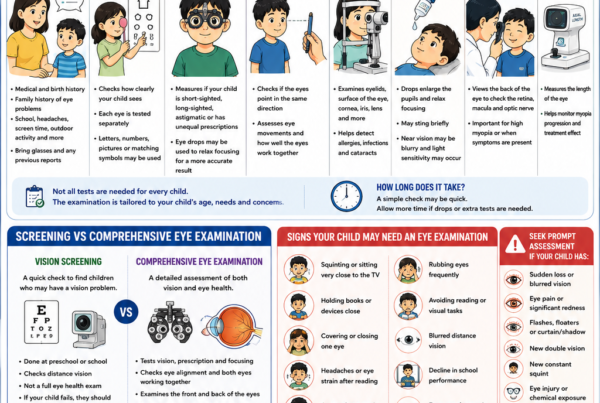
What Does Screening Usually Check?
Screening may assess:
- Distance visual acuity
- Eye appearance
- Alignment
- Red reflex
- Photoscreening or autorefraction
It is designed to be:
- Fast
- Repeatable
- Suitable for large numbers of children
- Sensitive to clinically important risk
What Does a Comprehensive Examination Add?
A comprehensive examination may include:
- Detailed medical and family history
- Vision in each eye
- Crowded visual acuity
- Eye alignment
- Eye movement
- Stereoacuity
- Pupil responses
- Cycloplegic refraction
- Slit-lamp examination
- Dilated retinal examination
- Additional tests when required
The AAO Pediatric Eye Evaluations Preferred Practice Pattern describes screening and comprehensive examination as related but distinct parts of paediatric eye care.
Why Can Screening Miss a Problem?
Possible reasons include:
- The condition developed after screening.
- The child guessed correctly.
- The child used the better eye around an inadequate occluder.
- Cooperation was limited.
- The screening tool did not test that condition.
- Hyperopia was hidden by accommodation.
- Strabismus was intermittent.
- The abnormality was outside the device’s referral criteria.
- Follow-up did not occur after a failed result.
Systematic reviews show that preschool screening accuracy varies by test, age, setting and definition of disease.
What if the Child Passes Screening but Parents Remain Concerned?
Arrange a comprehensive assessment when there is persistent concern about:
- Squinting
- Head tilt
- Closing one eye
- Difficulty seeing the board
- Reading fatigue
- Headaches
- Eye rubbing
- Abnormal photographs
- Poor depth judgement
- An eye turn
- Delayed visual behaviour
A screening result should not overrule a convincing symptom or visible abnormality.
What if the Child Fails a Screening?
Parents should:
- Read the referral instructions
- Arrange the recommended assessment
- Bring the screening result
- Bring current glasses
- Avoid assuming that the child will grow out of it
- Inform the clinic of any visible eye turn or white pupil
A failed screening does not always mean serious disease.
It does mean that the result should be confirmed.
What if the Child Was “Unable to Test”?
An untestable child may simply be:
- Shy
- Tired
- Unfamiliar with the symbols
- Developmentally unable to perform the test
However, poor vision may also make the test difficult.
The next step may be:
- Repeat screening
- Instrument-based screening
- Comprehensive assessment
- Objective refraction
The decision should reflect the child’s age and risk factors.
How Soon Should a Failed Screening Be Followed Up?
The urgency depends on the finding.
Prompt or Urgent Assessment
Arrange prompt assessment for:
- White pupil
- Abnormal red reflex
- Constant strabismus
- Sudden eye turn
- Poor visual behaviour
- New double vision
- Eye pain
- Eye trauma
- Marked asymmetry
- Suspected eye disease
Routine but Timely Assessment
A routine referral for reduced chart vision or a suspected refractive error should still be completed rather than delayed for many months.
The potential benefit of screening is lost when referred children do not receive examination and treatment. Updated screening recommendations therefore emphasise reliable referral and follow-up systems.
Why a Child May Need an Earlier Check Than Planned
New Blurred Vision
The child may report:
- Difficulty seeing the board
- Blurred television subtitles
- Needing to sit closer
- Difficulty recognising distant faces
- One eye being blurrier
Squinting
Squinting temporarily narrows the opening through which light enters and may slightly improve focus.
It can be a sign of refractive error.
Closing One Eye
This may occur with:
- Unequal vision
- Strabismus
- Double vision
- Light sensitivity
- Intermittent exotropia
Head Tilt or Face Turn
A persistent abnormal head posture may help the child compensate for:
- Strabismus
- Nystagmus
- Ptosis
- Unequal vision
- Astigmatism
- Restricted eye movement
Headaches During Visual Tasks
Possible causes include:
- Uncorrected refractive error
- Prolonged near work
- Migraine
- Dry eye
- Binocular-vision difficulty
- Poor ergonomics
- Non-ocular medical conditions
An eye examination can identify or exclude important ocular causes but does not diagnose every cause of headache.
Eye Rubbing
Frequent rubbing may be associated with:
- Allergy
- Dryness
- Fatigue
- Habit
- Corneal irritation
- Keratoconus risk
Treating the cause of itch is more helpful than repeatedly instructing the child not to rub.
Reading or School Difficulties
Children with refractive error may struggle with:
- Seeing the board
- Reading small print
- Sustaining visual attention
- Copying
- Hand-eye coordination
However, an eye examination does not diagnose dyslexia, language disorders or attention disorders.
Abnormal Photographs
Repeated:
- White pupil
- Unequal red reflex
- One eye consistently turning
- Unusual pupil appearance
should be assessed.
Eye Injury
Eye injuries may cause internal damage even when external redness is mild.
Prompt assessment is particularly important for:
- Sharp trauma
- High-speed projectiles
- Chemical exposure
- Reduced vision
- Irregular pupil
- Blood inside the eye
- Persistent pain
Sudden Flashes or Floaters
These are uncommon in younger children but require prompt assessment, especially with:
- High myopia
- Eye trauma
- Previous retinal surgery
- A curtain or shadow
- Sudden reduced vision
Eye Checks and Myopia Prevention
Does Regular Testing Prevent Myopia?
An eye examination does not prevent myopia by itself.
It allows earlier detection and timely discussion of:
- Outdoor time
- Near-work habits
- Optical myopia control
- Low-dose atropine
- Contact-lens options
- Axial-length monitoring
How Much Outdoor Time Is Helpful?
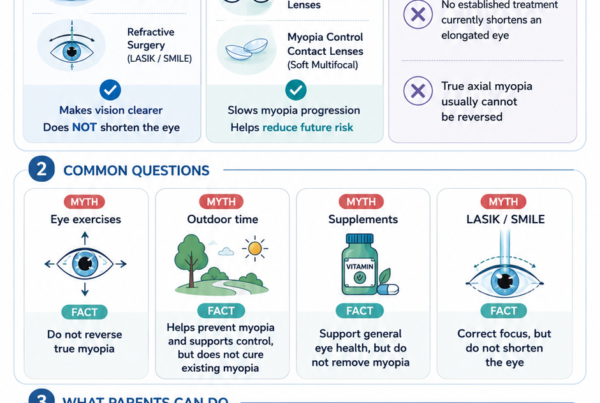
Research consistently associates greater outdoor exposure with a lower risk of developing myopia.
Outdoor time appears more effective in reducing myopia onset than in reversing or completely stopping established myopia.
Parents should build regular outdoor activity into the child’s routine while considering sun protection, hydration and heat safety.
Should Parents Check Vision at Home?
Parents can observe function but should not rely on home testing as a substitute for formal screening.
Useful observations include:
- Covering each eye separately during a familiar task
- Noticing whether one eye causes greater objection when covered
- Watching whether the child sits closer than before
- Asking whether each eye sees similarly
- Looking for an eye turn in photographs and daily activities
Home observations cannot accurately measure:
- Prescription
- Amblyopia
- Eye pressure
- Retinal health
- Optic-nerve health
- Subtle strabismus
Common Myths
“Every Child Needs a Specialist Eye Examination Every Year”
Not necessarily.
Healthy children who pass reliable recurrent screening and have no symptoms or risk factors may not require annual specialist examinations.
“School Screening Means No Other Eye Checks Are Needed”
False.
Screening does not replace condition-specific follow-up or examination for new symptoms.
“My Child Will Tell Me When Their Vision Changes”
Not always.
Children may not recognise gradual or one-sided blur.
“One Normal Screening Result Protects My Child Until Adulthood”
False.
Myopia and other eye conditions can develop later.
“A Child with Good Grades Cannot Have an Eye Problem”
False.
Children often compensate effectively.
“One Good Eye Is Enough”
False.
The weaker eye may develop amblyopia, and binocular vision may be affected.
“Children Who Wear Glasses Must Be Checked Every Month”
Usually false.
The appropriate interval depends on age, diagnosis and treatment.
“Glasses Prescriptions Always Change Every Six Months”
False.
Some prescriptions remain stable.
Others change faster.
“Myopia-Control Treatment Means Ordinary Reviews Are No Longer Needed”
False.
Treatment requires monitoring of both effectiveness and safety.
“If the Child Passes a Photoscreener, Hyperopia Is Excluded”
False.
Instrument-based screening can underestimate or miss hyperopia, particularly without cycloplegia.
“If a Child Cannot Complete Screening, Their Vision Is Probably Normal”
False.
An untestable result may require rescreening or examination.
“Dilating Drops Are Needed at Every Visit”
False.
Their use depends on the purpose of the visit and previous findings.
“Eye Checks Are Only About Glasses”
False.
They may assess:
- Alignment
- Visual development
- Pupils
- Cornea
- Lens
- Retina
- Optic nerve
- Neurological function
Frequently Asked Questions
My Child Has Never Complained. Do They Still Need Screening?
Yes.
Amblyopia and one-sided refractive errors may produce no obvious complaint.
My Child Passed Screening Last Year. When Is the Next Check?
For a child aged five or older with no symptoms or risk factors, repeat screening within approximately one to two years is reasonable.
Follow the local school, primary-care or eye-care schedule.
Should My Child Have an Eye Test Before Starting School?
A reliable preschool visual assessment is valuable because it may detect reduced vision before formal classroom demands increase.
Should Children Be Checked Before They Can Read?
Yes.
Babies and preschool children can be assessed without letters.
Does My Child Need an Eye Test Every Time the Glasses Break?
Not automatically.
If the prescription is recent and vision has not changed, replacement may be possible using existing details.
An examination is sensible when:
- The scheduled review is due
- The prescription is old
- Symptoms have changed
- The child has amblyopia or progressive myopia
How Often Should Glasses Be Changed?
Glasses should be changed when:
- The prescription changes meaningfully
- The lenses are damaged
- The frame no longer fits
- The optical centres are poorly positioned
- The child’s visual needs change
A new pair is not automatically required at every appointment.
Can My Child Be Checked While Wearing Contact Lenses?
The child should bring:
- Contact lenses
- Lens packaging
- Glasses
- Cleaning products
The lenses may need to be removed to examine the cornea or measure refraction.
How Often Should Axial Length Be Measured?
During active myopia management, approximately six-monthly measurement is commonly recommended when axial-length technology is available.
The result should be interpreted with refraction, age and treatment history.
My Child’s Myopia Has Not Changed in Six Months. Can Follow-Up Stop?
Usually not immediately.
One stable interval does not prove that future progression has ended.
Longer-term stability should be demonstrated.
Why Has the Doctor Asked for Review in Six Weeks?
Short-interval review may be needed to assess:
- Amblyopia response
- New glasses
- Patching
- Atropine
- Eye alignment
- Healing after surgery
- An uncertain finding
Why Has the Doctor Asked for Review Only in One Year?
A longer interval may be appropriate when:
- Vision is equal and stable
- The prescription is stable
- Eye alignment is normal
- No active treatment is required
- The eyes are otherwise healthy
Should Siblings Be Checked?
Siblings should undergo routine age-appropriate screening.
Earlier comprehensive examination may be appropriate when there is a strong family history of:
- Amblyopia
- Strabismus
- High refractive error
- Keratoconus
- Inherited eye disease
My Child Failed Screening but Sees Small Objects. Is an Examination Necessary?
Yes.
The child may be using one better-seeing eye.
Seeing small near objects does not prove that both eyes have normal distance vision.
Can a Child’s Vision Change Between School Screenings?
Yes.
Myopia may progress over months.
Parents should arrange assessment when new symptoms develop.
Is a Vision Check Needed Before Contact Lenses?
Yes.
The child requires:
- Accurate refraction
- Corneal assessment
- Lens fitting
- Hygiene education
- Follow-up
Do Children with Colour-Vision Deficiency Need Annual Eye Tests?
Congenital colour-vision deficiency is usually stable and does not by itself require annual specialist review.
Routine screening and eye care should continue.
Acquired colour-vision change may indicate retinal or optic-nerve disease and requires assessment.
Does Frequent Eye Testing Harm a Child?
No.
Routine vision assessment, refraction and non-invasive imaging do not weaken or damage the eyes.
Dilating drops and specialised tests are used when clinically appropriate.
When to Seek Urgent Eye Care
Do not wait for the next scheduled examination when a child develops:
- A white pupil
- Sudden loss of vision
- A sudden eye turn
- New double vision
- Severe eye pain
- Significant redness with reduced vision
- Marked light sensitivity
- A cloudy cornea
- Eye trauma
- Chemical exposure
- New abnormal eye movements
- A severe headache with vomiting or neurological symptoms
- New flashes, floaters or a curtain in the vision
- A painful red eye while wearing contact lenses
These symptoms may indicate:
- Retinal disease
- Cataract
- Glaucoma
- Infection
- Eye injury
- Optic-nerve disease
- Neurological disease
- Another ocular emergency
A Parent’s Eye-Check Schedule
Birth to One Year
- Attend routine newborn and infant assessments.
- Seek earlier examination for an abnormal reflex, poor tracking, persistent eye turn or structural concern.
One to Three Years
- Complete age-appropriate screening during routine healthcare or preschool programmes.
- Attend comprehensive examination after a failed or untestable screen.
Three to Five Years
- Ensure that each eye has been tested separately using visual acuity or an appropriate screening device.
- Do not delay follow-up after an abnormal result.
Five Years and Older
- Continue vision screening every one to two years.
- Arrange earlier assessment for new symptoms or risk factors.
Children Wearing Glasses
- Follow the prescribed interval, commonly every six to twelve months.
- Younger children and those receiving amblyopia treatment may require earlier review.
Children with Myopia
- Review approximately every six months during progression or myopia-control treatment.
- Monitor axial length when available.
Children with Amblyopia or Strabismus
- Attend reviews over weeks or months as advised.
- Do not rely on school screening to monitor treatment.
Children Wearing Contact Lenses
- Attend fitting and aftercare appointments.
- Seek prompt assessment for pain, redness, light sensitivity or sudden blur.
Questions to Ask the Eye-Care Professional
- Is my child’s vision equal in both eyes?
- Did my child pass an age-appropriate test?
- Was the result reliable?
- Is a cycloplegic refraction required?
- Does my child have amblyopia?
- Are the eyes properly aligned?
- Does my child need glasses?
- How often should the glasses be worn?
- Is my child myopic?
- Is the myopia progressing?
- Should axial length be monitored?
- Is myopia-control treatment appropriate?
- When should the next examination occur?
- What changes should prompt an earlier visit?
- Can school screening monitor this condition?
- Do siblings require earlier assessment?
- Are contact lenses appropriate?
- Are protective glasses needed for sports?
The Bottom Line
Children should receive age-appropriate vision and eye screening from infancy through the school years.
A practical schedule is:
- Visual assessment during newborn and infant care
- Screening during the toddler years
- Reliable monocular screening during the preschool years
- Repeat screening every one to two years from age five onward
A healthy, symptom-free child who repeatedly passes reliable screening does not necessarily need a comprehensive specialist eye examination every year.
A comprehensive examination is appropriate when:
- Screening is failed
- Screening cannot be completed
- Symptoms are present
- Risk factors are present
- A parent or teacher remains concerned
- An eye condition has already been diagnosed
More frequent follow-up may be needed for:
- Glasses
- Progressive myopia
- Myopia-control treatment
- Amblyopia
- Strabismus
- Contact lenses
- Prematurity
- Developmental conditions
- Diabetes
- Steroid use
- Previous eye surgery
Children with progressive myopia are commonly reviewed approximately every six months.
Children receiving amblyopia treatment may need review after several weeks.
Children with stable glasses may be reviewed every six to twelve months.
The next appointment should always be brought forward when a new visual symptom or visible abnormality develops.
The most important message is:
Eye-check frequency should be based on the child’s age and risk—not simply the calendar. Routine screening is valuable, but parents should never wait for the next school or annual check when vision changes, an eye turns, a pupil looks white or another concerning symptom appears.
References
- Hutchinson AK, Morse CL, Hercinovic A, et al. Pediatric Eye Evaluations Preferred Practice Pattern. Ophthalmology. 2023;130(3)–P270. PMID: 36543602.
- American Association for Pediatric Ophthalmology and Strabismus. Vision Screening Recommendations. Accessed July 2026.
- American Association for Pediatric Ophthalmology and Strabismus. AAPOS and Choosing Wisely: Vision Care for Children. Accessed July 2026.
- Saxena R, Sharma P, Gopal S, et al. National consensus statement regarding pediatric eye examination, refraction and amblyopia management. Indian J Ophthalmol. 2020;68:325–332. PMID: 31957721.
- Arnold RW, Donahue SP, Silbert DI, et al. AAPOS uniform guidelines for instrument-based pediatric vision screen validation 2021. J AAPOS. 2022;26(1):1.e1–1.e6. PMID: 35066152.
- Kulp MT, Ciner E, Maguire M, et al. Recommended practices for vision screening in preschool-age children: a 2025 update. PMID: 40892439.
- Ferreira A, Vieira R, Maia S, et al. Photoscreening for amblyopia risk factors assessment in young children: a systematic review with meta-analysis. Eur J Ophthalmol. 2023;33(1):92–103. PMID: 35522228.
- Schmucker C, Grosselfinger R, Riemsma R, et al. Diagnostic accuracy of vision screening tests for the detection of amblyopia and its risk factors: a systematic review. Graefes Arch Clin Exp Ophthalmol. 2009;247:1441–1454. PMID: 19669781.
- Jonas DE, Amick HR, Wallace IF, et al. Vision screening in children ages 6 months to 5 years: a systematic review for the US Preventive Services Task Force. PMID: 29561582.
- Cruz OA, Repka MX, Hercinovic A, et al. Amblyopia Preferred Practice Pattern. Ophthalmology. 2023;130(3)–P178. PMID: 36526450.
- Sprunger DT, Lambert SR, Hercinovic A, et al. Esotropia and Exotropia Preferred Practice Pattern. Ophthalmology. 2023;130(3)–P221. PMID: 36526451.
- Pediatric Eye Disease Investigator Group. A randomised trial of atropine versus patching for treatment of moderate amblyopia in children. Arch Ophthalmol. 2002;120:268–278. PMID: 11879129.
- Pediatric Eye Disease Investigator Group. A randomised trial of increasing patching for amblyopia. Ophthalmology. 2013;120:2270–2277. PMID: 23755872.
- Lawrenson JG, Shah R, Huntjens B, et al. UK and Ireland modified Delphi consensus on myopia management in children and young people. Ophthalmic Physiol Opt. 2024. PMID: 39295273.
- Saxena R, Dhiman R, Gupta V, et al. Prevention and management of childhood progressive myopia: national consensus guidelines. Indian J Ophthalmol. 2023;71:2873–2881. PMID: 37417137.
- Powell C, Hatt SR. Vision screening for amblyopia in childhood. Cochrane Database Syst Rev. 2009;(3). PMID: 19588363.
- Health Promotion Board Singapore. Health-promoting programmes for primary schools: Youth Preventive Health and Dental Services. Accessed July 2026.
- Health Promotion Board Singapore. Healthy Preschool Accreditation: School Health Services. Accessed July 2026.
- Health Promotion Board Singapore. What do my child’s eye-test results mean? Accessed July 2026.
- Hu B, Liu Z, Zhao J, et al. The global prevalence of amblyopia in children: a systematic review and meta-analysis. Front Pediatr. 2022;10:819998. PMID: 35601430.