Author: Dr Val Phua
Estimated reading time: 17 minutes
SMILE—short for Small-Incision Lenticule Extraction—usually provides a relatively quick and comfortable recovery after laser vision correction.
Many patients notice an immediate improvement in distance vision and can return to routine daily activities within several days. However, vision may not feel perfectly sharp on the first day. Compared with LASIK, SMILE can produce slightly slower recovery of very fine detail, contrast and crispness during the first days or weeks, even though the final visual results are generally comparable.
During early recovery, patients may experience:
- Hazy or mildly blurred vision
- Fluctuating clarity
- Grittiness or a foreign-body sensation
- Watering
- Light sensitivity
- Dryness
- Glare, halos or starbursts
- Difficulty driving at night
- A temporary difference between the two eyes
The official FDA patient booklet advises that vision should stabilise within several weeks. Research examining the corneal interface and optical quality suggests that subtler aspects of visual quality may continue improving for approximately three months or longer.
SMILE does not create a hinged LASIK flap, so there is no flap to wrinkle or displace. Nevertheless, a small corneal incision and an internal treatment interface must still heal. Patients should avoid rubbing or pressing on the eyes, use all prescribed medication correctly and attend every scheduled postoperative examination.
The exact recovery schedule varies according to:
- The amount of myopia and astigmatism treated
- Laser energy and treatment settings
- Lenticule thickness
- Ease of lenticule separation and removal
- Corneal surface health
- Tear-film stability
- Patient age
- Whether both eyes heal at the same rate
- The surgeon’s postoperative protocol
The treating surgeon’s instructions should always take priority over a general recovery timeline.
SMILE Recovery at a Glance
First Few Hours
You may notice:
- Hazy or watery vision
- Mild burning or grittiness
- Light sensitivity
- A sensation that something is in the eye
- Tearing
- Difficulty focusing on fine details
Resting with the eyes gently closed is usually helpful.
The Following Day
Many patients have useful functional vision and can manage ordinary indoor activities.
The first postoperative examination commonly assesses:
- Unaided vision
- The small corneal incision
- Corneal clarity
- The internal treatment interface
- Inflammation
- Eye pressure
- The ocular surface
First Week
Vision generally becomes progressively clearer.
Many patients can return to office work and routine activities, although dryness, glare or mild fluctuation may remain. Modern ZEISS patient information notes that some patients resume many normal activities as early as the following day, but recovery should still be individualised.
First Month
Distance vision is usually good, but:
- Contrast may still be improving
- Night vision may remain less crisp
- Dryness may cause intermittent blur
- One eye may recover more slowly
- Fine detail may vary with lighting
One to Three Months
The refraction and optical quality usually become increasingly stable.
Interface healing, corneal remodelling and neural adaptation continue even when the eye looks externally normal and the patient has already returned to work.
What Happens Immediately After SMILE?
During SMILE, a femtosecond laser creates a thin lens-shaped piece of corneal tissue called a lenticule and a small access incision. The surgeon separates and removes the lenticule through that incision, permanently changing the shape and focusing power of the cornea.
After the lenticule has been removed, the surgeon may:
- Check that the lenticule is complete
- Examine the internal corneal interface
- Smooth the overlying corneal cap
- Rinse the incision or interface when appropriate
- Apply antibiotic and anti-inflammatory drops
- Place a protective shield when required
Unlike LASIK, no flap is repositioned.
The small incision closes naturally as the epithelial surface heals. The internal space from which the lenticule was removed remains as a microscopic interface within the cornea.
What Will Vision Be Like Immediately After Surgery?
Vision immediately after SMILE is usually improved compared with uncorrected preoperative vision, but it may appear:
- Foggy
- Hazy
- Slightly grey
- Less contrasty
- Watery
- Unequal between the two eyes
Some patients describe being able to see larger objects clearly while fine writing, facial details or road signs remain less sharp.
This does not necessarily indicate an undercorrection. Early visual quality can be affected by:
- Tear-film instability
- Temporary corneal swelling
- Interface fluid
- Microscopic interface particles
- Tissue inflammation
- Corneal-cap microdistortions
- Neural adaptation
- Residual anaesthetic medication
Studies comparing SMILE and LASIK have found that LASIK may provide better unaided acuity or contrast during the first day or week, while the differences generally diminish with further healing.
Why Can SMILE Vision Recover More Slowly Than LASIK?
This may seem surprising because SMILE uses a smaller incision and does not create a flap.
The difference is related to how the optical tissue planes heal.
LASIK
During LASIK:
- A flap is lifted
- Excimer-laser treatment is applied directly to the exposed stromal surface
- The flap is repositioned
The optical bed can be inspected directly before the flap is replaced.
SMILE
During SMILE:
- Two internal laser planes create the lenticule
- The surgeon separates those planes manually
- The lenticule is removed through a small incision
- The overlying cap settles over the remaining corneal bed
During early healing, microscopic interface irregularity, tissue particles, inflammation and cap microdistortions may temporarily affect light scatter and contrast.
Research has shown that interface reflectivity and healing correlate with early visual quality after SMILE and may take several months to settle fully.
Modern lower-energy laser settings, faster laser platforms and refined dissection techniques have improved early recovery. Clinical trials have shown that lower femtosecond-laser energy can produce smoother tissue planes and faster visual recovery.
Does the Amount of Myopia Affect Recovery?
It can.
Patients with a lower myopic correction may experience faster early recovery because the lenticule is thinner and less corneal tissue is altered.
A study examining visual recovery according to the preoperative spherical equivalent found faster early recovery in lower-myopia patients, although differences between prescription groups were no longer significant at later visits.
Higher corrections may involve:
- A thicker lenticule
- More tissue separation
- Greater corneal shape change
- More postoperative optical remodelling
- A greater chance of residual refractive error
- More noticeable night-vision symptoms
This does not mean that highly myopic patients cannot obtain excellent SMILE results. It means that their fine visual recovery may take longer.
What Should You Do During the First Few Hours?
Patients are generally advised to:
- Arrange transport home
- Rest with the eyes gently closed
- Use all prescribed drops
- Avoid rubbing or pressing on the eyes
- Wear shields if prescribed
- Limit screens when uncomfortable
- Avoid dusty or smoky environments
- Keep the eye area clean
- Contact the clinic if pain or vision worsens
The FDA booklet states that patients should not drive until their doctor has given permission. It also warns that rubbing can increase the risk of blurred vision, infection, inflammation, swelling and epithelial ingrowth.
Is SMILE Painful After Surgery?
Most patients experience mild rather than severe discomfort.
Possible symptoms include:
- Grittiness
- Watering
- Mild burning
- Light sensitivity
- A foreign-body sensation
- Mild soreness
The FDA patient booklet notes that some discomfort or pain may occur as the anaesthetic drops wear off.
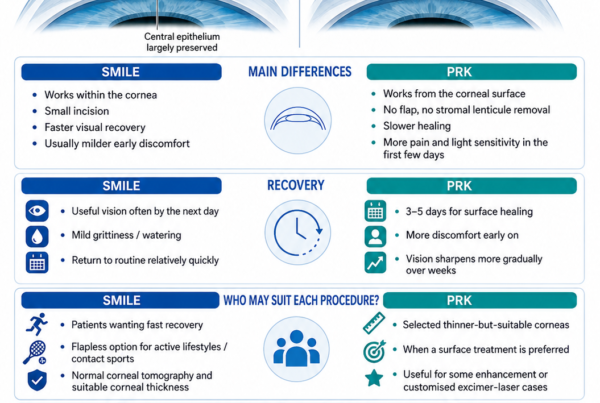
SMILE is generally more comfortable than PRK because the central epithelial surface is not removed.
Compared with LASIK, discomfort is usually similarly mild, although individual patients may experience more watering or grittiness in one eye.
Severe or increasing pain is not considered routine recovery.
Should You Wear Eye Shields?
Some surgeons recommend protective shields while sleeping for the first night or two.
They reduce the risk of:
- Unconscious rubbing
- Scratching the eye
- Pressure from a pillow
- Accidental contact from a child or pet
- Touching the eye while half asleep
SMILE has no flap to displace, but rubbing may still damage the small incision, disturb the surface epithelium or introduce infection.
What Happens at the First Postoperative Visit?
The first review is commonly arranged the day after surgery.
The doctor may check:
- Unaided distance vision
- Residual refractive error
- Corneal epithelial integrity
- The SMILE incision
- Corneal clarity
- Interface haze or particles
- Inflammation
- Eye pressure
- Dry-eye signs
The purpose is not simply to determine whether the patient can read 6/6.
A patient may have good eye-chart vision while still experiencing:
- Reduced contrast
- Halos
- Dryness
- Unequal vision between the eyes
- Difficulty in dim lighting
How Clear Should Vision Be the Next Day?
Many patients have functional vision the next day, but not everyone achieves their final clarity immediately.
Some patients may already see 6/6, while others may see approximately 6/7.5, 6/9 or less clearly despite an otherwise uncomplicated procedure.
The level of vision depends on:
- Initial prescription
- Residual refraction
- Tear-film quality
- Laser energy
- Interface smoothness
- Corneal swelling
- Healing response
A study of ultra-early recovery found that most patients improved significantly by the first day, although a subgroup had slower early recovery. This illustrates why first-day vision should not be used alone to judge the final outcome.
Why Is One Eye Clearer Than the Other?
The two eyes do not always heal at the same speed.
Possible causes include:
- Different prescriptions
- Different lenticule thicknesses
- Unequal astigmatism
- More difficult lenticule separation in one eye
- Greater dryness in one eye
- Mild swelling
- Different amounts of interface debris
- A small residual prescription
- Eye dominance
- Different visual targets in monovision
Mild asymmetry during the first days or weeks is common.
A significant, sudden or increasing difference requires examination.
What Eyedrops Are Used After SMILE?
Postoperative medication commonly includes:
- An antibiotic eyedrop
- A steroid or anti-inflammatory eyedrop
- Preservative-free lubricating drops
The precise medication and duration vary between surgeons.
Patients should:
- Follow the written schedule
- Wash their hands before using drops
- Avoid touching the bottle tip to the eye or eyelashes
- Avoid sharing medication
- Complete antibiotics as instructed
- Avoid increasing or reducing steroid treatment independently
The FDA booklet emphasises that prescribed medication and lubricants are necessary for proper healing.
Why Are Antibiotic Drops Used?
The small corneal incision temporarily creates a route through the epithelial barrier.
Antibiotic drops reduce the risk of postoperative infection while the incision is healing.
Infectious keratitis after SMILE is uncommon but potentially sight-threatening. Increasing pain, redness, discharge, light sensitivity or rapidly deteriorating vision requires urgent assessment. The official patient booklet includes infection and inflammation among the rare complications that can cause permanent visual loss.
Why Are Steroid Drops Used?
Steroid drops reduce postoperative inflammation within the cornea and interface.
They may help control:
- Routine inflammatory healing
- Interface haze
- Sterile inflammatory reactions
- Diffuse lamellar inflammation
Steroid drops can raise eye pressure in susceptible patients. The FDA booklet notes that prolonged steroid use may contribute to raised pressure, glaucoma or cataract, which is why medication should be supervised and postoperative reviews should not be skipped.
Why Are Lubricating Drops Important?
Although SMILE generally disturbs fewer anterior corneal nerves than LASIK, it still affects corneal sensation and tear-film regulation.
Lubricants may improve:
- Grittiness
- Burning
- Fluctuating vision
- Screen tolerance
- Light sensitivity
- Foreign-body sensation
Preservative-free lubricants are often preferred when drops are required frequently.
Does SMILE Cause Dry Eye?
Yes. SMILE can cause temporary dry-eye symptoms.
However, comparative evidence generally shows:
- Less early corneal denervation than LASIK
- Faster recovery of corneal sensation
- Better tear-film stability in some studies
- A lower or less severe early dry-eye burden in many patients
A 2025 meta-analysis found that keratorefractive lenticule extraction preserved corneal sensitivity and ocular-surface stability better than femtosecond LASIK during early recovery.
A prospective study found more corneal denervation after LASIK than SMILE during the first six months, although sensitivity in both groups had returned to baseline at 12 months. Patient-reported dry-eye scores did not differ significantly between the procedures in that study.
This means that SMILE reduces—but does not eliminate—the possibility of dryness.
How Long Does Dry Eye Last?
For many patients, dryness is mild and improves over several weeks or months.
Symptoms may last longer when there is:
- Pre-existing meibomian gland dysfunction
- Blepharitis
- Aqueous tear deficiency
- Contact lens intolerance
- Allergy
- High myopia
- Significant screen exposure
- Poor eyelid closure
- Autoimmune-related ocular-surface disease
A review of dry eye after SMILE concluded that both SMILE and LASIK can temporarily worsen ocular-surface measurements, but SMILE generally causes less nerve disruption and earlier recovery.
Why Does Vision Clear After Blinking?
This commonly indicates tear-film instability.
The tear film is the first optical surface through which light enters the eye. When it breaks up between blinks, vision may become blurry. Blinking temporarily restores a smoother optical surface.
This pattern may be particularly noticeable:
- During screen use
- In air-conditioning
- In windy conditions
- Late in the day
- When tired
- When dehydrated
Regular lubrication and treatment of eyelid-gland dysfunction may improve both comfort and vision.
Can You Use a Phone or Computer?
Screen use does not normally change the SMILE correction or damage the internal interface.
However, screen concentration reduces blinking and may increase:
- Dryness
- Blurred vision
- Eye strain
- Burning
- Headache
During the first few days:
- Take regular breaks
- Blink deliberately
- Enlarge text
- Reduce brightness when needed
- Use prescribed lubricants
- Avoid direct fan or air-conditioning airflow
ZEISS recovery guidance recommends frequent screen breaks during the first few days to reduce strain and dryness.
When Can You Return to Work?
Many patients can return to office-based work within one to three days.
A longer interval may be appropriate when work involves:
- Night driving
- Fine visual detail
- Long computer sessions
- Dust
- Smoke
- Chemicals
- Strong airflow
- Heavy physical activity
- Eye-trauma risk
Returning to work should depend on visual function and job safety rather than a fixed number of days.
When Can You Drive?
Patients should not drive immediately after surgery.
Driving may resume when:
- Vision meets the legal standard
- The postoperative examination is satisfactory
- Both eyes work comfortably together
- Glare and fluctuation are manageable
- The surgeon has confirmed that it is safe
Some patients are comfortable driving within a few days, while others require longer—particularly for night driving. FDA guidance specifically states that patients should not drive until their doctor permits it.
When Can You Drive at Night?
Night driving often takes longer than daytime driving because large pupils and bright headlights make subtle optical imperfections more noticeable.
Early symptoms may include:
- Halos
- Starbursts
- Glare
- Reduced contrast
- Ghost images
- Difficulty judging dim road markings
The FDA clinical data showed that reports of moderate or severe glare and halos were most frequent earlier in healing and reduced substantially at later visits.
Night driving should resume only when the patient feels confident and safe.
When Can You Exercise?
Light walking and routine daily movement may be possible relatively early when the patient feels comfortable.
During the first few days, avoid:
- Sweat entering the eyes
- Dusty gyms
- Eye rubbing
- Heavy straining when it causes discomfort
- Shared towels touching the face
- Activities with accidental facial contact
Modern ZEISS guidance states that many patients return to daily activities quickly but should avoid contact sports and dusty or smoky environments during early recovery.
The surgeon should advise when more strenuous exercise can resume.
When Can You Resume Contact Sports?
SMILE is often chosen by patients involved in contact sports because it does not create a hinged flap.
However, the small incision, epithelium and internal corneal interface still need time to heal.
Activities involving a risk of direct eye injury—such as boxing, martial arts, rugby, football or water polo—should be avoided until the surgeon confirms adequate healing.
Protective eyewear remains advisable whenever practical.
When Can You Swim?
Swimming pools, the sea, lakes, hot tubs and spas can expose the healing eye to:
- Bacteria
- Other microorganisms
- Chlorine
- Salt
- Chemical irritation
Patients should avoid swimming until the surgeon confirms that the incision and epithelial surface have healed adequately.
When swimming is resumed:
- Use well-fitting goggles
- Avoid opening the eyes underwater
- Do not rub the eyes afterwards
- Seek assessment for pain, redness or reduced vision
The exact restriction varies between clinics and should be individualised.
When Can You Shower or Wash Your Hair?
Showering is generally possible during early recovery, but avoid directing water, shampoo or soap into the eyes.
Helpful precautions include:
- Keep the eyes gently closed
- Allow water to run away from the face
- Do not rub with a towel
- Pat the surrounding skin carefully
- Avoid strong shower jets directly at the eyes
When Can You Wear Eye Makeup?
Makeup may introduce particles, microorganisms and mechanical rubbing near the healing incision.
Avoid eye makeup until the treating surgeon confirms that it is safe.
When restarting:
- Use clean or new products
- Avoid applying makeup inside the eyelid margin
- Remove it gently
- Do not pull or press on the eyelids
- Stop if irritation or redness develops
When Can You Fly?
Air travel does not normally change the SMILE correction or disturb a healed internal interface.
However, aircraft cabins are dry and may worsen:
- Burning
- Grittiness
- Visual fluctuation
- Light sensitivity
It is preferable to attend the early postoperative examination before travelling.
Carry:
- Prescribed medication
- Preservative-free lubricants
- Sunglasses
- The clinic’s contact information
Travel may need to be postponed if healing requires close observation.
Can You Drink Alcohol?
Alcohol does not reverse the SMILE correction, but it may:
- Increase dehydration
- Worsen dry-eye symptoms
- Interfere with medication use
- Reduce judgement
- Increase accidental rubbing or trauma
Avoiding alcohol on the day of surgery and during the immediate recovery period is generally sensible.
Do You Need Sunglasses?
Sunglasses can reduce:
- Light sensitivity
- Glare
- Wind exposure
- Dust exposure
- Squinting
- Accidental touching of the eyes
The FDA booklet specifically suggests sunglasses for early light and glare sensitivity.
Why Does Vision Fluctuate?
Possible causes include:
- Tear-film instability
- Mild corneal swelling
- Interface healing
- Epithelial remodelling
- Residual refractive error
- Pupil changes
- Accommodation
- Unequal recovery between the eyes
A temporary increase in corneal light scatter has also been documented during SMILE recovery. Straylight generally returns towards preoperative levels as healing progresses.
Is Corneal Haze Normal After SMILE?
The doctor may see mild corneal cloudiness or interface haze after SMILE.
The FDA booklet states that this usually does not affect vision and generally clears over time.
This is different from the surface stromal haze associated with PRK.
Clinically significant haze or inflammation after SMILE is uncommon but may cause:
- Reduced clarity
- Glare
- Light sensitivity
- Loss of contrast
Treatment depends on the cause and may include additional anti-inflammatory medication.
Are Halos and Starbursts Normal?
They are relatively common during early recovery.
Possible causes include:
- Large pupils
- Residual myopia or astigmatism
- Tear-film instability
- Corneal-interface scatter
- Higher-order aberrations
- Neural adaptation
Symptoms often improve over weeks or months.
Persistent or severe symptoms should be assessed for:
- Residual prescription
- Decentration
- Dry eye
- Irregular astigmatism
- Incomplete lenticule removal
- Another ocular cause
What Complications Can Delay Recovery?
Most patients recover without a major complication, but possible problems include:
- Epithelial abrasion
- Incision tear
- Incomplete lenticule removal
- Retained lenticule tissue
- Interface debris
- Epithelial ingrowth
- Sterile inflammation
- Infection
- Decentration
- Residual prescription
- Corneal ectasia
Reviews of SMILE complications note that many procedural complications are manageable when recognised promptly, but delayed diagnosis may lead to irregular corneal shape or reduced vision.
What Is an Epithelial Abrasion?
An epithelial abrasion is a defect in the thin surface layer of the cornea.
It may cause:
- Pain
- Watering
- Light sensitivity
- Grittiness
- Slower visual recovery
A bandage contact lens may occasionally be used to protect the surface while it heals.
What Is Retained Lenticule Tissue?
The removed lenticule should be examined to ensure that it is complete.
If a fragment remains inside the interface, it may cause:
- Irregular astigmatism
- Blurred vision
- Ghosting
- Distortion
- Delayed recovery
Significant retained tissue may require surgical removal.
Can Epithelial Ingrowth Occur After SMILE?
Yes, although the mechanism differs from LASIK.
Surface epithelial cells may enter the small incision and grow into the internal interface.
The FDA booklet warns that rubbing may increase this risk.
Small, stable areas may be observed. Progressive or visually significant epithelial ingrowth may require removal.
Can Infection Occur?
Yes, although serious infection is uncommon.
Seek urgent assessment for:
- Increasing pain
- Increasing redness
- Rapidly worsening vision
- Significant discharge
- A white or grey corneal spot
- Marked light sensitivity
Early treatment is important because infection can cause corneal scarring and permanent visual loss.
Can Eye Pressure Rise?
Steroid eyedrops may raise intraocular pressure in susceptible patients.
Raised pressure may cause no symptoms.
This is why postoperative examinations may include eye-pressure measurement, especially when:
- Steroid treatment is prolonged
- Stronger steroids are prescribed
- The patient has a history of steroid response
- Glaucoma risk is present
Can Corneal Ectasia Occur After SMILE?
Yes, although it is uncommon.
Corneal ectasia is progressive weakening and bulging of the cornea.
It may cause:
- Increasing myopia
- Irregular astigmatism
- Ghosting
- Reduced corrected vision
- Need for specialised contact lenses
- Need for corneal cross-linking
SMILE should not be performed on eyes with keratoconus, suspicious tomography or inadequate residual corneal structure. The FDA booklet lists insufficient corneal thickness, keratoconus and unstable corneal conditions as contraindications.
How Long Before the Result Is Considered Stable?
Functional vision may return within days, but complete stability takes longer.
A practical framework is:
Functional Stability
The patient can work, walk outdoors and manage normal daily tasks.
This may occur within the first few days.
Refractive Stability
Repeated prescription measurements become consistent.
This may take several weeks or months.
Optical Stability
Contrast, night vision, light scatter and interface quality continue improving.
This may take approximately three months or longer in some patients.
When Is an Enhancement Considered?
An enhancement should not be rushed.
It may be considered when:
- A meaningful residual prescription remains
- The refraction has stabilised
- The cornea and ocular surface are healthy
- Corneal tomography remains safe
- Adequate tissue remains
- The residual prescription genuinely explains the symptoms
Options may include:
- PRK over the SMILE cap
- Cap-to-flap conversion
- Thin-flap LASIK in selected eyes
- Spectacles
- Contact lenses
- Observation
A review of PRK enhancement after SMILE reported enhancement rates ranging from approximately 1% to 7% across included studies and found PRK to be a viable treatment for selected residual refractive errors.
The correct timing depends on stability rather than a fixed calendar date.
What Factors Can Delay Recovery?
Recovery may be slower with:
- Higher myopia
- Significant astigmatism
- Older age
- Pre-existing dry eye
- Meibomian gland dysfunction
- A thicker lenticule
- Higher laser-energy settings
- Difficult lenticule separation
- Epithelial abrasion
- Interface inflammation
- Residual prescription
- Poor medication compliance
- Eye rubbing
- Exposure to dust or contaminated water
Tear-film instability may also reduce objective visual quality after SMILE even when the refractive result is accurate.
Does SMILE Affect Near Vision?
SMILE corrects myopia but does not prevent presbyopia.
A myopic patient may have previously read without glasses by removing their distance spectacles.
After both eyes are corrected for distance:
- Distance vision improves
- The previous myopic near focal point disappears
- Existing presbyopia becomes more obvious
- Reading glasses may be needed
The FDA patient booklet explains that patients in their forties or older may require reading glasses even if they did not require them before surgery.
This is not delayed healing or regression.
What Symptoms Require Urgent Assessment?
Contact the clinic urgently for:
- Severe or increasing pain
- Rapidly worsening vision
- Sudden loss of vision
- Increasing redness
- Significant discharge
- A white or grey corneal spot
- Marked light sensitivity
- Trauma to the operated eye
- Symptoms that worsen after initially improving
- New flashes, floaters or a curtain-like shadow
The FDA patient booklet advises contacting the doctor for pain, a change in vision or loss of vision because these may indicate a serious condition.
Are Flashes and Floaters Part of SMILE Recovery?
No. They usually arise from the vitreous or retina rather than the corneal procedure.
Patients with moderate or high myopia retain an increased lifetime risk of:
- Posterior vitreous detachment
- Retinal tears
- Retinal holes
- Retinal detachment
- Myopic macular disease
SMILE corrects corneal focus but does not shorten the elongated myopic eye.
Sudden flashes, a shower of floaters or a curtain-like shadow requires urgent retinal examination.
Frequently Asked Questions About SMILE Recovery
Can I See Immediately After SMILE?
Usually, yes, but vision may be hazy or less crisp immediately after surgery.
It normally improves progressively over the following days and weeks.
Is SMILE Recovery Faster Than LASIK?
SMILE recovery is rapid, but LASIK often provides faster early crispness and contrast during the first day or week.
Final visual results are generally similar.
Is SMILE Recovery Faster Than PRK?
Yes.
PRK requires the central epithelium to regrow, resulting in more discomfort and slower visual recovery.
How Many Days Should I Take Off Work?
Many office workers take one to three days.
More time may be required for night driving, detailed visual work, dusty environments or physically hazardous occupations.
Is It Normal to Have Blurry Vision for a Week?
Mild blur or fluctuation can be normal, particularly if it gradually improves.
Marked or worsening blur should be assessed.
Why Is My Vision Not as Sharp as It Was With Contact Lenses?
Possible causes include:
- Dry eye
- Interface healing
- Residual prescription
- Astigmatism
- Optical aberrations
- Neural adaptation
Fine visual quality may take longer to settle than standard eye-chart acuity.
Why Is One Eye Recovering More Slowly?
The two eyes may have different prescriptions, lenticule thicknesses, dryness or healing responses.
A significant or worsening difference should be examined.
How Long Do Halos Last?
They often improve over several weeks or months.
Persistent halos should be assessed for dryness, residual refractive error and optical irregularity.
How Long Does Dry Eye Last?
Symptoms commonly improve over weeks to months.
Persistent dryness requires evaluation of the tear film, meibomian glands and corneal sensation.
Can I Rub My Eyes After SMILE?
Rubbing should be avoided during early healing and vigorous habitual rubbing should be discouraged long term.
Although there is no flap, rubbing can damage the incision and ocular surface.
Can I Use My Phone on the First Day?
Yes, according to comfort, but screen use may worsen dryness and strain.
Frequent breaks are helpful.
When Can I Drive?
Only when your vision is legally adequate, comfortable and approved by your surgeon.
Night driving may take longer.
When Can I Exercise?
Light activity may resume relatively early when comfortable.
Sweat, dust and direct eye trauma should be avoided until the surgeon provides clearance.
When Can I Swim?
Only after the surgeon confirms that the incision and corneal surface have healed adequately.
When Can I Wear Makeup?
Wait until your surgeon confirms that makeup can be used safely around the healing eye.
Can I Fly After SMILE?
Flying is usually possible after an uncomplicated early review, although cabin dryness may increase discomfort.
Does SMILE Have a Flap?
No hinged flap is created.
A corneal cap, small incision and internal interface remain.
Can the SMILE Incision Open?
The surface incision normally heals rapidly.
Trauma or vigorous rubbing during early recovery may disturb the epithelium and should be avoided.
Can SMILE Cause Infection?
Yes, although infection is rare.
Increasing pain, redness or reduced vision requires urgent review.
Can SMILE Cause Haze?
Mild interface cloudiness may be seen during healing and commonly clears.
Clinically significant haze or inflammation is uncommon.
Can SMILE Be Enhanced?
Yes.
Options may include PRK, cap-to-flap conversion or another treatment depending on corneal anatomy and residual prescription.
When Can an Enhancement Be Done?
Only after the refraction and corneal findings have stabilised.
The timing is individual and should not be rushed.
Can I Still Need Glasses?
Yes.
Glasses may still be helpful for:
- Residual prescription
- Night driving
- Fine visual tasks
- Reading after presbyopia develops
- Future refractive changes
Does SMILE Prevent Cataract or Glaucoma?
No.
Regular eye examinations remain important.
Key Takeaway
SMILE usually provides relatively fast and comfortable recovery.
During the first few hours, it is common to experience:
- Hazy or watery vision
- Mild burning or grittiness
- Light sensitivity
- A foreign-body sensation
- Fluctuating clarity
Many patients have functional vision by the following day and return to office work within several days.
However, SMILE may produce slightly slower recovery of very fine sharpness and contrast than LASIK during the first days or weeks. This is related to healing of the internal corneal interface rather than the presence of a flap.
Over the first several weeks:
- Vision generally becomes clearer
- Dryness improves
- Contrast recovers
- Halos and glare become less noticeable
- The two eyes become more balanced
Fine visual quality may continue improving for approximately three months or longer.
Important recovery principles include:
- Use all medication correctly
- Avoid rubbing or pressing the eyes
- Wear shields when prescribed
- Attend every postoperative review
- Take regular breaks from screens
- Avoid contaminated water and eye trauma
- Resume driving and sport only when cleared
- Do not judge the final result too early
- Seek prompt assessment when symptoms worsen
Severe pain, increasing redness, rapidly worsening vision, significant discharge, a white corneal spot or direct eye trauma requires urgent examination.
SMILE avoids LASIK flap complications, but it does not eliminate the need for careful postoperative protection, ocular-surface management and long-term eye care.
References
- US Food and Drug Administration. ZEISS VisuMax Femtosecond Laser SMILE Patient Information Booklet.
- Tay E, et al. Visual Recovery After Small Incision Lenticule Extraction in Relation to Preoperative Spherical Equivalent. 2021. PMID: 33047249.
- Donate D, et al. Assessment of Early Visual and Optical Quality Recovery After Small-Incision Lenticule Extraction. 2019. PMID: 31059577.
- Ganesh S, et al. Interface Healing and Its Correlation With Visual Recovery and Quality of Vision Following Small-Incision Lenticule Extraction. 2018. PMID: 29380760.
- Wan KH, et al. Fluctuation in Straylight Measurements During the Visual Recovery Phase After Small-Incision Lenticule Extraction. 2020. PMID: 31399702.
- Wong AHY, et al. Dry Eyes After SMILE. 2019. PMID: 31490199.
- Ma KK, et al. Corneal Sensitivity and Patient-Reported Dry Eye Symptoms After LASIK and SMILE. 2022. PMID: 35594919.
- Chen KY, et al. Effectiveness of Keratorefractive Lenticule Extraction Compared With Femtosecond LASIK for Dry Eye: A Meta-analysis. 2025. PMID: 40778870.
- Moin KA, et al. Three-Month Comprehensive Outcomes of Topography-Guided LASIK and SMILE. 2024. PMID: 38951314.
- Ji YW, et al. Lower Laser Energy Levels Lead to Better Visual Recovery After Small-Incision Lenticule Extraction: A Prospective Randomised Clinical Trial. 2017. PMID: 28499707.
- Asif MI, et al. Complications of Small-Incision Lenticule Extraction. 2020.
- Krueger RR, et al. A Review of Small-Incision Lenticule Extraction Complications. 2018. PMID: 29782336.
- Shah R. History and Results; Indications and Contraindications of SMILE Compared With LASIK. 2019. PMID: 31567264.
- Moshirfar M, et al. Photorefractive Keratectomy Enhancement After Small-Incision Lenticule Extraction. 2022. PMID: 36119391.
- Siedlecki J, et al. Enhancement Options After Myopic Small-Incision Lenticule Extraction. 2019.
- Mohamed-Noriega K, et al. Early Corneal Nerve Damage and Recovery Following Small-Incision Lenticule Extraction and LASIK. 2014. PMID: 24569584.
- Zhang Y, et al. Clinical Outcomes of SMILE and Femtosecond LASIK Used to Treat Myopia: A Meta-analysis. 2016. PMID: 27070233.