Author: Dr Val Phua
Estimated reading time: 10–12 minutes
Is Dry Eye Normal After LASIK?
Dryness is one of the most common temporary symptoms following LASIK.
Patients may experience:
- Grittiness or a sandy sensation
- Burning or stinging
- Tired eyes
- Watery eyes
- Fluctuating vision
- Light sensitivity
- Difficulty using screens for prolonged periods
- Contact-lens-like discomfort despite no longer wearing lenses
Dry-eye symptoms are particularly common during the first few weeks or months after corneal refractive surgery and often improve as the ocular surface heals and corneal nerves recover. However, patients with significant dry eye before surgery may experience more persistent or troublesome symptoms afterwards.
LASIK does not permanently cause severe dry eye in most patients. Nevertheless, careful screening, treatment of pre-existing ocular-surface disease and appropriate postoperative care are important for comfortable recovery and stable vision.
What Happens During LASIK?
During LASIK, a thin corneal flap is created using a femtosecond laser or microkeratome. An excimer laser then reshapes the underlying corneal tissue to correct myopia, hyperopia or astigmatism.
The cornea contains one of the highest concentrations of sensory nerves in the body. Creating the flap and reshaping the cornea temporarily interrupts some of these nerves.
These nerves normally help regulate:
- Tear production
- Blinking
- Ocular-surface sensation
- Corneal healing
- Communication between the cornea and lacrimal glands
Temporary disruption of this feedback system is an important reason dryness develops after LASIK.
Why Does LASIK Cause Dry Eye?
Post-LASIK dry eye usually results from several overlapping mechanisms.
Temporary Reduction in Corneal Sensation
Corneal nerves detect dryness and help stimulate reflex tearing and blinking.
After LASIK, reduced corneal sensitivity may temporarily result in:
- Less reflex tear production
- Less frequent or incomplete blinking
- Increased tear evaporation
- Reduced awareness that the ocular surface is becoming dry
As nerve function recovers, tear production and blinking usually improve.
Tear-Film Instability
The tear film forms a smooth optical layer over the cornea.
After surgery, changes in corneal sensation, blinking and surface shape may make the tear film break up more quickly. This can cause vision to fluctuate even when the LASIK correction itself is accurate.
Ocular-Surface Inflammation
LASIK triggers a controlled healing response.
Inflammation during this process may further destabilise the tear film and increase discomfort. Patients with pre-existing dry eye, blepharitis or meibomian gland dysfunction may have a more inflamed ocular surface before surgery and therefore experience more symptoms afterwards.
Meibomian Gland Dysfunction
The meibomian glands within the eyelids produce oil that slows tear evaporation.
LASIK does not necessarily create meibomian gland dysfunction, but pre-existing gland blockage may become more noticeable after surgery. Reduced blinking during screen use may worsen the problem.
Postoperative Eye Drops
Antibiotic and anti-inflammatory drops are important after surgery. However, preservatives within some formulations may irritate a sensitive ocular surface.
Patients should not stop or change prescribed postoperative medication without consulting their surgeon. Preservative-free lubricants may be used alongside prescribed medication when recommended.
Why Can Dry Eye Make My Vision Fluctuate?
The tear film is the first optical surface encountered by light entering the eye.
When the tear film is stable, vision remains clear. When it breaks up, the corneal surface becomes temporarily irregular.
Typical features include:
- Vision becoming blurry between blinks
- Vision clearing briefly after blinking
- Difficulty maintaining clarity during computer work
- Glare or halos that worsen when the eyes are dry
- Variable vision at different times of the day
This does not necessarily mean that the LASIK treatment has failed or that the prescription has returned.
A stable refraction cannot always be assessed accurately until the ocular surface has improved.
How Common Is Dry Eye After LASIK?
Reported rates vary considerably because studies use different definitions, questionnaires, tests and follow-up intervals.
Some studies measure new symptoms, while others include patients who already had dry eye before surgery. Tear-film test results may also change even when a patient has relatively few symptoms.
The most reliable general message is that:
- Temporary dryness is common after LASIK.
- Symptoms are usually most noticeable during the early postoperative period.
- Most patients improve progressively over the following months.
- Persistent, severe symptoms occur in a smaller proportion of patients.
The American Academy of Ophthalmology advises that dry-eye symptoms are common during the first few months after keratorefractive surgery and often subside with time.
How Long Does Dry Eye Last After LASIK?
Recovery varies from person to person.
First Few Days
Patients may experience:
- Grittiness
- Watering
- Light sensitivity
- Mild burning
- Fluctuating vision
These symptoms may reflect both ordinary postoperative healing and tear-film instability.
First Few Weeks
The eyes may feel comfortable at some times but dry during:
- Computer work
- Air-conditioning
- Prolonged reading
- Driving
- Late evenings
Frequent lubrication is commonly required during this period.
First Three to Six Months
For many patients, symptoms gradually improve as corneal sensation and tear regulation recover.
Artificial-tear requirements usually decrease over time.
Beyond Six to Twelve Months
Most patients achieve substantial recovery, although some continue to have symptoms because of:
- Pre-existing dry eye
- Meibomian gland dysfunction
- Blepharitis
- Incomplete blinking
- Significant screen exposure
- Autoimmune disease
- Persistent inflammation
- Abnormal corneal nerve sensation
Comparative research suggests that short-term dry-eye differences between LASIK and SMILE may narrow by approximately one year, although individual recovery remains variable.
Who Is More Likely to Develop Dry Eye After LASIK?
The most important risk factor is pre-existing ocular-surface disease.
Risk may be increased in patients with:
- Dry-eye symptoms before surgery
- Meibomian gland dysfunction
- Blepharitis
- Contact-lens intolerance
- Frequent artificial-tear use
- Heavy digital-device use
- An air-conditioned work environment
- Rosacea
- Autoimmune disease
- Diabetes
- Long-term use of certain medications
- Previous eye surgery
- Significant corneal staining
- Reduced tear-film stability
Patients considering LASIK should mention symptoms such as burning, watering, fluctuating vision and contact-lens discomfort even if these symptoms appear mild.
Treating pre-existing dry eye before surgery reduces the chance of postoperative worsening and may improve the accuracy of refractive measurements.
How Should the Eyes Be Assessed Before LASIK?
A refractive-surgery assessment should examine more than spectacle power and corneal thickness.
Ocular-surface assessment may include:
Symptom History
The surgeon may ask about:
- Dryness and grittiness
- Contact-lens tolerance
- Screen use
- Artificial-tear use
- Previous eye surgery
- Medical conditions
- Current medication
- Symptoms of rosacea or autoimmune disease
Tear-Film Examination
The tears may be assessed for:
- Stability
- Volume
- Rapid breakup
- Debris
- Excess evaporation
Ocular-Surface Staining
Special dyes can reveal microscopic corneal or conjunctival damage.
Eyelid and Meibomian Gland Assessment
The eyelid margins may be examined for:
- Blocked gland openings
- Thickened oil
- Blepharitis
- Rosacea
- Demodex-related inflammation
Additional Testing
Selected patients may undergo:
- Meibography
- Tear osmolarity
- Non-invasive tear-breakup testing
- Tear-production measurements
- Corneal topography or tomography
- Corneal-sensation assessment
Not every patient requires every test. The objective is to identify and treat clinically significant ocular-surface disease before proceeding with surgery.
Should LASIK Be Delayed If I Have Dry Eye?
Sometimes.
Mild, well-controlled dry eye does not automatically make a patient unsuitable for LASIK. However, surgery may be postponed when there is:
- Significant corneal staining
- Unstable tear film
- Active blepharitis
- Poorly controlled meibomian gland dysfunction
- Severe symptoms
- Unexplained eye pain
- Inaccurate or fluctuating measurements
Treatment may be started first, followed by repeat measurements once the ocular surface is stable.
The most appropriate procedure may also be reconsidered.
How Is Dry Eye After LASIK Diagnosed?
Postoperative symptoms should not automatically be attributed to ordinary dryness.
An assessment may include:
- Visual acuity
- Refraction
- Flap examination
- Tear-film stability
- Ocular-surface staining
- Eyelid and gland assessment
- Corneal sensation
- Evaluation for inflammation or infection
The surgeon will also look for other causes of discomfort or blurred vision, such as:
- Flap-related problems
- Diffuse lamellar keratitis
- Epithelial defects
- Corneal infection
- Residual prescription
- Irregular astigmatism
- Corneal ectasia
- Neuropathic corneal pain
How Is Dry Eye After LASIK Treated?
Treatment depends on the severity and underlying mechanism.
Follow Your Postoperative Medication Schedule
Prescribed antibiotic and anti-inflammatory drops protect the eye and control postoperative inflammation.
Use them exactly as directed.
Artificial tears should supplement—not replace—prescribed postoperative medication.
When several drops are required, leaving approximately five minutes between different medications can reduce washout.
Preservative-Free Artificial Tears
Preservative-free lubricants are commonly used after LASIK.
They may:
- Add moisture
- Reduce friction
- Stabilise the tear film
- Improve fluctuating vision
- Relieve burning and grittiness
Drops may be required frequently during the early postoperative period.
A patient who continues to need drops many times each day should be reassessed rather than simply continuing indefinite self-treatment.
Gel Drops and Ointments
More viscous gels may provide longer relief when ordinary drops wear off quickly.
Lubricating ointment may be helpful for:
- Significant nighttime dryness
- Morning discomfort
- Incomplete eyelid closure
- More severe ocular-surface disease
These products may temporarily blur vision and are often best used before sleep.
Treat Meibomian Gland Dysfunction
When gland dysfunction is present, treatment may include:
- Warm compresses
- Eyelid hygiene
- Full and frequent blinking
- Treatment of blepharitis
- Meibomian gland expression
- Thermal treatment
- Intense pulsed light in selected patients
- Treatment for rosacea or Demodex
Artificial tears alone may provide incomplete relief when rapid evaporation is the main problem.
Improve Screen Habits
Screen use reduces blink frequency and completeness.
Helpful strategies include:
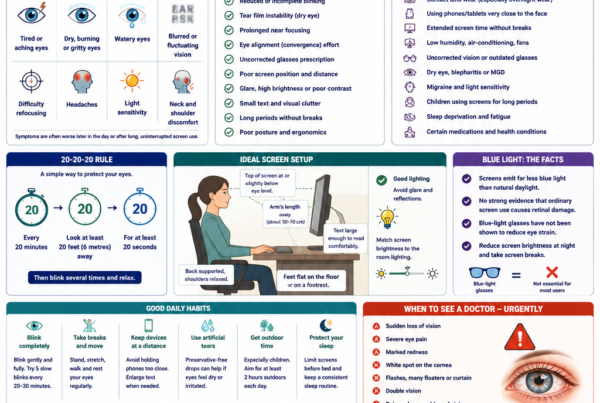
- Following the 20-20-20 rule
- Blinking fully and deliberately
- Positioning the screen slightly below eye level
- Increasing text size
- Taking regular breaks
- Avoiding direct air-conditioning or fan airflow
- Using adequate room lighting
Prescription Anti-Inflammatory Treatment
Persistent dry eye may require medication directed at ocular-surface inflammation.
Options may include:
- A short supervised course of topical corticosteroid
- Ciclosporin eye drops
- Other immunomodulatory treatment
- Treatment directed at associated eyelid inflammation
Steroid drops should not be started or continued without supervision because they may raise eye pressure, worsen infection or contribute to cataract formation.
Punctal Plugs
Small plugs may be inserted into the tear-drainage openings to retain natural and artificial tears for longer.
They may be considered when tear deficiency remains significant despite lubrication.
Uncontrolled eyelid inflammation should generally be treated first because retaining inflamed tears may not provide the desired result.
Autologous Serum Eye Drops
Serum eye drops are made from components of the patient’s own blood.
They contain proteins and growth factors not found in ordinary artificial tears and may be used for:
- Severe ocular-surface disease
- Persistent epithelial damage
- Significant neurotrophic changes
- Symptoms that do not respond to standard treatment
They require specialised preparation and storage.
Scleral Contact Lenses
Scleral lenses are large rigid lenses that vault over the cornea and hold a reservoir of fluid against the ocular surface.
They may help selected patients with severe or persistent postoperative dry eye.
They are not ordinary cosmetic contact lenses and require specialist fitting.
Treating Underlying Medical Conditions
Persistent dryness may occasionally be related to:
- Sjögren syndrome
- Rheumatoid arthritis
- Thyroid disease
- Diabetes
- Rosacea
- Medication side effects
Further medical investigation may be appropriate when dry eye is severe, associated with dry mouth or accompanied by systemic symptoms.
What Is Neuropathic Corneal Pain?
Rarely, a patient may experience severe burning, aching, light sensitivity or wind sensitivity that appears disproportionate to visible ocular-surface findings.
This may represent neuropathic corneal pain, in which the corneal nerves or pain-processing pathways remain abnormally sensitive.
Possible clues include:
- Severe pain despite minimal staining
- Pain triggered by light, wind or air conditioning
- Symptoms described as burning, electric or stabbing
- Poor response to ordinary artificial tears
- Pain persisting long after the surface appears healed
Neuropathic corneal pain is uncommon but can be disabling. It requires specialist assessment and may need a multidisciplinary treatment approach rather than repeated lubrication alone.
LASIK Versus SMILE: Which Causes Less Dry Eye?
Both LASIK and SMILE can cause temporary postoperative dryness.
SMILE uses a small incision rather than creating a large corneal flap, potentially interrupting fewer anterior corneal nerves.
Meta-analyses suggest that SMILE may have less effect on tear-film stability and corneal sensitivity during the early postoperative period than femtosecond LASIK. However, differences in symptoms may be relatively modest, and longer-term outcomes can become similar.
SMILE is therefore not completely free from dry eye, and LASIK should not automatically be rejected solely because dryness is possible.
Procedure selection should also consider:
- Prescription
- Corneal thickness and shape
- Astigmatism
- Visual requirements
- Enhancement options
- Recovery preferences
- Other surgical risks
What About PRK?
PRK does not create a corneal flap, but it removes the corneal epithelium before laser reshaping.
PRK can also cause temporary dry-eye symptoms and corneal nerve changes. Recovery is generally slower than LASIK because the epithelial surface must regrow.
Research comparing PRK, LASIK and SMILE has produced variable results because techniques, patient groups and dry-eye definitions differ. No procedure should be described as universally free from postoperative dryness.
Can Dry Eye After LASIK Be Prevented?
It cannot always be prevented completely, but the risk and severity may be reduced.
Helpful measures include:
- Identifying dry eye before surgery
- Treating meibomian gland dysfunction
- Managing blepharitis or rosacea
- Stabilising the tear film before measurements
- Temporarily stopping contact lenses as advised
- Using preservative-free lubricants
- Following postoperative medication carefully
- Taking screen breaks
- Avoiding smoke and direct airflow
- Attending scheduled reviews
The best time to address dry eye is often before refractive surgery rather than after symptoms become severe.
What Should I Avoid After LASIK?
During the early recovery period:
- Do not rub your eyes.
- Do not stop prescribed medication early.
- Do not use unapproved eye drops.
- Do not wear eye makeup until permitted.
- Avoid swimming until cleared by your surgeon.
- Avoid dusty or smoky environments where practical.
- Do not wear contact lenses unless specifically instructed.
- Avoid using redness-relieving drops repeatedly.
- Do not assume all pain or blur is ordinary dryness.
Follow your surgeon’s specific postoperative advice, as restrictions vary according to the procedure and recovery.
When Should I Contact My Surgeon?
Arrange a review if:
- Dryness is not progressively improving
- Vision frequently fluctuates
- Drops are needed many times each day
- Symptoms interfere with work or driving
- One eye is much worse than the other
- Light sensitivity persists
- The eyelids are inflamed or crusted
- Discomfort is worsening rather than improving
- Symptoms continue beyond the expected recovery period
- Pain is severe despite relatively normal examination findings
Warning Signs Requiring Prompt Assessment
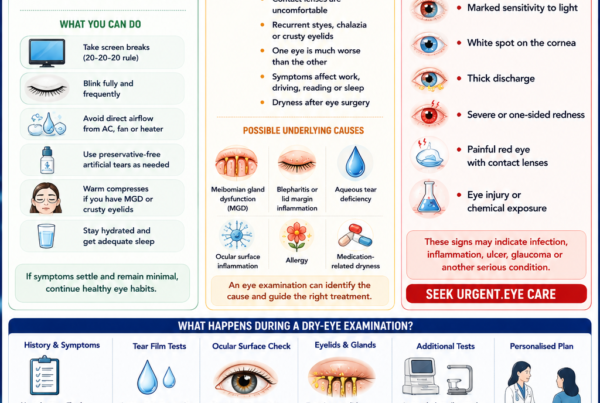
Seek prompt ophthalmic care if you develop:
- Significant or increasing eye pain
- Sudden or persistent reduction in vision
- Marked light sensitivity
- Severe or one-sided redness
- Thick discharge
- A white spot on the cornea
- Increasing haziness
- Eye injury or chemical exposure
- Symptoms that worsen rapidly
These features may indicate infection, inflammation or a flap-related complication rather than ordinary postoperative dry eye.
Frequently Asked Questions
Does everyone develop dry eye after LASIK?
No.
Temporary tear-film changes are common, but symptoms range from minimal to significant. Pre-existing dry eye and eyelid-gland disease increase the risk.
Is post-LASIK dry eye permanent?
Usually not.
Most patients improve over the first several months. Persistent symptoms require evaluation for underlying dry eye, gland dysfunction, inflammation or abnormal nerve pain.
Will artificial tears slow healing?
No. Appropriate preservative-free lubricants generally support comfort and ocular-surface recovery. They should be used alongside—not instead of—prescribed postoperative medication.
Can LASIK permanently damage the tear glands?
LASIK primarily affects corneal nerves rather than directly operating on the lacrimal glands. Tear regulation may be temporarily altered while corneal sensation recovers.
Why are my eyes watering after LASIK?
A dry or irritated ocular surface may stimulate reflex tearing. These watery tears may overflow but evaporate quickly because the tear film remains unstable.
Why is one eye drier than the other?
Healing, corneal sensation, eyelid function, gland obstruction and the degree of laser correction may differ between eyes. Persistent asymmetry should be examined.
Can I use warm compresses immediately after LASIK?
Do not begin eyelid massage or heated masks until your surgeon confirms that it is safe. Pressure around the eyes may be restricted during the early postoperative period.
Can IPL be used after LASIK?
Potentially, once the eyes have healed and clinically significant meibomian gland dysfunction is confirmed. Timing should be decided by the treating ophthalmologist.
Should I choose SMILE instead if I already have dry eye?
SMILE may have less short-term effect on some dry-eye measurements, but suitability depends on more than dryness alone. Significant ocular-surface disease should be treated before any elective refractive procedure.
Can LASIK be performed if I use artificial tears?
Using artificial tears does not automatically exclude LASIK. The cause and severity of the dryness must first be assessed and stabilised.
The Bottom Line
Dry eye is a common but usually temporary effect of LASIK.
It occurs mainly because corneal nerves are interrupted during surgery, temporarily altering tear production, blinking and ocular-surface sensation. Pre-existing meibomian gland dysfunction, blepharitis and tear-film instability may make symptoms more pronounced.
Most patients improve as the cornea heals over the following weeks and months.
Treatment may include:
- Preservative-free artificial tears
- Gels or ointments
- Better blinking and screen habits
- Treatment of meibomian gland dysfunction
- Prescription anti-inflammatory therapy
- Punctal plugs
- Serum tears or scleral lenses in severe cases
Persistent or worsening symptoms should not simply be accepted as an unavoidable consequence of surgery. A careful examination can distinguish ordinary postoperative dryness from inflammation, infection, flap complications or neuropathic corneal pain.
The best approach begins before surgery: identify ocular-surface disease, treat it properly and select the refractive procedure according to the individual patient’s eyes and visual needs.
References
- Amescua G, et al. Dry Eye Syndrome Preferred Practice Pattern. Ophthalmology. 2024.
- Jones L, et al. TFOS DEWS III: Management and Therapy. American Journal of Ophthalmology. 2025.
- Wolffsohn JS, et al. TFOS DEWS III: Diagnostic Methodology. American Journal of Ophthalmology. 2025.
- Sambhi RDS, et al. Dry Eye After Refractive Surgery: A Meta-analysis. Canadian Journal of Ophthalmology. 2020.
- Wang B, et al. Dry Eye Disease Following Refractive Surgery: A 12-Month Follow-up of SMILE Versus Femtosecond LASIK. 2015.
- Chen KY, et al. Keratorefractive Lenticule Extraction Versus Femtosecond LASIK for Postoperative Dry-Eye Outcomes: A Systematic Review and Meta-analysis. Journal of Refractive Surgery. 2025.
- Dossari SK, et al. Post-refractive Surgery Dry Eye: A Systematic Review of Pathophysiology, Risk Factors and Management. 2024.
- Moshirfar M, et al. Neuropathic Corneal Pain Following LASIK Surgery. 2021.