Author: Dr Val Phua
Estimated reading time: 22 minutes
Blue-light glasses are marketed as a solution for many modern eye and health concerns.
Advertisements commonly claim that they can:
- Reduce digital eye strain
- Prevent dry eyes
- Stop screen-related headaches
- Improve sleep
- Protect the retina
- Prevent age-related macular degeneration
- Protect children’s eyes
- Slow myopia
- Improve concentration
- Reduce glare
Some people genuinely feel more comfortable when wearing them.
However, the best available clinical evidence does not support many of the stronger marketing claims.
A 2023 Cochrane review evaluated 17 randomised controlled trials of blue-light-filtering spectacle lenses. It concluded that these lenses may provide little or no short-term benefit for computer-related eye strain compared with ordinary clear lenses. The review also found no clinically meaningful improvement in visual acuity and insufficient evidence that the lenses protect the macula or reliably improve sleep.
A double-masked randomised trial involving 120 symptomatic computer users similarly found no significant difference in eye-strain symptoms between blue-blocking and ordinary clear lenses after a two-hour computer task.
This does not mean that every blue-light-filtering lens is useless.
It means that their value depends on:
- The purpose for which they are being used
- How much blue light the particular lens blocks
- When it is worn
- Whether it is nearly clear or strongly amber-tinted
- The actual cause of the person’s symptoms
- Whether a specific condition such as migraine or light sensitivity is present
A lightly coated clear spectacle lens marketed for everyday computer use is very different from a strongly amber or orange lens worn before bedtime.
It is also different from:
- FL-41 lenses used for selected light-sensitive conditions
- Precision migraine filters
- UV-protective sunglasses
- Myopia-control spectacle lenses
- Blue-light-filtering intraocular lenses used during cataract surgery
These products should not be grouped together simply because they reduce part of the short-wavelength visible spectrum.
The central message is:
Blue-light glasses are not a proven general treatment for digital eye strain, dry eye, retinal protection or myopia. Stronger evening blue-blocking lenses may influence circadian light exposure in selected people, but sleep evidence remains mixed. The most effective management depends on identifying the true cause of the symptoms rather than assuming that blue light is responsible.
The Quick Answer
Do Blue-Light Glasses Reduce Digital Eye Strain?
Probably not to a clinically meaningful degree for most people.
Randomised trials have generally found no significant improvement over ordinary clear lenses.
In one double-blind study, participants developed symptoms after reading from a tablet, but symptom severity did not differ between two blue-filtering lenses and a standard clear lens.
A larger randomised trial also found no improvement in either subjective eye-strain scores or an objective visual-fatigue measure after prolonged computer use.
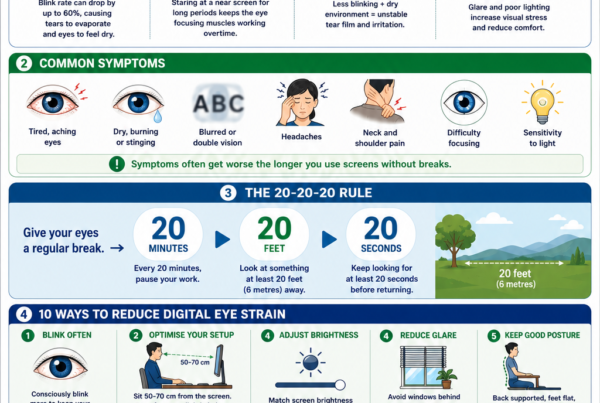
Digital eye strain is more commonly related to:
- Reduced blinking
- Incomplete blinking
- Dry eye
- Prolonged near focusing
- Poor screen position
- Small text
- Glare
- Uncorrected refractive error
- Inadequate lighting
- Long uninterrupted sessions
- Neck and shoulder posture
Blue-light filtration does not directly correct most of these factors.
Do They Protect the Retina from Screens?
There is no convincing clinical evidence that normal use of phones, tablets or computer displays damages the human retina or that blue-light spectacle coatings prevent retinal disease.
Measurements of computers, tablets and phones have found emissions well below recognised blue-light hazard limits under normal viewing conditions. A major review concluded that LEDs and screens used at ordinary domestic intensities have not been shown to be retinotoxic to the human eye.
Laboratory experiments may produce retinal-cell damage using:
- Very intense light
- Very close exposure
- Prolonged continuous illumination
- Isolated cells
- Animal eyes
- Conditions unlike ordinary screen use
These findings should not automatically be applied to a child or adult using a tablet at a normal distance.
Do Blue-Light Glasses Prevent Macular Degeneration?
This has not been demonstrated.
The Cochrane review found no randomised clinical-trial evidence showing that blue-light-filtering spectacles protect macular health.
Research into blue-light-filtering intraocular lenses after cataract surgery has also not established a clear protective effect against age-related macular degeneration. Reviews conclude that current clinical evidence does not justify promising macular protection from blue-light filtration.
Do They Improve Sleep?
Possibly in selected circumstances, but the evidence is mixed.
Blue-enriched evening light can influence circadian signalling and suppress melatonin. Strong amber lenses worn for several hours before bedtime reduce more short-wavelength light than ordinary nearly clear blue-filter coatings.
Small trials in people with insomnia have reported improvements in some subjective sleep measures with amber lenses.
However:
- Some trials found no objective improvement.
- Studies were generally small.
- Lens types differed substantially.
- Participants ranged from healthy adults to people with insomnia or psychiatric conditions.
- Ordinary clear blue-light coatings may block too little light to reproduce the effects of dark amber lenses.
A randomised crossover study in healthy adults found small subjective differences but no significant improvement in objective sleep measures.
The Cochrane review therefore concluded that the overall sleep effect remains uncertain.
Do They Prevent Myopia?
No.
Blue-light filtering is not an established myopia-control treatment.
Blue-light coatings should not be confused with specialised myopia-control lenses such as:
- DIMS spectacles
- Highly aspherical lenslets
- Other defocus or lenslet designs
- Diffusion-optics lenses
These designs slow myopia through specific retinal optical signals, not by adding an ordinary blue-light coating. Randomised-trial meta-analyses support specialised defocus spectacle designs rather than conventional blue-filter lenses for slowing axial elongation.
Are Blue-Light Glasses Harmful?
Lightly filtering clear lenses are generally well tolerated.
Possible disadvantages include:
- Additional cost
- Reflections from some coatings
- A slight change in colour appearance
- Reduced transmission of some blue wavelengths
- Unnecessary reliance on the glasses instead of treating the real problem
- Stronger colour changes with darker amber or orange filters
Commercial blue-blocking lenses vary greatly. Laboratory measurements have found that different products may remove very different proportions of blue light and may also alter blue perception, dim-light sensitivity and circadian stimulation to differing degrees.
What Is Blue Light?
The Visible-Light Spectrum
Visible light is the portion of electromagnetic radiation detected by the human visual system.
It includes wavelengths perceived broadly as:
- Violet
- Blue
- Green
- Yellow
- Orange
- Red
Blue light generally refers to relatively short-wavelength visible light, often approximately 400 to 500 nanometres.
The exact wavelength range used by manufacturers and researchers varies.
Is All Blue Light Dangerous?
No.
Blue light is a normal component of:
- Daylight
- Indoor lighting
- LED bulbs
- Computer displays
- Phones
- Tablets
- Televisions
It plays useful roles in:
- Colour vision
- Visual contrast
- Daytime alertness
- Pupil responses
- Circadian timing
- Regulation of sleep and wakefulness
The effect of light depends on:
- Wavelength
- Intensity
- Duration
- Distance
- Time of day
- Size of the illuminated retinal area
- Individual sensitivity
Describing all blue light as toxic is scientifically inaccurate.
What Is the Blue-Light Hazard?
The term blue-light hazard refers to the potential for short-wavelength visible light to produce photochemical retinal injury under sufficiently intense and prolonged exposure.
This is a real physical phenomenon.
It is relevant to exposure from sources such as:
- Direct solar viewing
- High-powered lamps
- Welding arcs
- Lasers
- Certain occupational or medical light sources
It does not mean that all blue light at all intensities damages the retina.
Normal screen exposure is far below the conditions used to produce retinal injury in many laboratory studies. Measurements of common consumer displays have found that they do not approach recognised ocular exposure limits during ordinary use.
Is Screen Blue Light the Same as Sunlight?
No.
Daylight is generally much brighter than a digital screen and contains a broad spectrum of visible light.
A phone held close to the face can appear subjectively bright in a dark room, but its absolute light output remains far below that of outdoor daylight.
This is why:
- Outdoor daylight strongly affects circadian timing.
- A screen may still affect sleep when used close to bedtime.
- Ordinary screen use has not been shown to cause the same retinal exposure as staring at the sun.
Directly viewing the sun is dangerous and can cause solar retinopathy.
What Do Blue-Light Glasses Actually Do?
Spectral Filtering
A blue-light-filtering lens absorbs or reflects part of the shorter-wavelength visible spectrum.
The amount filtered varies widely.
Some nearly clear lenses remove only a small proportion.
Darker yellow, amber or orange lenses may remove substantially more.
Clear Blue-Light Coatings
These lenses are designed to look almost colourless.
They may:
- Reflect part of the blue-violet spectrum
- Absorb a small amount of short-wavelength light
- Produce a faint residual reflection
- Have little effect on overall colour appearance
Because they block relatively little light, their biological effect may also be small.
Yellow or Amber Lenses
These remove more short-wavelength light.
They may be used for:
- Evening circadian light reduction
- Selected migraine or photophobia conditions
- Specific occupational visual needs
- Subjective glare control
They are more likely to:
- Alter colour appearance
- Reduce blue contrast
- Change dim-light perception
- Be visually obvious
Orange or Red Lenses
These may block most blue and sometimes green wavelengths.
They produce a much stronger circadian-light reduction than ordinary clear coatings.
However, they also substantially alter:
- Colour recognition
- Scene brightness
- Contrast
- Visual appearance
They are not equivalent to ordinary everyday spectacle lenses.
Anti-Reflective Coating Is Not the Same as Blue-Light Filtering
An anti-reflective coating reduces reflections from the front and back surfaces of a spectacle lens.
This may:
- Improve cosmetic appearance
- Reduce distracting reflections
- Improve lens transparency
- Help with night-time glare caused by lens-surface reflections
A lens may have:
- Anti-reflective coating only
- Blue-light filtration only
- Both
- Neither
Some wearers who report benefit from “blue-light glasses” may actually be responding to:
- A new accurate prescription
- Better anti-reflective coating
- Cleaner lenses
- Reduced glare
- Expectation or placebo effects
- Changed screen habits
Blue-Light Glasses and Digital Eye Strain
What Is Digital Eye Strain?
Digital eye strain describes symptoms associated with prolonged use of:
- Computers
- Phones
- Tablets
- Gaming displays
- Other near visual tasks
Symptoms may include:
- Tired eyes
- Burning
- Dryness
- Grittiness
- Watery eyes
- Intermittent blur
- Headache
- Difficulty refocusing
- Neck pain
- Shoulder discomfort
The condition is multifactorial.
Reduced Blinking
People blink less frequently and less completely when concentrating on a screen.
Reduced blinking causes:
- Faster tear evaporation
- Tear-film instability
- Dryness
- Fluctuating vision
- Burning
- Reflex watering
Blue-light lenses do not restore normal blinking automatically.
Prolonged Accommodation
Near work requires the natural lens inside the eye to change shape and maintain focus.
Long uninterrupted periods may cause:
- Focusing fatigue
- Temporary distance blur
- Frontal headache
- Difficulty switching focus
Filtering blue light does not remove the near-focusing demand.
Convergence Demand
The eyes turn inward to look at a near target.
Some people have:
- Convergence insufficiency
- Decompensated phoria
- Reduced fusional reserves
- Poor binocular coordination
This may cause:
- Eye strain
- Headache
- Double vision
- Loss of concentration
- Words moving on the page
Blue-light glasses do not correct an eye-coordination problem unless the glasses also contain an appropriate prescription or prism.
Uncorrected Refractive Error
Small amounts of:
- Myopia
- Hyperopia
- Astigmatism
- Presbyopia
may become more noticeable during prolonged screen use.
The benefit comes from correcting the refractive error, not from filtering blue light.
Poor Screen Ergonomics
Symptoms may be aggravated by:
- A screen that is too high
- A screen that is too close
- Small text
- Excessive reflections
- Poor posture
- An unsuitable chair
- Incorrect viewing distance
- Bright screen contrast in a dark room
These factors should be corrected directly.
What Do Randomised Trials Show?
A 2021 double-masked trial found that blue-blocking spectacles did not reduce either subjective symptoms or objective signs of eye strain compared with clear placebo lenses after a two-hour computer task.
Another double-blind study found that tablet reading increased symptoms, but blue-filtering lenses performed no better than standard clear lenses.
The 2023 Cochrane review concluded that blue-light-filtering lenses may provide little or no short-term improvement in computer-related visual fatigue.
Why Do Some People Still Feel Better?
Possible explanations include:
- The glasses contain an updated prescription.
- Anti-reflective coating reduces visible reflections.
- The person becomes more conscious of taking breaks.
- Screen brightness is reduced at the same time.
- Expectations influence symptom reporting.
- The lens tint reduces subjective discomfort in a light-sensitive individual.
- Symptoms naturally fluctuate.
- The frame protects the eyes from direct air-conditioning flow.
- A warmer colour appearance is subjectively more comfortable.
A genuine subjective benefit is still meaningful to the wearer.
However, it should not be interpreted as proof that screen blue light was damaging the eyes.
Blue-Light Glasses and Dry Eye
Does Blue Light Cause Screen-Related Dry Eye?
Digital-device-associated dryness is primarily related to:
- Reduced blinking
- Incomplete blinking
- Tear evaporation
- Air conditioning
- Meibomian-gland dysfunction
- Contact-lens wear
- Prolonged concentration
Blue light is not established as the main cause.
A 2025 randomised crossover trial compared blue-filtering lenses, anti-reflective clear lenses and uncoated lenses during a two-hour digital reading task. It found no significant difference in dry-eye symptoms, tear-film stability or other measured dry-eye signs.
Better Ways to Manage Screen-Related Dryness
More effective strategies may include:
- Conscious complete blinking
- Regular visual breaks
- Treating meibomian-gland dysfunction
- Warm compresses when appropriate
- Lubricating drops
- Adjusting air-conditioning
- Reducing contact-lens wearing time
- Increasing font size
- Positioning the screen slightly below eye level
- Treating ocular allergy
- Assessing for dry-eye disease
Why Does Looking Down Help?
A screen positioned slightly below eye level reduces the exposed ocular surface area.
This may reduce tear evaporation compared with looking upward at a high monitor.
When Should Dry Eye Be Assessed?
Arrange an eye examination when there is:
- Persistent burning
- Recurrent redness
- Contact-lens intolerance
- Fluctuating vision
- Significant light sensitivity
- Pain
- Symptoms that continue despite breaks
- One eye being consistently worse
Blue-Light Glasses and Retinal Damage
Why Are People Concerned?
Blue light carries more energy per photon than longer-wavelength visible light.
Laboratory exposure to intense short-wavelength light can produce:
- Oxidative stress
- Photoreceptor injury
- Retinal pigment epithelial damage
- Cell death
These findings establish biological plausibility under specific experimental conditions.
They do not prove that ordinary consumer screens cause retinal disease.
Laboratory Studies Versus Everyday Use
Laboratory studies may involve:
- Direct exposure of isolated cells
- Light intensities far above normal screens
- Continuous exposure without blinking or eye movements
- Animal species with different ocular structures
- Short distances
- Narrow-band blue LEDs
- Exposure without the normal filtering of the cornea and lens
Human eyes have protective features including:
- Blink responses
- Pupil constriction
- Eye movements
- Avoidance of uncomfortable brightness
- Absorption by the natural lens
- Macular pigment
- Antioxidant systems
What Do Exposure Measurements Show?
Studies measuring light from:
- Desktop screens
- Laptops
- Tablets
- Smartphones
- Domestic LED lighting
have found exposure levels substantially below recognised retinal hazard limits during normal use.
A 2023 review concluded that normal domestic LED and screen exposure has not been shown to be retinotoxic to the human eye.
Can Blue Light Ever Damage the Retina?
Yes, at sufficient intensity and duration.
Important hazards include:
- Looking directly at the sun
- Laser pointers
- High-powered industrial lights
- Welding without protection
- Improperly used medical light sources
- Unregulated high-intensity light devices
Blue-light glasses designed for computer use should not be treated as protection against these sources.
Do Screens Cause Macular Degeneration?
There is no convincing clinical evidence that ordinary screen use causes age-related macular degeneration.
Age-related macular degeneration is influenced by factors including:
- Age
- Genetics
- Smoking
- Cardiovascular risk
- Retinal biology
- Other environmental factors
Claims that computer glasses prevent macular degeneration are not supported by current clinical trials.
Blue-Light Glasses and Sleep
How Light Affects the Body Clock
The retina contains intrinsically photosensitive retinal ganglion cells.
These cells contain melanopsin and contribute to:
- Circadian timing
- Melatonin regulation
- Alertness
- Pupil responses
- Sleep-wake rhythms
Short-wavelength light has a relatively strong effect on this pathway.
Light exposure in the evening can signal daytime to the brain and potentially delay sleep.
Is Blue Light the Only Sleep Problem with Phones?
No.
Late-night device use may delay sleep because of:
- Engaging content
- Messaging
- Gaming
- Work
- Anxiety-provoking information
- Time displacement
- Notifications
- Habitual bedtime delay
- Bright room lighting
Blocking blue light does not remove these behavioural effects.
Clear Coatings Versus Amber Lenses
A nearly clear blue-filter coating may remove only a modest portion of circadian-active light.
A strong amber lens worn for two or three hours before bedtime may have a much larger effect.
Studies should therefore not be generalised across all products.
What Do Sleep Trials Show?
Small randomised trials in people with insomnia have reported improvements in some subjective sleep outcomes after wearing amber lenses before bedtime.
Other studies found:
- Small subjective improvements
- No objective improvement
- Mixed or inconsistent effects
- Differences according to the study population
A randomised trial in healthy adults found no significant improvement in objective sleep time or quality.
The Cochrane review considered the overall evidence too uncertain to conclude that blue-light-filtering spectacles reliably improve sleep.
Who Might Consider Strong Evening Blue-Blocking Lenses?
They may be considered as part of a broader sleep plan for someone who:
- Must work with bright screens late at night
- Has delayed sleep timing
- Has insomnia symptoms
- Cannot reduce evening light exposure
- Has been advised by a sleep specialist
- Understands that the evidence is not definitive
They should not replace:
- A regular sleep schedule
- Reducing late-night device use
- Dimming room lights
- Morning daylight exposure
- Treatment for insomnia
- Assessment for sleep apnoea
- Appropriate mental-health care
Practical Sleep Measures
More direct measures include:
- Stop recreational screen use before bedtime.
- Dim the entire room, not only the phone.
- Reduce screen brightness.
- Use warmer display settings.
- Avoid emotionally stimulating content.
- Maintain a consistent bedtime.
- Obtain bright outdoor light in the morning.
- Keep devices outside the bedroom.
- Treat underlying insomnia.
A 2026 randomised crossover sleep study found that restricting electronic-device use during the two hours before bedtime shortened sleep latency more than changing several room-light conditions alone.
Blue-Light Glasses and Headaches
Are Screen Headaches Caused by Blue Light?
Not usually as a single mechanism.
Possible causes include:
- Digital eye strain
- Dry eye
- Uncorrected prescription
- Poor posture
- Migraine
- Tension-type headache
- Sleep deprivation
- Dehydration
- Brightness
- Flicker
- Visual pattern sensitivity
- Binocular-vision difficulty
Generic blue-light glasses should not be considered a diagnostic test or treatment for every screen-related headache.
Migraine and Photophobia
Migraine commonly causes sensitivity to light.
Specific wavelengths may trigger greater discomfort in some patients.
Specialised lenses may therefore help selected individuals.
However, a precision migraine filter is not the same as an ordinary commercial blue-light coating.
FL-41 Lenses
FL-41 is a rose or pinkish tint that filters selected wavelengths.
Research has reported benefits in selected patients with:
- Blepharospasm
- Photophobia
- Chronic ocular pain
- Migraine-related light sensitivity
A randomised study found that FL-41 lenses improved blink frequency and light-sensitivity-related functional limitations in patients with benign essential blepharospasm.
Functional imaging research has also shown reduced light-evoked discomfort and neural activation in some patients with chronic ocular pain when using FL-41 tint.
These findings do not prove that ordinary blue-light-filter coatings treat migraine.
Precision Notch Filters
Some migraine lenses selectively reduce narrow wavelength bands rather than broadly blocking all blue light.
A randomised trial has evaluated filters targeting melanopsin-related wavelengths in migraine and photophobia.
Such products should be selected according to:
- Symptoms
- Tint tolerance
- Colour requirements
- Driving needs
- Specialist advice
When Should Headache Be Investigated?
Seek medical assessment for:
- New severe headache
- Sudden “worst-ever” headache
- Headache with neurological symptoms
- Double vision
- New pupil abnormality
- Headache with vomiting
- Headache after injury
- New visual-field loss
- Persistent headaches in a child
- Headaches that wake the person from sleep
Blue-Light Glasses and Myopia
Do Blue Filters Stop the Eye from Growing?
No established evidence shows that an ordinary blue-light coating slows axial elongation.
Myopia-control spectacles use specific optical structures such as:
- Multiple segments
- Aspherical lenslets
- Annular treatment zones
- Diffusion optics
These create retinal defocus or contrast-modifying signals.
A conventional blue-light coating does not reproduce these optics.
Can Blue-Light Glasses Replace Outdoor Time?
No.
Outdoor time is supported for reducing the risk of myopia onset in children.
The outdoor environment provides:
- High ambient illumination
- Longer viewing distances
- Varied visual scenes
- Reduced uninterrupted near work
Wearing blue-light glasses while remaining indoors does not reproduce this environment.
Could Filtering Short Wavelengths Affect Myopia?
The relationship between wavelength and eye growth remains an area of research.
Studies investigating violet-light transmission or wavelength-specific treatments should not be used to claim that ordinary commercial blue-light-filter spectacles prevent or worsen myopia.
Current established myopia-control choices include:
- Defocus spectacle lenses
- Atropine
- Dual-focus contact lenses
- Orthokeratology
- Selected combination treatment
Should Children Wear Blue-Light Glasses?
For Digital Eye Strain
There is no strong evidence that children routinely need blue-light-filtering spectacles for screen use.
Children experiencing symptoms should be assessed for:
- Myopia
- Hyperopia
- Astigmatism
- Accommodation problems
- Eye-alignment difficulty
- Dry eye
- Allergy
- Poor screen habits
- Headache disorders
For Retinal Protection
Routine screen blue light has not been shown to damage a healthy child’s retina under normal conditions.
Parents should be more concerned about:
- Excessive uninterrupted near work
- Very close viewing
- Reduced outdoor time
- Sleep displacement
- Eye rubbing
- Unrecognised refractive error
For Myopia Prevention
Blue-light glasses are not myopia-control glasses.
Parents should not pay for a blue-filter upgrade believing that it substitutes for:
- DIMS lenses
- Highly aspherical lenslets
- Other validated myopia-control optics
- Atropine
- Orthokeratology
- Outdoor activity
For Sleep
Evening light and device habits may affect sleep in teenagers.
The first approach should generally include:
- A consistent bedtime
- Less evening screen use
- Dimming room lights
- Removing devices from bed
- Morning outdoor light
- Reducing stimulating content
Strong amber filters may be considered in selected cases, but they are not required for every child.
Does Filtering Blue Light Affect Normal Development?
There is insufficient long-term evidence that routine clear blue-light-filtering spectacles provide a developmental benefit to children.
Because natural daylight contains blue wavelengths with normal visual and circadian functions, there is no reason to aim for continuous maximal blue-light elimination throughout the day.
UV Protection Is Different
What Is Ultraviolet Light?
Ultraviolet radiation lies outside the visible spectrum.
It is divided into:
- UVA
- UVB
- UVC
Excessive ultraviolet exposure is associated with conditions including:
- Photokeratitis
- Pterygium
- Cataract
- Eyelid and ocular-surface damage
Do Blue-Light Glasses Provide UV Protection?
Some do, but the functions are separate.
A lens may:
- Block UV without filtering much visible blue light
- Filter blue light while also providing UV protection
- Provide neither adequately
UV protection should be confirmed from the lens specification.
Are Clear Spectacles Enough Outdoors?
Clear UV-blocking lenses may reduce ultraviolet exposure but do not protect the eyelids and surrounding skin as well as appropriately fitted sunglasses.
For bright outdoor conditions, use:
- Sunglasses with reliable UV protection
- A hat
- Shade
- Appropriate skin protection
Do Blue-Light Glasses Reduce Glare?
What Is Glare?
Glare may result from:
- Bright light within the visual field
- Reflections
- Cataract
- Corneal irregularity
- Dirty spectacles
- Dry eye
- Large pupils
- Uncorrected astigmatism
Blue-Light Filtering Versus Anti-Reflective Coating
An anti-reflective coating is more directly relevant to spectacle-surface reflections.
A blue-light filter may alter colour or brightness but does not necessarily reduce all forms of glare.
Night Driving
Strong amber or orange lenses reduce the amount of light reaching the eye.
This can be undesirable when driving at night, when light is already limited.
Some blue-blocking filters have also been shown to reduce blue colour contrast, particularly under low-contrast conditions.
Drivers should not assume that yellow or amber glasses improve night-driving safety.
Night-driving difficulty should prompt assessment for:
- Cataract
- Refractive error
- Dry eye
- Corneal disease
- Glaucoma
- Macular disease
Do Blue-Light Glasses Affect Colour Vision?
Light Filters Change the Spectrum
Any filter that removes selected wavelengths changes the light reaching the eye.
The stronger the filter, the more likely the wearer is to notice a colour shift.
Clear Commercial Filters
Many mild filters produce only small colour changes.
A 2024 study found that selected blue-blocking lenses did not cause colour confusion on standard colour tests, although short-wavelength blue hues showed greater colour changes.
Stronger Filters
Other studies have found reductions in blue colour contrast, particularly at low contrast, and changes in colour appearance with stronger filters.
Colour changes may matter for:
- Graphic design
- Photography
- Medical imaging
- Electrical work
- Aviation
- Transport
- Laboratory work
- Colour-critical inspection
Will Blue-Light Glasses Make Vision Sharper?
They do not generally improve high-contrast visual acuity.
The Cochrane review found probably little or no difference in best-corrected visual acuity compared with ordinary lenses.
A six-month randomised study also found no clinically significant effect on contrast perception under bright, dim or glare conditions with mild or moderate blue-blocking spectacle lenses.
Who Might Reasonably Choose Blue-Light Glasses?
Someone Who Likes the Appearance or Comfort
A person may choose them because:
- The tint feels comfortable.
- Reflections are less noticeable.
- The coating is bundled with an anti-reflective treatment.
- The additional cost is acceptable.
- Colour change is minimal.
This is a preference rather than a medical necessity.
Someone with a Specific Light-Sensitive Condition
A targeted filter may be considered for:
- Migraine photophobia
- Blepharospasm
- Chronic ocular pain
- Selected neurological light sensitivity
The appropriate filter may be FL-41, a precision tint or a notch filter rather than a standard blue-light coating.
Someone Working with Bright Screens Late at Night
Strong amber evening lenses may be considered when:
- Screen use cannot be avoided
- Sleep timing is delayed
- Other sleep measures are already being addressed
- The wearer understands that evidence remains mixed
Someone Who Wants an Anti-Reflective Coating
The person should ask whether the desired benefit comes from:
- Anti-reflection
- Scratch resistance
- UV blocking
- Blue-light filtration
- A combination
This avoids paying for a feature under the wrong assumption.
Who Should Not Rely on Them?
Blue-light glasses should not be relied upon to:
- Treat progressive visual loss
- Prevent macular degeneration
- Stop myopia
- Correct an inaccurate prescription
- Treat dry-eye disease
- Cure migraine
- Replace sleep-hygiene measures
- Make unlimited screen use harmless
- Protect against lasers or direct sunlight
Choosing a Lens
Ask What the Lens Actually Filters
Useful questions include:
- Which wavelengths are reduced?
- How much blue light is blocked?
- Is the lens nearly clear or tinted?
- Does it also block ultraviolet radiation?
- Does it have anti-reflective coating?
- Will it alter colour perception?
- Is it intended for daytime use or evening use?
- What clinical evidence supports the claim?
Avoid Relying on a Single Percentage
A claim such as “blocks 40% of blue light” is incomplete unless it states:
- The wavelength range
- Measurement method
- Whether the percentage is averaged
- Whether only a narrow peak is blocked
- Whether the lens is clear or visibly tinted
Two lenses with the same advertising percentage may have different spectral profiles.
Check the Prescription First
The most important spectacle feature is an accurate prescription.
An unnecessary or incorrect prescription may cause more visual discomfort than the presence or absence of a blue-light coating.
Consider Colour-Critical Work
People working with colour should trial the lens before committing to strong filtration.
Consider Night Use
A dark amber lens may be appropriate before bed but unsuitable for:
- Driving
- Walking in dim conditions
- Operating machinery
- Tasks requiring accurate colour judgement
Better Ways to Reduce Digital Eye Strain
Correct the Prescription
Arrange an examination when there is:
- Persistent blur
- Squinting
- Headache
- One eye seeing differently
- Difficulty changing focus
- Double vision
- Frequent prescription changes
Blink Fully
During screen use:
- Blink consciously.
- Close the eyelids completely.
- Use brief blink exercises.
- Treat dry eye when present.
Increase Text Size
Enlarging the font allows a longer viewing distance and reduces squinting.
Adjust the Screen Distance
A practical distance is approximately:
- Arm’s length for a desktop monitor
- Farther than ordinary reading distance for a laptop when feasible
- At least approximately 30 to 40 centimetres for handheld devices
The exact distance depends on screen size and the user’s vision.
Position the Screen Appropriately
The top of a desktop monitor should generally be around or slightly below eye level.
A slightly downward gaze may reduce exposed ocular surface area and neck strain.
Match Brightness to the Room
Avoid:
- A glaringly bright screen in a dark room
- A very dim display that forces closer viewing
- Reflections from windows or ceiling lights
Take Breaks
A practical approach is to:
- Look away every 20 to 30 minutes.
- Focus across the room.
- Blink fully.
- Stand and move periodically.
- Take longer breaks after extended sessions.
The “20-20-20 rule” is a convenient reminder rather than a proven medical treatment.
Preserve Outdoor Time
For children, outdoor activity is more relevant to myopia prevention than purchasing ordinary blue-light glasses.
Treat the Ocular Surface
Management may include:
- Warm compresses
- Eyelid hygiene
- Lubricating drops
- Allergy control
- Reduced contact-lens wear
- Meibomian-gland treatment
Improve Posture
Adjust:
- Chair height
- Desk height
- Keyboard position
- Screen angle
- Back support
- Elbow support
Neck and shoulder pain should not be blamed entirely on the eyes.
Common Myths
“Blue Light from Screens Burns the Retina”
False under normal consumer use.
Ordinary screens have not been shown to produce retinal injury at customary viewing distances and brightness levels.
“Blue-Light Glasses Are Essential for Everyone Who Uses a Computer”
False.
Randomised trials do not show a meaningful general benefit for digital eye strain.
“Blue Light Is the Main Cause of Digital Eye Strain”
False.
Blinking, dryness, focusing demand, prescription and ergonomics are more plausible major contributors.
“Blue-Light Glasses Prevent Dry Eye”
Not established.
A randomised trial found no significant benefit for dry-eye signs or symptoms during digital-device use.
“They Prevent Macular Degeneration”
Unproven.
Clinical trials have not demonstrated that blue-light-filtering spectacles prevent macular disease.
“Children Need Them to Protect Their Developing Eyes”
Not routinely.
Healthy screen habits, outdoor time and proper eye examinations are more important.
“They Stop Childhood Myopia”
False.
Blue-light coatings are not myopia-control optics.
“If the Lens Reflects Blue, It Blocks All Blue Light”
False.
The reflected colour does not reveal the complete transmission spectrum.
“The Darker the Lens, the Healthier It Is”
False.
Stronger filtering may alter colour, brightness and night vision without providing a proven health advantage.
“They Always Improve Sleep”
False.
Sleep-study findings are mixed, and ordinary clear coatings may block too little light to have a meaningful circadian effect.
“Night Mode and Blue-Light Glasses Make Late-Night Screen Use Harmless”
False.
Content, timing, duration and sleep displacement remain important.
“Blue-Light Glasses Cure Migraine”
False.
Selected therapeutic tints may help some patients with photophobia, but migraine requires appropriate diagnosis and management.
“A Blue Filter Is the Same as an Anti-Reflective Coating”
False.
They are separate lens features.
“A Blue Filter Is the Same as UV Protection”
False.
The wavelength ranges and protective purposes differ.
“Yellow Glasses Always Improve Night Driving”
False.
They reduce the total light reaching the eye and may alter low-contrast colour perception.
“Feeling Better Proves That Blue Light Was Damaging My Eyes”
False.
Comfort may improve for several reasons unrelated to retinal injury.
Frequently Asked Questions
Are Blue-Light Glasses Worth Buying?
They are not medically necessary for most people.
They may be reasonable when:
- The additional cost is small.
- The wearer prefers the appearance.
- An anti-reflective coating is included.
- A specific therapeutic tint has been recommended.
- The wearer understands the limitations.
Should I Pay Extra for the Coating?
That depends on:
- Cost
- Tint
- Reflections
- Colour needs
- Personal preference
Do not pay extra expecting proven prevention of retinal disease or myopia.
Why Do My Eyes Feel Less Tired When I Wear Them?
Possible reasons include:
- Updated prescription
- Anti-reflective coating
- Reduced subjective brightness
- Placebo effect
- Improved screen habits
- Reduced photophobia
- Natural symptom variation
Can I Wear Them All Day?
Lightly filtering clear lenses can generally be worn all day when comfortable.
There is no established need for healthy people to block as much blue light as possible throughout the daytime.
Should I Wear Amber Glasses During the Day?
Strong amber glasses may:
- Alter colours
- Reduce brightness
- Affect dim-light tasks
They are usually used for a specific purpose rather than routine all-day wear.
Can I Drive in Blue-Light Glasses?
Clear, lightly filtering lenses are usually compatible with ordinary driving when the prescription is correct.
Strong yellow, amber or orange lenses may reduce light transmission and alter colour contrast, especially at night.
Can I Wear Them Over Contact Lenses?
Plano blue-filtering spectacles can be worn over contact lenses, but this does not make unsafe contact-lens habits safer.
Do Blue-Light Contact Lenses Work?
Some contact lenses include light-filtering properties.
Their clinical benefit depends on the exact design and intended purpose.
They should not be assumed to prevent digital eye strain or retinal disease without supporting evidence.
Do Blue-Light Screen Protectors Work?
They can reduce some emitted short-wavelength light.
This does not prove that they reduce eye strain or prevent disease.
They may also alter:
- Colour
- Brightness
- Contrast
- Display quality
Is Phone Night Mode Enough for Sleep?
Night mode may reduce some short-wavelength output, but:
- Brightness still matters.
- Room lighting matters.
- Content remains stimulating.
- Device use may delay bedtime.
Reducing or stopping device use before bed is more direct.
Should Children Wear Them for Online Learning?
Not routinely.
Instead:
- Enlarge text.
- Maintain a reasonable distance.
- Take breaks.
- Preserve outdoor time.
- Use appropriate lighting.
- Arrange an eye test for symptoms.
Do They Protect Against LED Classroom Lighting?
There is no evidence that healthy children require blue-light glasses for ordinary classroom LED exposure.
Are They Useful After Cataract Surgery?
A spectacle blue-light coating is not routinely required after cataract surgery.
The implanted intraocular lens already contains ultraviolet filtration and may or may not include additional blue-light filtration depending on the model.
Clinical evidence has not established that blue-filtering IOLs clearly prevent macular degeneration.
Do They Help After LASIK or SMILE?
They do not treat the common causes of postoperative symptoms such as:
- Dry eye
- Tear-film instability
- Residual refractive error
- Higher-order aberrations
- Night glare
An anti-reflective coating or tint may improve subjective comfort, but persistent symptoms require assessment.
Can Blue-Light Glasses Treat Photophobia?
Generic blue filters are not always the correct choice.
Selected patients may benefit from:
- FL-41
- Precision tints
- Migraine notch filters
- Neutral-density filters
The underlying cause of photophobia should first be identified.
Can They Prevent Cataract?
No convincing evidence shows that ordinary blue-light spectacles prevent cataract.
UV protection is more directly relevant to long-term sunlight exposure.
Can They Prevent Glaucoma?
No.
Can They Prevent Retinal Detachment?
No.
Can They Treat Floaters?
No.
Can They Improve Concentration?
There is no established direct effect for the general population.
Improvement may occur indirectly when:
- Headache is reduced
- Sleep improves
- glare is reduced
- An inaccurate prescription is corrected
Can They Cause Headaches?
Some users may experience discomfort from:
- An inaccurate prescription
- Frame pressure
- Lens reflections
- Tint
- Colour change
- Adaptation
Reported adverse events in trials were uncommon but included headache and discomfort.
Can They Affect Colour-Vision Testing?
Mild filters may have little effect on standard tests, but stronger filtration can alter blue colour appearance and contrast.
Remove tinted or filtering spectacles when formal colour testing requires unfiltered viewing, unless the examiner specifically instructs otherwise.
Are Cheap Blue-Light Glasses the Same as Prescription Ones?
Not necessarily.
They may differ in:
- Optical quality
- Lens power accuracy
- Surface distortion
- Filter spectrum
- Coating durability
- UV protection
- Frame fit
Non-prescription lenses can still contain unintended optical power.
How Can I Check Whether the Lens Really Filters Blue Light?
A simple demonstration card or blue laser test does not provide a complete clinical assessment.
Meaningful information requires a spectral transmission curve showing:
- Wavelength
- Percentage transmission
- Overall visible-light transmission
When Should Screen Symptoms Be Examined?
Arrange an eye examination when there is:
- Persistent blurred vision
- Frequent headaches
- One eye seeing differently
- Double vision
- Difficulty refocusing
- Significant light sensitivity
- Eye pain
- Recurrent redness
- Contact-lens intolerance
- A child sitting increasingly close
- Difficulty seeing the classroom board
- Symptoms despite appropriate breaks
Warning Symptoms Requiring Prompt Assessment
Blue light from an ordinary screen should not be assumed to explain:
- Sudden loss of vision
- A dark central spot
- New distortion
- A curtain or shadow
- New flashes and floaters
- Severe eye pain
- A red, light-sensitive eye
- Sudden double vision
- A severe headache with neurological symptoms
These symptoms may indicate another eye or neurological condition and require appropriate assessment.
A Buyer’s Checklist
Before purchasing blue-light glasses, ask:
- What problem am I trying to solve?
- Has my prescription been checked?
- Do I have dry eye?
- Is glare or reflection the main issue?
- Does the lens include anti-reflective coating?
- How much blue light is filtered?
- Over which wavelengths?
- Is the lens clear, yellow, amber or orange?
- Will it alter colour accuracy?
- Is it intended for daytime or evening use?
- Is there evidence for my specific condition?
- Could a cheaper clear anti-reflective lens provide the same practical benefit?
- Would screen and sleep habits provide more benefit?
The Bottom Line
Blue-light glasses are heavily marketed, but the strongest claims exceed the available clinical evidence.
For digital eye strain:
- Randomised trials show little or no meaningful advantage over ordinary clear lenses.
- Symptoms are more often related to dryness, blinking, near focus, refractive error and ergonomics.
For retinal protection:
- Normal use of phones, tablets and computer screens has not been shown to damage the human retina.
- Screen emissions remain far below recognised blue-light hazard limits during ordinary viewing.
- There is no clinical evidence that blue-light spectacle coatings prevent macular degeneration.
For dry eye:
- Blue-light filtering has not been shown to improve tear-film signs or symptoms during screen use.
For sleep:
- Strong amber lenses may affect evening circadian-light exposure.
- Some small trials report subjective sleep benefits.
- Objective outcomes are inconsistent.
- Ordinary nearly clear coatings may filter too little light to have the same effect.
For migraine and photophobia:
- Selected therapeutic tints such as FL-41 or precision notch filters may help certain patients.
- These are not equivalent to generic blue-light computer glasses.
For children and myopia:
- Blue-light coatings are not myopia-control lenses.
- They should not replace outdoor time, defocus spectacles, atropine, dual-focus contact lenses or orthokeratology when these are indicated.
Blue-light glasses are generally low-risk, but they may:
- Add unnecessary cost
- Alter colour perception
- Reduce light transmission
- Distract from the actual cause of symptoms
The most important message is:
Blue-light glasses may be a reasonable preference or a targeted tool for selected light-sensitive or evening-use situations, but they are not an essential protective device for everyone who uses a screen. Treat the prescription, ocular surface, viewing habits, lighting, posture and sleep routine first.
References
- Singh S, Downie LE, Anderson AJ, et al. Blue-light filtering spectacle lenses for visual performance, sleep and macular health in adults. Cochrane Database Syst Rev. 2023. PMID: 37593770.
- Singh S, Downie LE, Anderson AJ. Do blue-blocking lenses reduce eye strain from extended screen time? A double-masked randomised controlled trial. Am J Ophthalmol. 2021;226:243–251. PMID: 33587901.
- Palavets T, Rosenfield M. A double-blind test of blue-blocking filters on symptoms of digital eye strain. Work. 2019. PMID: 32007978.
- Lawrenson JG, Hull CC, Downie LE. The effect of blue-light-blocking spectacle lenses on visual performance, macular health and the sleep-wake cycle: a systematic review. Ophthalmic Physiol Opt. 2017. PMID: 29044670.
- O’Hagan JB, Khazova M, Price LLA. Low-energy light bulbs, computers, tablets and the blue-light hazard. Eye. 2016;30:230–233.
- Cougnard-Grégoire A, Merle BMJ, Aslam T, et al. Blue-light exposure: ocular hazards and prevention—a narrative review. Ophthalmol Ther. 2023;12:755–788. PMID: 36808601.
- Watcharapalakorn A, Poyomtip T, Srisurattanamethakul N, et al. Effect of blue-filtering spectacle lenses on signs and symptoms of dry eye during exposure to a digital screen. Ophthalmic Physiol Opt. 2025;45:1342–1349. PMID: 40521793.
- Shechter A, Kim EW, St-Onge MP, Westwood AJ. Blocking nocturnal blue light for insomnia: a randomised controlled trial. J Psychiatr Res. 2018. PMID: 29101797.
- Bigalke JA, Greenlund IM, Nicevski JR, Carter JR. Effect of evening blue-light-blocking glasses on subjective and objective sleep in healthy adults. Sleep Health. 2021;7:485–490. PMID: 33707105.
- Burkhart K, Phelps JR. Amber lenses to block blue light and improve sleep: a randomised trial. Chronobiol Int. 2009. PMID: 20030543.
- Lu SH, et al. Effect of light exposure before bedtime on polysomnography and sleep quality: a randomised crossover study. Behav Sleep Med. 2026;24:261–273. PMID: 41243216.
- Alzahrani HS, Khuu SK, Roy M. Modelling the effect of commercially available blue-blocking lenses on visual and non-visual functions. Clin Exp Optom. 2020;103:339–346. PMID: 31441122.
- Lin JB, Gerratt BW, Bassi CJ, Apte RS. Blue-light-filtering intraocular lenses for retinal protection: limitations of the evidence. JAMA Ophthalmol. 2019. PMID: 30789642.
- Downie LE, Busija L, Keller PR. Blue-light-filtering intraocular lenses for protecting macular health. Cochrane Database Syst Rev. 2018. PMID: 29786830.
- Kang-Mieler JJ, et al. Effect of blue-light-filtering intraocular lenses on age-related macular degeneration: a nationwide cohort with ten-year follow-up. PMID: 34411525.
- Blackburn MK, Lamb RD, Digre KB, et al. FL-41 tint improves blink frequency, light sensitivity and functional limitations in benign essential blepharospasm. Ophthalmology. 2009. PMID: 19410958.
- Reyes N, et al. FL-41 tint reduces activation of neural pathways of photophobia in chronic ocular pain. Am J Ophthalmol. 2024. PMID: 38101593.
- Hamedani AG, et al. Targeting intrinsically photosensitive retinal ganglion cells to reduce migraine pain and light sensitivity: a randomised double-blind trial. PMID: 37150129.
- Santandreu M, Valero EM, Gómez-Robledo L, et al. Long-term effects of blue-blocking spectacle lenses on colour perception. Opt Express. 2022;30:19757–19770. PMID: 36221743.
- Alzahrani HS, et al. Effect of blue-blocking lenses on colour-contrast sensitivity. Clin Exp Optom. 2021. PMID: 32830377.